
Bullish candlestick patterns are one-, two- or three-candle shapes that appear after a decline and suggest buyers are taking control, so price may turn up. The most widely used are the hammer, inverted hammer, dragonfly doji, bullish engulfing, piercing line, bullish harami, tweezer bottom, morning star and three white soldiers. None of them predicts a rise on its own: they work best at support, after a clear downtrend, and when the next candle confirms them.
This chapter explains each pattern, how to confirm it, how crypto's 24/7 markets change the classic rules, what the patterns actually did on BTC's daily chart since 2017, and how to plan a trade around one. For the basics of reading candles, start with what candlesticks are; for the opposite signals, see bearish candlestick patterns.
Key Takeaways
- Context first: a bullish pattern means little in a sideways range or an uptrend; it matters after a decline, near support.
- Wait for confirmation: on BTC's daily chart, a hammer or bullish engulfing followed by a close above the pattern's high was up 20 days later about 60% of the time, against 53% for an average day.
- Unconfirmed, they were close to a coin flip: the same patterns without confirmation did little better than any other day after a decline.
- Crypto rarely gaps: because markets trade 24/7, patterns that require a price gap in stocks usually appear without one in crypto.
- Plan the risk: place the stop below the pattern's low and size the position so a failed signal is a small, planned loss.
Bullish Candlestick Patterns Cheat Sheet
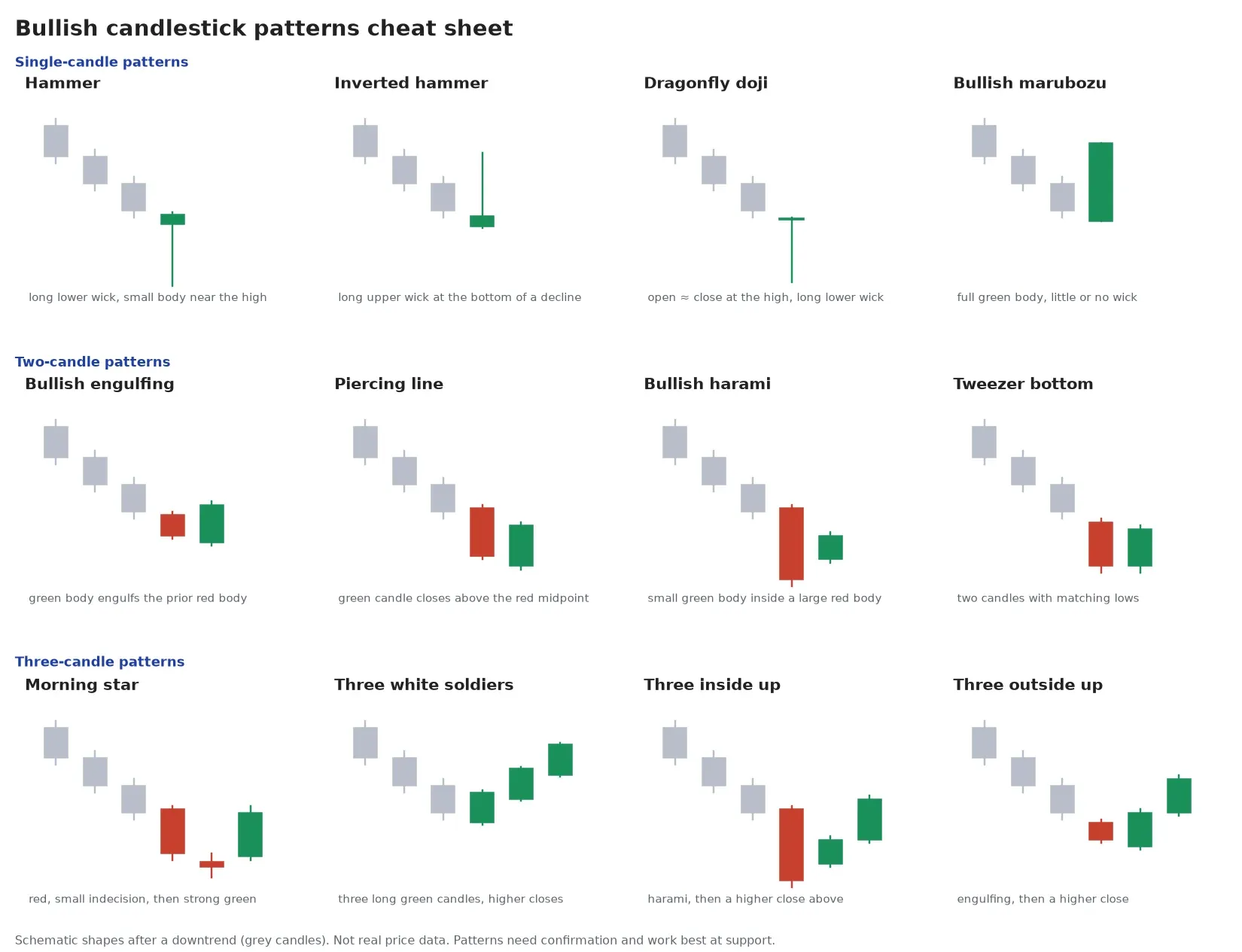
Schematic shapes of 12 bullish patterns after a downtrend. Not real price data.
| Pattern | Candles | What it shows | Confirmation to look for |
|---|---|---|---|
| Hammer | 1 | Sellers pushed down, buyers drove price back near the high | Next candle closes above the hammer's high |
| Inverted hammer | 1 | Buyers tested higher prices at the bottom of a decline | Next candle closes above the inverted hammer's body |
| Dragonfly doji | 1 | A sell-off fully rejected; open and close at the high | A higher close on the next candle |
| Bullish marubozu | 1 | Buyers in control from open to close | Follow-through above the marubozu's high |
| Bullish engulfing | 2 | A green body swallows the prior red body | A higher close, ideally on higher volume |
| Piercing line | 2 | A green candle closes above the middle of the prior red body | A close above the red candle's open |
| Bullish harami | 2 | Selling stalls: a small green body inside a large red one | A close above the harami's high |
| Tweezer bottom | 2 | Two candles hold the same low | A higher close after the second candle |
| Morning star | 3 | Strong fall, indecision, then strong buying | Third candle closes above the middle of the first |
| Three white soldiers | 3 | Three long green candles with higher closes | Already self-confirming; watch for exhaustion |
| Three inside up | 3 | A bullish harami followed by a higher close | Third candle closes above the first candle's open |
| Three outside up | 3 | A bullish engulfing followed by a higher close | Third candle extends the rise |
Single-Candle Bullish Patterns
Hammer
A hammer has a small body near the top of its range and a long lower wick, at least twice the body's length, with little or no upper wick. It forms after a decline: sellers pushed price lower during the session, but buyers drove it back up before the close. The body can be green or red, though a green body is the stronger signal. Read more in our hammer candlestick guide.
Inverted hammer
The inverted hammer has a small body near the bottom and a long upper wick, at the end of a decline. Buyers pushed price up during the session but could not hold it, which is why it needs a higher close on the next candle more than most patterns. It has the same shape as a shooting star; the difference is where it appears.
Dragonfly doji
A dragonfly doji opens and closes at or near the session high, with a long lower wick. The whole sell-off inside the candle was bought back. It is a form of doji, so on its own it signals indecision; after a downtrend and at support, it leans bullish.
Bullish marubozu
A bullish marubozu is a long green candle with little or no wick at either end: it opened near the low and closed near the high. Buyers were in control for the whole period. After a decline it can mark the start of a reversal; inside an uptrend it often signals continuation.
Two-Candle Bullish Patterns
Bullish engulfing
A small red candle is followed by a larger green candle whose body completely covers the red body. Sellers who were in control are overwhelmed in a single period. It is one of the most watched reversal signals, especially when it forms at support on high volume. See our bullish engulfing guide.
Piercing line
A strong red candle is followed by a green candle that opens at or below the red close and closes above the midpoint of the red body, but below its open. In stock markets the green candle usually opens with a gap below the prior low; in crypto it normally opens right at the prior close. The deeper the green close into the red body, the stronger the signal. See the piercing line guide.
Bullish harami
A large red candle is followed by a small green candle whose body sits entirely inside the red body. It signals that selling momentum has stalled rather than reversed, so it needs confirmation more than most patterns. See the bullish harami guide, including how it differs from an engulfing pattern.
Tweezer bottom
Two consecutive candles reach almost exactly the same low, usually a red candle followed by a green one. Price tested a level twice and held both times, which often marks short-term support.
Three-Candle Bullish Patterns
Morning star
The morning star starts with a strong red candle, followed by a small-bodied candle that shows indecision, and then a strong green candle that closes above the midpoint of the first. The middle "star" usually gaps below the first candle in stocks; in crypto it typically does not. See the morning star guide.
Three white soldiers
Three consecutive long green candles, each opening within the previous candle's body and closing near its high, with short upper wicks. It shows steady, sustained buying after a decline. Because the move is already large by the third candle, entries after it can be late; some traders wait for a pullback. See our three white soldiers guide and how it compares with three black crows.
Three inside up
A bullish harami followed by a third green candle that closes above the first red candle's open. It is a harami that has been confirmed.
Three outside up
A bullish engulfing followed by a third green candle that closes higher again. It is an engulfing pattern that has been confirmed.
Do Bullish Candlestick Patterns Work? A BTC Test
We scanned Binance BTC/USDT daily candles from August 2017 to October 2026 for five patterns, counting only those that formed after a decline (a close below the close 10 days earlier). We then measured BTC's price 5 and 20 days after the pattern's close, and compared it with every day after a decline.
| BTC daily, 2017 to 2026 | Times found | Higher 5 days later | Higher 20 days later | Median 20-day move |
|---|---|---|---|---|
| Any day after a decline (baseline) | 1,531 | 53% | 53% | +0.8% |
| Hammer | 81 | 57% | 52% | +0.5% |
| Bullish engulfing | 166 | 49% | 57% | +2.6% |
| Piercing line | 24 | 42% | 46% | -2.5% |
| Morning star | 21 | 43% | 33% | -2.9% |
| Hammer, confirmed by a close above its high | 25 | 44% | 60% | +6.3% |
| Bullish engulfing, confirmed by a close above its high | 50 | 52% | 59% | +6.9% |
Historical description on one market and timeframe, not a backtest of a trading strategy, with small samples for most patterns. Past performance does not guarantee future results.
- On their own, the patterns were close to a coin flip. Unconfirmed hammers and engulfings did about as well as any day after a decline, and the piercing line and morning star did worse in our small samples.
- Confirmation helped. Waiting for a close above the pattern's high cut the number of signals by two thirds, but the confirmed ones were up 20 days later about 60% of the time, with a median move of more than 6%.
- Location helped the hammer. Hammers that made a new 20-day low were up 5 days later in 15 of 22 cases (68%), consistent with the idea that the pattern matters most at a level where buyers step in.
- Three white soldiers almost never formed on BTC's daily chart after a decline by our definition, which is why it is not in the table.
How Crypto Changes the Classic Rules
- No gaps: candlestick patterns were described for markets that close overnight, so several definitions involve a price gap. Crypto trades 24/7, so each candle normally opens at the previous close. Apply the shape and the close, not the gap.
- Candle close times: the daily candle closes at a fixed time set by the exchange or charting platform, often 00:00 UTC. The same move can form a pattern on one platform's daily chart and not another's.
- Noise on low timeframes: on 1-minute to 15-minute charts, wicks and engulfing shapes appear constantly. Patterns on the 4-hour, daily and weekly charts carry far more weight.
- Liquidity: on thinly traded altcoins a single large order can create a long wick, so check volume before trusting a shape.
How to Confirm a Bullish Pattern
- Check the trend: there should be a clear decline before the pattern.
- Check the location: patterns at support, a prior low or a round number are more meaningful than patterns in the middle of a range.
- Wait for the next close: a close above the pattern's high is the simplest confirmation, and in our BTC test the one that made the difference.
- Look at volume: higher volume on the bullish candle shows real buying; see volume analysis.
- Add an indicator: an oversold RSI or bullish divergence adds weight.
How to Trade a Bullish Candlestick Pattern
A simple plan, used here as an illustration rather than a recommendation:
- Setup: BTC falls into a support zone around 76,000 and prints a hammer on the 4-hour chart, with the pattern low at 75,600 and high at 76,500.
- Entry: the next 4-hour candle closes above the hammer's high at 76,800, confirming the pattern.
- Stop: just below the pattern low, at 75,500, a risk of 1,300 per BTC.
- Target: the next resistance at 78,750, a reward of 1,950 per BTC, or 1.5 times the risk.
- Size: choose the position size so that losing 1,300 per BTC equals the share of your account you are willing to risk, often 1% or less.
If you are already short rather than looking to buy, the same pattern can be a reason to tighten a stop or take partial profit rather than to open a new trade.
Illustrative numbers, not a recommendation or real trade.
Common Mistakes
- Buying every green candle that looks like a pattern, without a decline before it.
- Entering before the pattern's candle has closed; a shape can change completely before the close.
- Ignoring the bigger trend: a bullish pattern on the 15-minute chart inside a strong daily downtrend often fails.
- Placing stops inside the pattern instead of below its low.
- Relying on one pattern instead of combining it with levels, volume and indicators. See which patterns traders find most reliable.
Practise and Trade Patterns in Altrady
- Chart replay: replay historical markets candle by candle to practise spotting bullish patterns and testing entries without risking money.
- Price and trend line alerts: get notified when price reaches the support zone where you expect a pattern to matter.
- Smart orders: set the entry, a stop below the pattern low and several take-profit targets in one order.
- Risk/reward calculator and paper trading to size the trade and test your rules first.
Frequently Asked Questions
What are bullish candlestick patterns?
They are candle shapes that appear after a decline and suggest buying pressure is taking over, such as the hammer, bullish engulfing and morning star. They signal a possible reversal or bounce, not a certain one.
What is the strongest bullish candlestick pattern?
No pattern is reliable on its own. Traders often rate the bullish engulfing, morning star and three white soldiers highly, but in our BTC test what mattered most was confirmation: a close above the pattern's high, at support, after a clear decline.
Do bullish candlestick patterns work in crypto?
Unconfirmed, they did little better than a coin flip on BTC's daily chart from 2017 to 2026. Confirmed hammers and engulfings were up 20 days later about 60% of the time, against 53% on average. Use them as one part of a setup, mainly on 4-hour and daily charts.
What is the difference between a hammer and an inverted hammer?
Both appear after a decline. The hammer has a long lower wick and shows a sell-off that buyers reversed; the inverted hammer has a long upper wick and shows buyers testing higher prices. Both need a higher close to confirm.
What is the difference between a bullish engulfing and a bullish harami?
In an engulfing, the green body is larger than the red body before it and covers it completely. In a harami, the green body is smaller and sits inside the red body. The engulfing shows buyers taking over; the harami shows selling slowing down.
Which timeframe is best for bullish candlestick patterns?
The 4-hour, daily and weekly charts give the most meaningful signals. Lower timeframes produce many more patterns, and many more false ones.
Candlestick patterns describe what has happened, not what will happen. Trading involves risk, including the loss of your capital. This article is not financial advice.