
Crypto markets reward systematic traders and punish emotional ones. The Turtle Trading Strategy gives you a complete rules-based framework: when to enter, where to exit, how much to risk, and when to add to winners. Built by Richard Dennis and William Eckhardt in the 1980s, the system proved that consistent, disciplined trend-following beats discretionary intuition - and the same logic applies in crypto today.
Overviewing the Turtle Trading Strategy
The Turtle Trading Strategy is a rules-based trend-following system born from a famous 1980s experiment by Richard Dennis and William Eckhardt. The two traders bet that anyone could be taught to trade profitably given the right rules and discipline. They recruited 13 novices, named them "Turtles," handed them a complete trading system, and over the next four years the group reportedly produced an annualized return north of 80%.
The lesson stuck: a clear, mechanical system reliably beats discretionary trading because it removes emotion from the moment of execution. The Turtle approach focuses on capturing the meat of trends in any market - originally commodities and currencies, today equally relevant in crypto. The trader's job is not to predict where price is going. The job is to follow the rules and let the trend pay the bills.
Key aspects of the strategy
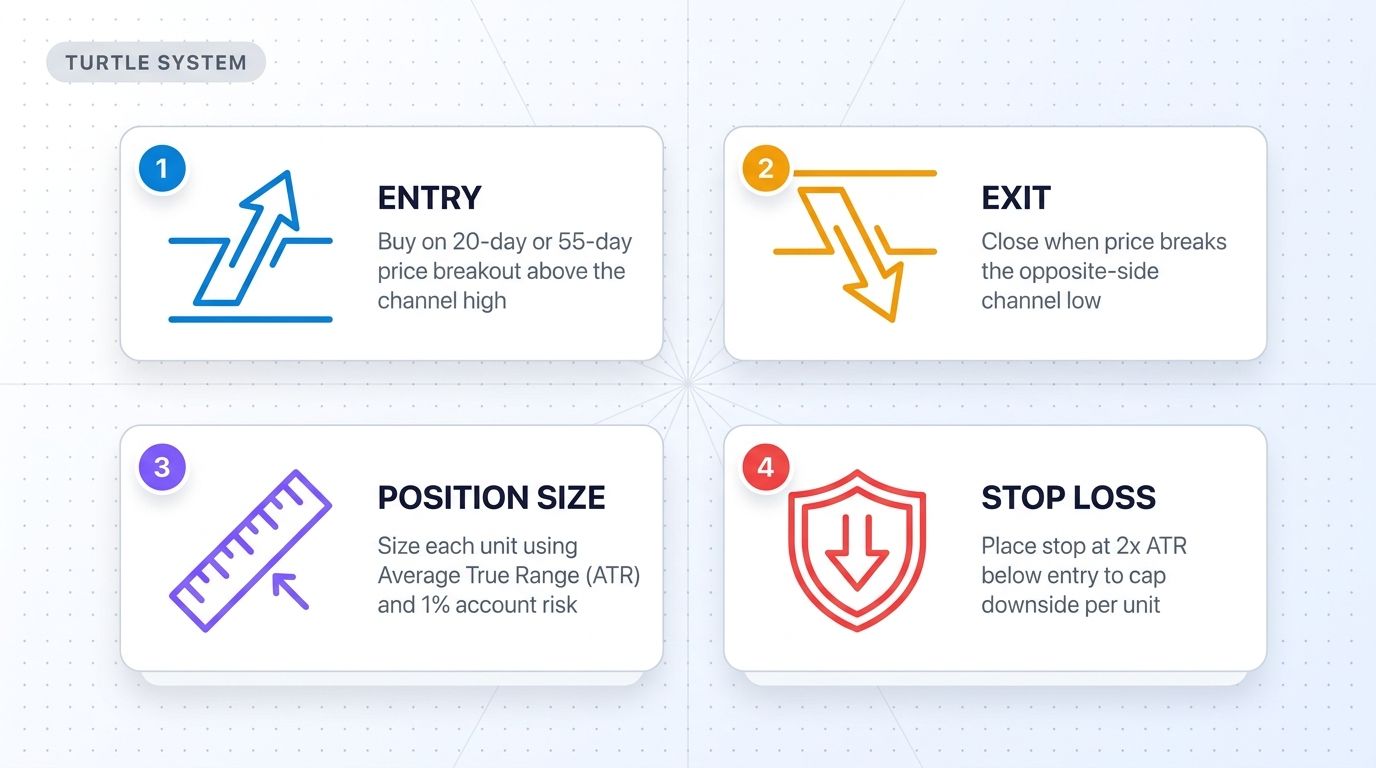
- Pure trend-following - no counter-trend trades, no bottom fishing.
- Volatility-adjusted position sizing using Average True Range (ATR).
- Two parallel systems: a tactical short-term setup and a higher-conviction long-term setup.
- Mechanical exit rules that cut losses fast and ride winners far.
- Pyramid scaling to add to winning positions as the trend extends.
The System: Turtle Trading Rules
The Turtle System is built on the Donchian Channel - a simple indicator that plots the highest high and lowest low over a chosen lookback period. Breaks above or below those channel boundaries are the system's only entry triggers. Two parallel rule sets, called System 1 (S1) and System 2 (S2), define what counts as a valid breakout.
- Rule 1 (S1): Short-term, 20-day Donchian channel. Buy when price breaks above the 20-day high; sell short when price breaks below the 20-day low. The trade is skipped if the previous S1 signal was a winner - the rationale is that big trends usually start after a series of small false breakouts.
- Rule 2 (S2): Long-term, 55-day Donchian channel. Same logic, longer lookback. Used as the safety net when an S1 signal was skipped, ensuring the trader does not miss the actual large move when it arrives.
Donchian Channels and the Two Entry Systems
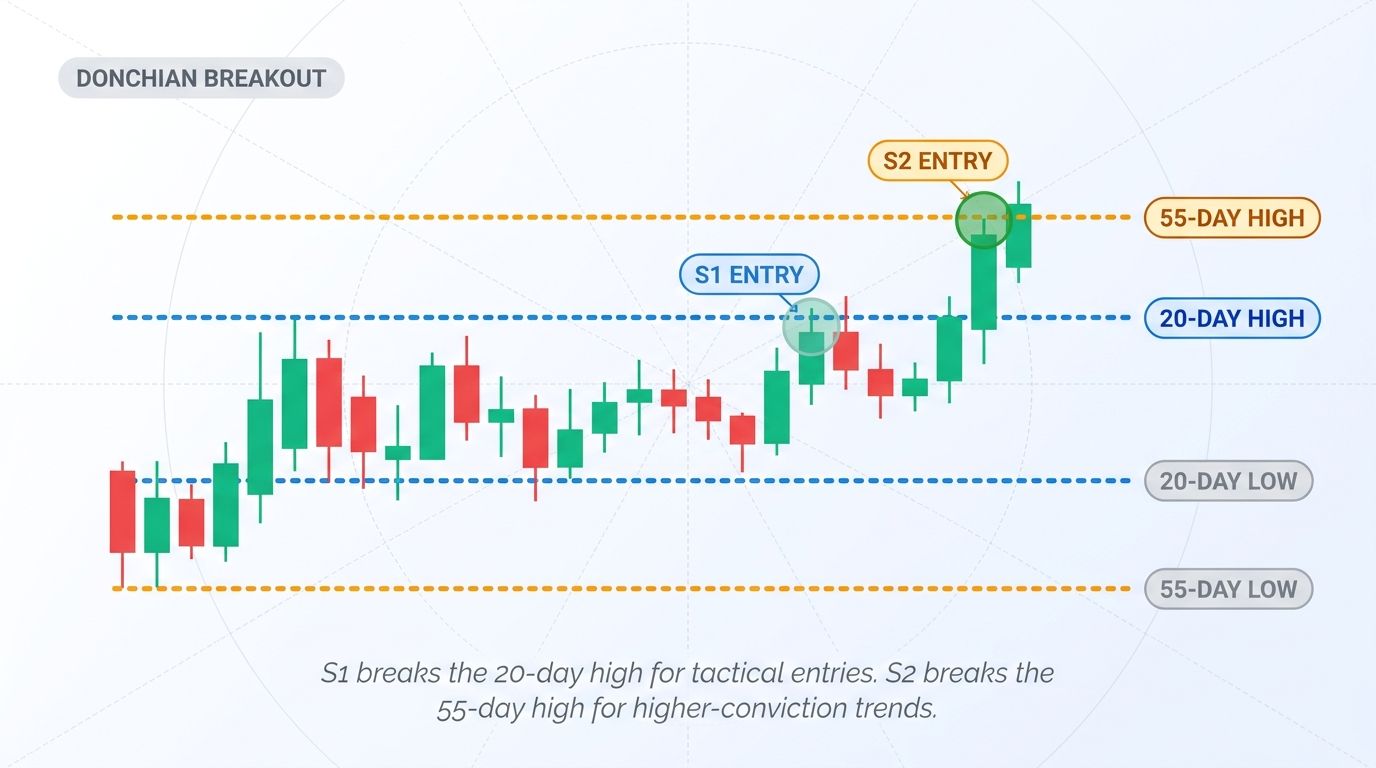
System 1 and System 2 are not alternatives - they work together. The 20-day breakout (S1) gives faster, more frequent signals, but it produces more whipsaws in choppy markets. The 55-day breakout (S2) is slower and rarer, but the few signals it produces tend to align with the strongest sustained moves.
The skip-after-winner rule for S1 is one of the most counter-intuitive parts of the system. After a winning S1 trade, traders ignore the next S1 signal entirely. This filters out the typical post-winner mean reversion and forces patience. If a real new trend starts, the S2 channel will catch it.
Short-term entry (S1)
- Long entry: price closes above the 20-day high.
- Short entry: price closes below the 20-day low.
- Skip the signal if the previous S1 trade was profitable.
Long-term entry (S2)
- Long entry: price closes above the 55-day high (only if not already in the market).
- Short entry: price closes below the 55-day low (only if not already in the market).
- S2 signals are always taken regardless of recent results.
Position Sizing with ATR (Average True Range)
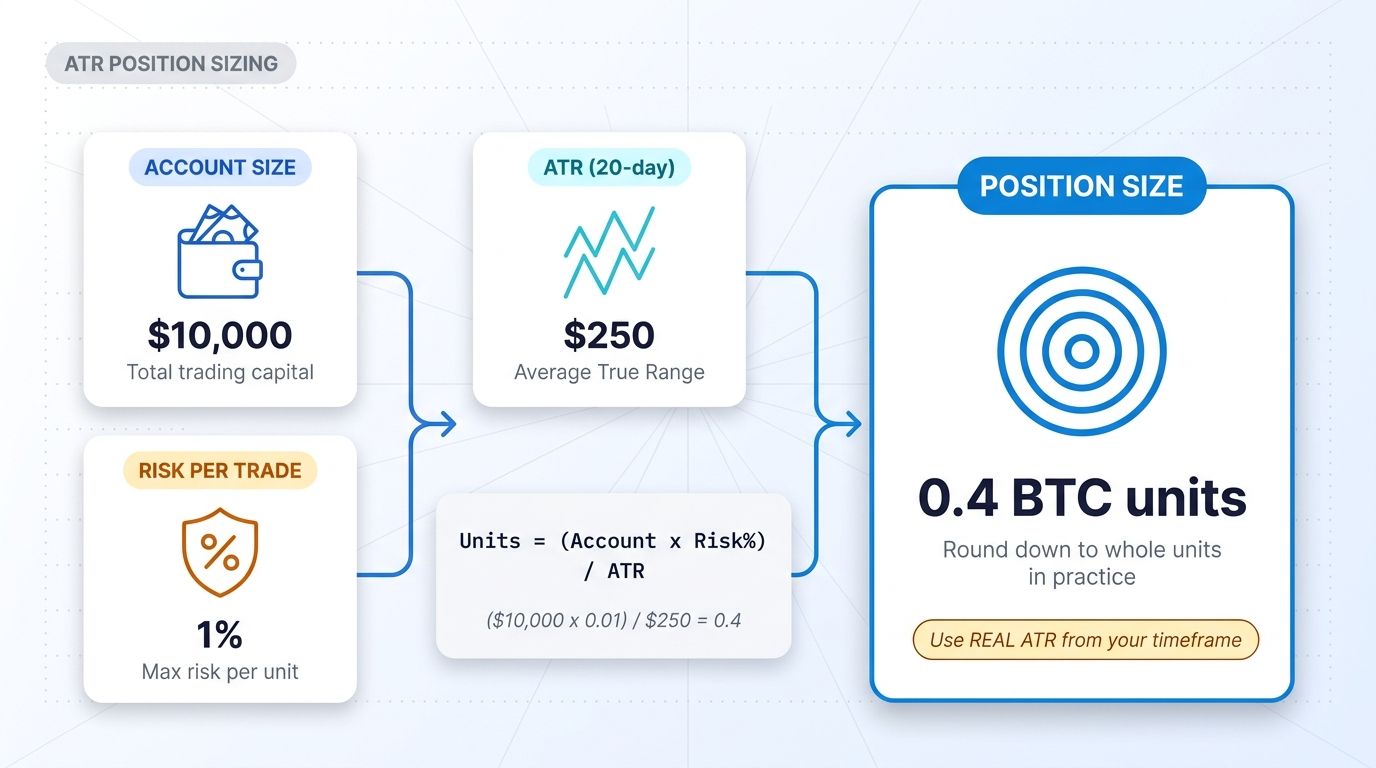
Turtle position sizing is volatility-adjusted, not fiat-adjusted. The system defines a "unit" as the amount of an asset whose 1 ATR price move equals roughly 1% of the trader's account equity. The exact formula:
Units = (Account Value x Risk %) / ATR
If your account is $10,000, you risk 1% per unit, and the 20-day ATR for BTC is $250, your unit size is ($10,000 x 0.01) / $250 = 0.4 BTC. Round down to a tradable size in practice.
The genius of ATR-based sizing is that it normalizes risk across assets. Whether you trade BTC, SOL, or ETH, a 1 ATR move always represents the same percentage of your account. You stop having to mentally adjust position sizes for "more volatile" coins - the math does it for you.
Original Turtles capped exposure at 4 units per market and 6 units across closely correlated markets, with a hard ceiling of about 12 units across the whole portfolio. Total account risk in worst-case scenarios stayed bounded because each unit was sized to a known volatility-defined loss.
Stop Loss and Pyramiding Rules
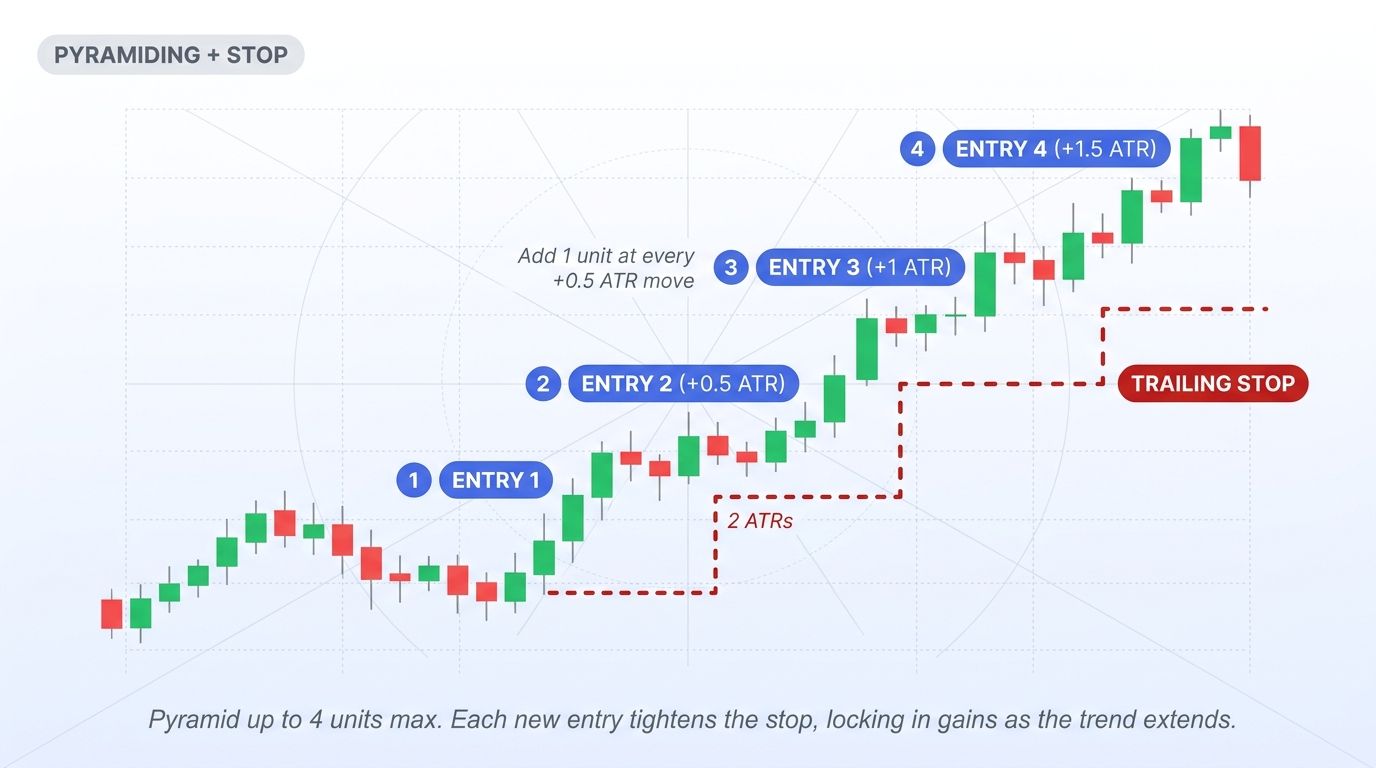
Every Turtle entry comes with a fixed stop loss placed exactly 2 ATR below the entry price (or above, for shorts). That stop never moves in the wrong direction. If price hits the stop, the trade is closed immediately - no exceptions, no "let me give it a little more room."
The pyramid rule is what allows Turtles to capture massive trends. After the first entry, the trader adds one additional unit every time price moves +0.5 ATR in their favor, up to a maximum of four units in a single market. Each new unit comes with its own 2 ATR stop, which sits below the latest entry, not below the original entry. This staircase effect locks in progressively more profit as the trend extends.
If price reverses and stops out the most recent unit, the earlier units stay in the trade. The trader takes a small loss on the latest entry while still riding the bigger position toward the eventual exit signal.
Capital management overlays
- Drawdown adjustment: when the account drops 10%, cut all unit sizes by 20%. Reduce again at every additional 10% drawdown.
- Restoration: normal sizing resumes only after the account makes new equity highs.
- Correlation discipline: closely-related markets (BTC and ETH, for example) count toward the same exposure limit.
Exit Rules: Turning Trends Into Cash
Entry and stops protect the downside. Exits convert paper profits into realized gains. Turtle exits are mechanical breakouts in the opposite direction.
- S1 exit (long): close when price breaks the 10-day low.
- S1 exit (short): close when price breaks the 10-day high.
- S2 exit (long): close when price breaks the 20-day low.
- S2 exit (short): close when price breaks the 20-day high.
The S2 exit is intentionally slower than the S2 entry. The system is designed to grab the meat of a trend - giving up some peak gains in exchange for not getting shaken out of the move too early. Most Turtles say the hardest part of the system is sitting through pullbacks of 20-30% on a winning position because the exit signal has not triggered yet.
Why Turtle Trading Works: The Psychology Behind It
Trend-following has produced consistent edges for over 100 years across markets and decades. The Turtle System isolates that edge with rules that bypass the most expensive human errors:
- Confirmation bias removal: entries are mechanical breakouts. The trader does not need to "believe" the trend - the channel break is the proof.
- Loss aversion neutralized: stops are pre-defined. There is no debate at the moment of pain about whether to hold and hope.
- Recency bias offset: the skip-after-winner rule prevents the trader from over-trusting recent wins.
- Variance acceptance: the system is designed around many small losses and a few enormous wins. Win rate is typically 30-40%, but average winners are 3-5x average losers.
The math only works if the trader sticks to the rules during losing streaks. Most failures with Turtle Trading are not failures of the rules - they are failures to follow the rules when ten trades in a row have been losers and the next breakout looks "too obvious to fade."
Turtle Trading in the Crypto Market
Crypto suits Turtle Trading better than most asset classes. Three structural reasons:
- Markets trade 24/7, so price never gaps over your stop overnight (slippage is still possible during fast moves, but gap risk is minimal compared to traditional markets).
- Trends are unusually persistent in crypto bull and bear cycles. The 2020-2021 BTC run, the 2022 bear, and the 2023-2024 recovery all produced multi-month moves where 20/55-day breakout rules captured the bulk of the gains.
- Volatility is high enough that ATR-based sizing produces meaningful position sizes even on small accounts. A $5,000 account can run the system on BTC and ETH simultaneously without exceeding correlation limits.
The system needs adaptation for crypto specifics. Most modern implementations use the 4-hour or daily timeframe rather than the original daily-only setup, because intraday volatility on lower timeframes generates too many false signals. Some traders also add a regime filter - only trading the long side when the 200-day moving average is rising, only trading the short side when it is falling - to avoid grinding losses in clearly counter-trend conditions.
Common Mistakes Traders Make with Turtle Trading
The Turtle System looks simple, which is why most traders break it the same way:
- Skipping the position-sizing math. Eyeballing position sizes destroys the volatility normalization that makes the system robust. A 1 BTC position is not the same risk as a 1 ETH position.
- Moving stops further away. If the stop hits, the trade is over. Period. Tightening or loosening the stop in real time turns a mechanical edge back into emotional gambling.
- Quitting the system after a losing streak. Turtle Trading produces extended drawdown periods - sometimes 4-6 months without a meaningful winner. Traders who quit during the drought miss the breakout that pays for the entire prior period.
- Trading too many markets. Original Turtles ran the system on 20+ futures markets simultaneously. Crypto traders often try to copy that breadth on too small an account, ending up with correlated positions that all move against them at once.
- Skipping the pyramid step. The big winners come from pyramided positions, not initial entries. Traders who only take the first unit cap their upside and still take the same drawdown risk as a fully-loaded Turtle.
Using Turtle Trading in an Altrady Workflow
Altrady gives the Turtle System everything it needs to run cleanly across multiple exchanges from one dashboard.
- Multi-exchange charting with built-in Donchian Channel and ATR indicators makes it trivial to monitor 20-day and 55-day breakouts across BTC, ETH, SOL, and major altcoins on Binance, Coinbase, Kraken, and others - without juggling tabs.
- Smart Trading order types let you pre-define entry, stop loss, and take profit levels in a single ticket. The 2 ATR stop and the breakout-exit logic can be set as soon as the entry triggers.
- Risk-Reward Calculator automates the ATR-based unit calculation. Plug in account size, risk %, and current ATR, and the calculator returns the exact unit size to trade.
- Quick Scanner filters across hundreds of pairs to surface the ones currently breaking 20-day or 55-day highs, so you never miss a setup.
- Paper Trading lets you run the full Turtle System against historical and live data without risking capital - the right way to learn how 30-day drawdowns feel before they cost real money.
The system rewards traders who can execute consistently. Build a free trial account, run Turtle entries on BTC and ETH for a quarter, and let the rules do the work.
Conclusion
The Turtle Trading Strategy is one of the few public trading systems with a verified track record across decades and asset classes. Its rules are simple enough to fit on a single page: enter on a Donchian breakout, size with ATR, stop at 2 ATR, pyramid every 0.5 ATR up to four units, exit on the opposite breakout. The hard part is not understanding the rules - it is following them through 4-6 month drawdown stretches without changing anything.
For crypto traders specifically, the system is a strong starting framework. Trends are persistent, volatility supports clean ATR sizing, and 24/7 markets remove gap risk. Whether you adopt the rules verbatim or use them as a foundation to layer your own filters on top, the Turtle approach forces the discipline that separates professional traders from emotional gamblers.
Start small, paper-trade first, and let the trend-following math compound. The system has been working for forty years and it does not care whether the asset is corn futures or Bitcoin.
Frequently Asked Questions
What are the basic rules of Turtle Trading?
The basic rules: enter on a Donchian Channel breakout (20-day or 55-day high or low), size positions using Average True Range so each unit risks roughly 1% of equity, place stop losses at 2 ATR from entry, pyramid up to four units as the trend extends, and exit on a 10-day or 20-day breakout in the opposite direction.
How do Turtle Traders determine position size?
Turtle Traders calculate position size with the formula Units = (Account Value x Risk %) / ATR. A 1 ATR price move equals roughly 1% of the account, so risk per unit stays constant regardless of which asset is being traded. This volatility-based sizing is what makes the system work across BTC, ETH, and any other crypto without needing manual adjustments.
What is the Donchian Channel in Turtle Trading?
The Donchian Channel plots the highest high and lowest low over a fixed lookback period. Turtle Traders use the 20-day channel for short-term breakouts (System 1) and the 55-day channel for longer-term, higher-conviction breakouts (System 2). A close beyond either boundary is the only trigger for entries.
Can Turtle Trading rules work in crypto markets?
Yes. Crypto markets are highly trending, volatile, and trade 24/7 with minimal gap risk - all conditions that suit Turtle Trading. Most modern crypto implementations use the 4-hour or daily timeframe and may add a 200-day moving average regime filter to avoid counter-trend losses.
Why do most traders fail with Turtle Trading?
Most failures come from breaking the rules during drawdowns. The system produces many small losses while waiting for a few large winners, and a 30-40% win rate feels demoralizing in real time. Traders who tighten stops, skip pyramid entries, or quit after a losing streak miss the trades that pay for everything else.
What is the difference between System 1 and System 2 in Turtle Trading?
System 1 (S1) uses a 20-day Donchian breakout for tactical entries and skips the next signal after any winning trade. System 2 (S2) uses a 55-day breakout for higher-conviction entries and never skips. Both systems run in parallel - S2 catches the big move when an S1 signal was skipped.
How much capital do I need to start Turtle Trading in crypto?
Practical implementations work with $3,000-$5,000+ on crypto. Below that, ATR-based unit sizing produces fractional positions that round down to zero on most exchanges. Original Turtles ran the system on multi-million-dollar accounts across 20+ markets, but the rules scale down to a smaller two- or three-pair crypto setup just fine.
If you want to trade like a Turtle, Altrady gives you the multi-exchange charting, smart trading order types, ATR-aware position sizing tools, and paper trading environment to implement the system end to end. Sign up for a free trial and run the rules on a real exchange feed without risking capital.