
You configured your AI trading bot, validated it on paper for two weeks, watched it print 8% in a calm sideways market, and then real volatility arrived. By the time you logged in, the bot had averaged down through six grid levels, blown past your mental stop-loss because you forgot to set a hard one, and the account was 35% underwater. The bot was running exactly as designed. The problem was not the strategy. The problem was that you treated risk management as something you would deal with later, and later arrived faster than you expected.
This is how most AI crypto trading bot accounts get destroyed, not by bad strategy selection but by missing or weak risk controls layered on top of an otherwise reasonable strategy. The bot does exactly what you told it to do, even when the conditions that made the strategy profitable have changed. This guide breaks down the risk management framework that separates traders who run bots for years from traders who blow up in a month: position sizing math, stop-loss types, drawdown circuit breakers, diversification, and the specific failure modes you should engineer against from day one.
Why Bot Accounts Blow Up
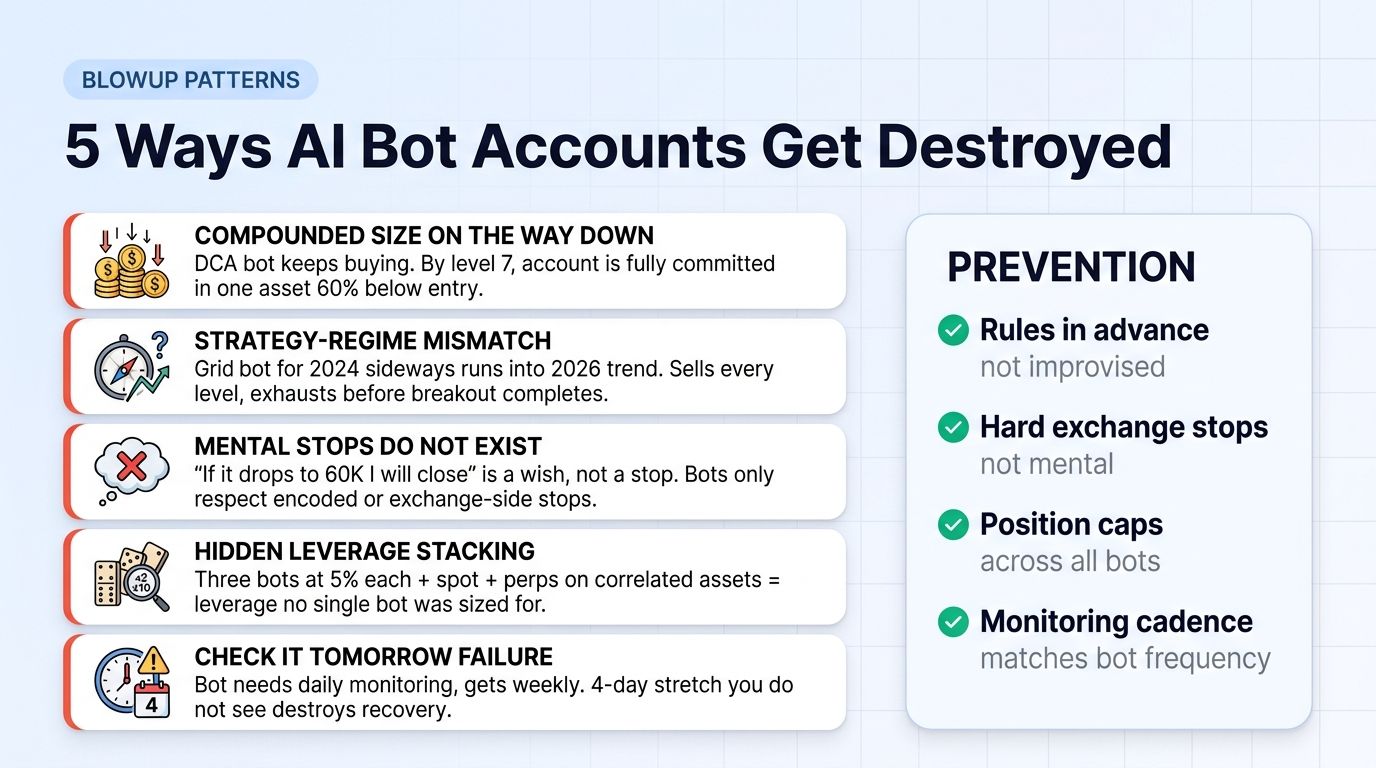
Account blow-ups follow a small number of repeatable patterns. Recognizing them is the first defense.
Compounded position size on the way down. A DCA bot configured to "buy the dip with 10% of remaining capital at each level" sounds reasonable until you realize that by the seventh down-leg you have committed the entire account on a single asset that is now 60% below your initial entry. The bot did its job. You did not constrain how much risk it could take.
Strategy regime mismatch. A grid bot calibrated for the 2024 sideways range continues running into a 2026 strong trend, dutifully selling every grid level on the way up and exhausting all sell-side liquidity before the breakout completes. By the time you intervene, you have realized losses on every level while the asset is at a new high.
No hard stop, just mental stops. "If it drops to 60K I will close the position" is not a stop-loss. It is a wish. Bots do not have mental stops. Either the stop is encoded in the bot configuration, the exchange order book, or it does not exist.
Hidden leverage stacking. Running three bots simultaneously, each with 5% per-position risk, while also holding spot positions and a perpetuals futures position on the same correlated assets gives you effective leverage that no single bot was sized for. A 20% market move wipes out the correlated cluster all at once.
The "I will check it tomorrow" failure. A bot that needs daily monitoring but gets monitored weekly will inevitably encounter a 4-day stretch you did not see. By the time you do see it, the account state is unrecoverable.
Every blow-up pattern above is preventable with risk management discipline. None require sophisticated math. They require deciding rules in advance and not overriding them mid-trade.
Position Sizing for AI Bots
Position sizing is the single most important risk control. It determines how much you can be wrong without the account dying, and that single number drives every other decision.
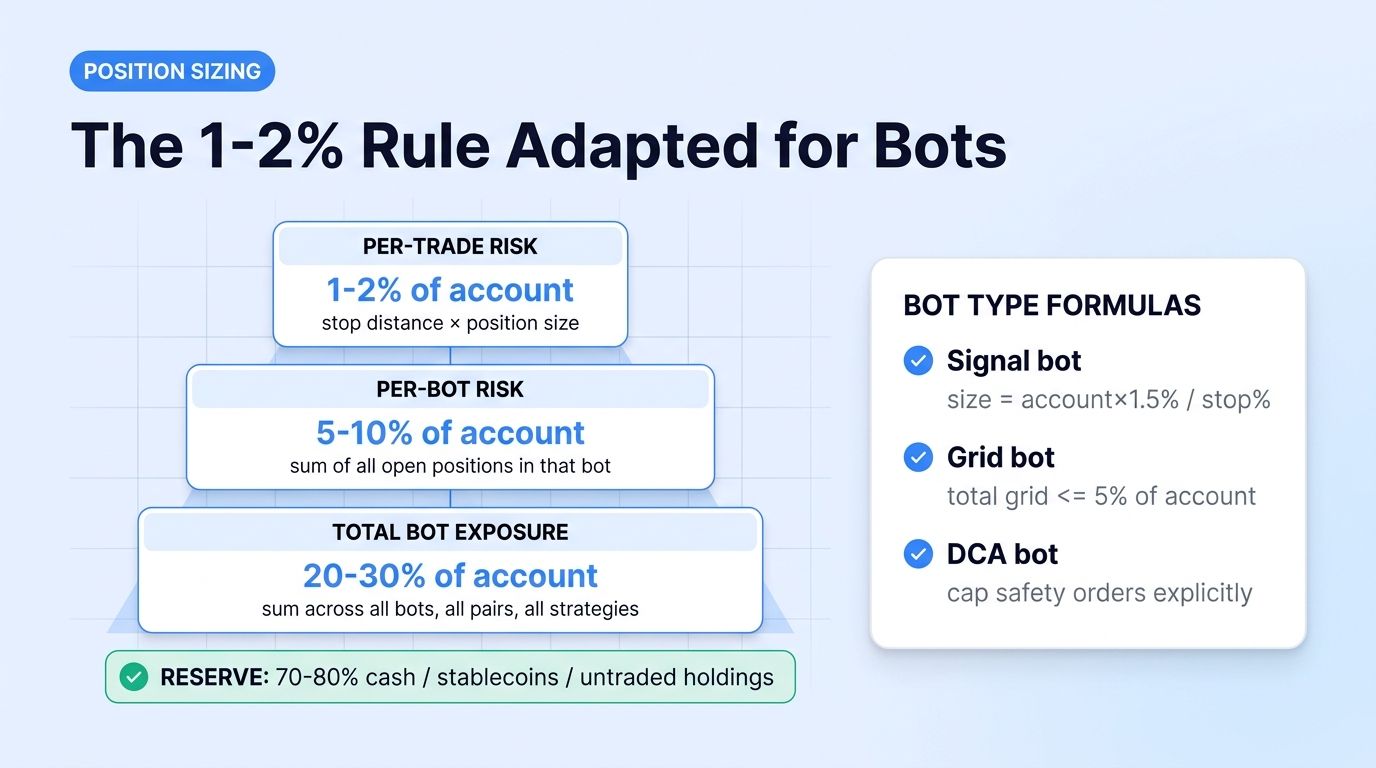
The 1-2% Rule (Adapted for Bots)
The traditional risk-of-ruin guidance for manual traders is to risk 1-2% of account capital per trade. For AI bots, this scales differently because bots run multiple concurrent positions and can compound losses faster than humans intervene.
Practical adaptation: - Per-trade risk (distance from entry to stop-loss × position size): 1-2% of account - Per-bot risk (sum of all open positions in that bot): no more than 5-10% of account - Total bot exposure (sum across all bots): no more than 20-30% of account in active bots at any time
The remaining 70-80% sits in cash, stablecoins, or assets you would hold regardless of trading activity. This reserve is what lets you recover from a bot drawdown without forced liquidation.
Sizing Formula for Each Bot Type
Different bot types have different sizing math.
Signal bots (one position at a time per trade): position size = (account × 1.5%) / stop-loss distance %. Example: $10,000 account, 1.5% risk, 4% stop = $3,750 position.
Grid bots (multiple concurrent grid levels): total grid capital = account × 5% maximum. Example: $10,000 account = $500 spread across the grid. If you set 10 grid levels, each level holds approximately $50.
DCA bots (averaging down on positions): total DCA budget = account × 5% maximum, with explicit cap on number of safety orders. A DCA configured with unlimited safety orders is a position size grenade with a pulled pin.
If these numbers feel painfully small, you have correctly identified why most retail bot accounts blow up. Traders size for bull market dreams and get destroyed by bear market reality.
Stop-Loss Types for Bots
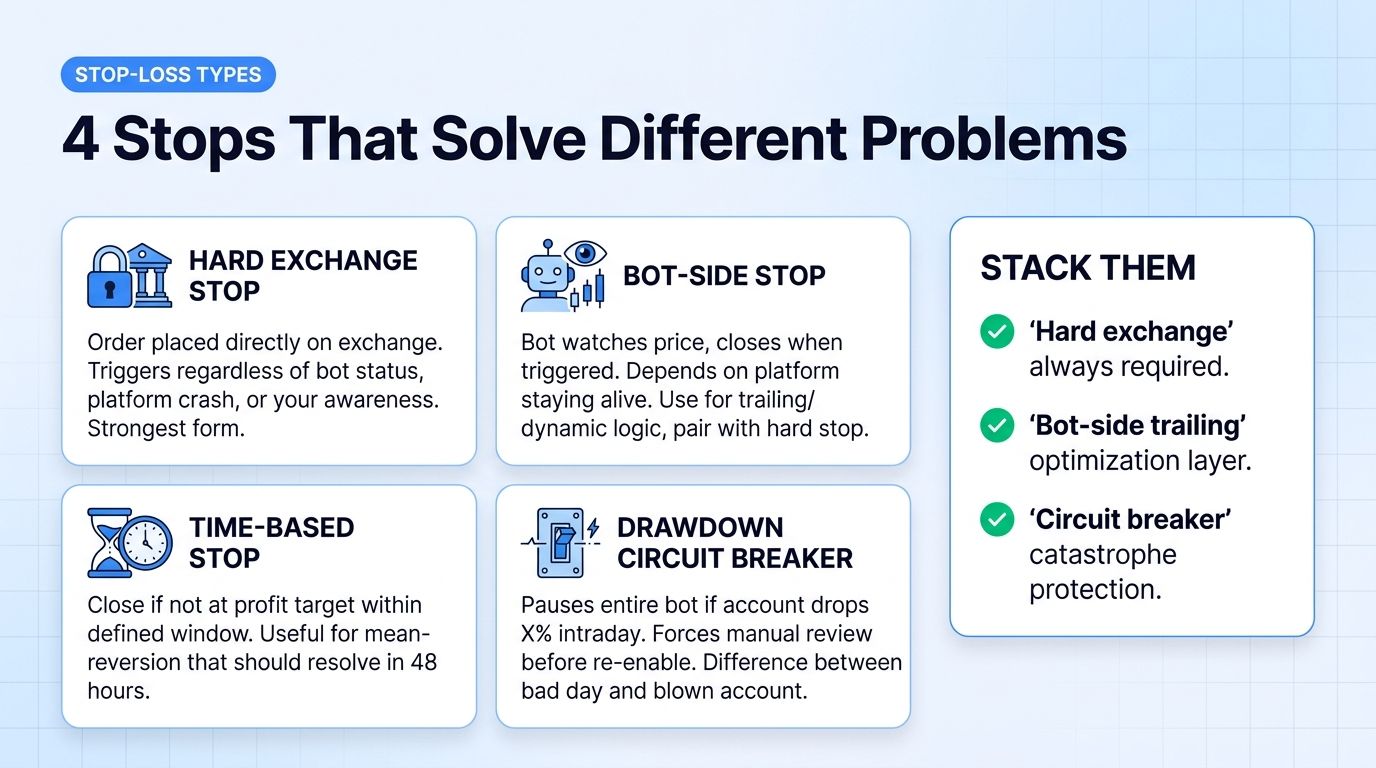
A stop-loss is not a single thing. Different stops solve different problems.
Hard Stop-Loss (Exchange-Side Order)
The strongest form. You place a stop order directly on the exchange that triggers at a specific price regardless of bot status, network connectivity, or your awareness of the position. If your bot platform crashes, the exchange still executes the stop.
This is the only stop type that protects you against catastrophic scenarios (platform outage, your own laptop dying, internet failure during a fast move).
Bot-Side Stop-Loss
The bot software watches the price and closes the position when triggered. Less robust because it depends on the bot platform staying alive. Use for trailing stops and other dynamic logic, but always pair with a hard exchange stop as a backstop.
Time-Based Stop
Close the position if it has not reached its profit target within a defined time window. Useful for mean-reversion strategies that should resolve within a known timeframe. If the price has not snapped back in 48 hours, the strategy assumption was wrong and you exit at whatever price.
Drawdown Circuit Breaker
A higher-level control that pauses the entire bot if its account state drops by a configured percentage. Example: bot pauses if intraday drawdown exceeds 4% or weekly drawdown exceeds 10%. Forces a manual review before re-enabling.
The circuit breaker is the difference between a bad day and a blown account. It assumes the bot might be wrong about market regime and limits how badly that wrongness can compound before you intervene.
Drawdown Tolerance and Recovery Math
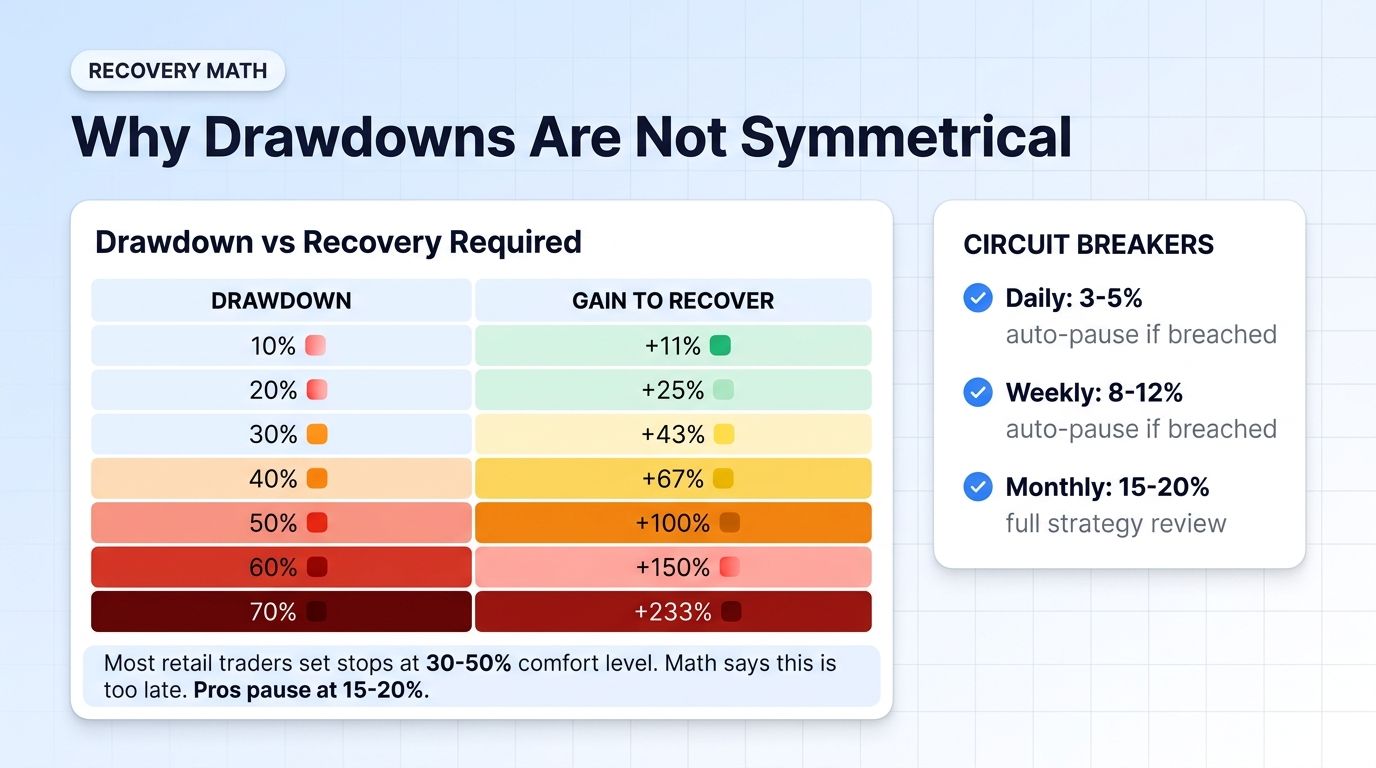
Drawdowns are not symmetrical. A 50% drawdown requires a 100% gain to recover, not 50%. This compounding asymmetry is why limiting maximum drawdown matters more than maximizing peak return.
| Drawdown | Required gain to recover |
|---|---|
| -10% | +11% |
| -20% | +25% |
| -30% | +43% |
| -40% | +67% |
| -50% | +100% |
| -60% | +150% |
| -70% | +233% |
Most retail traders set their drawdown stop where they "feel comfortable", which is usually 30-50%. The math says this is too late. Professional risk managers typically pause systems at 15-20% drawdown and reassess. The cost of pausing too early is missing some upside. The cost of pausing too late is permanent account impairment that may take years to recover.
For AI trading bots, a reasonable circuit breaker is: - Daily drawdown limit: 3-5% (auto-pause if breached) - Weekly drawdown limit: 8-12% (auto-pause if breached) - Monthly drawdown limit: 15-20% (full strategy review required)
Risk-Reward Ratio Setup
A risk-reward ratio compares potential profit against potential loss for each trade setup. A 2:1 ratio means risking 1 unit to potentially gain 2 units. Higher ratios let you be wrong more often and still net profitable.
For AI bots, target risk-reward should be at least: - 1.5:1 for high-frequency strategies (multiple trades per day) - 2:1 for swing strategies (multi-day holds) - 3:1 or better for trend-following strategies (asymmetric upside)
In practice this means: if your stop is 2% from entry, your take-profit should be at least 3-4% away. Bots configured with take-profit closer than stop-loss are mathematically losing strategies, even with 60% win rates.
Altrady's Risk Reward Calculator implements this constraint at the order placement layer: every Smart Trading order requires entry, stop-loss, and take-profit values, and the calculator surfaces the resulting risk-reward ratio before you submit. This is a small UX detail that prevents a common failure mode (placing trades without explicit risk-reward thinking) by making the math visible before commitment rather than invisible after.
Diversification Across Bots and Strategies
Running one bot on one pair with one strategy concentrates risk. Diversification reduces single-point-of-failure exposure.
Across pairs: a bot that trades only BTC is exposed to BTC-specific risk. Spreading across BTC, ETH, and 2-3 large-cap altcoins reduces correlation but does not eliminate it (in major crashes, all crypto correlates to 1).
Across strategies: combining a grid bot (sideways), a DCA bot (accumulation), and a trend-following bot creates strategies that win in different market regimes. When one is bleeding, another is profiting, smoothing the equity curve.
Across exchanges: keeping bots on Binance, Coinbase, Kraken, KuCoin, Bybit, and Bitvavo simultaneously protects against exchange-specific catastrophe (the FTX scenario). Each exchange holds a portion of capital, none holds everything.
Across timeframes: a high-frequency bot on 5-minute charts and a swing bot on 4-hour charts respond to different signals. Both can coexist without overlapping trade decisions.
The trade-off of diversification is increased operational complexity. Managing 8 bots across 5 exchanges takes more attention than 1 bot on 1 exchange. The right level of diversification matches your time budget and the platform's multi-exchange capabilities. Trying to manage 20+ bots manually leads to neglect, which is its own risk.
Real Failure Modes to Engineer Against
Beyond the patterns above, three specific scenarios destroy bot accounts and are worth pre-planning for.
Exchange API outage. The exchange goes down for 2 hours during a fast market move. Your bot cannot place orders, your stops do not trigger, and price moves past your intended exit. Defense: keep position sizes small enough that a 2-hour outage during a 20% move does not exceed your drawdown tolerance.
Exchange insolvency or freeze. The FTX scenario. Your funds are frozen indefinitely. Defense: never hold more than 30% of total capital on any single exchange, regardless of how trustworthy it seems today.
Bot platform compromise. The bot platform's database is breached and your API keys (read-only or trade-only, never withdrawal-enabled) are exposed. Defense: only ever grant trade-only API permissions, never enable withdrawal, and rotate keys quarterly. Platforms that custody funds (deposit funds to the platform itself) carry higher risk than connect-to-exchange architectures.
Altrady operates as a connect-to-exchange platform, meaning your capital stays on Binance, Coinbase, Kraken, KuCoin, Bybit, Bitvavo, OKX, MEXC, and 11+ other exchanges, with the platform only receiving the API credentials needed to execute trades on your behalf. The worst-case platform compromise would expose your trade execution, not your funds. This architectural choice matters more than feature lists for traders thinking about counterparty risk.
A Minimum-Viable Risk Framework
If you are starting from no risk management, here is the minimum-viable setup you should implement before turning on any bot with real capital.
- Per-trade risk capped at 1.5% of account via position sizing formula
- Hard exchange-side stop-loss for every position (not bot-side only)
- Total bot exposure capped at 25% of account across all bots
- Daily drawdown circuit breaker at 4% that auto-pauses bots
- Maximum 30% capital on any single exchange
- Trade-only API permissions (no withdrawal)
- Weekly review checkpoint where you actually look at every bot's state
If implementing this framework feels like overhead, that is the correct reaction. Risk management is overhead. The traders who skip it because it feels excessive are funding the traders who don't.
Pricing Risk Management Tools
Cost matters in risk management because over-paying for risk tools cuts into the returns those tools are protecting. A risk system that costs $300/month on a $10,000 account requires 3.6% annual return just to break even on the tool itself.
Altrady's pricing structure includes risk management tools at every tier: Basic €28/mo (5 trading accounts, 2 bots, Smart Trading with TP/SL, Risk Reward Calculator), Essential €50/mo (15 accounts, 5 bots, 350 price alerts), Premium €90/mo (30 accounts, 50 bots, Backtesting Pro for risk validation, TA Scanner Plus). A 5-day trial is available for testing the framework before committing.
The right tool for your situation depends on account size. For sub-$2,000 accounts, free or near-free options (Pionex in-exchange bots) make sense because subscription cost is a meaningful percentage of return. For mid-size accounts ($5,000-$50,000), paid platforms with proper risk controls pay for themselves through better discipline. For larger accounts, the risk reduction from professional infrastructure dwarfs the subscription cost.
FAQ
What is a safe drawdown limit for an AI crypto trading bot?
A common professional standard is 15-20% maximum drawdown before pausing the bot and reviewing the strategy. Retail traders often allow 30-50% drawdown, which is mathematically dangerous because recovery requires disproportionately large gains (a 50% drawdown needs a 100% gain to recover).
Should I use a hard stop-loss or a trailing stop with my AI trading bot?
Use both. A hard stop-loss placed directly on the exchange protects against catastrophic scenarios (platform outage, bot crash, fast market moves) and triggers regardless of bot status. A trailing stop managed by the bot adapts to favorable price action and locks in gains. The hard stop is your insurance, the trailing stop is your optimization.
How many AI trading bots should I run at the same time?
Start with one bot until you understand its behavior in different market regimes, typically 2-3 months of live operation. Then scale to 2-3 bots running different strategies (grid, DCA, signal) on different pairs. Most experienced traders converge on 3-5 bots total, balancing diversification benefit against monitoring overhead.
What is the right position size for AI crypto trading bots?
Per-trade risk should be 1-2% of total account capital. For bots specifically, also cap per-bot total exposure at 5-10% and total bot exposure across all bots at 20-30% of account. The remaining 70-80% should sit in cash, stablecoins, or untraded holdings as recovery reserve.
What happens if my AI trading bot platform crashes during a market move?
If your only protection is a bot-side stop-loss, your position runs unprotected until the platform recovers. The defense is to always place hard stop-loss orders directly on the exchange in addition to bot-side stops. Exchange-side orders trigger independent of platform status, network connectivity, or your awareness of the position.