
The promise of AI in crypto trading is hard to ignore. Bots that learn from market data, adapt to shifting conditions, and execute trades faster than any human can react. For Swing Traders managing positions across multiple exchanges, the appeal is obvious. But the gap between what AI trading bots claim to do and what they actually deliver is wider than most traders expect.
This guide breaks down how AI crypto trading bots really work, what separates genuine machine learning from basic automation, and how to evaluate whether an AI bot belongs in your trading stack. No hype, no sales pitch, just a clear look at where this technology stands in 2026 and what it means for active traders.
What Is an AI Crypto Trading Bot?
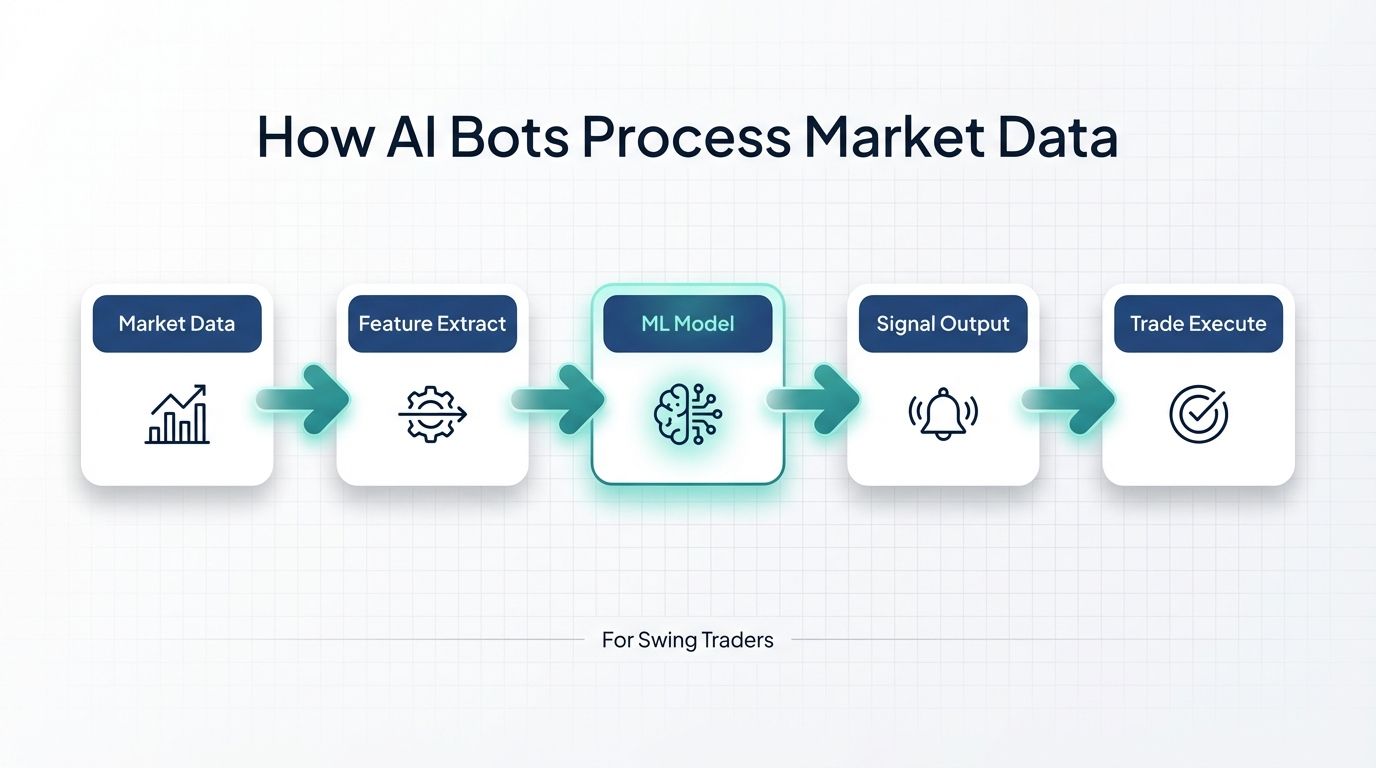 How AI bots process market data from ingestion to trade execution.
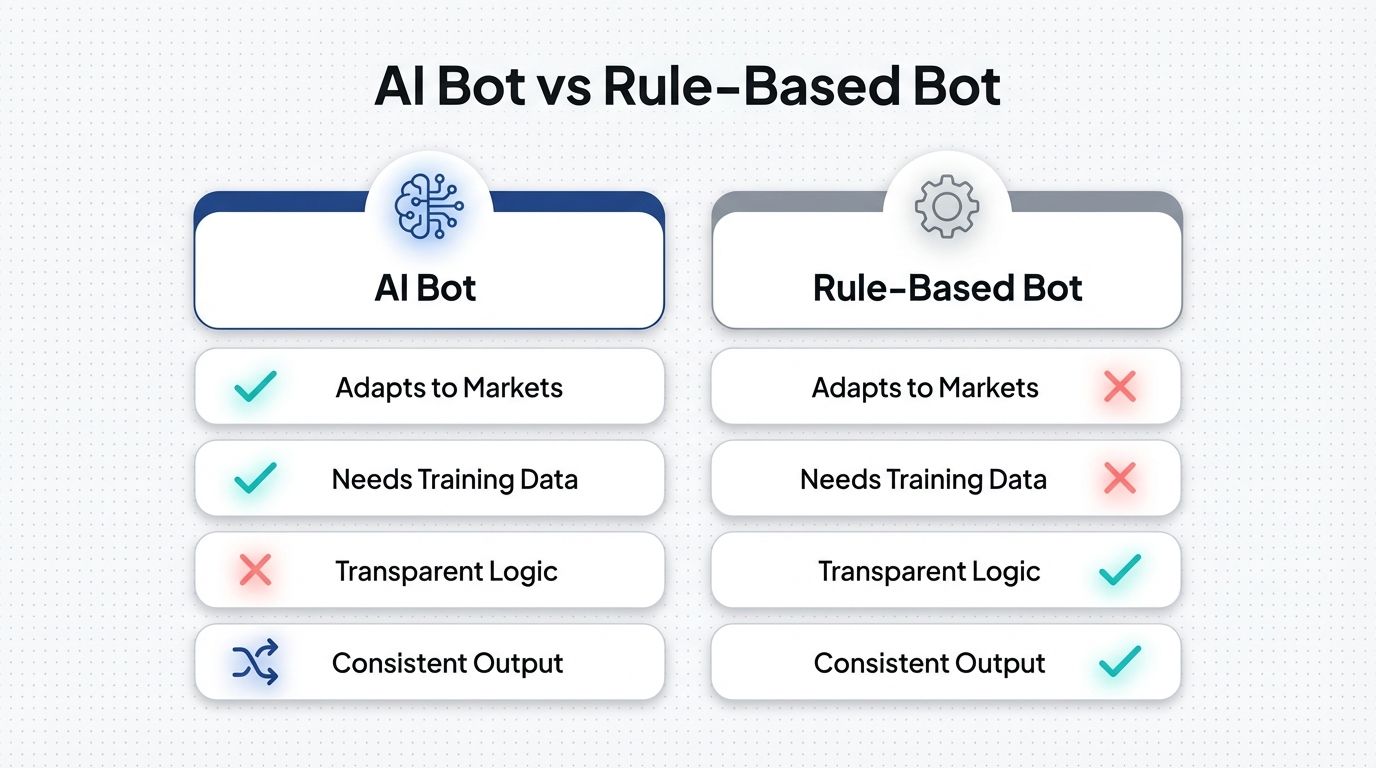
An AI crypto trading bot is software that uses machine learning algorithms to analyze market data, identify patterns, and execute trades automatically. Unlike traditional trading bots that follow fixed rules (if price drops 5%, buy), AI bots are designed to learn from historical and real-time data, adjusting their behavior as market conditions change.
The core difference comes down to adaptability. A rule-based bot does exactly what you tell it. An AI bot attempts to figure out what you should be telling it, based on data it has processed. In practice, most AI trading bots sit somewhere on a spectrum between simple automation and genuine machine learning.
At the basic end, you have bots that use pre-built indicators with some optimization. At the advanced end, you have systems running neural networks trained on millions of data points. The label "AI" gets applied to both, which is why understanding what is actually under the hood matters before you trust one with real capital.
How AI Trading Bots Actually Learn
 Key differences between AI-driven bots and traditional rule-based bots.
The term "machine learning" gets thrown around loosely in crypto trading, so it helps to understand what the learning process actually involves. These trading bots should not be confused with AI agent tokens, which represent autonomous on-chain AI entities (like Virtuals or AIXBT) rather than user-controlled trading assistants.
Supervised Learning
Most AI trading bots use supervised learning. The system is trained on labeled historical data, where each data point includes market conditions and the outcome that followed. The bot learns to recognize patterns that preceded profitable moves and patterns that preceded losses. Over time, it builds a model that can predict likely outcomes when it sees similar patterns in live markets.
The catch is that crypto markets are notoriously non-stationary. Patterns that worked in a 2024 bull run may fail completely in a 2026 sideways market. A well-built AI bot accounts for this by retraining regularly on recent data, but many commercial bots ship with static models that degrade over time.
Reinforcement Learning
A smaller number of bots use reinforcement learning, where the system learns by trial and error in a simulated environment. It receives rewards for profitable actions and penalties for losses, gradually developing a strategy through thousands of simulated trades. This approach can produce more adaptive strategies, but it requires enormous computational resources and careful environment design.
Swing Traders should be cautious here. A bot trained in a simulated environment may behave very differently when it encounters real slippage, exchange downtime, or liquidity gaps that the simulation did not account for.
Natural Language Processing
Some newer AI bots incorporate NLP to analyze news sentiment, social media activity, and on-chain data alongside price action. The idea is that market-moving events often appear in text before they show up in charts. While promising, sentiment analysis in crypto is still noisy. A single misleading headline can trigger false signals that a purely price-based model would have ignored.
What AI Trading Bots Can and Cannot Do
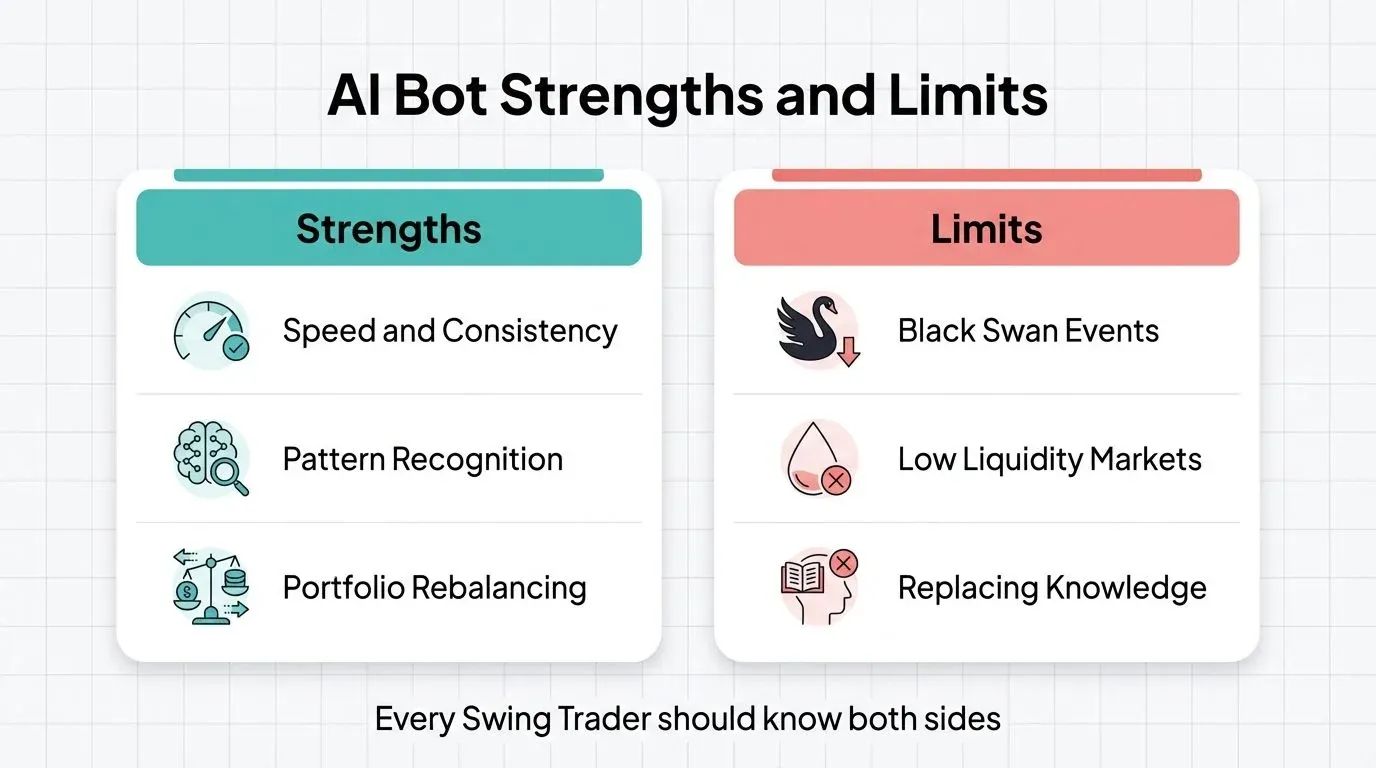
 Every Swing Trader should understand both sides before deploying AI bots.
Before committing capital to any AI bot, it helps to have realistic expectations about where this technology performs well and where it falls short.
What AI Bots Do Well
Speed and consistency are where AI bots genuinely outperform human traders. They can monitor dozens of trading pairs across multiple exchanges simultaneously, something no manual trader can sustain. They execute without hesitation, removing the emotional decision-making that causes many Swing Traders to exit positions too early or hold losing trades too long.
Pattern recognition at scale is another genuine strength. An AI bot can process years of candlestick data, order book depth, funding rates, and volume profiles faster than any human analyst. When the patterns it has learned appear in live data, it can act in milliseconds.
AI bots also excel at portfolio rebalancing and position sizing. They can continuously calculate optimal allocation across assets based on correlation, volatility, and risk parameters, adjusting in real time as conditions shift.
What AI Bots Cannot Do
No AI trading bot can predict black swan events. Flash crashes triggered by exchange failures, regulatory announcements, or major protocol exploits are by definition outside the historical data the bot was trained on. When these events hit, AI bots often perform worse than a human trader who can assess context and act on judgment.
AI bots also struggle with low-liquidity environments. A model trained on BTC/USDT data will not perform the same way on a small-cap altcoin with thin order books. Slippage, wide spreads, and sudden liquidity drops can turn a theoretically profitable strategy into a losing one.
Most importantly, AI bots cannot replace trading knowledge. A bot is a tool, not a strategy. Traders who deploy AI bots without understanding the underlying logic are essentially speculating blindly with extra steps.
How to Evaluate an AI Crypto Trading Bot
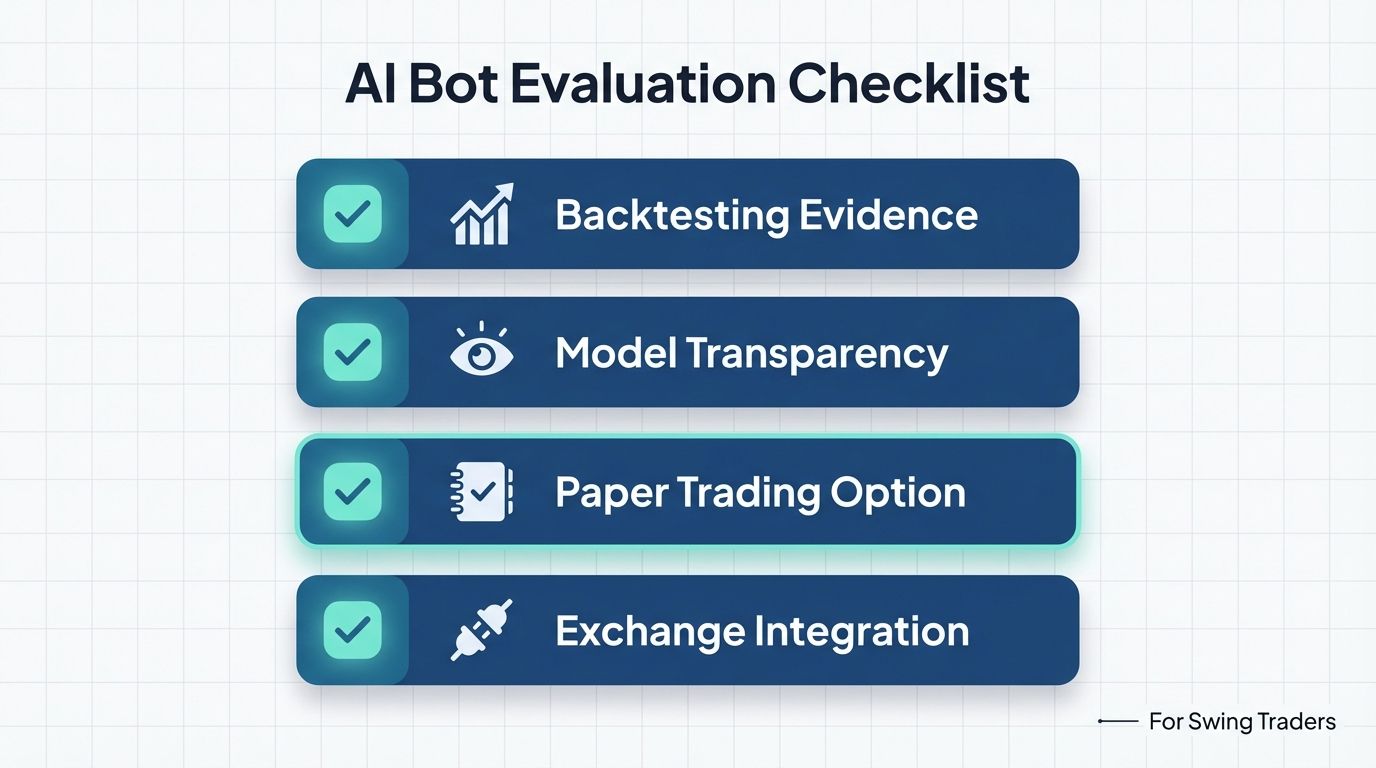 Use this checklist to evaluate any AI trading bot before connecting your accounts.
The AI trading bot market is crowded and largely unregulated. Many products use "AI" as a marketing label without delivering genuine machine learning capabilities. Here is a practical framework for evaluating any AI bot before connecting it to your exchange accounts.
Check the Backtesting Evidence
Any credible AI bot should provide verifiable backtesting results. Look for tests that cover multiple market conditions, including bear markets, sideways ranges, and high-volatility periods. Be skeptical of results that only show performance during bull runs. Ask whether the backtesting accounts for realistic slippage, trading fees, and execution delays.
Understand the Model Transparency
Legitimate AI trading products explain their methodology. They describe what data inputs the model uses, how often it retrains, and what risk management rules are built in. If a bot claims proprietary AI but provides zero detail about how it works, that is a red flag. You do not need to understand the math, but you should understand the logic.
Evaluate Paper Trading Options
The best way to test an AI bot is with paper trading before committing real funds. A platform that offers paper trading integration shows confidence in its product. It also gives you a risk-free way to observe how the bot handles different market conditions over weeks or months rather than days.
Look at Exchange Integration
AI bots need reliable exchange connections to execute effectively. Check which exchanges are supported, whether the bot uses API connections with proper security (IP whitelisting, withdrawal restrictions), and how the bot handles exchange downtime or API rate limits. Swing Traders who operate across multiple exchanges should prioritize bots that support multi-exchange management from a single dashboard.
Common Mistakes Traders Make with AI Bots
Even experienced traders fall into predictable traps when they start using AI trading bots. Recognizing these mistakes early can save both capital and frustration.
Over-Trusting the AI Label
The biggest mistake is assuming that "AI-powered" means reliable. Many bots marketed as AI are running basic moving average crossovers or RSI thresholds with a machine learning label attached. Always ask for specifics about the model architecture and training process before assuming the bot is doing anything sophisticated.
Skipping Paper Trading
Deploying an AI bot on a live account without paper trading first is a common and costly error. Market conditions change constantly, and a bot that looks promising on a demo page may underperform in live conditions. Paper trading for at least four to six weeks across different market phases gives you a much clearer picture of real performance.
Ignoring Risk Management
AI bots are not immune to drawdowns. Traders who set large position sizes or disable stop losses because "the AI knows what it is doing" are taking on unnecessary risk. Always set maximum drawdown limits, position size caps, and kill switches that halt the bot if losses exceed your threshold.
Running Too Many Bots Simultaneously
More bots does not mean more profit. Running multiple AI bots on overlapping trading pairs can create conflicting signals, excessive trading fees, and correlation risks. Start with one bot on one strategy, measure the results, and scale only after you have evidence that it performs consistently.
Not Monitoring Performance
AI bots require ongoing oversight. Set a regular review schedule to check performance metrics, compare results against benchmarks, and verify that the bot is executing as expected. A bot that performed well three months ago may need adjustment as market dynamics shift.
Set up alerts for unusual activity, such as unexpected large trades, rapid drawdowns, or extended periods of inactivity. Most quality trading platforms provide notification systems that help you stay informed without needing to watch the bot constantly.
AI Trading Bot Safety Checklist
Before deploying any AI crypto trading bot with real funds, run through this checklist:
- Verify the bot provider has a track record of at least 12 months with documented performance
- Confirm that API connections use read-only and trade-only permissions (never withdrawal permissions)
- Enable IP whitelisting on all connected exchange accounts
- Set maximum drawdown limits and automatic stop conditions
- Paper trade for at least four to six weeks before going live
- Start with a small allocation (no more than 5 to 10 percent of your trading capital)
- Check that the bot handles exchange API rate limits gracefully
- Verify that the bot provider has clear documentation on model updates and retraining schedules
- Ensure you have real-time alerts set up for unusual trading activity
- Review performance weekly against a simple buy-and-hold benchmark
Frequently Asked Questions
Are AI crypto trading bots profitable?
AI crypto trading bots can be profitable, but there is no guarantee. Profitability depends on the quality of the underlying model, the market conditions during deployment, and how well the trader manages risk settings. Most reputable bot providers publish backtested results, but past performance does not guarantee future returns. The safest approach is to start with paper trading, validate results across different market phases, and allocate only a small portion of your total capital to any single bot strategy.
Is it safe to connect an AI bot to my exchange account?
Connecting an AI bot to your exchange account is generally safe if you follow basic security practices. Use API keys with trade-only permissions and never enable withdrawal access. Enable IP whitelisting so the API key only works from the bot provider's servers. Choose bot platforms that have a documented security track record and transparent data handling policies. If a bot provider asks for your exchange password or requests withdrawal permissions, that is a major warning sign.
Can I build my own AI trading bot?
Building your own AI trading bot is technically possible but requires significant expertise in both machine learning and crypto market mechanics. You need access to clean historical data, computing resources for model training, and a robust execution framework that handles real-world conditions like slippage and API rate limits. For most traders, using established trading platforms with built-in automation features is more practical than building from scratch. Platforms that offer customizable bot configurations with visual strategy builders give you many of the benefits of automation without requiring programming skills.
Start a free trial on Altrady to paper test AI-driven signals, apply clear risk controls, and see whether an AI bot improves your trading before risking real funds.