
You are deciding between subscribing to an AI trading signal service and running an AI trading bot, and the marketing for both promises the same outcome: better-than-human results without the emotional baggage. The two products sound similar enough that traders often pick one, fail, and then assume the entire category is broken, when in reality they picked the wrong tool for how they actually trade.
AI trading signals and AI trading bots solve different problems. Signals tell you what to do and leave the execution to you. Bots execute autonomously based on rules or models. The choice between them depends on how much manual oversight you want, how much you trust your own discretionary judgment, and what kind of strategy you are running. This guide breaks down the practical differences, when each format wins, and the hybrid approach most experienced traders eventually adopt.
The Core Difference in One Sentence
AI trading signals are decisions delivered to a human who acts on them. AI trading bots are decisions executed by software without human intervention. Everything else, performance, cost, complexity, risk, flows from this single distinction.
What AI Trading Signals Look Like in Practice
A signal arrives as a notification, message, or feed entry telling you something like: "BTC long entry at 65,800, stop-loss 64,500, take-profit 68,200, position size 1.5R". The signal might come from a Telegram channel, a TradingView alert, a paid signal service, an in-platform indicator, or an AI model output. You then decide whether to take the trade, where to enter manually, and whether to override the levels based on what you see in the order book or news flow.
The trader is the executor. The signal is the input.
This format works well for: - Traders who want to learn from a system they can review trade by trade - Discretionary traders who use signals as confluence with their own analysis - Anyone trading less than 5-10 setups per week (manual execution stays manageable) - Strategies that require qualitative judgment (fundamental events, news context, market regime detection) - Traders who do not yet trust automation enough to leave it unsupervised
The downside is that you have to be at your screen, you can miss signals while sleeping or working, and emotional override (skipping a signal because it "feels wrong") often turns a profitable signal feed into an unprofitable trader.
What AI Trading Bots Look Like in Practice
A bot is configured once and then runs continuously, placing orders, managing positions, and closing trades according to its programmed logic. The trader sets parameters (asset, position size, strategy type, risk limits) and the bot operates within those limits without further input until paused or reconfigured.
In modern crypto bot platforms, the most common bot types are: - Grid bots: place buy orders at predefined price levels below the current price and matching sell orders above, profiting from oscillation in sideways markets - DCA (Dollar Cost Averaging) bots: enter a position and place additional buys at lower prices to average down, taking profit when price recovers - Signal bots: execute trades automatically based on technical indicator signals (RSI, MACD, moving average crossovers, custom strategies) - Trend-following bots: enter on momentum confirmations and trail stops to capture extended moves - Arbitrage bots: exploit price differences between exchanges, requiring sophisticated infrastructure
The bot is the executor. The trader is the configurator.
This format works well for: - Traders who want consistent execution at scale across many pairs or exchanges - Repetitive strategies that benefit from emotionless execution (DCA, grid, mechanical signal entries) - 24/7 markets where humans cannot be present (crypto runs while you sleep) - Removing the psychological layer that destroys retail traders (FOMO, revenge trading, paralysis) - Operators who have validated a strategy in paper mode and want to scale it
The downside is that bots execute the strategy whether market conditions still favor it or not. A grid bot that worked beautifully in May 2025 sideways action will keep "buying the dip" all the way down to zero in a 2026 capitulation if not paused. The bot does not know what year it is or what is happening in the news.
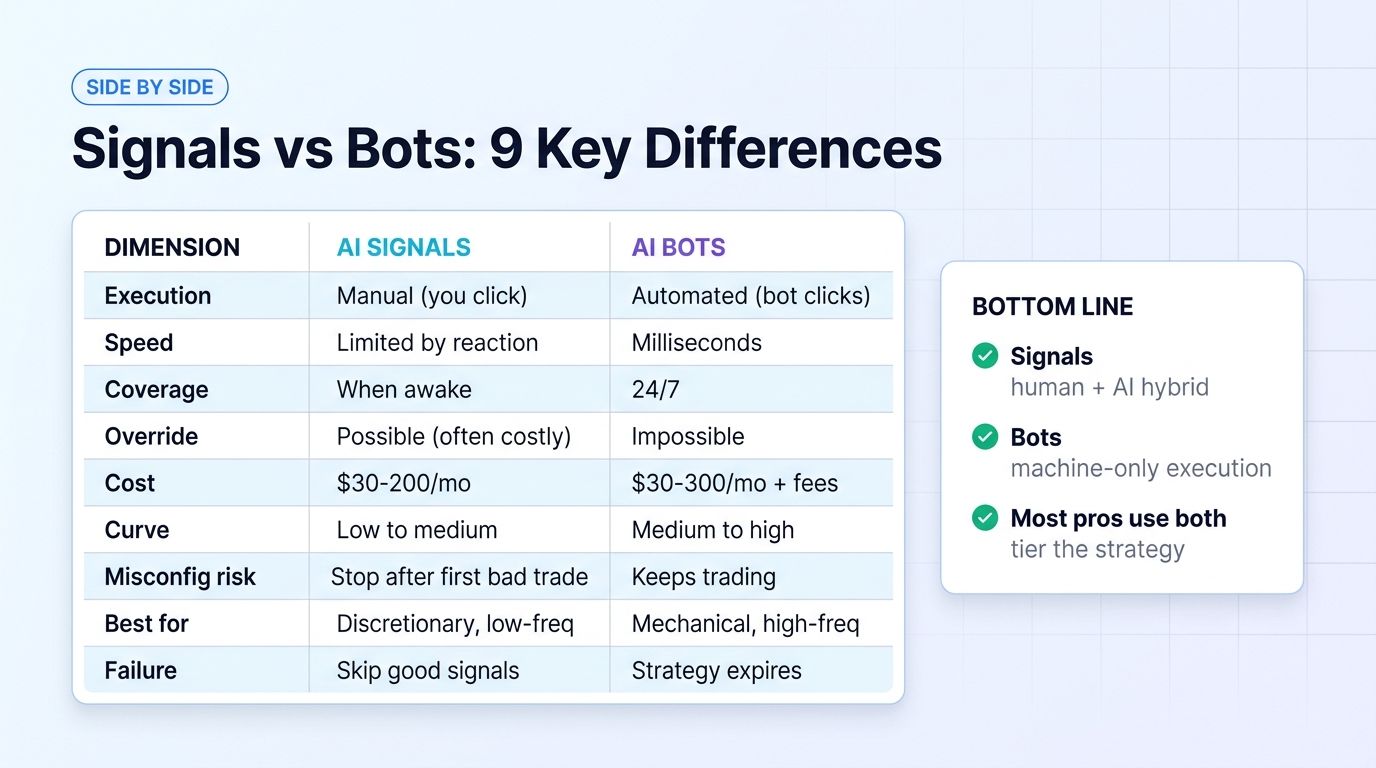
Side by Side Comparison
| Dimension | AI Trading Signals | AI Trading Bots |
|---|---|---|
| Execution | Manual (you click) | Automated (bot clicks) |
| Speed | Limited by your reaction | Milliseconds |
| Coverage | When you are awake | 24/7 |
| Emotional override | Possible (often costly) | Impossible (within bot logic) |
| Cost structure | Subscription (often $30-200/mo) | Subscription (often $30-300/mo) plus exchange fees |
| Learning curve | Low to medium | Medium to high |
| Risk if misconfigured | You can stop after first bad trade | Bot keeps trading until you intervene |
| Best for | Discretionary traders, low-frequency, learning | Mechanical strategies, high-frequency, scaled |
| Failure mode | You skip good signals, take bad ones | Strategy keeps running past its expiration date |
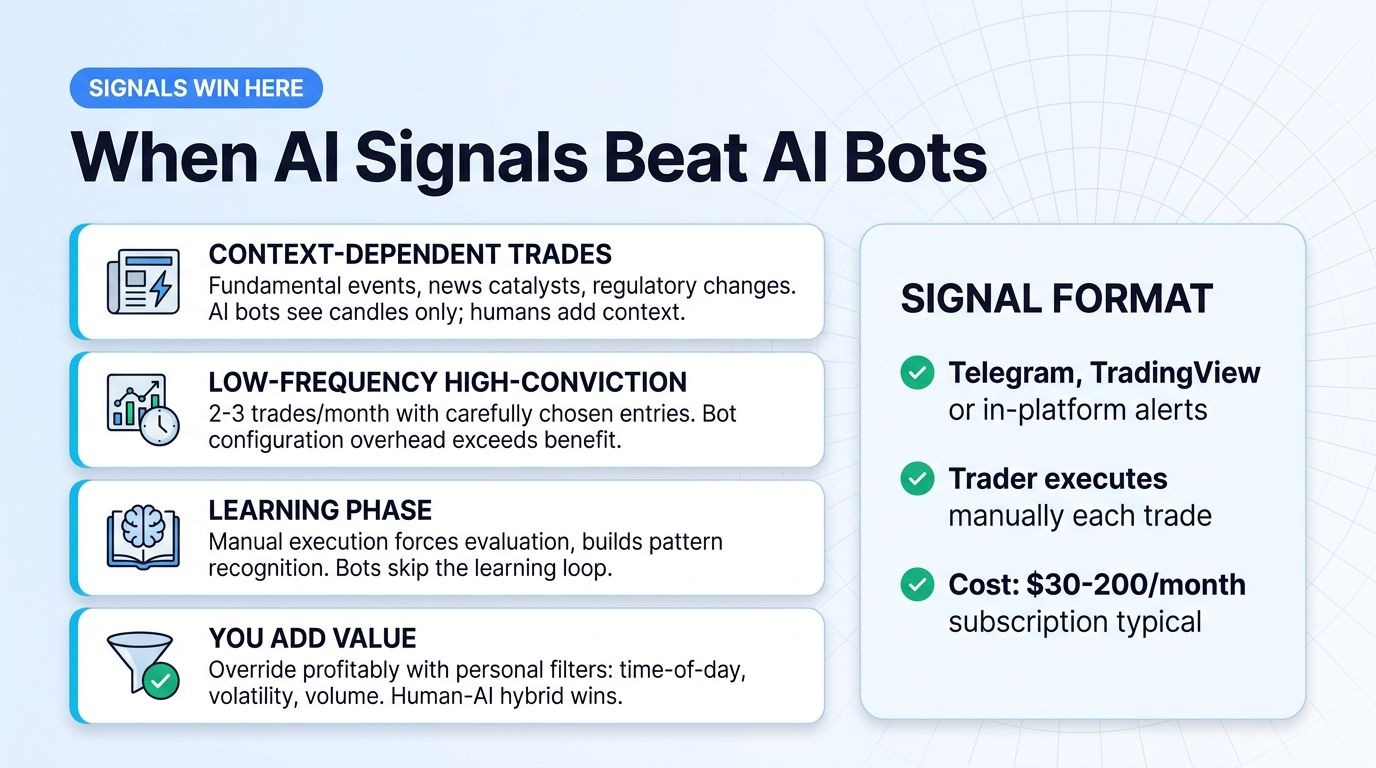
When Signals Win
There are specific scenarios where signals outperform bots, even for traders who could run either.
Strategies that depend on context outside price. A signal feed from a fundamental analyst can flag "ETH long because Dencun upgrade dropped today and gas fees fell 90%". A bot reading the same chart sees a normal candle pattern and has no idea about the upgrade. For event-driven trades, signals plus human context wins.
Low-frequency, high-conviction trades. If you take 2-3 trades per month with carefully chosen entries, a bot is overkill. The cognitive overhead of configuring and monitoring a bot exceeds the benefit when manual execution is fast enough.
Learning periods. Traders who want to understand WHY each trade happened benefit from manually executing signals. The pause between signal arrival and your click forces you to evaluate the setup, building pattern recognition over time. Bots skip this learning loop.
Markets where you can override profitably. Some traders consistently improve signal performance with their own filters (skipping signals during low-volume hours, adjusting position size based on volatility, etc.). These traders are essentially adding a human-AI hybrid model and outperforming pure automation.
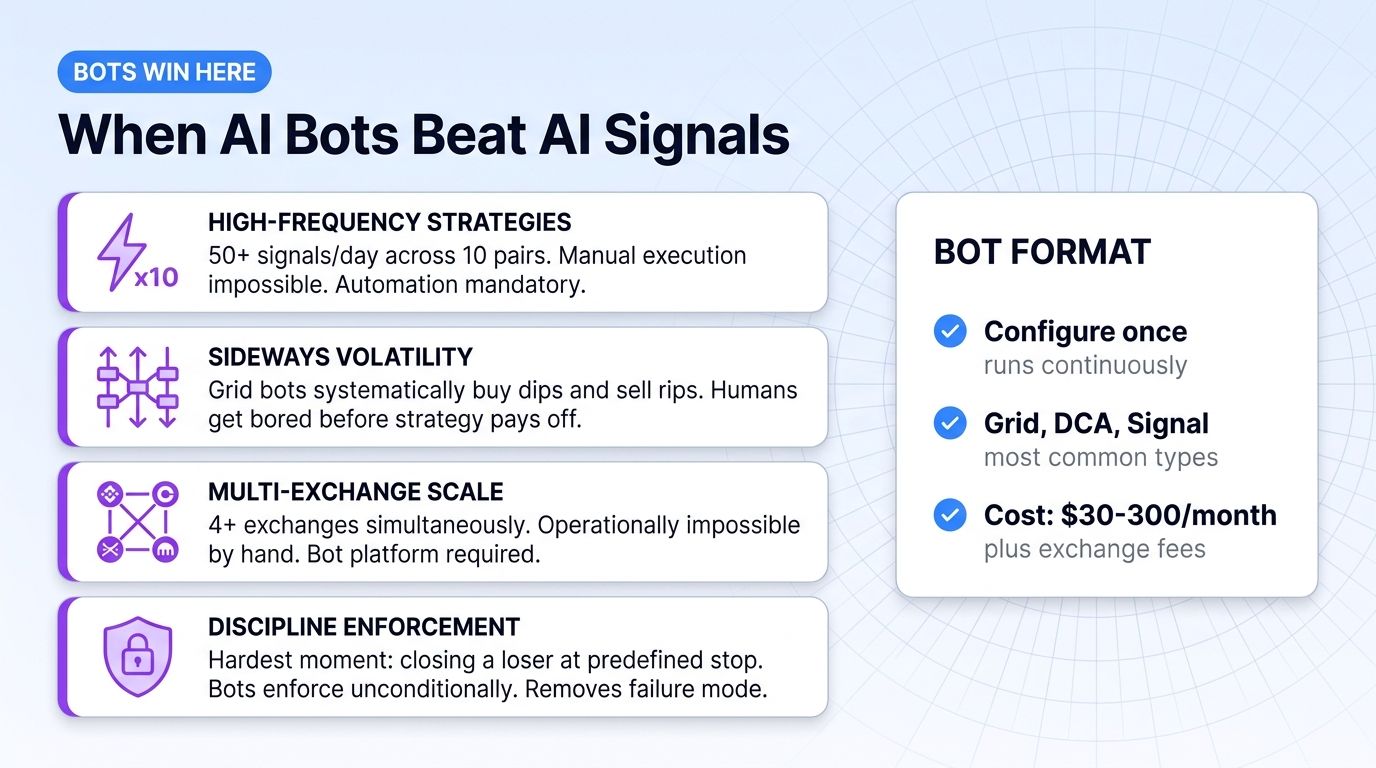
When Bots Win
Bots dominate in different conditions.
High-frequency strategies. A signal bot trading 5-minute charts on 10 pairs generates 50+ signals per day. No human can execute that volume manually with consistency. Automation is mandatory.
Sideways volatility capture. Grid bots are mechanically better than humans at systematically buying dips and selling rips in ranges. Manual traders get bored, distracted, or impatient before the strategy pays off. Bots do not.
Multi-exchange scale. If you trade across Binance, Coinbase, Kraken, and Bybit simultaneously, manual execution is operationally impossible. A bot platform that connects to all your accounts and executes consistently is the only viable path.
Discipline enforcement. The hardest moment in trading is closing a losing position at the predefined stop. Most retail traders freeze and let losses run. A bot enforces the stop unconditionally, removing the failure mode that destroys most accounts.
Time-zone constraints. Crypto markets do not respect work schedules. A trader with a day job who wants to participate in 24/7 price action without setting alarms at 3 AM needs automation.
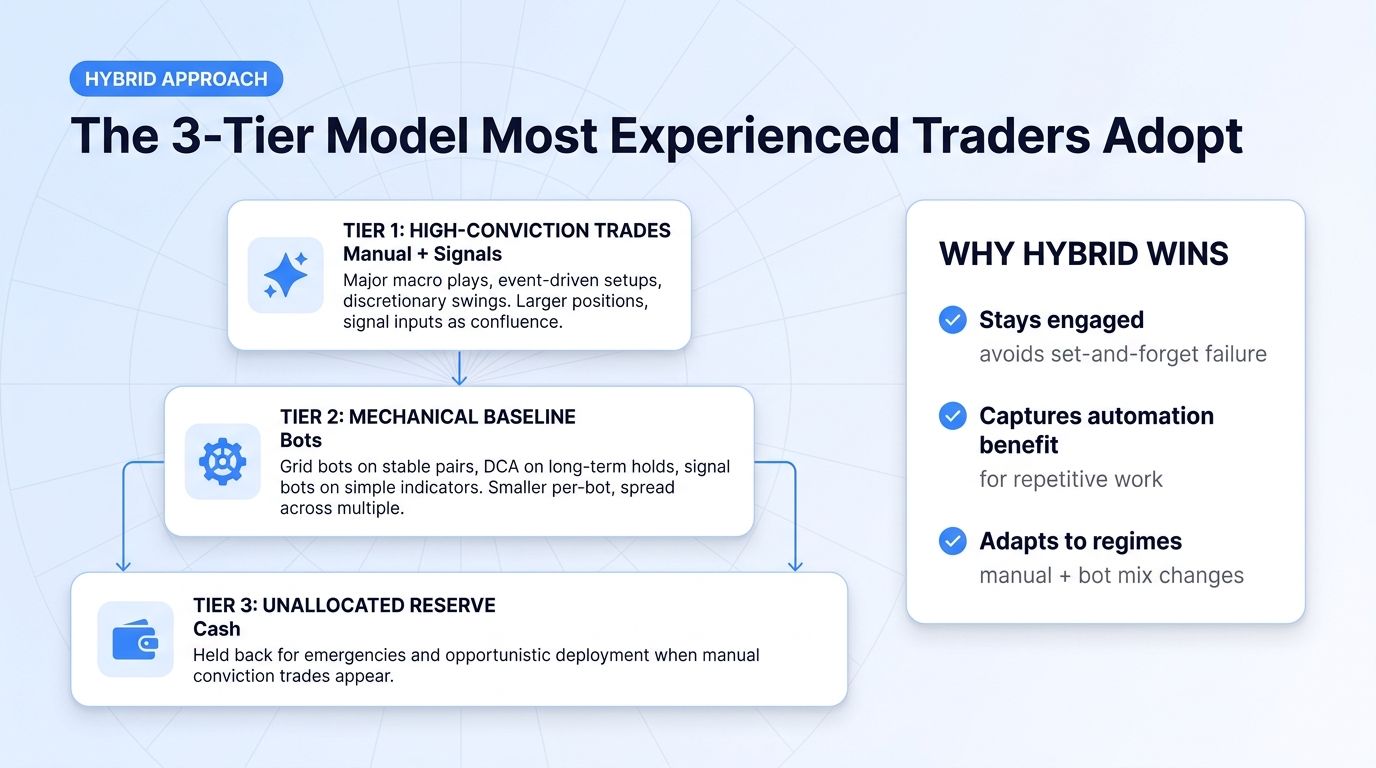
The Hybrid Model Most Experienced Traders Adopt
After 6-18 months of trading experience, most operators converge on a hybrid setup rather than committing fully to one format.
Tier 1 (manual + signals): the high-conviction trades. Major macro plays, event-driven setups, and discretionary swing trades. These are traded manually using signal inputs as confluence with personal analysis. Position sizes are larger because conviction is higher.
Tier 2 (bots): the mechanical baseline. Grid bots running on stable, range-bound pairs. DCA bots accumulating long-term holds. Signal bots executing simple indicator strategies. Position sizes are smaller per bot but spread across multiple bots and pairs.
Tier 3 (cash): the unallocated reserve. Capital held back for emergencies and opportunistic deployment when manual conviction trades appear.
This three-tier model keeps the trader engaged with markets (avoiding the "set and forget" failure mode where the bot runs unsupervised through a regime change) while capturing the operational benefits of automation for repetitive tasks.
Cost Comparison
Pure cost per month is not the right way to compare. The real comparison is cost-to-return ratio, which depends on account size and strategy.
A $30/month signal service is reasonable for an account of $5,000+ if the trader actually executes the signals consistently. Below $5K, a 7-15% annual return ($350-750) gets eaten by the $360/year subscription. Many beginner traders pay for signal services they cannot afford to act on profitably.
A $99/month bot subscription requires a meaningful account ($10,000+) to be cost-effective unless the bot is dramatically outperforming. Bot platforms like Pionex (free, monetized via spread), 3Commas, Cryptohopper, Bitsgap, and Altrady have a range of tiers. Match the platform's pricing to your account size, not to its feature list.
How Altrady Handles Both
Altrady is not strictly a signal service or a bot platform. It combines a manual trading terminal with 3 native bots (Signal, Grid, DCA) operating as co-equal pillars across 19+ exchanges. The design assumption is the hybrid model described above.
For signal-style use: traders connect to TradingView (built-in integration) or use the Smart Money Indicator and TA Scanner to generate entry signals, then execute manually through the multi-exchange terminal with Smart Trading orders that include TP/SL and trailing stops in a single submission.
For bot-style use: the Signal Bot can subscribe to TradingView alerts or custom signals and execute them automatically. The Grid Bot runs on configured ranges. The DCA Bot accumulates positions on price drops.
For the hybrid approach, both modes operate side by side on the same account, with funds staying on your own exchange accounts (Binance, Coinbase, Kraken, KuCoin, Bybit, Bitvavo, OKX, MEXC, and others). Pricing is straightforward: Basic €28/mo (5 trading accounts, 2 bots), Essential €50 (15 accounts, 5 bots), Premium €90 (30 accounts, 50 bots). 5-day trial available.
This positioning fits traders who do not want to commit fully to either pure signals or pure bots. Pure signal seekers may prefer dedicated platforms like TradingView with provider feeds. Pure bot seekers may prefer Pionex's free in-exchange bots or 3Commas' marketplace.
Decision Framework
Use this 4-question check to pick the right format for your situation.
- How many trades do you take per week? Under 10: signals work. Over 30: bots are necessary. In between: hybrid.
- Does your strategy require context outside the chart? Yes (news, fundamentals, regime detection): signals or hybrid. No (mechanical price-based logic): bots.
- Can you be at your screen when signals arrive? Mostly: signals fine. Mostly not: bots required.
- Have you forward-tested in paper for 30 days? No: start with signals plus paper trading. Yes: ready for bots.
FAQ
Can I use AI signals and AI bots at the same time?
Yes, and it is the most common approach for experienced traders. Signals from a paid service or your own analysis drive your manual high-conviction trades, while bots run mechanical strategies on different pairs or with smaller position sizes. The key is keeping total exposure across both within your overall risk budget.
Are AI trading signals accurate?
Accuracy varies wildly by provider. Track records over 6+ months are the only meaningful indicator. Look for signal services that publish full trade history, not curated highlights. Win rate alone is not enough, average win size versus average loss size and overall risk-adjusted return matter more.
Which is cheaper, signals or bots?
Roughly comparable. Signal services typically cost $30-200/month. Bot subscriptions typically cost $30-300/month plus exchange fees. The cheaper option for any given trader depends on which one they will actually use consistently. A $30/month signal service the trader ignores costs more than a $99/month bot the trader uses well.
Do I need coding skills for AI bots?
Not for most retail platforms. Modern bot platforms (3Commas, Cryptohopper, Pionex, Bitsgap, Altrady) provide no-code interfaces where you configure parameters via dropdowns and sliders. Coding becomes useful only for custom strategy development on platforms like Hummingbot or proprietary frameworks.
Can AI signals tell me when to exit a trade?
Some can. Quality signal services include exit signals (take-profit triggers, stop-loss adjustments, trailing stops). Many basic services only signal entries and leave exits to the trader, which is a major weakness because most trader losses come from poor exit decisions, not poor entries.