
You have seen the screenshots. "AI bot turned $1,000 into $47,000 in 30 days." A YouTube thumbnail of someone holding a Lambo key. A Telegram channel selling "the algorithm that beats the market." If you have spent any time researching AI crypto trading bots, you have already learned that most marketing claims are either cherry-picked, retroactively fitted, or outright fabricated.
The honest answer to "are AI crypto trading bots profitable?" is more nuanced than yes or no. They can be profitable, but the conditions that determine whether you make money or lose it have very little to do with the AI itself, and almost everything to do with how the bot is configured, what market it operates in, and whether the trader running it understands what they are doing. This guide breaks down what actually drives bot profitability in 2026, where the marketing claims fail, and how to evaluate whether a specific bot setup will work for your situation.
The Short Answer Up Front
AI crypto trading bots are profitable for some traders, in some market conditions, with some configurations. They are not a passive income machine, they do not eliminate risk, and "AI" in most retail bot products is more marketing than machine learning. If you are deciding whether to use one, the question is not "do bots work?" but "does this specific bot, with this specific strategy, in this specific market, fit my risk tolerance and capital?"
Why Performance Data Is So Murky
Three reasons make it hard to find honest profitability data on AI crypto trading bots.
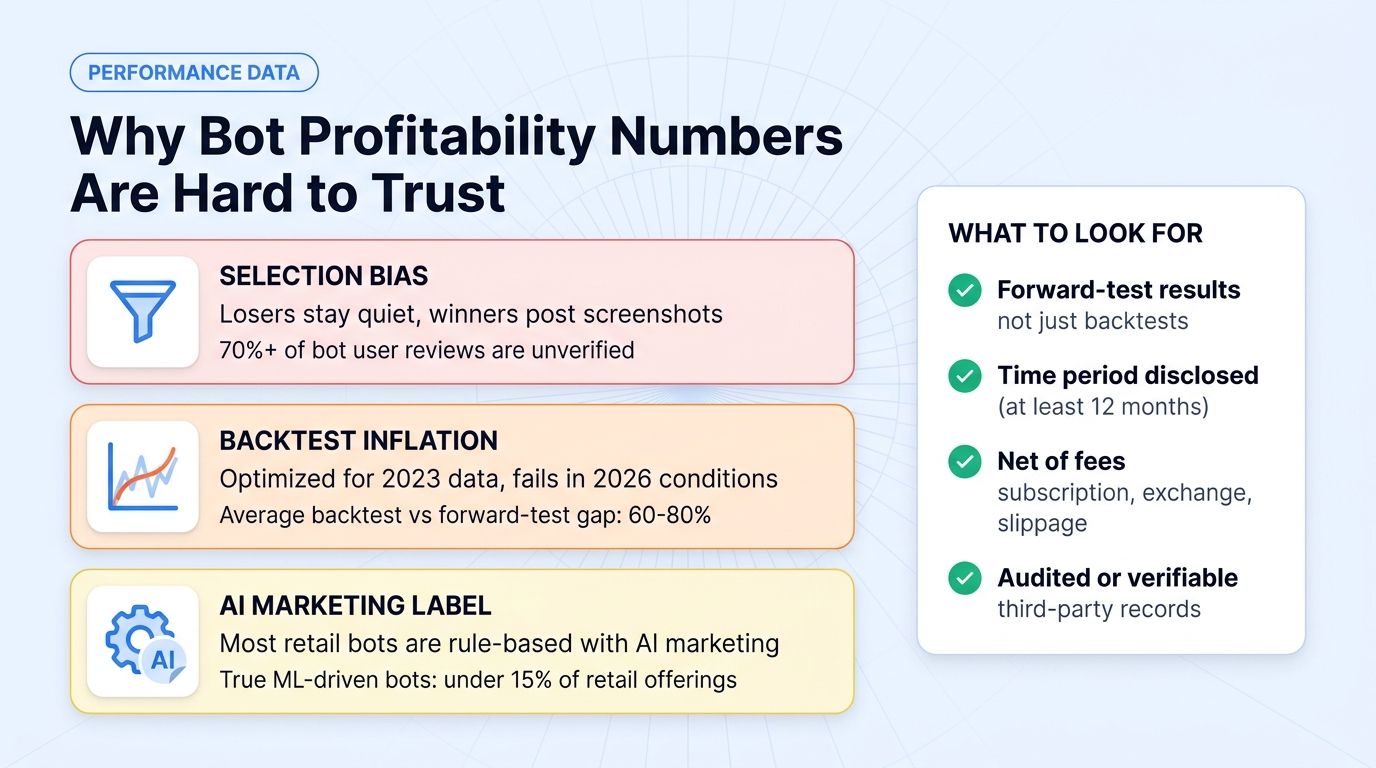
Selection bias dominates the public record. Traders who lose money on bots quietly switch them off. Traders who make money post screenshots, write Twitter threads, and sell courses. The dataset you see online is filtered by survivorship. A platform showing "73% of users profitable" without disclosing time period, capital, or whether unprofitable users got refunded is not actually disclosing performance.
Backtested returns are not real returns. A bot's backtest can show 200% annualized returns on 2023 data and lose money in 2026 because the market regime changed. Curve fitting, where a strategy is optimized to fit historical data so well that it has no predictive power, is the single most common failure mode for AI trading strategies. Always look for forward-test or live results, not backtests.
Most "AI" bots are rule-based with marketing language. Genuine machine learning models that adapt to crypto market data require substantial infrastructure, training datasets, and monitoring. Most bots sold to retail traders use grid logic, dollar-cost averaging logic, or signal-following logic with the AI label applied for marketing. This is not necessarily bad, simple rule-based bots can be profitable, but understanding what you are actually running matters.
What Actually Drives AI Bot Profitability
After reviewing the bot platform landscape (3Commas, Cryptohopper, Pionex, TradeSanta, Bitsgap, Altrady, and others) and the academic research on algorithmic crypto trading, four factors consistently separate profitable bot setups from unprofitable ones.
1. Strategy-Market Fit
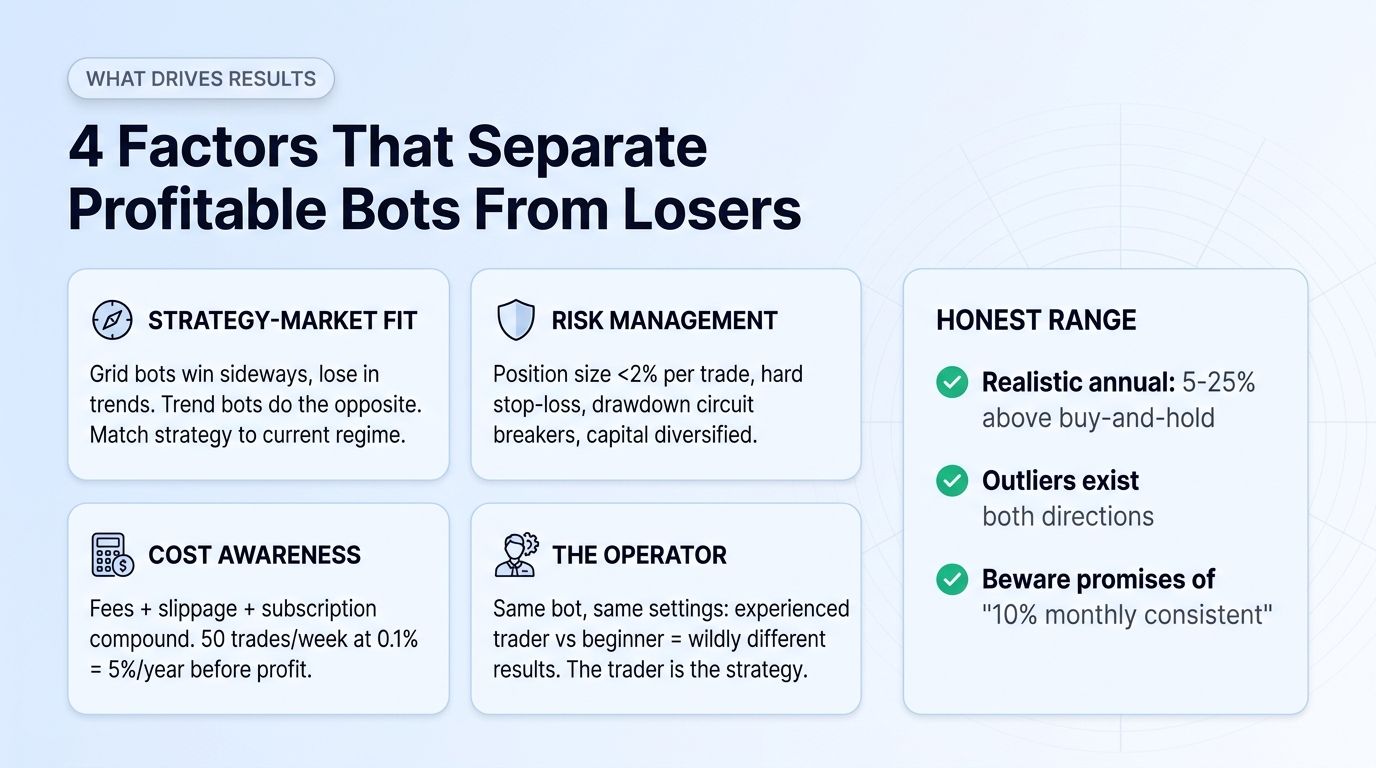
A grid bot prints money in a sideways market and bleeds capital in a strong trend. A trend-following bot does the opposite. AI signal bots that buy on RSI oversold signals work in mean-reverting markets and fail when momentum is dominant. The single biggest predictor of profitability is whether the strategy matches current market behavior.
In practice, this means traders who simply "turn on a bot and forget it" tend to lose money over a full market cycle, because no single strategy works in all market conditions. Profitable bot operators typically run different strategies in different market regimes, or reduce position sizes when conditions are unfavorable.
2. Risk Management Configuration
Bots without strict risk management amplify losses faster than humans. A DCA bot configured to keep buying as price falls will eventually exceed your account capacity if the asset goes to zero. A grid bot in a strong trend will run out of grid levels and stop working. An AI signal bot following bad signals can churn capital through fees while taking small losses repeatedly.
The traders who report consistent bot profitability share specific risk constraints: position size capped at 1-2% of account per trade, hard stop-losses at predefined levels, drawdown circuit breakers that pause the bot if losses exceed a threshold, and capital diversified across multiple bots and exchanges rather than concentrated in one.
3. Cost Awareness
Trading fees, slippage, and spread compound quickly when a bot trades frequently. A bot generating 50 trades per week at 0.1% per trade pays 5% in fees alone over a year before any profit. High-frequency strategies need exchange tier discounts, maker rebates, or liquidity-provider rewards to be net profitable. Many published "profitable" bot returns ignore fees, taxes, and the cost of the bot subscription itself.
4. The Operator
This is the factor most marketing material avoids: a bot is only as good as the trader who configures it. The same bot, with the same settings, run by an experienced trader who adjusts parameters monthly versus a beginner who set it up once and walked away, will produce dramatically different results. The bot is not the strategy. The trader who chooses the bot, picks the asset, sets the parameters, and decides when to pause is the strategy.
What Realistic Returns Look Like
Public, verifiable performance data from disciplined bot operators in 2024-2026 (from forums, audited Cryptohopper marketplace results, and TradingView signal services) suggests that experienced traders running well-configured bots typically achieve net annual returns in the range of 5-25% above buy-and-hold for the same asset. Outliers exist in both directions, but anyone promising "consistent 10% monthly" is either lying, picking a 2-month window, or operating outside risk limits that will eventually wipe out their account.
For context, simply holding Bitcoin from Jan 2024 to Jan 2026 returned over 200% with no bot, no strategy, and no fees. Many "profitable" bots actually underperformed buy-and-hold for the same period. The bot was profitable in absolute terms but cost the trader money in opportunity terms.
This is the most important framing question: profitable compared to what? A bot that beats sitting in cash but loses to buy-and-hold is not really doing its job for a long-term holder. It might still make sense for someone who needs active income or wants to trade the volatility, but the comparison matters.
When AI Bots Make Sense
After all the caveats, there are specific situations where AI crypto trading bots are genuinely useful, often more useful than manual trading.
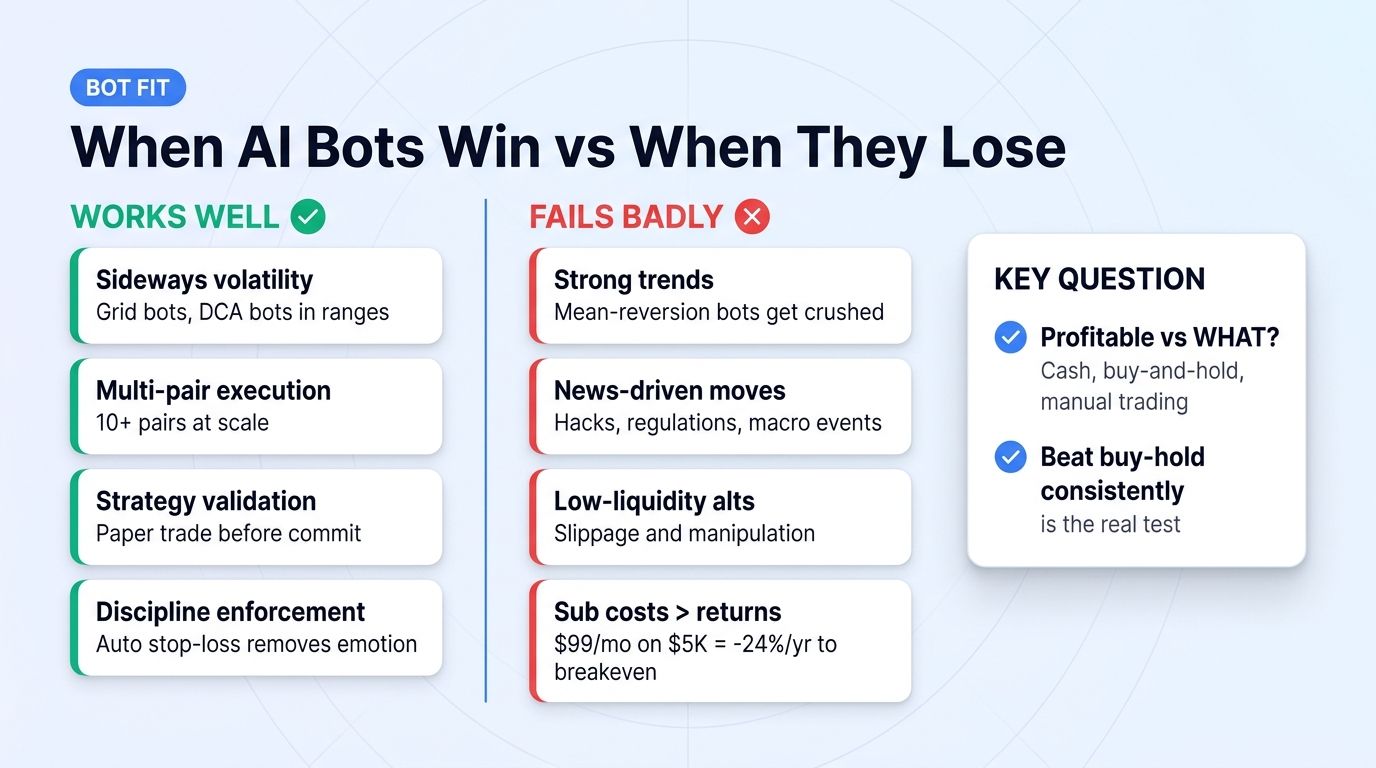
You want to capture sideways volatility. Grid bots and DCA bots are meaningfully better than humans at systematically buying dips and selling rips in range-bound markets. Boredom and impatience cause manual traders to abandon mean-reversion strategies before they pay off. Bots do not get bored.
You want consistent execution at scale. If you trade 10+ pairs across 3+ exchanges, the operational overhead of manual trading exceeds the cognitive bandwidth of one person. A signal bot that consistently executes the same logic across all your accounts at any hour is more reliable than checking charts at 3 AM.
You want to test and refine a strategy before committing capital. A paper trading bot lets you validate a strategy on live market data without risking real money. Two months of forward-testing in paper mode is worth more than two years of backtesting because it captures the messy reality of slippage, fees, and order book depth.
You want to enforce discipline. The strongest argument for bots is psychological. The trader who knows they should cut losses at 2% but freezes when the moment comes will lose less money with an automated stop-loss. Bots remove the emotional layer that destroys most retail traders.
Where AI Bots Fail
Conversely, there are situations where running a bot will likely lose you money compared to either trading manually or sitting in cash.
Strong trending markets punish mean-reversion bots. If Bitcoin is breaking out to new highs, your grid bot at 60K-65K is selling too early and shutting down at 70K with no upside left. Until the trend exhausts, the bot underperforms holding.
News-driven volatility wrecks signal bots. An exchange hack, regulatory announcement, or unexpected macro event creates price action that no historical pattern can predict. Bots running on RSI or MACD signals during these events typically buy into falling knives or sell into recoveries.
Low-liquidity altcoins are bot graveyards. Slippage, manipulation, and sudden delistings turn what looked like a profitable backtest into real losses. Stick to high-volume pairs (BTC, ETH, top-20 by market cap) for any bot strategy.
Bot subscription costs that exceed returns. A trader paying $99/month for a bot subscription on a $5,000 account needs to net 23.8% annually just to break even on the subscription. Match the bot's cost to your account size or use platforms with affordable tiers.
How Altrady Approaches This
Altrady operates in this space differently from pure-bot platforms. The 3 native bots, Signal Bot, Grid Bot, and DCA Bot, are designed to operate as a co-equal pillar with manual trading rather than replace it. The assumption is that disciplined traders blend automated execution with discretionary judgment, using bots for repeatable patterns (DCA accumulation, grid in ranges, signal entries) and switching to the manual terminal when conditions need human judgment.
The platform stays connected to your own exchange accounts (Binance, Coinbase, Kraken, KuCoin, Bybit, and 14+ others) rather than custodying funds, so the worst-case risk is bot misconfiguration rather than platform insolvency. Risk Reward Calculator forces position sizing decisions before each trade, and Backtesting Pro on the Premium tier lets you forward-test strategies on real market data before committing capital. Pricing is straightforward: Basic €28, Essential €50, Premium €90 per month, with a 5-day trial.
Altrady is not selling a "passive income" promise, and a Bot Seeker who wants a fully autonomous, hands-off solution will probably be happier on a different platform. Altrady fits traders who want manual control plus automation for specific repeatable tasks.
Decision Framework
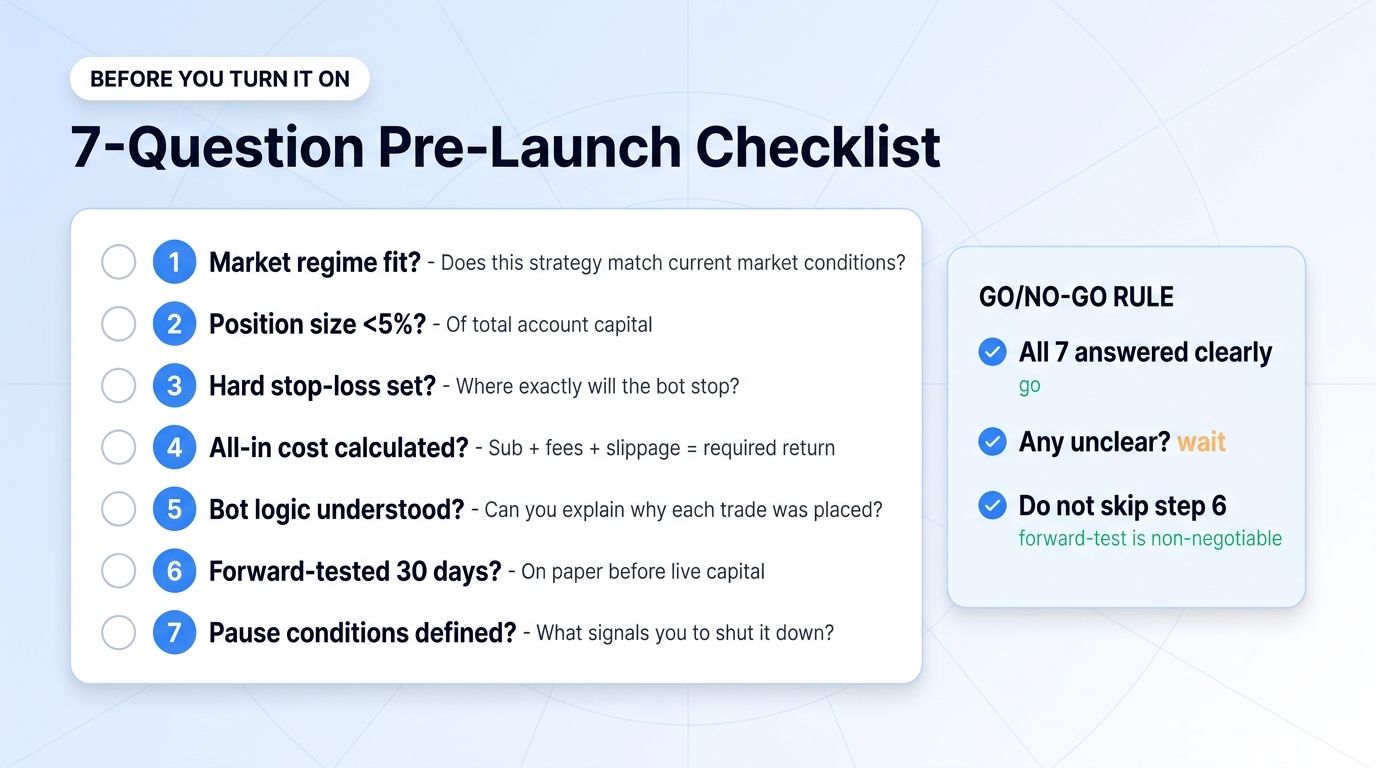
Before turning on any bot, work through this checklist.
- What market regime is this strategy designed for, and is the current market in that regime?
- What is my position size as a percentage of account, and is it under 5%?
- What is my hard stop-loss, and where will the bot stop if it hits?
- What is the all-in cost (subscription, exchange fees, slippage) and what return does that imply?
- Do I understand this bot's logic well enough to know why a trade was placed?
- Have I forward-tested this on paper for at least 30 days?
- What conditions would cause me to pause or shut down this bot?
If you cannot answer any of these clearly, you are not ready to run the bot with real capital.
FAQ
Are AI crypto trading bots legal?
Yes, in nearly every jurisdiction. Algorithmic trading is legal as long as it is not used for market manipulation (wash trading, spoofing, layering). Some jurisdictions require registration if you operate a bot service for others, but personal use of bots on your own exchange account is universally legal in major markets including the US, EU, UK, Australia, and most of Asia.
How much money do I need to start with an AI bot?
Most bot subscriptions assume an account of at least $1,000 to $5,000 to be cost-effective. Below that, the subscription fees plus exchange minimums consume too much of any returns. Some platforms offer paper trading without a minimum so you can validate the strategy first.
Can I use multiple AI bots at the same time?
Yes, and many experienced traders do. Running a grid bot on a sideways pair, a DCA bot on a long-term hold, and a signal bot on momentum trades simultaneously diversifies strategy risk. The key is keeping total leverage and position size across all bots within your risk budget.
Do AI bots work in bear markets?
Some do, but most retail bots are designed for sideways or bull conditions. DCA bots can be useful in bear markets if you have conviction in the asset and capital to keep buying. Grid bots in bear markets typically run out of buy levels. Short-side bots exist but require derivatives access (futures, perps) and add liquidation risk.
What is the most common reason AI trading bots fail?
Strategy-market mismatch. The trader picks a bot designed for one market regime (sideways) and runs it in another (trending), or never updates the parameters as market conditions change. The second most common reason is over-leverage, where the bot's position size compounds losses faster than the trader can intervene.