

Swing Traders, most people begin this project from the wrong end. They start by asking which AI model to use, when the harder and more important question is what exact job the bot is supposed to do. A trading bot only becomes useful when it has a narrow role, clear inputs, defined risk rules, and a measurable way to judge whether it is helping or hurting performance.
That is why a strong AI crypto trading bot is rarely “just AI.” In practice, the useful version is a system made of separate layers: data, signal logic, risk control, execution, and review. Altrady fits into that stack on the execution and workflow side, because its Signal Bot and webhook tools are designed to receive external signals, while paper accounts can be used for testing before live deployment.
What an AI crypto trading bot actually is
An AI crypto trading bot is a trading system that uses some form of automated intelligence to help decide whether a trade should be taken, avoided, sized differently, or managed in a specific way. The “AI” can be a machine learning model, a classifier, a ranking model, an LLM-assisted filter, or even a rules-based system enhanced by AI-generated signal scoring.
That distinction matters because many bots described as AI bots are really automated execution systems that act on externally generated signals. There is nothing wrong with that, but if you cannot explain whether your system is predictive, reactive, or simply automated, you will struggle to understand where any edge is actually coming from.
The cleanest way to design the system
The easiest way to avoid building a tangled mess is to think of the bot as a set of layers instead of one script doing everything. First comes the market data and feature layer, which tells the system what it can observe. Then comes the signal layer, where the model or decision logic classifies setups or ranks opportunities. After that comes risk, which decides whether the signal deserves capital and how much.
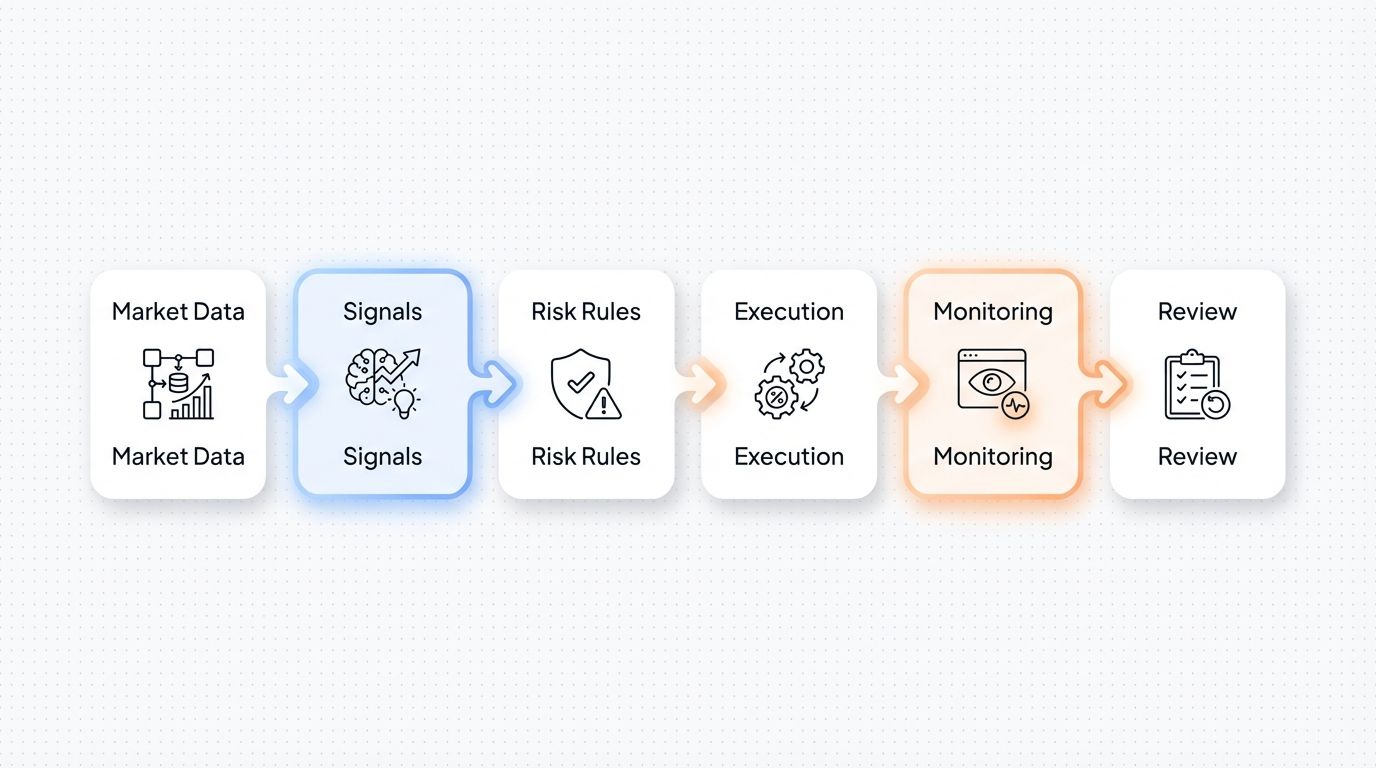
Only then should execution enter the picture. Once the signal and risk logic are stable, the bot needs a way to route those signals into real or paper execution, monitor what it is doing, and record what happened. If those functions are blurred together, you end up with a system that may place orders but cannot explain why, cannot be tested honestly, and cannot be improved with confidence.
Start by defining one narrow job
Before choosing tools, define the bot’s role in one sentence. It might filter breakout setups, rank watchlist candidates, classify trend versus range conditions, or decide whether a trade should be blocked because volatility is too high. The narrower the job, the easier the system is to evaluate and the easier it is to improve.
This is where many projects go wrong. Instead of building a bot that performs one useful decision well, traders try to create a machine that predicts everything, sizes everything, enters everything, and exits everything. That usually produces a complicated project with too many moving parts and no reliable way to tell which part is working.
Data quality matters more than model hype
A bot can only act on the information it sees, so poor inputs will usually produce poor outputs no matter how impressive the model sounds. In most realistic systems, the useful features are not exotic. They are the basics of price, structure, volatility, trend state, volume behavior, and market context across more than one timeframe.
What matters is alignment between the data and the bot’s job. If the model is supposed to filter momentum trades, then the features should describe momentum quality and setup context. If it is supposed to block bad trades in choppy markets, then the features should describe noise, compression, or lack of trend. The biggest mistake here is collecting too many features just because you can. More inputs do not automatically create better decisions. They often create more noise and more overfitting.
The safest AI bot style for most traders
For most traders, the best first version is not a fully autonomous AI trader. It is an AI-assisted signal bot. In that structure, the model helps score or filter trades, but a separate execution layer handles orders according to pre-defined rules. That makes the system easier to test because you can isolate whether the AI is improving signal quality without also giving it full control over capital.
A second practical version is a rules-based strategy with AI ranking on top. This works well when you already have setups you understand, but you want help deciding which of several candidates deserves attention. It is often a stronger starting point than “full AI trading” because it reduces the chance that you mistake complexity for edge. Fully automated AI execution can come later, but it should be earned by testing, not assumed from the beginning.
Risk rules must be built before live execution
Most bots do not fail because they cannot identify a chart pattern. They fail because they do not know when to stay small, when to stop, or when to do nothing. If your bot can open a position but cannot clearly explain its stop logic, size logic, and maximum risk conditions, then it is not ready.
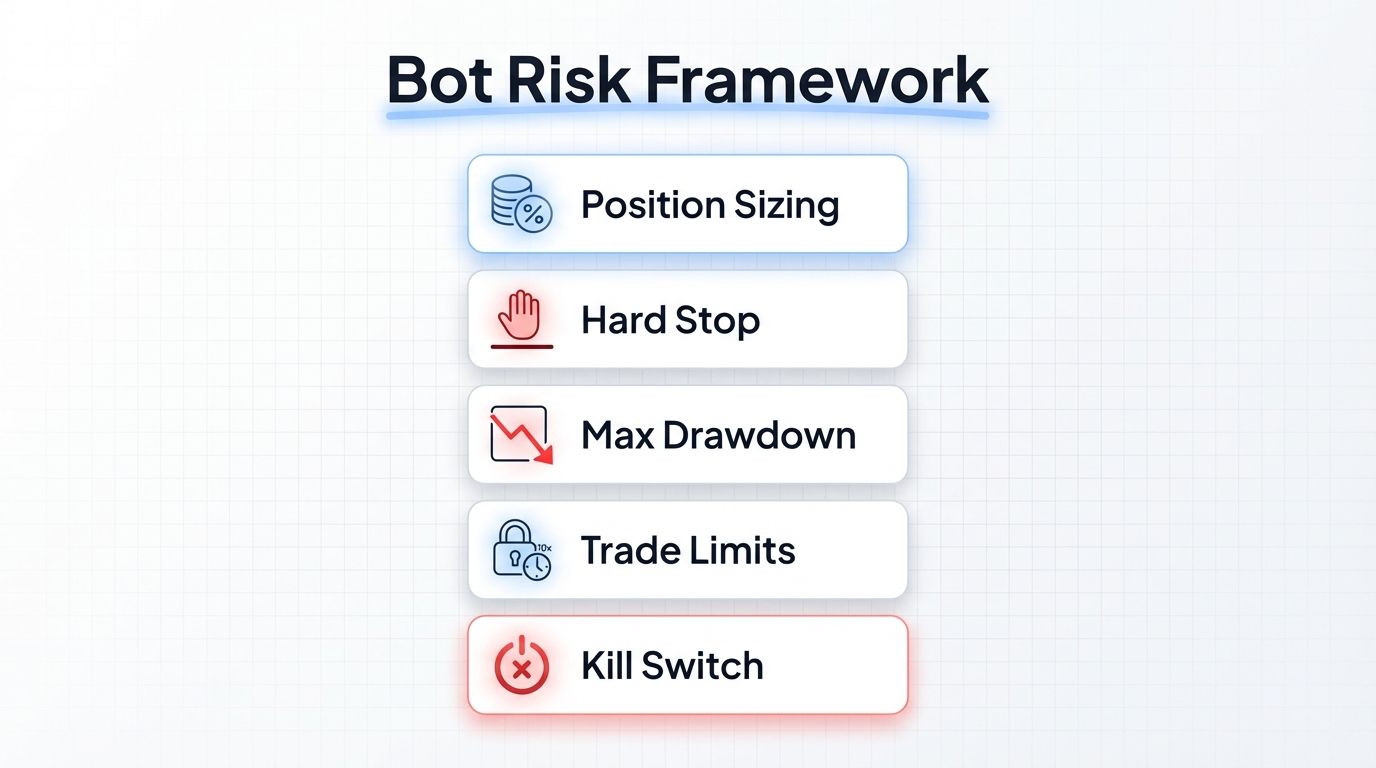
At minimum, a bot should know how position size is determined, where the hard stop sits, how much damage is allowed per day, and what market conditions should disable trading. These rules matter more than many traders want to admit, because in live trading the best signal in the world is still dangerous if it is connected to weak risk logic. This is also the part of the system that should remain understandable even if the signal layer becomes more complex.
Testing should happen in stages
A bot should not jump from code to live capital just because the logic “looks good.” First it needs historical testing, then forward testing on unseen data, then paper execution, and only then small live deployment. That sequence matters because many strategies survive only in clean backtests and break the moment real execution friction appears.
Altrady’s support documentation is useful here because it explicitly supports paper trading accounts across the trading terminal, Signal Bot, analytics, and other parts of the platform. Its webhook and Signal Bot documentation also makes clear that paper accounts can be used during testing before moving a bot into live trading.
That staged process is where trust is built. A bot that behaves correctly in paper mode, survives operational testing, and still makes sense after review is far more valuable than a bot that impresses you in a notebook but has never survived live conditions.
How signals can reach execution
Once the signal logic is stable, you need a reliable path from signal generation to order execution. One practical route is to let your model or script generate a signal and send it by webhook into an execution layer. Altrady’s Signal Bot documentation states that webhook Signal Bots are designed to receive and act on webhook signals, and that each webhook Signal Bot is built around one exchange, one trading account, and one quote currency.
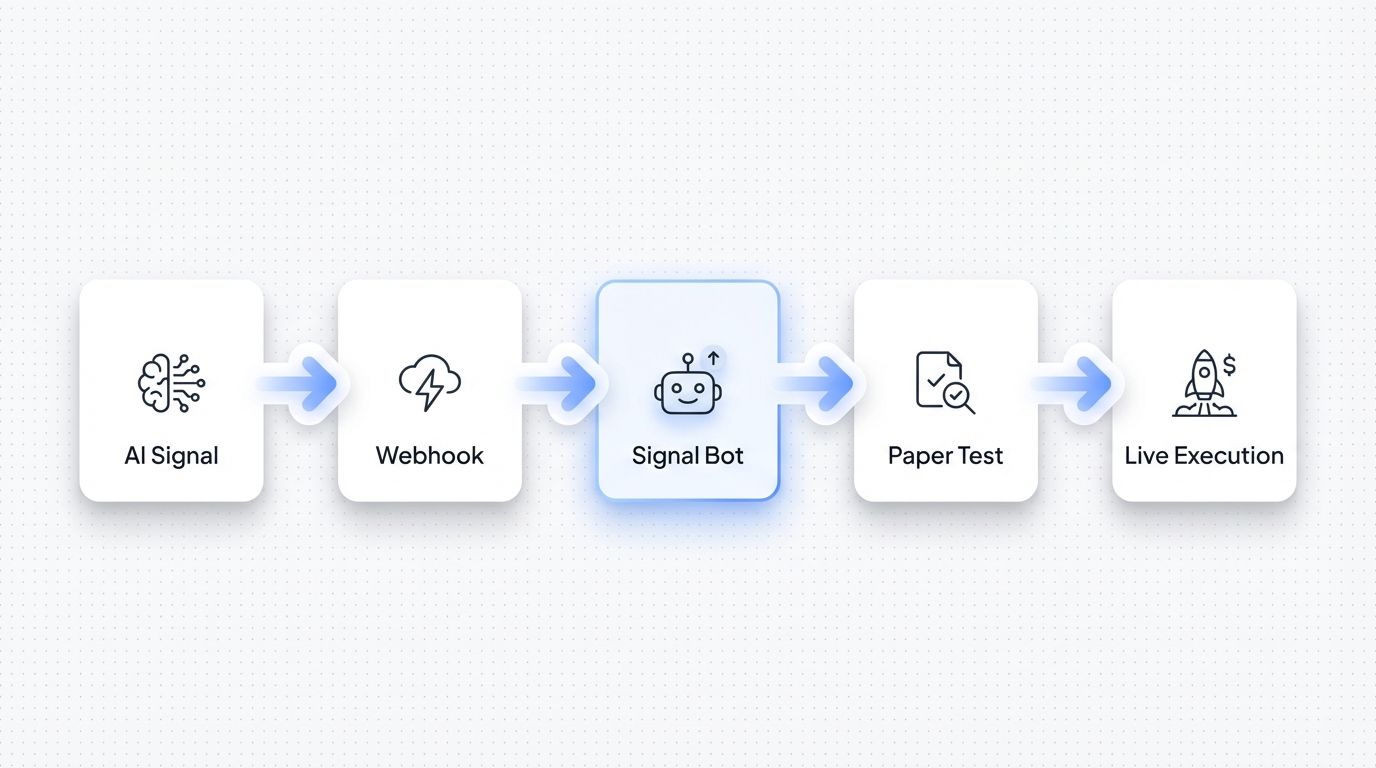
That structure is actually helpful because it forces discipline. Instead of creating a vague “all-in-one” bot, you define exactly which exchange account the bot belongs to and which quote currency it operates in. If you need multiple bots for different purposes, Altrady also supports multiple trading accounts on the same exchange, which makes it possible to keep experiments and live strategies separated more cleanly.
Where Altrady fits in an AI bot workflow
Altrady is not your model-training environment, and it should not be treated as one. Its role is more practical: once your signal logic exists, Altrady can serve as part of the execution and workflow layer. Its Signal Bot feature is designed to work with custom webhook signals, and its support materials describe how bots can be configured with webhook support, paper testing, and account-level settings.
This matters because execution stability is often the weakest part of DIY bot projects. A signal may be clever, but if it cannot be executed consistently, monitored clearly, or reviewed honestly, the project never becomes operational. A cleaner division of labor is usually better: let your AI generate the idea, let execution rules control the trade, and let a workflow tool help you test and review whether the system is worth trusting.
What makes an AI bot actually useful
A useful bot does not need to be dramatic. It only needs to improve one meaningful part of the process. That improvement could be better trade filtering, fewer low-quality setups, cleaner reaction speed, more consistent execution, or fewer emotional mistakes.
If the bot makes your process harder to explain, harder to test, or harder to review, then it is probably adding complexity instead of edge. A good AI crypto trading bot should make your decisions more measurable, not more mysterious. That is the standard that matters.
Common mistakes when building an AI crypto trading bot
The biggest mistake is overbuilding the intelligence layer while underbuilding the execution and review layers. Traders spend weeks thinking about models and almost no time thinking about slippage, kill-switches, paper testing, or whether their signal logic still makes sense after fees and latency.
Another common problem is trying to solve too many tasks at once. A system that predicts direction, sizes positions, filters volatility, adjusts exits, and reallocates capital may sound powerful, but it is usually too complicated to validate properly. The safer path is to make one useful thing work, then add complexity only after the baseline is stable.
A better build path for Swing Traders
Swing Traders, the strongest path is usually the boring one. Start with one narrow use case, build a simple non-AI version first, then add AI only where it clearly improves the process. Test it in paper mode, log what it does, and compare it to a simpler baseline.
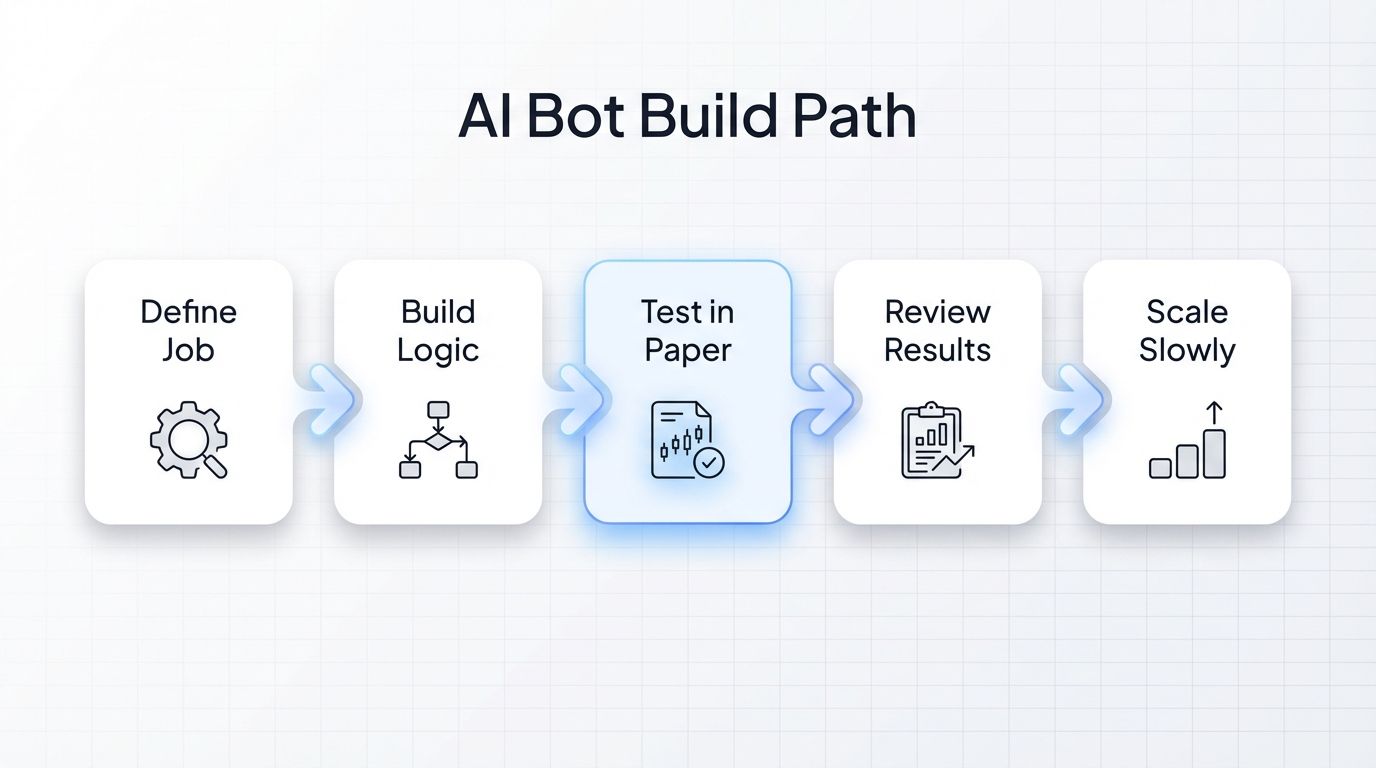
That kind of progression feels slower, but it is how useful systems are built. You are not trying to impress yourself with automation. You are trying to create a process that survives real conditions and can still be trusted after a bad week.
FAQ
Do you need machine learning to create an AI crypto trading bot?
Not always. Many useful AI trading bots are really structured automation systems where AI helps filter, rank, or classify setups rather than making every decision end to end. That kind of design is often easier to test and much easier to trust.
For many traders, that is actually the better starting point. If the AI clearly improves one part of the process, you can expand later. If it does not, you can remove it without breaking the whole workflow.
Can I connect an AI bot to Altrady?
Yes, indirectly. Altrady supports webhook-based Signal Bot workflows, so if your script or model can generate signals and send them in the expected format, Altrady can be used as part of the execution layer. Its support materials also show that paper accounts can be used for bot testing before going live.
The cleanest way to think about it is this: your AI produces the signal, and Altrady helps route that signal into a testable and reviewable execution workflow.
What is the safest way to start?
The safest way is to start with one narrow strategy, conservative position sizing, and paper testing before any live capital is used. A rules-first design with AI assistance is usually safer than jumping directly into full autonomous execution.
What matters most is not how advanced the model sounds. What matters is whether the system survives realistic conditions and whether you can still explain why it is taking trades.
Risk disclaimer
Trading is risky. Losses can happen quickly in volatile markets, and an AI crypto trading bot does not guarantee better entries, better exits, or profit. Swing Traders, use conservative sizing, hard risk limits, and paper testing before letting any bot touch live capital. Start a free trial on Altrady to test webhook-driven execution, set alerts, and track whether your bot improves real trading decisions.