
You are evaluating Pionex against Altrady because both promise crypto bot automation - but the architectural choice underneath these two platforms is so different that the comparison is less about which is better and more about which one matches how you want to trade. Pionex is an exchange that ships with built-in bots. Altrady is a multi-exchange aggregator and trading terminal that connects to exchanges via API and adds bots on top. Same surface goal, very different mechanics, very different tradeoffs.
This guide breaks down where each one wins, where each one falls short, and which type of trader benefits most from each setup. No pure marketing fluff, just a real comparison so you can pick the platform that matches how you actually trade.
The TL;DR: Exchange + Bots vs Multi-Exchange Aggregator
Pionex is a centralized crypto exchange with 16 plus built-in trading bots accessible directly from your account dashboard. You deposit funds into Pionex, pick a bot, configure it, and it runs against the liquidity available on Pionex itself. The whole experience is self-contained, simple to set up, and aimed at users who want automation without managing API keys or external platforms.
Altrady is a different beast. It does not hold your funds. Instead, it connects via API to 19 plus exchanges including Binance, Coinbase, Kraken, Bybit, KuCoin, OKX, Bitfinex, Crypto.com, and others, and gives you a unified manual trading terminal with integrated DCA, grid, and signal bots. Your funds stay on the exchanges where you originally deposited them. Altrady acts as the execution and management layer.
Each model has real strengths. Pionex wins on simplicity and fee structure for bot-only users. Altrady wins on liquidity reach, manual trading capability, and execution flexibility for users who span multiple exchanges. The right choice depends on whether you want a single-exchange bot platform or a multi-exchange terminal.
Architecture Difference: Single Exchange vs 19 Plus Exchanges
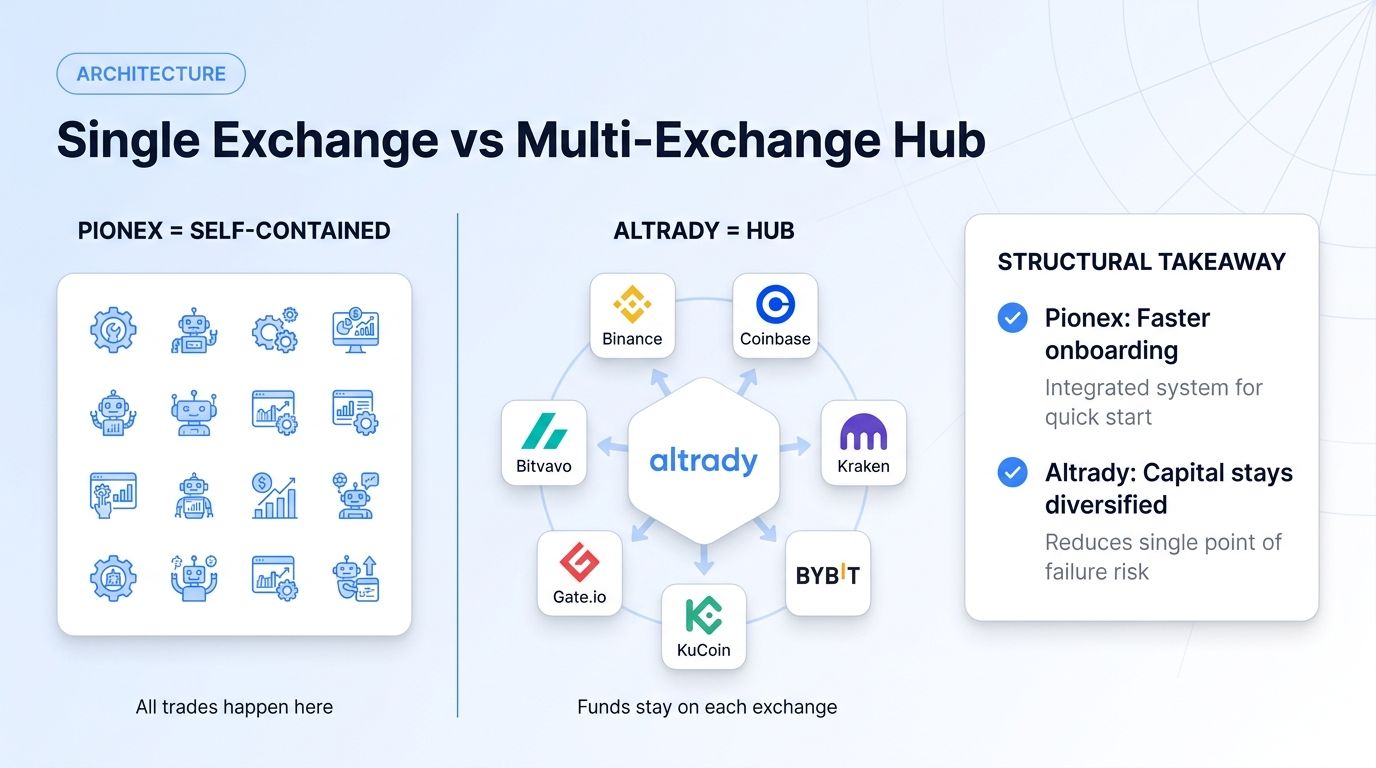
This is the most important difference and the one most traders underweight when they first compare. Pionex operates as a single exchange. Every trade your bot makes happens against Pionex's order book, with Pionex's liquidity, and at Pionex's prices. If a coin you want to trade is not listed on Pionex, you cannot trade it through the platform at all.
Altrady gives you access to whatever is listed on any of the 19 plus connected exchanges. If a hot altcoin is only listed on KuCoin, you connect KuCoin and trade it. If you want better fee tiers on Binance for high-volume pairs, you route through Binance. If a coin shows tighter spreads on Bybit during a specific session, you can choose Bybit. The aggregator model gives you the entire connected market as your trading surface.
There is a real tradeoff here. Pionex's single-exchange architecture means simpler operations. One account, one balance, one set of pairs. No API key management, no juggling between exchanges. For users who only want to run a few simple bots on major coins, this simplicity has value.
Altrady's multi-exchange architecture means more setup work upfront but more flexibility long-term. You manage API keys per exchange and make routing decisions per trade. In exchange, you get access to far more pairs, better price arbitrage opportunities, and the freedom to trade where execution is best at any given moment. For active traders, the aggregator model wins. For passive bot users who do not care which exchange the bot runs on, the single-exchange model is easier.
Bot Variety Compared
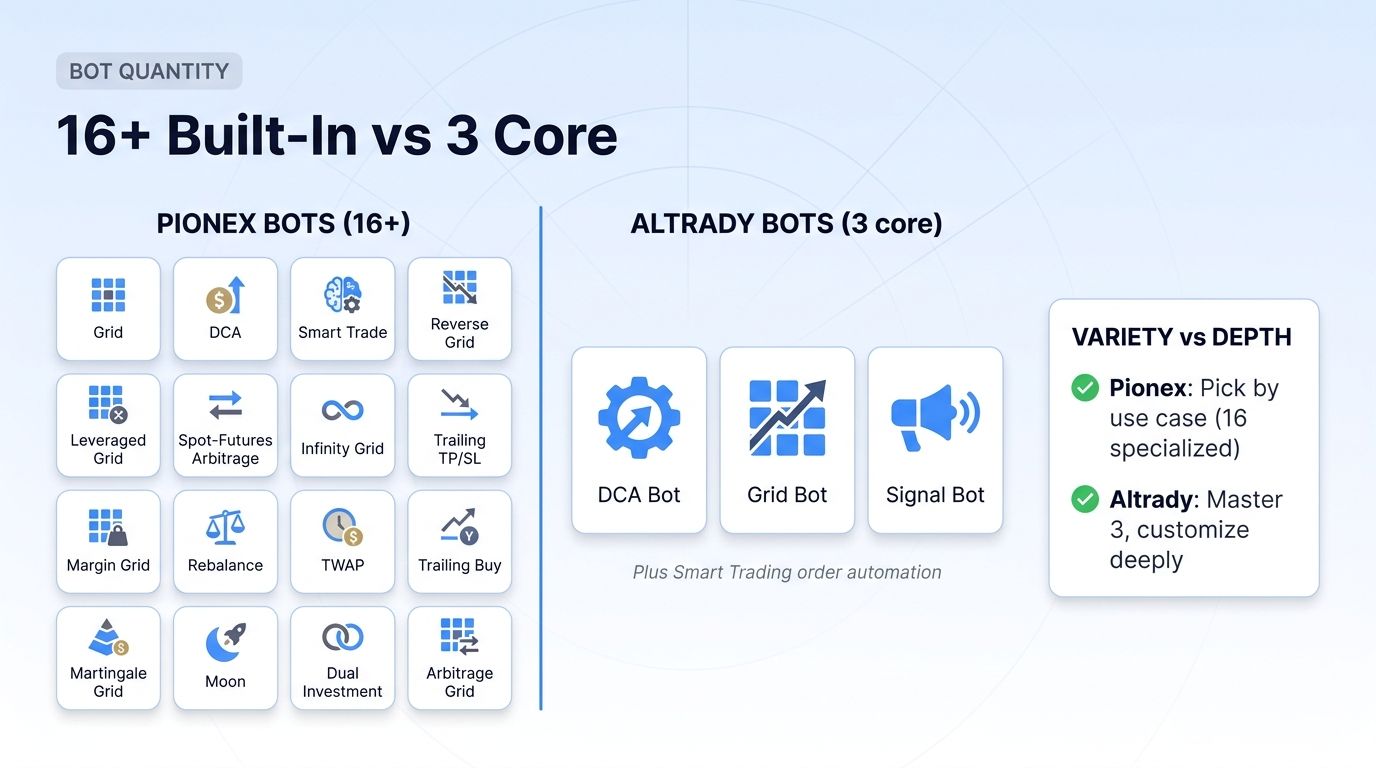
Pionex's bot library is broad. The 16 plus built-in bots include Spot Grid, Futures Grid, DCA Bot, Smart Trading, Reverse Grid, Infinity Grid, Margin Grid, Rebalancing Bot, Arbitrage Bot, Spot-Futures Arbitrage, Leveraged Grid, TWAP, Trailing Buy, Trailing Sell, and others. The variety covers most common automation use cases.
Altrady's bot lineup is smaller but tightly integrated with the manual terminal. The platform offers DCA bots with customizable order grids, deviation-based safety orders, and take-profit logic. Grid bots run buy-and-sell ladders within defined ranges. Signal bots execute trades based on TradingView alerts or other webhook sources.
Pionex wins on bot variety. If you want a leveraged grid, an infinity grid, or a specific arbitrage bot, Pionex has it built in. Altrady wins on integration depth. The DCA, grid, and signal bots are all tied into the same manual terminal you use for discretionary trading. You can intervene on a bot position with a manual stop, hand off a manual position to a bot, or adjust bot parameters mid-trade without leaving the workflow.
Liquidity and Execution: Where the Real Difference Shows
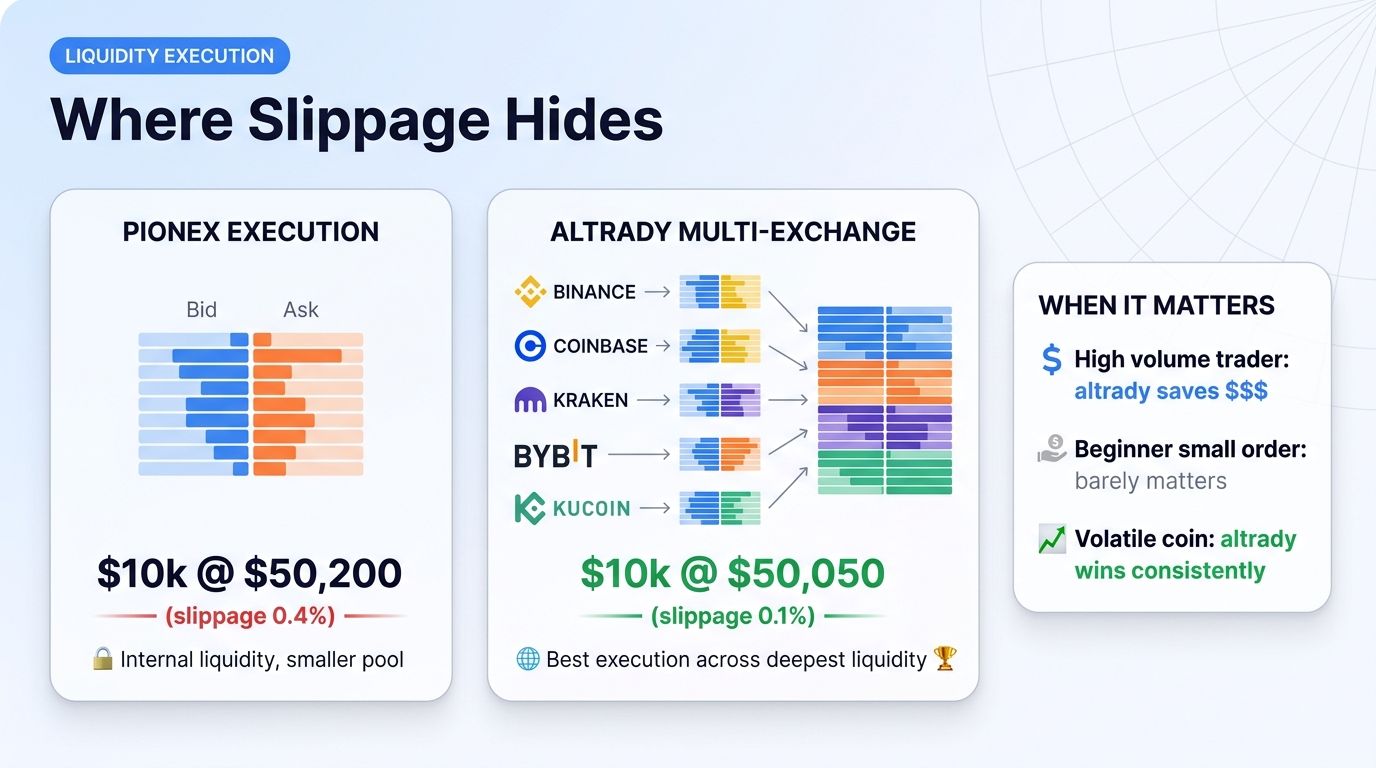
This is where the multi-exchange model gets a clear advantage. Pionex's liquidity is real but bounded by the exchange's own order book depth. For major pairs like BTC/USDT and ETH/USDT, the depth is usually fine for retail-sized trades. For smaller altcoins or larger position sizes, you can hit slippage that you would not see on Binance, Bybit, or other deeper venues.
Altrady routes orders directly to whichever connected exchange you choose. That means you tap into the deepest liquidity pool available for any given pair. For BTC, ETH, SOL, and other top-volume coins, that often means Binance, OKX, or Bybit with hundreds of millions in book depth. For specific altcoins, the deepest book might be on a different exchange. You have the choice.
This matters most for two trader profiles. Active traders moving size around will see real cost differences over thousands of trades because slippage on a single-exchange bot platform compounds. Traders chasing specific altcoins will find that Pionex simply does not list everything they want, while a multi-exchange aggregator covers a much wider universe.
It matters less for passive bot users running small DCA strategies on BTC. The execution difference for a 100 USDT weekly DCA is essentially negligible. The honest tradeoff is simplicity versus execution quality. Single-exchange platforms are simpler but may cost you on slippage at scale. Multi-exchange aggregators are more complex but give you better fills.
Fees and Costs
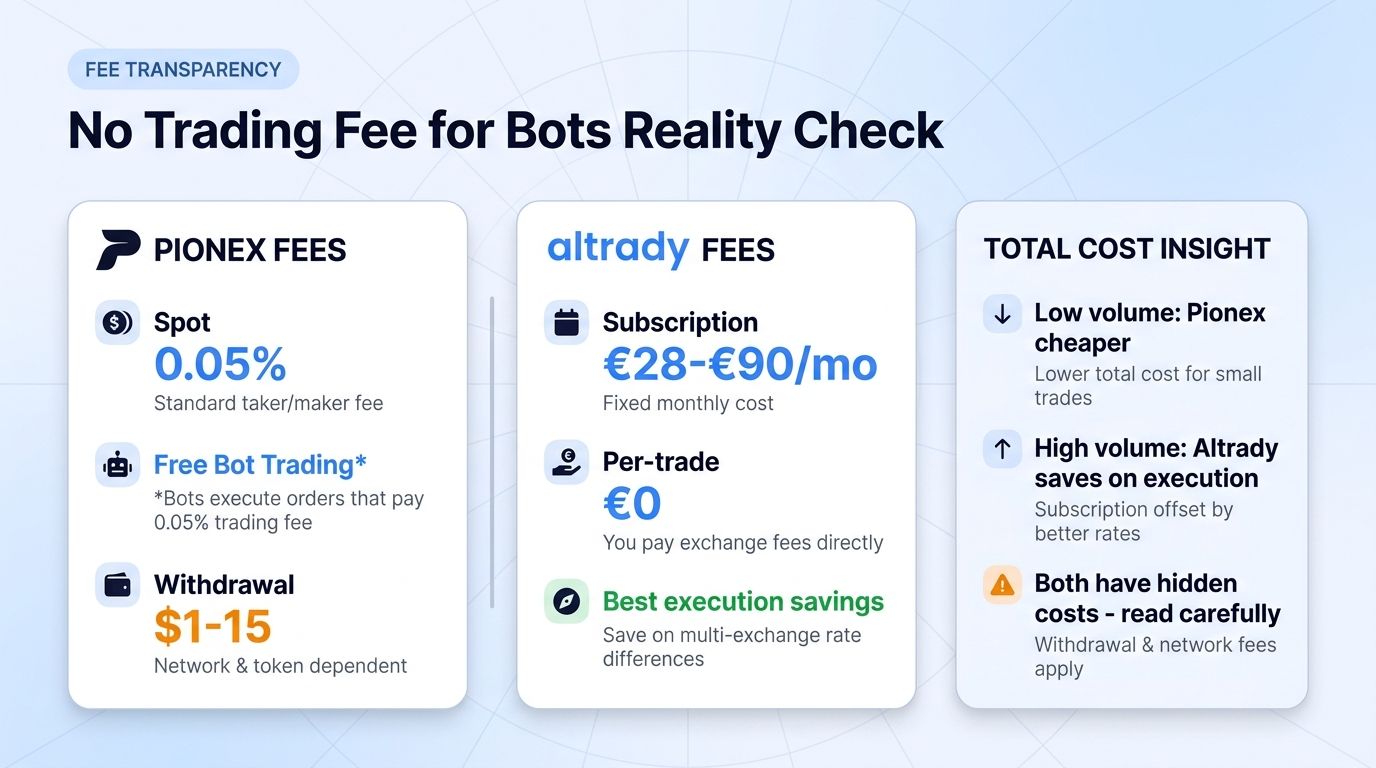
Pionex markets itself heavily on the no trading fee for bot trading message. The reality is more nuanced. Pionex charges 0.05 percent maker and taker fees on all trades including bot trades. The bots themselves are free to use, meaning Pionex does not charge a separate platform fee on top of the trading fee. This is genuinely competitive but not actually zero. Compare it to Binance at 0.1 percent default and falling to 0.075 percent or lower with BNB discounts and high volume tiers.
Altrady has a subscription model. You pay a monthly fee for the platform itself and you continue to pay the trading fees of whatever exchange you connect. Pricing in 2026 starts with a free Basic plan, then Essential at around 24.95 USD per month, Pro at around 39.95 USD per month, and Premium at around 59.95 USD per month with annual billing discounts.
The total cost picture depends on your trading volume. Low-volume users running a few small bots will likely pay less in total at Pionex because the absolute fee on small trades is tiny. High-volume users on Binance, Bybit, or KuCoin with maker rebates and VIP tiers may end up paying meaningfully less per dollar traded even after factoring in Altrady's subscription, because exchange fee tiers scale down sharply with volume. Run your actual numbers based on expected trade volume before deciding.
Charting, Risk Management, and Paper Trading
Charting on both platforms uses TradingView integration, so the actual chart experience is similar. The difference is in the layer wrapped around the chart. Pionex has functional charting with bot configuration alongside, but the trader-focused tooling is lighter. The platform is built for setting up bots, not for active discretionary trading.
Altrady's chart experience is built for active trading. The Smart Trading panel sits next to the chart, letting you preset entry, multiple take-profit targets, stop loss, and position size in one workflow before clicking buy. Trailing stops, break-even rules, and stop-loss cascading are built in. This depth of risk management is the platform's defining advantage and it does not really exist in equivalent form on Pionex.
Position sizing tools are stronger on Altrady. The platform includes a dedicated calculator that respects account risk rules, leverage settings, and stop loss distance, automatically computing the right position size for your defined risk per trade. Pionex offers basic sizing inside its bot configuration but does not emphasize manual risk math the way Altrady does because manual trading is not the primary use case.
Paper trading exists on Altrady as a full simulated environment using real market data across connected exchanges. You can test manual strategies, bot configurations, or hybrid setups without risking capital. Pionex does not offer a dedicated paper trading mode in the same way. Some bots have backtesting features, but a true risk-free practice environment for both manual and bot trading is more developed on Altrady.
For traders who care about risk management and practice infrastructure before going live, Altrady has a clear edge.
Who Should Use Which
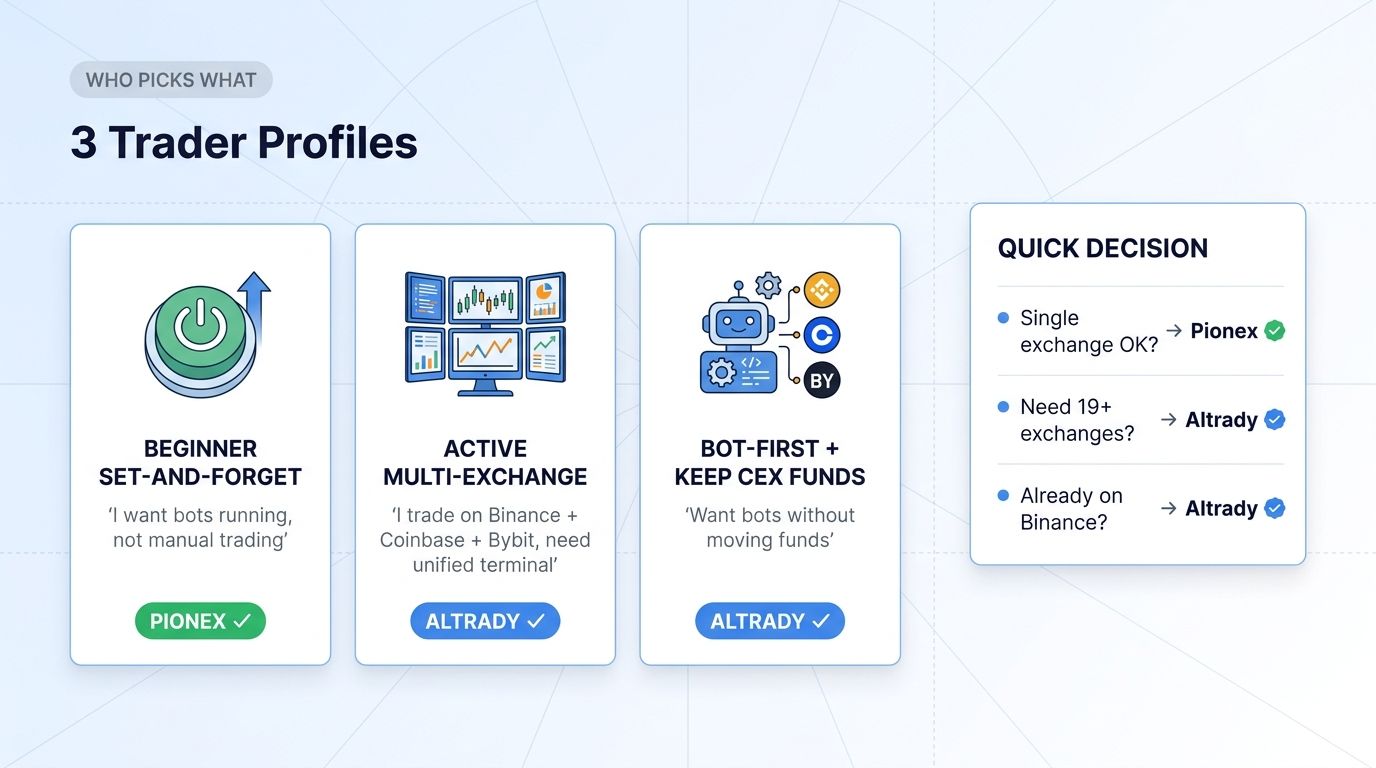
The passive bot user. If you want a few simple bots like Spot Grid or DCA running on BTC and ETH, you do not care which exchange the bot runs on, and you value setup simplicity above all else, Pionex is hard to beat. The bot variety is real, the fee structure for casual users is fair, and there is no API key management to deal with.
The active multi-exchange trader. If you trade across multiple exchanges, watch charts during sessions, take discretionary entries, manage risk per position, and want bots integrated into a manual terminal rather than living in their own silo, Altrady is the much better fit. The aggregator model unlocks liquidity and pair selection that single-exchange platforms cannot match.
The hybrid trader. If you want both manual and automated trading from one platform with deep integration between the two, want exposure to coins listed across many exchanges, and value risk management tools that match how professional traders think, Altrady is the more cohesive choice. Pionex's manual trading capability exists but is not its strength.
A reasonable test is to compare your weekly trading patterns against the limits of each platform. If you find yourself wanting coins not listed on Pionex, hitting slippage on size, or wishing you had more risk control on manual trades, you have outgrown the single-exchange model.
FAQ
Can I run Pionex bots and Altrady bots on the same exchange at the same time?
Yes, but only on exchanges that Altrady connects to via API. Pionex itself is not one of Altrady's connected exchanges, so the question is more about running Altrady on Binance or Bybit while also running Pionex separately. This works fine since they are independent accounts. Just be aware of capital allocation across the two platforms.
Are Pionex bots really fee-free?
Not literally. Pionex charges 0.05 percent maker and taker fees on bot trades. The platform is fee-free in the sense that there is no extra subscription or platform fee on top of trading fees, but the exchange-level fee still applies. Always factor in the 0.05 percent when calculating bot profitability, especially for high-frequency strategies.
Which platform is safer for holding funds?
This is an important question. Pionex holds your funds directly because it is an exchange. You are exposed to exchange risk if anything happens to the platform. Altrady never holds your funds. Your assets stay on whichever exchange you connect via API, and Altrady only requires trading permissions, not withdrawal permissions. From a custody risk standpoint, Altrady's model has structural advantages because you choose which exchange holds your assets.
Do I need different skill levels for each platform?
Pionex is easier for beginners because the bot setup is largely template-driven and there is no API key management. Altrady has a steeper initial learning curve because of the manual terminal depth, multi-exchange API setup, and broader feature set. Active traders quickly grow into Altrady's depth. Pure passive bot users may find Pionex more accessible long-term.
Can I trade futures on both?
Yes, both platforms support futures trading. Pionex offers Futures Grid, Leveraged Grid, and other derivatives bots directly on its perpetual contracts. Altrady supports futures and perpetuals on connected exchanges that offer derivatives, including Bybit, Binance Futures, OKX, and others. Manual derivatives trading is more developed on Altrady. Bot-based derivatives strategies are more developed on Pionex.
Final Thoughts
Pionex and Altrady solve different problems. Pionex is an exchange-with-bots aimed at users who want automation in a self-contained environment with a single account. Altrady is a multi-exchange aggregator aimed at active traders who want unified execution and risk management across the broader market.
If you trade actively, want access to coins across multiple exchanges, value tight risk management baked into your manual workflow, and want bots integrated into a real trading terminal rather than living in a separate silo, Altrady is the natural fit. The 19 plus exchange coverage, Smart Trading panel, position sizing tools, and paper trading environment are designed exactly for this kind of trader.
Start with the Altrady free trial, test the multi-exchange workflow against how you actually trade, and use paper trading to validate setups before risking real capital. The aggregator model takes a few days to learn, but once it clicks, going back to a single-exchange bot platform feels like trading with one hand tied behind your back.