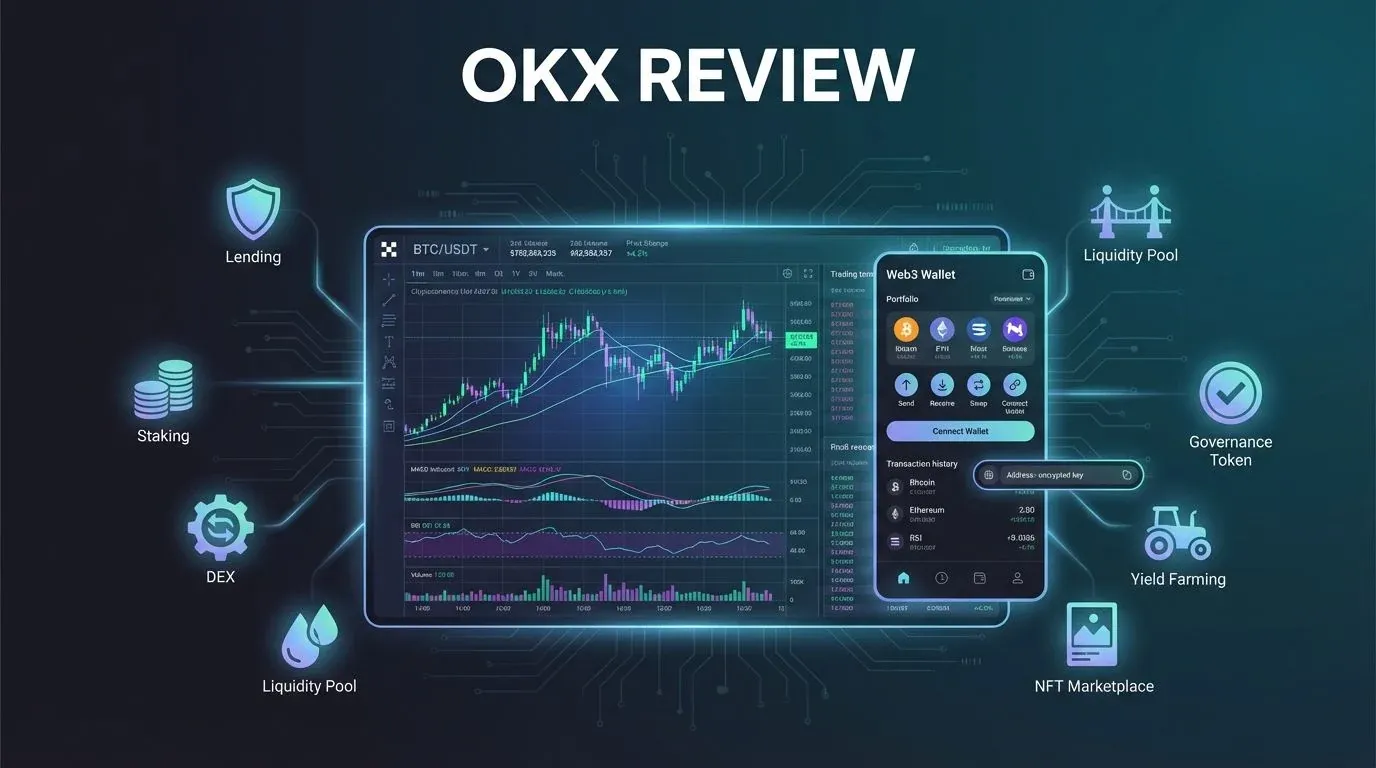

What Is OKX?
OKX, formerly known as OKEx, is one of the world's largest cryptocurrency exchanges by daily trading volume. Founded in 2017 by Star Xu, the platform is headquartered in Seychelles and has grown to serve more than 50 million users across 180+ countries. OKX has consistently ranked among the top five exchanges globally, processing billions of dollars in daily transactions.
What sets OKX apart from many competitors is its comprehensive approach to crypto services. The exchange offers not only traditional spot and derivatives trading but also a fully integrated Web3 wallet, DeFi access, an NFT marketplace, and a suite of passive income tools. This breadth of features has helped OKX attract both retail traders and institutional participants.
In this OKX review, we break down the platform's core features, fee structure, security practices, and overall value proposition so you can decide whether OKX fits your trading needs in 2026.
Key Features of OKX
OKX has evolved well beyond a simple exchange. Its product ecosystem now spans active trading, decentralized finance, passive earning, and automated strategies. Here is a closer look at the main features.
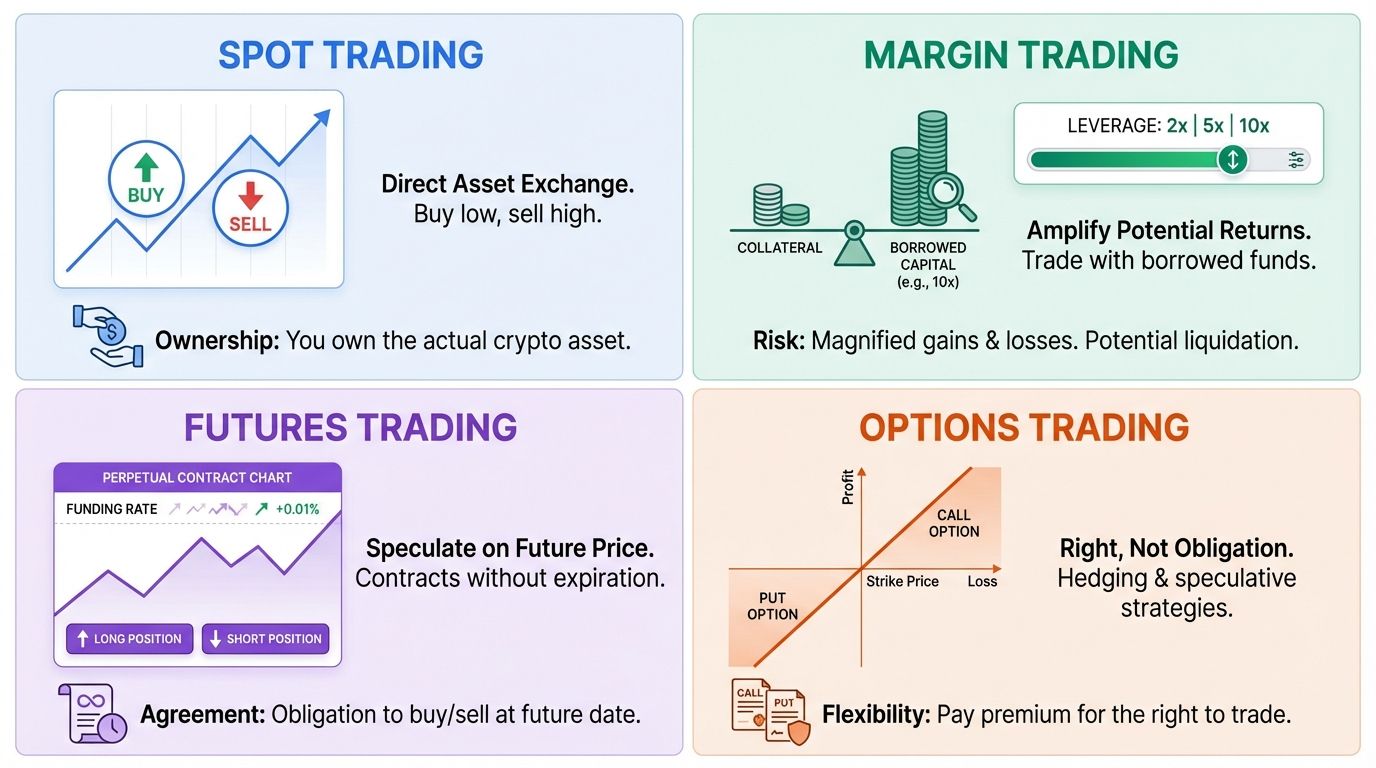 OKX offers a comprehensive suite of trading features including spot, margin, and futures markets
Spot, Margin, and Futures Trading
OKX supports an extensive range of trading products. The spot market offers access to 300+ trading pairs, covering major cryptocurrencies like Bitcoin and Ethereum alongside a deep selection of altcoins and emerging tokens.
For traders looking to amplify their positions, margin trading is available with adjustable leverage. The futures and perpetual swap markets are where OKX truly shines, offering leverage up to 125x on select contracts. This makes OKX a popular choice among derivatives traders who need flexible position sizing and deep liquidity.
Advanced order types are well supported. Traders can use limit orders, market orders, stop-loss and take-profit orders, trailing stops, and iceberg orders. The trading interface itself is customizable, with TradingView charts built in, multiple layout options, and real-time order book data.
OKX also offers options trading on BTC and ETH, a feature that remains relatively rare among centralized exchanges. This gives sophisticated traders additional instruments for hedging and speculative strategies.
OKX Web3 Wallet
The OKX Web3 Wallet is one of the most feature-rich non-custodial wallets available today. It supports over 80 blockchain networks, giving users direct access to decentralized applications (dApps) across the entire crypto ecosystem.
Key capabilities of the OKX Web3 Wallet include:
- DEX Aggregator: Routes trades across multiple decentralized exchanges to find the best price and lowest slippage. It aggregates liquidity from platforms like Uniswap, SushiSwap, Curve, and dozens more.
- Cross-Chain Swaps: Enables token swaps between different blockchains without requiring users to manually bridge assets. This simplifies multi-chain portfolio management significantly.
- NFT Marketplace: A built-in marketplace for buying, selling, and minting NFTs across Ethereum, Polygon, Solana, and other supported chains.
- dApp Discovery: A curated browser for exploring DeFi protocols, GameFi platforms, and other Web3 applications directly from the wallet interface.
The wallet uses multi-party computation (MPC) technology for key management, meaning users retain full control of their assets without needing to manage a traditional seed phrase. This approach balances security with usability.
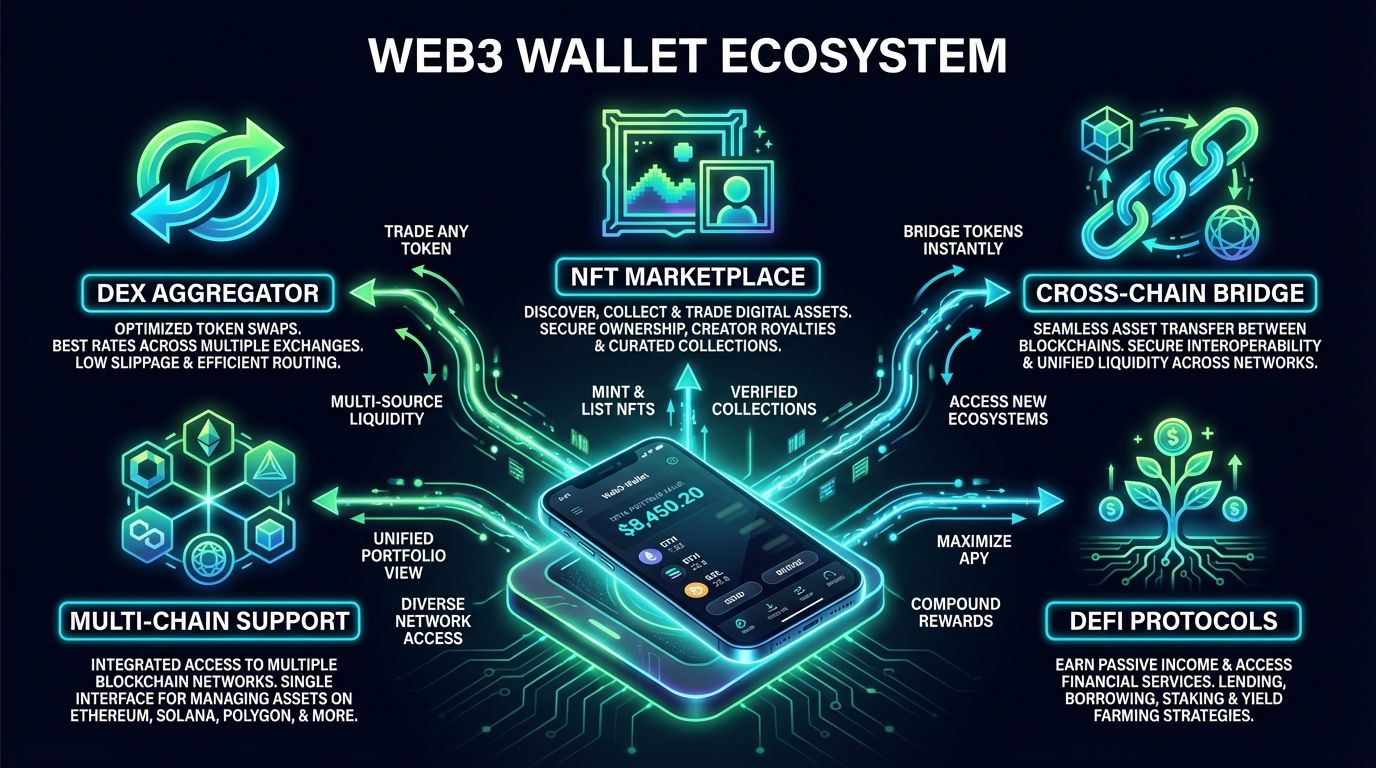 The OKX Web3 Wallet provides a comprehensive gateway to decentralized finance
Trading Bots
OKX provides several automated trading strategies that users can configure without coding knowledge. These bots run on OKX's infrastructure, so they operate 24/7 without requiring a separate server or constant monitoring.
Available trading bots include:
- Grid Bot: Automatically places buy and sell orders at preset intervals within a defined price range. Grid bots are ideal for ranging markets where price oscillates within a band.
- DCA (Dollar-Cost Averaging) Bot: Executes recurring purchases at fixed intervals, helping users accumulate positions over time and reduce the impact of short-term volatility.
- Smart Portfolio: A rebalancing bot that maintains target allocation percentages across a basket of chosen assets. When prices shift, the bot automatically buys underweight assets and sells overweight ones.
- Arbitrage Bot: Designed to capture price differences between spot and futures markets. The bot simultaneously takes long and short positions to lock in a funding rate or basis spread.
While these bots provide a convenient starting point, traders managing strategies across multiple exchanges will quickly find that exchange-native bots are limited to that single platform's markets.
OKX Earn
For users who prefer passive income over active trading, OKX Earn offers a range of yield-generating products:
- Simple Earn (Savings): Flexible and fixed-term deposits that generate interest on idle crypto holdings. Flexible deposits can be withdrawn at any time, while fixed terms offer higher APY rates.
- Staking: On-chain staking for proof-of-stake assets like ETH, SOL, DOT, and ATOM. OKX handles the technical requirements while users earn staking rewards.
- Lending: Users can lend their crypto to margin traders on the platform and earn interest based on market demand for borrowed funds.
- Structured Products: More advanced offerings such as dual investment, Shark Fin, and Snowball products. These structured products offer potentially higher returns but come with specific conditions regarding market direction and price thresholds.
APY rates vary by asset and product type. OKX displays estimated returns clearly, though actual yields depend on market conditions and may fluctuate.
OKX Fee Structure
Fees are a critical factor in any OKX exchange review. Fortunately, OKX maintains a competitive fee schedule that rewards active traders through its tiered VIP program.
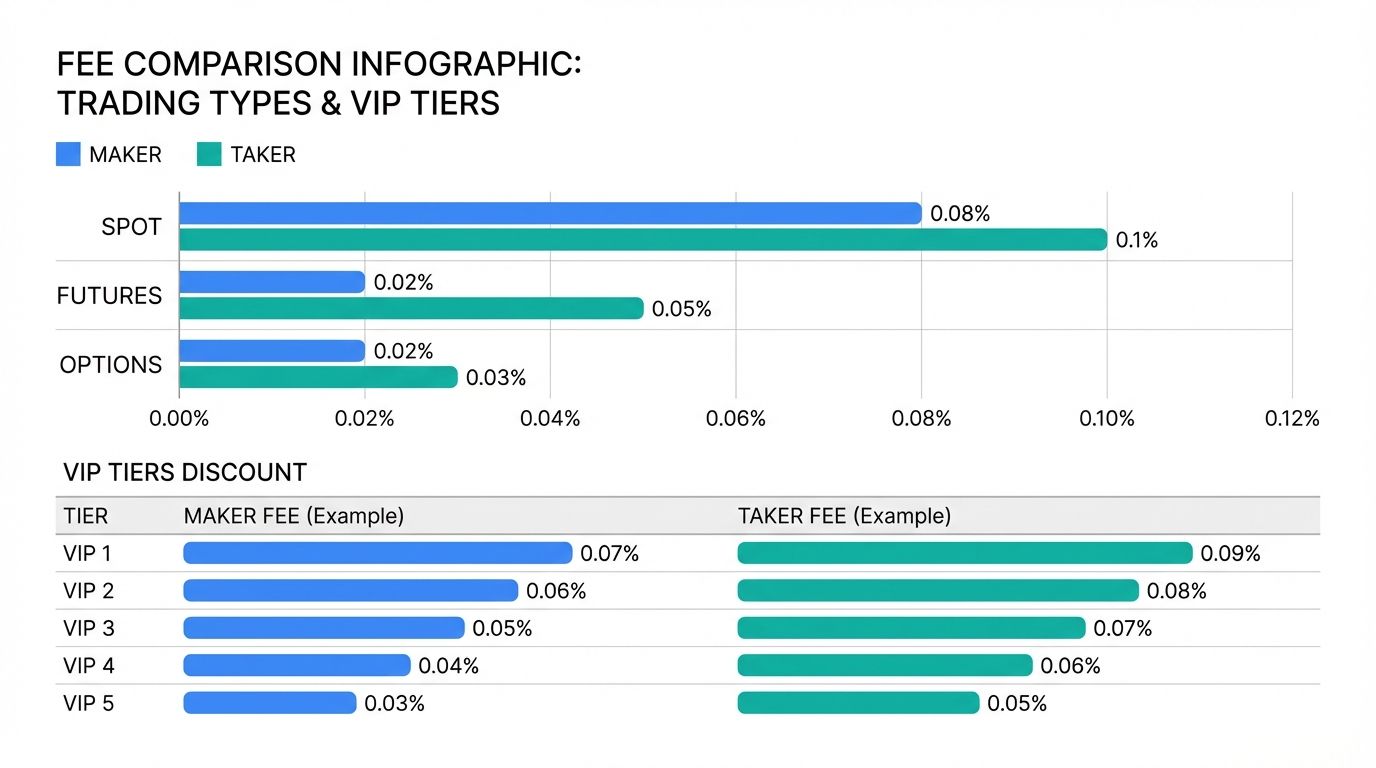 OKX offers competitive trading fees with additional discounts through its VIP tier system
Trading Fees
OKX uses a maker-taker fee model across all its markets. Standard (non-VIP) rates are:
| Market | Maker Fee | Taker Fee |
|---|---|---|
| Spot | 0.08% | 0.10% |
| Futures | 0.02% | 0.05% |
| Options | 0.02% | 0.03% |
These base rates are already competitive compared to most major exchanges. However, the real savings come through OKX's VIP tier system. There are eight VIP levels, determined by your 30-day trading volume or OKB (OKX's native token) holdings.
At the highest VIP tiers, maker fees drop to as low as -0.005% on spot (meaning you actually earn a rebate for providing liquidity) and -0.01% on futures. Taker fees at top tiers fall to 0.02% for spot and 0.015% for futures.
Holding OKB tokens also provides a 25% discount on trading fees when used for fee payment, making it worthwhile for regular traders to maintain an OKB balance.
Deposit and Withdrawal Fees
OKX does not charge fees for depositing cryptocurrency. You only pay the network transaction fee when sending crypto from an external wallet to your OKX account, and that cost is borne by the sending wallet.
Withdrawal fees vary by asset and network. OKX sets these fees based on current network congestion and transaction costs. For example, a Bitcoin withdrawal costs approximately 0.0001 BTC, while an Ethereum withdrawal costs around 0.0005 ETH. Withdrawing on layer-2 networks or alternative chains (such as Arbitrum, Polygon, or Tron for USDT) is significantly cheaper.
Fiat deposits and withdrawals are available in select regions through bank transfers and third-party payment processors. Fees for these services depend on the payment method and region.
Security and Compliance
Security is paramount when choosing an exchange, and this section of our OKX review covers the platform's approach to protecting user funds and data.
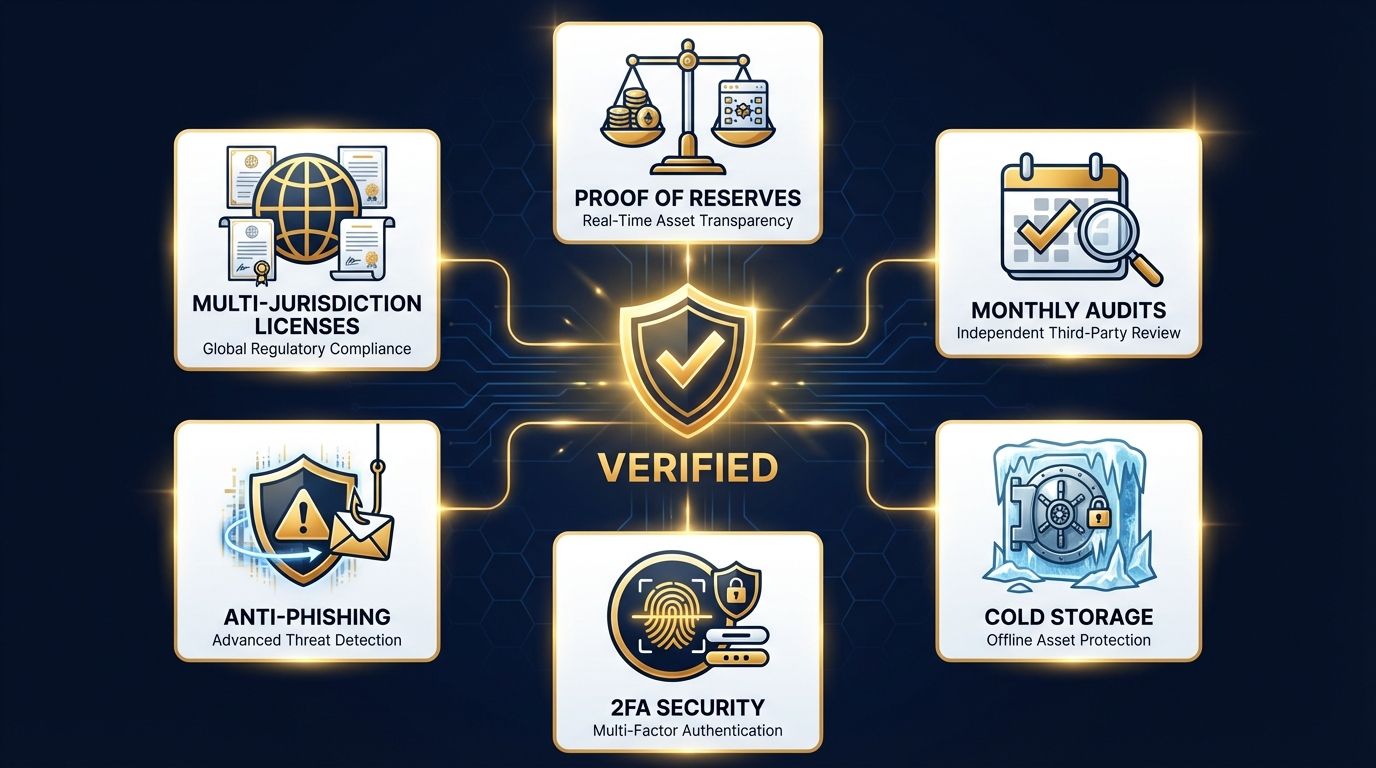 OKX maintains robust security measures and holds regulatory licenses across multiple jurisdictions
Proof of Reserves (PoR): OKX publishes monthly Proof of Reserves reports verified by third-party auditors. These reports confirm that OKX holds reserves exceeding 100% of all user deposits for major assets including BTC, ETH, and USDT. Users can independently verify their account's inclusion in the Merkle tree through OKX's self-verification tool.
Cold Storage: The vast majority of user funds are stored in offline, air-gapped cold wallets. Only a small percentage of assets remain in hot wallets to facilitate daily withdrawals and trading operations.
Account Security Features:
- Two-factor authentication (2FA) via Google Authenticator or SMS
- Anti-phishing codes that appear in all official OKX emails, helping users identify genuine communications
- Withdrawal address whitelisting to prevent unauthorized fund transfers
- Login notifications and device management
- Passkey support for passwordless authentication
Regulatory Compliance: OKX has actively pursued regulatory licenses across multiple jurisdictions. The exchange holds licenses or registrations in Dubai (VARA), the European Union (under MiCA), Hong Kong, Australia, and several other regions. This growing regulatory footprint reflects OKX's commitment to operating within legal frameworks, though the platform is notably restricted in the United States and certain other jurisdictions.
Insurance and Risk Management: OKX maintains a risk reserve fund to cover potential losses from extreme market events. The exchange also employs real-time monitoring systems to detect suspicious activity, market manipulation, and unauthorized access attempts.
OKX Pros and Cons
Pros:
- Very competitive trading fees, especially at higher VIP tiers
- Extensive derivatives market with up to 125x leverage and options trading
- Feature-rich Web3 wallet with DEX aggregation and cross-chain swaps
- Monthly Proof of Reserves adds transparency and trust
- Built-in trading bots require no coding or external setup
- Wide selection of earn products for passive income
- Strong liquidity across major and altcoin markets
- Regulatory licenses in multiple jurisdictions
Cons:
- Not available to users in the United States
- The sheer number of features can overwhelm beginners
- Customer support response times can be slow during peak periods
- Some advanced products (structured earn, options) carry significant risk that may not be fully understood by newer traders
- Withdrawal limits apply until full identity verification (KYC) is completed
- OKB token discount structure adds complexity to fee calculations
Why Traders Use Multi-Exchange Platforms Instead
While OKX is a strong exchange on its own, experienced traders rarely limit themselves to a single platform. Relying exclusively on one exchange introduces several risks and limitations.
Single point of failure: If OKX experiences downtime, a security incident, or a regulatory change affecting your region, your entire trading operation is disrupted. Spreading activity across multiple exchanges provides redundancy.
Price discrepancies: Crypto prices can vary between exchanges, sometimes significantly during volatile periods. Traders who monitor multiple exchanges can take advantage of better prices, tighter spreads, and deeper liquidity pools.
Feature gaps: No single exchange excels at everything. You might prefer OKX for derivatives but find another platform better for certain altcoin listings or fiat on-ramps. Multi-exchange access lets you use the best tool for each job.
Portfolio fragmentation: Managing positions, orders, and balances across several exchanges becomes chaotic without a unified interface. Logging into multiple platforms, tracking P&L separately, and reacting to market moves across fragmented dashboards slows you down when speed matters most.
This is precisely why multi-exchange trading platforms have become essential tools for serious traders. Rather than juggling browser tabs and apps, a unified dashboard lets you monitor, execute, and manage everything from one place.
Elevate Your Trading with Altrady
If this OKX review has highlighted features you want to use alongside other exchanges, Altrady is the platform that brings it all together. Altrady connects to 19+ major exchanges, including OKX, letting you trade, track, and manage your entire crypto portfolio from a single, powerful dashboard.
With Altrady, you get:
- Unified Portfolio Tracking: See all your holdings across OKX and every other connected exchange in one consolidated view. No more logging into multiple platforms to check your balances.
- Smart Orders: Execute advanced order types like ladder orders, take-profit chains, and trailing stops that work across any connected exchange. Place orders on OKX and Binance side by side without switching tabs.
- Real-Time Alerts: Set custom price alerts, volume alerts, and portfolio threshold notifications so you never miss a trading opportunity, regardless of which exchange the action is on.
- Multi-Exchange Execution: Compare prices across all your connected exchanges and execute where conditions are most favorable. React to market moves instantly instead of manually checking each platform.
- Break-Even Calculator and Analytics: Track your true cost basis and performance metrics across all positions and all exchanges in real time.
Whether you are a day trader managing leveraged positions on OKX, a swing trader diversifying across platforms, or a long-term holder earning yield on multiple exchanges, Altrady streamlines your workflow and reduces the risk of operating in silos.
Start your free trial today and experience what it means to trade smarter across every exchange you use.
Frequently Asked Questions
Is OKX safe and legitimate?
Yes, OKX is widely regarded as a safe and legitimate cryptocurrency exchange. It has been operating since 2017 and serves over 50 million users globally. OKX publishes monthly Proof of Reserves reports verified by independent auditors, confirming that user deposits are fully backed. The platform employs industry-standard security measures including cold storage for the majority of funds, two-factor authentication, anti-phishing codes, and withdrawal whitelisting. Additionally, OKX holds regulatory licenses in jurisdictions such as Dubai (VARA), the European Union, Hong Kong, and Australia. While no exchange is entirely risk-free, OKX has established a strong track record of security and regulatory compliance.
Is OKX available in the United States?
No, OKX does not serve users in the United States. The exchange withdrew from the U.S. market due to the complex and evolving regulatory environment for cryptocurrency platforms in the country. American residents are blocked from creating accounts or accessing OKX's trading services. U.S.-based traders should look at domestically licensed alternatives or consider using a multi-exchange platform like Altrady that connects to exchanges available in their region.
What are OKX's trading fees?
OKX uses a maker-taker fee model with competitive base rates. For spot trading, the standard fees are 0.08% for makers and 0.10% for takers. Futures trading fees start at 0.02% for makers and 0.05% for takers. These rates decrease as you move up through OKX's VIP tier system, which is based on your 30-day trading volume or OKB token holdings. At the highest tiers, makers can actually receive rebates (negative fees). Holding OKB and using it to pay fees provides an additional 25% discount. There are no fees for depositing cryptocurrency, while withdrawal fees vary depending on the asset and blockchain network used.
How does OKX compare to Binance?
OKX and Binance are both top-tier exchanges with deep liquidity and extensive feature sets. OKX offers competitive futures fees and a more advanced Web3 wallet experience, while Binance has larger overall trading volume and more listed tokens. Both exchanges offer trading bots, earn products, and derivatives markets. The best choice depends on your specific needs and geographic availability. Many active traders use both simultaneously with a tool like Altrady to manage positions from one dashboard.
Does OKX require KYC verification?
Yes, OKX requires identity verification (KYC) for most services. Level 1 requires a government-issued ID and unlocks trading with daily withdrawal limits. Level 2 requires additional documentation and increases those limits. Level 3 is required for fiat services and the highest withdrawal thresholds. The KYC process is typically completed within minutes using automated verification.
2026 Update: What to Check Before You Act
OKX is best evaluated by matching its features to your trading workflow: spot, derivatives, bots, Web3 access, fiat, or multi-exchange portfolio management.
| Check | What to review | Why it matters |
|---|---|---|
| Market access | Review supported assets, derivatives availability, regional restrictions, and fiat rails. | Availability can differ by jurisdiction and product type. |
| Trading cost | Compare spot and derivatives fees, spreads, funding, and withdrawal costs. | Actual cost depends on execution quality, not only the fee table. |
| Risk controls | Check proof-of-reserves, account security, withdrawal controls, and API permissions. | Exchange reviews should include operational safety, not only features. |
Quick trader checklist
- Confirm the current OKX product availability in your region.
- Use restricted API keys if connecting third-party tools.
- Compare OKX with other venues for the pairs you actually trade.
FAQ
Is OKX suitable for active crypto traders?
OKX can suit active traders who need broad market access and advanced tools, but users should verify regional availability, fees, liquidity, and account-security controls before using it as a primary venue.