
AI is no longer a buzzword in crypto trading - it is a working tool. From pattern-recognition systems that scan thousands of pairs in seconds to sentiment models that quantify Twitter mood, machine learning is changing how active traders make decisions in 2026. Done well, AI extends the human trader. Done badly, it produces overconfident black-box signals that blow up accounts. This guide covers what AI actually does in crypto trading right now, the four highest-leverage use cases, the human strengths AI cannot replace, and the pitfalls that separate sustainable AI workflows from expensive experiments.
What "AI-Powered" Actually Means in Crypto Trading
The phrase "AI-powered crypto trading" gets used loosely. Some platforms market basic technical-indicator alerts as AI; others deploy genuine machine-learning models trained on millions of price points. Understanding the spectrum matters because the marketing word means very different things across products.
Real AI in crypto trading does three core jobs:
- Pattern recognition at scale. Scanning hundreds of pairs simultaneously to identify setups (breakouts, divergences, candlestick patterns) faster than any human can.
- Statistical modeling. Quantifying probability of price moves based on historical patterns and current market regime.
- Decision support. Producing buy/sell/hold signals with confidence scores that let the trader prioritize attention.
What AI does not do well in 2026: predict the unpredictable (regime changes, geopolitical shocks, narrative shifts), or replace the trader's judgment about when to step away from the market entirely. AI is a force-multiplier for traders with sound process. It is not an autopilot.
How AI Processes Market Data Into Decisions
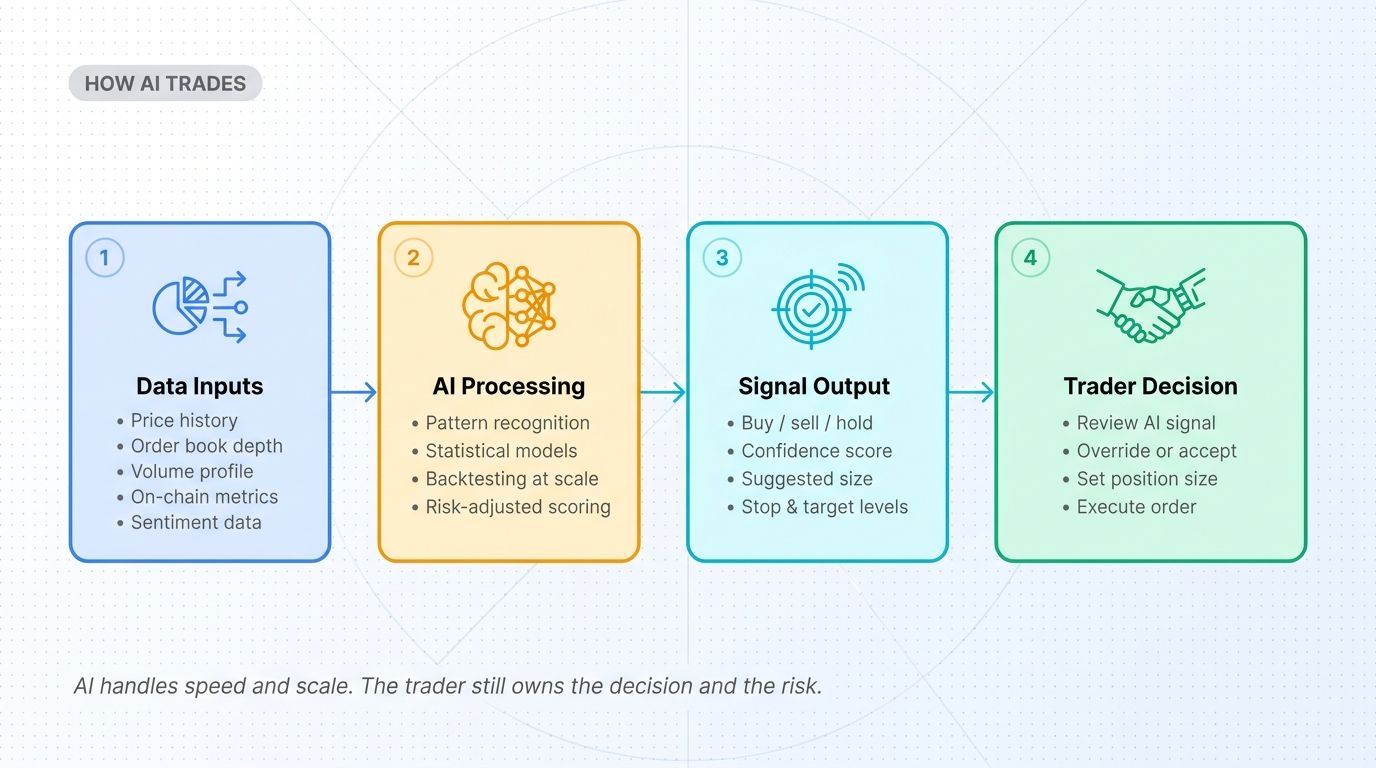
The pipeline from raw data to trader decision typically has four stages:
- Data Inputs: price history, order book depth, volume profile, on-chain metrics (wallet flows, exchange inflows, mining hashrate), sentiment data (Twitter, Reddit, news headlines).
- AI Processing: the model runs pattern recognition, statistical scoring, and (in advanced systems) cross-market correlation analysis. Backtesting at industrial scale validates which patterns historically produced positive expectancy.
- Signal Output: buy/sell/hold action with a confidence score (e.g., 0-100), suggested position size based on volatility, and stop/target levels derived from the pattern.
- Trader Decision: the human reviews the AI signal, decides whether to accept or override based on context the AI cannot see, sets final position size, and executes.
The "trader decision" stage is the difference between AI as decision-support and AI as autopilot. Sustainable AI workflows keep the human in the loop for the final risk-taking decision. Auto-execution systems (often marketed as "AI bots") remove the human - which works great when the model is correct and catastrophic when the regime shifts.
The Four AI Use Cases That Actually Produce Edge
1. Pattern Recognition
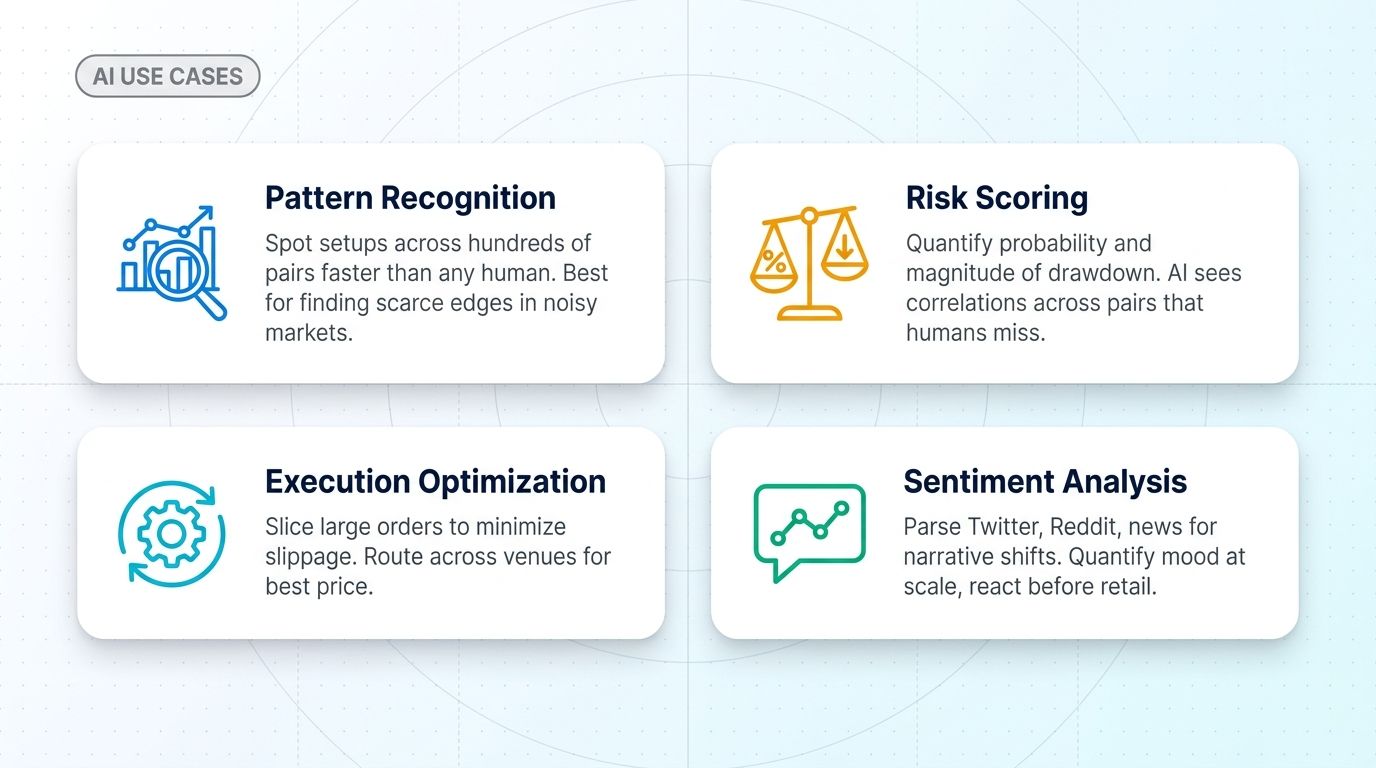
The clearest AI win is multi-pair pattern scanning. Note this is AI as a trader's assistant - separate from the broader autonomous AI crypto category where AI agents operate on-chain without continuous human input. A human trader can scan 5-10 charts deeply per session. An AI scanner can process 500+ pairs in seconds and surface only the ones with high-conviction setups. The trader's attention shifts from finding patterns to evaluating them.
Modern AI scanners detect breakouts, divergences, candlestick patterns (Hammer, Hanging Man, Engulfing), Donchian channel breaks, and chart patterns (Head and Shoulders, triangles, wedges). Confidence scores let traders ignore weak setups and focus on the top 3-5 each session.
2. Risk Scoring
AI quantifies probability of drawdown by analyzing correlations across markets. If BTC, ETH, and SOL all show similar exhaustion patterns simultaneously, the systemic risk is much higher than any one chart suggests. AI models capture these cross-market signals that human traders often miss because they only watch one or two charts at a time.
Output: a portfolio-level risk score that adjusts position sizing dynamically. Higher correlation = smaller positions. Independent setups = larger positions. The math protects from concentration mistakes.
3. Execution Optimization
For traders entering large positions, AI execution algos slice orders across time and venues to minimize slippage. The model learns each market's typical liquidity profile and routes order flow accordingly. Result: better fills on volatile coins, especially during high-volume regimes.
Retail traders rarely need this directly, but multi-exchange terminals (like Altrady) increasingly offer smart-routing as a feature - the platform AI handles the execution mechanics while the trader handles the decision.
4. Sentiment Analysis
AI parses thousands of Twitter posts, Reddit threads, and news articles in real time, scoring overall mood as bullish or bearish. The output is a quantified sentiment index that often leads price by 1-3 days. Traders use sentiment shifts as a confirming signal - a bullish technical setup paired with rising AI sentiment scores carries higher conviction than the chart alone.
Limitations: AI sentiment models often fail to detect sarcasm, irony, or nuanced market psychology. They work as one input among several, not as a stand-alone signal.
What AI Cannot Replace: The Human Trader's Edge
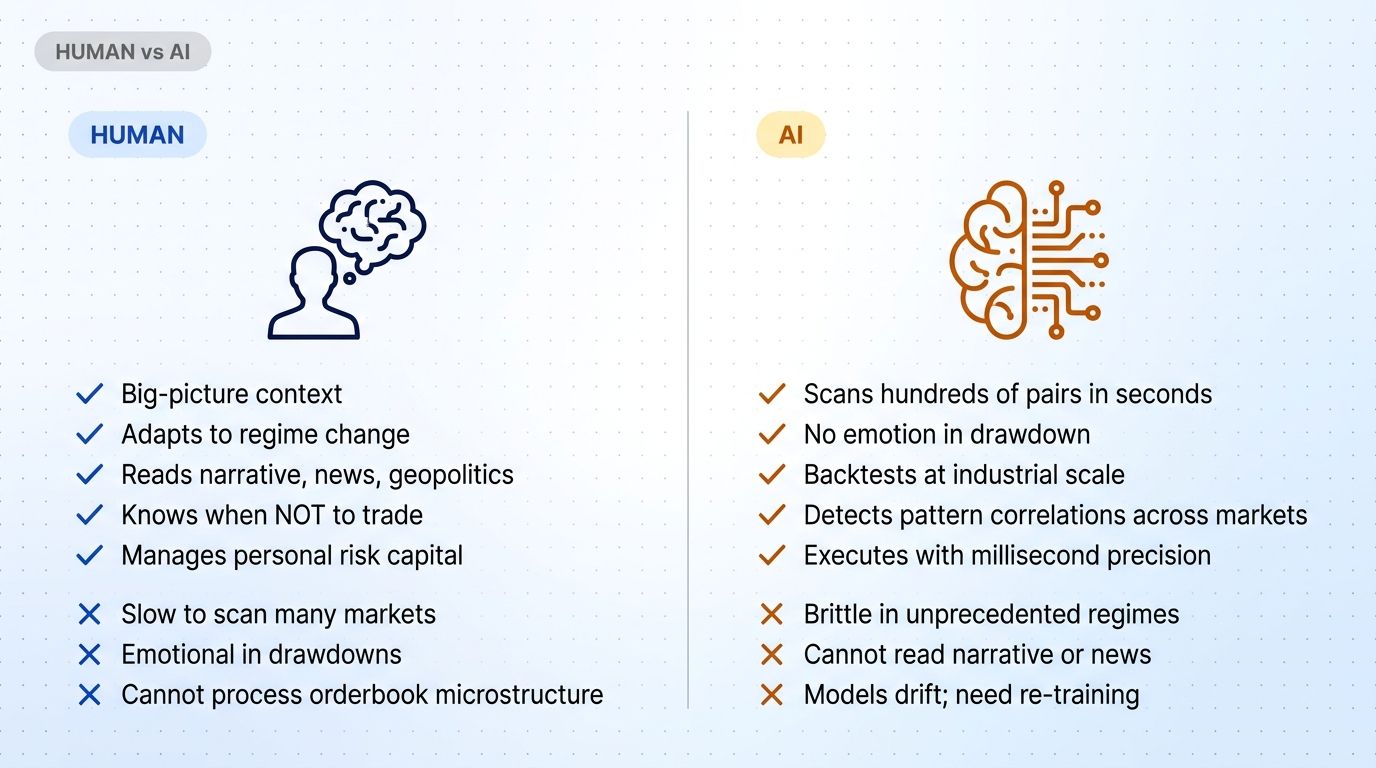
AI is exceptional at narrow, well-defined tasks. It is terrible at general intelligence about markets. The human trader retains a meaningful edge in five specific areas:
- Reading narrative and news. AI sentiment models score posts. They do not understand why "Trump tariffs on chip exports" affects crypto liquidity. Humans connect dots across geopolitics, regulation, and market psychology that text-classification models miss.
- Adapting to regime changes. AI models trained on bull-market data fail in bear markets and vice versa. Humans recognize regime shifts in real time (often before the data shows it) and adjust strategy.
- Knowing when not to trade. AI almost always produces a signal. It rarely says "the market is too messy, sit out today." Humans recognize chop and step aside.
- Big-picture context. Why is BTC dropping while ETH rallies? AI can detect the divergence; humans interpret it as ETF rebalancing flows or sector rotation.
- Personal risk capacity. AI optimizes mathematical risk. Humans know their own emotional limits, family situation, and capital availability. The right position size depends on both.
The best AI-powered crypto traders use AI for what it is good at (speed, scale, pattern detection) and rely on human judgment for what it is good at (context, regime awareness, narrative). Either side alone underperforms the combination.
Common Pitfalls When Adopting AI Trading Tools
The hype around AI in crypto has led to predictable failures. Watch for these:
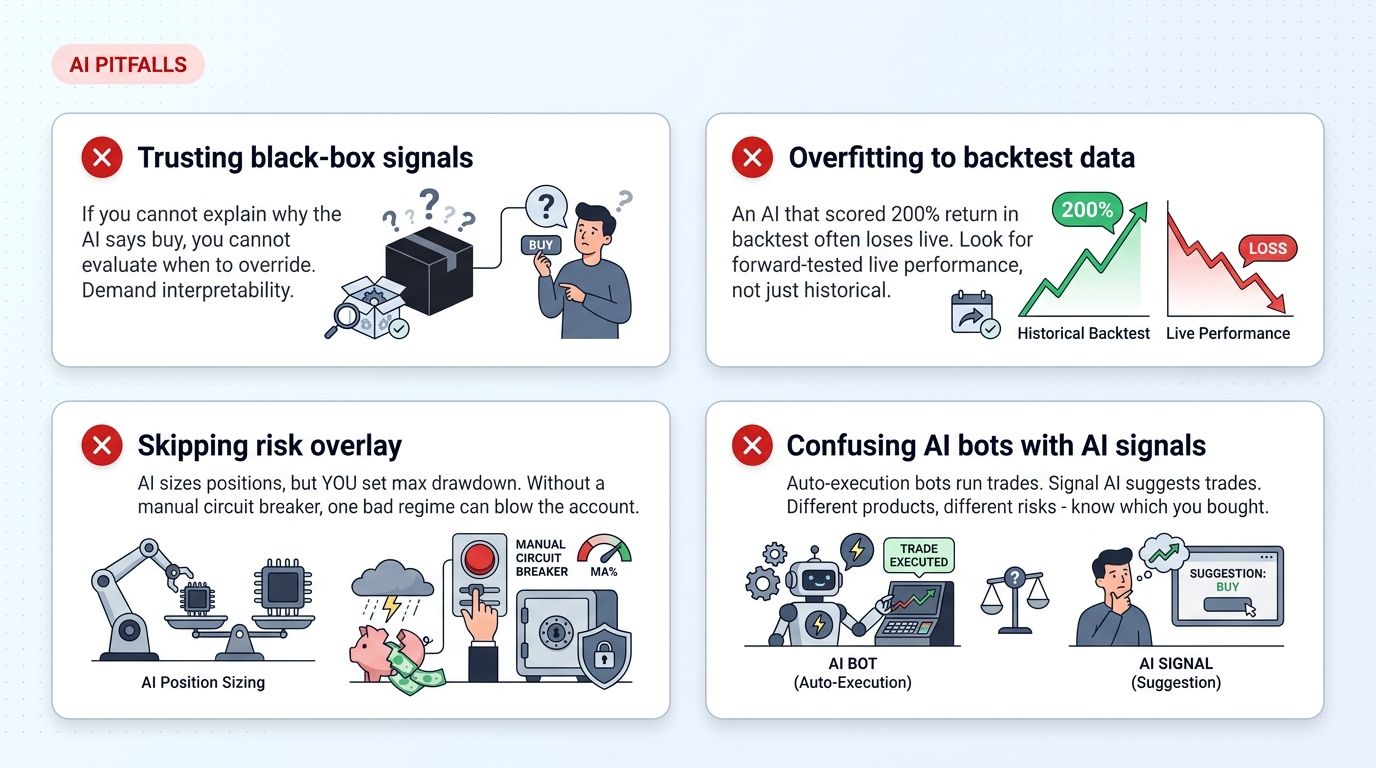
- Trusting black-box signals. If the platform cannot explain why the AI says buy, you cannot evaluate when to override. Demand interpretability - what features drove the signal, what historical patterns it matches, what the confidence score actually means.
- Overfitting to backtest data. AI products often advertise spectacular backtest returns (200%+ annually) that fail to replicate in live trading. Look for forward-tested live-performance metrics, not just historical backtests. A model that returned 200% in backtest but 5% in live trading is a model with serious overfitting.
- Skipping the human risk overlay. AI sizes positions based on volatility, but you set the maximum drawdown your account can tolerate. Without a manual circuit breaker (e.g., "stop all AI trading if account drops 10%"), one bad regime can blow the entire account.
- Confusing AI bots with AI signals. AI bots auto-execute trades; AI signals suggest trades and let the human decide. Different products, different risk profiles. Buying an AI bot when you wanted decision-support is an expensive mistake.
- Underestimating model drift. AI models trained on 2021 data are not the same model anymore. Crypto markets evolve, and so should the AI. Demand transparency on model retraining cadence and validation methodology.
How to Evaluate an AI Trading Tool
Before subscribing to any AI-powered crypto trading service, run it through this checklist:
- What does the AI actually do? Pattern recognition, sentiment analysis, signal generation, auto-execution? Different products. Match to your need.
- How are signals generated? Statistical models? Neural networks? Simple indicator combinations dressed up as AI? Demand technical disclosure.
- What's the live (not backtest) performance? Forward-tested live returns over 6+ months in different market regimes.
- How interpretable are the signals? Can you see what drove each signal, or is it opaque?
- What human controls exist? Can you override individual signals? Set a maximum daily loss? Pause auto-execution?
- Is there a free trial or paper trading mode? No way to evaluate without testing. Anything that demands payment up-front without trial is a red flag.
- What is the user community saying? Look beyond the marketing site - check Reddit, Twitter, Trustpilot for real-user reviews 6+ months after launch.
Using AI in an Altrady Workflow
Altrady integrates AI-powered features into the multi-exchange day-trading workflow without removing the human from the decision loop.
- Quick Scanner with AI pattern recognition surfaces breakouts, divergences, candlestick patterns, and channel breaks across hundreds of pairs. You set the criteria; the scanner does the work.
- Smart Trading order types let you act on AI signals with one-click bracket orders (entry, stop, take profit) - the AI suggests, you decide and execute.
- Risk-Reward Calculator applies volatility-aware position sizing math automatically, integrating ATR-based unit calculation with your account-level risk settings.
- Trading journal with pattern tagging lets you backtest your own AI-augmented decisions over time. Patterns that work for you compound; patterns that do not get filtered out.
- Paper trading mode on the live UI so you can validate AI-augmented workflow without risking capital before deploying real money.
The free trial includes full access. Test AI-augmented scanning against your current manual workflow and measure time-per-decision before committing to a paid plan.
Conclusion
AI-powered crypto trading is real, valuable, and overhyped simultaneously. The genuine wins are in pattern recognition at scale, risk scoring, execution optimization, and sentiment analysis. The hype lives in promises of autopilot returns that vanish the moment market regime changes. The best AI workflows pair machine speed with human judgment - AI surfaces opportunities, the trader decides which ones to take and how much risk to run.
For traders adopting AI tools in 2026, the playbook is clear: evaluate interpretability, demand live (not just backtest) performance, keep human controls on risk, and never confuse signal-AI with auto-execution AI. Done right, AI extends what one trader can do alone. Done badly, it accelerates losses faster than any human ever could.
Frequently Asked Questions
What is AI-powered crypto trading?
AI-powered crypto trading uses machine learning models to analyze market data, recognize patterns, score risk, and produce trading signals. Modern AI workflows handle three core jobs: pattern recognition at scale, statistical modeling of price moves, and decision support for the trader. The human typically retains the final decision on whether to take each trade.
Is AI better than humans at crypto trading?
AI is better at speed (scanning hundreds of pairs in seconds), scale (processing data sources humans cannot), and emotion-free execution. Humans are better at reading narrative and news, adapting to regime changes, knowing when not to trade, and personal risk management. The best workflows combine both - AI surfaces opportunities, humans decide which to take.
What is the difference between AI signals and AI bots?
AI signals suggest trades and let the human decide whether to execute. AI bots auto-execute trades without human approval. Different products with very different risk profiles. Signal-AI keeps you in control of risk. Bot-AI removes you from the loop, which is fine when the model is correct and catastrophic when the market regime shifts.
Can AI predict crypto prices accurately?
AI cannot predict prices reliably. What AI does well is identify patterns that historically had positive expectancy (e.g., Donchian breakouts in trending markets, Head and Shoulders at uptrend tops). These pattern signals carry higher win rates than random entries, but every AI model fails when market regime changes faster than the model can retrain.
What use cases produce real edge from AI in crypto trading?
Four use cases produce edge today: (1) multi-pair pattern recognition that surfaces high-conviction setups across hundreds of pairs, (2) cross-market risk scoring that adjusts position sizing for correlation, (3) execution optimization that minimizes slippage on large orders, and (4) sentiment analysis that quantifies social mood across Twitter, Reddit, and news in real time.
How do I evaluate an AI crypto trading tool?
Run any AI tool through this checklist: what does it actually do, how are signals generated, what is the live (not backtest) performance over 6+ months, how interpretable are the signals, what human controls exist for risk, is there a free trial, and what is the user community saying after 6+ months. Tools that fail interpretability or live-performance checks are usually overfit backtests being marketed as AI.
What are the biggest risks of using AI in crypto trading?
The five biggest risks: (1) trusting black-box signals you cannot evaluate, (2) overfit models that show great backtests but fail in live trading, (3) skipping human risk overlay so one bad regime blows the account, (4) confusing AI bots (auto-execute) with AI signals (suggest), and (5) model drift as crypto markets evolve faster than the AI is retrained.
AI tools work best when integrated into a real trader's workflow, not replacing it. Altrady gives you AI-powered pattern scanning, multi-exchange charting, smart bracket orders, and paper trading - so you can test AI-augmented decision-making before committing real capital. Sign up for a free trial and run the workflow against your current setup.