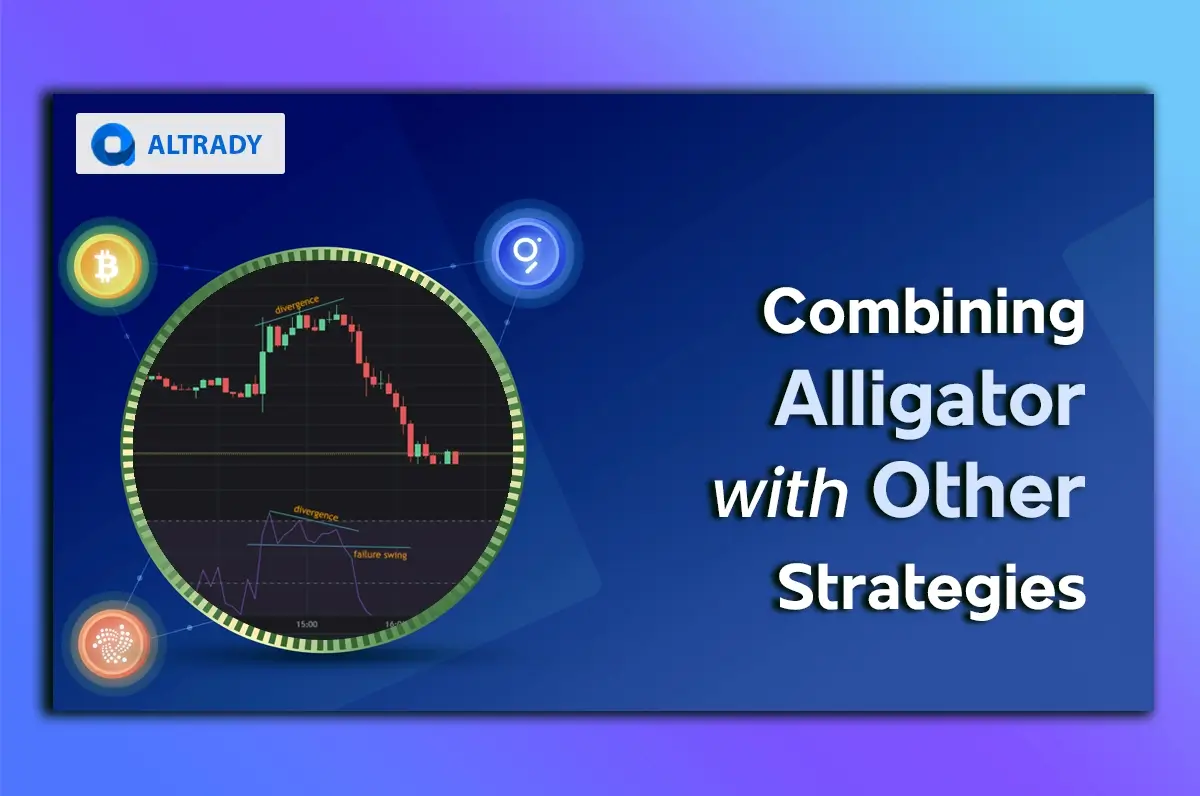

Bill Williams developed a simple directional indicator as it is the Alligator. Often traders use it to detect trends and ranges. In the world of cryptocurrency, having the ability to combine multiple strategies represents a plus in the trading of every market participant. This article unveils how the Alligator can combine multiple methods to seize trend and range conditions.

Alligator Trading: How it works
The understanding of the Alligator indicator relies on the premise proposed by its creator Bill William, which affirms that the market only trends 15% to 30% of the time.
With such an assumption, the Alligator performs a critical function for traders: to measure trends, which are the more complex phases of the market cycles.
Under that 15% to 30% chance to seize a trend, the Alligator identifies if the potential trend strengthens or weakens over time as it evolves. How does it do that?
This indicator comprises three lines to achieve its objective:
- Jaw (blue line): it primarily takes a value of 13 periods (bars) and is smoothed by 8 periods (bars) consequently.
- Teeth (red line): it takes the previously smoothed 8-bar line (SMMA), and it is smoothed now by 5 bars consequently.
- Lips (green line): it takes the previously smoothed 8-bar line (SMMA), and it is smoothed now by 3 bars consequently.
The GAP
The gap between the Jaw, the Teeth, and the Lips lines indicates the potential weakness or strengthening of a trending market. It identifies the following scenarios:
- Strong trends
- Week trends
- Ranges
The gap does so by expanding or narrowing between the lines.
As the gap expands with the trend, it suggests a stronger momentum. When it narrows, the trend is weaker. Finally, when it flattens, the market will likely be in a range.
How Do Traders Use It?
Primarily, traders use the Alligator to spot crossovers between its lines for potential entry and exit signals.
- Bullish crossover: It occurs when the lips line goes above the teeth and jaw lines.
- Bearish crossover: It occurs when the lips line goes below the teeth and jaw lines.
Now, beyond its general application, traders can enhance the effectiveness of the Alligator by combining it with other strategies as we will learn.
There are possible combinations with:
- Pullback strategy since the Alligator works for trends.
- Breakout strategy since the indicator serves to spot ranges.
- Turning points strategy since the indicator is directional and crossovers upward and downward.
- Enhancing trend-following strategy.
Alligator With Pullback Strategy For Strong Crypto Trends
The dynamic of a trend that prolongs over time is determined by pullbacks and momentum stages.
- Bullish trends move within higher highs (momentum) and higher lows (pullback).
- Bearish trends move within lower lows (momentum) and lower highs (pullback).
The central idea for using the Alligator with the pullback strategy consists of
- Following a trend as long as the price remains above (bullish) or below (bearish) the Lips line.
- And seizing entries when it pull-backs towards the Lips.
- And exit when it goes away with the prevailing direction.
To enhance the pullback dynamic, traders can spot price action patterns bouncing near the Lips, such as follows:
- Engulfing Candles (Bullish)
- The Morning Start (Bullish)
- Shooting Star Candles (Bearish)
- Three Black Soldiers (Bearish)

Alligator With Breakout Strategy For Crypto Ranges
When the Alligator lines narrow, the market is likely in a consolidation stage (range).
From that stage on, the market requires a breakout to resume the prevailing trend or make a reversal.
Here, traders can seize a breakout to the upside or downside of the range. The role of the Alligator is when it crossovers, traders get a signal.
For example:
- Bullish signal: The price does a breakout up of the range while the Lips crossover above the Teeth and the Jaw.
- Bullish signal: The price does a breakout down of the range while the Lips crossover below the Teeth and the Jaw.
To enhance the signal, traders can:
- To use volume to measure the breakout.
- To wait for a pullback to the breakout point to confirm it is not a false breakout.
Confirming Turning Points with MACD And Stochastic
The scenarios exposed previously, regarding trends, ranges, pullbacks, and breakouts are virtually the anteroom for turning points.
By using the Stochastic indicator for overbought/oversold levels or MACD for divergences, and spotting failure swings in the RSI, traders can confirm potential turning points signaled by the Alligator's crossovers.
For example, a possible scenario for a turning point could emerge such as follows:
- The market has been trending for a while, expanding the Alligator's gap.
- Then the market falls in a range, narrowing the Alligator lines.
- Finally, the price breaks out of the range while the Alligator makes a crossover.
Now, in that scenario, traders can confirm the reversal such as follows:
- Spotting a failure swing in the RSI.
- Detecting a turning point around an overbought (80 values) or oversold (20 values) level in the Stochastic oscillator.
- Following a divergence in the MACD.
Enhancing Trend Following
The ultimate strategy consists of resuming the primary approach of the Alligator: to follow trends. But now, enhancing the gap function and momentum phase.
In this case, the ADX alone or the ADX with DMI will be the perfect combination.
How? Let's see:
- A reading in the ADX between 25-50 values means the trend strength is increasing (momentum). This could happen as the Alligator's gap expands. Traders can execute an entry at this point.
- Values between 50-75 denote the strength is sustainable. The Alligator's gap should remain expanded. Traders can feel confident in their trade position.
- Values over 60-70 denote that the trend is strong. The Alligator's gap should remain expanded but could begin to narrow. Traders can feel confident in their trade position as long as the price is above the Lips but can start to take profits as a strong trend only appears 15% to 30% of the time, according to Bill Williams.

Conclusion
The Williams Alligator provides traders with a straightforward method through a gap expansion and narrowing to detect trends, measure it, and consequently, spot a range. The simple functionality of this indicator allows it to combine multiple approaches across price action patterns, pullbacks, breakouts, and the use of other indicators such as the MACD, Stochastic, and ADX.
In Altrady, crypto traders use the Alligator and its multiple implementations via a trading terminal with tradingview integration. Sign up for a free trial account today.