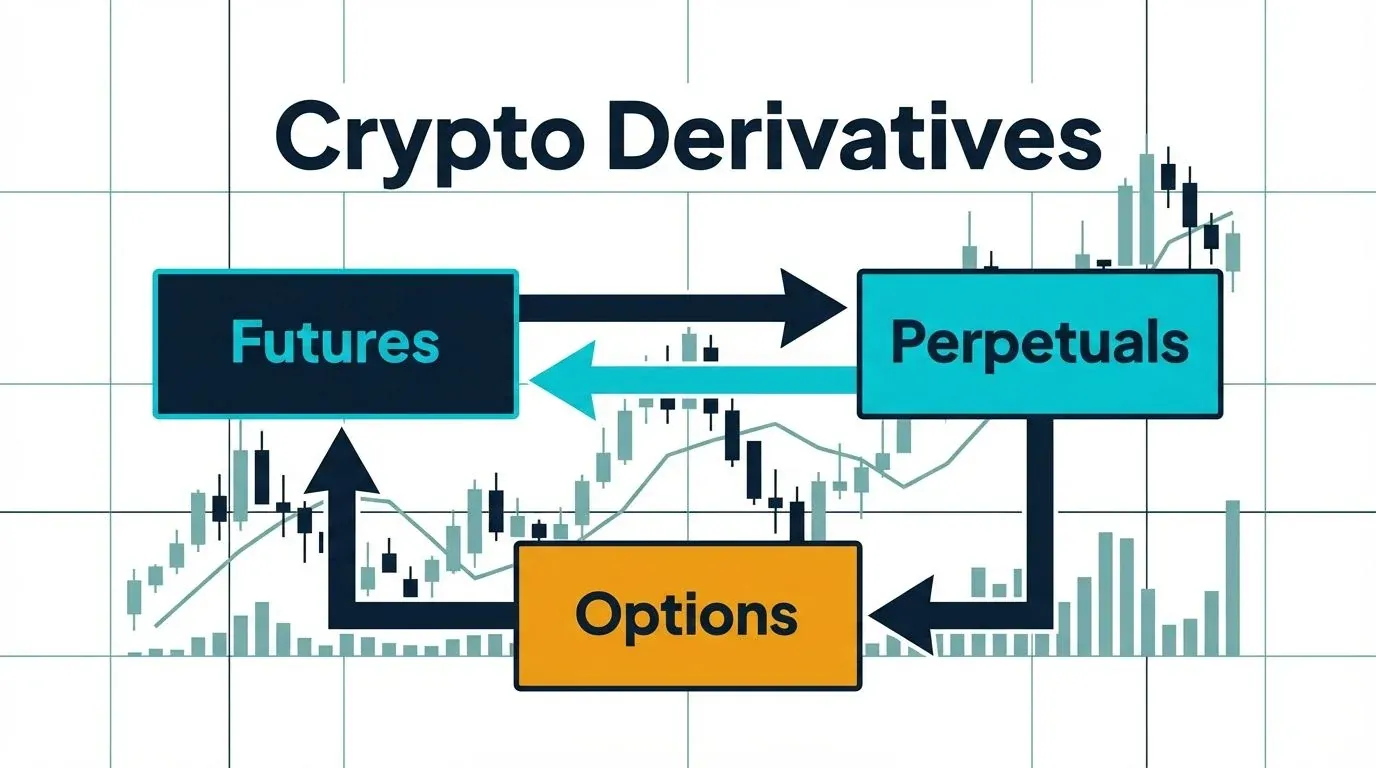

Crypto derivatives have quietly become one of the most powerful tools in a trader's arsenal. While spot trading lets you buy and sell digital assets at current market prices, derivatives allow you to speculate on price movements, protect existing positions, and amplify potential gains without necessarily holding the underlying asset. As crypto markets mature, these instruments are no longer reserved for institutional desks. Retail traders worldwide are actively using futures, options, perpetual swaps, and other derivative products to pursue more sophisticated strategies.
Yet with great power comes a steep learning curve. The same instruments that let a skilled trader profit in both bull and bear markets can wipe out an account in minutes if misused. This guide breaks down everything you need to know about crypto derivatives, from core mechanics to practical use cases and the risks every trader must manage carefully.
1. What Are Crypto Derivatives
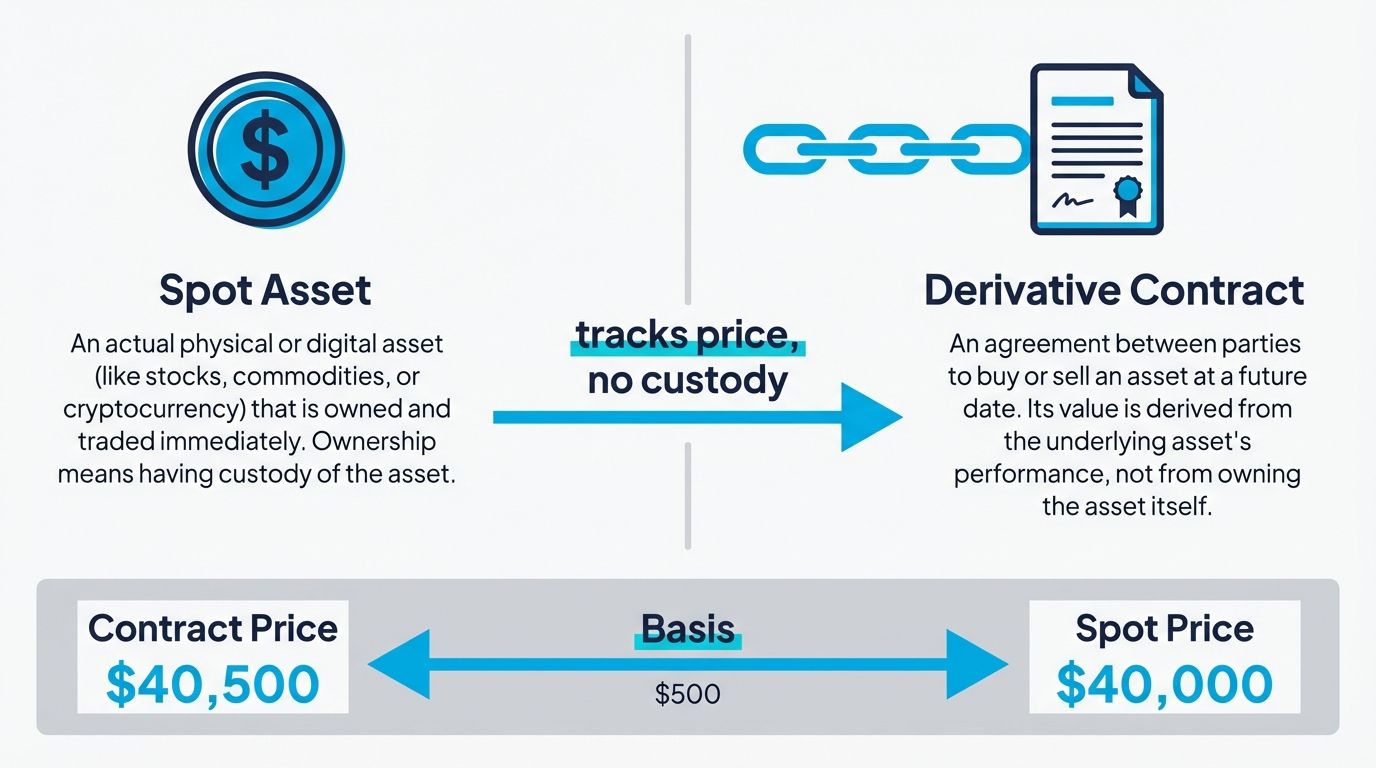
A derivative is a financial contract whose value is derived from the price of an underlying asset. In the crypto space, the underlying asset is typically a cryptocurrency like Bitcoin or Ethereum, and the derivative contract enables traders to gain exposure to that asset's price movements without buying the coin directly.
Crypto derivatives originated in traditional finance, where futures and options have been traded on commodities, equities, and currencies for decades. When Bitcoin futures were launched by the CME in late 2017, it marked a turning point for the crypto industry, signaling that institutional-grade instruments were arriving in digital asset markets. Today, crypto derivatives account for a significant share of total daily trading volume across major exchanges.
- Contract-based exposure: Traders agree to buy or sell an asset at a specified price and time, or hold a position that mirrors spot price movements.
- No custody required: Because you are trading a contract rather than the asset itself, you do not need to hold or store the underlying cryptocurrency.
- Available on regulated and unregulated venues: Derivatives are offered on regulated exchanges like CME as well as on crypto-native platforms that operate globally.
Understanding derivatives starts with recognizing that the contract price tracks, but does not always perfectly match, the spot price of the underlying asset. The difference between the contract price and the spot price is known as the basis, and managing that gap is part of every professional derivatives trader's workflow.
2. Types of Crypto Derivatives
The crypto derivatives market offers several distinct product types, each with its own mechanics, use cases, and risk profile. Knowing the differences is essential before placing your first trade.
Futures Contracts
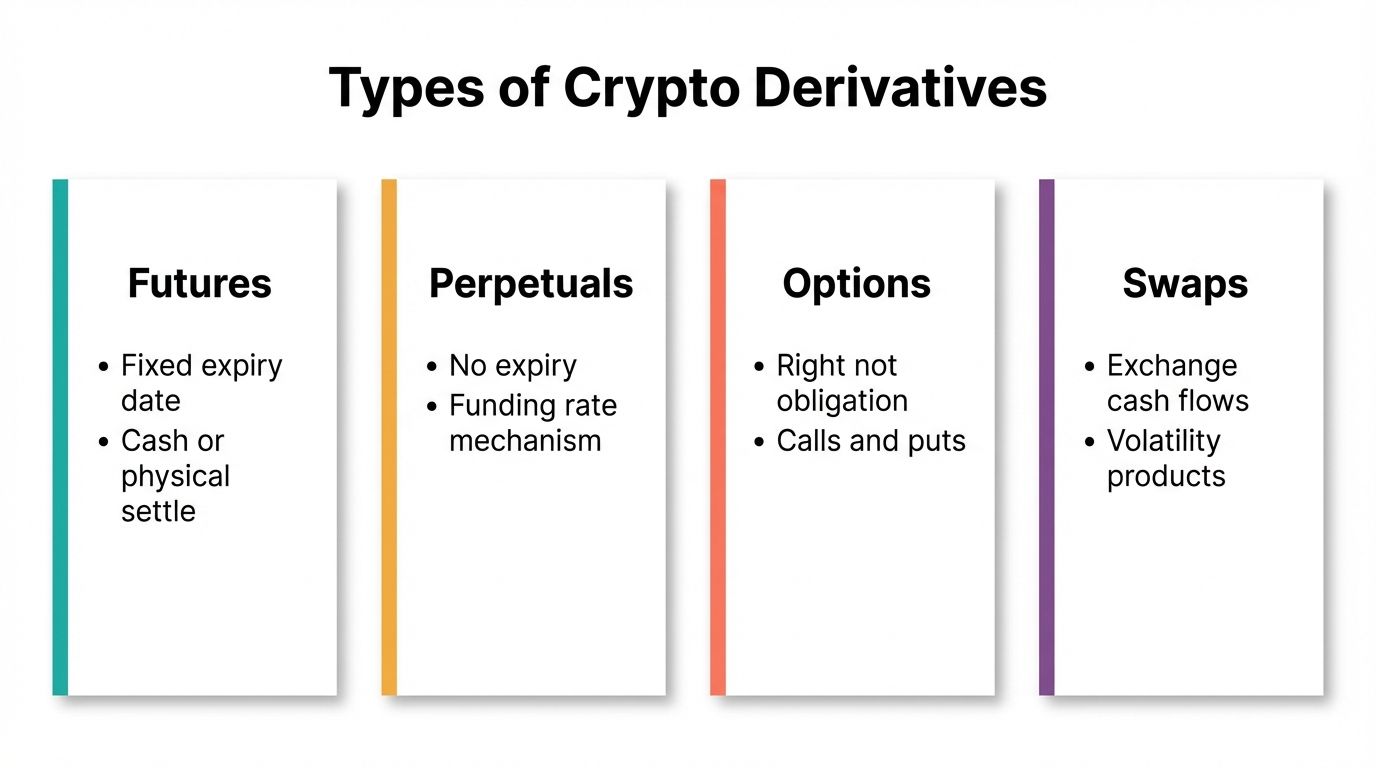
A futures contract is an agreement to buy or sell an asset at a predetermined price on a specific future date. Crypto futures are typically cash-settled, meaning no actual cryptocurrency changes hands. Traders profit or lose based on the difference between the contract price and the settlement price at expiry. Quarterly and monthly futures are common, and they tend to trade at a premium or discount to spot depending on market sentiment.
Perpetual Swaps
Perpetual swaps, often called perpetuals or perps, are the most popular derivative product in crypto. Unlike futures, perpetuals have no expiry date. Traders can hold a position indefinitely, as long as they maintain sufficient margin. The mechanism that keeps perpetual prices aligned with spot is called the funding rate. When perpetuals trade above spot, longs pay shorts. When they trade below spot, shorts pay longs. This self-correcting mechanism prevents prices from diverging for extended periods.
Options Contracts
An options contract gives the buyer the right, but not the obligation, to buy or sell an asset at a specific price (the strike price) before or at expiration. Call options profit from price increases; put options profit from price decreases. Options in crypto are increasingly popular for hedging and for constructing non-linear payoff structures that are impossible to achieve with simple spot or futures positions.
Swaps and Variance Products
Beyond perpetuals, crypto markets also offer volatility swaps and other structured products that let traders take positions on metrics like implied volatility rather than price direction. These are more advanced instruments generally used by institutional participants and sophisticated retail traders.
3. How Crypto Derivatives Work Mechanically
To trade derivatives effectively, you need to understand the core mechanics that govern how positions are opened, maintained, and closed.
- Margin: Rather than paying the full notional value of a trade, traders post a fraction of the total as collateral. This collateral is called margin. Initial margin is the amount required to open a position; maintenance margin is the minimum balance required to keep it open.
- Leverage: Because you post only a fraction of the notional value, you are effectively trading with leverage. A 10x leverage position means every 1% move in the underlying translates to a 10% gain or loss on your margin.
- Mark Price vs. Last Price: Most exchanges use a mark price, calculated from multiple data sources, to determine whether a position should be liquidated. This prevents temporary price spikes on a single exchange from triggering mass liquidations unfairly.
- Liquidation Engine: If your account equity falls below the maintenance margin threshold, the exchange's liquidation engine will automatically close your position. Partial liquidations are used by some exchanges to reduce the impact.
- Settlement: Futures contracts settle either in cash (the profit or loss is credited in a stablecoin or fiat equivalent) or in the underlying cryptocurrency. Perpetuals settle continuously via the funding rate mechanism.
- Funding Rate: Paid every 8 hours on most exchanges, the funding rate is a small percentage transferred between long and short positions to keep the perpetual price anchored to spot.
Understanding these mechanics is not optional. Many traders blow up accounts because they misunderstand leverage ratios, ignore funding rate costs on long-held positions, or fail to monitor their margin levels during volatile sessions.
4. Use Cases: Hedging, Speculation, and Leverage
Crypto derivatives are not just for speculation. They serve a range of legitimate purposes that span from portfolio protection to income generation.
Hedging
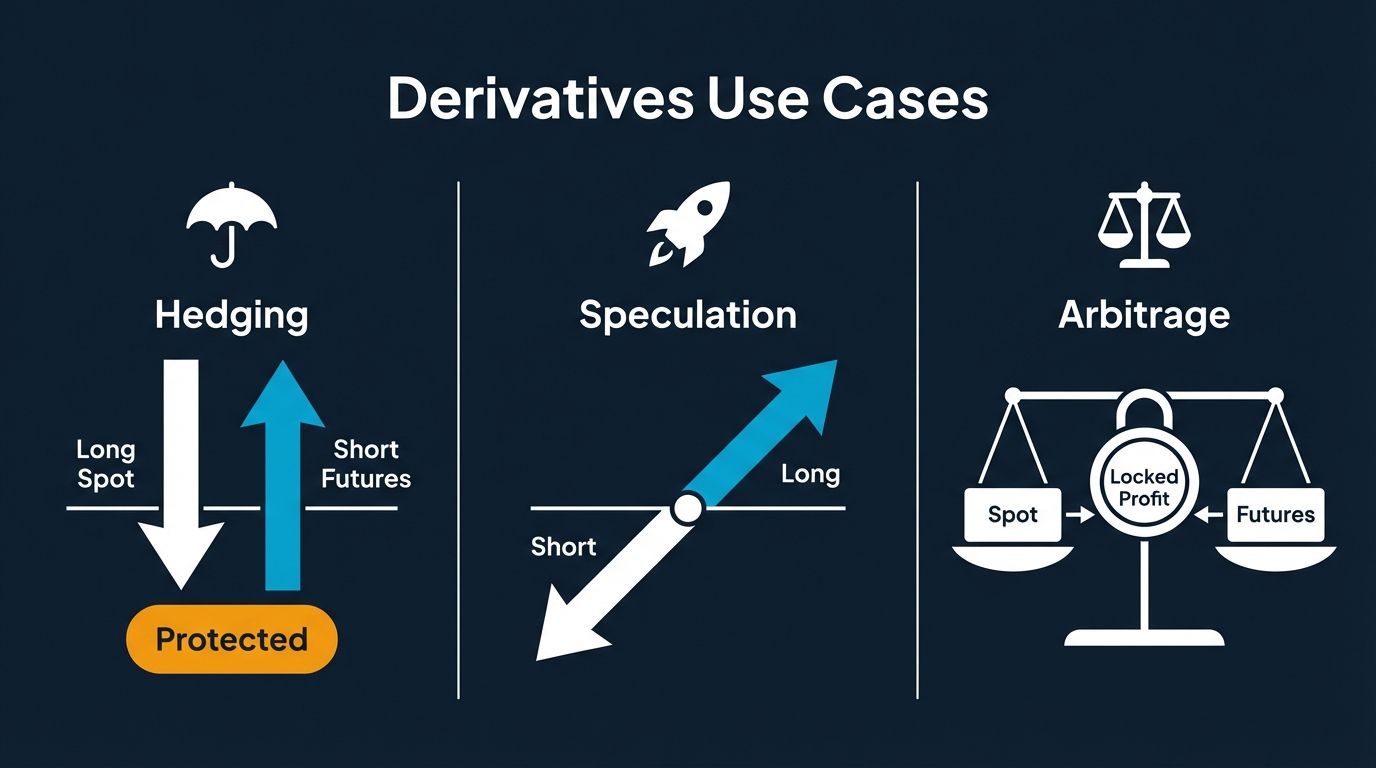
A miner holding Bitcoin inventory can open a short futures position to lock in a selling price for the coins they plan to sell in the next quarter. If Bitcoin falls, the short position profits, offsetting losses on their inventory. This is pure hedging, and it is how professional market participants use derivatives to manage real-world exposure.
Traders who hold large spot positions can similarly use short perpetuals or put options to protect against downside without liquidating their holdings, which could trigger taxable events or disrupt their long-term strategy.
Directional Speculation
Most retail traders use derivatives to speculate on price direction with amplified exposure. Going long on a Bitcoin perpetual with 5x leverage allows a trader to control five times more exposure than their capital alone would allow. The same works in reverse: short positions allow traders to profit from falling prices, something that is difficult or impossible in spot markets without complex workarounds.
Basis Trading and Arbitrage
The difference between futures prices and spot prices creates arbitrage opportunities. Cash-and-carry trades involve buying spot and simultaneously shorting a futures contract that trades at a premium. The trader locks in the basis as profit, regardless of which direction the market moves. This is a market-neutral strategy that sophisticated traders use to generate consistent returns.
Options Strategies
Options allow traders to construct defined-risk strategies. Buying a call option limits the maximum loss to the premium paid, while still allowing unlimited upside if the asset rallies. More complex strategies like straddles, strangles, and iron condors let traders position around expected volatility events such as protocol upgrades or macroeconomic announcements.
5. Risks Every Crypto Derivatives Trader Must Understand
The leverage and complexity of derivatives introduce risks that go well beyond what spot traders face. Managing these risks is what separates profitable traders from those who lose their capital quickly.
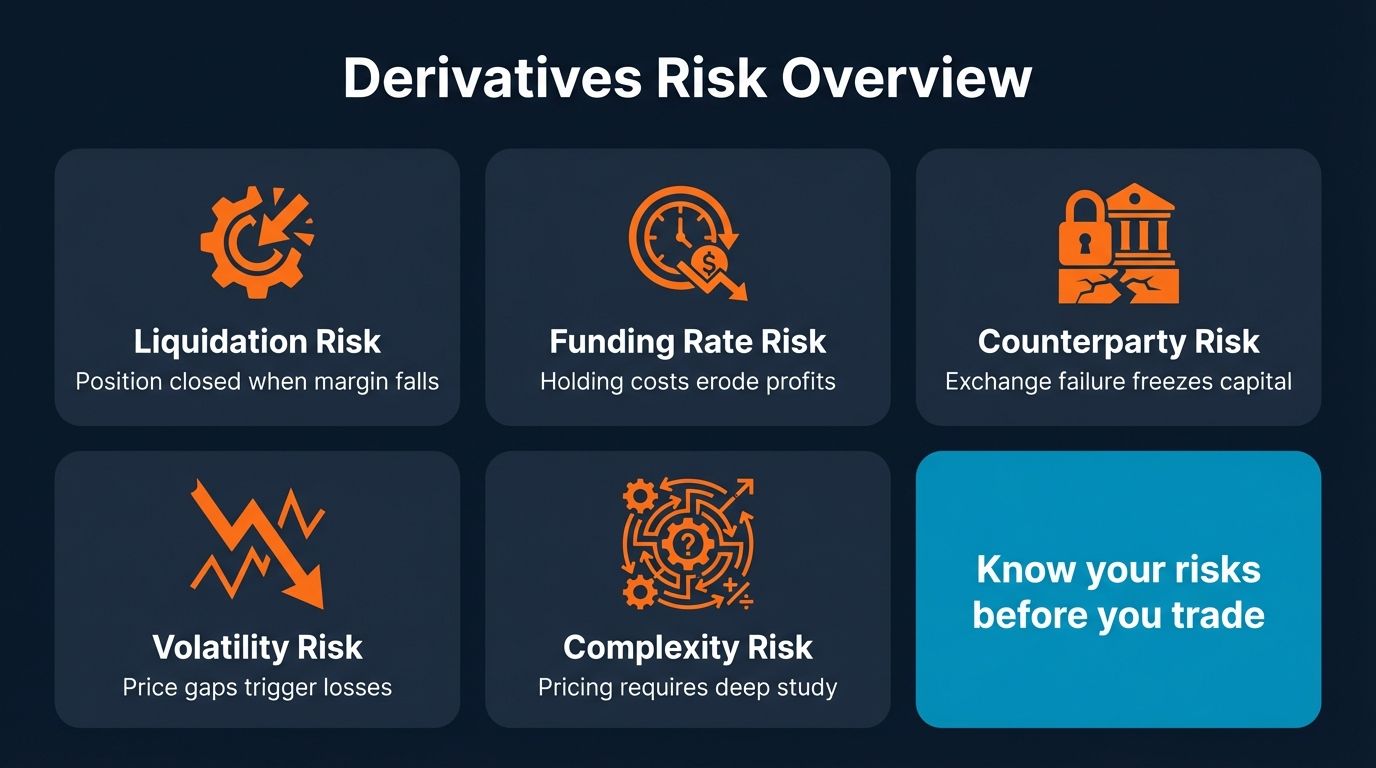
Liquidation Risk
The most immediate risk for leveraged traders is liquidation. When a position moves against you and your margin falls below the maintenance threshold, the exchange closes your position automatically. At high leverage ratios, even a small adverse move can trigger liquidation. Cascading liquidations across many positions can amplify market volatility, creating waterfalls where one liquidation triggers others in rapid succession.
Funding Rate Risk
Holding perpetual positions for extended periods exposes traders to funding rate costs. During bull markets, funding rates for long positions can be extremely high, making it expensive to maintain bullish exposure. A position that is directionally correct over a month may still lose money if funding payments erode the profit margin.
Counterparty and Exchange Risk
Trading on centralized exchanges means trusting the platform with your collateral. Exchange insolvencies and exit scams have cost traders billions of dollars in past crypto market cycles. Using regulated platforms, keeping only what you need on exchange, and diversifying across venues reduces this exposure.
Volatility and Gap Risk
Crypto markets trade 24 hours a day, seven days a week. Price gaps during low-liquidity windows, particularly in altcoin derivatives markets, can cause positions to move from profitable to liquidated before a trader has time to react. Stop-loss orders, position sizing, and constant monitoring are essential risk management tools.
Complexity Risk
Options pricing involves the Greeks (delta, gamma, vega, theta) that take time to fully understand. Traders who use options without understanding how time decay and implied volatility affect their positions often make systematic errors that compound over time.
6. How to Trade Crypto Derivatives Using the Right Tools
Having the right platform and tools is as important as having the right strategy. Crypto derivatives markets move fast, and manual tracking of multiple positions, margin levels, and funding rates across different exchanges is error-prone and exhausting.
Professional derivatives traders use portfolio dashboards, real-time alerts, and multi-exchange management tools to stay on top of their exposure. Key features to look for include cross-exchange position aggregation, real-time P&L tracking, customizable alerts for margin levels and price targets, and clean order entry interfaces that reduce execution errors.
- Multi-exchange support: Derivatives positions are often spread across Binance, Bybit, OKX, and other venues. A single dashboard that consolidates all positions saves time and reduces mistakes.
- Automated alerts: Set alerts for funding rate thresholds, margin ratio warnings, and price levels so you can act quickly without staring at screens all day.
- Trade journal integration: Tracking every trade, including entry rationale, position size, and outcome, is how traders identify patterns in their own performance and improve systematically.
- Backtesting and signals: Access to historical data and signal tools helps validate strategies before risking real capital on untested setups.
Whether you are executing your first futures trade or managing a complex multi-leg options position, having clean, reliable infrastructure beneath your strategy is non-negotiable.
Start Trading Crypto Derivatives Smarter with Altrady
Altrady is a professional crypto trading platform built for traders who take derivatives seriously. With support for multiple exchanges in a single dashboard, real-time portfolio tracking, customizable alerts, and powerful trading tools, Altrady gives you the infrastructure to manage leveraged positions without losing control.
Whether you are hedging a spot portfolio with perpetual shorts, running basis trades across exchanges, or building out an options strategy, Altrady keeps your entire operation visible and manageable from one place. The platform is designed to reduce the operational friction that causes costly mistakes, so you can focus on strategy rather than logistics.
Altrady offers a free trial so you can explore all features before committing. If you are serious about trading crypto derivatives at a higher level, getting started with Altrady is a logical first step. Take the free trial today and see how much cleaner your trading workflow can be.
Frequently Asked Questions About Crypto Derivatives
What is the difference between a crypto futures contract and a perpetual swap?
A futures contract has a fixed expiry date on which the contract settles, either in cash or the underlying asset. A perpetual swap has no expiry date and can be held indefinitely, as long as the trader maintains sufficient margin. Perpetuals use a funding rate mechanism to keep the contract price aligned with the spot price of the underlying cryptocurrency.
Is trading crypto derivatives legal?
The legality of crypto derivatives trading depends on your jurisdiction. In many countries, including most of Europe, Canada, and parts of Asia, retail access to crypto derivatives is legal and regulated. In some jurisdictions, regulators restrict access to leveraged crypto products for retail traders. It is important to verify the rules that apply in your country before opening a derivatives account.
What leverage is safe for a beginner trading crypto derivatives?
Most risk management professionals recommend that beginners start with 2x to 3x leverage at most, or avoid leverage entirely until they have built a strong foundation in position sizing and market analysis. High leverage ratios such as 50x or 100x can result in full account liquidation from a single adverse move of just 1% or 2%. Starting small allows traders to learn how derivatives behave without catastrophic downside consequences.
How does the funding rate affect a perpetual swap position?
The funding rate is a periodic payment exchanged between long and short positions, typically every 8 hours. When the perpetual contract price is higher than the spot price, longs pay shorts a small fee to incentivize short sellers and bring the price back down. When the perpetual trades below spot, shorts pay longs. For traders holding positions for days or weeks, accumulated funding rate payments can meaningfully impact overall profitability and must be factored into any trade plan.
Can I trade crypto derivatives without owning any cryptocurrency?
Yes. Most crypto derivatives platforms allow you to fund your margin account with stablecoins like USDT or USDC, which means you can trade Bitcoin or Ethereum derivatives without ever holding the underlying asset. This makes derivatives accessible to a wider range of traders, though it also means your capital remains exposed to the volatility of the contracts you trade.