
What Are Crypto Funding Rates?
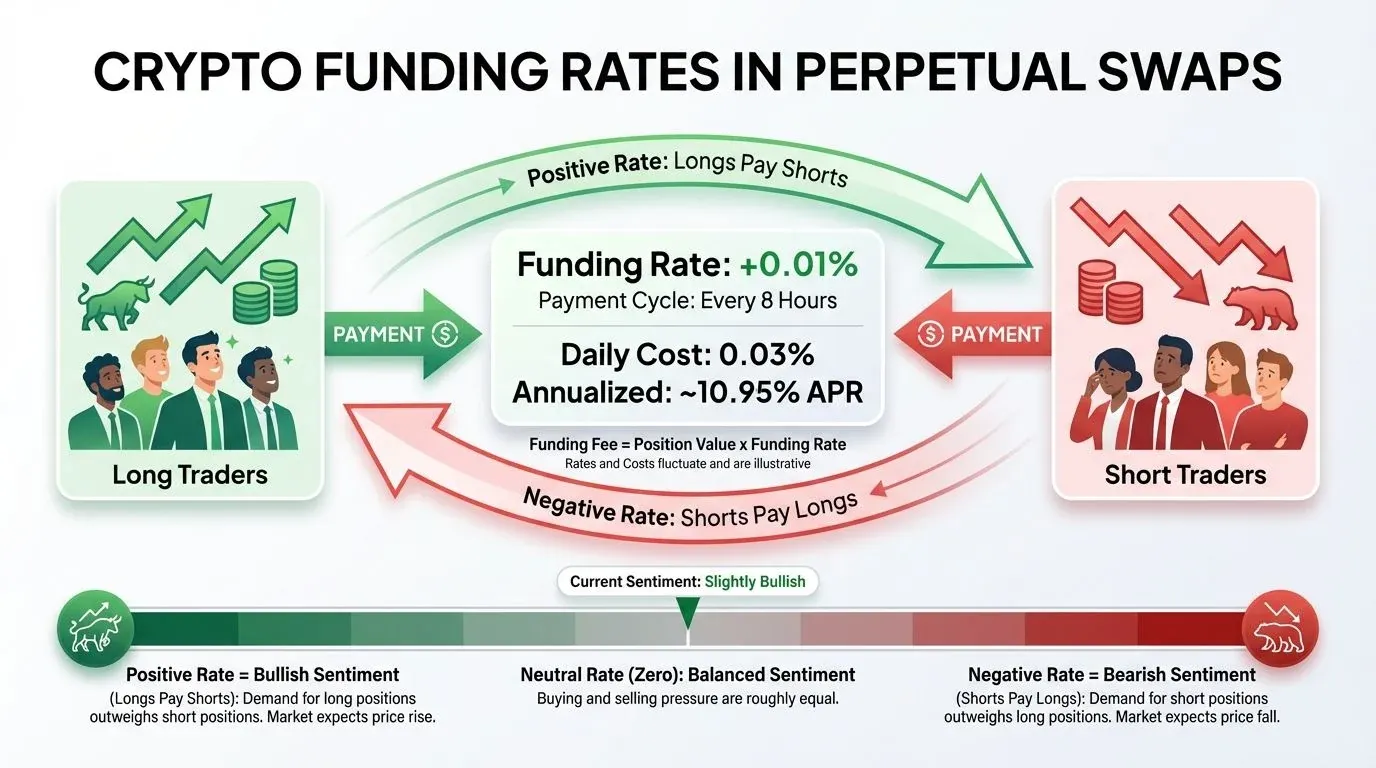
Crypto funding rates are periodic payments exchanged between traders holding long and short positions in perpetual futures contracts. Unlike traditional futures contracts that expire on a set date, perpetual swaps have no expiry. Funding rates are the mechanism that keeps perpetual swap prices anchored to the underlying spot price of the asset.
Think of funding rates as a balancing fee. When the perpetual contract price drifts too far above the spot price, the market is said to be in a bullish bias. In that state, longs pay shorts to incentivize more shorting and push the price back in line. When the contract price falls below spot, the market flips bearish, and shorts pay longs instead.
Without this mechanism, perpetual futures prices would quickly diverge from the actual cryptocurrency spot price, making the contract useless as a hedging or trading instrument.
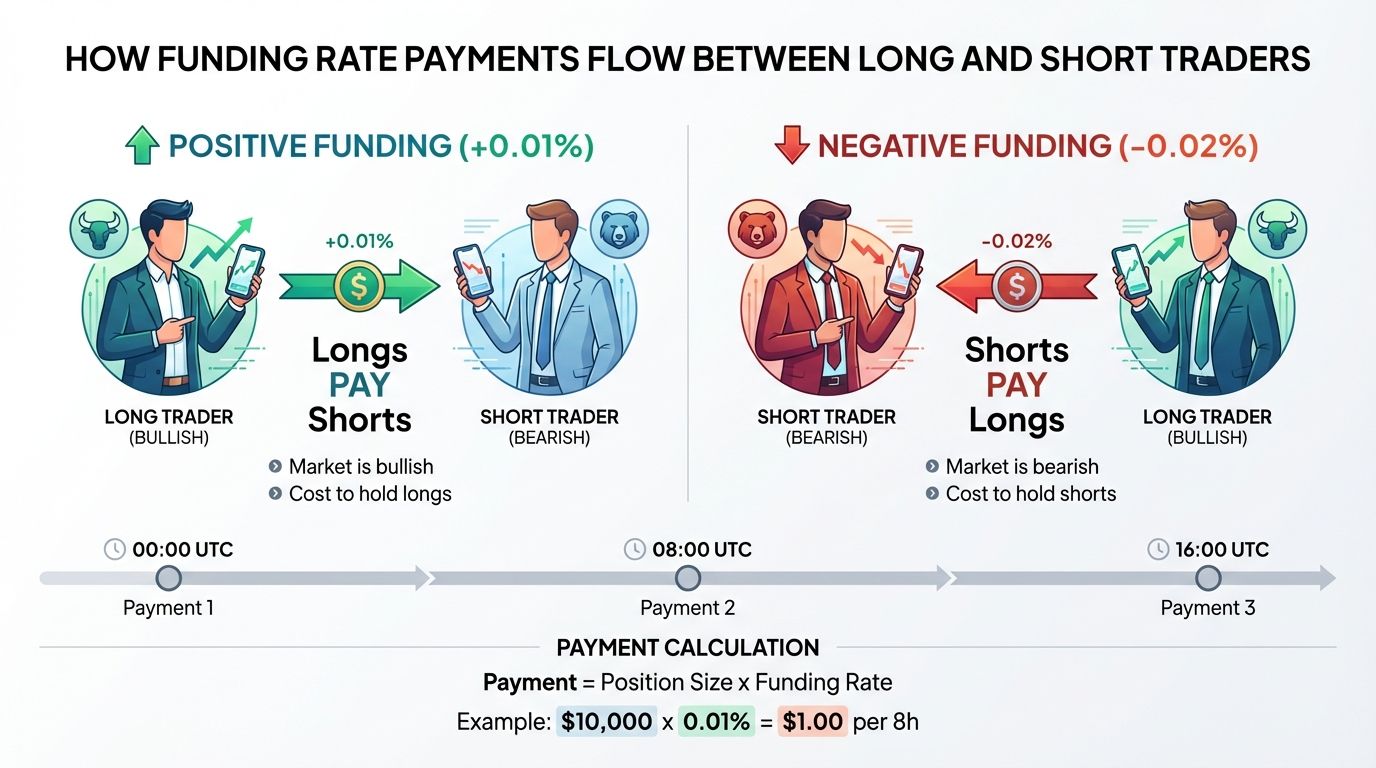
Funding rates are expressed as a percentage and typically applied every 8 hours. Most major exchanges follow the 8-hour cycle, meaning a funding payment is collected three times per day: at 00:00, 08:00, and 16:00 UTC.
How Funding Rates Work in Perpetual Swaps
The 8-Hour Funding Cycle
The funding rate is calculated based on two components: the interest rate (usually a small fixed baseline) and the premium, which reflects the difference between the perpetual contract price and the spot index price.
Every 8 hours, a trader with an open position either pays or receives a funding payment. The formula is straightforward:
Funding Payment = Position Size x Funding Rate
For example, if you hold a $10,000 long BTC position and the current funding rate is 0.01%, you pay:
$10,000 x 0.01% = $1.00
That payment is deducted from your margin and transferred to all short position holders, proportionally.
Positive vs. Negative Funding Rates
A positive funding rate means the perpetual price is trading above spot. Longs pay shorts. This signals bullish market sentiment because more traders are buying the perpetual contract than selling it.
A negative funding rate means the perpetual price is trading below spot. Shorts pay longs. This signals bearish sentiment or capitulation, where more traders are selling or shorting the asset.
Annualizing the Rate
To understand the real cost or income of holding a position over time, it helps to annualize the rate:
- Daily rate = 0.01% x 3 (three 8-hour intervals) = 0.03%
- Annual rate = 0.03% x 365 = 10.95% APR
At first glance, 0.01% per interval sounds tiny. But when annualized, a consistently positive funding rate of 0.01% per 8 hours means long holders effectively pay about 10.95% per year just to maintain their positions. For traders who hold perpetual longs for weeks or months, this cost compounds significantly.
Conversely, when funding goes negative and stays there, short holders pay an equivalent cost. Tracking these rates is essential before deciding whether to hold a direction in perpetual futures.
Why Funding Rates Matter for Traders
Funding rates serve as one of the most reliable sentiment indicators in the crypto market. Here is why every active trader should monitor them.
Market Sentiment Gauge
When funding rates are consistently high and positive, say above 0.05% to 0.1% per 8 hours, it typically indicates the market is overheated. Too many traders are holding leveraged longs. Historically, sustained extreme positive funding often precedes sharp corrections because those over-leveraged longs get liquidated as soon as prices dip.
Conversely, deeply negative funding rates often appear near market bottoms, when fear dominates and traders are over-extended on the short side. A squeeze becomes likely.
Cost of Carry
If you plan to hold a leveraged long position on a perpetual swap for an extended period, funding payments eat into your returns. At 0.03% daily, you are paying roughly $3 per $10,000 in position size every day, or about $90 per month. That adds up fast, especially during a sideways market where there is no price appreciation to offset the cost.
Identifying Opportunity Windows
When funding flips from positive to negative, it can signal sentiment shift and potential entry points for contrarian trades. The funding rate alone is not a buy or sell signal, but when combined with price action, volume, and other indicators, it adds meaningful context.
Funding Rate Arbitrage Strategy
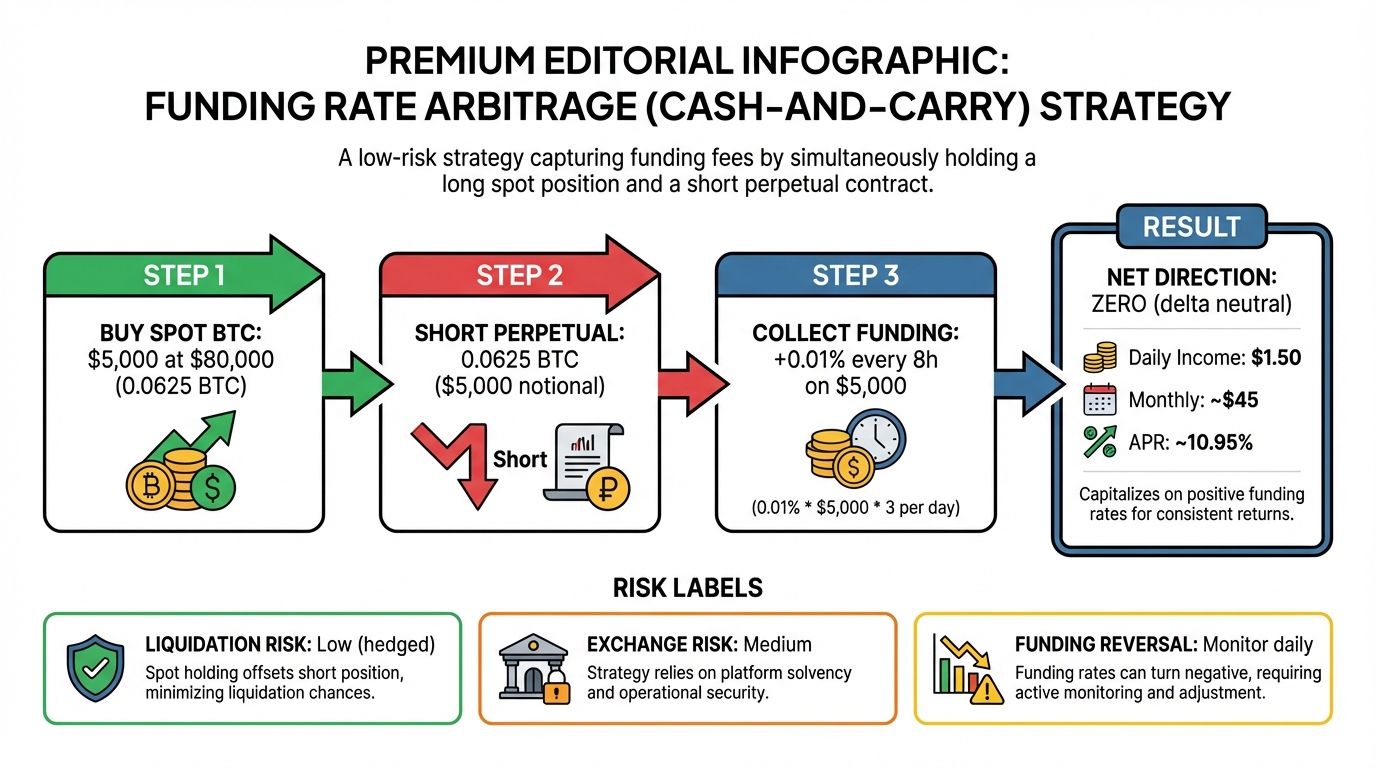
One of the most popular low-risk strategies in crypto trading is funding rate arbitrage, also called the cash-and-carry trade. It allows traders to collect funding payments without taking directional exposure to the market.
How the Cash-and-Carry Trade Works
The core idea is simple: neutralize price risk by holding an equal and opposite position in the spot market and the perpetual market simultaneously.
Setup: 1. Buy $10,000 worth of BTC on the spot market (or hold it already) 2. Open a $10,000 short position on BTC perpetual futures
Net price exposure: Zero. If BTC goes up, the spot position gains and the short loses an equal amount. If BTC drops, the spot loses but the short gains.
Income: The short position collects funding payments from longs, as long as the funding rate stays positive.
Example with numbers:
- BTC spot price: $80,000
- Funding rate: 0.03% per 8 hours
- Position size: $10,000
Income per 8-hour interval = $10,000 x 0.03% = $3.00 Daily income = $3.00 x 3 = $9.00 Monthly income (30 days) = $9.00 x 30 = $270 Annualized yield = 32.85%
This yield is earned with near-zero directional market risk, provided funding rates stay positive.
Risks to Consider
The main risk is funding rate reversal. If rates flip to zero or negative, the trade stops generating income. If rates go significantly negative, you start paying funding on the short side. You also carry liquidation risk on the short leg if you are using leverage, and exchange risk (counterparty risk) for both legs.
For this strategy to work, it is critical to monitor funding rates continuously across exchanges and react when conditions change.
How to Read Funding Rate Data
Understanding the Numbers
Most exchanges display funding rates as a percentage applied per interval. Some also show the predicted funding rate, which is a forward estimate of what the next interval's rate will be based on current price divergence.
A few key readings to understand:
| Rate | Interpretation |
|---|---|
| +0.01% per 8h | Neutral to slightly bullish. Standard baseline. |
| +0.05% to +0.1% per 8h | Elevated bullish bias. Longs are heavy. |
| +0.3%+ per 8h | Extreme greed. High risk of long liquidation cascade. |
| Negative | Bearish sentiment. Shorts paying longs. |
| Very negative (below -0.05%) | Extreme fear. Potential short squeeze setup. |
Annualized Rate as a Benchmark
Annualizing funding helps you compare the yield potential of a carry trade against other opportunities. As shown earlier, 0.01% per 8 hours equals roughly 10.95% APR, while 0.03% per 8 hours scales to about 32.85% APR. These figures put the opportunity in context against, say, DeFi yield strategies or stablecoin lending rates.
Predicted vs. Actual Rate
Predicted funding changes in real time based on the premium between the perpetual price and spot. It is the most live indicator of current sentiment. If predicted funding is spiking upward, it means demand to go long on the perpetual is surging right now. That can be a precursor to a price move or a signal to enter a carry trade before the rate resets.
Funding Rates Across Major Exchanges
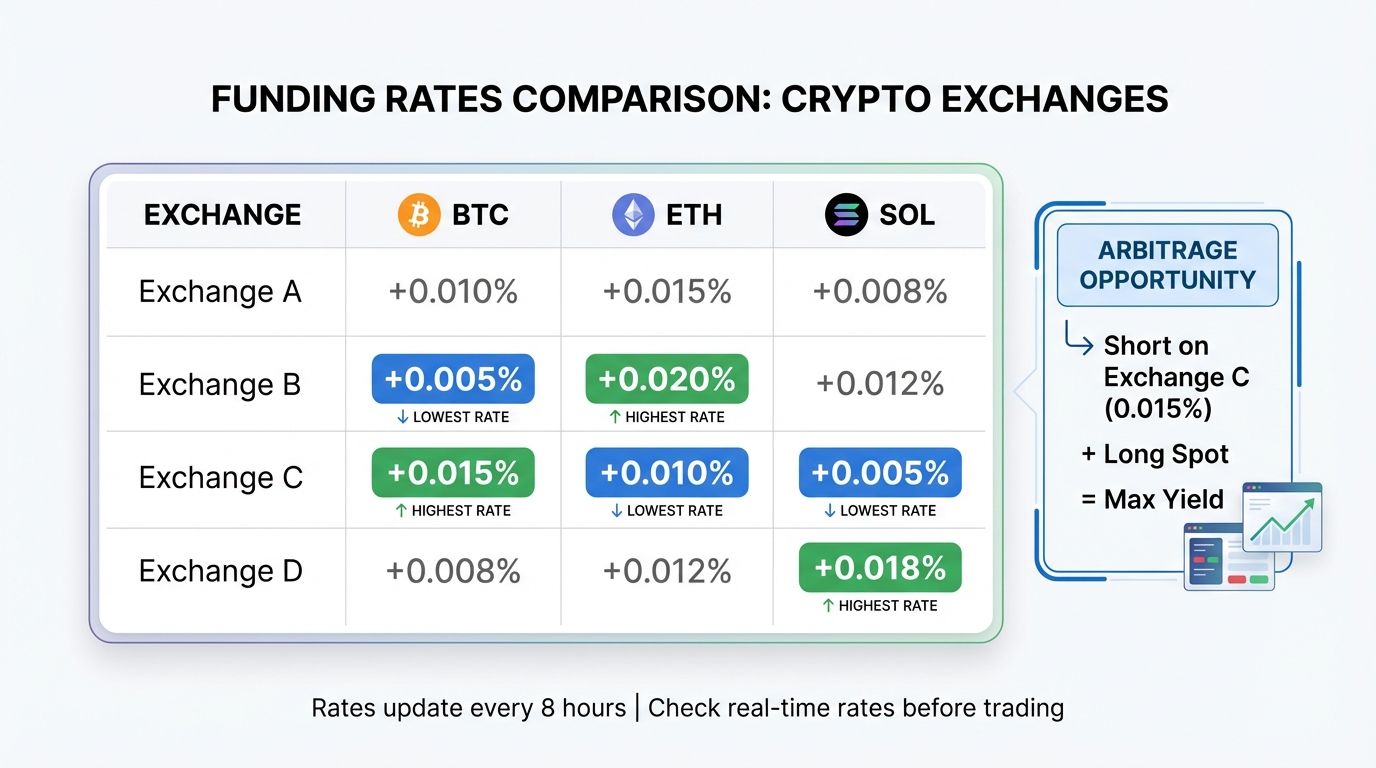
Different exchanges calculate and apply funding rates using slightly different formulas and intervals. This creates a situation where the same asset, say BTC perpetual, may have a 0.03% funding rate on one exchange and 0.05% on another at the same time.
Why Rates Differ Between Exchanges
Each exchange uses its own spot index price (usually an average from multiple spot markets), its own insurance fund baseline, and its own cap on funding rate magnitude. Some exchanges cap funding at 0.05% per interval, others at 1% or higher. This means funding rates can diverge significantly across platforms, especially during volatile periods.
Cross-Exchange Arbitrage
When funding rates differ significantly between exchanges, advanced traders can run a cross-exchange version of the carry trade:
- Short the perpetual on Exchange A where funding is high (collecting high payments)
- Long the perpetual on Exchange B where funding is low or negative (paying little or even receiving payments)
This approach captures the spread between exchange rates rather than simply hedging against spot. The challenge is managing collateral across multiple platforms simultaneously and monitoring both positions in real time.
Timing Matters
Because funding resets every 8 hours, some traders enter carry positions 5 to 10 minutes before the settlement time and exit shortly after, capturing just that interval's payment without long-term exposure. This requires fast execution and real-time rate visibility.
Common Mistakes with Funding Rate Trading
Ignoring Rate Reversal Risk
The most common mistake is assuming funding rates will stay positive indefinitely. Markets shift. A bullish market can flip bearish within hours, turning a profitable carry trade into a loss-generating one. Always have an exit plan if funding flips direction.
Underestimating Exchange Risk
Holding significant capital on an exchange for an extended carry trade introduces counterparty risk. Exchange failures, withdrawal freezes, and hacks are real risks in crypto. Spreading positions across reputable exchanges and keeping only what is needed for the trade reduces this exposure.
Miscalculating Net Yield
Beginners often calculate funding income without accounting for trading fees, slippage on entry and exit, and margin costs. On a $10,000 position at 0.01% funding per interval, the gross daily income is $3. If you paid 0.04% in taker fees on both the spot and perp leg at entry, that is $8 upfront, more than two full days of funding income before you even start profiting.
Overusing Leverage
Running the short leg with high leverage magnifies liquidation risk. A temporary price spike can wipe out the short position before the hedge has time to work. Many experienced funding traders keep the short leg at 1x to 2x leverage maximum, treating the strategy as a yield tool rather than a high-return trade.
Monitoring Only One Exchange
Because funding rates differ across exchanges, watching only one platform gives an incomplete picture of market sentiment and misses the best carry trade opportunities. Real-time multi-exchange visibility is essential.
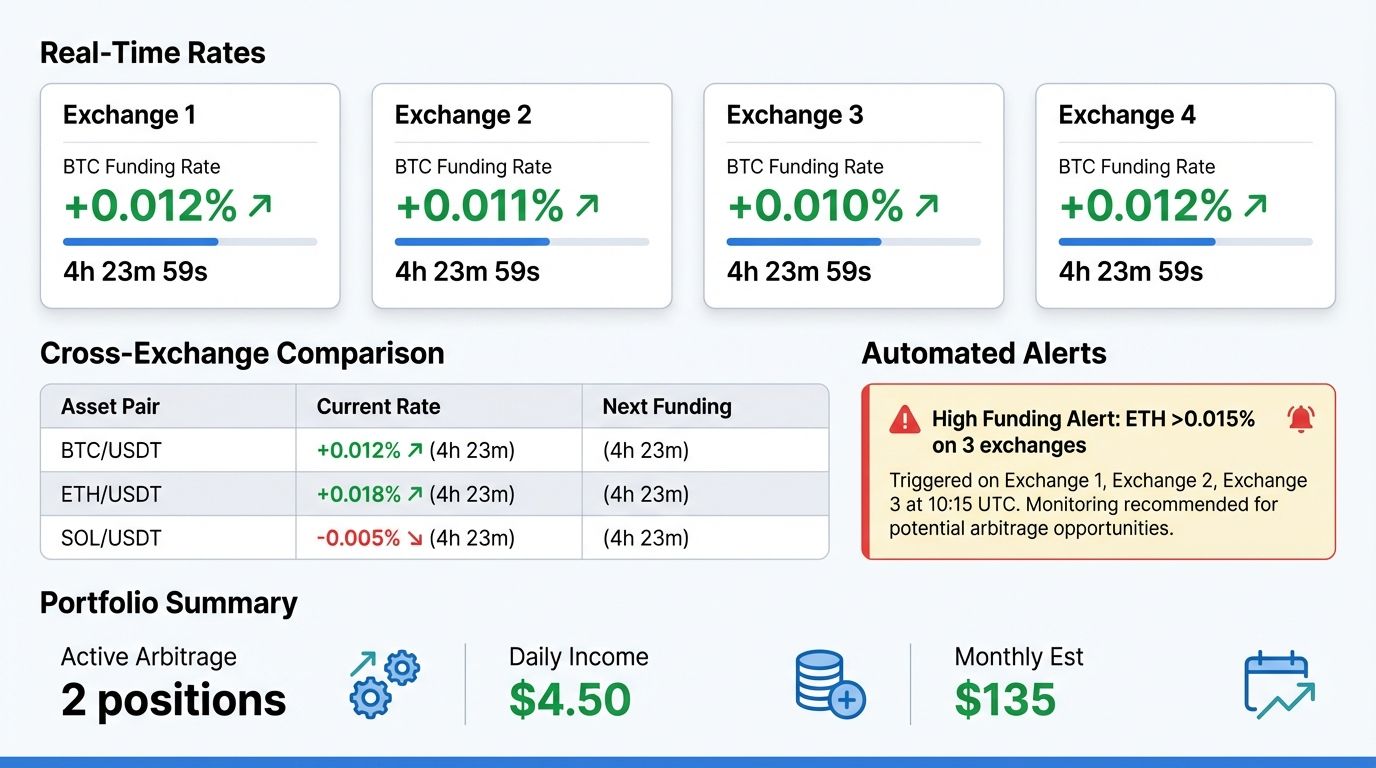
Monitor Funding Rates Across Exchanges with Altrady
Profitable funding rate trading requires more than spreadsheets and manual checks. You need real-time data from multiple exchanges in one place, smart order tools that let you execute on both legs quickly, and alerts that tell you when funding rates shift so you can act before the next settlement window.
Altrady is a professional multi-exchange crypto trading platform that brings all of this together. With Altrady, you can:
- Monitor funding rates across all major exchanges from a single dashboard, so you always know where rates are highest and where arbitrage opportunities exist
- Set funding rate alerts to notify you when rates cross a threshold, ensuring you never miss a profitable entry or exit window
- Execute smart orders on multiple exchanges simultaneously, reducing the time between spotting an opportunity and acting on it
- Track your open positions and P&L across spot and perpetual markets in one unified view, making cash-and-carry management much cleaner
- Access historical funding rate charts to analyze rate patterns, identify seasonal trends, and backtest your carry trade approach
Whether you are a retail trader looking to add a consistent yield strategy to your portfolio or a more advanced trader pursuing cross-exchange arbitrage, having all funding rate data centralized is a real edge.
Start with a free trial and see how much cleaner your funding rate workflow becomes when everything is in one dashboard.
Frequently Asked Questions
What is a crypto funding rate?
A crypto funding rate is a periodic payment exchanged between long and short traders in a perpetual futures contract. It is designed to keep the perpetual price aligned with the underlying spot price. When the perpetual trades above spot, longs pay shorts. When it trades below spot, shorts pay longs.
How often are funding rates paid?
Most major exchanges apply funding rates every 8 hours, resulting in three payments per day at 00:00, 08:00, and 16:00 UTC. Some exchanges have moved to hourly or even shorter funding intervals, so it is important to check the specific exchange's rules for each contract you trade.
Can you make money from funding rates without taking price risk?
Yes, through the cash-and-carry trade. By holding an equal long position in the spot market and a short position in the perpetual market, you neutralize directional price exposure. The short leg collects funding payments when rates are positive. The main risks are funding rate reversal, exchange counterparty risk, and trading fees eroding net yield.
What does a very high positive funding rate mean?
A very high positive funding rate, typically above 0.05% to 0.1% per 8 hours, signals strong bullish sentiment and heavy long positioning. Historically, sustained extreme positive funding precedes market corrections because the over-leveraged long side is vulnerable to liquidation cascades on any price dip. It can be useful as a contrarian bearish signal or as a trigger to enter a carry trade.
Why do funding rates differ between exchanges?
Each exchange uses its own spot index price, its own funding rate formula, and its own caps on maximum or minimum rates. During volatile market conditions, these differences can become significant, creating cross-exchange arbitrage opportunities where traders can short a high-funding perpetual on one exchange while longing a low-funding or negative-funding perpetual on another, capturing the spread as income.