
Every crypto trader has experienced it: you place a trade at one price, but the order fills at a different price. This gap between your expected price and the actual execution price is known as crypto slippage, and it can quietly eat into your profits over time. Whether you are a beginner or an experienced trader, understanding slippage is essential for protecting your bottom line.
Crypto slippage is especially common in the fast-moving world of digital assets. Unlike traditional stock markets, crypto markets operate 24/7 with varying levels of liquidity across thousands of trading pairs. In this guide, we will break down exactly what crypto slippage is, what causes it, how to calculate it, and most importantly, how to minimize its impact on your trading results.
1. What Is Slippage in Crypto Trading?
Crypto slippage occurs when a trade executes at a price that differs from the price you expected at the moment you placed the order. If you submit a market order to buy Bitcoin at $65,000, but the order fills at $65,150, you have just experienced $150 of slippage. This difference can seem small on a single trade, but it compounds significantly over hundreds or thousands of trades.
Slippage is not unique to crypto. It happens in stocks, forex, and commodities markets as well. However, the cryptocurrency market is particularly prone to slippage due to its high volatility, fragmented liquidity across multiple exchanges, and the varying depth of order books for different tokens. Smaller altcoins with thin order books can experience slippage rates of 1% to 5% or more on a single trade.
It is important to note that slippage is not a fee charged by your exchange. It is a natural market phenomenon driven by supply, demand, and order book dynamics. Understanding this distinction helps traders approach slippage as a risk factor that can be managed rather than an unavoidable cost.
2. What Causes Crypto Slippage?
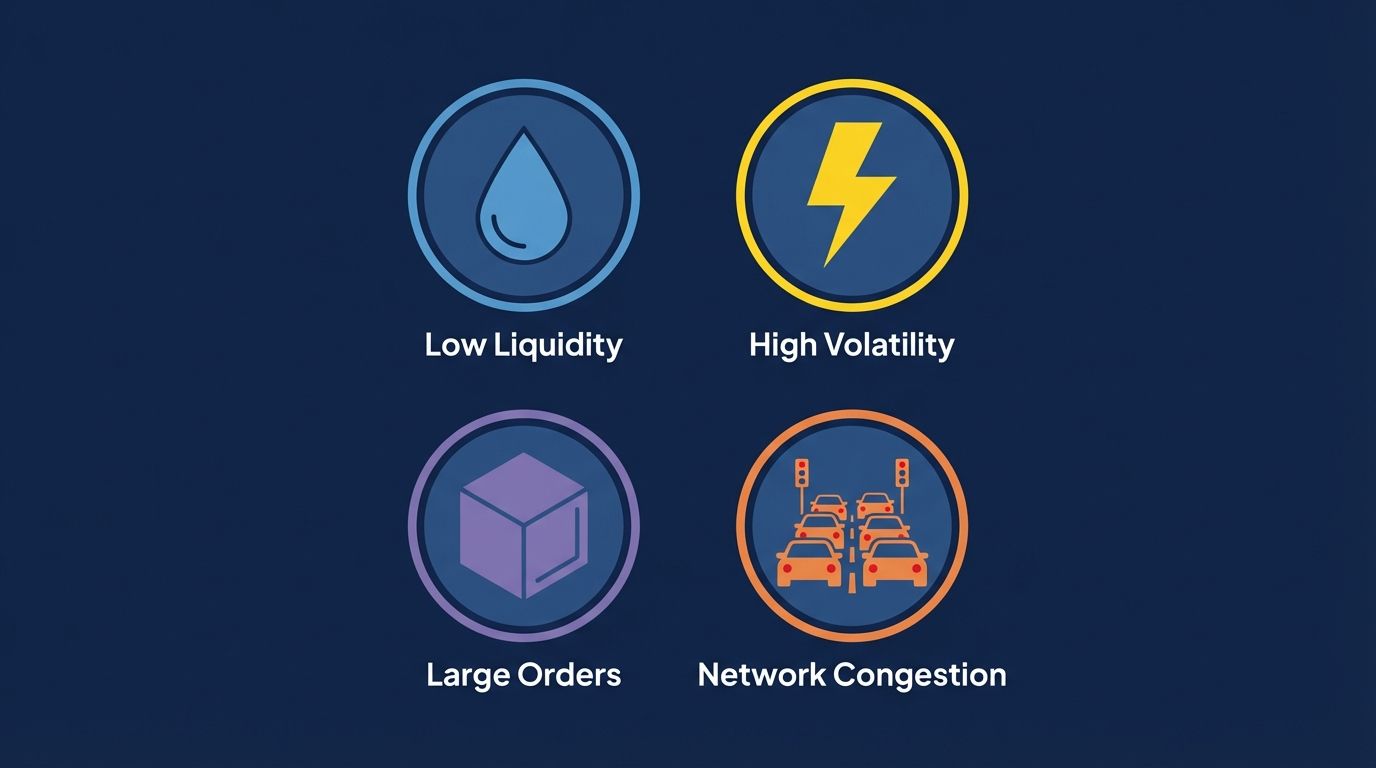
Several factors contribute to crypto slippage. Knowing these causes allows you to anticipate when slippage is likely and take preventive action before placing your trades.
Low Liquidity
Liquidity refers to how easily an asset can be bought or sold without significantly affecting its price. High-liquidity pairs like BTC/USDT on major exchanges have deep order books with plenty of buy and sell orders at various price levels. When you trade a low-liquidity pair, there may not be enough orders at your desired price to fill your entire trade. The order then "walks" through the order book, filling at progressively worse prices. This is one of the most common causes of crypto slippage, especially for newer or smaller-cap tokens.
High Volatility
Cryptocurrency prices can move dramatically within seconds. During periods of extreme volatility, such as major news events, exchange outages, or large liquidation cascades, prices shift rapidly between the moment you click "buy" or "sell" and the moment your order reaches the exchange matching engine. The faster prices move, the greater the potential for slippage. Major market events like Federal Reserve announcements, regulatory news, or sudden whale movements can trigger volatility spikes that increase slippage across the entire market.
Large Order Sizes
Even in liquid markets, placing an exceptionally large order relative to the available order book depth can cause slippage. If you want to buy $500,000 worth of an altcoin but the order book only has $50,000 in sell orders near the current price, your order will consume multiple price levels to get filled. Each successive price level is slightly worse than the previous one. This is sometimes called "price impact" and is closely related to slippage. Institutional traders and whales must manage this carefully to avoid moving the market against themselves.
Network Congestion
For trades executed on decentralized exchanges (DEXs), network congestion adds another layer of slippage risk. When blockchains like Ethereum experience high transaction volumes, your swap transaction may sit in the mempool for minutes before being confirmed. During that waiting period, the price of the token can change substantially. Additionally, on DEXs, other traders or bots may front-run your transaction by paying higher gas fees to get their orders executed first, further increasing the slippage you experience. This is a unique challenge in decentralized trading that centralized exchanges largely avoid.
3. Types of Crypto Slippage
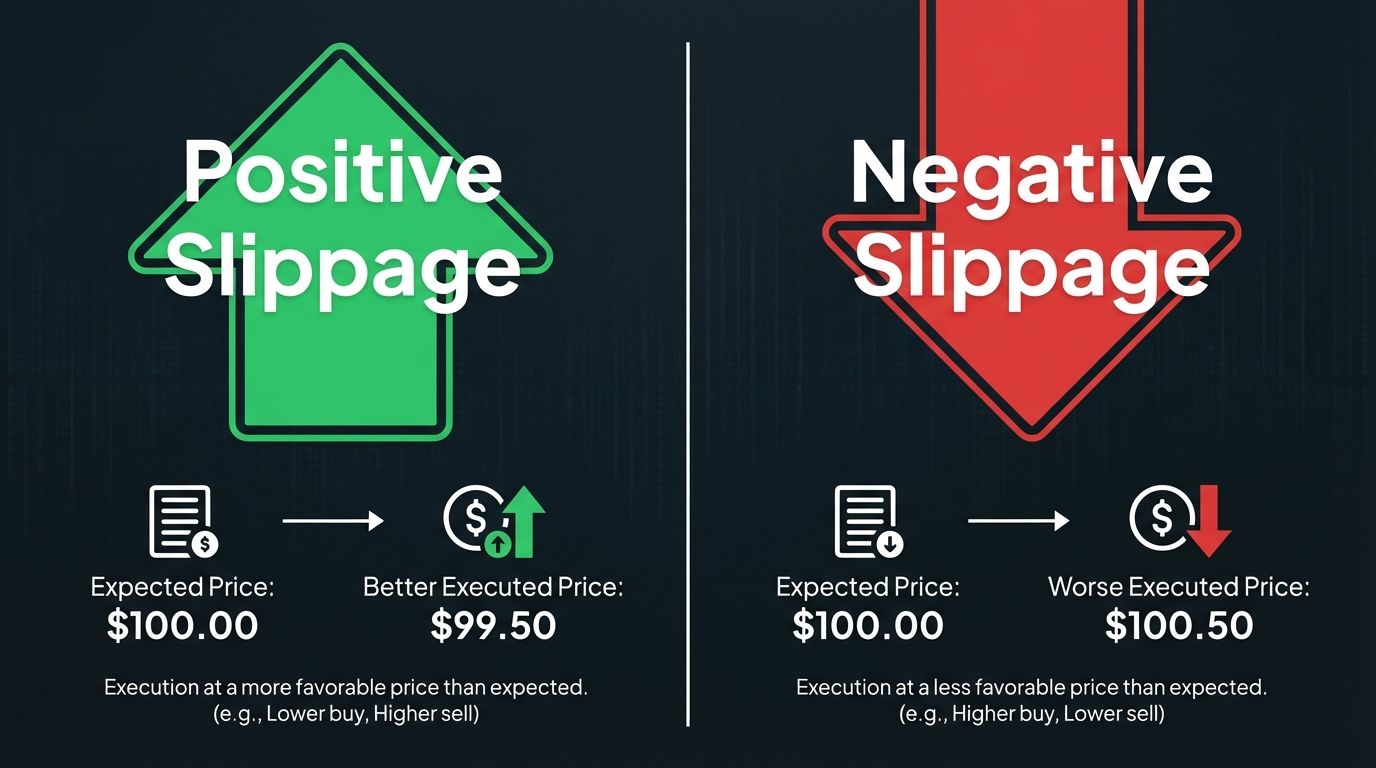
Not all slippage works against you. Understanding the two types of slippage helps you see the full picture and set realistic expectations for your trades.
Negative Slippage
Negative slippage is the more commonly discussed type because it costs you money. It occurs when your order fills at a worse price than expected. For a buy order, negative slippage means you pay more than anticipated. For a sell order, it means you receive less. For example, if you place a market sell order for Ethereum at $3,500 but it fills at $3,480, you have experienced $20 of negative slippage per ETH. Across a position of 10 ETH, that adds up to $200 in unexpected losses.
Positive Slippage
Positive slippage works in your favor. It happens when market conditions shift and your order fills at a better price than you expected. Using the same example, if your buy order for Ethereum at $3,500 actually fills at $3,485, you have saved $15 per ETH. While positive slippage does occur, traders should not rely on it. Over a large number of trades, slippage tends to be slightly negative on average because market makers and high-frequency traders are faster at capturing favorable price movements.
Most exchanges and DEXs allow you to set a "slippage tolerance" percentage. This defines the maximum slippage you are willing to accept before your order is automatically canceled. Setting this parameter correctly is a critical skill for managing both types of slippage.
4. How to Calculate Crypto Slippage
Calculating slippage is straightforward once you understand the formula. Knowing how to measure it allows you to track your trading efficiency and identify patterns in when and where slippage hits you hardest.
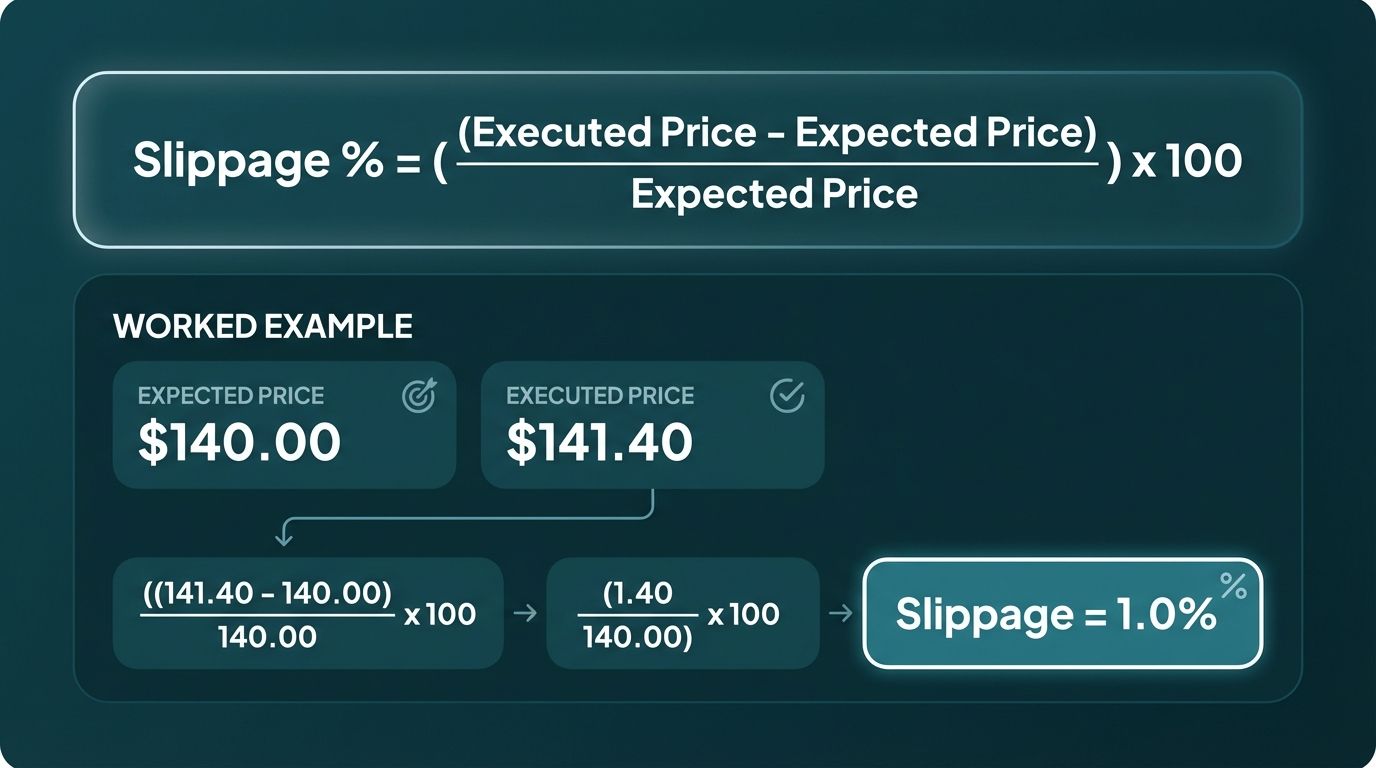
The basic slippage formula is:
Slippage (%) = ((Executed Price - Expected Price) / Expected Price) x 100
Here is a practical example. Suppose you place a market order to buy Solana (SOL) when the displayed price is $140.00. Your order fills at $141.40. The slippage calculation would be:
Slippage = ((141.40 - 140.00) / 140.00) x 100 = 1.0%
In this case, you experienced 1% negative slippage on your buy order. For a $10,000 position, that equals $100 in slippage cost. If you make 50 similar trades per month with an average slippage of 0.5%, you are losing approximately $2,500 monthly to slippage alone.
To track slippage effectively, consider maintaining a simple trading log. Record the expected price (the price shown when you initiated the order), the actual fill price, the pair traded, the time of day, and the exchange used. Over time, this data reveals which pairs, exchanges, and market conditions produce the most slippage, allowing you to adjust your strategy accordingly.
For traders using decentralized exchanges, slippage calculation should also account for gas fees and any price impact displayed by the DEX interface. Many DEX platforms like Uniswap and Jupiter show estimated slippage and price impact before you confirm a transaction, giving you a chance to cancel if the numbers are too high.
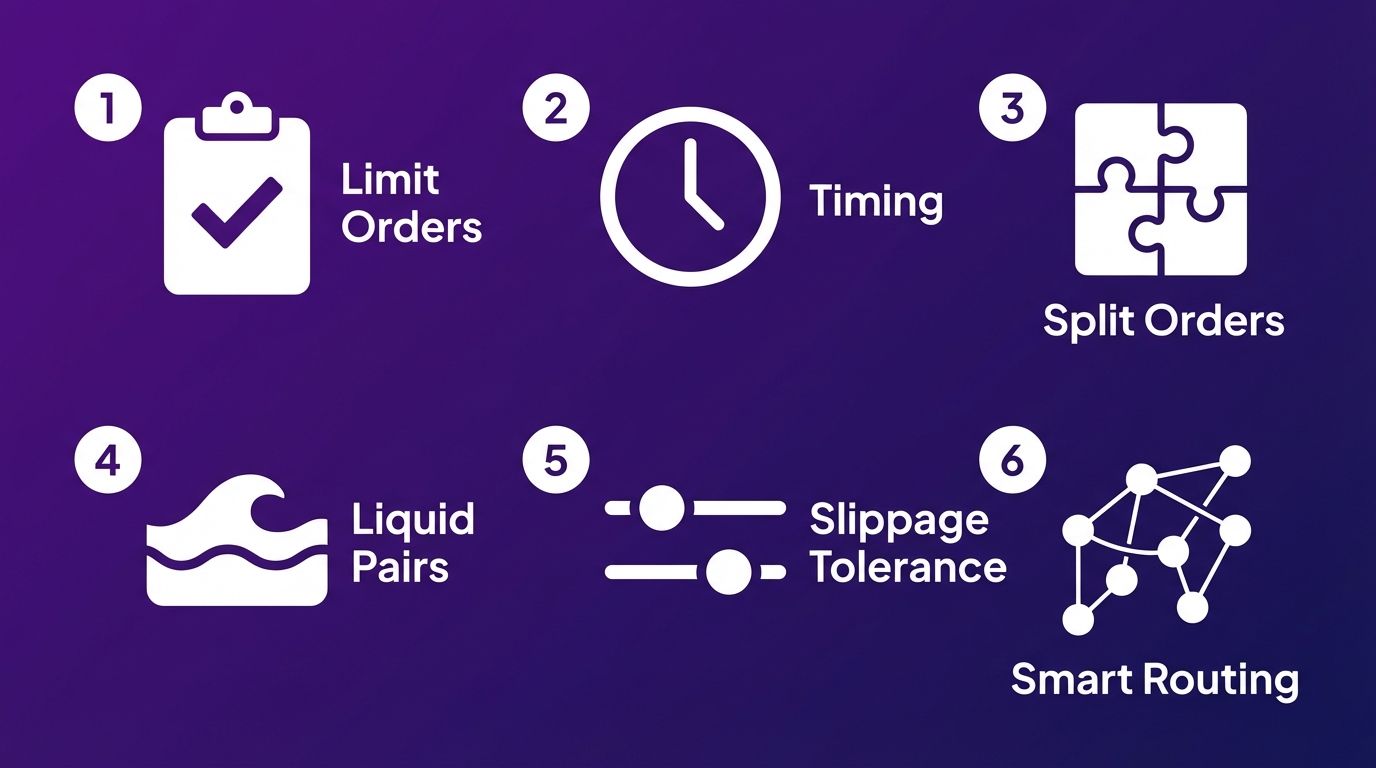
5. 6 Strategies to Minimize Crypto Slippage
While you cannot eliminate slippage entirely, you can reduce it dramatically with the right approach. These proven strategies help you keep more of your profits and execute trades closer to your intended price.
Strategy 1: Use Limit Orders Instead of Market Orders
The single most effective way to control slippage is to use limit orders rather than market orders. A limit order specifies the exact maximum price you are willing to pay (for buys) or the minimum price you will accept (for sells). Your order will only execute at your specified price or better, never worse. The trade-off is that limit orders are not guaranteed to fill if the market moves away from your price. However, for most trading scenarios, the protection against slippage is well worth the possibility of a missed entry.
Strategy 2: Trade During High-Liquidity Periods
Crypto markets run around the clock, but liquidity is not constant. Trading volume typically peaks during the overlap of U.S. and European trading hours (roughly 13:00 to 17:00 UTC). During these windows, order books are deepest and spreads are tightest, meaning your orders are more likely to fill near your expected price. Avoid placing large market orders during weekends, holidays, or low-activity hours when liquidity thins out and slippage risk increases.
Strategy 3: Split Large Orders Into Smaller Pieces
If you need to execute a large position, break it into multiple smaller orders spread across time. Instead of placing a single $100,000 market order, consider executing ten $10,000 orders over the course of an hour. Each smaller order has less impact on the order book and is more likely to fill near the current market price. This technique, sometimes called "order splitting" or using a TWAP (Time-Weighted Average Price) strategy, is standard practice among institutional traders and is equally valuable for retail traders dealing with less liquid pairs.
Strategy 4: Choose Highly Liquid Trading Pairs
Whenever possible, trade pairs with high daily volume and deep order books. Major pairs like BTC/USDT, ETH/USDT, and SOL/USDT on large exchanges typically have minimal slippage for standard order sizes. If you must trade a smaller altcoin, check the order book depth before placing your order. Many exchanges display order book visualization tools that show how much liquidity exists at each price level. If the depth is shallow, expect slippage and adjust your order size or use limit orders accordingly.
Strategy 5: Set Appropriate Slippage Tolerance
On decentralized exchanges, always configure your slippage tolerance before confirming a swap. Setting it too low (like 0.1%) may cause your transactions to fail repeatedly. Setting it too high (like 10%) exposes you to front-running bots and excessive slippage. For most major token swaps on DEXs, a slippage tolerance between 0.5% and 1.5% is reasonable. For newer or lower-liquidity tokens, you may need to increase it, but do so cautiously and understand the risk involved.
Strategy 6: Use Advanced Trading Platforms With Smart Order Routing
Modern trading platforms can aggregate liquidity from multiple sources and route your orders to minimize slippage automatically. Platforms that connect to multiple exchanges simultaneously can find the best available price across all connected venues, significantly reducing the chance that your order walks through a thin order book. Smart order routing technology handles the complexity of finding optimal execution paths so you can focus on your trading strategy rather than worrying about execution quality.
6. How Altrady Helps You Manage Crypto Slippage
Altrady is built with execution quality in mind. The platform provides a comprehensive suite of tools designed to help traders minimize slippage and maintain control over their order execution across multiple exchanges from a single interface.
With Altrady, you can connect to multiple major exchanges simultaneously and monitor order book depth across all of them in real time. This visibility allows you to identify where liquidity is deepest before placing your trades, helping you choose the optimal exchange and trading pair for each order.
The platform supports advanced order types including limit orders, ladder orders, and smart trading features that give you precise control over your entry and exit prices. Ladder orders automatically split your position across multiple price levels, implementing the order-splitting strategy described above without manual effort. This reduces your market impact and helps achieve better average fill prices.
Altrady's real-time portfolio tracking and trade analytics also make it easy to monitor your actual execution prices versus your intended prices across all connected exchanges. By reviewing this data regularly, you can identify which pairs, times, and exchanges give you the best execution and adjust your trading habits accordingly.
The multi-exchange dashboard eliminates the need to switch between exchange tabs, which means faster order placement and less time for prices to move between your decision and your execution. In fast-moving markets, those extra seconds can make a meaningful difference in slippage.
Start Trading With Less Slippage Today
Crypto slippage does not have to drain your trading profits. With the right tools and strategies, you can significantly reduce slippage and keep more of your gains. Altrady gives you the multi-exchange connectivity, advanced order types, and real-time market data you need to execute trades at the prices you actually want.
Ready to take control of your trade execution? Sign up for a free trial of Altrady today and experience the difference that professional-grade trading tools make. Stop losing money to slippage and start trading smarter.
Frequently Asked Questions
What is a good slippage tolerance for crypto trading?
For major cryptocurrency pairs on centralized exchanges, slippage should typically be below 0.1% for standard order sizes. On decentralized exchanges, setting a slippage tolerance between 0.5% and 1.5% is generally appropriate for established tokens. For low-liquidity altcoins on DEXs, you may need to set tolerance as high as 3% to 5%, but always be aware that higher tolerance increases your exposure to front-running and unfavorable fills.
Is crypto slippage the same as trading fees?
No, slippage and trading fees are completely different costs. Trading fees are fixed percentages charged by the exchange for facilitating your trade. Slippage is the variable difference between your expected execution price and your actual fill price, caused by market conditions like liquidity and volatility. Both reduce your net profit, but they are managed through different strategies. You can minimize fees by choosing low-fee exchanges, and you can minimize slippage by using limit orders and trading liquid pairs.
Why is slippage worse on decentralized exchanges?
Decentralized exchanges (DEXs) often experience higher slippage for several reasons. First, they use automated market maker (AMM) models instead of traditional order books, which means large trades create proportionally larger price impacts. Second, blockchain transaction times create a delay between when you submit your swap and when it executes, during which prices can change. Third, DEX liquidity is often more fragmented across multiple pools and protocols. Finally, front-running bots on public blockchains can detect your pending transaction and trade ahead of you, worsening your execution price.
Can slippage ever work in my favor?
Yes, positive slippage occurs when your order fills at a better price than expected. For example, if you place a buy order expecting to pay $100 per token but the market moves down and you fill at $99, you benefit from $1 of positive slippage. While this does happen, it is less frequent than negative slippage for most retail traders because market makers and high-frequency trading algorithms are faster at capturing favorable price movements. You should not count on positive slippage in your trading plan, but it is a welcome bonus when it occurs.
How does order size affect slippage?
Order size has a direct relationship with slippage. Larger orders relative to the available liquidity in the order book will experience more slippage because they consume multiple price levels to get filled. A $1,000 market order on BTC/USDT might experience negligible slippage, while a $1,000,000 order on the same pair could move the price noticeably. For smaller-cap tokens with thinner order books, even moderate-sized orders can cause significant slippage. This is why splitting large orders into smaller pieces is one of the most effective strategies for reducing slippage.