
The crypto market never sleeps, and without a structured plan, neither will you. Whether you are chasing pumps on altcoins or panic-selling during a Bitcoin dip, trading on emotion is the fastest way to drain your portfolio. Learning how to create a crypto trading plan is the single most important step you can take to trade with confidence, protect your capital, and build consistent results over time.
A trading plan is your personal rulebook. It defines what you trade, when you enter and exit, how much you risk, and how you measure success. Professional traders across every financial market rely on written plans, and crypto is no exception. In this guide, you will learn exactly how to create a crypto trading plan step by step, from setting goals to reviewing performance.
Why Every Crypto Trader Needs a Written Trading Plan
Most traders skip the planning phase entirely. They open an exchange, see a coin pumping on social media, and throw money at it. Sometimes it works. Most of the time, it does not. Without a plan, every decision becomes emotional, and emotional decisions compound into losses.
A written trading plan solves this by giving you a framework for decision-making before the pressure hits. When Bitcoin drops 15% in an hour, your plan already tells you what to do. When a new token is trending on every crypto forum, your plan tells you whether it fits your strategy or not.
Here is what a solid trading plan provides:
- Consistency: You follow the same process for every trade, removing guesswork
- Accountability: You can review your decisions against your own rules
- Emotional control: The plan decides, not your fear or greed
- Measurable improvement: A written plan gives you data to analyze and optimize
Think of your trading plan as a business plan. No serious business operates without one, and your trading account deserves the same discipline.
Setting Clear Trading Goals
Before you place a single trade, you need to define what success looks like. Vague goals like "make money" or "get rich from crypto" will not guide your decisions. Your goals need to be specific, measurable, and time-bound.
Short-Term vs Long-Term Goals
Short-term goals focus on weekly or monthly targets. Examples include:
- Achieve a 5% portfolio return per month
- Limit maximum drawdown to 10% per quarter
- Execute at least 20 trades per month following your system
Long-term goals cover annual targets and career-level objectives:
- Grow your trading account by 50% in one year
- Transition from part-time to full-time trading within two years
- Build a diversified crypto portfolio worth a specific dollar amount
Income vs Growth Objectives
Your goals also depend on whether you need active income from trading or you are focused on long-term capital growth. Income-focused traders typically take more frequent trades and aim for smaller, consistent profits. Growth-focused traders may hold positions longer and tolerate larger drawdowns in exchange for bigger overall returns.
Write your goals down. Revisit them every quarter. Adjust as your skills, capital, and market conditions change.
Choosing Your Trading Style
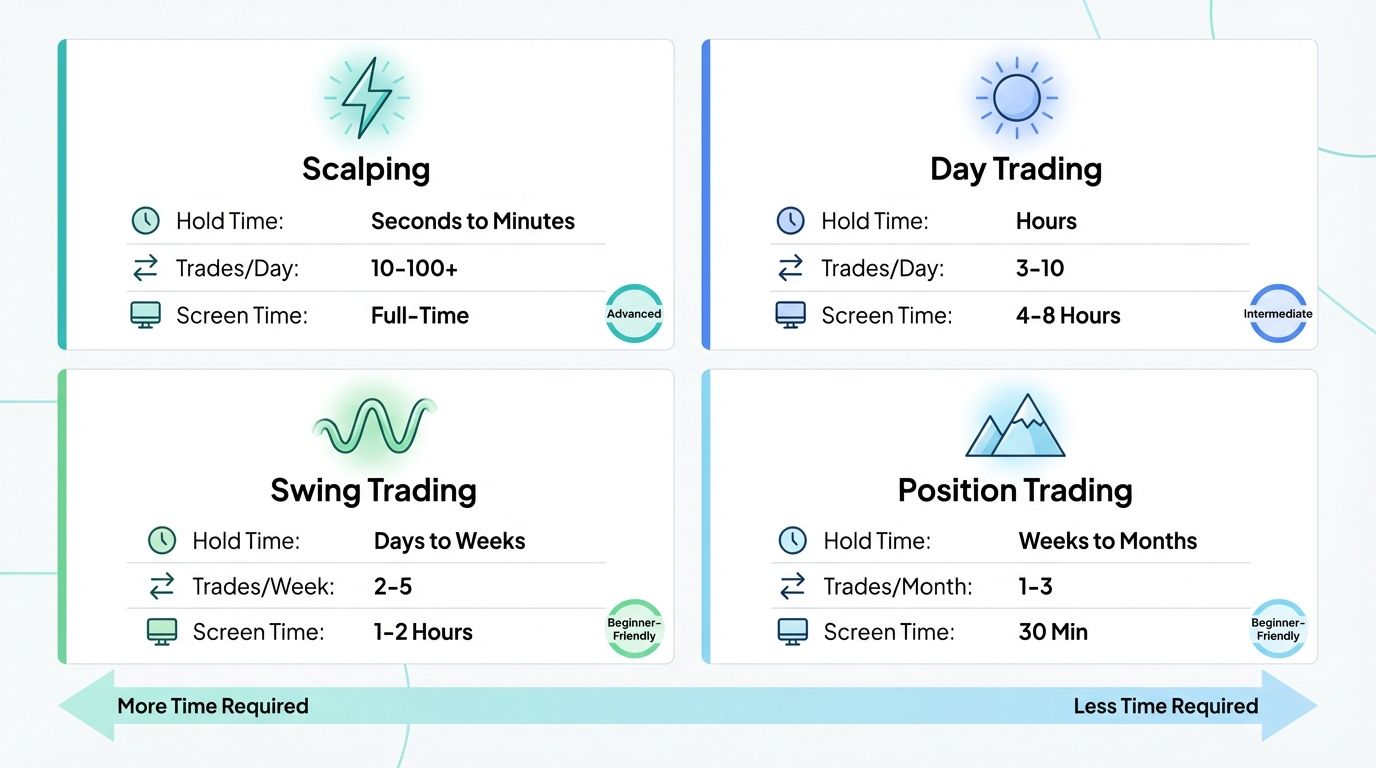
Your trading style determines how often you trade, how long you hold positions, and how much time you spend monitoring charts. Picking the right style is critical because it must align with your schedule, personality, and risk tolerance.
Day Trading
Day traders open and close all positions within a single trading day. This style requires:
- Several hours of active screen time daily
- Fast decision-making and execution
- Strong understanding of intraday technical analysis
- Tight risk management, typically risking 0.5% to 1% per trade
Day trading suits people who can dedicate full attention to the markets during active hours and who thrive under fast-paced conditions.
Swing Trading
Swing traders hold positions for days to weeks, capturing medium-term price movements. This style is ideal if you:
- Have a full-time job and cannot watch charts all day
- Prefer analyzing daily and 4-hour timeframes
- Are comfortable holding through overnight volatility
- Want a balance between trade frequency and time commitment
Position Trading
Position traders hold for weeks to months, focusing on major trends and fundamental shifts. This approach requires patience, a larger risk tolerance per trade, and a strong conviction in your analysis.
Scalping
Scalpers make dozens or even hundreds of trades per day, targeting tiny price movements. This style demands:
- Extremely fast execution (often automated)
- Very low trading fees
- Access to high-liquidity markets
- Intense focus and discipline
Choose one primary style and master it before experimenting with others. Trying to scalp, swing trade, and position trade simultaneously is a recipe for confusion.
Defining Your Risk Management Rules
Risk management is where most trading plans succeed or fail. You can have the best entry strategy in the world, but without proper risk controls, one bad trade can wipe out months of profits. This section is non-negotiable when learning how to create a crypto trading plan.
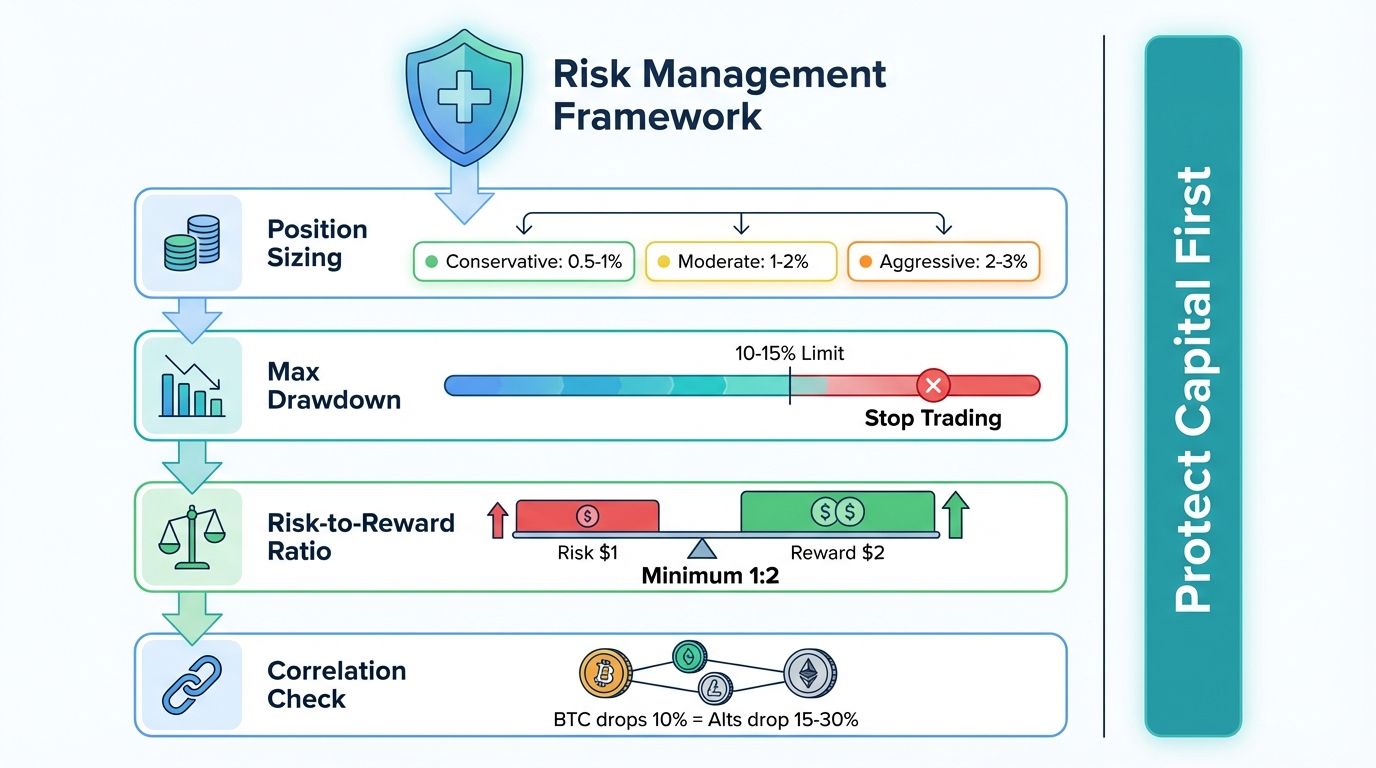
Position Sizing
Position sizing determines how much capital you allocate to each trade. The most common approach is the percentage risk model:
- Conservative: Risk 0.5% to 1% of total capital per trade
- Moderate: Risk 1% to 2% of total capital per trade
- Aggressive: Risk 2% to 3% of total capital per trade (not recommended for beginners)
For example, if your trading account holds $10,000 and you risk 1% per trade, your maximum loss on any single trade is $100. This means your stop-loss placement and position size must be calculated so that if the stop is hit, you lose no more than $100.
Maximum Drawdown Limits
Set a maximum drawdown threshold for your account. A common rule is to stop trading if your account drops by 10% to 15% from its peak. At that point, step back, review your trades, and identify what went wrong before resuming.
Risk-to-Reward Ratio
Every trade should have a minimum risk-to-reward ratio before you enter. A 1:2 ratio means you risk $1 to potentially make $2. Many successful traders will not take any trade below a 1:1.5 ratio.
Correlation Risk
In crypto, many altcoins are heavily correlated with Bitcoin. If you hold five long positions on five different altcoins and Bitcoin drops 10%, all five positions may move against you simultaneously. Account for correlation when calculating your total portfolio exposure.
Entry and Exit Criteria
Your trading plan must define exactly when you enter a trade and when you exit, both in profit and at a loss. Leaving this to "feel" is not a plan.
Technical Indicators
Common technical tools for crypto trading entries include:
- Moving averages: A crossover of the 20-period and 50-period moving averages on the daily chart can signal trend direction
- RSI (Relative Strength Index): Readings below 30 may indicate oversold conditions, while readings above 70 suggest overbought levels
- Volume: Breakouts confirmed by above-average volume tend to be more reliable
- Support and resistance levels: Price zones where buying or selling pressure has historically been strong
Price Action Signals
Many traders prefer pure price action, using candlestick patterns and chart structures:
- Bullish engulfing candles at support levels
- Higher highs and higher lows confirming uptrends
- Breakouts from consolidation ranges with strong momentum
Fundamental Triggers
Crypto fundamentals can also drive entries:
- Major protocol upgrades (e.g., Ethereum network updates)
- Regulatory decisions affecting specific tokens
- Adoption milestones, partnerships, or exchange listings
- On-chain metrics showing increased network activity
Exit Rules
Your exit strategy is just as important as your entry. Define these in advance:
- Stop-loss: The exact price level where you exit a losing trade. Never move your stop-loss further away from your entry
- Take-profit targets: Set at least one take-profit level based on key resistance zones or a fixed risk-to-reward ratio
- Trailing stops: A dynamic stop that moves in your favor as the price rises, locking in profits while allowing the trade to run
- Time-based exits: If a trade has not moved in your direction within a set period (e.g., 5 days for a swing trade), close it and move on
Capital Allocation and Portfolio Rules
Beyond individual trades, your plan should address how you allocate capital across your entire portfolio.
Allocation Framework
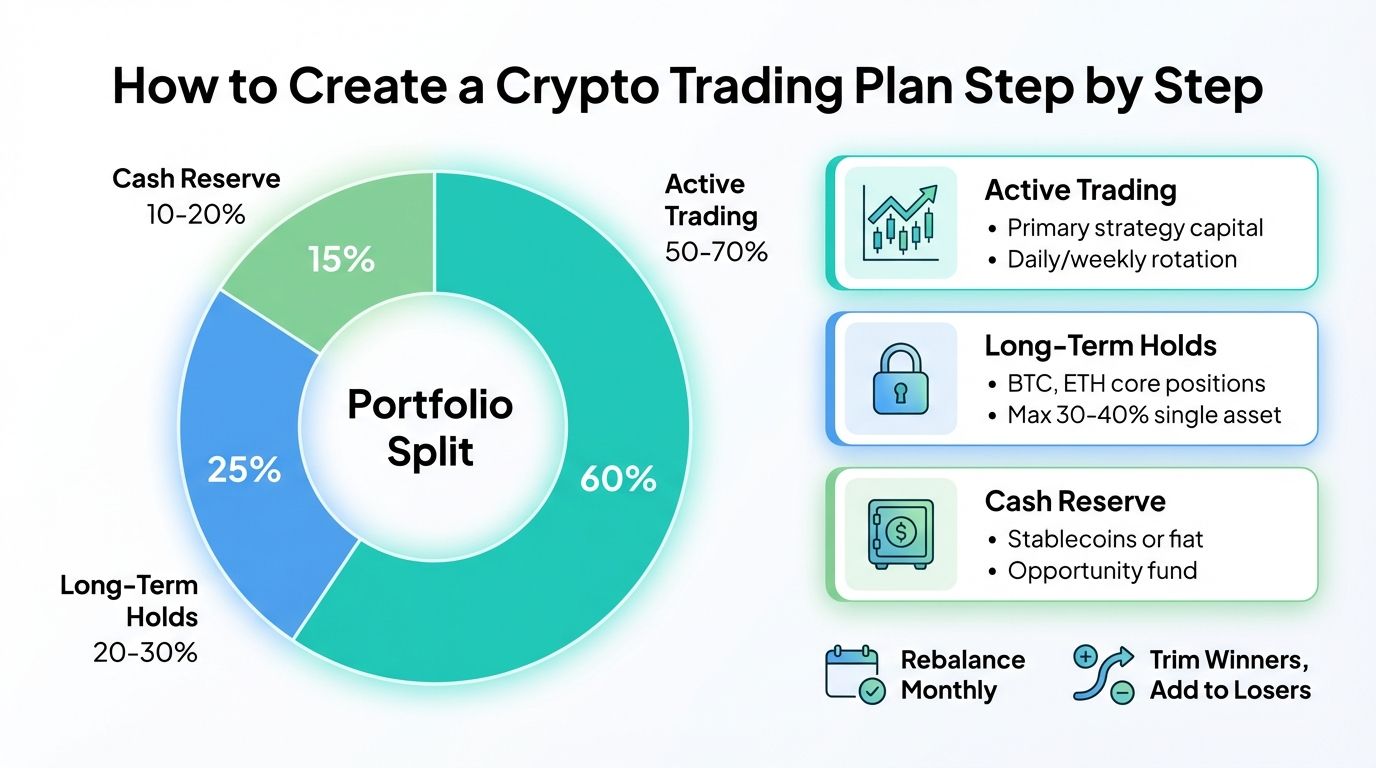
Consider dividing your crypto capital into buckets:
- Active trading capital (50% to 70%): Funds used for your primary trading strategy
- Long-term holds (20% to 30%): Core positions in assets you believe in fundamentally (Bitcoin, Ethereum, or other high-conviction picks)
- Cash reserve (10% to 20%): Stablecoins or fiat kept on the sidelines for unexpected opportunities or to reduce exposure during high-volatility periods
Diversification Rules
Set limits on how much of your portfolio can be in a single asset. A common rule is no more than 10% to 15% in any single altcoin, with a higher allowance (up to 30% to 40%) for Bitcoin or Ethereum due to their relative stability and liquidity.
Rebalancing Schedule
Review your portfolio allocation monthly. If one position has grown significantly compared to others, consider trimming it back to your target allocation. This enforces the discipline of taking profits and prevents overexposure to a single asset.
Keeping a Trading Journal and Reviewing Performance
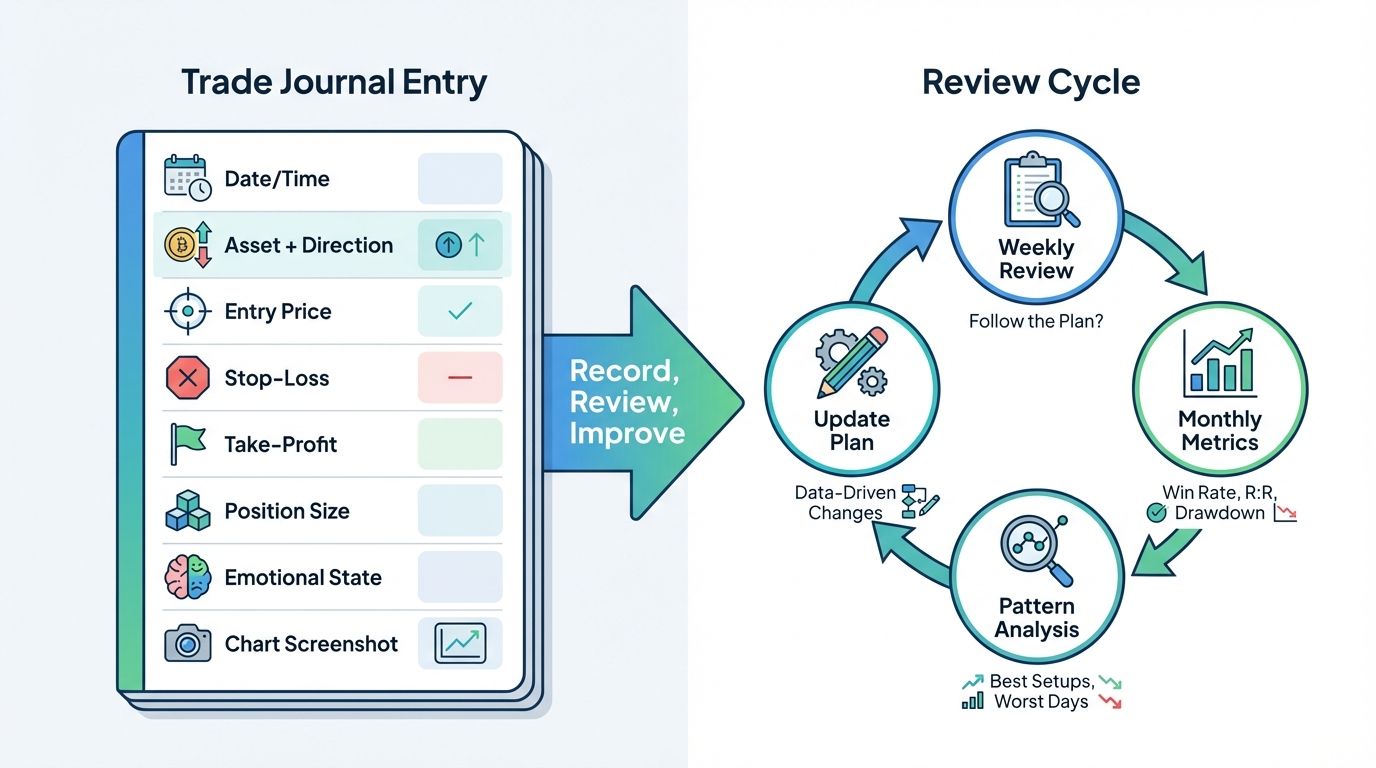
A trading plan without a review process is incomplete. Your journal is where theory meets reality, and where the real learning happens.
What to Record for Every Trade
- Date and time of entry and exit
- Asset traded and direction (long or short)
- Entry price, stop-loss, and take-profit levels
- Position size and risk amount
- The specific setup or signal that triggered the trade
- Your emotional state at entry and exit
- The outcome: profit, loss, or breakeven
- Screenshots of the chart at entry and exit
Weekly and Monthly Reviews
Set a recurring schedule to review your trading journal:
- Weekly review: Look at all trades from the past week. Did you follow your plan? Which setups worked best? Were there any impulsive trades?
- Monthly review: Analyze win rate, average risk-to-reward, total return, and maximum drawdown. Compare these metrics against your goals. Adjust your plan if the data supports changes.
Your journal will reveal patterns you cannot see in the moment. Maybe you perform poorly on Monday mornings. Maybe your win rate is significantly higher on swing trades compared to day trades. This data is gold.
Common Mistakes When Creating a Crypto Trading Plan
Even traders who build a plan often make critical errors. Avoid these pitfalls:
Making the Plan Too Complicated
A 50-page plan with 20 indicators and dozens of rules is not practical. You need a plan that fits on one to two pages and that you can reference quickly during live trading. Simplicity breeds consistency.
Not Following the Plan
The best plan in the world is useless if you ignore it. If you find yourself constantly deviating from your rules, either your plan does not match your personality (and needs adjustment) or you lack the discipline to execute (and need to work on that first).
Failing to Update the Plan
Markets change. Your skills improve. A plan written six months ago may need updates based on new data from your journal. Treat your plan as a living document, not a static contract.
Ignoring Risk Management
Many traders spend 90% of their planning time on entries and almost none on exits, position sizing, or drawdown limits. The risk management section of your plan is arguably the most important part. Prioritize it.
Overtrading
A good trading plan limits how often you trade. If your plan calls for swing trades but you are placing five trades a day, you are overtrading. More trades do not equal more profits. In fact, overtrading usually increases fees and emotional fatigue.
How Tools Like Altrady Help Execute Your Trading Plan
Knowing how to create a crypto trading plan is one thing. Executing it consistently across multiple exchanges is another challenge entirely. This is where a dedicated trading platform becomes essential.
Altrady is designed for traders who want to manage their entire trading workflow from a single dashboard. Instead of logging into three or four different exchanges, you can view all your portfolios, set up trades, and manage risk in one place.
Key features that support your trading plan execution:
- Multi-exchange trading: Execute trades across Binance, Coinbase, Kraken, KuCoin, and many more without switching tabs
- Smart order types: Set up laddered orders, trailing stops, and take-profit targets that match your plan's exit rules precisely
- Portfolio tracking: Monitor your capital allocation across all exchanges in real time, ensuring you stay within your portfolio rules
- Quick scanner: Identify trading opportunities that match your criteria using customizable filters for volume, price change, and technical signals
- Alerts and notifications: Get notified when your setups trigger, so you never miss a planned entry
Trading with discipline is much easier when your tools are built for it. Altrady removes the friction of multi-exchange management and gives you the control needed to stick to your plan.
Ready to put your trading plan into action? Start your free trial with Altrady and experience how a professional-grade platform makes disciplined trading possible across all your exchanges.
Frequently Asked Questions
How often should I update my crypto trading plan?
Review your plan at least once per month during your performance review. Make adjustments when your trading journal data shows consistent underperformance in a specific area, when market conditions shift significantly (such as transitioning from a bull to a bear market), or when your personal financial goals change. Avoid making impulsive changes after a single losing trade. Let the data guide your revisions over a meaningful sample size of at least 20 to 30 trades.
Can I use the same trading plan for all cryptocurrencies?
Your core risk management rules (position sizing, maximum drawdown, risk-to-reward minimums) should apply to all assets. However, your entry and exit criteria may need adjustments for different types of cryptocurrencies. Large-cap coins like Bitcoin and Ethereum tend to move differently than small-cap altcoins. Volatility, liquidity, and spread differences mean that stop-loss distances and position sizes may vary. Your plan should account for these differences with asset-specific guidelines.
What is the biggest mistake beginners make with crypto trading plans?
The most common mistake is creating a plan but not following it. Many beginners spend time building detailed rules, then abandon them the moment the market gets exciting or scary. The second biggest mistake is neglecting risk management entirely, focusing only on entries while ignoring stop-losses, position sizing, and drawdown limits. A trading plan is only valuable if you execute it consistently and protect your capital first.
Do I need trading software to follow a trading plan?
While you can technically follow a trading plan with manual exchange logins and a spreadsheet, trading software makes execution significantly easier and more reliable. Platforms like Altrady allow you to set automated stop-losses, trailing stops, and take-profit orders that enforce your plan's rules even when you are away from the screen. For traders managing positions across multiple exchanges, a unified platform is practically essential.
How long does it take for a crypto trading plan to show results?
Give your plan at least three months and a minimum of 30 to 50 trades before evaluating its effectiveness. Short-term results in crypto are heavily influenced by market conditions, and a small sample size does not provide statistically meaningful data. Track your metrics consistently, stick to your rules, and make data-driven adjustments during your monthly reviews. Most traders see meaningful improvement in their consistency and risk management within the first quarter of disciplined plan execution.