

Every successful crypto trader knows that price charts only tell half the story. The real action happens inside the crypto order book, where buyers and sellers reveal their intentions before a trade even takes place. Understanding how to read this data gives you a significant edge over traders who rely on charts alone.
A crypto order book is essentially the heartbeat of any exchange. It shows you the supply and demand for a specific trading pair in real time. Whether you are a day trader looking for quick scalps or a swing trader planning your next big move, learning to read the order book can help you time your entries, spot manipulation, and avoid costly mistakes. In this guide, we break down everything you need to know about reading a crypto order book effectively.
1. What Is a Crypto Order Book and Why It Matters
A crypto order book is a digital ledger that displays all open buy and sell orders for a specific cryptocurrency pair on an exchange. It updates in real time and is organized by price level, showing the quantity of tokens that traders want to buy or sell at each price point. Think of it as a transparent window into market sentiment at any given moment.
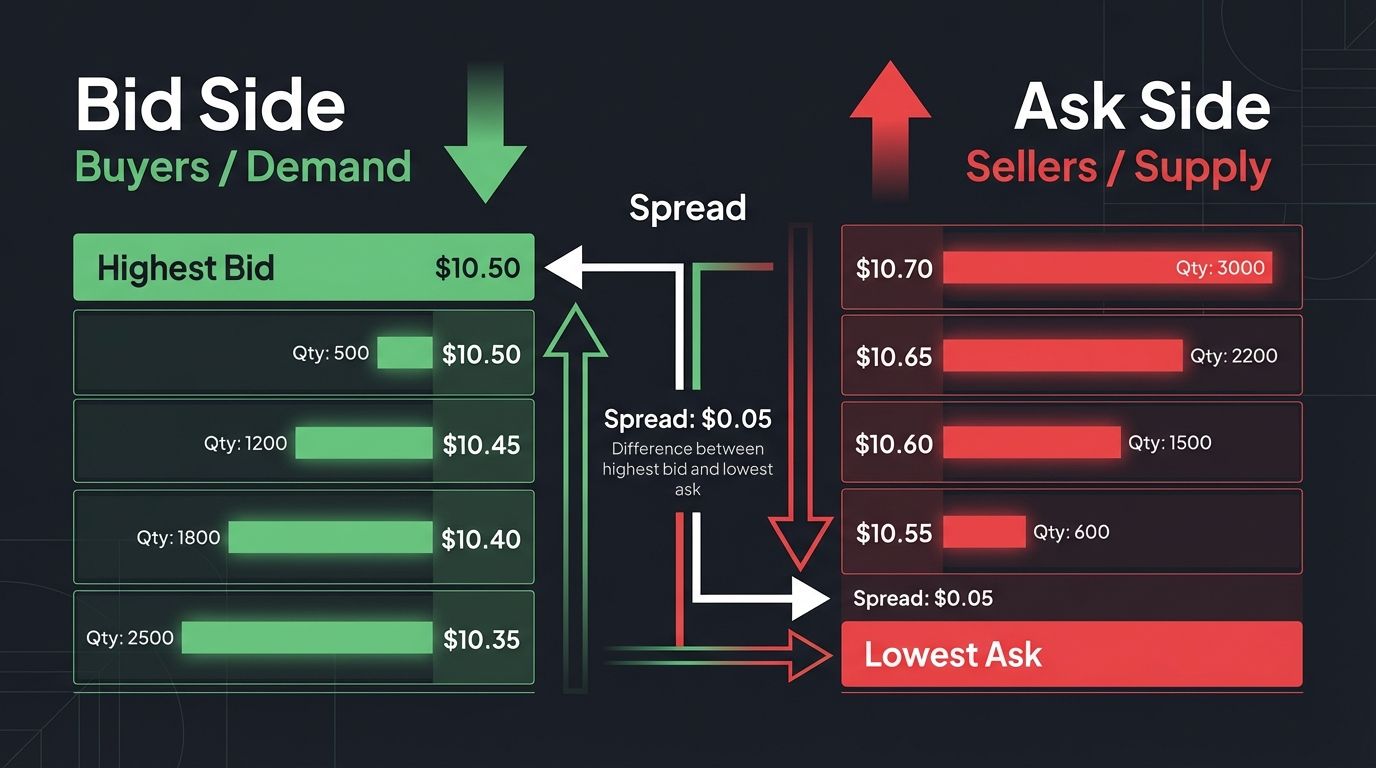
The order book consists of two primary sides. The bid side lists all pending buy orders, representing demand. The ask side (also called the offer side) lists all pending sell orders, representing supply. The gap between the highest bid and the lowest ask is known as the spread, which is a key indicator of market liquidity.
Why does this matter? Because the order book reveals information that candlestick charts simply cannot show. You can see:
- Where large players are positioning themselves before price moves happen
- How much liquidity exists at specific price levels
- Whether buying or selling pressure dominates at the current moment
- Potential support and resistance zones based on order concentration
Professional traders and market makers use the order book as their primary tool for decision-making. Retail traders who learn to read it gain a perspective that most of their competitors overlook entirely.
2. How to Read the Bid and Ask Sides
Reading the bid and ask sides of a crypto order book is the foundational skill you need to develop. Once you understand how these two columns interact, you can start extracting meaningful trading signals from raw data.
The bid side appears on the left (or bottom, depending on the exchange interface). It shows orders from buyers who want to purchase the asset at a price lower than the current market price. Bids are arranged from highest to lowest. The highest bid represents the maximum price a buyer is currently willing to pay.
The ask side appears on the right (or top). It shows orders from sellers who want to sell the asset at a price higher than the current market price. Asks are arranged from lowest to highest. The lowest ask represents the minimum price a seller is currently willing to accept.
Each row in the order book typically displays three pieces of information:
- Price - The specific price level at which the order is placed
- Quantity (Size) - The amount of the asset available at that price
- Cumulative Total - The running total of all orders up to and including that price level
The spread is the difference between the lowest ask and the highest bid. A tight spread (small gap) indicates high liquidity and active trading. A wide spread suggests lower liquidity, which means you may face more slippage when executing trades. For example, if the highest bid for BTC/USDT is $64,950 and the lowest ask is $64,955, the spread is $5. In highly liquid markets, this spread can be as low as $1 or even less.
Pay close attention to the order imbalance between bids and asks. If the bid side shows significantly more volume than the ask side near the current price, it suggests stronger buying pressure. The opposite signals stronger selling pressure. This imbalance often precedes short-term price movements.
3. Understanding Order Book Depth and the Depth Chart
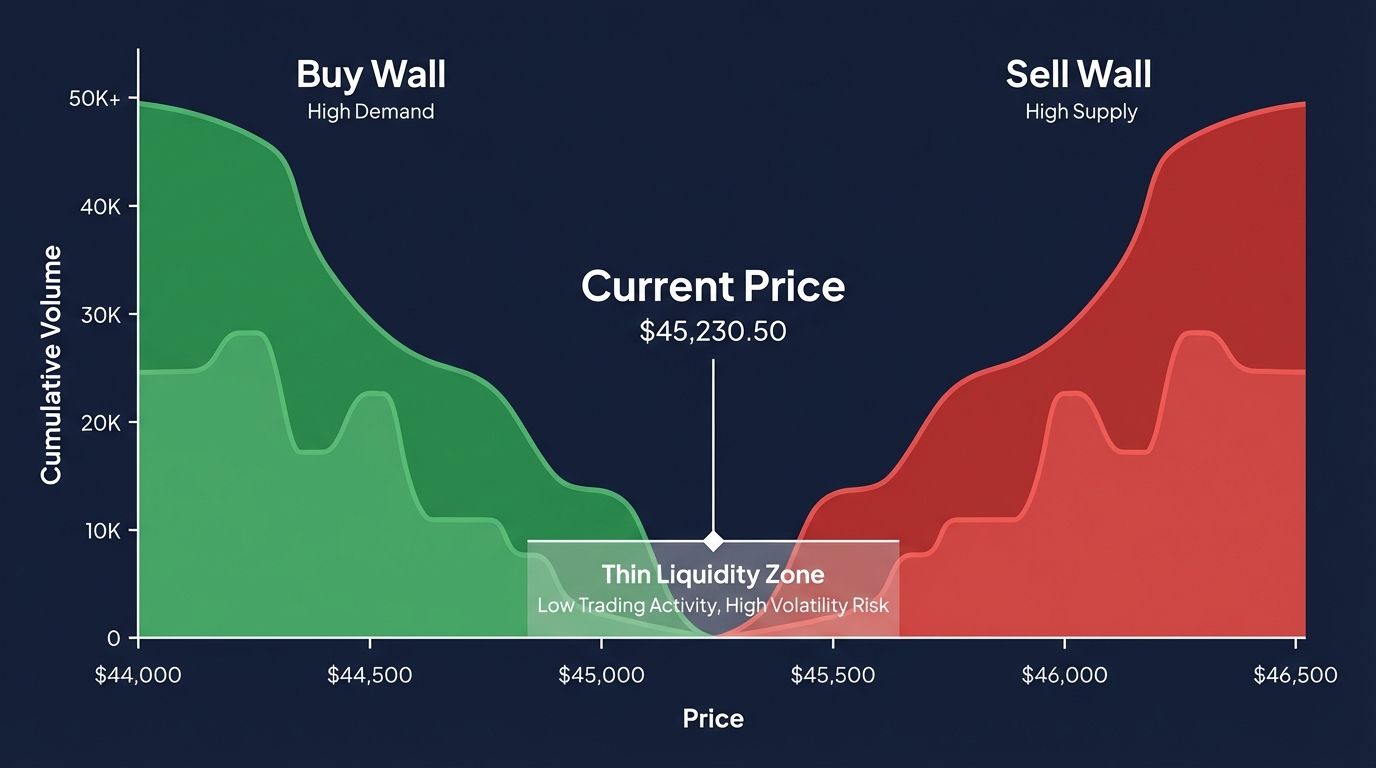
Order book depth refers to the total volume of buy and sell orders at various price levels. It gives you a visual and numerical picture of how much buying or selling interest exists across a range of prices. Most exchanges offer a depth chart, which is a graphical representation of the order book data.
The depth chart displays two curves. The green curve (left side) represents cumulative bid orders, growing from right to left as prices decrease. The red curve (right side) represents cumulative ask orders, growing from left to right as prices increase. Where the two curves meet is the current market price.
Here is what you should look for when analyzing order book depth:
- Steep walls - A sudden vertical jump on either side indicates a large concentration of orders at a specific price. These often act as temporary support (bid walls) or resistance (ask walls).
- Gradual slopes - A smooth, gradual curve suggests evenly distributed orders. This typically means the price can move more freely through those levels.
- Asymmetry - If the bid side curve is much larger than the ask side, it signals that buyers dominate. If the ask side is larger, sellers hold more power.
- Thin areas - Price levels with very few orders are vulnerable to rapid price swings. A single large market order can push through thin areas quickly, causing significant volatility.
Understanding depth is crucial for position sizing. If you plan to execute a large order, checking the depth tells you how much slippage to expect. For example, if you want to buy 10 BTC but the order book only shows 2 BTC available within a $50 range of the current price, your order will push the price up significantly as it fills through multiple price levels.
The depth chart is particularly useful for identifying key support and resistance zones. When you see a large cluster of bid orders at a specific price, that level is likely to act as support because sellers would need to fill all those buy orders to push the price lower. Similarly, a large cluster of ask orders creates resistance.
4. Types of Orders You Will See in the Order Book
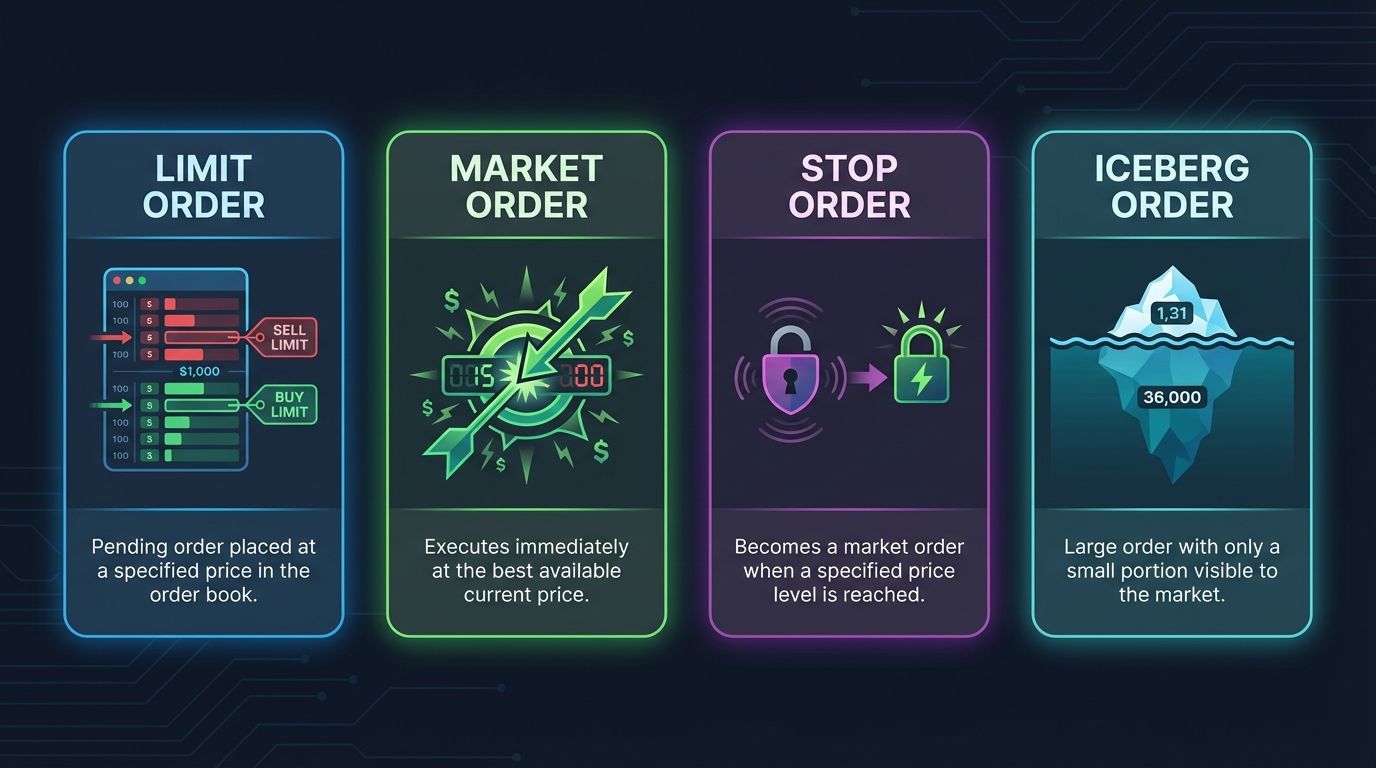
Not all orders appear in the crypto order book in the same way. Understanding the different order types helps you interpret what is happening and why certain patterns emerge. Here are the main order types every trader should know:
Limit Orders
Limit orders are the backbone of the order book. When a trader places a limit buy order, it goes on the bid side at the specified price and waits to be filled. When a trader places a limit sell order, it goes on the ask side. Limit orders are only executed at the specified price or better. They add liquidity to the market and are what create the visible structure of the order book.
Market Orders
Market orders do not appear in the order book because they execute immediately at the best available price. When someone places a market buy order, it matches against the lowest ask. When someone places a market sell order, it matches against the highest bid. Market orders remove liquidity from the order book and cause the visible orders to disappear as they are filled.
Stop Orders (Stop-Loss and Stop-Limit)
Stop orders remain hidden from the order book until they are triggered. A stop-loss order becomes a market order when the price hits the stop level. A stop-limit order becomes a limit order when triggered. Because they are invisible until activation, stop orders can create sudden bursts of volume and rapid price movements when price reaches a cluster of stop levels.
Iceberg Orders (Hidden Orders)
Iceberg orders only show a small portion of the total order size in the order book. For example, a whale wanting to buy 500 BTC might display only 5 BTC at a time, automatically refilling as each portion is filled. This makes the visible order book an incomplete picture of total market interest.
Fill or Kill (FOK) and Immediate or Cancel (IOC)
These specialized orders either execute entirely at once (FOK) or fill whatever is available and cancel the rest (IOC). They briefly interact with the order book but do not remain as standing orders. Traders use them for precise execution without leaving a footprint.
The key takeaway is that what you see in the order book is not the complete picture. Hidden orders, stop orders, and algorithmic trading strategies mean that the visible order book represents only a portion of actual market interest. Smart traders use the visible data as one input among many rather than the sole basis for decisions.
5. Advanced Order Book Strategies: Spoofing, Walls, and Iceberg Orders
Once you understand the basics of a crypto order book, you need to learn about the tactics that sophisticated traders and algorithms use to manipulate or take advantage of order flow. Recognizing these patterns can save you from falling into traps.
Spoofing
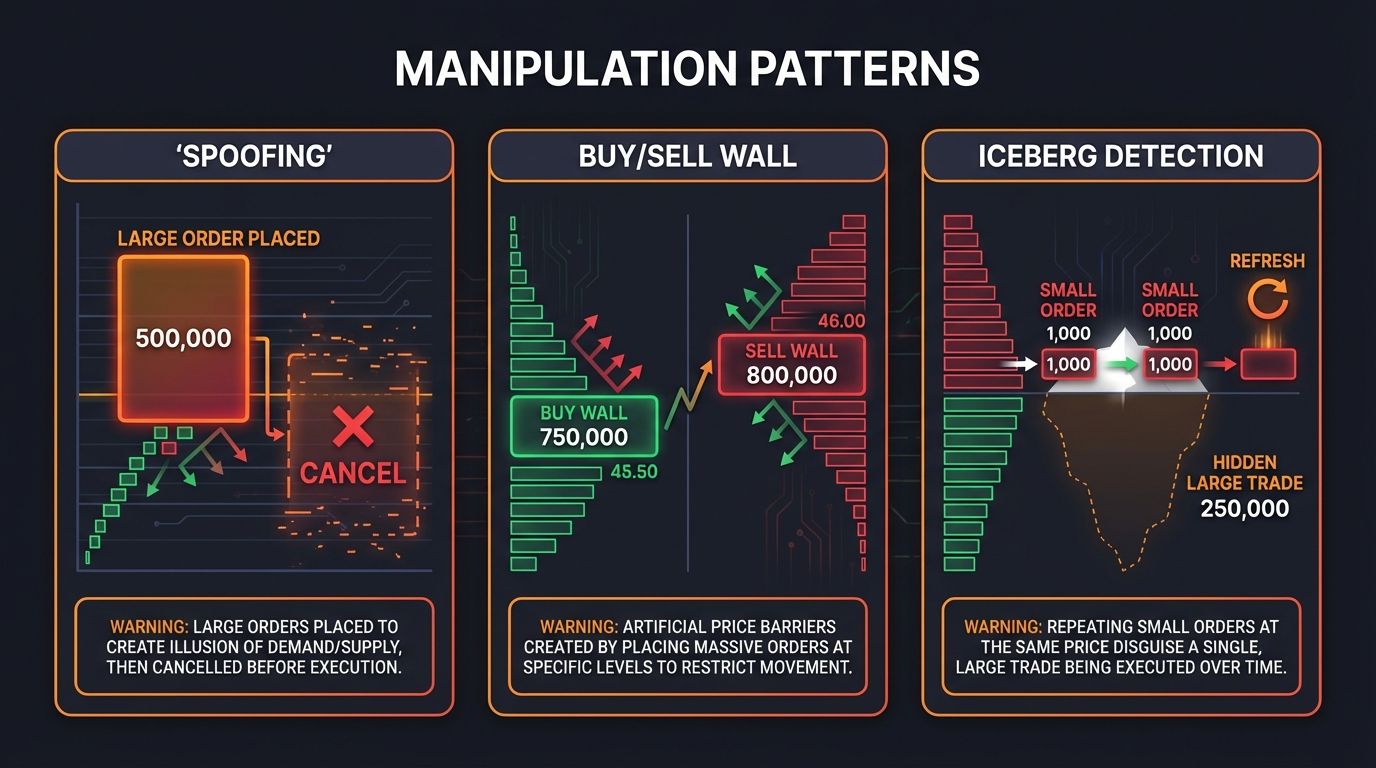
Spoofing is the practice of placing large orders with no intention of having them filled. A trader might place a massive buy wall at $64,800 to create the illusion of strong demand, encouraging other traders to buy. Once the price moves up, the spoofer cancels the large bid and sells into the buying pressure they artificially created. Spoofing is illegal in regulated markets, but it remains common in cryptocurrency exchanges with less oversight.
Signs of spoofing include:
- Large orders that appear and disappear within seconds
- Massive walls that vanish just as price approaches them
- Repetitive placement and cancellation of orders at the same price level
Buy Walls and Sell Walls
A buy wall is a very large bid order (or cluster of bid orders) at a specific price level. It can be legitimate, representing genuine demand from a whale or institution, or it can be a spoofing tactic. A sell wall is the opposite: a large concentration of ask orders.
Legitimate walls often act as strong support or resistance. When a buy wall holds firm as price tests it, traders gain confidence in that support level. When a sell wall absorbs buying pressure without breaking, it confirms resistance. However, you should always question whether a wall is real by observing how it behaves when price approaches.
Iceberg Order Detection
While iceberg orders are designed to hide large positions, you can sometimes detect them by watching for a specific pattern: a small order at the same price that keeps refilling every time it is consumed. If you notice that 5 BTC at $65,000 keeps reappearing every time it gets filled, there is likely a much larger hidden order behind it. This signals serious interest at that price level and often represents institutional activity.
Layering
Layering is a more sophisticated form of spoofing where traders place multiple orders at different price levels to create a false impression of depth. For example, a trader might place progressively larger sell orders at $65,100, $65,200, and $65,300 to make it appear that heavy resistance exists. When other traders sell in response, the layering trader buys at lower prices and cancels the fake sell orders.
The best defense against manipulation is patience and skepticism. Do not react impulsively to sudden walls or dramatic changes in the order book. Wait to see if the orders hold when price tests them, and always combine order book analysis with other forms of technical analysis.
6. Using the Order Book for Better Trade Entries and Exits
Now that you understand how to read a crypto order book and recognize common patterns, it is time to apply this knowledge for better trading decisions. Here are practical ways to use order book data for improved entries and exits.
Finding Optimal Entry Points
Before entering a trade, check the order book to identify price levels with strong bid support. If you want to go long, placing your buy order just above a significant buy wall can provide a safety net. The wall acts as a floor, reducing your downside risk if the trade moves against you. Always verify that the wall appears genuine by monitoring it over a few minutes before relying on it.
Timing Your Entries with Order Flow
Watch the speed at which orders are being filled on each side. If ask orders are being consumed rapidly while bid orders remain steady, aggressive buying is occurring. This is often a signal that upward momentum is building. Conversely, if bids are being eaten through quickly, selling pressure is intensifying.
Setting Realistic Take-Profit Levels
Use the order book to identify where large sell walls exist above the current price. These represent potential resistance where your upward momentum may stall. Setting your take-profit just below a major sell wall gives you the best chance of having your order filled before a reversal.
Managing Slippage
For larger positions, the order book is essential for managing slippage. Check the depth at your desired entry price to ensure enough liquidity exists to fill your order without moving the price significantly. If the book is thin at your entry level, consider splitting your order into smaller pieces or using limit orders instead of market orders.
Combining with Technical Analysis
The order book works best when combined with traditional technical analysis. If your chart shows a support level at $64,500 and the order book confirms a large cluster of bid orders at the same price, you have a high-confidence support zone. When multiple data sources agree, the probability of a successful trade increases significantly.
Here is a practical checklist for using the order book before any trade:
- Check the spread to confirm adequate liquidity
- Analyze the bid/ask ratio for buying or selling pressure
- Identify significant walls that may act as support or resistance
- Look for signs of spoofing or manipulation
- Verify that order book data aligns with your chart analysis
- Calculate potential slippage for your intended position size
Start Reading the Order Book with Altrady
Mastering the crypto order book is one of the most valuable skills you can develop as a trader. It gives you insight into real-time supply and demand, helps you spot manipulation, and allows you to time your entries and exits with greater precision.
Altrady provides professional-grade order book tools across multiple exchanges in a single unified interface. With real-time order book visualization, depth charts, and advanced trading features, you can analyze market microstructure and execute trades faster than switching between exchange tabs.
Ready to take your order book analysis to the next level? Sign up for a free trial of Altrady today and experience how a professional trading terminal can transform the way you read and react to the crypto order book.
FAQ
What is the difference between a crypto order book and a trade history?
A crypto order book shows pending orders that have not yet been filled. It represents future intentions of buyers and sellers. Trade history (also called the trade tape or time and sales) shows orders that have already been executed. Together, they provide a complete picture of market activity, but the order book is forward-looking while trade history is backward-looking.
Can the crypto order book be manipulated?
Yes, the order book can be manipulated through tactics like spoofing, layering, and wash trading. Traders place large fake orders to influence other participants and then cancel them before execution. While these practices are illegal in regulated markets, enforcement in cryptocurrency markets varies. Always watch for orders that appear and disappear quickly, especially large walls that vanish when price approaches.
How do I know if a buy wall or sell wall is real?
A genuine wall typically remains in place as price approaches and partially fills without being pulled. A fake wall (spoof) usually disappears before price reaches it. Monitor the wall over several minutes and across multiple timeframes. If the wall has been sitting at the same level for an extended period and has partially filled, it is more likely to be legitimate. Also check if the wall aligns with a technical support or resistance level for additional confirmation.
Should beginners rely on the order book for trading decisions?
Beginners should use the order book as a supplementary tool rather than their primary decision-making method. Start by learning to read basic bid/ask data and the spread. As you gain experience, incorporate depth analysis and pattern recognition. The order book moves extremely fast and can be overwhelming at first. Combine it with chart analysis and risk management fundamentals for a balanced approach to trading.
Why do some orders not appear in the crypto order book?
Several order types remain hidden from the visible order book. Stop orders only appear after being triggered. Iceberg orders display only a fraction of their total size. Dark pool orders execute entirely off-book on certain exchanges. Additionally, over-the-counter (OTC) trades between large parties bypass the order book completely. This means the visible order book always represents only a portion of the total market interest in any trading pair.