
Most memecoin guides explain what memecoins are. This one assumes you already know. What you need is a working framework that keeps you in the game across the 80-90% of trades that fail, plus the discipline to capture the 10-20% that produce the entire portfolio return.
The math is brutal. Most new memecoins die within 48 hours of launch. Of the ones that survive, most never recover their initial peak. Of the few that pump, most reverse before the average trader exits. Memecoin trading is not about being right more often. It is about position sizing such that being wrong does not end your account, and being right rewards you for the asymmetry you accepted.
This guide covers the framework professional memecoin traders use: position sizing, entry triggers, exit logic, and the behavioral rules that separate consistent profit from consistent rekt.
The Core Risk Framework
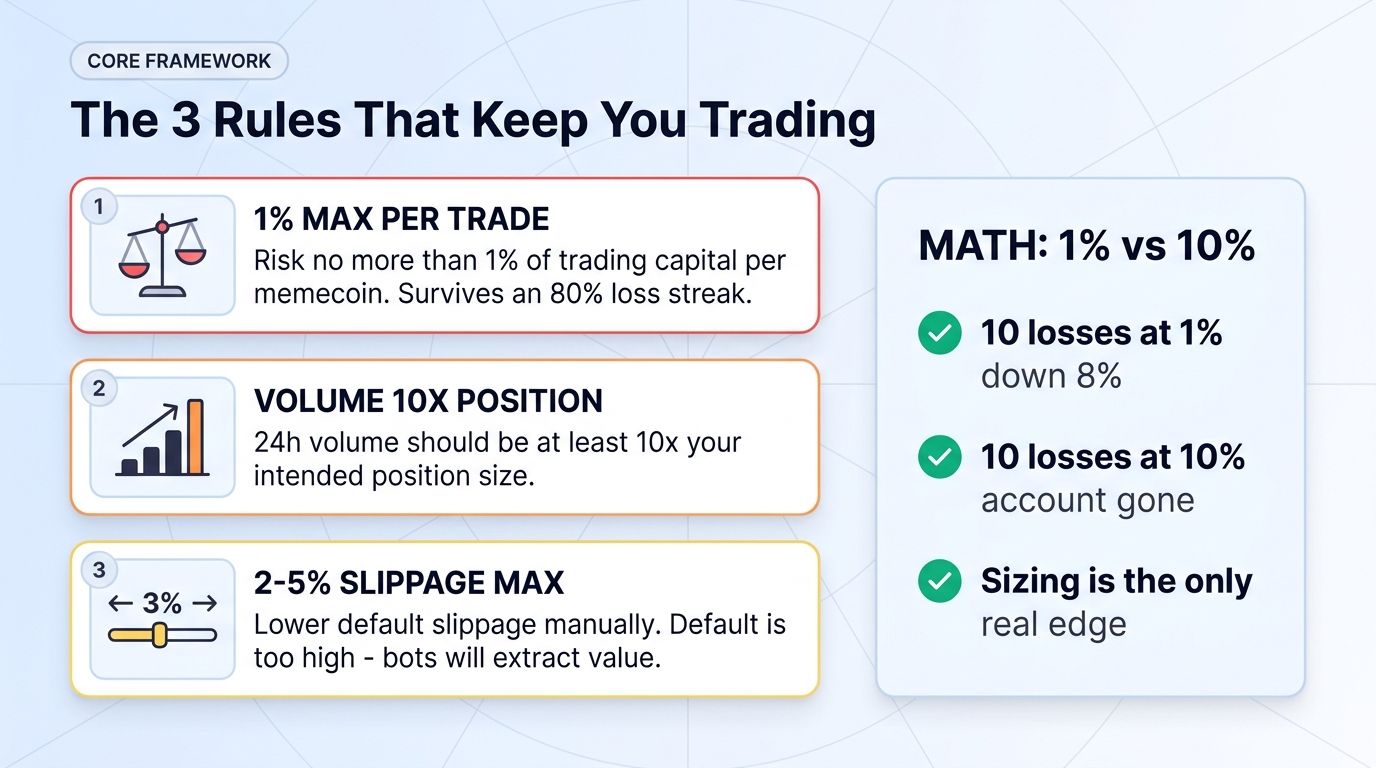
Three rules, in order of importance.
Rule 1: Never risk more than 1% of your trading capital on a single memecoin position. If you have $10,000 in trading capital, your maximum loss on any single memecoin should be $100. This is non-negotiable. The math:
- 1% risk per trade
- 80% loss rate (typical for memecoin trading)
- 10 trades in a bad streak
Result with 1% sizing: down 8% on your overall account. Survivable. You keep trading.
Same scenario with 10% sizing: down 80%. You stop trading because the capital is gone.
This is why position sizing is the only risk control that matters at the portfolio level. Stop-losses help individual trades. Position sizing keeps you in the game across many trades.
Rule 2: Check liquidity before you enter. Before any memecoin entry, look at:
- 24-hour trading volume. Should be at least 10x your intended position size. If you want to buy $1,000 worth, the token should be moving at least $10,000 in 24 hours.
- Order book depth or pool liquidity. You should be able to exit your full position within 2% of the current price. If selling $1,000 would move the price 10%, that token is too thin for your size.
These checks prevent the most common memecoin failure mode: you find a token, buy in, then discover you cannot sell without taking a 20%+ haircut from your own market impact.
Rule 3: Set maximum slippage at 2-5% before submitting any swap. On most DEX trades, the default slippage tolerance is far higher than it should be. A 15% slippage tolerance means a sandwich-attack bot can extract significant value from your trade. Lower the slippage manually for every trade.
Entry Triggers
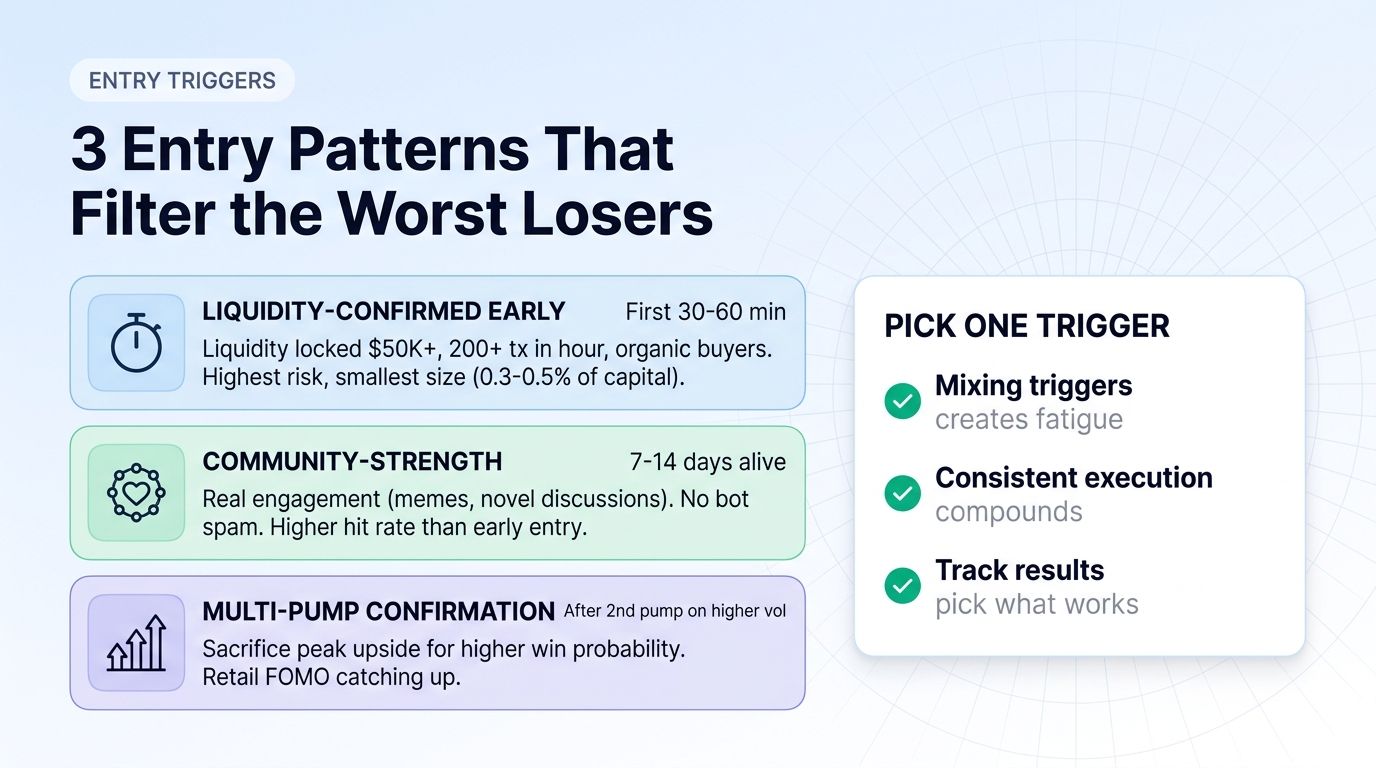
Three patterns that consistently produce above-average results across cycles. None guarantees a winner. All filter out the worst losers.
Trigger 1: Liquidity-confirmed early entry. A new memecoin launches. You watch it for the first 30-60 minutes. If liquidity is added (typically $50,000+) and not removed, transaction count climbs above 200 in the first hour, and the price action shows organic buying (no single wallet dominating), this is a candidate for early entry. Use a small portion of your daily risk budget (typically 0.3-0.5% of capital) and accept that this is the highest-loss-rate strategy.
Trigger 2: Community-strength entry. Look at X (formerly Twitter), Telegram, and Reddit. Distinguish genuine engagement (original memes, novel discussions, organic shares) from spam (repeated price predictions, copy-paste shilling, bot accounts). Memecoins with real community engagement survive at a much higher rate than those with bot-driven hype. If a memecoin has been alive for 7-14 days with growing organic engagement and no major holder consolidation, this is an established entry candidate with a higher hit rate than early entries.
Trigger 3: Multi-pump confirmation. A memecoin pumps, retraces, then pumps again on higher volume. The second pump on higher participation often signals that retail FOMO is catching up to early holders. Entry on the second-pump breakout is later but more reliable than entry on the first pump. You sacrifice peak upside for higher win probability.
Exit Logic
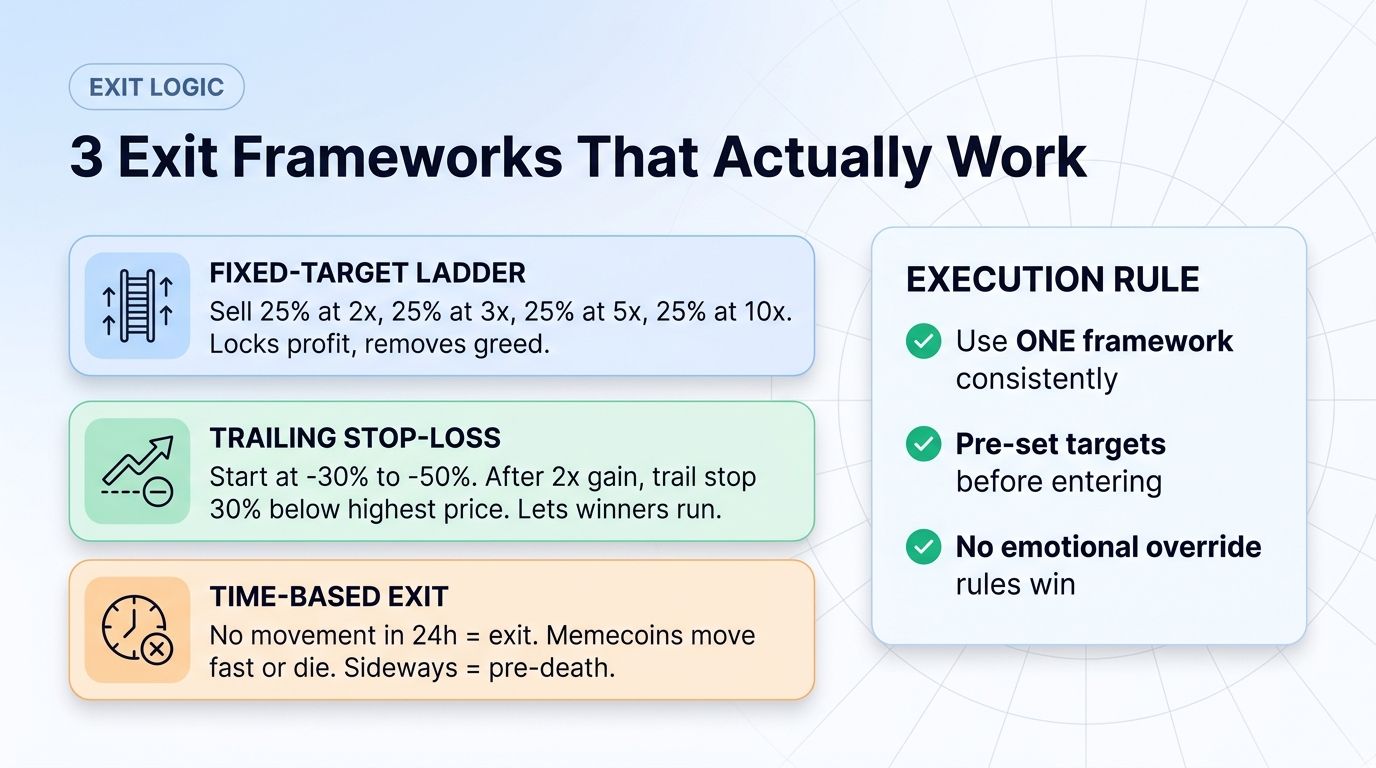
Exits are where most memecoin traders lose money even after picking winners. Three frameworks that work.
Framework 1: Fixed-target ladder. Set predetermined exit levels at 2x, 3x, 5x, and 10x your entry. Sell 25% of position at each level. This guarantees you take profit on winners and removes the decision-making that causes traders to hold through 80% retraces.
Framework 2: Trailing stop-loss. Set an initial stop at -30% to -50% from entry. As the position moves into profit, trail the stop up. A simple rule: stop trails by 30% from the highest price reached after a 2x gain. This locks in some profit while letting winners run further.
Framework 3: Time-based exit. If a memecoin position has not moved in 24 hours after entry, exit. Memecoins move fast or die. Sideways action is usually pre-death consolidation. Time decay is your enemy.
Use one framework consistently. Mixing frameworks introduces decision fatigue and emotional override.
The Behavioral Rules That Actually Matter
Position sizing keeps you solvent. Entry triggers improve your hit rate. Exit logic captures profit. Behavioral rules determine whether you actually execute the plan.
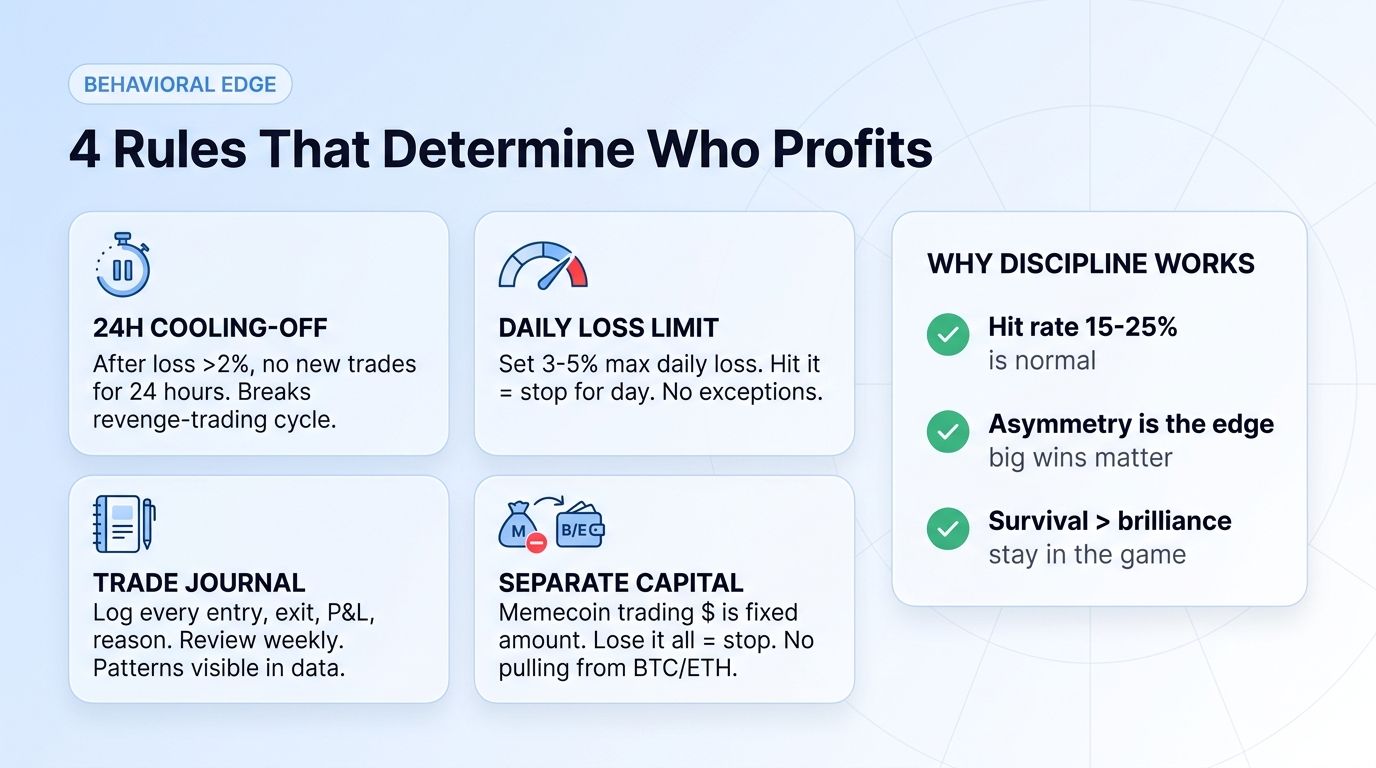
Rule 1: Mandatory cooling-off after any loss greater than 2%. No new trades for 24 hours. Loss aversion makes the next decision worse. The brain wants to make back the loss, leading to oversizing and reaching for marginal setups. The 24-hour pause breaks the cycle.
Rule 2: Predetermined daily loss limit. Set a maximum daily loss (typically 3-5% of trading capital). Hit it and stop for the day. No exceptions. Daily limits prevent the catastrophic 30%+ account drawdowns that happen when traders chase recovery in a single session.
Rule 3: Trade journal. Log entry, exit, P&L, and the reason for each trade. Review weekly. Patterns become visible only when you have data. Most traders skip this because it feels like overhead. The ones who profit consistently treat it as non-negotiable.
Rule 4: Separate memecoin capital from core crypto. Memecoin trading capital is a defined dollar amount, not a percentage of your total crypto. If you lose it all, you stop. You do not pull from BTC, ETH, or DeFi positions to refund the memecoin account.
Tools That Help
Three categories of tooling that matter.
On-chain screeners. Dexscreener and similar tools surface new launches, filter by volume and liquidity, and provide real-time charts. Set up filters that match your entry criteria so you screen for candidates instead of scrolling.
Multi-exchange platforms. When a memecoin lists on Binance, Coinbase, or Kraken, the dynamics change. You no longer face on-chain MEV but you face cross-exchange arbitrage and higher volume. A crypto trading platform like Altrady that connects to 19+ exchanges lets you manage CEX-listed memecoin positions alongside your other holdings and run automated strategies via tools like the signal bot or DCA bot for the rare memecoins that develop multi-week trends.
Alert systems. Price alerts, volume spikes, and wallet-tracking notifications let you act on developments without staring at charts. Dexscreener offers basic price alerts free. Nansen and similar paid tools provide deeper wallet-level insights for higher-budget traders.
How Memecoin Trading Fits Into a Crypto Portfolio
A framework that has held up across cycles:
- Core crypto (BTC, ETH, large-cap altcoins): 60-80% of total crypto capital. Slow to move, low volatility relative to memes.
- Mid-cap thematic plays (AI agents, DePIN, RWA): 10-20%. Narrative exposure with more upside than blue-chip and less downside than memes.
- Memecoin trading capital: 5-15%. Defined dollar amount. Trade actively or hold for cycle-driven moves. Refresh capital only when overall portfolio grows, not by reallocating from core.
Memecoins are not investments. They are trades. Treat the allocation as expense capital that is meant to either grow significantly or burn out. Either outcome is acceptable. What is not acceptable is letting memecoin losses bleed into your core positions through emotional rebalancing.
FAQ
What is the average loss rate for memecoin trades?
Roughly 70-85% of memecoin trades result in losses or breakeven across most market conditions. Profitable memecoin traders win 15-25% of the time but make 3-10x more on winners than they lose on losers. The asymmetry is the entire edge.
Should I use leverage on memecoin trades?
No. Memecoins routinely move 30-50% in minutes. Leverage on those moves leads to liquidation in seconds. The volatility that creates memecoin opportunity is the same volatility that makes leverage suicidal.
Where do most memecoins launch?
Solana and Base dominated memecoin launches in 2025-2026 due to low transaction costs and active retail traders on those chains. Ethereum mainnet sees fewer launches because gas costs price out small position sizes. BNB Chain has its own meme ecosystem at lower volumes.
Can I run a memecoin trading bot on Altrady?
For memecoins listed on centralized exchanges (Binance, Coinbase, Kraken, Bybit, and others Altrady connects to), yes. You can configure a signal bot or DCA bot for memecoin trading with the same risk controls as any other crypto position. For on-chain DEX-only memecoins, you need Dexscreener-style tools and a wallet, not a CEX-focused platform.
What is the biggest mistake memecoin traders make?
Position sizing. Specifically, increasing position size after wins (overconfidence) and after losses (revenge trading). Both patterns destroy accounts. Fixed 1% sizing across all conditions is unsexy but it works.
Conclusion
Memecoin trading is one of the few crypto activities where the framework matters more than the picks. You will lose 70-85% of trades. You will pick winners and exit at breakeven because you held too long. You will skip the winner that mooned because the chart looked weak that morning. None of that matters if your position sizing keeps you in the game.
For traders, the practical takeaway is this: memecoin trading is risk management dressed up as speculation. The traders who do this profitably are not better at picking the next 100x. They are better at not losing on the 100 picks that go to zero. Fixed 1% sizing, predetermined exits, mandatory cooling-off after losses, and a separate capital pool from your core holdings are the actual edge.
The category will keep producing winners and losers in roughly the same proportion next cycle. The traders who learn the framework now will keep some of those profits. The traders who treat each memecoin as a unique opportunity will donate to the others.