
When a whale wants to sell 100 BTC, they don't just hit "market sell" and watch price collapse 5%. They use an iceberg order - showing the public orderbook only 5 BTC at a time while the other 95 BTC sit hidden, fed in slices as each chunk fills. The mechanic is simple, the impact on price discovery is significant, and crypto retail traders who learn to spot icebergs in the orderbook gain an edge most participants don't even know exists.
What Is an Iceberg Order?
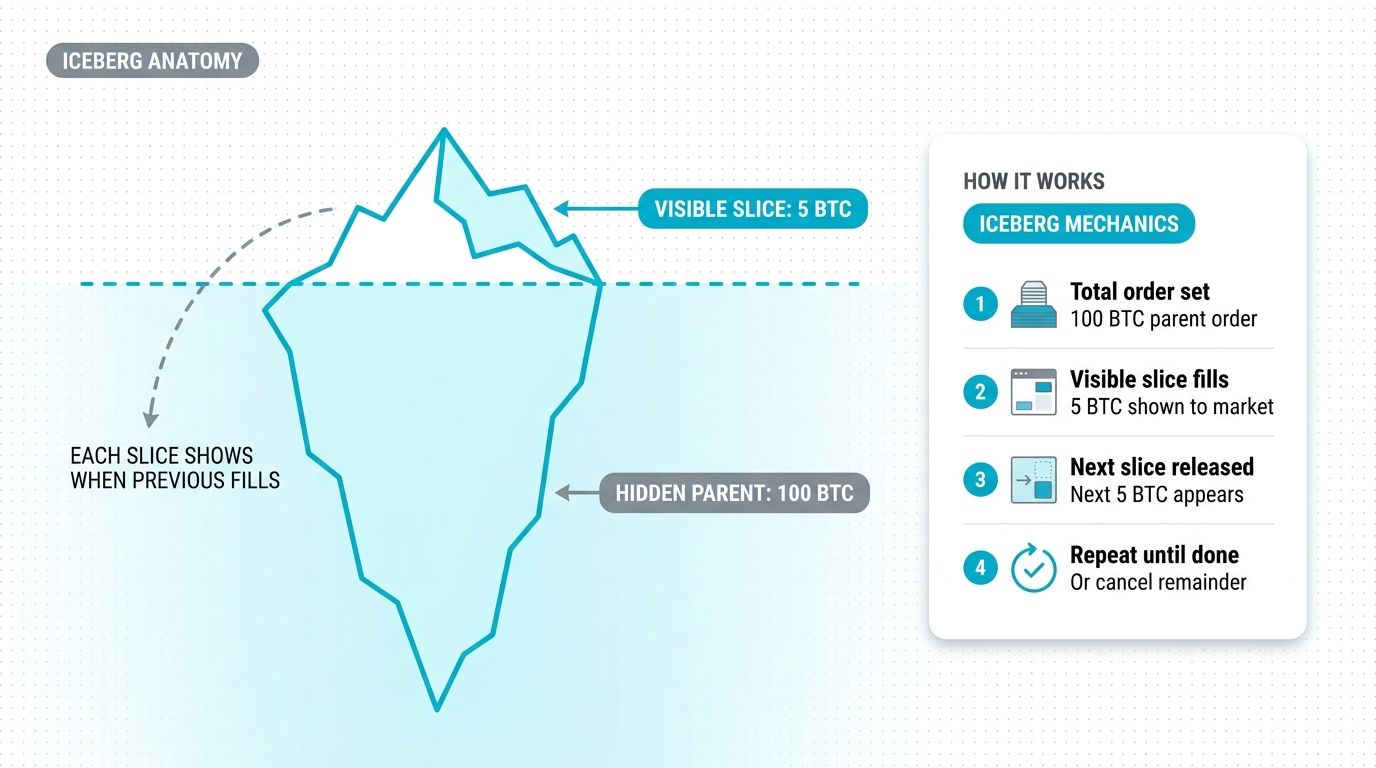
An iceberg order (also called a hidden or reserve order) is a large limit order broken into smaller visible slices, where only one slice appears on the public orderbook at a time. As each visible slice fills, the next slice is automatically released from the hidden parent. The total size of the order remains hidden from the market, even though the small slice is fully visible.
The name comes from the visual analogy: like an iceberg, only the tip is visible above water. The much larger mass sits below the surface, invisible to other traders watching the public orderbook.
Why Whales Use Iceberg Orders
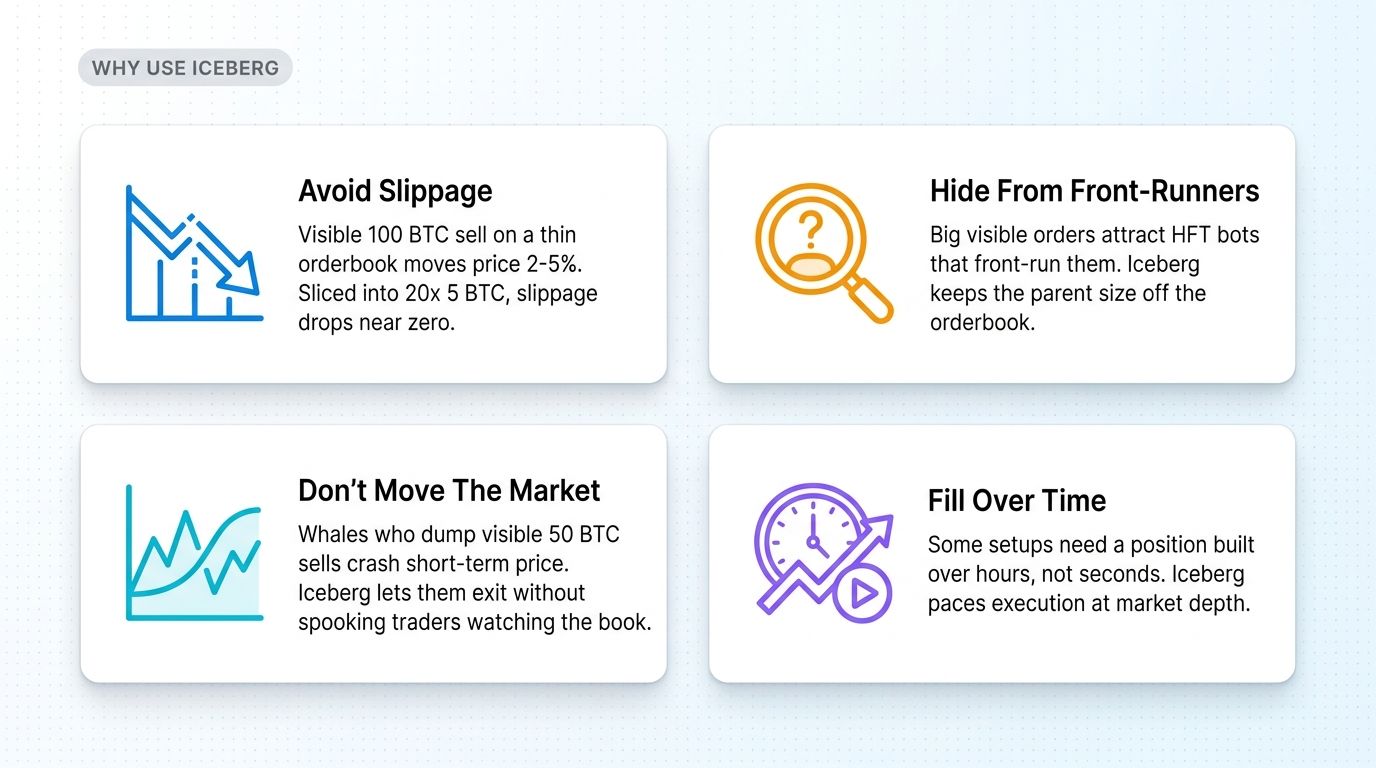
Avoid Slippage on Thin Books
Crypto orderbooks - even on major exchanges - are surprisingly thin once you go past a few BTC of size. A visible 100 BTC market sell on a moderately active book can move price 2-5% before fully filling. Sliced into 20 visible 5-BTC iceberg slices, the same parent fills with near-zero slippage because each slice respects natural orderbook depth.
Hide From Front-Runners and HFT Bots
Visible large orders attract front-running. HFT bots monitor orderbooks for unusually large levels and trade ahead of them, profiting from the predictable price impact. Iceberg orders keep the parent size off the public book, denying front-runners the signal.
Don't Spook the Market
A whale dumping a visible 50 BTC sell wall sends a panic signal to everyone watching the book. Other traders react: short bids drop, sellers join in, and what should have been an orderly exit becomes a small price crash. Iceberg lets the whale exit without telegraphing intent.
Fill Over Time at Market Depth
Some setups need a position built or unwound over hours rather than seconds. Iceberg paces execution at the natural market depth, making it less expensive than aggressive single-shot fills.
How an Iceberg Order Is Constructed
The iceberg order has three core parameters:
- Total order size (parent): the full amount being executed. Hidden from public.
- Visible slice size: how much shows on the orderbook at any given time. Common ratio: 1-10% of total.
- Slice refresh rule: when one slice fills, when the next is released. Most exchanges trigger immediately on fill.
For example, a 100 BTC parent with 5 BTC visible slices means the orderbook always shows 5 BTC at the iceberg level until the parent is fully filled or canceled. Public observers see 5 BTC; the actual size is 20x that.
How to Detect Iceberg Orders in the Market
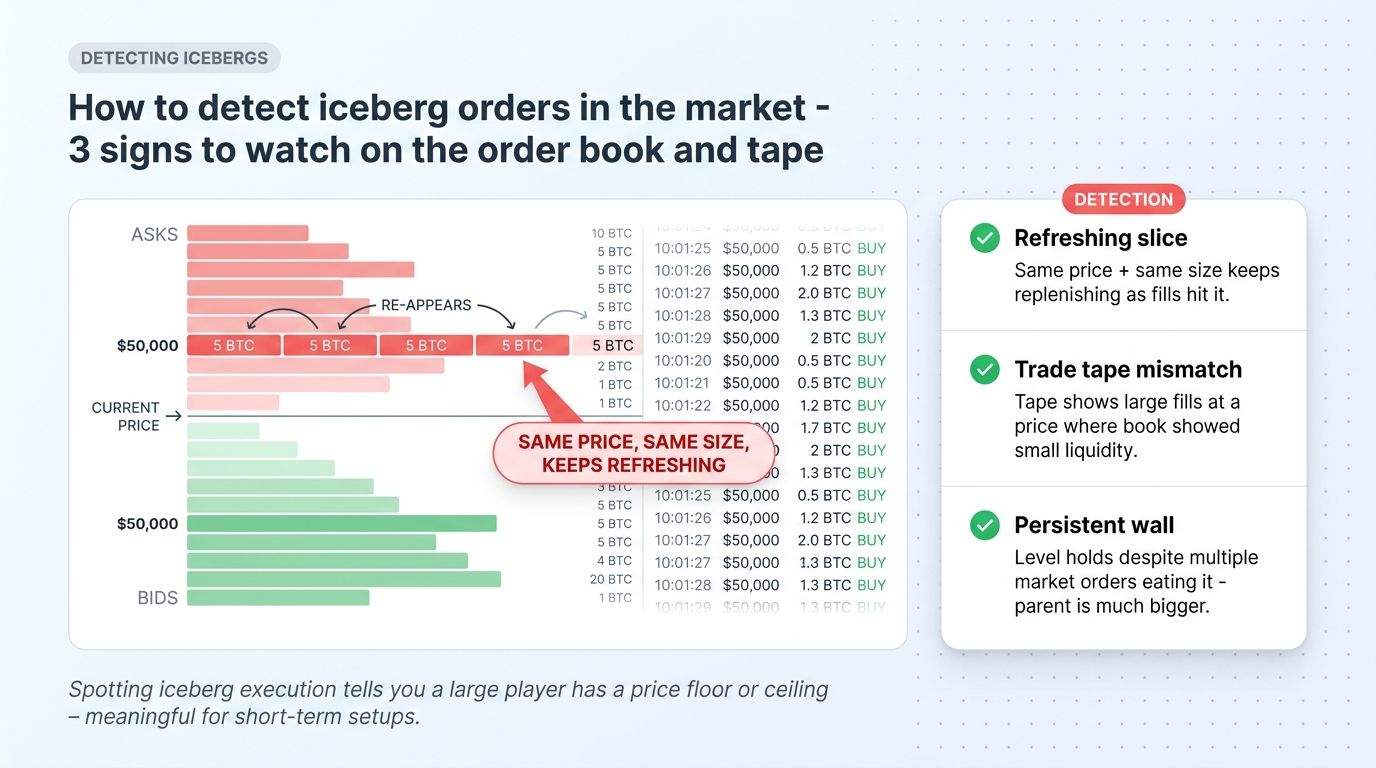
Spotting iceberg orders is a skill that separates pro traders from book-watchers:
Sign 1: Refreshing Slice
Same price level, same exact size, keeps replenishing as fills hit it. A 5 BTC bar at $50,000 disappears, immediately reappears at 5 BTC, gets eaten again, reappears again. That's the iceberg refilling.
Sign 2: Trade Tape Mismatch
Tape shows large fills at a price where the visible book showed small liquidity. If you see 50 BTC traded at $50,000 in the tape but the book never showed more than 5 BTC at that level, the trades came from an iceberg parent.
Sign 3: Persistent Wall
A level absorbs multiple market orders eating into it without breaking. Each time the visible slice fills, a fresh slice appears. The visible size stays small but the wall holds firm because the hidden parent is much bigger than the public can see.
Spotting iceberg execution tells you a large player has set a price floor or ceiling. Meaningful for short-term setups - if a 100 BTC iceberg buy is supporting price at $50,000, that level is unlikely to break until the parent finishes filling.
Iceberg Order Limitations
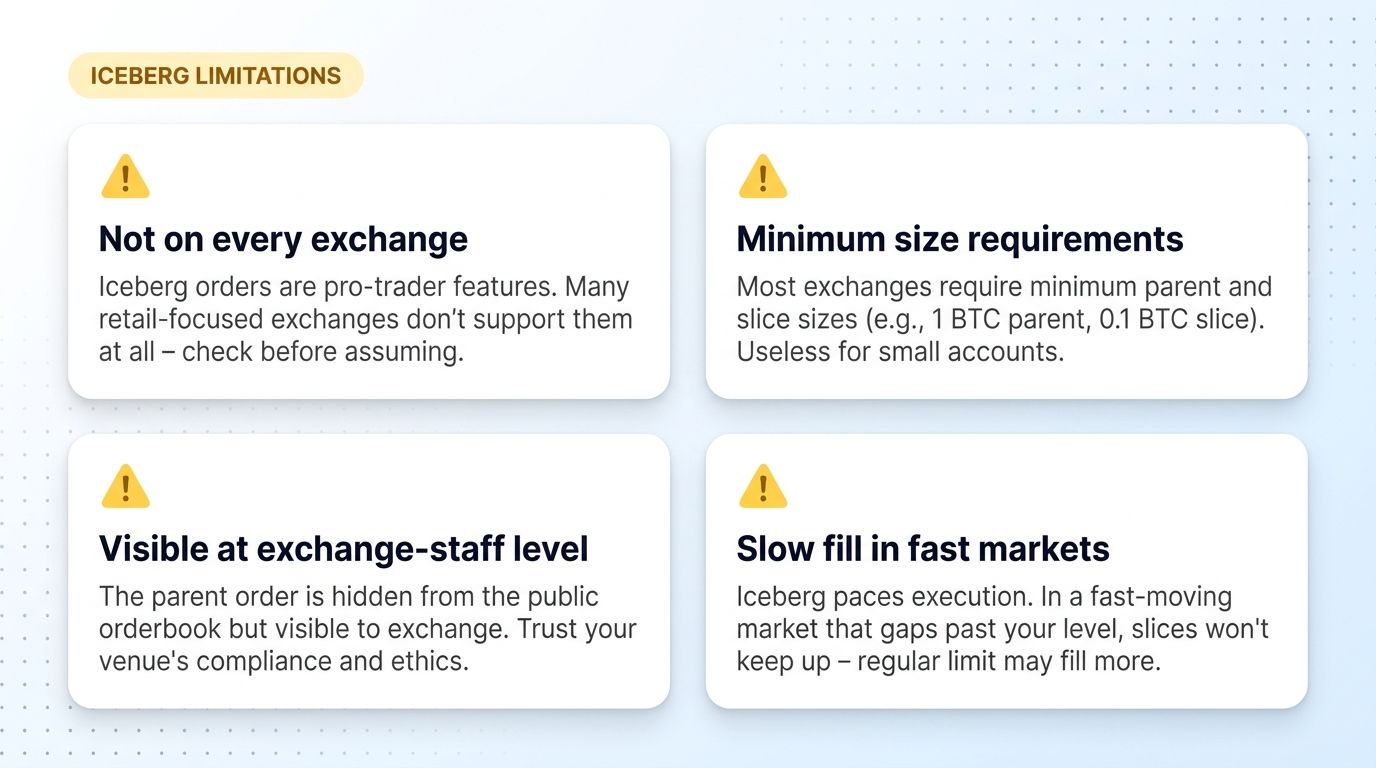
- Not available on every exchange. Iceberg is a pro-trader feature. Many retail-focused exchanges don't support it. Check before assuming.
- Minimum size requirements. Most exchanges require minimum parent and slice sizes (e.g., 1 BTC parent, 0.1 BTC slice). Useless for accounts under $5,000.
- Visible at exchange-staff level. The parent order is hidden from the public orderbook but visible to exchange operators. You're trusting the venue's compliance and ethics.
- Slow fill in fast markets. Iceberg paces execution. In a fast-moving market that gaps past your level, slices won't keep up - a regular limit may fill more, faster.
Iceberg vs Other Hidden Order Types
Iceberg is one of several hidden-execution mechanisms. The differences matter:
- Iceberg: visible slice + hidden parent. Slice size is publicly visible; total is hidden.
- Hidden Order (Reserve Order): entire order is hidden from public. Less common in crypto - some exchanges offer it as a separate type.
- Dark Pool Execution: orders matched off-exchange entirely, neither size nor existence visible publicly. Common in equities; rare but emerging in institutional crypto.
- TWAP/VWAP Algorithms: orders sliced over time using time-weighted or volume-weighted logic. Different from iceberg - TWAP shows nothing on the book, executes via repeated small orders to match a benchmark.
Using Iceberg Orders in an Altrady Workflow
Altrady's Smart Trading interface gives you access to iceberg-style execution where the underlying exchange supports it:
- Cross-exchange iceberg - place an iceberg on BTC across the exchanges that support it (Binance, OKX, Bybit, Kraken Pro) from one terminal.
- TWAP execution as alternative when iceberg isn't supported - same goal, different mechanic.
- Orderbook scanner to spot iceberg execution from other large players (helpful for context).
- Paper trading mode for testing large-order workflow before deploying real capital.
Sign up for a free trial and test institutional execution tools without risking capital.
Conclusion
Iceberg orders are a tool whales use to enter and exit large positions without distorting the market. For retail traders, the practical value is twofold: occasionally placing your own iceberg when account size warrants it, and learning to spot icebergs that other large players are running so you can understand short-term price floors and ceilings.
Most accounts under $10,000 won't trigger minimum size requirements for iceberg execution. But understanding the mechanic improves how you read the orderbook - and a better orderbook read translates into better entries, better stops, and better exits across every trade you take.
Frequently Asked Questions
What is an iceberg order?
An iceberg order is a large limit order divided into smaller visible slices, where only one slice appears on the public orderbook at a time. As each visible slice fills, the next is automatically released from the hidden parent until the full order completes or is canceled. The total size remains hidden from public view.
Why is it called an iceberg order?
The name comes from the visual analogy: only the tip of the iceberg is visible above water. The much larger mass sits below the surface, invisible to observers. The visible slice is the "tip"; the hidden parent is the "underwater mass."
Do all crypto exchanges support iceberg orders?
No. Iceberg orders are typically available on professional exchanges (Binance Pro, Kraken Pro, OKX, Bybit, Bitfinex). Many retail-focused exchanges don't support them. Always check the order-types documentation before assuming.
How do I detect an iceberg order in the orderbook?
Three signs: (1) same price + same size that keeps refreshing as fills hit it, (2) trade tape shows large fills at a price where the visible book showed only small liquidity, (3) a persistent wall that absorbs multiple market orders without breaking. Together these signal hidden parent size much larger than what's visible.
What is the minimum size for an iceberg order?
Varies by exchange. Most require minimum parent size of 0.5-1 BTC (or equivalent) and minimum slice size of 0.05-0.1 BTC. Accounts under $5,000 typically can't access iceberg orders on major venues.
Are iceberg orders the same as hidden orders?
No. Iceberg has a publicly visible slice; only the parent is hidden. A pure hidden order (reserve order) has no visible portion at all. Both are forms of order-hiding but differ in how much information they reveal to the public.
Can iceberg orders be used to manipulate the market?
Iceberg execution itself isn't manipulative - it's a legitimate liquidity-sourcing tool used by institutions worldwide. Manipulation usually involves combining iceberg with deceptive practices (spoofing, wash trades) which are separately illegal. Iceberg as a standalone order type is fully compliant on regulated exchanges.
Iceberg orders are a tool most retail traders never touch but every active trader should understand. Altrady gives you cross-exchange iceberg execution, orderbook scanning, and paper trading - so you can test institutional workflows before deploying real capital. Sign up for a free trial.