
Smart Money Concepts and Inner Circle Trading are two popular trading frameworks used for market analysis and system building. Many crypto traders compare the two to understand how each approach reads liquidity, market structure, and entry timing. Both can be applied across different styles, from active trading to longer-term approaches.
While Smart Money sets the foundation for understanding market structure, Inner Circle builds on it with a more defined terminology and a structured method for planning entries and exits.
At Altrady, we've extensively researched and tested Smart Money Concepts, including the ICT methodology, in the cryptocurrency market. This guide provides a practical introduction to both approaches and explains the difference between SMC and ICT in crypto, along with how they can be used to support better trading decisions.
Smart Money Concepts (SMC) and the ICT Approach
Smart Money Concepts are a set of conceptual tools used to track how capital is positioned in the market. The framework focuses on institutional investors, market makers, central banks, and professional traders, and in crypto markets, large holders often referred to as whales.
SMC is a broader framework from which to pick advanced concepts to interpret the price movements in the market from the perspective of potential forces that influence such movements and the reasons behind.
These concepts serve as the foundation for market structure analysis, give support and resistance levels a sense of meaning, extend the application of price action, and help track the market from the very viewpoint of professionals and institutional traders.
Three key ideas play a key role when using SMC:
- Institutional trading as a market mover.
- Market manipulation as an intrinsic part of market structure.
- Accumulation/distribution phases according to the Wyckoff method.
Overview of SMC principles
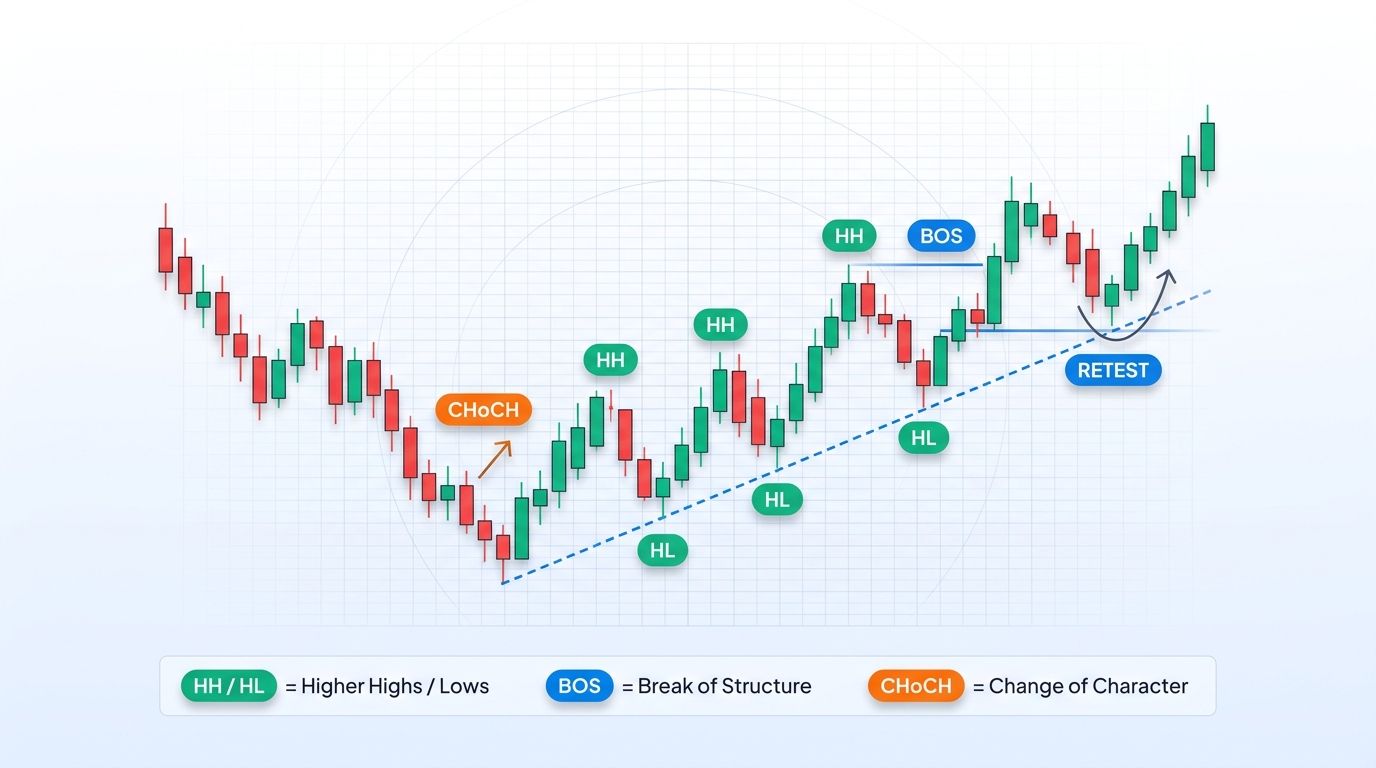
Market Structure
This refers to analyzing the directions that shape the markets as a consequence of price movements through their different cycles, such as ranges, trends, and subsequent high and low formations.
SMC considers this as crucial to identify patterns and optimal entry opportunities around areas where the most significant price movements may take place. In this sense, the following components represent a vital part of this principle:
- Higher Highs (HH) and Higher lows (HL) to identify potential uptrends.
- Lower lows (LL) and Lower highs (LH) to identify potential downtrends.
- Break of structure (BOS) to spot relevant breakouts through highs and lows that change the prevailing market direction and signal potential reversals.
- Change of Character (CHoCH) to detect slight changes in the structure, often indicating a range or trendline breakout and retest.
Order flow
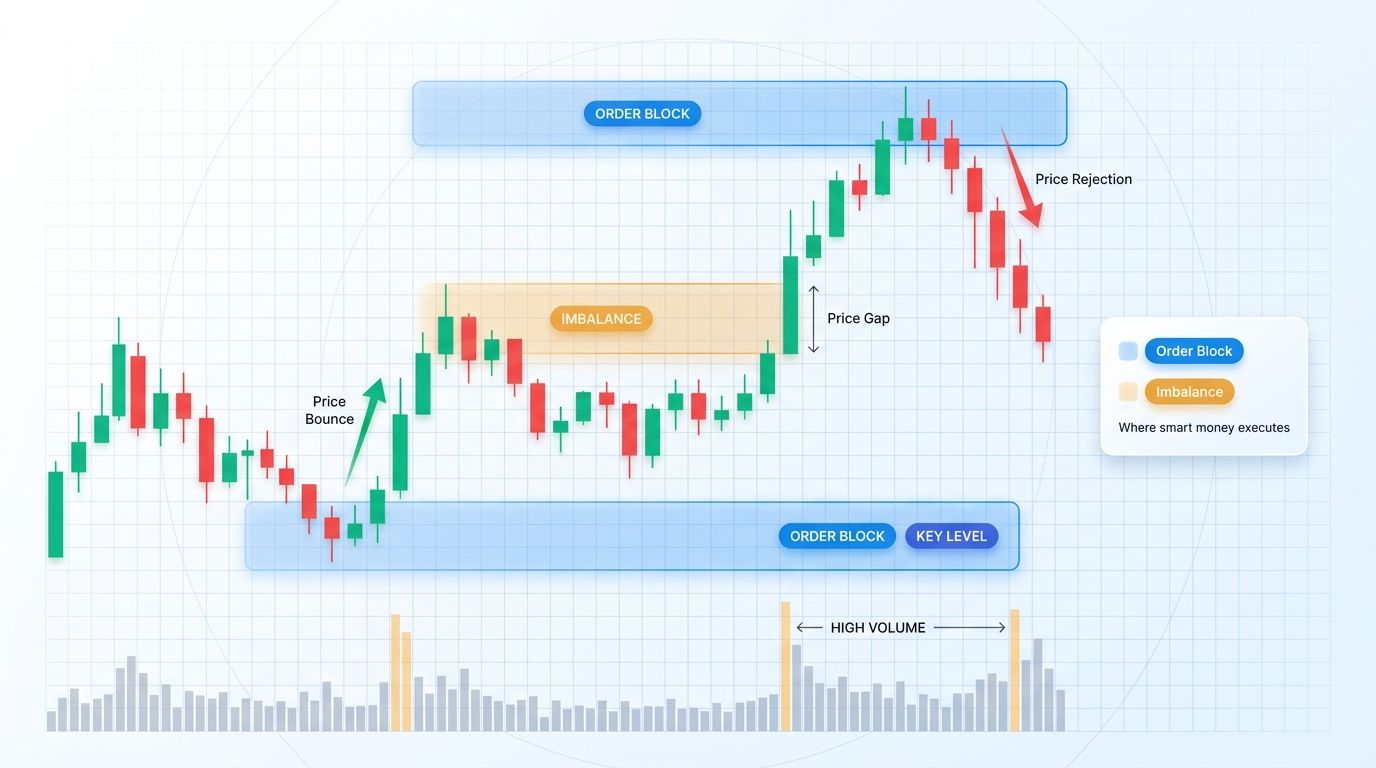
This principle addresses the activity behind buyers’ and sellers’ orders in the market, aiming to identify where the smart money (institutional traders) are executing or placing their orders.
This way, traders can detect the following:
- Imbalances that represent areas for potential price movements since there is a substantial difference between buy and sell orders.
- Order blocks that represent levels of large clustered orders, thus acting as support or resistance. Traders often refer to these as key levels.
Wyckoff Method
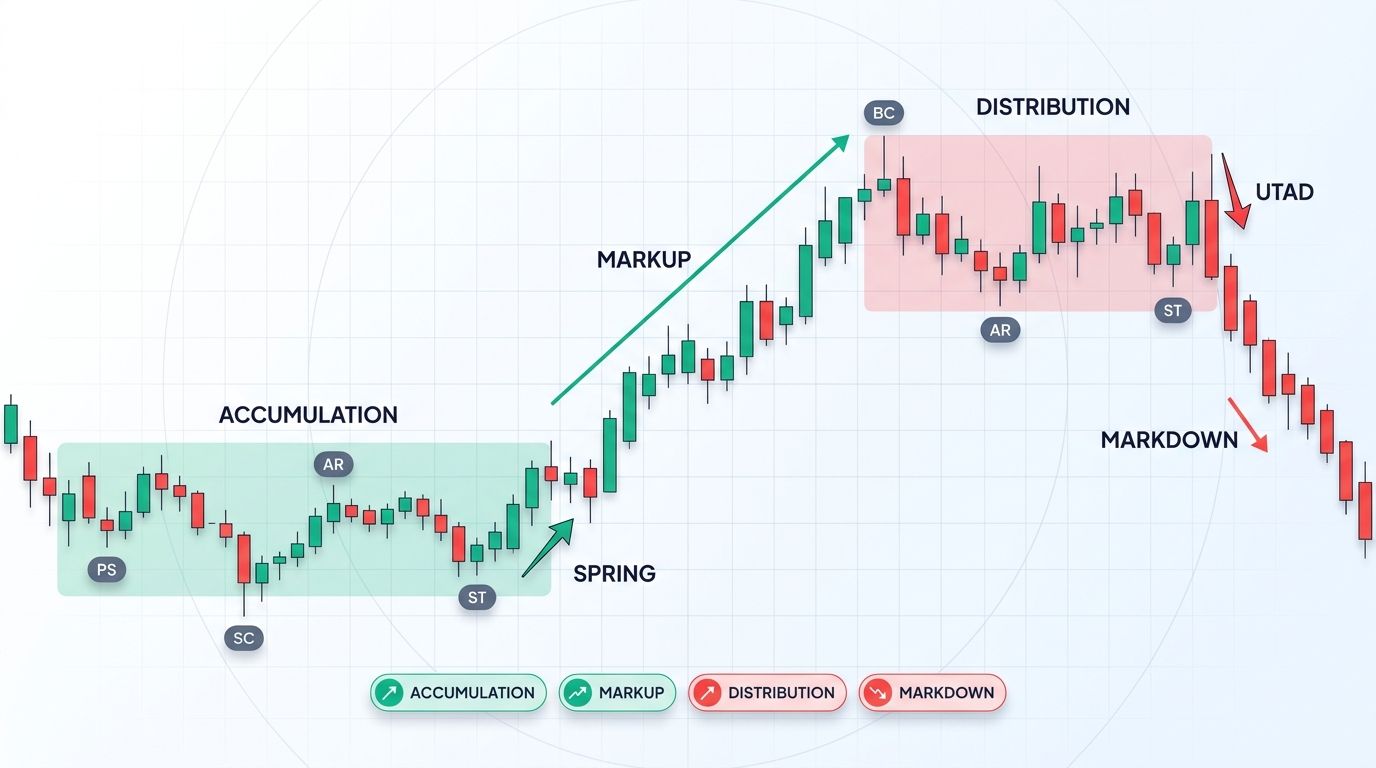
This is a technical analysis method designed to detect phases of accumulation and distribution that anticipate subsequent upside and downside moves respectively. It also helps traders understand the formation of supply and demand zones.
This approach relies on the following concepts:
- Law of supply and demand.
- Law of cause and effect.
- Law of effort and result, where effort represents the volume and result represents price movements.
Introducing Inner Circle Trading (ICT): A Specific SMC approach
Developed by Michael J. Huddleston, Inner Circle Trading concepts aim to help traders understand not only price action, but also the context behind it.
ICT concepts help resolve complexity in the market, providing defined terminology for common trading scenarios.
Like SMC, manipulation and institutional trading play a key role in the Inner Circle Trading strategy.
This trading method not only traces resistance and support levels but also makes an effort to decipher how institutional traders will behave over those levels.
Key Differences Between ICT and SMC
Let’s use a comparative table to showcase the key differences between both methods.
| Table | ICT | SMC |
| Focus | ICT incorporates technical analysis with a focus on identifying key levels, like support and resistance, institutional footprints through concepts like "algo trading", and psychological levels with round numbers. | SMC emphasizes understanding price action and interpreting the "footprints" left by institutional activity, including supply and demand zones, order flow analysis, and market structure. |
| Structure | ICT utilizes a specific framework with tools like the "Fair Value Gap". | SMC offers a more flexible framework that focuses on reading market structure, liquidity, and order flow through price action. |
| Learning curve | ICT requires learning a specific terminology and trading philosophy. Paid educational resources are available. | SMC has a steeper learning curve as it requires a deeper understanding of price action and market behavior. |
| Advantages | Offers a structured approach with clear entry and exit signals. May be easier to grasp for beginners familiar with technical analysis. | Offers a versatile framework applicable to any market, including crypto. Focuses on core principles of market dynamics. |
| Disadvantages | Relies on specific indicators and patterns. Requires memorizing ICT's terminology and trading concepts. | More subjective interpretations of price action can lead to conflicting signals. Requires more experience and practice to master. |
Choosing the Right Approach
- For Beginners: If you're new to trading, ICT's structured approach with clear signals might be easier to grasp initially.
- For Experienced Traders: If you have a solid understanding of technical analysis and want a deeper understanding of market behavior, SMC might be a better fit.
- Combine Strategies: You can consider combining elements of both approaches. Use ICT's key level identification with SMC's price action analysis for a more comprehensive view.
While both approaches can be effective, crypto has unique conditions that affect how ICT and SMC should be executed. The key is adapting the framework to crypto’s volatility, liquidity profile, and the psychological pressure that comes with fast price movement.
ICT vs SMC for Crypto Markets
Crypto markets tend to move faster and swing harder than many traditional markets. That higher volatility can create more frequent setups, but it also increases the chance of quick invalidations and emotional mistakes. Both ICT and SMC can work well in crypto, as long as the approach is adjusted for speed, wider swings, and stricter execution discipline.
Market Considerations
Crypto volatility is a constant, not an exception. ICT and SMC can both be applied in volatile conditions, but risk management must be tighter, invalidation levels need to be clear, and position sizing should reflect how quickly price can move against the trade. Liquidity is equally important, since trading liquid coins helps reduce slippage and makes entries and exits closer to the intended levels, while illiquid coins can ruin execution even when the analysis is correct.
Trader Personality Considerations
Risk tolerance should be defined early and kept consistent. With ICT or SMC, staying within personal limits helps maintain decision quality over time, especially when crypto volatility magnifies stress. Psychological control matters because rapid price movement often triggers FOMO, and that typically leads to impulsive trades taken outside the plan, which is one of the biggest reasons otherwise solid concepts look inconsistent in real execution.
Risk Management Considerations
A clear trading plan should be prepared before entering any crypto trade, including the entry trigger, stop loss, target, and risk per trade. Starting with smaller position sizes makes it easier to test strategies under real market conditions while limiting downside during adaptation. Staying updated on market trends, major news events, and ecosystem developments also helps, since crypto sentiment can shift quickly and overwhelm technical setups. Backtesting and forward testing different ICT and SMC models on historical and live data helps identify what holds up in changing conditions, and Altrady’s paper trading feature supports this process by letting traders test those models in a simulated environment using current market data.
Conclusion
Smart Money Concepts offer a broader framework for reading crypto markets through structure, liquidity, and institutional behavior. Inner Circle Trading (ICT) builds on that foundation with a more defined terminology and a methodical approach aimed at improving timing for entries and exits.
Common ICT concepts include swing points, equal highs and lows, Fair Value Gaps, and premium and discount zones. Meanwhile, SMC provides a wider toolkit to analyze price action, evaluate market context, and support more informed decision-making through research and market scanning.
Altrady helps traders put these ideas into practice by making it easier to scan the market and test SMC and ICT models using a free trial and paper trading.