
Understanding the difference between a market order vs limit order in crypto is one of the most important steps for any trader. Whether you are just getting started with your first Bitcoin purchase or actively trading altcoins across multiple exchanges, choosing the right order type can significantly affect your execution price, your trading costs, and your overall profitability.
Every crypto exchange offers several order types, but market orders and limit orders remain the two foundational options. They each serve a distinct purpose and come with their own set of advantages and trade-offs. In this guide, we will break down exactly how each order type works, compare them side by side, explore additional order types you should know, and show you how to combine them into advanced strategies using a platform like Altrady.
1. What Is a Market Order in Crypto Trading?
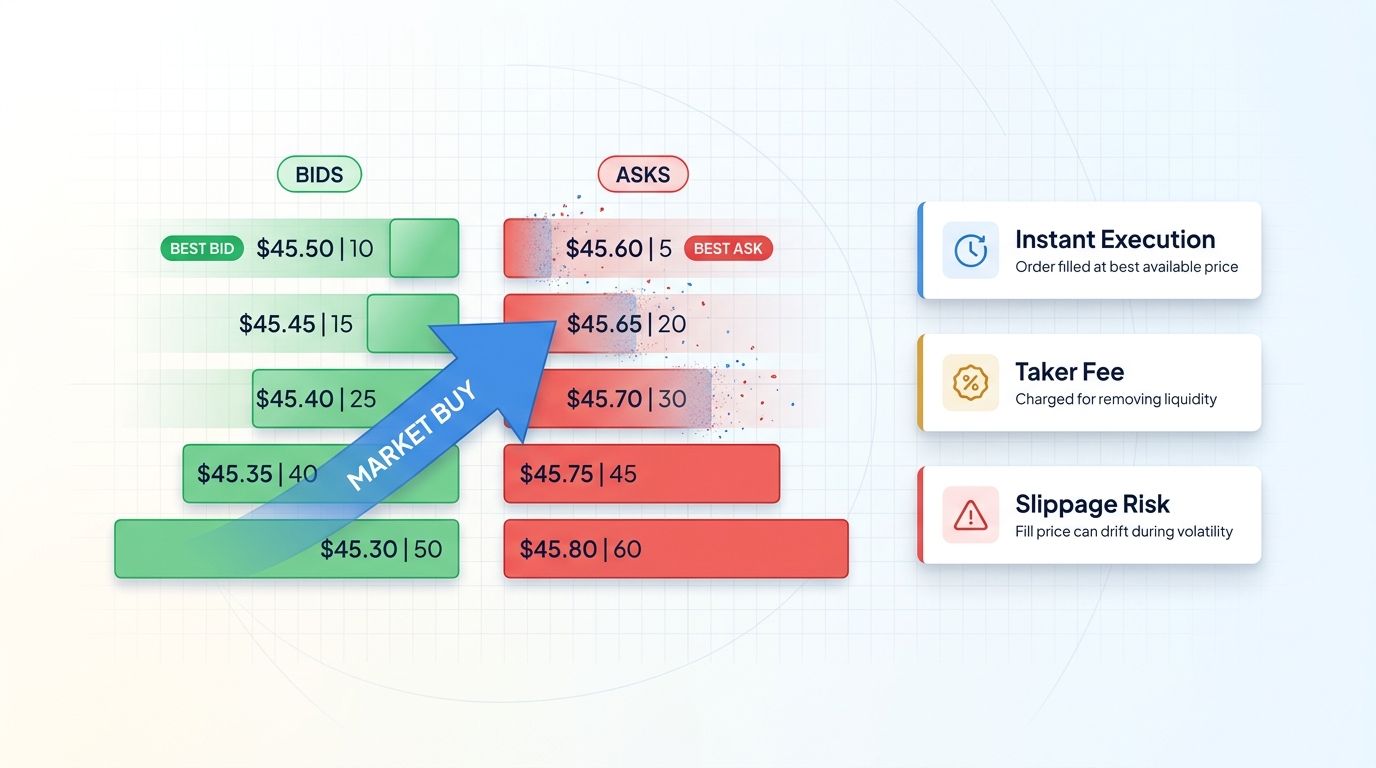
A market order is the simplest and fastest type of order you can place on a cryptocurrency exchange. When you submit a market order, you are telling the exchange to buy or sell a specific amount of crypto at the best available price right now. The order executes almost instantly because it matches against existing orders sitting in the order book.
For example, if Bitcoin is currently trading at $67,500 and you place a market buy order for 0.1 BTC, the exchange will fill your order at whatever the lowest ask price is at that moment. If there is enough liquidity, your entire order fills in a fraction of a second.
How market orders interact with the order book:
- Market orders are considered "taker" orders because they remove liquidity from the order book
- The exchange matches your order against the best available limit orders on the opposite side
- If your order size is larger than the available quantity at the best price, the remaining portion fills at the next best price, and so on
- This cascading fill process is what causes slippage
Key advantages of market orders:
- Guaranteed execution: As long as there is liquidity, your order will fill
- Speed: Orders execute almost instantly, which is critical during fast-moving markets
- Simplicity: No need to calculate or set a specific price
Drawbacks of market orders:
- Slippage risk: In thin or volatile markets, the actual execution price may differ significantly from the price you saw when placing the order
- Higher fees: Most exchanges charge higher taker fees for market orders compared to maker fees for limit orders
- No price control: You accept whatever price the market gives you
Market orders are best used when speed of execution matters more than getting the absolute best price. If a coin is pumping and you need to enter immediately, or if you need to exit a position to cut losses during a crash, a market order gets the job done.
2. What Is a Limit Order in Crypto Trading?
A limit order gives you full control over the price at which your trade executes. Instead of accepting the current market price, you specify the exact price (or better) at which you want to buy or sell. The order then sits in the order book and waits until the market reaches your specified price.
For example, if Ethereum is trading at $3,400 and you believe it will dip to $3,200 before bouncing, you can place a limit buy order at $3,200. Your order will only fill if and when the price drops to $3,200 or lower. If the price never reaches that level, the order remains unfilled until you cancel it.
How limit orders work in the order book:
- Limit orders are "maker" orders because they add liquidity to the order book
- Buy limit orders are placed below the current market price
- Sell limit orders are placed above the current market price
- Orders are filled on a first-come, first-served basis at each price level
- Partial fills are possible if the market only briefly touches your price
Key advantages of limit orders:
- Price control: You never pay more (or receive less) than your specified price
- Lower fees: Most exchanges offer reduced maker fees for limit orders
- Strategic entries and exits: You can set orders at key support and resistance levels and walk away
- No slippage: Your order fills at your price or better, never worse
Drawbacks of limit orders:
- No execution guarantee: If the market never reaches your price, your order will not fill
- Missed opportunities: Being too aggressive with your limit price can mean watching a trade move without you
- Partial fills: Your order might only partially fill, leaving you with an incomplete position
Limit orders are ideal for traders who plan their entries and exits in advance, who trade larger positions where slippage could be costly, or who simply want to pay lower exchange fees.
3. Market Order vs Limit Order: Key Differences Compared
Now that you understand how each order type works individually, let us compare market order vs limit order in crypto side by side to highlight the practical differences that matter most.
Execution Speed
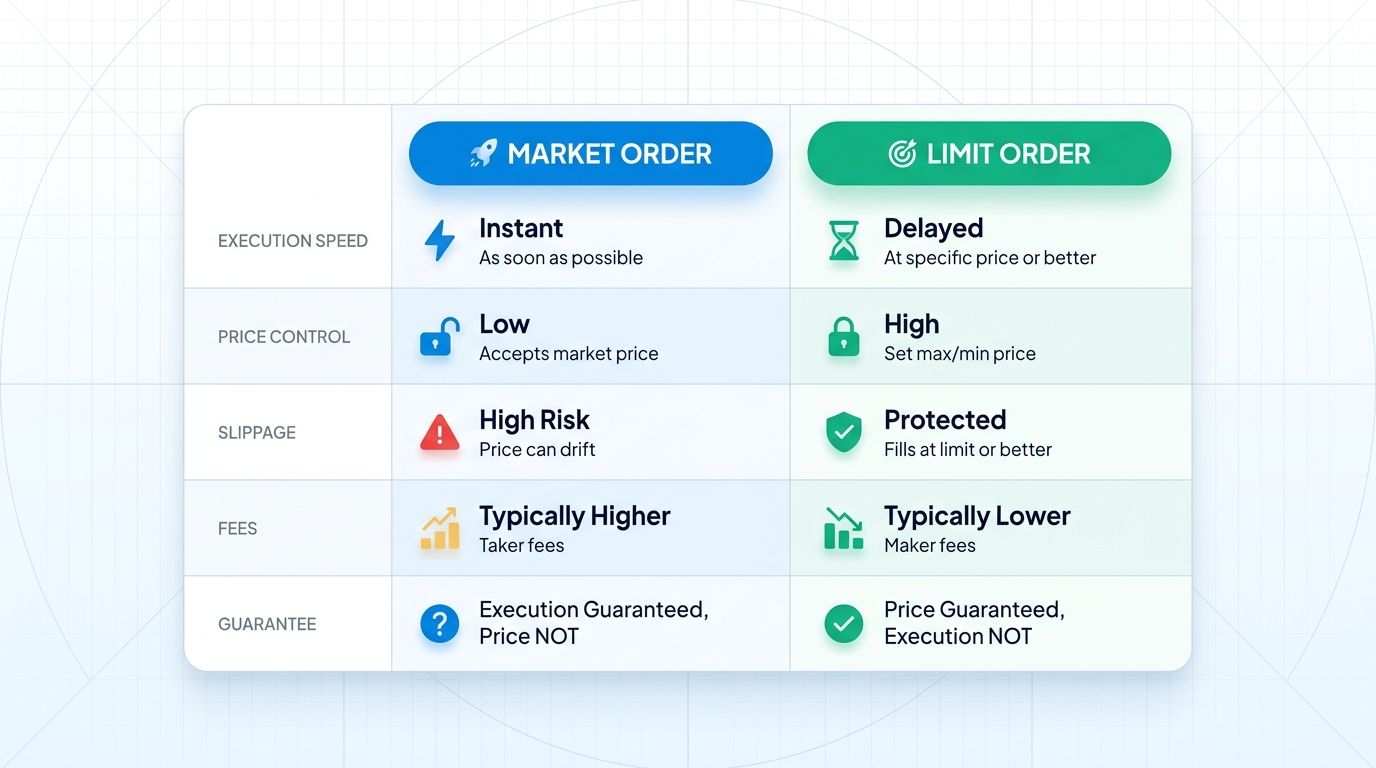
Market orders execute instantly at the best available price. Limit orders only execute when the market reaches your specified price, which could take minutes, hours, days, or may never happen at all.
Price Control
Market orders offer zero price control. You accept whatever the order book gives you. Limit orders give you complete control since your trade only fills at your price or a better one.
Slippage
Market orders are susceptible to slippage, especially on large orders or in low-liquidity markets. Limit orders have zero slippage because the price is predetermined.
Trading Fees
Market orders incur taker fees, which are typically 0.1% to 0.2% on major exchanges. Limit orders benefit from maker fees, which are usually 0.02% to 0.1% lower.
Execution Guarantee
Market orders are virtually guaranteed to fill as long as there is any liquidity. Limit orders may never fill if the price does not reach your target level.
Best Use Case
Market orders excel in urgent situations: breaking news, flash crashes, rapid breakouts. Limit orders shine in planned, strategic trading: buying support, selling resistance, scaling into positions.
Complexity
Market orders require only a quantity input. Limit orders require both a quantity and a price, plus a decision about how long the order should remain active (Good Till Cancelled, Immediate or Cancel, etc.).
The bottom line is that neither order type is universally better than the other. The choice between market and limit orders depends entirely on your trading situation, your time horizon, and how much price precision matters for your specific trade.
4. Other Crypto Order Types Every Trader Should Know
While market and limit orders form the foundation, crypto exchanges offer several advanced order types that can help you manage risk and automate your trading strategy. Here are the most important ones:
Stop-Loss Order
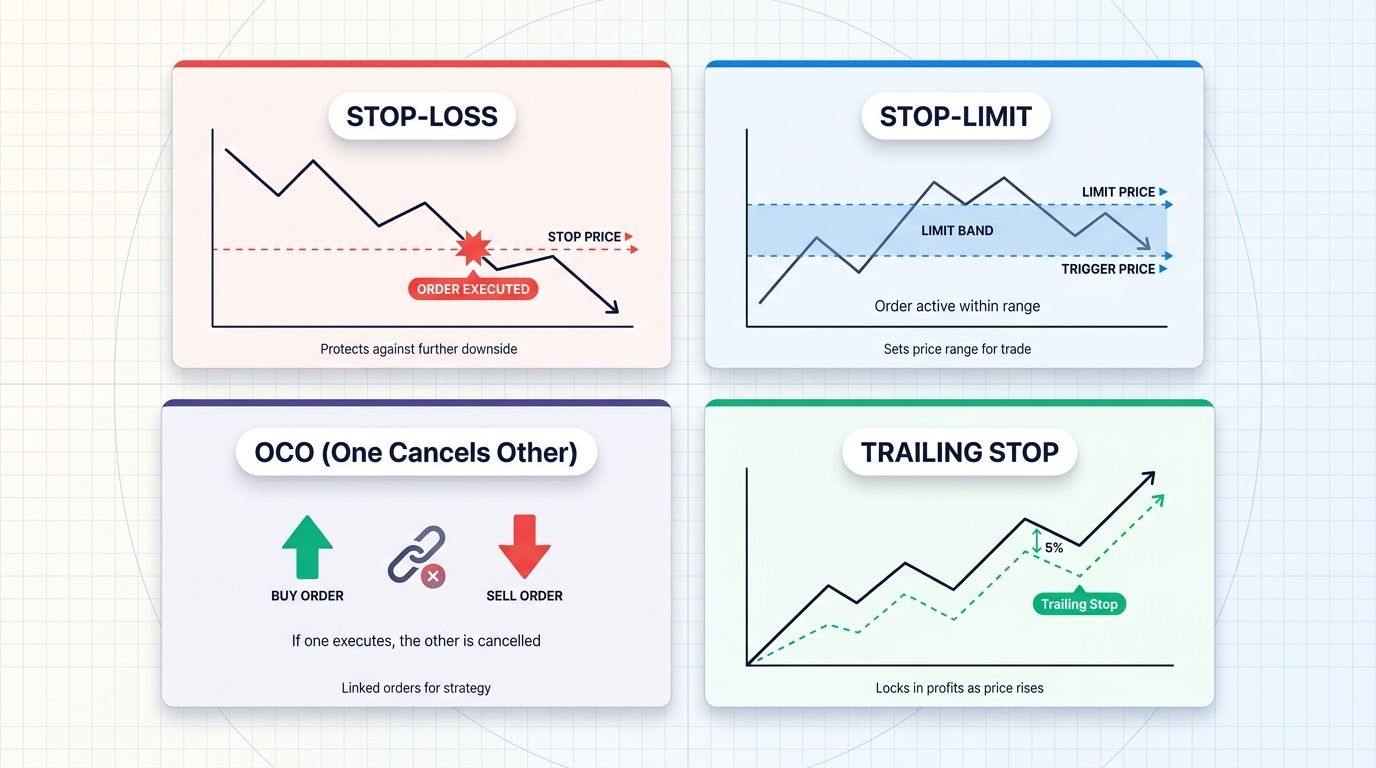
A stop-loss order automatically sells your position when the price drops to a predetermined level. It acts as a safety net to limit your downside risk. For example, if you buy Bitcoin at $67,000, you might set a stop-loss at $64,000 to cap your maximum loss at roughly 4.5%. Once triggered, a stop-loss typically converts into a market order and executes at the next available price.
Stop-Limit Order
A stop-limit order combines a stop trigger with a limit order. When the stop price is hit, instead of executing at market price, the system places a limit order at your specified limit price. This gives you more control over your exit price, but it carries the risk that your limit order may not fill if the market moves too quickly past your limit price.
- Stop price: The trigger level that activates the order
- Limit price: The minimum (for sells) or maximum (for buys) price at which the order can fill
OCO (One Cancels the Other) Order
An OCO order lets you place two conditional orders simultaneously. When one order fills, the other is automatically cancelled. This is incredibly useful for setting both a take-profit and a stop-loss on the same position. For instance, if you hold ETH bought at $3,400, you might set an OCO with a sell limit at $3,800 (take-profit) and a stop-loss at $3,100 (risk management). Whichever level gets hit first, the other order disappears.
Trailing Stop Order
A trailing stop follows the price as it moves in your favor and only triggers when the price reverses by a specified amount or percentage. If Bitcoin rises from $67,000 to $72,000 and you have a 5% trailing stop, the stop level moves up to $68,400. If the price then drops 5% from the peak, the trailing stop triggers and sells your position. This allows you to ride trends while locking in profits.
Fill or Kill (FOK) and Immediate or Cancel (IOC)
These are time-in-force conditions for limit orders. A Fill or Kill order must be filled entirely and immediately, or it is cancelled completely. An Immediate or Cancel order fills as much as possible right away and cancels the remaining unfilled portion. Both are useful for traders who need either full execution or no execution at all.
5. When to Use Market Orders vs Limit Orders in Crypto
Choosing the right order type is not about which one is "better" in the abstract. It is about matching the order type to your specific trading scenario. Here is a practical breakdown of when to use each:
Use a market order when:
- Breaking news hits the market. When a major regulatory announcement drops or an exchange hack is reported, every second counts. A market order gets you in or out immediately.
- You are trading highly liquid pairs. On pairs like BTC/USDT or ETH/USDT with deep order books, slippage is minimal even with market orders. The convenience of instant execution outweighs the small price difference.
- You need to close a losing position fast. When your stop-loss mental level is breached and you are manually exiting, speed matters more than saving a few basis points.
- You are placing small orders. For small position sizes, the slippage on a market order is typically negligible. The time saved by not managing a limit order is worth more.
- A breakout is confirmed. When a coin breaks above a key resistance level on high volume, waiting for a pullback with a limit order might mean missing the entire move.
Use a limit order when:
- You have a clear entry or exit price in mind. If your technical analysis identifies $3,200 as strong support for ETH, a limit buy at $3,200 lets you set it and forget it.
- You are trading large positions. For larger orders, slippage on a market order can be significant. A limit order ensures you get the price you calculated in your risk/reward analysis.
- You are trading low-liquidity altcoins. Thin order books on smaller altcoins can cause dramatic slippage with market orders. Limit orders protect you from paying inflated prices.
- You want to reduce trading fees. Over hundreds of trades, the difference between taker and maker fees adds up. Active traders who consistently use limit orders save meaningful amounts on fees.
- You are scaling into or out of positions. Placing limit orders at multiple price levels allows you to dollar-cost average into a position or take profits gradually as the price rises.
Many experienced traders use a combination of both. They might enter a position with a limit order at a planned level, then use a market order to exit quickly if conditions change unexpectedly.
6. Advanced Order Strategies with Altrady
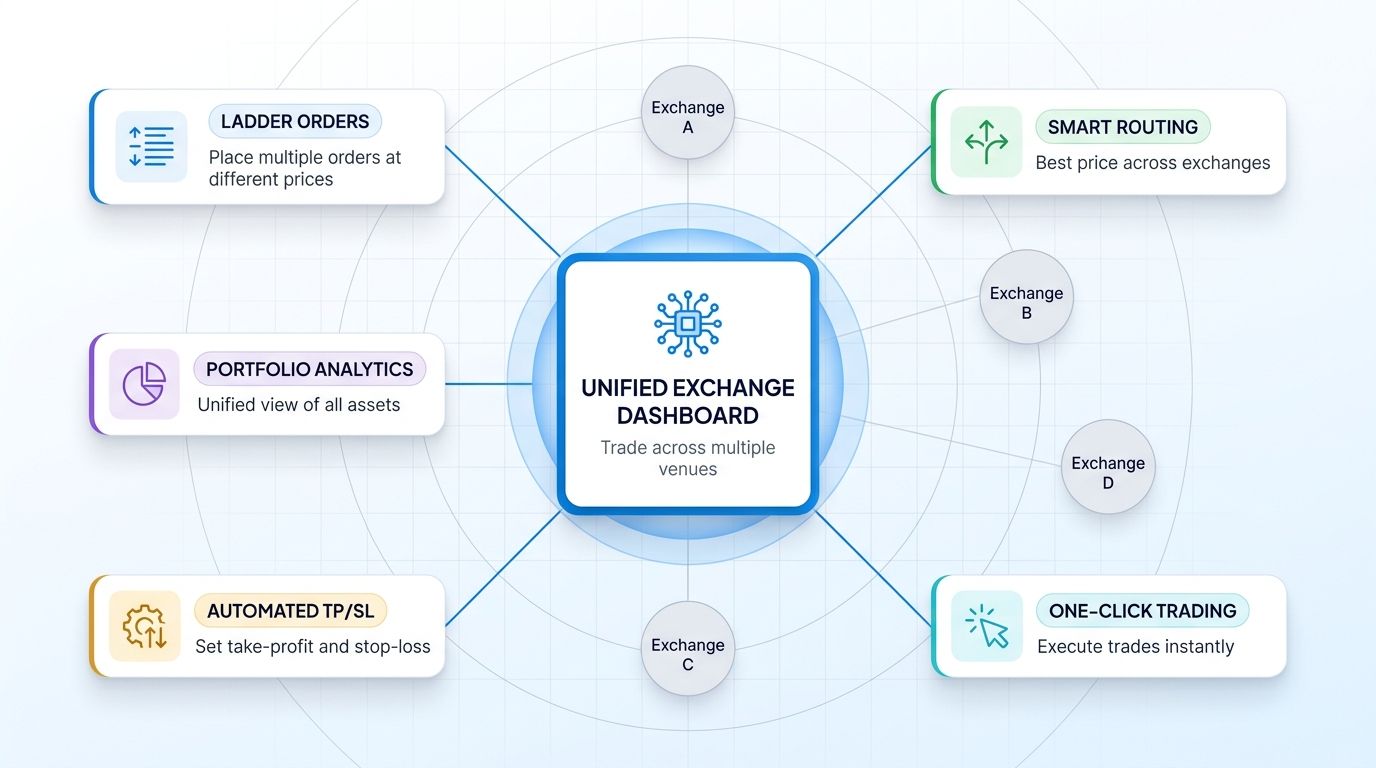
Understanding order types is one thing. Executing them efficiently across multiple exchanges is another challenge entirely. This is where a multi-exchange crypto trading platform like Altrady gives you a genuine edge.
Unified Order Management Across Exchanges
Instead of logging into Binance, KuCoin, Coinbase, and Kraken separately, Altrady lets you manage all your orders from a single dashboard. You can place market orders on one exchange and limit orders on another without switching tabs or windows. This unified view saves time and reduces the risk of errors.
Smart Order Routing
Altrady allows you to compare order books across exchanges and choose the one with the best liquidity for your trade. If BTC/USDT has a tighter spread on Binance than on KuCoin, you can route your order accordingly. This means less slippage on your market orders and better fill rates on your limit orders.
One-Click Order Placement
Speed matters in crypto trading. Altrady's quick order feature lets you place pre-configured market or limit orders with a single click. You define your default order size, select your preferred order type, and execute without filling out forms every time.
Automated Take-Profit and Stop-Loss
Altrady supports automated take-profit and stop-loss configurations directly from the trading interface. You can set up what is effectively an OCO order by defining both your profit target and your maximum acceptable loss when entering a trade. The platform handles the rest.
Ladder Orders for Scaling In and Out
One of Altrady's most powerful features is ladder orders, which let you create multiple limit orders at incrementally different price levels in a single action. Instead of manually placing five separate buy orders at $3,100, $3,150, $3,200, $3,250, and $3,300, you set the range and the number of orders. Altrady distributes them evenly. This is an advanced scaling strategy that would be tedious to execute manually.
Real-Time Alerts and Notifications
Combine your limit order strategy with Altrady's alert system. Set price alerts at key technical levels, and when the market approaches your target, you can decide whether to let your limit order fill or adjust it based on new information. This keeps you informed without requiring you to watch charts 24/7.
Portfolio Tracking and Performance Analytics
After executing your orders, Altrady tracks your portfolio performance across all connected exchanges. You can review which order types yielded the best results, analyze your average slippage on market orders, and optimize your strategy over time with data rather than guesswork.
Start Trading Smarter with Altrady
Now that you understand the difference between market order vs limit order in crypto and how to use advanced order types strategically, it is time to put that knowledge into action. Altrady provides all the tools you need to execute market orders, limit orders, stop-losses, trailing stops, and ladder orders across multiple exchanges from one powerful dashboard.
Sign up for a free trial of Altrady today and experience how a professional-grade trading platform can streamline your order execution, reduce slippage, and help you trade with more confidence. Whether you are a beginner learning order types for the first time or an experienced trader looking for a faster workflow, Altrady has you covered.
Frequently Asked Questions
What is the main difference between a market order and a limit order in crypto?
The main difference is execution. A market order executes immediately at the best available price, while a limit order only executes when the market reaches the specific price you set. Market orders prioritize speed, and limit orders prioritize price control.
Which is better for beginners, market orders or limit orders?
Market orders are simpler for beginners because they only require you to specify the quantity you want to buy or sell. However, beginners should learn to use limit orders early on because they offer better price control, lower fees, and protection against slippage, especially on less liquid trading pairs.
Can I lose money from slippage on a market order?
Yes. Slippage occurs when your market order fills at a worse price than expected, typically because of low liquidity or high volatility. On a large market buy order in a thin order book, you might pay significantly more than the displayed price. Using limit orders or trading highly liquid pairs can help minimize slippage.
What happens if my limit order never gets filled?
If the market price never reaches your limit price, your order simply remains open and unfilled. Depending on the time-in-force setting you chose (Good Till Cancelled, day order, etc.), the order will eventually expire or stay open until you manually cancel it. No fees are charged for unfilled orders.
Can I use both market and limit orders in the same trading strategy?
Absolutely. Many successful traders combine both order types. A common approach is to enter a position using a limit order at a planned price level and then set a market-based stop-loss for risk management. You might also use limit orders for take-profit targets while keeping a market order ready for emergency exits. Platforms like Altrady make it easy to manage both order types simultaneously across multiple exchanges.