
What Is Position Trading?
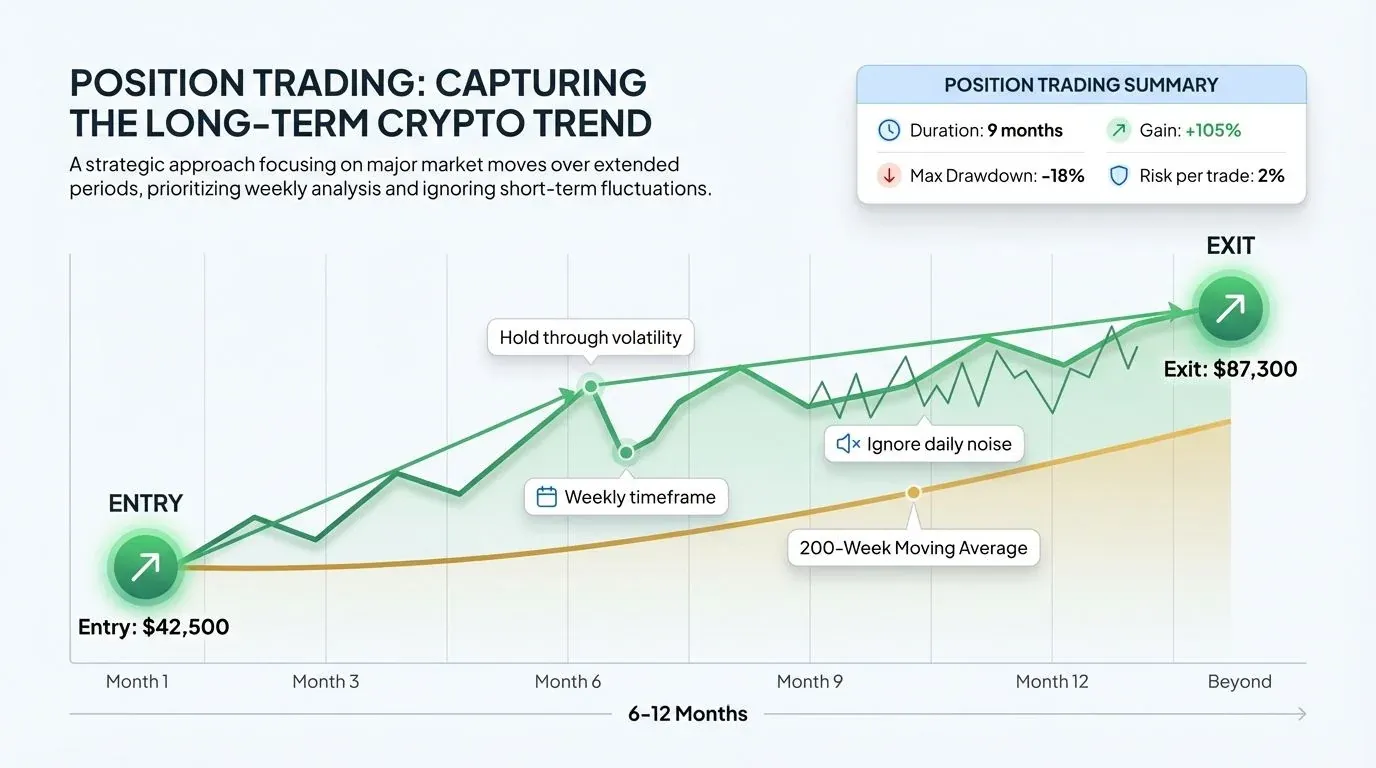
Position trading is a long-term trading strategy where traders hold their positions for weeks, months, or even years. Unlike short-term strategies that focus on intraday or multi-day price movements, position traders aim to capture large, sustained price trends. They enter a trade based on a high-conviction thesis and hold through short-term volatility, waiting for the broader trend to play out.
In the context of crypto, position trading often means riding macro bull or bear cycles. A position trader might accumulate Bitcoin at a key support level, hold through months of sideways price action, and exit near the peak of a bull run. The focus is on the bigger picture rather than daily noise.
Position traders typically use weekly and monthly charts as their primary timeframes. Daily charts may be used for refining entries, but the core analysis lives on higher timeframes. This approach filters out the constant price fluctuations that shorter-term traders react to, allowing position traders to focus on structural market moves.
This style suits traders who cannot monitor screens all day and prefer to make fewer, higher-quality decisions. It also tends to incur lower transaction costs because trades are held for extended periods rather than opened and closed repeatedly.
How Position Trading Differs from Other Styles
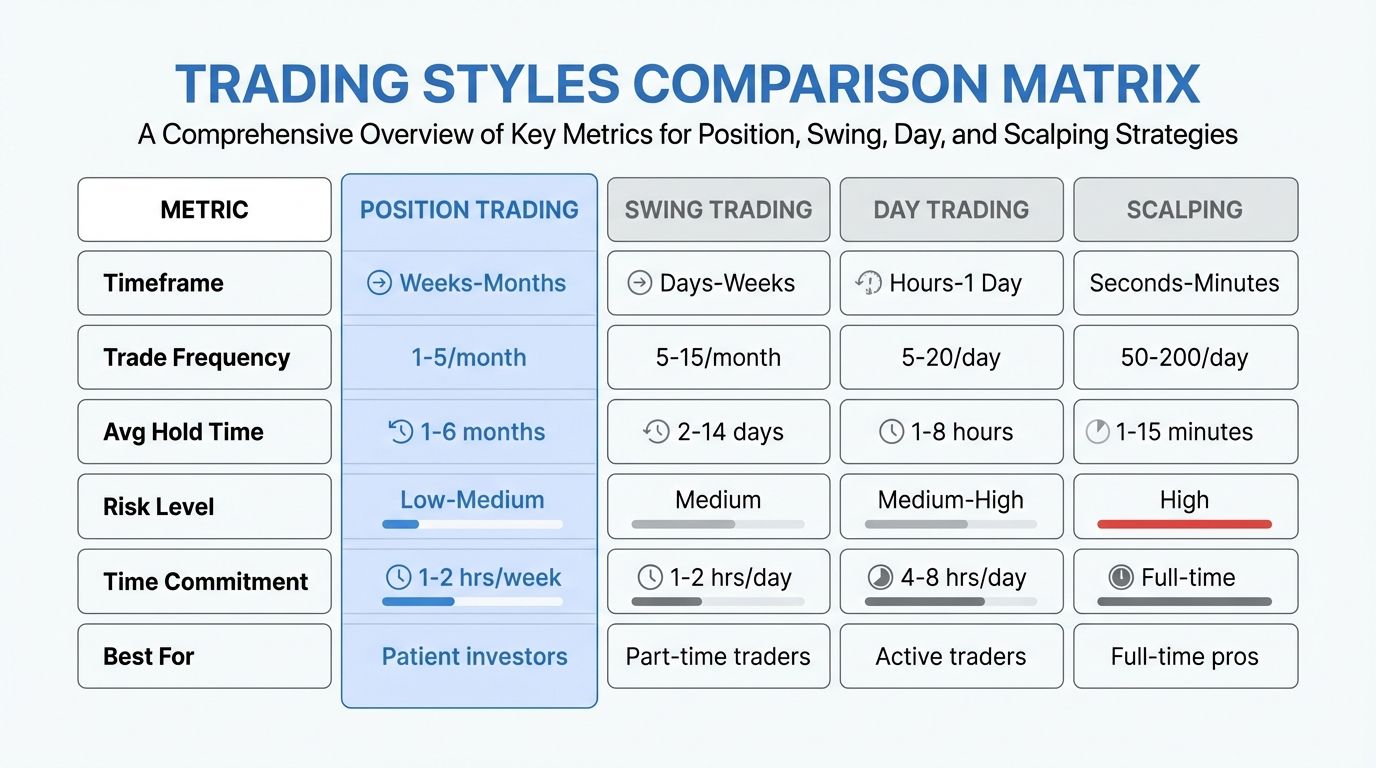
Understanding position trading becomes clearer when you compare it to other popular approaches.
Position Trading vs. Day Trading
Day traders open and close all positions within a single trading session. They rely on 1-minute to 15-minute charts, execute dozens of trades per day, and never carry overnight exposure. Position traders, by contrast, hold for weeks to months and check charts perhaps once or twice per week. The psychological demands are entirely different. Day trading requires constant attention and quick reflexes. Position trading requires patience and the ability to tolerate short-term drawdowns without panic.
Position Trading vs. Swing Trading
Swing trading occupies the middle ground, with typical holding periods from 2 days to a few weeks. Swing traders use 4-hour and daily charts to capture intermediate price swings within a larger trend. Position traders use those same larger trends as their primary backdrop, but they stay in the trade through the individual swings rather than exiting at each peak or trough.
Position Trading vs. Scalping
Scalping is at the opposite extreme. Scalpers hold positions for seconds to minutes, target tiny price differences, and execute hundreds of trades per session. The strategy demands extreme focus, fast execution tools, and deep market liquidity. For position traders, scalping activity is essentially invisible noise on their weekly charts.
A simple comparison across four dimensions:
- Holding period: Scalping (seconds to minutes), Day trading (minutes to hours), Swing trading (days to weeks), Position trading (weeks to months)
- Chart timeframe: Scalping (1m to 5m), Day trading (5m to 1h), Swing trading (4h to daily), Position trading (weekly to monthly)
- Trades per month: Scalping (hundreds), Day trading (dozens), Swing trading (several), Position trading (one to a few)
- Primary skill required: Scalping (execution speed), Day trading (pattern recognition), Swing trading (momentum reading), Position trading (macro trend analysis)
Key Principles of Position Trading
Successful position trading is built on a small set of core principles that separate disciplined practitioners from those who confuse long-term holding with passively ignoring their portfolio.
Conviction Based on Fundamental and Technical Alignment
Position traders do not enter a trade just because price is moving up. A strong position trade is supported by both a fundamental thesis (why this asset should appreciate in value over time) and a technical setup (a price structure that confirms the thesis is being validated by market participants). When both align, the probability of a successful position improves significantly.
Patience Over Activity
The edge in position trading is patience. Many traders who attempt this style undermine themselves by exiting early during periods of consolidation or minor pullbacks. The market constantly tests conviction. Position traders accept that prices will move against them temporarily and stay focused on whether the original thesis remains intact.
Selective Entry
Because position trades are held for extended periods, the entry price matters. Entering at a technically poor level locks in a larger drawdown from the start and increases the chance of being stopped out before the trend develops. Position traders spend considerable time waiting for the right entry, often placing limit orders at key support zones and walking away.
Thesis Management Over Price Management
A position trader monitors their thesis, not just their profit and loss. If the fundamental or technical reason for entering the trade breaks down, that is the exit signal regardless of whether the position is in profit or at a loss. Conversely, if the thesis remains strong, short-term price weakness is not a reason to exit.
Position Trading Strategies for Crypto
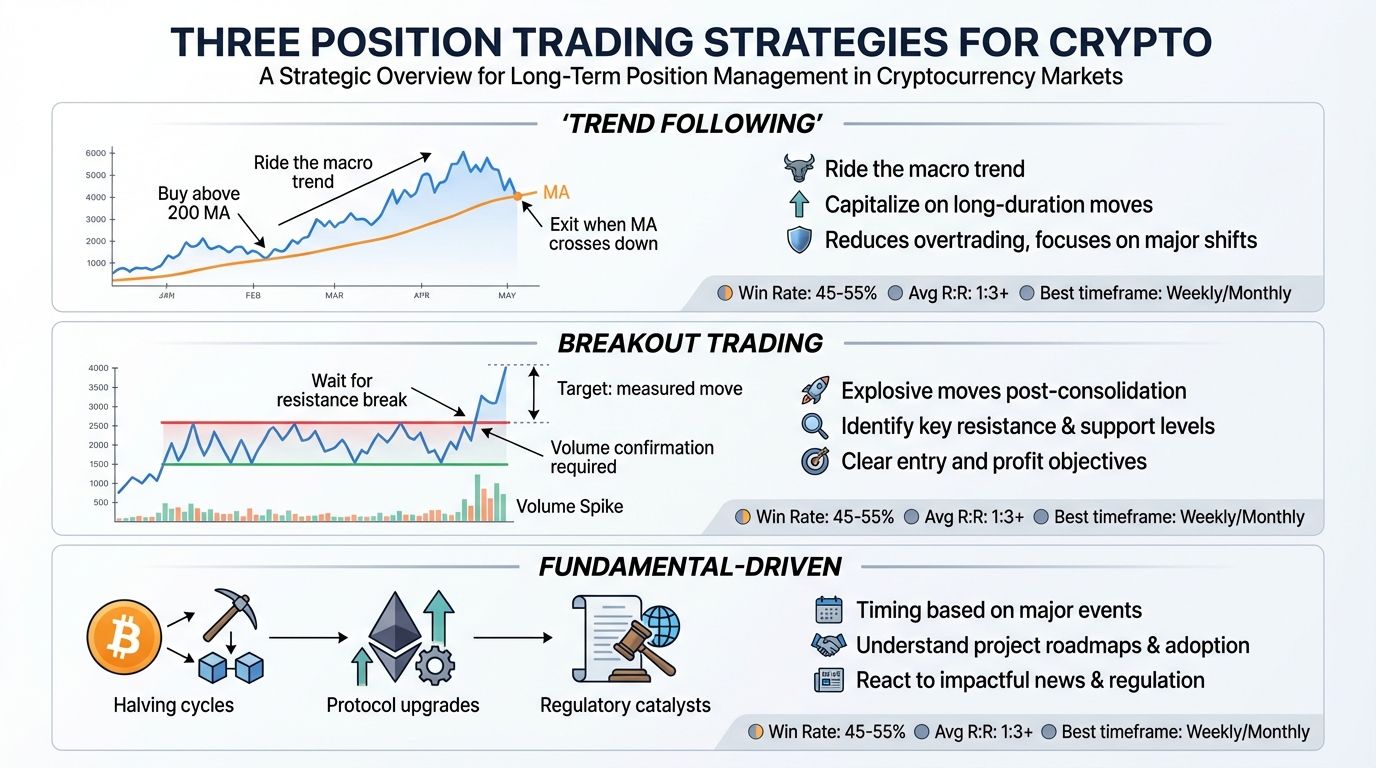
Several core strategies apply well to crypto's characteristic cycles and volatility.
Trend Following
This is the most widely used position trading strategy. The core idea is simple: identify an asset in a clear uptrend, wait for a retracement or consolidation, and enter in the direction of the dominant trend.
In crypto, macro uptrends are often driven by Bitcoin halving cycles. Historical data shows that Bitcoin has consistently entered multi-month bull markets in the 12 to 18 months following each halving event. A trend-following position trader might identify this macro tailwind, use a weekly chart to confirm that price is above a rising 200-week moving average, and enter a long position targeting the next major resistance level.
Breakout Trading
Breakout position traders focus on key resistance levels that have held for months or years. When price breaks above a long-standing resistance level with strong volume confirmation, it signals that a structural shift has occurred and a new trend may be beginning.
Ethereum's price history offers good examples. When ETH breaks above previous cycle highs, it often initiates a sustained trend that unfolds over months. A position trader entering on a confirmed weekly close above a multi-year resistance level can ride this move with a clear invalidation level just below the broken resistance, which now acts as support.
Fundamental-Driven Trading
Some position traders build positions based primarily on upcoming catalysts or long-term value assessments. In crypto, these catalysts include protocol upgrades, major network migrations, institutional adoption milestones, or regulatory clarity events.
For example, a trader who closely followed Ethereum's multi-year transition to proof-of-stake had a clear fundamental thesis for holding a long position over an extended timeframe. The underlying technology upgrade was expected to reduce sell pressure from miners and improve network economics, a thesis that could be held regardless of short-term price noise.
Technical Analysis Tools for Position Traders
While fundamental context is important, position traders rely on specific technical tools to time entries, set targets, and define invalidation levels.
Moving Averages
The 200-week moving average is one of the most respected indicators in crypto position trading. Bitcoin has historically found long-term support at this level during bear markets, making it a frequent accumulation zone for position traders. The 50-week and 21-week moving averages are also commonly used to identify trend direction and dynamic support levels.
A common position entry setup involves price reclaiming the 21-week moving average from below and holding above it for at least two consecutive weekly closes. This signals a potential trend change from bearish to bullish at the macro level.
Trend Lines and Channels
Long-term trend lines drawn on weekly and monthly charts can define the boundaries of major market cycles. When price respects a rising trend line over multiple months, it gives position traders a structural reference point. A break of a major trend line on the weekly chart is often a valid exit signal.
Support and Resistance Levels
Historical price levels where buying or selling has been concentrated act as meaningful reference points on higher timeframes. On a monthly chart, these levels tend to carry more weight because they represent collective market memory over long periods. Position traders use these levels to set entries (buying near support), targets (selling near resistance), and stop losses (placing stops below significant support).
On-Chain Metrics
For Bitcoin and Ethereum, on-chain data provides an additional layer of analysis unavailable in traditional markets. Metrics such as realized price, MVRV ratio, and long-term holder supply can indicate whether the market is in a period of undervaluation or overvaluation. Position traders who incorporate these tools can refine their entries and exits beyond what price action alone reveals.
Risk Management for Position Traders
Holding trades for weeks or months introduces specific risk management challenges that differ from shorter-term styles.
Position Sizing
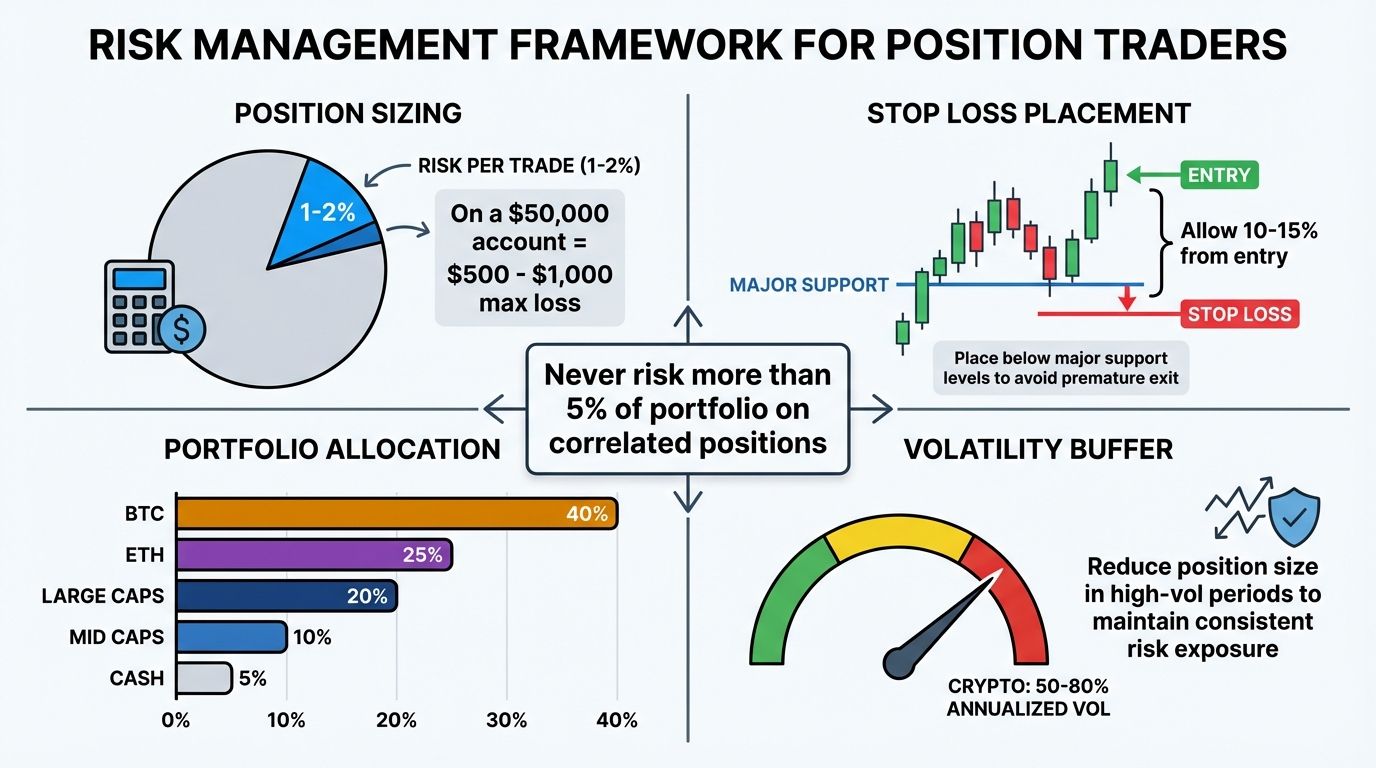
Because crypto can experience 30 to 50 percent corrections even within a broader uptrend, position size must be calibrated carefully. A common rule is to risk no more than 1 to 2 percent of total capital on any single trade. This means that even if a position is stopped out with a 20 percent decline from entry, the damage to the overall portfolio is limited to 1 to 2 percent.
Many position traders use staged entries rather than allocating the full position at once. They might enter with 30 percent of the planned allocation at a key support level, add another 30 percent when price confirms the direction, and hold the remaining 40 percent in reserve to average into weakness if the thesis remains intact.
Stop Loss Placement
Stop losses for position trades are typically placed below major structural support levels rather than at arbitrary percentage levels. A stop placed at a technically meaningful level is more logical than a flat 10 or 15 percent stop because it reflects actual market structure. If price breaks below a major weekly support level, the position thesis is likely invalidated regardless of the exact percentage decline.
Wide stops require smaller position sizes to keep overall risk controlled. This is the trade-off in position trading: larger stop distances mean smaller allocated position sizes, but those smaller positions are held for much larger potential moves.
Portfolio Allocation
Position traders typically hold a small number of high-conviction positions rather than a large number of small speculative positions. A common framework allocates the largest share (often 50 to 60 percent) to core positions in Bitcoin and Ethereum, a smaller share (20 to 30 percent) to high-conviction altcoin positions with strong fundamentals, and keeps a cash reserve (10 to 20 percent) available to deploy during significant pullbacks.
This structure ensures that the portfolio is concentrated enough to generate meaningful returns from correct calls while maintaining enough diversification to survive unexpected events in any single asset.
Managing Through Volatility
Crypto markets are prone to sharp, sudden corrections even during bull markets. Bitcoin has historically dropped 30 to 40 percent multiple times within a single bull cycle before resuming its uptrend. Position traders must have both a defined risk management framework and the psychological preparation to hold through these drawdowns without abandoning positions prematurely.
A useful practice is to write down the thesis for each position at entry, including the conditions that would invalidate it. During volatile periods, reviewing this document helps traders evaluate whether the correction is a normal pullback within the trend or a genuine breakdown of the thesis.
Pros and Cons of Position Trading
Advantages
Lower time commitment. Position trading does not require constant screen monitoring. Once a position is set with appropriate stop losses and target orders, the trader can check in weekly rather than hourly.
Lower transaction costs. Fewer trades mean fewer fees, less slippage, and lower tax complexity in jurisdictions where each trade is a taxable event.
Larger profit potential per trade. By staying in a trend for months, position traders can capture moves of 100 percent or more on individual positions, which is simply not achievable with day trading or scalping.
Reduced emotional stress. Without the constant need to react to short-term price movements, position traders experience lower day-to-day psychological pressure compared to shorter-term styles.
Alignment with crypto's macro cycles. Crypto markets are driven by multi-year cycles tied to Bitcoin's halving schedule and broader adoption waves. Position trading is a natural fit for capturing these cycles.
Disadvantages
Capital is tied up for extended periods. Money committed to a long-term position cannot easily be deployed elsewhere if a better opportunity arises without closing the existing trade.
Large drawdowns must be tolerated. Even a correctly positioned trade can show a 25 to 35 percent drawdown before moving in the expected direction. Traders who cannot tolerate this psychologically will exit prematurely.
Requires patience that many traders lack. The most common failure mode in position trading is not bad analysis but premature exits driven by impatience or fear during consolidation phases.
Overnight and long-term risk exposure. Black swan events, regulatory announcements, exchange failures, and protocol exploits can all occur while a position is held. Position traders carry this tail risk, unlike day traders who close out before each session ends.
Slower feedback loop. Position traders wait months to know whether a trade worked. This makes it harder to develop trading skills quickly compared to strategies with faster iteration cycles.
Manage Positions Across Exchanges with Altrady
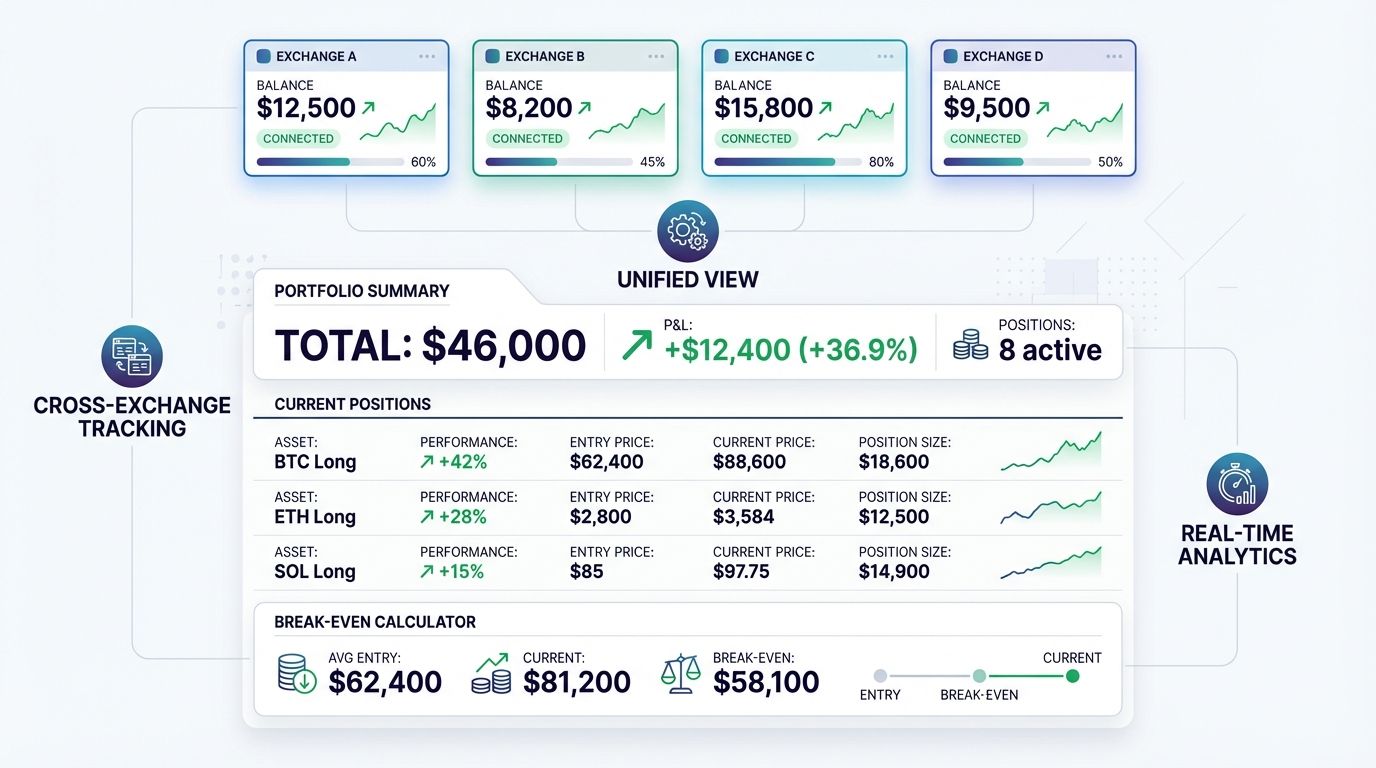
Position trading across multiple exchanges creates a real logistical challenge. When your BTC is on one exchange, ETH on another, and a long-tail altcoin position on a third, keeping a clear view of your overall portfolio performance, risk exposure, and entry levels becomes complicated fast.
Altrady solves this by connecting 19 or more exchanges into a single unified dashboard. You can see all your open positions, unrealized profit and loss, and portfolio allocation in one place without switching between multiple platform tabs.
For position traders specifically, Altrady's smart order tools are particularly valuable. You can place bracket orders with both take-profit and stop-loss targets simultaneously. Once set, these orders work automatically in the background while you focus on analysis rather than execution. If price reaches your target or invalidates your thesis, the system handles the exit without requiring you to be at your desk.
The break-even calculator helps you quickly assess what price level your position needs to reach to cover fees and initial risk, which is useful for sizing partial exits as your position moves in your favor. Real-time alerts notify you when key price levels are reached, so you do not need to watch charts constantly to stay informed about your positions.
Whether you are managing a two-position portfolio or tracking a dozen assets across multiple exchanges, Altrady is designed to give position traders the control and visibility they need without the complexity of juggling separate platforms.
Start a free trial today and see how much simpler long-term crypto position management becomes when everything is in one place.
Frequently Asked Questions
How long should a position trade be held?
There is no fixed rule for how long a position trade must be held. The holding period is determined by the trade thesis, not by a calendar. Some position trades play out in 4 to 6 weeks when price moves quickly to target. Others may take 6 to 12 months if the expected catalyst unfolds slowly. The correct time to close a position trade is when either the price target is reached, the stop loss is triggered, or the original thesis has been invalidated by new information.
Can beginners use position trading in crypto?
Position trading is often considered more accessible to beginners than day trading or scalping because it does not require constant monitoring or fast execution. However, beginners must still develop solid skills in reading higher-timeframe charts, identifying macro trends, and managing risk through proper position sizing. The biggest challenge for new traders is the psychological discipline required to hold through drawdowns. Starting with a small allocation and keeping detailed trade journals to review decisions is strongly recommended for anyone new to this style.
What is the biggest risk in position trading crypto?
The biggest risk is holding through a trend reversal rather than a temporary correction. In crypto, trends can reverse sharply and permanently due to regulatory changes, exchange failures, or broad market cycle shifts. Position traders who do not have clearly defined invalidation levels and stick to them can watch a profitable position turn into a large loss over weeks. Proper stop placement at technically meaningful levels and the discipline to honor those stops is the most critical risk management skill for this style.
How does position trading work in a bear market?
Most retail position traders focus on long positions during bull markets, but the same principles apply to bear market positioning with some adjustments. During a confirmed bear market, some traders short crypto assets on the same long-term timeframes, targeting major support levels as profit targets. Others shift entirely to stablecoins and wait for clear signs of trend reversal before establishing new long positions. Identifying when a bear market is ending, typically through a combination of on-chain metrics, technical structure, and macro context, is a valuable skill for position traders who want to deploy capital at the bottom of cycles rather than after a significant move has already occurred.
How many positions should a position trader hold at once?
Most experienced position traders recommend holding between 3 and 8 positions at any time. Fewer than 3 creates concentration risk where a single adverse event could seriously damage the portfolio. More than 8 starts to dilute attention and makes it harder to monitor each position's thesis with the depth required. The ideal number depends on available capital, the number of genuinely high-conviction opportunities present at any given time, and the trader's ability to stay informed on each asset's fundamentals. Quality over quantity is the guiding principle.