
Pump.fun is a memecoin launchpad on Solana where anyone can create a token in seconds and trade it immediately on a bonding curve, a pricing formula that raises the price as more people buy. When enough buying fills the curve, the token "graduates" and its liquidity moves to PumpSwap, Pump.fun's own exchange, where it trades like any other Solana token.
This guide explains how Pump.fun works in 2026, how to trade on it step by step, whether it is safe, and a risk framework for a market where most tokens go to zero. Memecoins are highly speculative; nothing here is financial advice.
- Pump.fun is a launchpad, not an exchange. You trade from your own Solana wallet; tokens start on a bonding curve and graduate to PumpSwap when the curve fills.
- Graduation moved from Raydium to PumpSwap in March 2025, and in 2026 the BOOST mechanism uses part of the migration liquidity to buy and burn tokens in the first five minutes.
- Most tokens never graduate. Only a few percent of launches fill their curve; in late July 2026 the rate ranged from 2.5% to 6.7%.
- The platform is non-custodial, the tokens are not vetted. The main risks are rug pulls, bot front-running, fake sites and wallet drainers, not Pump.fun holding your funds.
- Size tiny and plan exits first. Risk a small fixed amount per trade, check the creator's wallet, and decide your exit before you buy.
What Is Pump.fun?
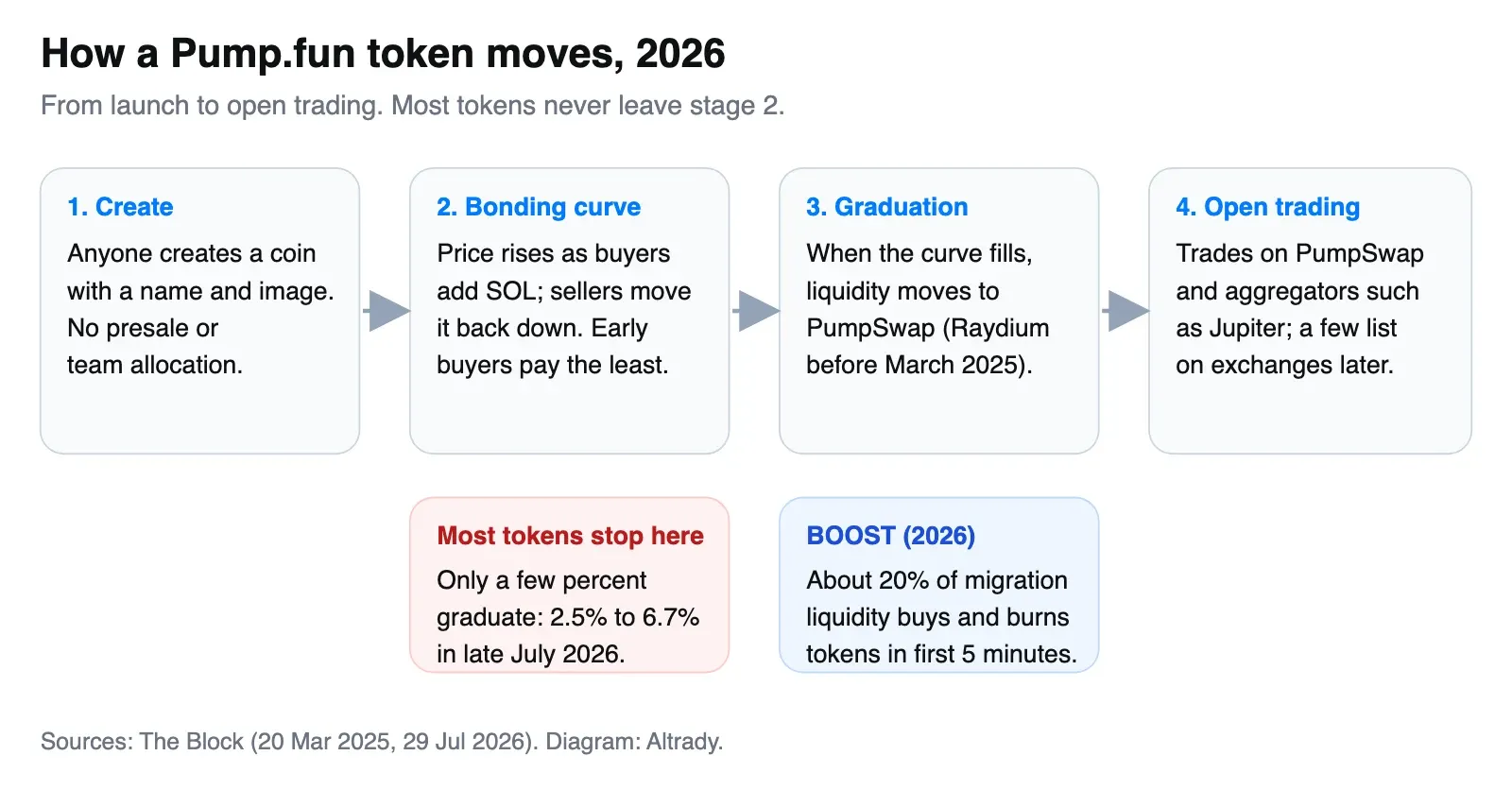
Pump.fun lets anyone launch a Solana token by choosing a name, ticker and image. There is no presale, no reserved team allocation and no vesting: every coin starts on the same bonding curve, and anyone can buy from the first second.
The bonding curve
Instead of an order book, the price is set by a formula. Each buy adds SOL to the curve and pushes the price up; each sell takes SOL out and pushes it down. The first buyers pay the lowest prices, which is why launches attract sniping bots within milliseconds.
Graduation to PumpSwap
When the curve fills, the token graduates and its liquidity moves into a PumpSwap pool. Until March 2025 graduated tokens moved to Raydium, and graduation required a market cap of about $69,000. On 20 March 2025 Pump.fun launched PumpSwap, sent graduated tokens there instead and dropped the 6 SOL migration fee, according to The Block.
BOOST in 2026
In 2026 Pump.fun made BOOST its default launch mechanism. About 20% of the liquidity that used to be locked in the PumpSwap pool at graduation now funds automatic market buys during the first five minutes after migration, and the tokens bought are burned. The Block reported graduation rates of 2.5% the week before and 6.7% on one day in late July 2026 after the change.
How to Trade on Pump.fun, Step by Step
- Set up a Solana wallet. Phantom, Solflare or Backpack work. Use a separate wallet for memecoins, not the one holding your long-term funds.
- Fund it with SOL. Buy SOL on an exchange and withdraw it to the wallet. Keep a little extra for network fees.
- Open the real site. Type pump.fun yourself or use a bookmark; fake look-alike sites and sponsored links are a common way wallets get drained.
- Research the coin before buying. Check how much of the supply the creator and top holders own, whether the creator has already sold, how much is in the curve, and whether the community is real or bot-driven. Screeners such as Dexscreener, GMGN and Photon show holder and creator activity.
- Set slippage and size. Enter the SOL amount and a slippage limit. High slippage gets you filled in a fast market but lets bots trade ahead of you at a worse price.
- Confirm in your wallet and check the transaction on a Solana explorer.
- Plan the exit. Decide your exit levels before you buy. Automatic stop-loss and take-profit orders on Solana memecoins generally need a trading bot interface that supports them.
- After graduation, the token trades on PumpSwap and through aggregators such as Jupiter. A few tokens later list on centralized exchanges, where you can use normal limit, stop-loss and take-profit orders.
Is Pump.fun Safe?
Pump.fun is non-custodial: your SOL and tokens stay in your own wallet, and trades go through Solana programs rather than a company account. That removes the risk of an exchange freezing or losing your balance. It does not make trading safe, because almost all the risk sits in the tokens and in how people try to steal from traders.
- Rug pulls and creator dumps. Creators can buy a large share at launch and sell into the first buyers. Nothing on Pump.fun vets tokens.
- Bundled launches. Some creators spread their buys across many wallets so the supply looks distributed. Holder checks in screeners help spot clusters of fresh wallets.
- Bots and front-running. Sniping and sandwich bots buy before and sell after retail orders. Protected RPCs and lower slippage reduce, but do not remove, the disadvantage.
- Phishing and wallet drainers. Fake sites, fake support accounts and malicious "claim" links ask you to sign transactions that empty your wallet. Never sign something you do not understand.
- Losing most trades. With only a few percent of launches graduating, most positions on the curve end at a loss.
A practical rule: treat any SOL in your memecoin wallet as money you can afford to lose completely, and keep the wallet separate from everything else.
A Risk Framework for Pump.fun Trading
- Fixed, small position size. Many traders risk 0.5% to 1% of their trading capital per memecoin. Ten losing trades at 1% cost 10%; at 10% per trade they wipe out most of the account. See how to calculate position size.
- Enough liquidity to exit. In a thin curve, your own sell moves the price sharply against you. Set a minimum before you enter.
- Creator and holder check. Avoid coins where the creator or a cluster of linked wallets holds a large share, or where the creator has already started selling.
- Exits decided in advance. A stop level, a take-profit ladder that sells part of the position at each target, and a time limit if nothing happens.
- Separate capital. Fund memecoin trading with a fixed amount. If it runs out, stop instead of topping it up from other holdings.
Tools Memecoin Traders Use
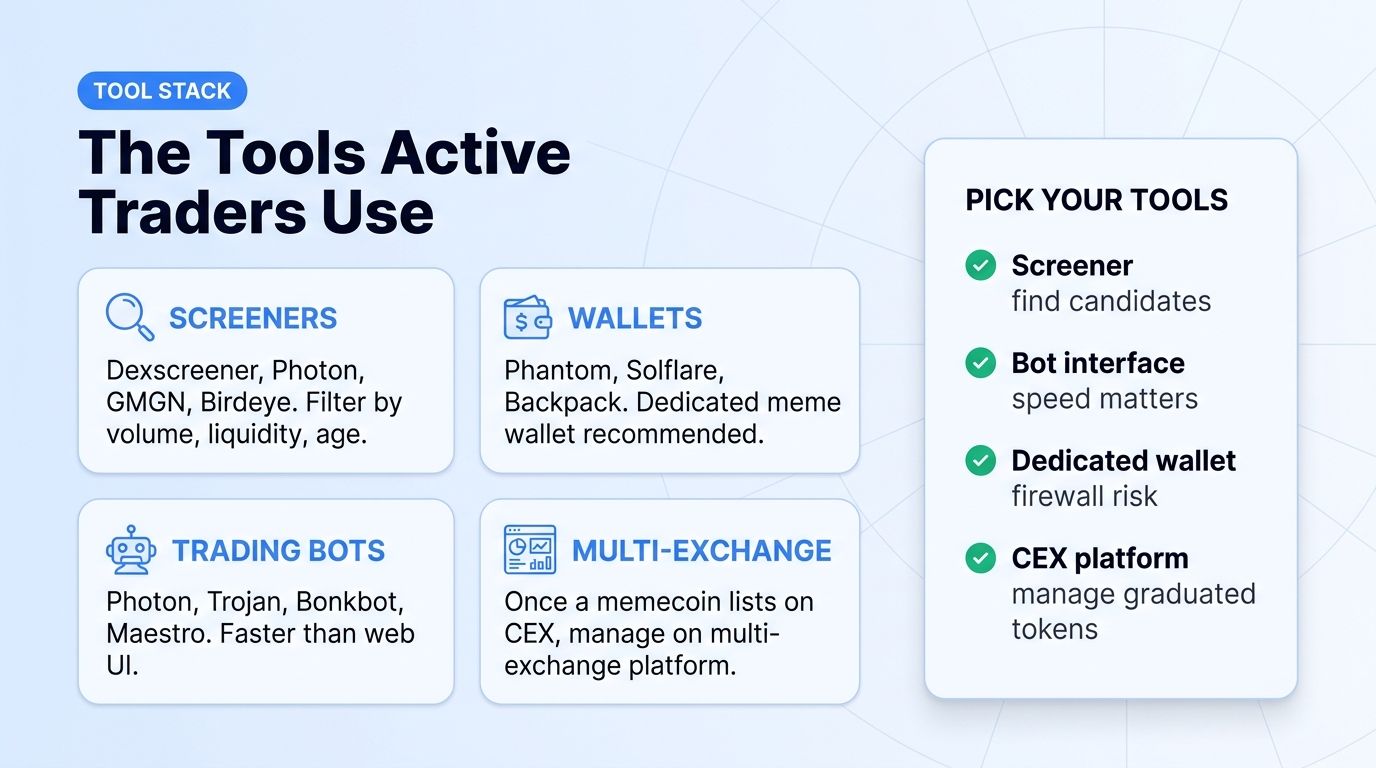
- Screeners: Dexscreener, GMGN, Photon and Birdeye filter new tokens by volume, liquidity, age and holder activity. See our Dexscreener guide.
- Wallets: Phantom, Solflare and Backpack.
- Trading bots and interfaces: Photon, Trojan, Bonkbot and Maestro offer faster execution than the web interface and features such as automatic sells. They need access to a wallet, so use a dedicated one.
Can You Paper Trade Pump.fun?
We could not find a simulated or demo mode on the Pump.fun site as of October 2026, so every trade on the bonding curve uses real SOL. Traders who want to practise usually start with very small amounts. Once a memecoin lists on a centralized exchange, you can practise on it properly: Altrady's paper trading lets you trade exchange-listed memecoins with simulated funds, including stop losses and take profits.
Trading Listed Memecoins With Altrady
Altrady does not trade tokens on Pump.fun's bonding curve or on PumpSwap, which happen in your Solana wallet. Many larger memecoins later list on centralized exchanges. Pump.fun's own PUMP token, for example, trades against USDT on Binance, Bybit, OKX, KuCoin, MEXC, Gate and Kraken, and BONK and WIF trade on Binance (checked on the exchanges' public market data on 24 October 2026). For those, Altrady adds what the Pump.fun interface lacks:
- Stops and targets on every entry. Smart orders set the entry, stop loss and a take-profit ladder in one order.
- Alerts instead of screen-watching. Price and trend line alerts on volatile memecoins.
- Scanning. The TA scanner flags volume spikes and indicator setups across every market on your exchanges.
- Practice first. Paper trading with simulated funds before using real money.
Frequently Asked Questions
What is Pump.fun?
Pump.fun is a Solana memecoin launchpad where anyone can create a token and trade it immediately on a bonding curve. When the curve fills, the token graduates and its liquidity moves to PumpSwap, Pump.fun's own exchange.
Is Pump.fun safe?
The platform is non-custodial, so your funds stay in your own wallet. The tokens are not vetted, though: rug pulls, creator dumps, bot front-running, fake sites and wallet drainers are common, and most tokens lose almost all their value. Only trade money you can afford to lose, from a separate wallet.
How do you trade on Pump.fun?
Set up a Solana wallet such as Phantom, fund it with SOL, open pump.fun directly, research the coin's holders and creator, set your amount and slippage, and confirm the trade in your wallet. Decide your exit levels before you buy.
Where do Pump.fun tokens go after graduation?
Since 20 March 2025, graduated tokens move to PumpSwap instead of Raydium, and the 6 SOL migration fee was dropped. In 2026 the BOOST mechanism uses about 20% of the migration liquidity to buy and burn tokens in the first five minutes.
How many Pump.fun tokens graduate?
Only a small share. The Block reported a graduation rate of 2.5% for one week in July 2026, rising to 6.7% on one day later that month after BOOST became the default.
Can you paper trade on Pump.fun?
We could not find a demo mode on the Pump.fun site as of October 2026, so trades on the bonding curve use real SOL. Memecoins that list on centralized exchanges can be practised with simulated funds on a paper trading account, such as Altrady's.
Can you set a stop loss on Pump.fun?
Automatic stop-loss orders on Solana memecoins generally need a third-party trading bot interface. Once a token lists on a centralized exchange, you can use normal stop-loss and take-profit orders, for example through Altrady's smart orders.
Does Altrady support Pump.fun?
Not directly: Pump.fun and PumpSwap trades happen in your Solana wallet. Altrady connects to 19 centralized exchanges, so you can trade memecoins that list there, such as PUMP, BONK or WIF, with smart orders, alerts and paper trading.
Trade exchange-listed memecoins with a stop loss and take-profit ladder on every entry, and practise first on a paper account.
No credit card required. Memecoins are extremely risky; past performance does not guarantee future results.