
Intro
In the world of trading, and especially in the crypto market, the Bollinger Bands indicator has solidified a special place for itself, serving as one of the best indicators to overcome volatility seasons.
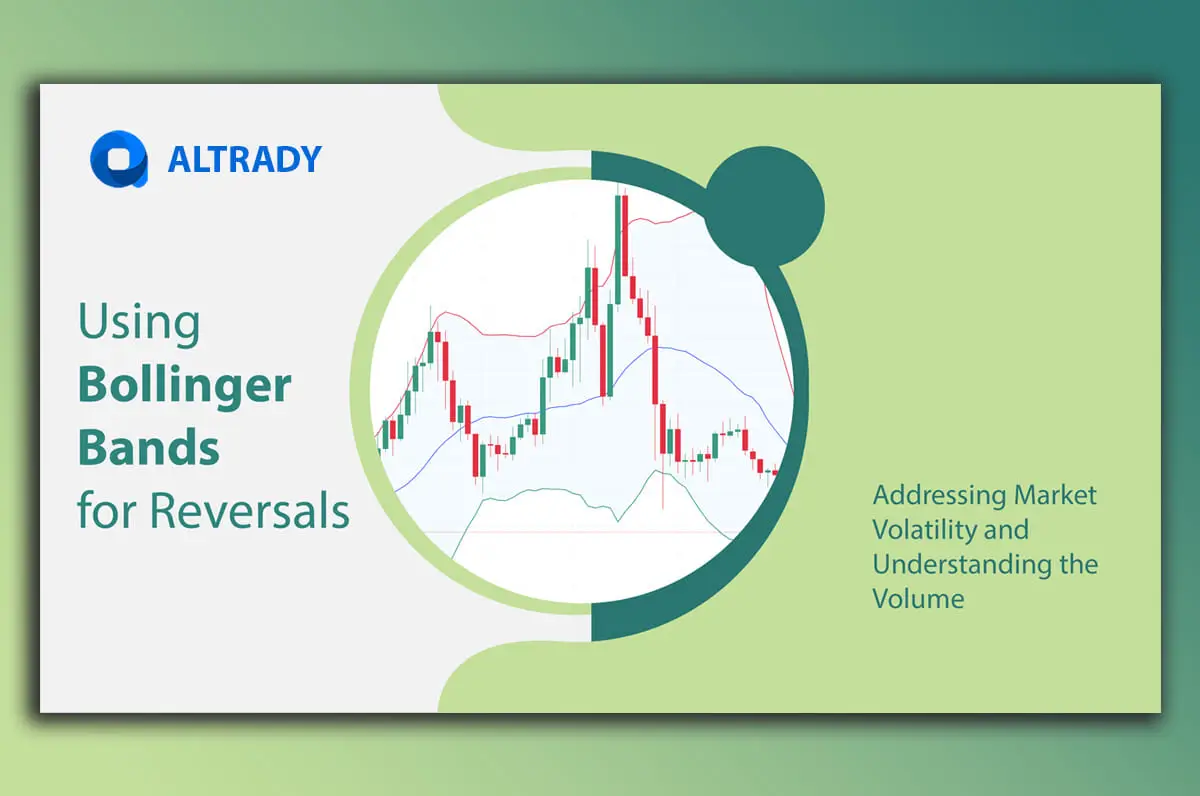
The Bollinger Bands is built based on standard deviations and simple moving averages (SMA). It consists of three elements:
- An upper line: represents a number of standard deviations above the middle line.
- The middle line: A simple moving average, like the 20-day periods.
- A lower line: represents a number of standard deviations below the middle line.
The core function of these elements is to expand and contract, acting as pivot points, and in the case of the moving average, to follow the price action based on an average calculation. gauge trends and act as a splitter for downward and upward momentums.
In this guide, we will delve into the role of market volatility and the use of volume as confirmation for reversal strategy.

Using Bollinger Bands for Reversals
Driven by band expansions, Bollinger Bands can offer significant signals on reversal points of price action.
Even though spotting oversold and overbought levels is not a core approach of this indicator, combining Bollinger Bands with the RSI can lead to reliable signals of this type.
However, Bollinger Bands has its strategy for identifying reversal points based on ranging markets and is very convenient for swing trading.
The Bollinger Bounce Strategy
This strategy focuses on the price bouncing between the upper and lower bands. Expected to occur during ranging markets mainly, Bollinger Bands is a distinguished indicator for this type of strategy. When volatility tightens, traders often watch for a band squeeze as a sign that the current range may soon expand.
Let's decipher how it works:
- When the price touches or goes through the upper band, it might be close to an overbought condition. In this case, traders could expect a retracement to the middle band from an uptrend to a downtrend.
- When the price touches or goes through the lower band, it might be close to an oversold condition. In this case, traders could expect a correction from a downtrend to an uptrend to the middle band.
Keys to Identify Bounce Reversals
When the price breaches the Bollinger Bands, it could be an instance to expect a bounce reversal. But how to identify those instances?
- When the price dips above and then reverses downward notably, it could be a Bollinger Bounce signal for a downtrend.
- When the price dips below and then reverses upward notably, it could be a bounce signal for an uptrend.
Confirmations With Reversal Indicators & Other Tools
As with any other indicator, it is a good practice to confirm signals by the hand of a second tool, like:
- Candlestick patterns: These are significant candlestick formations that engulf previous movements, like a bullish or bearish reversal pattern. Expect these formations close to the upper or lower band to confirm a reversal.
- Volume Indicator: An increase in volume alongside a price reversal strengthens the Bollinger Bounce signal.
- Moving Averages: If the price moves out from any of the Bollinger Bands over a moving average line, like the 50 days or 100 days, then it reinforces the reversal cases.

Trading the Bollinger Bounce
- Entry: Traders can place long positions after a confirmed Bollinger Bounce off the lower band, especially near support levels or accompanied by a bullish candlestick pattern.
- Exit: Take profit once the price is near the middle band or some resistance levels, weakening the signal.
- Stop-Loss: Once the entry executes, place a stop-loss below the Bollinger Bounce low point or a relevant candlestick.
Bollinger Bands And Market Volatility
The core approach and functionality of Bollinger Bands is measuring and reflecting volatility. In crypto markets, this is especially useful since these types are highly driven by overleveraging and substantial liquidity.
Bollinger Bands reflect the volatility based on three lines – the middle band (SMA), upper band, and lower band. When the bands are expanding, it reflects there is increasing volatility. This could lead to breakout possibilities:
- Upward Breakout: Strong breaks above the upper band strengthen the idea of strong uptrend continuation.
- Downward Breakout: A break below the lower band should signal a downtrend continuation.
When the bands are tightening, it reflects there is decreasing volatility. This could lead to calm market conditions, like:
- Consolidation: The price could be in a consolidation phase before a potential breakout in either direction, up or down.
- Continuation: Squeezed bands during an installed trend strengthen continuation possibilities. However, be aware of lengthy squeeze phases, it can precede a volatile breakout.
Volume Indicator, Trends, and Volatility:
Understanding how Bollinger Bands react to volatility can lead to an advanced approach using volume indicators and assessing trends to make more informed trading decisions:
For example:
Uptrend with expanding volume: While low-volume breakouts require awareness, high-volume activity during breakouts above the upper band can suggest strong momentum and strengthen the signal for a continuation.
Downtrend with expanding bands: This case indicates continuation or exhaustion (an oversold condition). However, looking for high volume as confirmation through downward movements can strengthen the bearish side.
Some popular indicators you can consider combining with Bollinger Bands:
- Relative Strength Index (RSI): Gauge the speed and magnitude of price movements identifying overbought/oversold conditions.
- Tick Volume: Measures the price changes and number of trades taking place in the market.
- On-Balance Volume (OBV): Measures the flow of money into or out of an asset, tracking the volume of positive and negative price changes.
Conclusion
Bollinger Bands is a versatile indicator and reliable tool primarily for measuring volatility. However, it can also serve as a reference for overbought and oversold levels.
Volatility plays a major role in this tool, making it a distinguished option to assess ranging markets, look for breakouts, and bounce reversal trade opportunities. Using volume measurements, traders can enhance their performance by filtering signals
In Altrady, you can continue studying the Bollinger Bands and even start testing the Bounce Strategy through a free trial account.