
In May 2026, Solana achieved a milestone that the crypto community had been debating for years. Daily DEX trading volume on Solana surged 79% and overtook Ethereum on the key metric. For a network that was widely written off as defunct after the FTX collapse in November 2022, the trajectory has been one of the most remarkable comebacks in crypto history.
The volume flippening is not the same as a full "flippening" of market capitalization (Ethereum still significantly exceeds Solana by market cap). But the activity-level reversal is structurally significant. Trading volume reflects where users are actually engaging, and Solana's leadership on this metric signals that real economic activity has shifted.
This guide explains what the volume flippening actually shows, the forces driving Solana's outperformance, what it means for SOL versus ETH allocations, the structural risks, and how traders should position for the new dynamic.
What the Volume Flippening Actually Shows
Note: Solana's throughput capacity expanded further in 2026 with the launch of Solana Firedancer, the second major validator client built by Jump Crypto targeting 1M TPS.
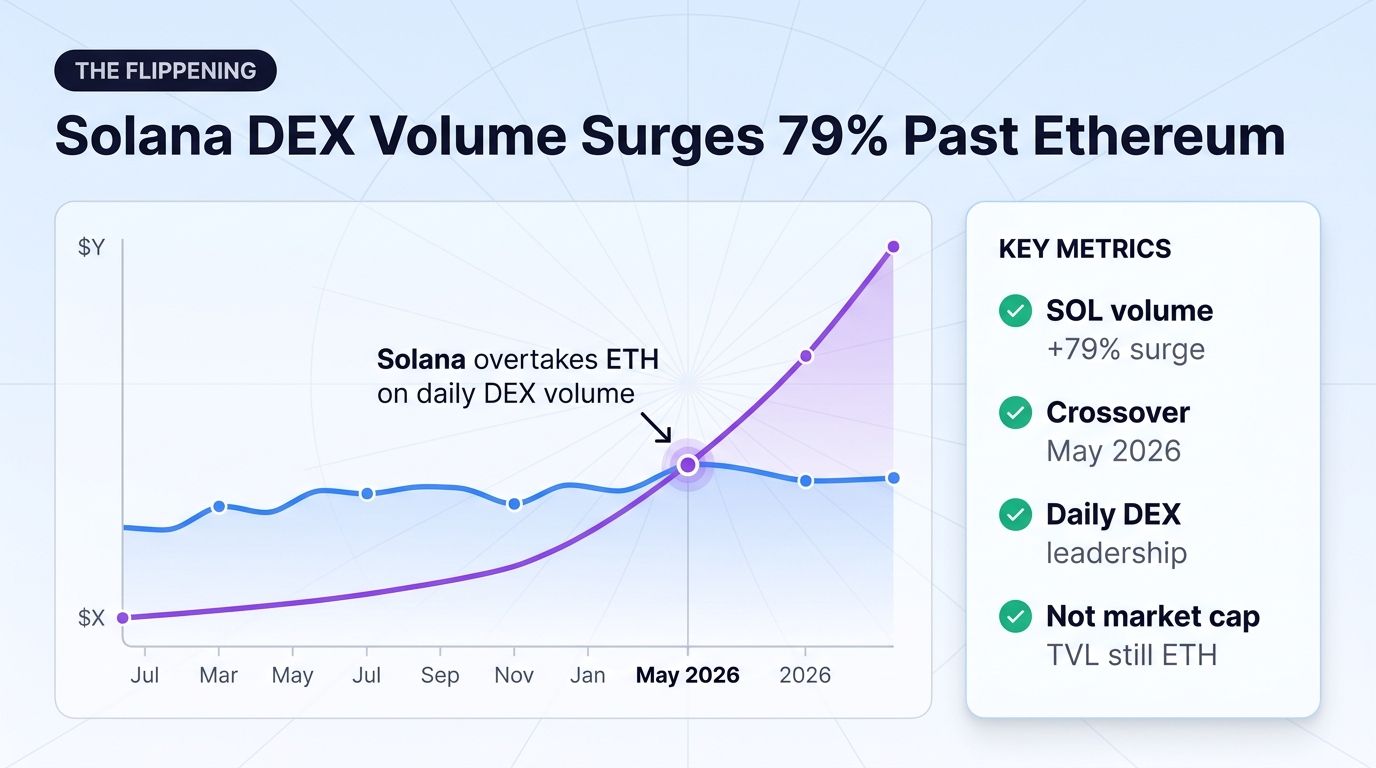
The headline metric: daily DEX trading volume on Solana surpassed Ethereum's daily DEX volume in May 2026. The 79% surge in Solana DEX volume reflects multiple compounding factors.
Three categories of activity dominate Solana DEX volume.
Category 1: Memecoin trading. Pump.fun and related memecoin platforms generate enormous transaction volume. Each memecoin trade involves multiple DEX swaps, and the high volume of trades produces substantial cumulative dollar volume.
Category 2: Stablecoin and major token swaps. USDC/SOL, USDT/SOL, and major token pair swaps on Solana DEXs (Jupiter, Raydium, Orca) generate steady volume from routine trading and arbitrage.
Category 3: New token launches and rotational activity. Solana's low-fee, high-speed environment supports continuous launches of new tokens. Each launch generates concentrated volume in its early days.
The combination produces sustained high volume that has now exceeded Ethereum's DEX volume on a daily basis.
What it does NOT show: Solana DEX volume exceeds Ethereum DEX volume, but Ethereum still has substantially higher TVL (total value locked) in lending protocols, derivatives platforms, and longer-duration DeFi positions. The activity metrics differ from the wealth-storage metrics.
Why Solana Outperformed in 2024-2026
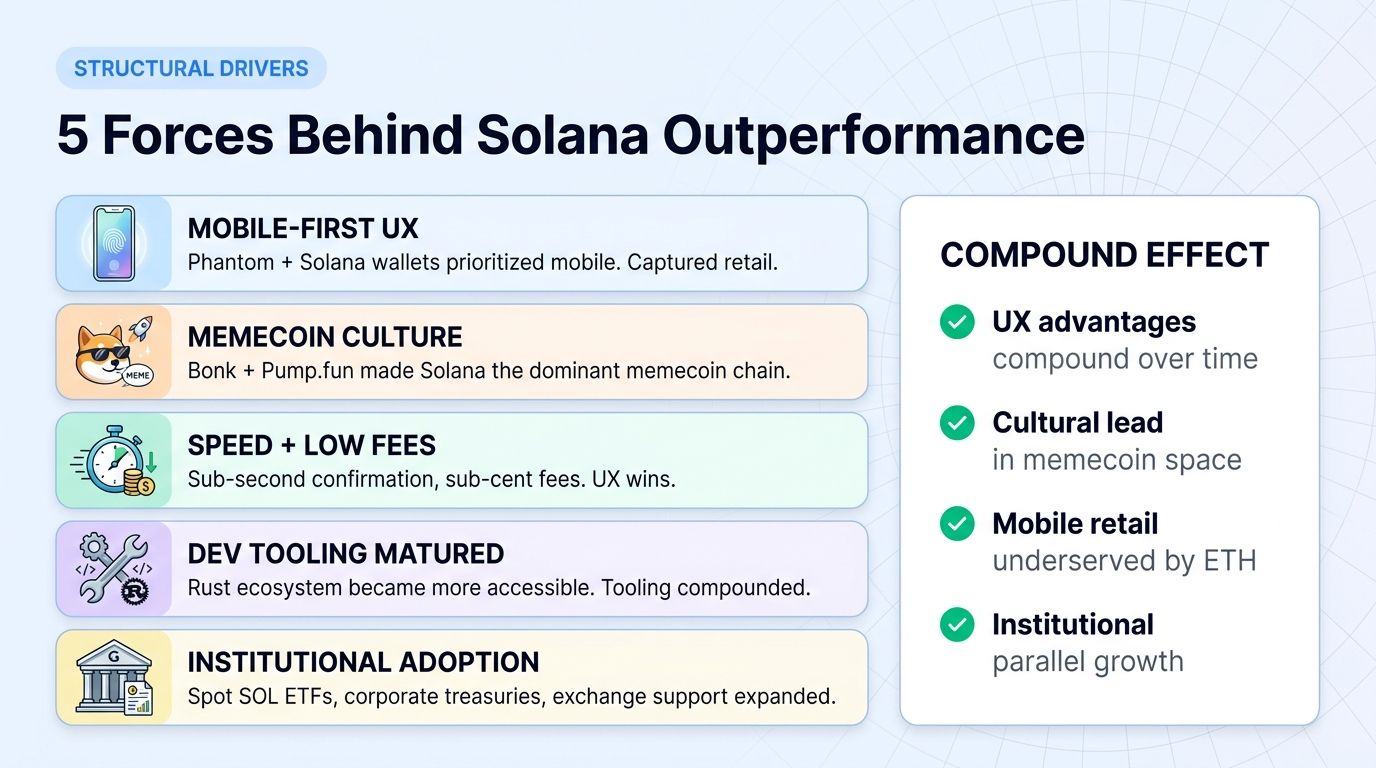
Five structural factors.
Factor 1: User Experience Advantages
Solana transactions are fast (sub-second confirmation) and cheap (typically under $0.01). Users who try Solana after using Ethereum mainnet often prefer the experience. The UX advantage compounds as users perform more transactions.
Factor 2: Memecoin and Pump.fun Ecosystem
Solana became the dominant memecoin ecosystem starting in 2023-2024 with Bonk, then accelerating with Pump.fun in 2024-2025. The memecoin culture attracted retail attention and trading activity that other networks failed to capture.
Factor 3: Mobile-First Wallet Experience
Phantom and other Solana wallets prioritized mobile UX. The mobile-first design captured retail users who were never going to install MetaMask and pay Ethereum gas fees.
Factor 4: Developer Toolkit Maturity
The Solana developer experience matured through 2024-2026. Rust-based development is more accessible than it was in early days. The ecosystem of tools, libraries, and infrastructure has compounded.
Factor 5: Institutional Adoption
Institutional adoption of Solana accelerated through 2024-2026. Spot SOL ETFs launched (alongside spot BTC and ETH ETFs), corporate treasuries added SOL, and major exchanges expanded Solana support.
Why Ethereum Underperformed (Relatively)
The other side of the comparison.
Reason 1: Layer-2 Dilution
Ethereum's scaling strategy shifted to Layer 2 rollups. Activity moved from mainnet to Arbitrum, Optimism, Base, and other L2s. This scales the ecosystem but dilutes mainnet metrics.
The challenge is that L2 volume does not consolidate to a single visible metric. Each L2 has its own activity, none of which individually rivals Solana, but cumulatively they may match or exceed.
Reason 2: Higher Fees on Mainnet
Even after EIP-1559 and various optimizations, Ethereum mainnet fees remain higher than Solana fees. For routine trading, the cost differential matters.
Reason 3: Less Memecoin Capture
Ethereum L2s have memecoin activity, but Solana captured the dominant culture. The network effects in memecoin trading favor concentration on one network, and Solana won that contest.
Reason 4: Slower Block Times
Ethereum's 12-second block times produce different user experience than Solana's sub-second blocks. For high-frequency activities (memecoin trading, arbitrage), the speed differential matters.
What This Means for SOL vs ETH Allocation
The flippening prompts portfolio allocation questions.
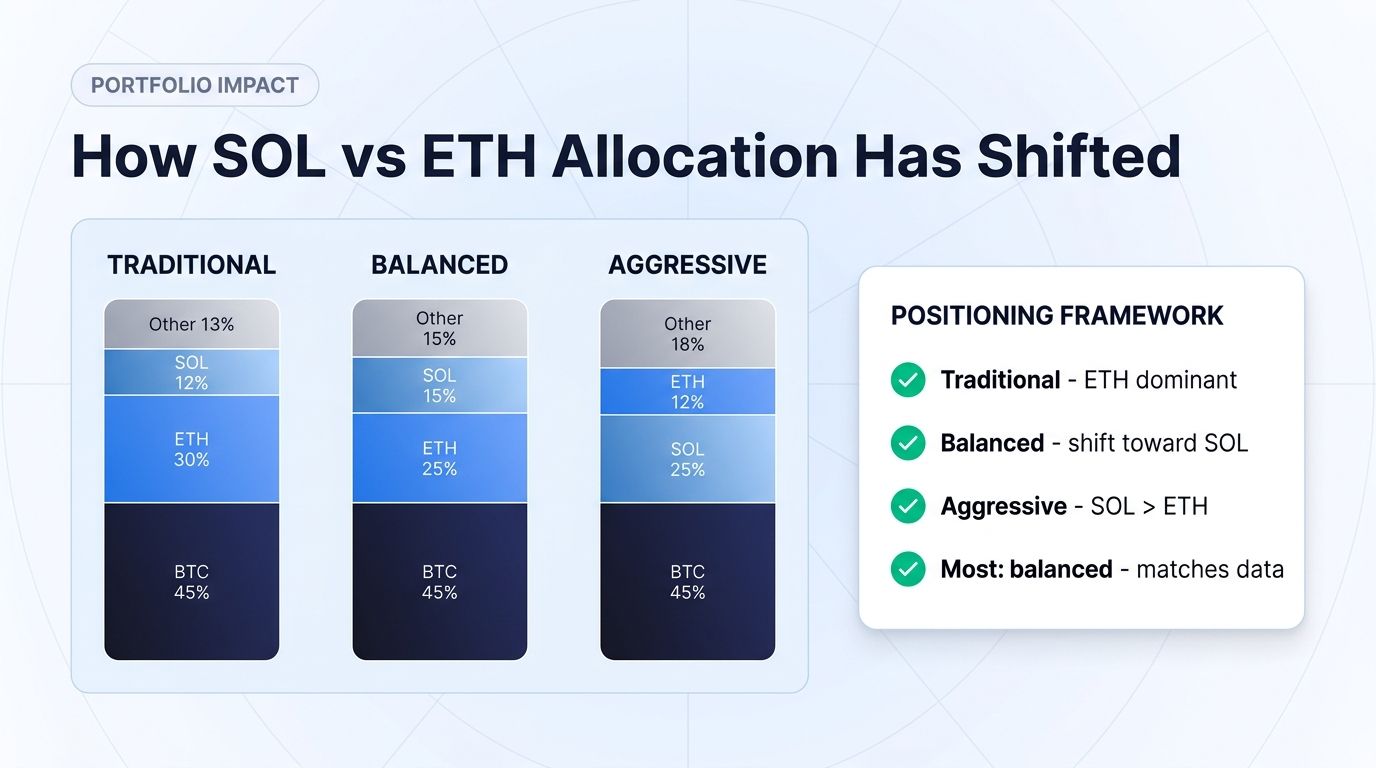
Traditional View (Pre-Flippening)
ETH dominant in alt-L1 allocation:
- BTC: 40-50%
- ETH: 25-35%
- SOL + alt-L1s: 10-20%
- Other: 5-15%
Adjusted View (Post-Flippening)
More balanced ETH/SOL allocation:
- BTC: 40-50%
- ETH: 20-30%
- SOL: 10-20%
- Other alt-L1s: 5-10%
- Other: 5-15%
The shift recognizes Solana's structural improvement while maintaining ETH as the second-largest position due to its larger market cap, DeFi TVL, and longer track record.
Aggressive View
Some traders are taking more aggressive positions favoring Solana:
- BTC: 40-50%
- SOL: 20-30%
- ETH: 10-15%
- Other: 10-25%
This reflects conviction that the volume-leadership translates to longer-term outperformance. The risk is reversal: if Ethereum metrics improve (L2 maturation, app-specific chains, etc.), the aggressive SOL position underperforms.
The Structural Risks for Solana
Despite the strong performance, several risks exist.
Risk 1: Memecoin dependency. A significant portion of Solana's volume comes from memecoin trading. If the memecoin cycle ends or activity moves elsewhere, Solana's volume metrics decline.
Risk 2: Centralization concerns. Solana's validator set is smaller than Ethereum's and more concentrated. Major outages have occurred (less frequently than 2021-2022 but still present). Centralization concerns persist.
Risk 3: Token unlock pressure. SOL has multi-year vesting schedules. Continued unlocks create ongoing supply pressure.
Risk 4: Competition from Monad, Sui, Aptos. Other high-performance L1s compete for the same use cases. If Monad's EVM compatibility or other competitors gain traction, Solana faces pressure.
Risk 5: Regulatory scrutiny. Solana has historically faced more regulatory uncertainty than Ethereum. The CLARITY Act may resolve this, but specific provisions could affect SOL's classification.
Risk 6: MEV and frontrunning. Solana's mempool architecture allows certain MEV patterns. As awareness grows, the user experience for non-sophisticated traders may degrade.
The Structural Risks for Ethereum
The other side.
Risk 1: Continued L2 dilution. If activity continues moving to L2s, mainnet metrics weaken. Whether this is bad for ETH depends on whether L2 activity captures value back to ETH (through fees, security demand, etc.).
Risk 2: Higher-performance alternatives. Solana, Monad, and other high-performance L1s create real competitive pressure. Ethereum's "world computer" thesis faces sustained challenge.
Risk 3: Slow protocol evolution. Ethereum protocol changes (like the much-discussed scaling roadmap) take years. In a rapidly evolving competitive landscape, slow evolution can be costly.
Risk 4: Staking centralization. Ethereum staking is concentrating in large pools (Lido, Coinbase). Concentration creates governance and security concerns.
How Traders Should Position
Three practical approaches.
Approach 1: Maintain Balanced Allocation
Hold both ETH and SOL with relative weights reflecting current views. Adjust as data evolves. This is the most diversified approach and works well if you have moderate conviction on either side.
A platform like Altrady connects to 19+ exchanges, allowing unified position management across both major tokens and many smaller positions.
Approach 2: Active Rotation Based on Metrics
Monitor key metrics (DEX volume, TVL, developer activity, fee revenue) and rotate between ETH and SOL based on which is trending favorably. This requires more active management but can produce alpha if executed well.
Approach 3: Focus on Use Case Allocation
Allocate based on use case fit:
- Long-term store of value: ETH (or BTC)
- Active trading and memecoin exposure: SOL
- Yield farming and DeFi: ETH (where TVL is higher)
- High-frequency activities: SOL
This approach matches asset to purpose rather than committing capital based on which network "wins."
The 2026 Outlook
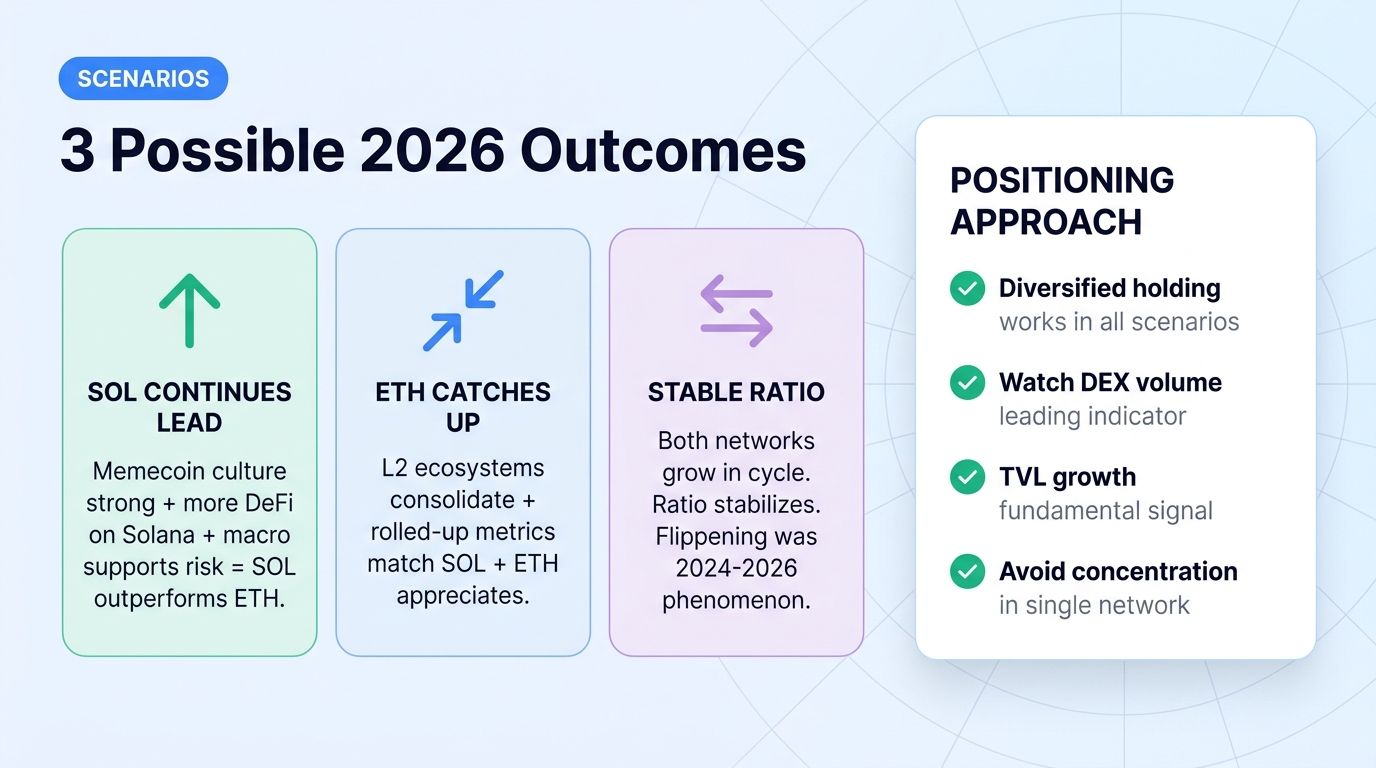
Three scenarios for the rest of 2026.
Scenario 1: Solana Continues Leadership
If memecoin culture remains strong, more DeFi protocols launch on Solana, and macro conditions support risk assets, SOL continues outperforming ETH. Volume leadership extends to other metrics over time.
Scenario 2: ETH Catches Up Through L2 Consolidation
If Ethereum L2s mature into more cohesive ecosystem, consolidated metrics (rolled up across L2s) may match or exceed Solana. ETH appreciates from improved fundamental story.
Scenario 3: Both Networks Grow with Stable Ratios
In a positive crypto cycle, both networks grow significantly without dramatic relative outperformance. The flippening was a 2024-2026 phenomenon, but the ratio stabilizes in 2026-2027.
Each scenario has different implications for trading strategy. Watching the data over time helps determine which is unfolding.
How the Flippening Affects Other Tokens
The dynamic between ETH and SOL affects broader markets.
Solana ecosystem tokens (Jupiter, Pyth, Raydium, others): Benefit from SOL outperformance. Higher Solana activity drives more usage of these protocols.
Ethereum ecosystem tokens (Aave, Uniswap, MakerDAO, etc.): Mixed. TVL remains higher on Ethereum, but new activity often launches on Solana.
Memecoins: Solana memecoins benefit most. Ethereum memecoins face competitive pressure.
Stablecoins: Both networks have growing stablecoin activity. The flippening shifts where stablecoin volume concentrates.
How the Flippening Fits Into Broader Trends
The volume reversal sits inside several larger trends.
Trend 1: Distributed activity across multiple L1s. Crypto is no longer single-chain dominant. Multiple L1s have meaningful activity. Solana leading Ethereum on volume is one expression of this distribution.
Trend 2: User experience matters more than ever. Fast, cheap transactions win user attention. Networks that deliver superior UX accumulate users; those that do not stagnate.
Trend 3: Retail returns to crypto. Memecoin activity, mobile-first wallets, and easier on-ramps brought retail back to crypto. Solana captured disproportionate share of this retail return.
Trend 4: Institutional adoption parallel. Alongside retail growth, institutional adoption accelerated through 2024-2026. Spot ETFs, corporate treasuries, and regulatory clarity have all contributed.
For traders, understanding these trends helps frame how the SOL-ETH dynamic might evolve. The next phase depends on whether trends compound or reverse.
FAQ
Is Solana a better investment than Ethereum now?
Not necessarily. They serve different purposes and have different risk profiles. Solana has higher current activity but more concentration in volatile categories (memecoins). Ethereum has higher TVL and more diverse use cases. Most diversified investors hold both.
What does the flippening mean for ETH's long-term value?
The volume flippening does not directly threaten ETH's market cap dominance or long-term value. ETH benefits from deep DeFi TVL, staking economics, and L2 ecosystem development. The flippening is a specific signal about specific activity, not a verdict on ETH's overall trajectory.
Can the volume flippening reverse?
Yes. Network effects work both ways. If memecoin culture moves elsewhere, if Ethereum L2s consolidate effectively, or if Solana experiences technical issues, the volume leadership could reverse. Multi-month or multi-year volume leadership is more durable than single-month spikes, but nothing is permanent.
Should I rotate from ETH to SOL?
This depends on your conviction and time horizon. Aggressive traders may rotate. Diversified investors may rebalance modestly. Long-term holders may not change positions. Whatever you decide, sizing positions to a level where worst-case reversals do not damage your portfolio is the standard approach.
Can I trade both SOL and ETH on Altrady?
Yes. Both SOL and ETH are listed on virtually every major crypto exchange. Altrady connects to 19+ exchanges, allowing unified position management for both tokens alongside other crypto holdings. You can run automated strategies (signal bot, grid bot, DCA bot) on either or both, and view your full portfolio across exchanges in one dashboard.
Conclusion
Solana's DEX volume overtaking Ethereum in May 2026 is one of the most significant market structure events of the cycle. The 79% volume surge reflects real economic activity, sustained user growth, and structural advantages in user experience and ecosystem development.
For traders, the practical takeaway is this: the SOL-ETH dynamic has shifted meaningfully. Allocation frameworks that treat ETH as automatically dominant over SOL deserve reconsideration. The new equilibrium likely involves more balanced positioning across both networks, with active monitoring of the underlying metrics.
The longer-term question is whether the flippening is the start of a sustained Solana leadership period or a peak that gets reversed as Ethereum L2 ecosystems mature. Either outcome is possible. Watching DEX volume, TVL, developer activity, and other metrics over the next 6-12 months will provide the answers.
What is already clear: crypto is no longer single-chain. Multiple high-performance L1s deliver real economic activity, and traders who diversify intelligently across them are positioned better than those concentrated in any single network.
The next chapter of the Solana versus Ethereum dynamic will be written by user adoption, protocol launches, and macro conditions over the coming year. For now, the volume flippening stands as one of the more important signals that the crypto landscape continues evolving in ways that demand updated allocation strategies.