
BTC had ripped from $58,000 to $68,500 over three weeks, and the rally looked unstoppable until price stalled at a prior resistance zone. Then three consecutive bearish daily candles appeared, each opening inside the previous body and closing near its low. That is the three black crows pattern, and this guide covers how to identify it, the psychology behind it, and how to build a disciplined trading plan around it in crypto markets.
What Is the Three Black Crows Pattern?
The three black crows pattern is a bearish candlestick formation made up of three consecutive bearish (red) candles, each closing lower than the previous one. Traders treat it as a strong signal that sellers have taken control of price.
The pattern most often signals a bearish reversal when it appears after a sustained uptrend or at a key resistance level. It can also act as a bearish continuation signal when it develops inside an existing downtrend, confirming that sellers are still in charge.
What makes the pattern meaningful is persistence. A single red candle is noise, but 3 red candles in a row with steadily lower closes tell a clear story of three sessions of steady distribution.
How to Identify Three Black Crows on a Chart
Not every cluster of 3 red candles qualifies as a valid three black crows setup. The structure has specific requirements, and ignoring them leads to weak trades.
The three-candle structure
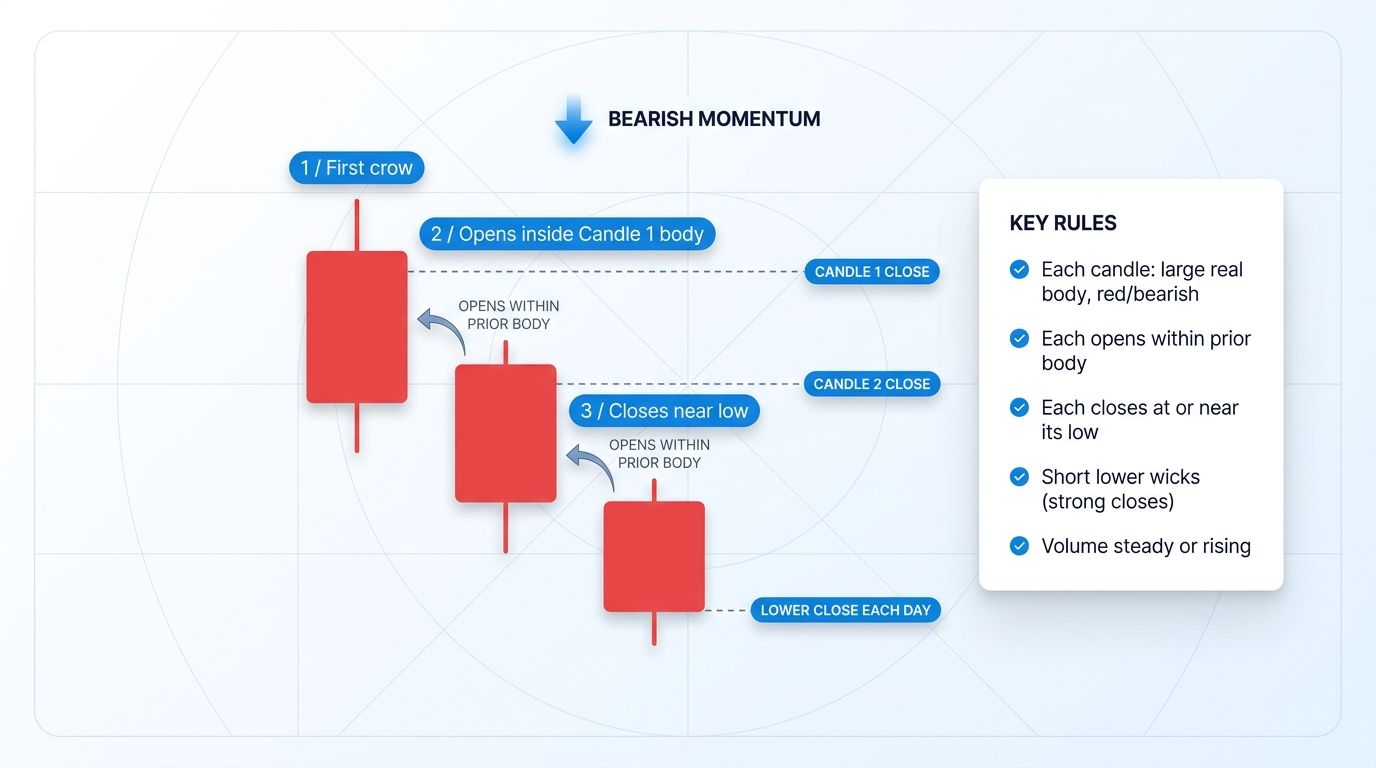
A textbook three black crows pattern has three features in sequence:
- Each candle is bearish, with a large real body and a close well below the open.
- Each candle opens within the real body of the prior candle, not above it. This shows sellers step in early rather than waiting for a gap down.
- Each candle closes at or near its session low, with short lower wicks. That tells you sellers kept pressing until the close.
When all three candles share these traits, the pattern carries weight. If any candle has a long lower wick, a doji body, or an open outside the prior range, the signal weakens.
Key identification rules
Beyond the three-candle skeleton, confirm these details before labeling a setup as three black crows:
- Body size should be similar across the three candles, or growing slightly. A shrinking third body hints at exhaustion.
- Lower wicks stay short. Long lower wicks mean buyers pushed back intraday, which dilutes the bearish story.
- Volume should stay steady or rise across the three sessions. Rising volume under falling closes is the cleanest confirmation.
- Context decides everything. After a strong uptrend or at resistance, the pattern is a bearish reversal signal. Inside a downtrend, it is a bearish continuation signal.
Why Three Black Crows Works: The Psychology
The three black crows pattern works because it compresses three full sessions of persistent distribution into one visible structure. Each candle tells a story of sellers overwhelming buyers from open to close.
On candle one, buyers try to extend the prior uptrend. Price opens inside the last green body, but sellers take over and drive price down, closing near the low. That is the first crack in bullish control.
On candle two, buyers attempt to defend. Price opens inside the previous bearish body, but sellers again dominate the session and force a lower close. Confidence on the long side is now visibly shaken.
By candle three, the shift is complete. Another lower open, another lower close, another session where every attempt to recover was sold into. Buyers who bought the top are underwater. New shorts see confirmation. The market has moved from buyer control to clear seller dominance.
Three Black Crows vs Other Bearish Patterns
Several bearish patterns can look similar at first glance. Knowing the differences helps you pick the right trade idea.
Three Black Crows vs Evening Star
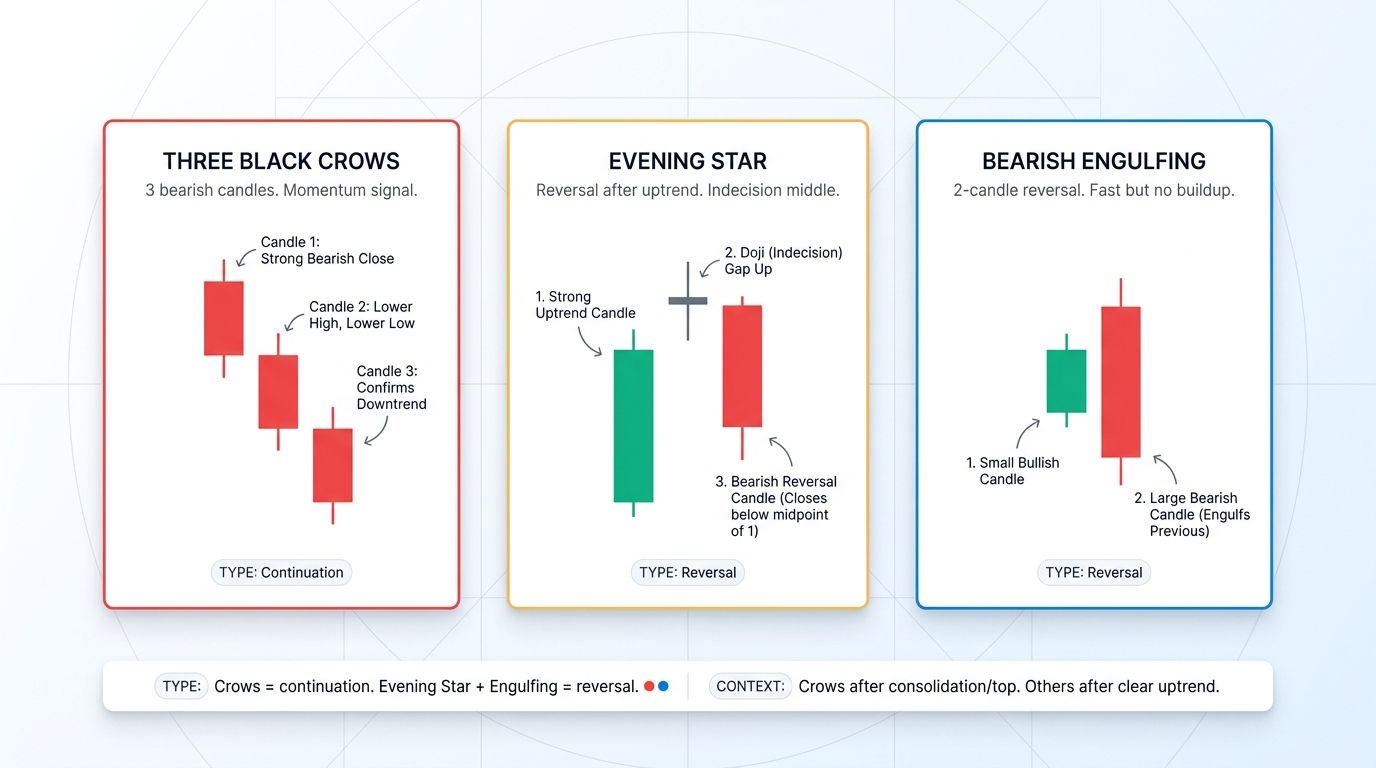
The three black crows vs evening star comparison is the most common one. Evening star is a three-candle reversal made of a strong bullish candle, a small-bodied candle (often a doji) that gaps up, and a large bearish candle that closes deep into the first candle's body. The signal comes from one decisive red candle after a stall.
Three black crows, by contrast, needs three bearish candles in sequence with lower closes. Evening star is a sharper turning point, while three black crows is a more sustained reversal or continuation.
Three Black Crows vs Bearish Engulfing
A bearish engulfing pattern is two candles: a smaller green candle followed by a larger red candle whose body engulfs the prior green body. It signals a sudden shift in momentum at a high.
Three black crows needs three candles and takes longer to form, but the longer sequence filters out some false signals. Bearish engulfing is faster, while three black crows tends to be more reliable when the trend has been extended.
Three Black Crows vs Bearish Marubozu
A bearish marubozu is a single candle with a large red body and little to no wicks on either side. It says one session of total seller control.
Three black crows is that same message stretched across three sessions. A marubozu can be an early warning, while three black crows is a confirmation structure that often follows it.
How to Trade the Three Black Crows Pattern
A clean pattern is not the same as a clean trade. Use a consistent framework every time you spot three black crows.
Rule 1: Check the market context
Zoom out first. Three black crows at the top of a long rally is a textbook bearish reversal signal. Inside an existing downtrend, it is a bearish continuation signal and can be traded as a momentum short.
Rule 2: Confirm candle structure (strong bodies, small lower wicks)
Look at the candles, not just the colors. Each should have a large bearish body with a short lower wick. A long lower tail or a small spinning-top body means the pattern is weak and should be skipped.
Rule 3: Volume confirmation
Volume is the sanity check. On spot and perpetual markets, you want volume that holds steady or rises across the three sessions. Declining volume while price drops suggests the move lacks fresh supply and risks a snapback.
Rule 4: Beware of oversold conditions
Do not short into a hole. If RSI is already below 30 or the asset has dropped 15 to 20 percent in the last few sessions, the three black crows may be the end of the move, not the start. Wait for a retest into resistance or use smaller size.
Entry, Stop, Target Framework
A clean template for shorting a three black crows setup:
- Entry: short on the close of the third candle, or on a small retracement into the third candle's open.
- Stop loss: above the high of the first candle in the pattern, giving the structure room to breathe.
- Target 1: the nearest prior support or swing low, for a partial take-profit.
- Target 2: the next major support level or measured move equal to the height of the prior rally.
- Risk management: size the position so the distance to stop equals no more than 1 to 2 percent of account equity.
Example: Three Black Crows on BTC Breakdown
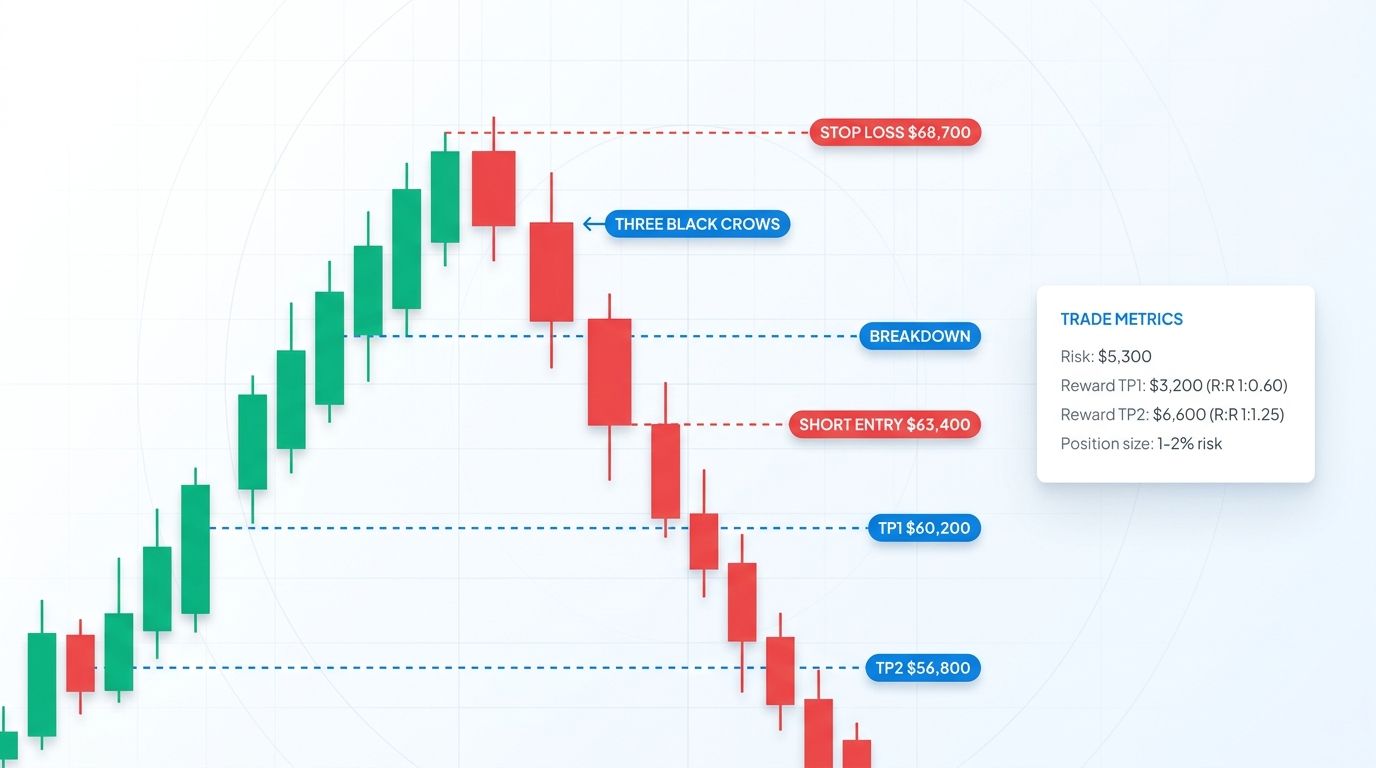
Assume BTC has just rallied from $58,000 to $68,500 over three weeks and runs into a known resistance band. Over the next three daily sessions, three black crows forms:
- Candle 1: opens at $68,500, closes at $66,900. Large red body, short lower wick.
- Candle 2: opens at $66,950 (inside candle 1 body), closes at $65,100. Body size similar, volume slightly higher.
- Candle 3: opens at $65,200, closes at $63,400 near the session low.
A disciplined trader shorts on the close of candle 3 at $63,400. Stop loss goes above the high of candle 1 at $68,700, which is $5,300 of risk per BTC. First target TP1 sits at prior support of $60,200. Second target TP2 sits at the next major demand zone at $56,800.
Risk-reward math:
- Risk per BTC: $68,700 minus $63,400 equals $5,300.
- Reward to TP1: $63,400 minus $60,200 equals $3,200, which is about 0.6R.
- Reward to TP2: $63,400 minus $56,800 equals $6,600, which is about 1.25R.
By scaling out 50 percent at TP1 and moving the stop to breakeven, the remaining 50 percent carries a favorable blended profile with no further downside on the trade.
Common Mistakes When Trading Three Black Crows
Even a valid pattern can produce a loser if the execution is sloppy. Watch out for these pitfalls:
- Shorting into oversold. If RSI is already deep below 30 and price has plunged for days, three black crows may be the final flush, not the start.
- Ignoring volume. Low or fading volume across the three candles is a yellow flag. Demand and supply both matter.
- Chasing the fourth candle. Entering on a fourth red candle far below the pattern means poor risk-reward and a much wider stop.
- Misidentifying random 3 red candles. Without lower opens inside the prior body, strong bodies, and short lower wicks, a red cluster is not a real three black crows pattern.
- Placing the stop too tight. A stop inside the pattern range tends to get hit on normal noise. Use the high of candle one or a recent swing high.
- Skipping context. In ranges, three black crows often stalls at the range low rather than breaking down. Respect the structure around it.
Three Black Crows in Crypto Markets
Crypto adds its own flavor to the pattern. The rules above still hold, but a few market realities shape how reliable the signal is.
Timeframe reliability matters more in crypto than in traditional markets. On the daily and 4-hour charts, three black crows tends to mark meaningful shifts. On 5-minute or 15-minute charts, the pattern prints constantly and carries far less weight.
The 24/7 nature of crypto changes how sessions develop. There is no opening gap, so candle opens often sit close to the prior close. This is favorable for three black crows because the requirement that each candle open inside the prior body becomes easier to satisfy cleanly.
Altcoin caveats are real. Thin order books and low-liquidity tokens can produce fake patterns that reverse sharply on the next candle. Prioritize majors like BTC and ETH and high-volume USDT pairs. On smaller alts, reduce size and widen your stop to account for volatility.
How Altrady Helps You Spot and Trade Three Black Crows
Spotting three black crows reliably across dozens of symbols is hard without the right tooling. Altrady is built to make that workflow realistic for an individual trader.
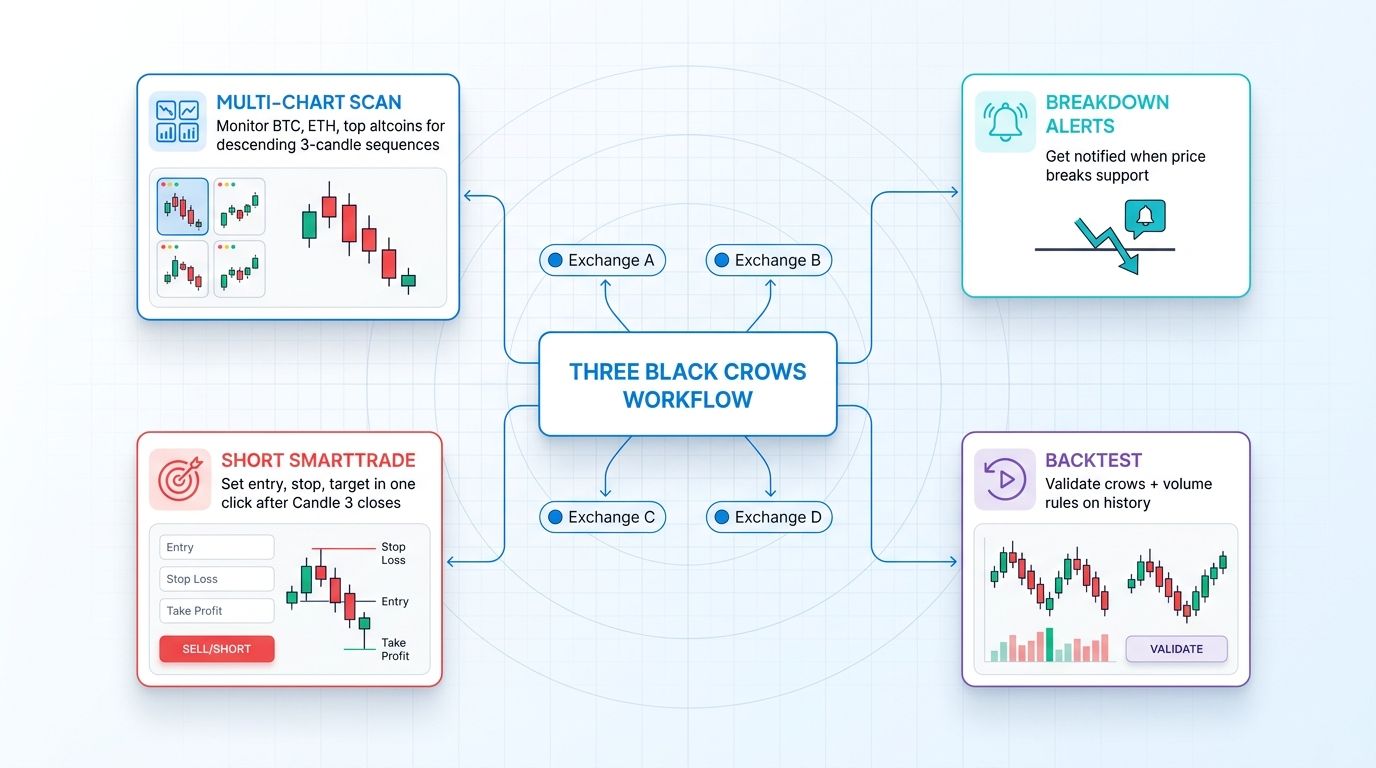
The multi-chart view lets you monitor BTC, ETH, and your top alt pairs side by side on the same timeframe, so you can scan for three-candle setups across a watchlist in one screen. Alerts on price, indicator, and custom conditions notify you when an asset reaches a resistance level where a three black crows pattern would matter.
Once you see the setup, SmartTrade orders let you pre-define entry, stop loss, and multiple take-profit levels in a single ticket, so the discipline of your plan carries through execution. Paper trading lets you test the pattern on live market data without risking capital, and the backtest feature helps you measure how three black crows has performed on your preferred symbols and timeframes before you commit real size.
Start your free trial with Altrady and see how a dedicated terminal changes the way you trade candlestick patterns.
Frequently Asked Questions
Is three black crows a reliable pattern?
Three black crows is one of the more reliable bearish candlestick patterns when it appears at the end of a strong uptrend or at clear resistance with supportive volume. Reliability drops sharply when it shows up in choppy ranges, on very short timeframes, or without volume confirmation. Treat it as a high-probability setup only when market context, candle quality, and volume all line up. No single pattern works in isolation, so combine it with trend structure and key levels.
What is the difference between three black crows and evening star?
The three black crows vs evening star comparison comes down to structure and speed. Evening star is a three-candle reversal built around a stall candle in the middle and one decisive red candle at the end. Three black crows is three bearish candles in a row with steadily lower closes. Evening star catches sharp tops earlier, while three black crows reflects a slower, broader shift in control and tends to produce more sustained moves after the third candle closes.
Can three black crows appear mid-trend?
Yes. When three black crows forms inside an existing downtrend, it acts as a bearish continuation signal rather than a reversal. In this case, it confirms that sellers are still pressing after a small bounce or consolidation. Traders use mid-trend three black crows setups as momentum continuations, often entering shorts on the close of the third candle with a stop above the recent bounce high. The same volume and body-size rules still apply for the signal to be trusted.
What timeframe is best for trading three black crows?
The daily timeframe is the sweet spot for most crypto traders, with the 4-hour timeframe a close second. Daily charts filter out intraday noise and produce patterns that line up with funding cycles and macro flows. 4-hour charts offer more setups and suit active traders. Below that, signals print so often that false patterns outnumber real ones. Weekly three black crows is rare but extremely meaningful when it appears at major resistance on BTC or ETH.
Where should I place my stop loss for three black crows?
Place the stop loss just above the high of the first candle in the pattern. That level marks the origin of the bearish sequence, so a move back above it invalidates the thesis. Very tight stops placed inside the third candle's range tend to get hit on normal noise. If the first candle's high is too far from your entry, reduce position size rather than tightening the stop. Risk per trade should stay within 1 to 2 percent of account equity.
Conclusion
Three black crows is a clean, readable candlestick pattern that packages three sessions of seller control into one structure, which is why it earns attention as both a bearish reversal signal after uptrends and a bearish continuation signal inside downtrends. The edge comes from combining strict identification rules with market context, volume confirmation, and a disciplined entry, stop, and target framework rather than reacting to any cluster of 3 red candles. On crypto, daily and 4-hour charts give the pattern its highest reliability, with altcoin liquidity deserving extra care. Start your free trial with Altrady to put multi-chart scanning, alerts, SmartTrade orders, paper trading, and backtesting behind every three black crows setup you take.