
Why Knowing When to Take Profits Is Just as Important as Knowing When to Buy
Every crypto trader remembers a moment they wish they had sold. The portfolio was up 80%, the market felt unstoppable, and greed whispered that the rally had further to run. Then the correction came, wiping weeks of gains in a matter of hours. Understanding when to take profits in crypto trading is the skill that separates consistently profitable traders from those who ride emotional rollercoasters.
Buying at the right time gets all the attention, but selling well is what actually locks in returns. A trade is incomplete until you have exited, and an unrealized gain is not real profit. The crypto market is notorious for violent reversals. Coins that pump 200% in a week can retrace 60% the following week, leaving holders with a fraction of their peak gains.
This guide breaks down the signals, strategies, and practical frameworks you need to take profits with confidence. Whether you are swing trading altcoins or managing a longer-term Bitcoin position, the principles here will help you protect your capital and grow your account over time.
Key Signs It Is Time to Take Profits
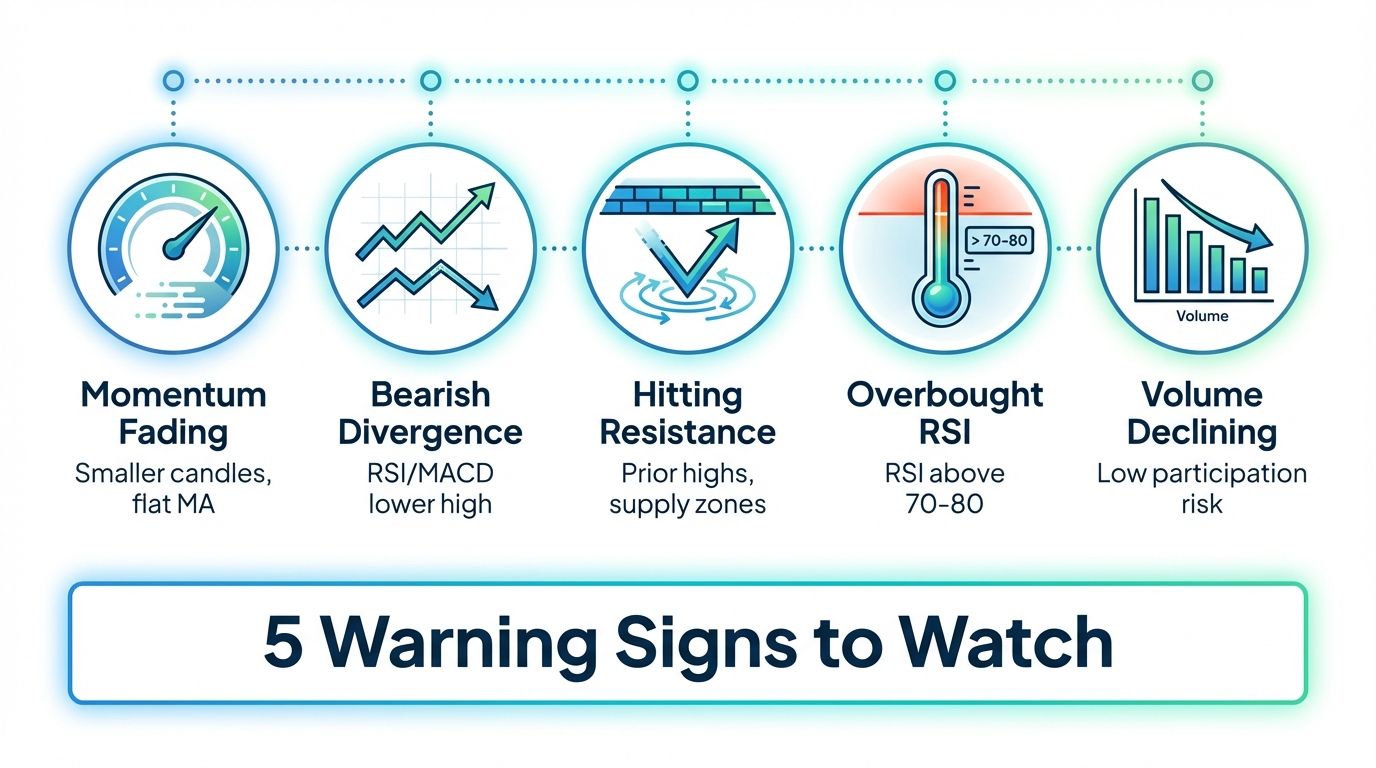
Recognizing when a move is losing steam is the first step toward disciplined profit-taking. Here are the most reliable signals that a rally may be running out of fuel.
Momentum Is Slowing Down
When price continues to climb but the rate of increase is shrinking, momentum is fading. Shorter green candles on higher timeframes, a flattening moving average, or a declining MACD histogram all point to weakening buying pressure. This does not guarantee an immediate reversal, but it does mean the easy gains are likely behind you.
Bearish Divergence on Oscillators
Bearish divergence occurs when price makes a higher high but an oscillator (such as RSI or MACD) makes a lower high. This is one of the most widely trusted warning signals in technical analysis. It indicates that although price is still rising, the underlying momentum is deteriorating. Divergences do not always trigger instantly, but they significantly raise the odds of a pullback.
Price Hitting Strong Resistance
If your asset is approaching a well-established resistance level, whether from a previous all-time high, a historical supply zone, or a key Fibonacci extension, that is a natural area to consider taking some or all of your profits. Markets often stall or reverse at resistance because a large concentration of sell orders sits at those levels.
RSI Entering Overbought Territory
An RSI reading above 70 on the daily or weekly chart signals overbought conditions. In crypto, assets can stay overbought longer than in traditional markets, so an RSI of 75 or 80 does not mean "sell everything immediately." However, it does indicate that the risk-to-reward ratio for new buyers is unfavorable, and existing holders should start tightening their exit plan.
Volume Is Declining on Up Moves
Healthy rallies are supported by rising volume. When price continues higher but volume drops, it means fewer participants are driving the move. This type of low-volume drift higher is fragile and susceptible to sharp reversals once sellers step in.
Profit-Taking Strategies That Actually Work
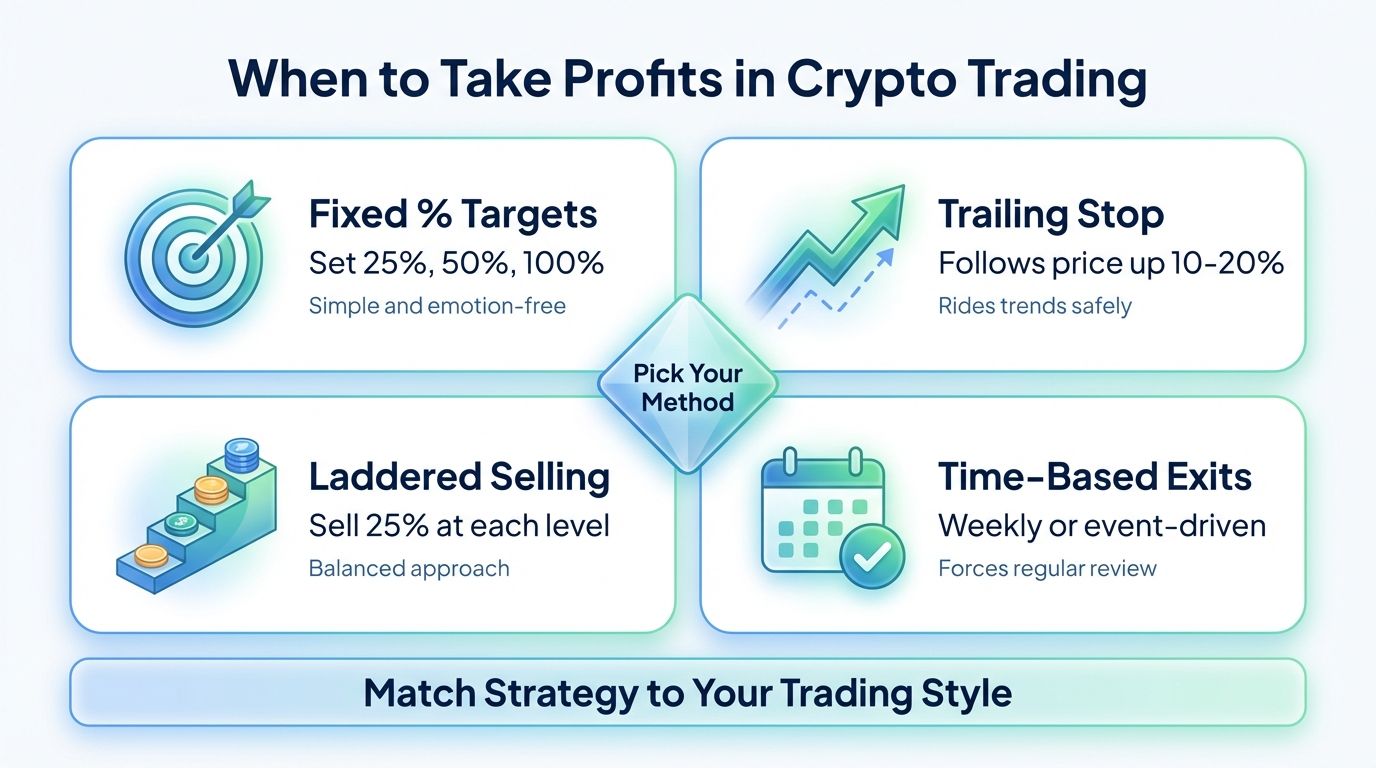
Knowing when to take profits in crypto trading is only half the equation. You also need a repeatable method for executing your exits. Below are four proven strategies.
Fixed Percentage Targets
This is the simplest approach. Before entering a trade, you define the exact percentage gain at which you will sell. For example, you might set a rule that you always take profits at 25%, 50%, or 100% above your entry price.
A practical example: you buy Ethereum at $2,000 with a target of 50% profit. When ETH reaches $3,000, you execute your sell order regardless of how bullish the market feels. This method removes emotion from the equation and ensures you actually realize gains.
The downside is that fixed targets can leave money on the table during strong trends. That is where more flexible approaches come in.
Trailing Stop-Loss
A trailing stop moves upward with the price, maintaining a fixed distance below the current market price. If the price reverses by more than that distance, the stop triggers and your position closes at a profit.
For instance, you might set a 15% trailing stop on a Bitcoin position. If BTC rises from $60,000 to $80,000, your trailing stop moves up to $68,000 (15% below $80,000). If the price then drops to $68,000, you exit with a solid gain rather than watching it fall further.
Trailing stops are excellent for trending markets because they let your winners run while still protecting your downside. The key is choosing the right percentage: too tight (5%) and normal volatility will stop you out prematurely, too loose (30%) and you give back a large chunk of your gains before the stop triggers.
Laddered or Incremental Selling
Instead of exiting your entire position at one price, you sell in stages. This is one of the most popular methods among experienced traders because it balances profit-taking with upside participation.
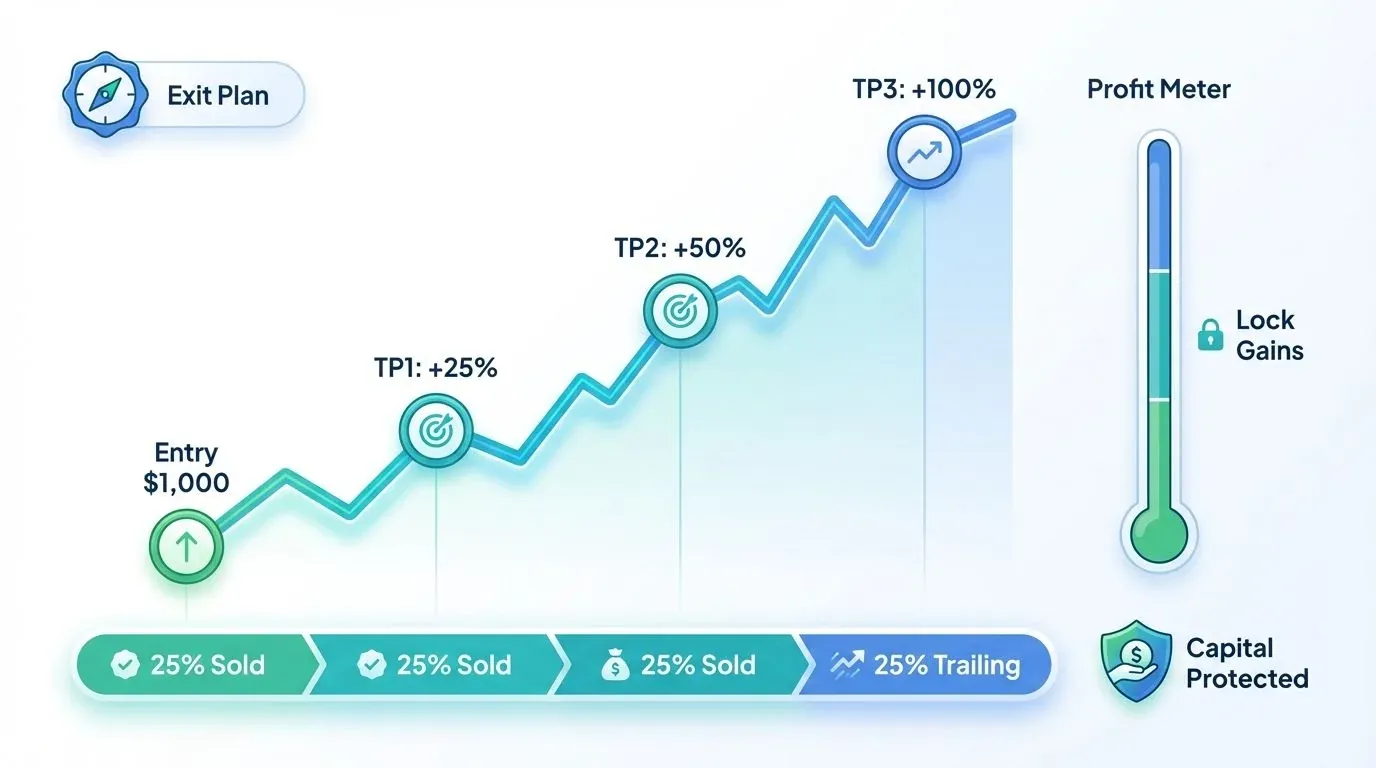
Here is a common laddered exit plan for a $10,000 position:
- Sell 25% when the position is up 30% (locking in $750 profit)
- Sell another 25% when the position is up 60% (locking in $1,500 profit)
- Sell 25% when the position is up 100% (locking in $2,500 profit)
- Let the final 25% ride with a trailing stop
With this approach, you secure meaningful profits at multiple levels while keeping exposure to further upside. Even if the final 25% gets stopped out at breakeven, you have already banked $4,750 in realized gains.
Time-Based Exits
Some traders set calendar-based rules for profit-taking. For example, you might review all positions every Friday and take profits on anything that has gained more than 20% during the week. Alternatively, you might decide to reduce exposure 30 days before a known macro event (such as a Federal Reserve meeting or a Bitcoin halving anniversary).
Time-based exits work well as a complement to other methods. They force regular portfolio review and prevent the common trap of "forgetting" about a profitable position until it has already reversed.
Partial Profit-Taking vs. Full Position Exits
One of the most important decisions when learning when to take profits in crypto trading is whether to sell everything or just a portion.
When Partial Exits Make Sense
Partial exits are ideal when you still have conviction in the trade but the risk-reward has shifted. By taking some profits off the table, you reduce your exposure while maintaining a smaller position that can benefit from continued upside. This approach also provides psychological relief, as it is much easier to hold through a pullback when you have already locked in gains.
A common framework is the "free ride" method. You sell enough of your position to recover your initial investment, then let the remaining shares (which now represent pure profit) ride risk-free. For example, if you invested $5,000 and the position doubles to $10,000, you sell $5,000 worth and hold the remaining $5,000 as a "house money" position.
When Full Exits Are Appropriate
Full exits make sense when your original thesis has changed, when the asset reaches a major technical target, or when broader market conditions have turned bearish. If Bitcoin breaks below a critical support level while your altcoin position is still in profit, closing entirely is often the smart play. You can always re-enter later with a fresh setup.
How to Set Take-Profit Levels Using Technical Analysis
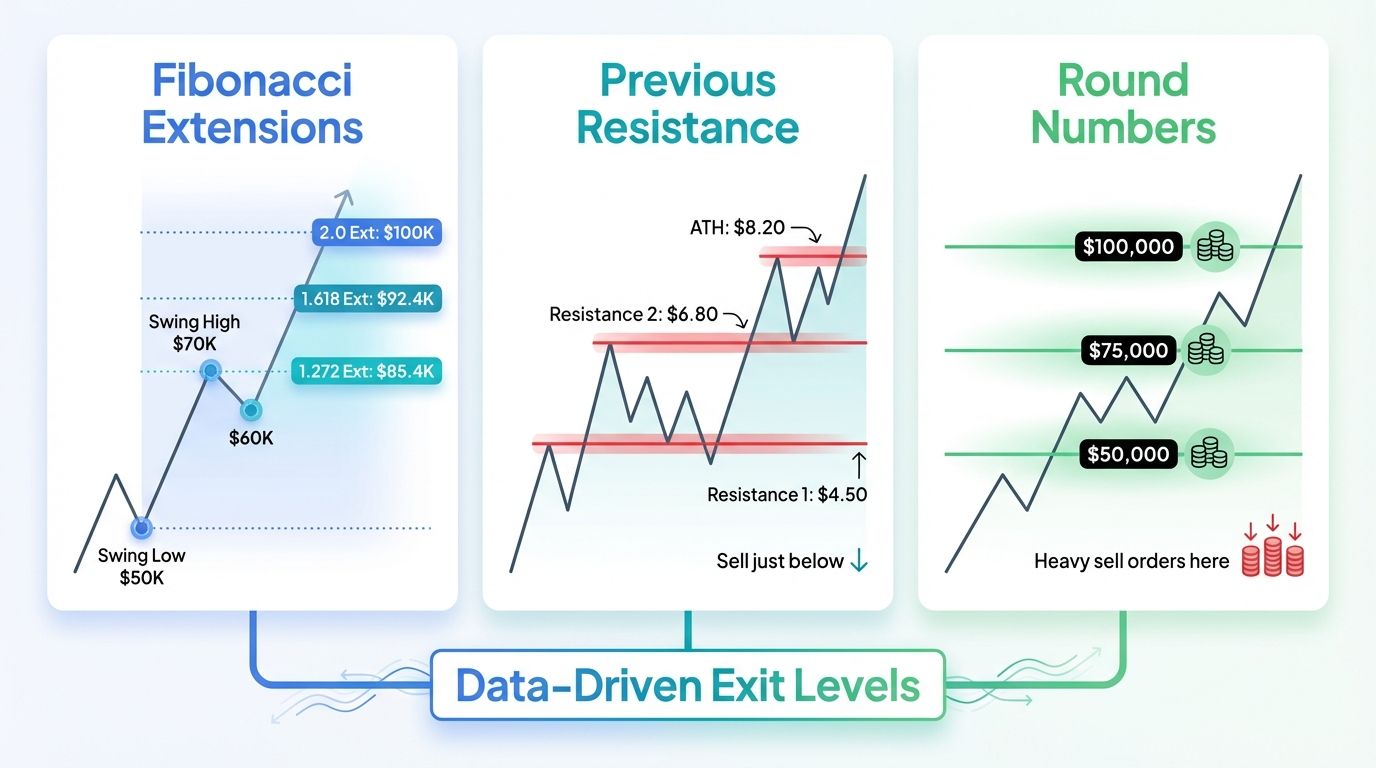
Technical analysis provides objective, data-driven levels where you can place your take-profit orders. Here are three of the most effective methods.
Fibonacci Extensions
Fibonacci extension levels (1.272, 1.618, 2.0, 2.618) project where a move might end based on the size of the previous impulse wave. After identifying a swing low and swing high, you apply the Fibonacci extension tool to project potential targets above the high.
For example, if Bitcoin rallied from $50,000 to $70,000 and then pulled back to $60,000, the 1.618 extension projects a target near $92,360. Many traders use the 1.618 level as their primary take-profit target because it aligns with natural market behavior surprisingly often.
Previous Resistance Zones
Historical price levels where the market previously reversed carry significance because they represent areas of heavy supply. If an altcoin was rejected three times at $4.50 before finally breaking through, that $4.50 level becomes support, and the next major resistance might be the previous all-time high at $6.80. Placing take-profit orders just below these levels (in this case, around $6.70) captures gains before the expected selling pressure arrives.
Round Psychological Numbers
Markets consistently react to round numbers. Bitcoin at $100,000, Ethereum at $5,000, or any altcoin hitting a clean dollar figure will attract a cluster of sell orders. Placing your take-profit orders slightly below these round numbers (at $99,500 instead of $100,000, for instance) increases your fill probability.
Stablecoin Rotation as a Profit-Taking Method
Taking profits does not always mean converting to fiat currency. Many crypto traders rotate profits into stablecoins like USDT, USDC, or DAI. This strategy keeps your capital within the crypto ecosystem, ready to be redeployed when new opportunities appear, while still protecting you from downside risk.
Stablecoin rotation is especially useful during periods of uncertain market direction. If you are up 60% on a position but the market is giving mixed signals, rotating into stablecoins lets you lock in those gains without the friction and potential tax complications (depending on your jurisdiction) of moving to a bank account.
Some traders also park stablecoins in yield-generating protocols to earn passive returns while they wait for the next setup. This turns idle capital into productive capital during sideways markets.
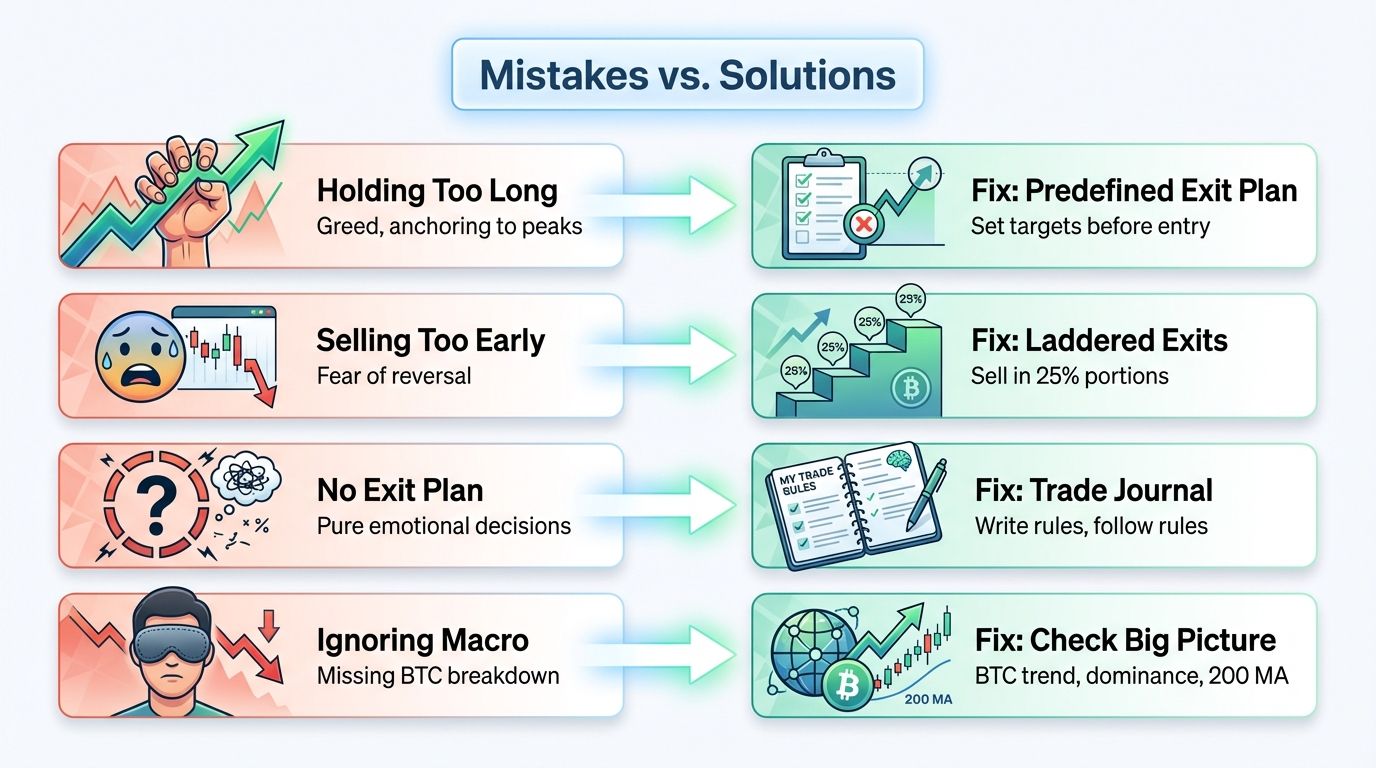
Common Profit-Taking Mistakes and How to Avoid Them
Understanding when to take profits in crypto trading also means recognizing the psychological traps that cause traders to mismanage their exits.
Holding Too Long Due to Greed
This is the number one mistake. A trader sees a 50% gain, thinks "this could easily go to 100%," and holds. The position then retraces to 10% profit, and the trader thinks "I will sell when it gets back to 50%." This cycle of anchoring to peak unrealized gains has destroyed more portfolios than almost any other behavior.
The fix is simple: have a plan before you enter, and execute it mechanically. No trade goes straight up forever.
Selling Too Early Due to Fear
The opposite extreme is equally damaging. A trader takes a 5% profit after two days, then watches the asset rally another 80%. Over time, this pattern of cutting winners short while letting losers run (hoping they recover) produces a negative expectancy.
The fix is to use a structured approach like laddered selling. By selling in portions, you satisfy the urge to lock in gains while keeping exposure to the larger move.
Not Having a Plan at All
Entering a trade with no defined exit is speculation without discipline, not trading. Without a plan, every decision becomes emotional. You hold through peaks, panic-sell at bottoms, and never develop a consistent track record.
Before every trade, answer two questions: "At what price do I take profits?" and "At what price do I cut my loss?" If you cannot answer both, do not enter the trade.
Ignoring the Bigger Picture
Taking profits on an altcoin trade while ignoring that Bitcoin just broke below its 200-day moving average is like celebrating a small battle while losing the war. Always consider the macro environment, Bitcoin dominance trends, and overall market structure when deciding on your exit timing.
How Altrady Helps You Execute Better Profit-Taking
Managing take-profit orders across multiple exchanges can be overwhelming, especially if you are running several positions simultaneously. Altrady's multi-exchange trading platform is designed to streamline exactly this process.
With Altrady, you can set advanced take-profit orders, including laddered exits and trailing stops, across all your connected exchanges from a single dashboard. Instead of logging into Binance, Coinbase, and KuCoin separately to manage your positions, you handle everything from one unified interface.
The platform's portfolio tracking tools give you a real-time view of your unrealized gains across every position, making it easy to identify which trades have reached your target levels. Altrady's smart trading features also allow you to create multi-step exit strategies where your take-profit orders execute automatically based on your predefined rules.
For traders who want to implement the laddered selling strategy described earlier, Altrady's order management tools make it straightforward to set multiple limit sell orders at different price levels for the same position. You configure your exit plan once, and the platform handles the execution.
If you have been looking for a way to bring structure and discipline to your profit-taking process, start your free trial of Altrady and experience how professional-grade tools can transform your trading results.
Real-World Profit-Taking Scenarios
Scenario 1: Swing Trading an Altcoin Breakout
You spot a breakout on Solana above a multi-week resistance at $140. You enter at $145 with a $5,000 position. Your plan:
- Take-profit 1: sell 30% at $175 (a 20.7% gain, banking $310 profit)
- Take-profit 2: sell 30% at $200 (a 37.9% gain, banking $569 profit)
- Trailing stop on remaining 40%: set at 12% below the highest price reached
SOL rallies to $215. Your first two targets fill, locking in $879 combined. The trailing stop sits at $189.20. Price eventually reverses and your stop triggers at $189.20, adding another $354 profit on the remaining shares. Total realized profit: $1,233 on a $5,000 position, a 24.7% return.
Scenario 2: Taking Profits on a Bitcoin Cycle Trade
You accumulated BTC at an average price of $45,000 during a bear market pullback. After several months, BTC reaches $90,000, doubling your investment. Rather than selling everything:
- You sell 50% at $90,000, recovering your entire initial investment plus a 50% return on that portion
- The remaining 50% becomes your "free ride" position with zero risk to your original capital
- You set a trailing stop of 20% on the remaining position
BTC continues to $110,000 before correcting. Your trailing stop triggers at $88,000. Total result: half your position closed at $90,000 and the other half at $88,000, for an average exit of $89,000. That is a 97.8% return on your full position, captured without guessing the exact top.
Frequently Asked Questions
What percentage profit should I take in crypto trading?
There is no universal answer because it depends on your strategy and timeframe. Day traders often target 3% to 10% per trade. Swing traders typically aim for 20% to 50%. Position traders holding through major market cycles might target 100% or more. The key is to define your target before entering the trade and stick to it. A good starting point for intermediate traders is to use laddered exits, taking partial profits at 25%, 50%, and 100% above your entry.
Should I take profits all at once or in stages?
Taking profits in stages (laddered selling) is generally the better approach for most traders. Selling your entire position at once means you need to pick the exact right moment, which is extremely difficult in volatile crypto markets. By selling in portions at predetermined levels, you lock in gains progressively while still maintaining exposure to further upside. This method also reduces the emotional stress of trying to time the perfect exit.
How do I know if I am selling too early or too late?
If you consistently sell and then watch the price continue much higher, your targets may be too conservative. Consider using trailing stops instead of fixed targets to capture more of the trend. If you frequently watch profitable positions turn into losses because you held too long, you likely need stricter exit rules or tighter trailing stops. Track your trades in a journal, recording both your entry and exit prices and what the price did after you sold. Over 20 to 30 trades, patterns will emerge that tell you exactly how to calibrate your strategy.
Is it better to take profits in stablecoins or fiat currency?
Both options have advantages. Stablecoins keep your capital inside the crypto ecosystem, allowing you to re-enter positions quickly when new opportunities arise. There is no bank transfer delay, and you maintain the flexibility to act on time-sensitive setups. Fiat withdrawals provide the security of having funds in a regulated bank account and may be preferable if you need to cover living expenses or want to fully de-risk. Many traders use a hybrid approach: rotating most profits into stablecoins for redeployment while periodically withdrawing a portion to fiat for personal use.
Can Altrady help me automate my profit-taking strategy?
Yes. Altrady supports advanced order types including take-profit orders, trailing stops, and multi-step exit strategies across multiple exchanges from a single dashboard. You can configure laddered sell orders at different price levels for the same position, and the platform executes them automatically when your targets are reached. This eliminates the need to monitor charts constantly and removes the emotional component from your exit decisions. Start a free trial to set up your first automated take-profit strategy.