

Swing Traders, trading on multiple exchanges can be a real advantage, but only if it reduces friction instead of multiplying it. The moment you spread capital across platforms, your biggest enemy stops being “finding a setup” and becomes operational chaos: missed positions, duplicated alerts, inconsistent risk rules, and decisions made from whichever tab you opened last.
This article explains why traders use multiple exchanges, what usually breaks when they do, and how to turn multi-exchange trading into one repeatable workflow. You will also see where Altrady fits, because the whole point of a trading terminal is to keep execution, monitoring, and review consistent even when you use more than one venue.
Why traders use multiple exchanges?
Most traders expand beyond one exchange for practical reasons, not because they want complexity. Different exchanges offer different liquidity, different products (spot vs futures), different listings, and sometimes different availability depending on the country.
The advantage is optionality. You can choose the venue that best matches the pair, the order type, or the market condition. The downside is fragmentation, because optionality becomes a problem when you cannot track positions and risk cleanly across accounts.
The most common multi-exchange setups
There is a big difference between “using multiple exchanges” and “running a multi-exchange system.” A system has structure, so you can audit it. Without structure, you end up guessing why results change.
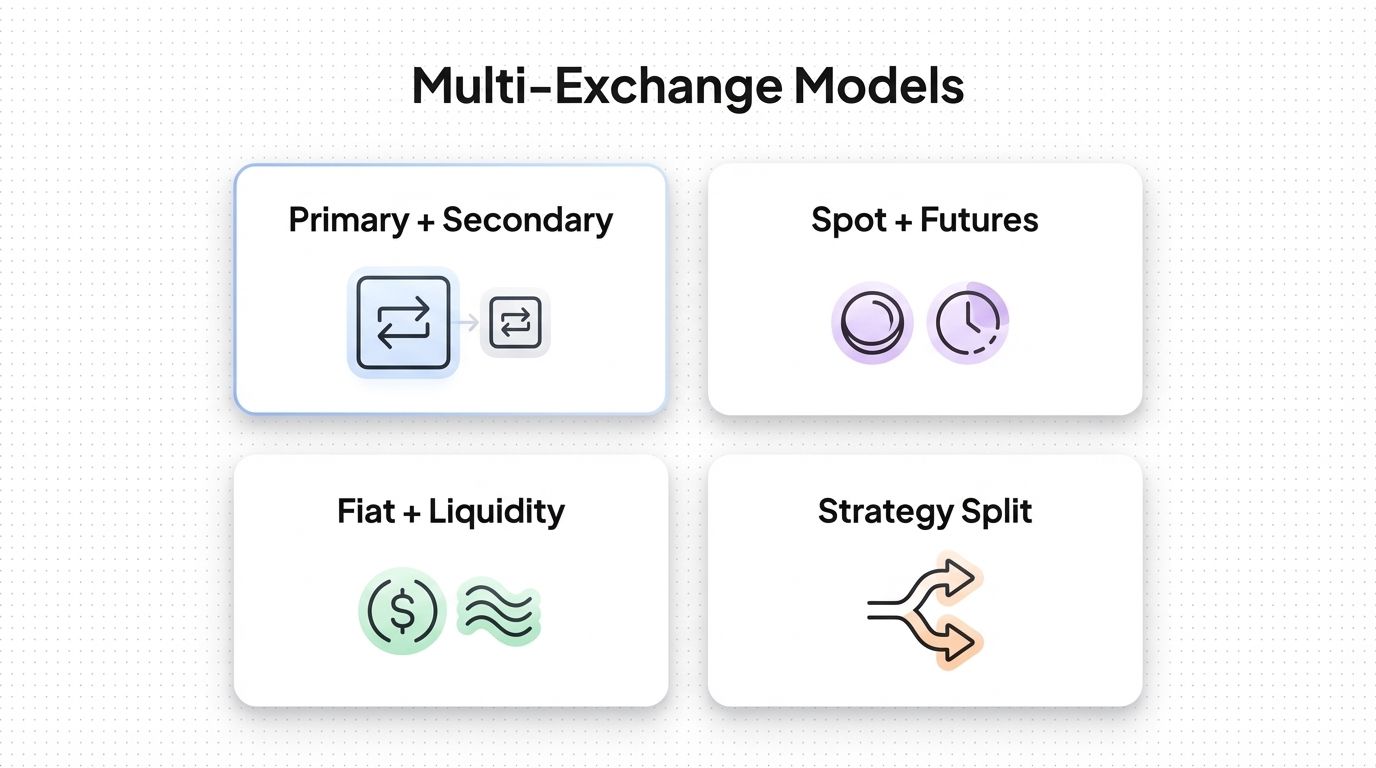
Common models that stay manageable:
• One primary exchange for most trades, secondary exchanges for specific coins
• One exchange for spot, another for futures
• One exchange for fiat access, another for deeper liquidity
• Separate exchanges for separate strategies, so results do not get mixed
Pick one model and stick with it long enough to learn what it actually improves. Switching your structure every few weeks makes performance feel random even if your strategy is fine.
The hidden problems of trading on multiple exchanges
Multi-exchange trading looks easy until volatility hits. Then the workflow gets stress-tested, and most mistakes come from coordination, not chart reading.
Typical failure points:
• You forget a position because it is on another exchange
• You take the same idea twice because you saw it on two venues
• Fees, spreads, and funding costs differ more than you expected
• Transfers are slow when you need speed, or withdrawals get held
• Margin rules differ, and liquidation risk is not consistent
• Security risk increases because you now manage more accounts and keys
These problems are solvable, but the solution is never “add more exchanges.” The solution is one workflow that keeps your monitoring, risk rules, and review consistent.
Where Altrady fits for multi-exchange trading
Swing Traders, Altrady’s value here is simple: it is designed to let you trade on multiple exchanges from one terminal, so you do not have to learn a new interface every time you add a venue.
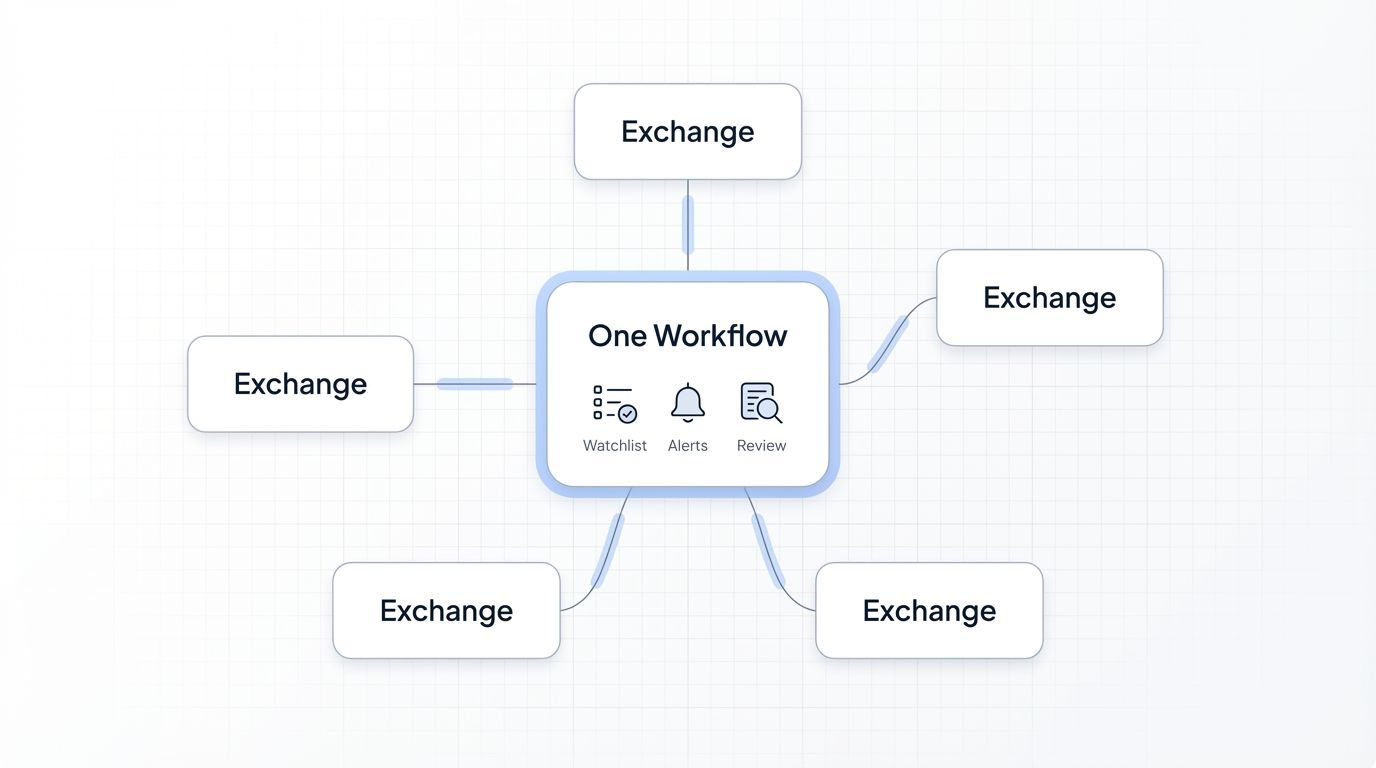
You can connect multiple exchanges, and you can also connect multiple accounts on the same exchange as separate trading accounts, which is useful if you split strategies or manage more than one portfolio.
That matters because a unified workflow changes your behavior. Instead of checking different platforms with different layouts, you can keep one routine for discovery, alerts, execution, and review, while still executing on the exchange accounts you already use.
A clean workflow to trade crypto on multiple exchanges
The easiest way to reduce chaos is to structure your process into three layers. When these layers are clear, adding another exchange becomes a controlled change instead of a new source of noise.
1. Discovery: decide what markets are worth attention
2. Execution: trade with consistent rules and risk
3. Review: track outcomes so you improve with evidence
Altrady features like watchlists and price alerts can support the first two layers, while journaling and analytics support the third. The tool does not replace your strategy, but it can keep your strategy consistent across venues.
Step-by-step: manage multiple exchanges without losing control
Below is a practical routine that works even if you use two exchanges today and four exchanges later. The goal is to reduce context switching, because context switching is where most mistakes live.
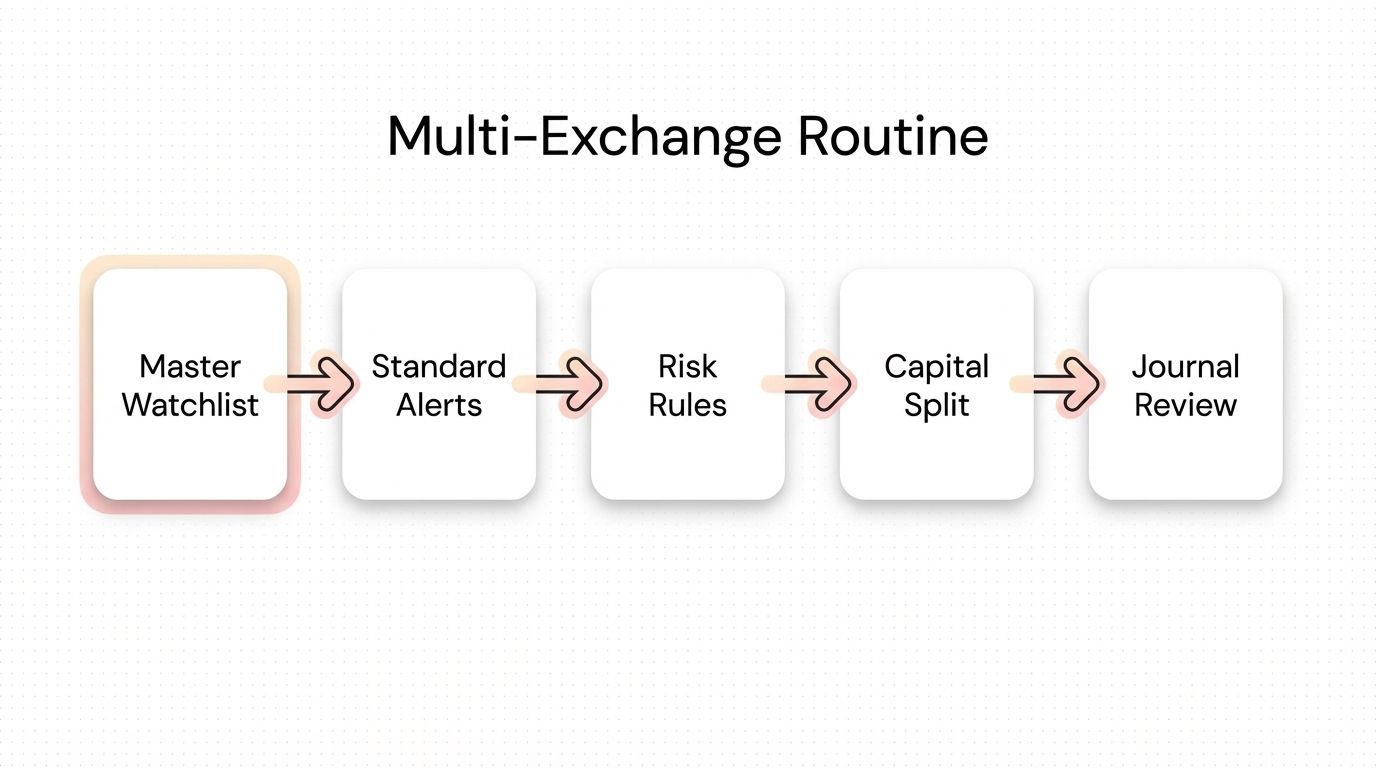
Step 1: Build one master watchlist
If you have three exchanges but three different watchlists, your brain becomes the syncing mechanism. That is fragile. A master watchlist gives you one source of truth for what you monitor and what you ignore.
Keep the watchlist small and purposeful. Add markets because they fit a strategy, not because they are trending. When your list is clean, alerts become meaningful and you stop reacting to everything.
Step 2: Standardize alerts across your markets
Alerts are how multi-exchange trading becomes sustainable without constant chart watching. You mark key levels or conditions, then let the system notify you when action is required.
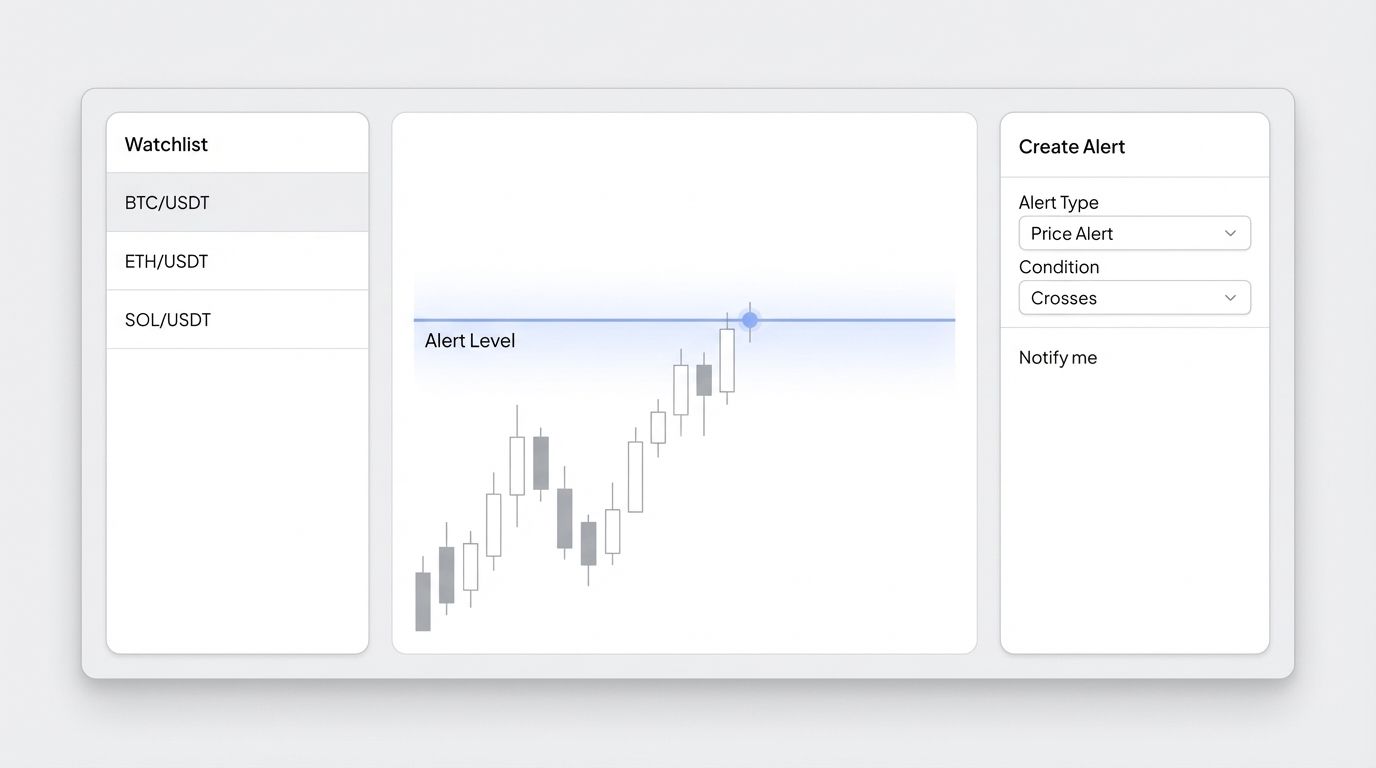
The most important part is consistency. If your alert rules change depending on the exchange, you are not running one system, you are running several. A unified alerts workflow helps you apply the same triggers across markets and reduce impulsive entries.
Step 3: Use the same risk rules everywhere
Fees may differ per exchange, but risk discipline should not. Multi-exchange trading becomes dangerous when your rules are inconsistent, because you cannot trust your own outcomes.
A simple risk policy is usually enough:
• Position sizing based on stop distance
• Predefined stop-loss orders on every trade
• A max daily loss limit
• A cap on total open positions across all exchanges
If you cannot summarize your risk rules in a few lines, they are too complex to execute during volatility.
Step 4: Keep capital allocation simple
A common trap is spreading capital so thin that you are constantly transferring funds. Transfers are not a strategy. They are operational overhead, and during high volatility they can become a serious execution risk.
A cleaner model is to allocate capital per purpose. For example:
• Exchange A: primary spot trading
• Exchange B: futures only
• Exchange C: niche listings with a small allocation
This reduces the need for urgent transfers and makes it easier to review performance by venue.
Step 5: Track performance by exchange and strategy
If you do not journal across exchanges, you will misread your results. One venue can perform well while another quietly bleeds through fees, poor execution, or the wrong strategy fit.
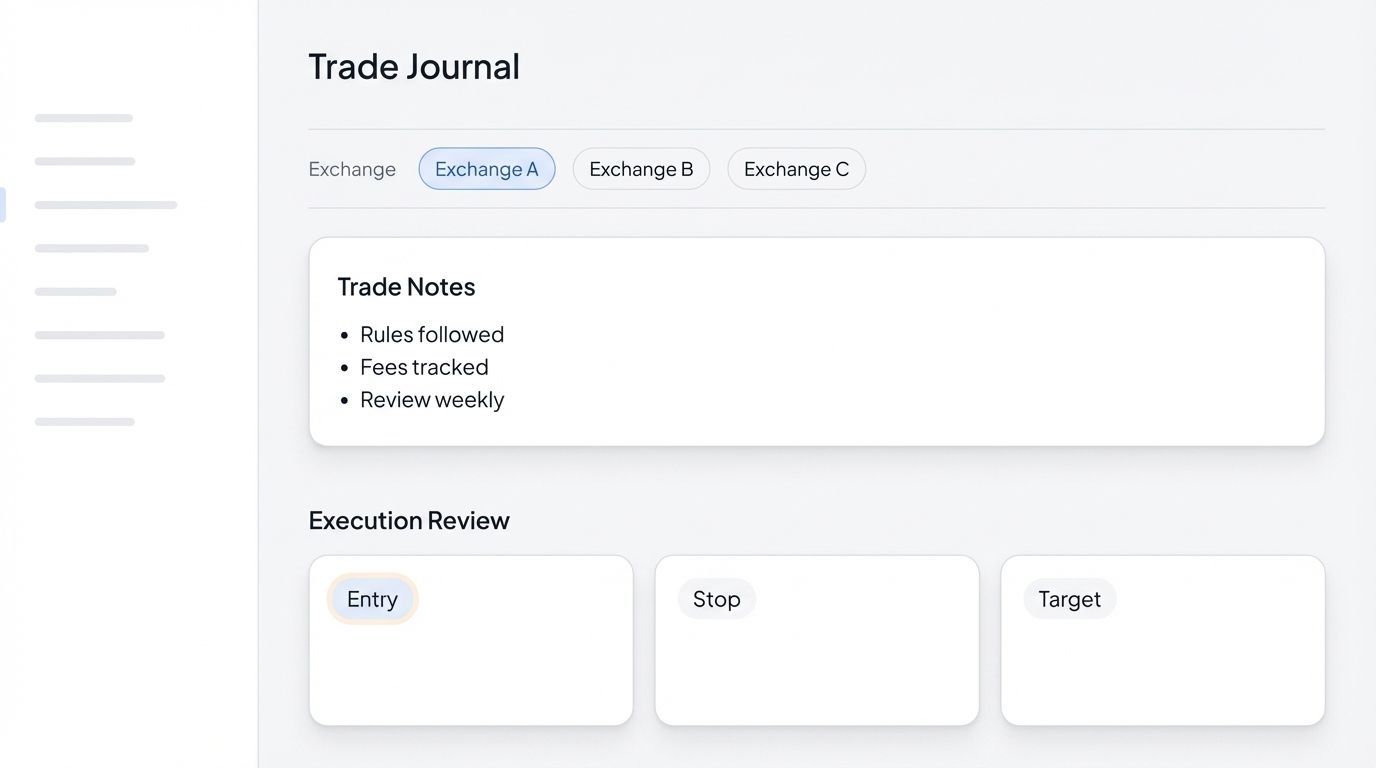
A journal with tags for exchange, pair, and strategy gives you clarity. Once you can review performance by tag, you can make smarter decisions like reducing one exchange to view-only, cutting a strategy that fails on one venue, or consolidating to fewer markets.
Common mistakes Swing Traders make with multi-exchange trading
Most traders who struggle on multiple exchanges do not fail because their strategy is bad. They fail because the workflow is inconsistent, so the same strategy produces different behavior in different places.
Common mistakes:
• Opening too many accounts “just in case”
• Duplicating the same trade idea across venues without a plan
• Ignoring fees and funding costs until results degrade
• Forgetting open positions or stops
• Chasing listings instead of trading a repeatable setup
• Treating transfers as an edge
The fix is usually fewer exchanges and stronger process, not more tools. Once the workflow is stable, adding a new exchange becomes a deliberate choice instead of a distraction.
FAQ on Crypto Trading on Multiple Exchanges
Is it better to trade on multiple exchanges?
It can be, if you have a clear reason such as liquidity, futures access, or specific listings. The benefit comes from structure, not from collecting accounts.
If you cannot track risk and positions cleanly, fewer exchanges will often produce better results.
How many exchanges should a trader use?
For most Swing Traders, two or three well-chosen exchanges are enough. Beyond that, complexity grows faster than opportunity.
The right number is the number you can manage without missing positions, forgetting stops, or constantly moving funds.
How do I track performance across multiple exchanges?
You need consistent journaling and tagging by exchange and strategy. Without that, you will remember the wins and lose track of what caused the losses.
A weekly or monthly review that compares exchange-level results usually improves performance faster than adding another venue.
Risk disclaimer
Trading is risky. Losses can happen quickly in volatile markets, and using multiple exchanges can multiply mistakes if your workflow is not structured. Swing Traders, use position sizing, predefined stops, and disciplined review before scaling complexity.
Start a free trial on Altrady to connect your exchanges, centralize watchlists and alerts, and track multi-exchange trades in a single workflow.