
By May 2026, the AI crypto market capitalization crossed $20.94 billion. The category encompasses three distinct sub-themes: AI infrastructure tokens (compute marketplaces like Bittensor, Render, Akash), AI service tokens (specific AI tools and applications), and AI agent tokens (autonomous on-chain agents that transact independently).
AI agent tokens are the newest and most-watched sub-category. Projects like Virtuals Protocol, AIXBT, GAME, and others tokenize autonomous AI agents that operate continuously on-chain. The agents trade, analyze markets, participate in governance, and execute strategies without human intervention.
This guide explains what AI agent tokens are, the leading projects in 2026, the technical architecture that enables agent autonomy, the use cases (trading, social, gaming, financial), the risks, and how traders should think about AI agent token allocation.
What Are AI Agent Tokens?
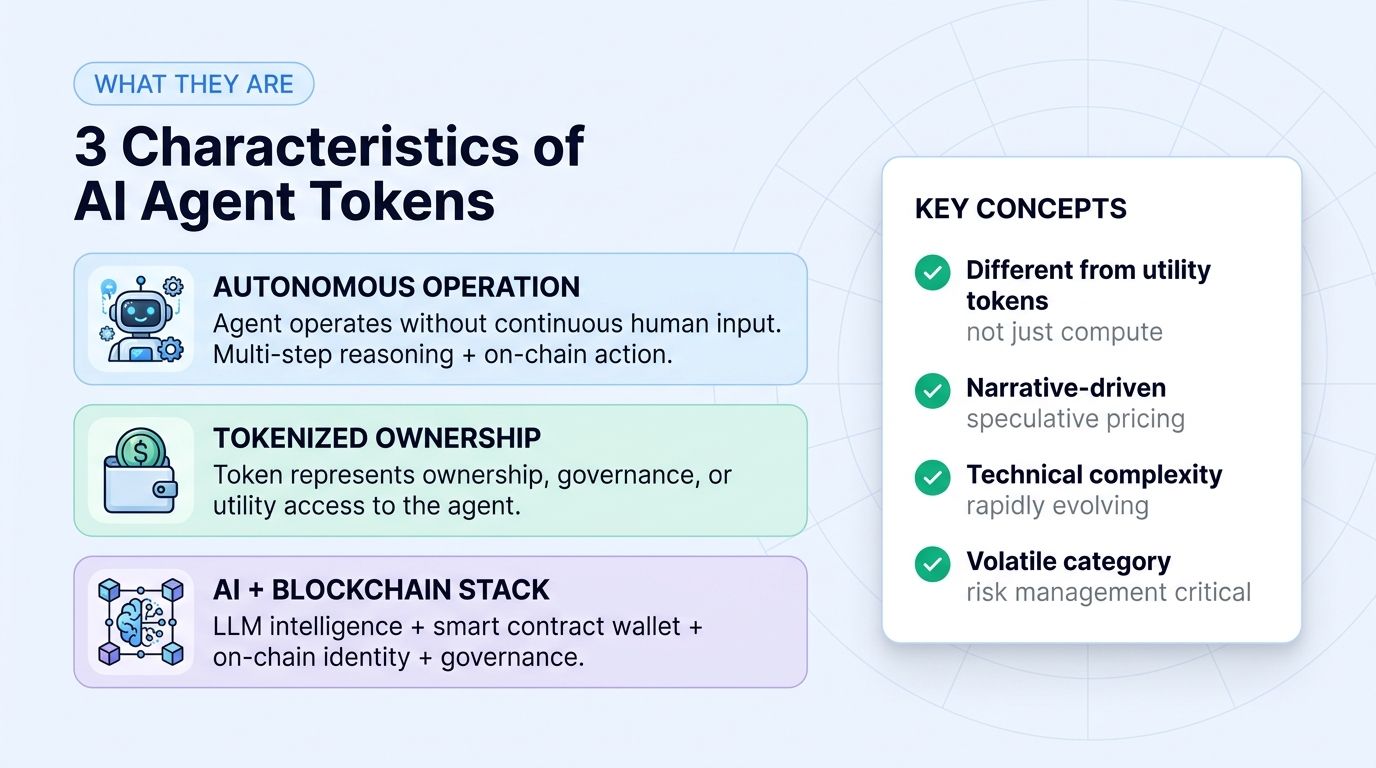
AI agent tokens are crypto tokens associated with autonomous AI agents that operate on blockchain networks. The agents have wallets, hold tokens, execute transactions, and interact with other agents and humans without continuous human direction.
Three structural characteristics define the category.
First, the agents are autonomous. Once deployed and configured, the agent operates without continuous human input. It may make decisions about trading, communication, governance participation, or other on-chain activities based on its programming and reinforcement learning.
Second, the tokens represent ownership or governance over the agent. Different projects implement this differently. Some tokens represent agent ownership shares. Others provide governance over the agent's parameters or strategy. Some give utility access to the agent's services.
Third, the underlying technology stack combines AI models (often large language models or specialized agent frameworks) with blockchain smart contracts that handle the agent's on-chain interactions. The combination requires both AI engineering and crypto engineering expertise.
Why AI Agent Tokens Matter in 2026
Three forces converged.
First, AI capability has matured. LLMs and agent frameworks (LangChain, AutoGen, others) can now handle multi-step reasoning tasks reliably. Autonomous agents that make complex decisions are now technically feasible.
Second, on-chain infrastructure supports agent operations. Account abstraction (ERC-4337 and similar), gasless transactions, multi-sig structures, and other primitives enable agents to operate without continuous human approval for routine transactions.
Third, the narrative resonates. "Autonomous AI agents trading on-chain" captures imagination in a way that pure AI infrastructure tokens (which trade more like utility plays) do not. The narrative drives speculative capital into the category.
For traders, AI agent tokens represent one of the highest-momentum sub-categories of 2026. The market cap growth has been substantial, though the underlying fundamentals are still emerging.
The Leading AI Agent Token Projects
By 2026, several projects have established positions in the category.
Virtuals Protocol (VIRTUAL)
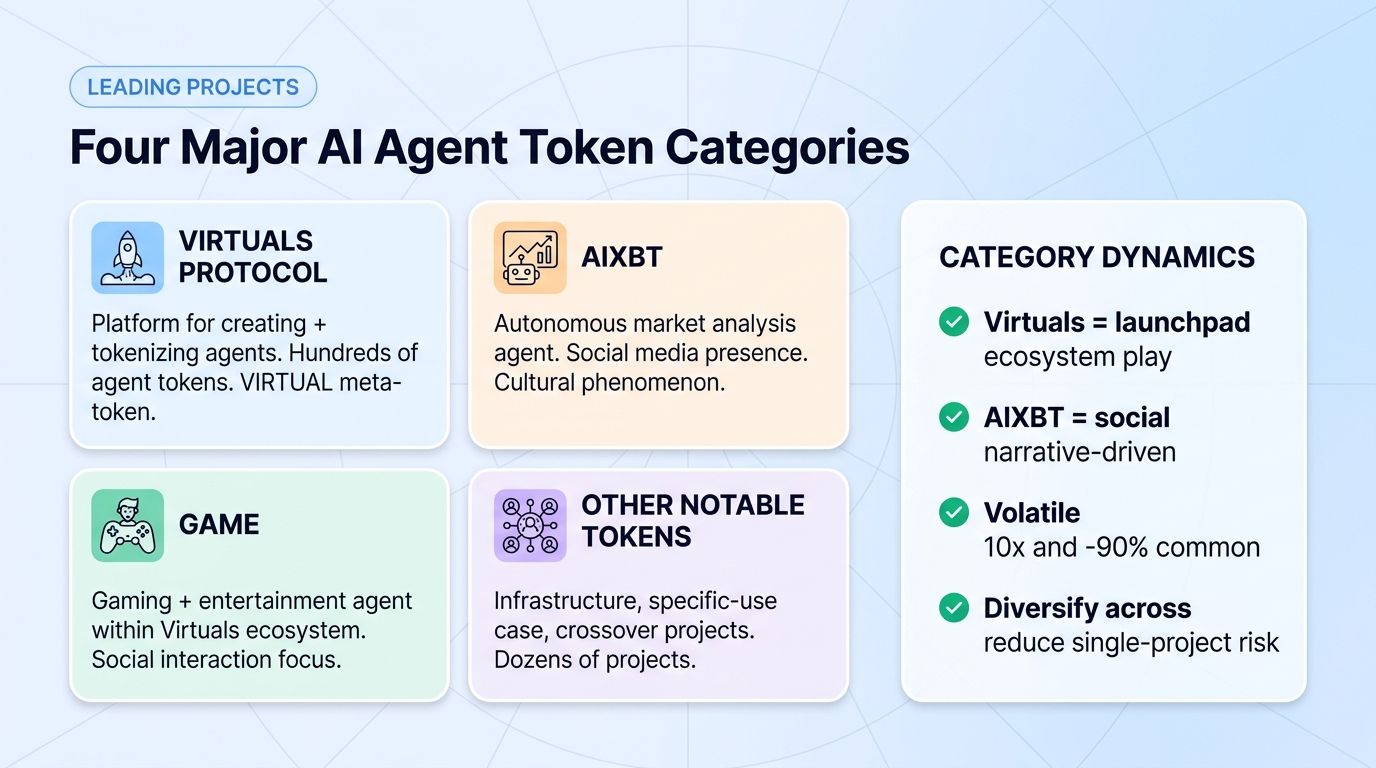
Virtuals is a platform for creating and tokenizing AI agents. Users can launch their own agents through the platform, and each agent has its own token. The platform also has the VIRTUAL meta-token that captures value from the broader ecosystem.
By 2026, Virtuals hosts hundreds of individual agent tokens. The platform has become the leading "AI agent launchpad" in the Web3 space. The ecosystem includes both highly-traded agent tokens and niche specialized agents.
AIXBT
AIXBT is one of the highest-profile autonomous trading agent tokens. The agent operates as a market analysis bot that publishes insights on social media and participates in trading activities. The associated token gives holders various levels of access to the agent's outputs.
AIXBT became a cultural phenomenon in 2024-2025 with significant social media following. The 2026 version represents a more mature implementation with more sophisticated agent capabilities.
GAME (Virtuals ecosystem)
GAME is a token within the Virtuals ecosystem associated with a gaming and entertainment-focused agent. The agent participates in gaming activities, social interactions, and ecosystem governance.
The token represents one of the major individual agent tokens within Virtuals' broader platform.
Other Notable Tokens
The category includes dozens of additional projects:
- AI agent infrastructure tokens (frameworks for agent deployment)
- Specific use case agents (DeFi yield agents, NFT trading agents, social agents)
- Crossover projects that combine AI agents with other crypto themes
Market dynamics are highly volatile. Individual agent tokens can rise dramatically on viral moments and fall equally fast when narratives shift.
The Technical Architecture
Three layers underpin AI agent token systems.
Layer 1: AI Model Layer
The intelligence of the agent comes from AI models. Most agents use:
- Large Language Models (GPT-4, Claude, Gemini, open-source alternatives)
- Specialized agent frameworks for multi-step reasoning
- Custom fine-tuning for specific tasks
- Reinforcement learning from on-chain feedback
The model layer determines the agent's capabilities. More sophisticated models enable more complex agent behaviors.
Layer 2: Blockchain Integration Layer
The agent's on-chain identity and operations require:
- Smart contract wallet (often account-abstracted)
- Transaction signing infrastructure
- On-chain identity (sometimes ENS or similar)
- Governance participation capability
- Token economics implementation
This layer handles the "agent acts on-chain" mechanics.
Layer 3: Coordination Layer
Multi-agent systems require coordination:
- Agent-to-agent communication protocols
- Discovery mechanisms (how agents find each other)
- Reputation systems
- Coordination on shared resources
This layer is the most experimental and varies significantly between projects.
The Use Cases
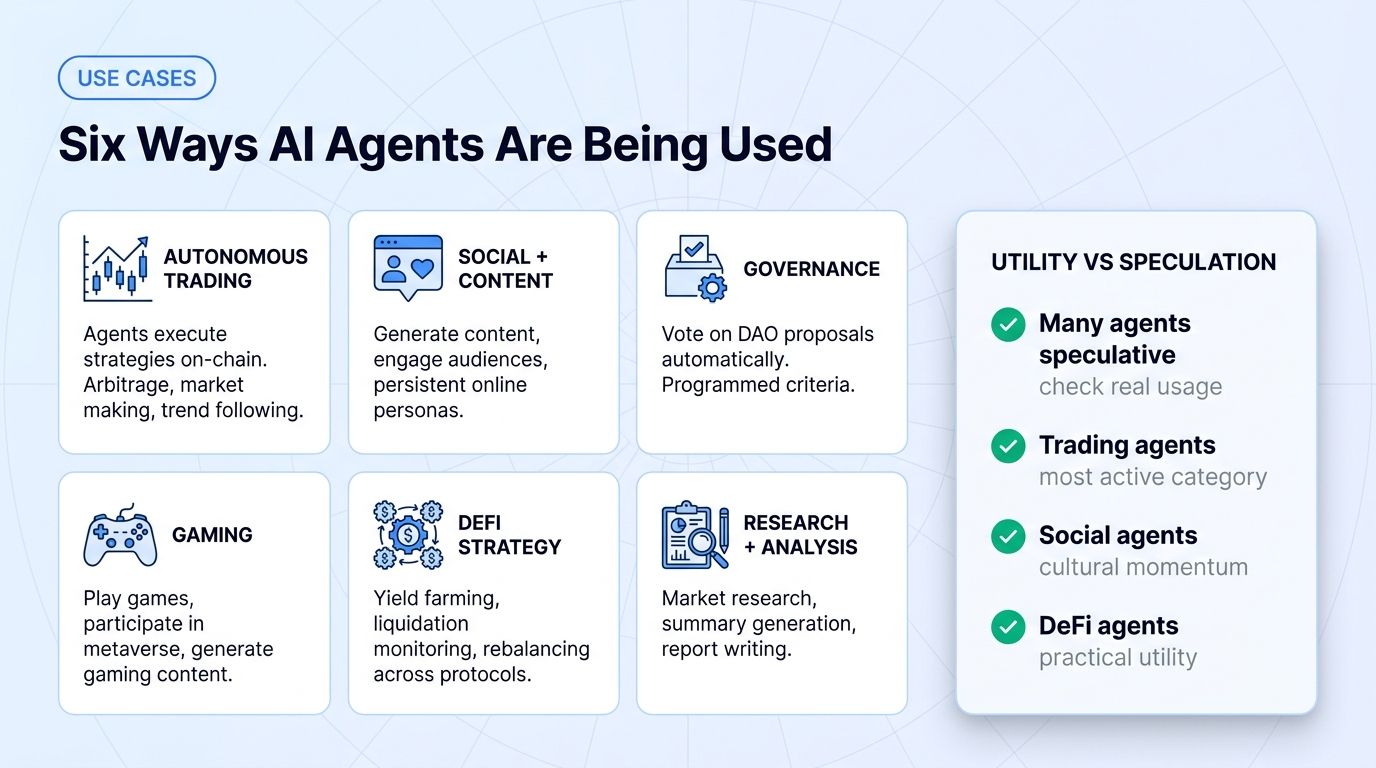
Several distinct use cases drive agent adoption.
Use Case 1: Autonomous Trading
Agents execute trading strategies on-chain. They monitor markets, evaluate opportunities, and execute trades without human intervention. Some specialize in specific strategies (arbitrage, market making, trend following).
Use Case 2: Social and Content Generation
Agents generate content, engage with audiences, build social media followings. The agent operates as a persistent online persona with consistent voice and behavior.
Use Case 3: Governance Participation
Agents participate in DAO governance, voting on proposals based on programmed criteria. This automates governance for token holders who lack time for continuous monitoring.
Use Case 4: Gaming and Entertainment
Agents play games, participate in metaverse environments, generate gaming content. The crypto-gaming intersection produces specific use cases for autonomous agents.
Use Case 5: DeFi Strategy Execution
Agents manage DeFi positions: yield farming, liquidation monitoring, rebalancing across protocols. The complexity of optimal DeFi positioning makes it well-suited for autonomous agents.
Use Case 6: Research and Analysis
Agents conduct market research, summarize information, generate reports. Some traders use agent-generated analysis as one input to their decision making.
How Traders Can Get AI Agent Token Exposure
Three practical paths.
Path 1: Hold individual agent tokens on a centralized exchange. Major agent tokens (VIRTUAL, AIXBT, others) trade on Binance, OKX, Bybit, Kraken, and many DEXs. A platform like Altrady connects to 19+ exchanges, allowing unified position management for these tokens alongside other crypto holdings.
Path 2: Hold the broader AI crypto basket. Combining AI agent tokens with AI infrastructure tokens (TAO, RNDR, AKT) creates diversified AI crypto exposure. The category captures both autonomous-agent narrative and underlying compute infrastructure.
Path 3: Hold ecosystem governance tokens (VIRTUAL). Holding the platform-level token (VIRTUAL for the Virtuals ecosystem) provides exposure to the ecosystem rather than individual agents. Less volatile than individual agent tokens but more aligned with category growth.
The Risks of AI Agent Token Investing
Volatility risk. AI agent tokens are highly volatile. Individual tokens can rise 1000% on viral moments and fall 90% when narratives shift. Most retail allocations end up underwater.
Concentration risk. Many investors over-allocate to specific high-momentum tokens at peaks. The risk-adjusted approach is significant diversification.
Underlying value uncertainty. Many agent tokens don't have clear fundamental value drivers beyond narrative momentum. The "what is this token actually worth?" question is often unanswerable.
Technical risk. Agent systems are complex. Bugs, exploits, or unexpected agent behavior can damage value rapidly.
Regulatory risk. Autonomous on-chain agents are at the regulatory frontier. Future regulations could classify agent activity (especially trading agents) under existing securities or commodities frameworks.
Token unlock pressure. Like many crypto tokens, agent tokens have vesting schedules. Continued unlocks create supply pressure.
Smart contract risk. Bugs in agent smart contracts or supporting infrastructure can result in loss of funds.
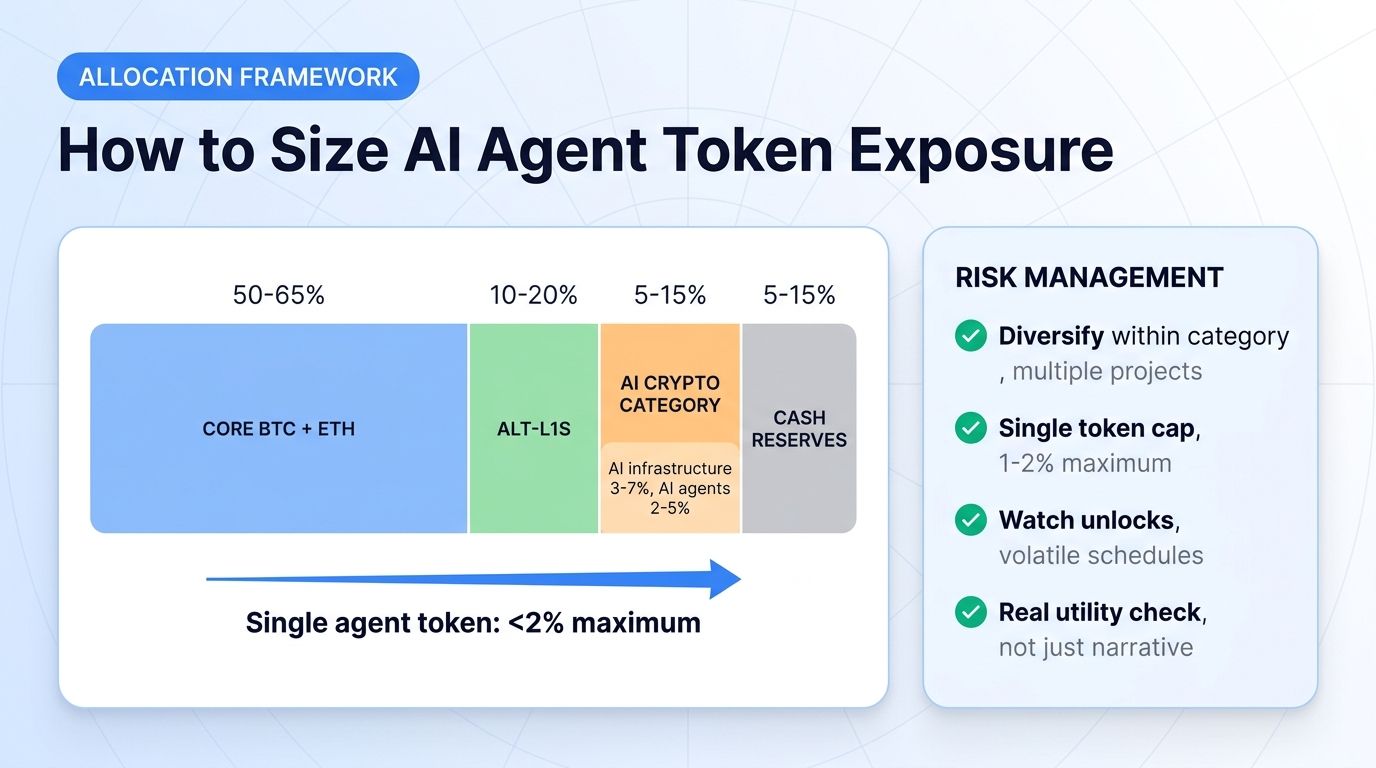
How AI Agent Tokens Fit Into a Portfolio
A practical framework:
- Core large-cap holdings (BTC, ETH): 50-65% of crypto allocation
- Major alt-L1s (SOL, others): 10-20%
- AI crypto category (combined): 5-15%. Within this:
- - AI infrastructure (TAO, RNDR, AKT): 3-7%
- - AI agent tokens (VIRTUAL, AIXBT, others): 2-5%
- Cash reserves: 5-15%
Individual AI agent token positions should typically be 1-2% maximum due to volatility. Diversification across multiple agent tokens reduces single-project risk.
What to Watch in the Next 12 Months
Three indicators.
Indicator 1: Real-world agent utility. Are AI agents actually delivering useful services beyond speculative trading? Adoption metrics, user counts, and revenue would all signal real utility.
Indicator 2: Regulatory clarity. Do regulators specifically address autonomous AI agents? Clear regulation could either accelerate adoption (with compliance frameworks) or restrict it (with new constraints).
Indicator 3: Capital allocation patterns. Does AI agent token market cap continue growing? Is institutional capital allocating to the category? Are professional traders building positions?
If all three trend positively, the category has structural support. If they stagnate, the category may be primarily speculative.
FAQ
Are AI agents actually autonomous?
The degree of autonomy varies significantly. Some agents are essentially scripted bots with AI-generated content overlays. Others operate with more genuine reasoning and decision making. The most sophisticated agents combine LLM reasoning with on-chain action capability. True full autonomy with complex decision making is still emerging.
Can AI agents lose money?
Yes, just like human traders. AI agents executing trading strategies are subject to the same market risks as human-operated strategies. Bad strategy plus AI execution still equals losses. The token may also decline if the agent's perceived value decreases.
What is the difference between AI agent tokens and AI infrastructure tokens?
AI infrastructure tokens (TAO, RNDR, AKT) represent compute and network resources used by AI applications. They are essentially utility tokens for AI infrastructure marketplaces. AI agent tokens represent the agents themselves or platforms for deploying them. The two categories are complementary: infrastructure tokens underpin the platforms that host agents.
Should I invest in individual agent tokens or platforms?
Both approaches have merit. Individual agent tokens offer higher upside (and risk) if specific agents become highly successful. Platform tokens (VIRTUAL) offer diversified exposure to the broader ecosystem. Most diversified investors hold platform tokens with smaller positions in select individual agent tokens.
Can I trade AI agent tokens on Altrady?
Yes. Major AI agent tokens (VIRTUAL, AIXBT, and others) are listed on multiple exchanges. Altrady connects to 19+ exchanges, so you can manage AI agent token positions alongside other crypto holdings, run automated strategies via the signal bot, grid bot, or DCA bot, and use unified portfolio tracking.
Conclusion
AI agent tokens represent one of the most-watched sub-categories of crypto in 2026. The combination of mature AI capability, supportive on-chain infrastructure, and resonant narrative has created a $20 billion category that continues attracting capital.
For traders, the practical takeaway is this: AI agent tokens are real and likely durable as a category, but individual token selection is high-risk. The volatility, concentration risks, and underlying value uncertainty all argue for diversified exposure rather than concentrated positions.
The longer-term trajectory depends on whether autonomous AI agents deliver real-world utility beyond speculative trading. Early signs are mixed: some agents have genuine user adoption; many others are primarily speculative vehicles. The next 12 to 24 months will produce decisive data on which projects move into productive use cases.
For diversified crypto portfolios, allocating a small percentage (3 to 5%) to AI agent tokens makes sense as part of broader AI crypto exposure. Diversifying within the category across platform tokens and select individual agent tokens reduces single-project risk while maintaining exposure to category growth.
The category represents one of crypto's experimental frontiers in 2026. Like all frontiers, it produces both extraordinary winners and extraordinary losers. Sizing positions to a level where worst-case outcomes do not damage your overall portfolio is the standard discipline.