
For many crypto traders, the choice between auto trading and manual trading defines how they interact with the market every single day. Some prefer the hands-on control of reading charts, spotting patterns, and executing orders in real time. Others rely on algorithms, bots, and automated systems to handle the heavy lifting while they focus on strategy and risk management.
Swing Traders who hold positions for days or weeks often find themselves caught between both worlds. They want the precision of manual analysis but lack the time to monitor every price movement across multiple exchanges. This tension between control and efficiency is exactly what makes the auto trading vs manual trading debate so relevant in 2026.
This article breaks down both approaches honestly, covering how each one works, where each excels, where each falls short, and how to decide which fits your trading goals.
What Is Manual Trading?
Manual trading is the traditional approach where a trader makes every decision by hand. You analyze charts, read indicators, evaluate market conditions, and place each order yourself. There is no algorithm or bot involved in the execution process.
This approach demands a deep understanding of technical analysis, market structure, and price action. Manual traders spend hours studying candlestick patterns, support and resistance levels, moving averages, and volume profiles before entering a position.
Strengths of Manual Trading
The biggest advantage of manual trading is adaptability. Human traders can interpret news events, social sentiment, and unusual market behavior in ways that most algorithms cannot. When a sudden regulatory announcement hits the market or a whale moves a large position, an experienced manual trader can react with nuance rather than following rigid rules.
Manual trading also builds genuine market understanding. By placing every trade yourself, you develop intuition about how markets move, how liquidity shifts at different times of day, and how specific assets respond to macro events.
Weaknesses of Manual Trading
The most significant drawback is emotional interference. Fear, greed, and overconfidence are constant threats to manual traders. A losing streak can lead to revenge trading, while a winning streak can create dangerous overconfidence that leads to oversized positions.
Time is another major limitation. No human can monitor charts 24 hours a day across multiple exchanges. Crypto markets never close, which means manual traders inevitably miss opportunities while sleeping, working, or simply living their lives.
What Is Auto Trading?
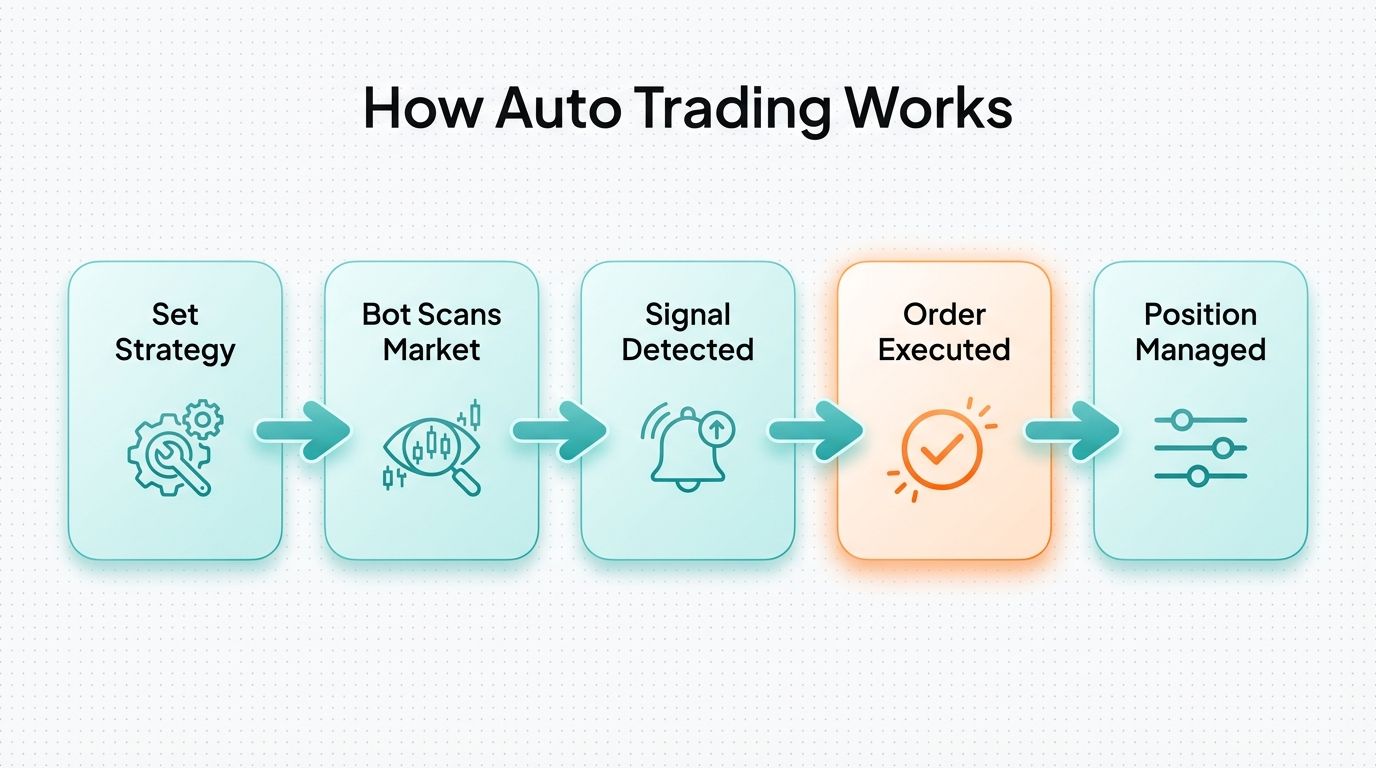
Auto trading uses software, bots, or algorithms to execute trades based on predefined rules and parameters. Once you configure your strategy, the system handles everything from order placement to position management without requiring your constant attention.
In crypto, auto trading typically takes the form of trading bots that connect to exchanges through API keys. These bots can run strategies like grid trading, dollar-cost averaging (DCA), signal-based entries, and more.
Strengths of Auto Trading
Speed and consistency are the primary advantages. A trading bot can execute orders in milliseconds, far faster than any human can click buttons on an exchange interface. This speed advantage matters most during volatile market conditions when prices move rapidly.
Bots also eliminate emotional decision-making entirely. They follow your rules without deviation, regardless of whether the last ten trades were winners or losers.
The ability to trade 24/7 across multiple exchanges simultaneously is another critical benefit. A single trader using bots can run strategies on Binance, Bybit, KuCoin, and Kraken at the same time.
Weaknesses of Auto Trading
Bots only perform as well as the strategy behind them. A poorly configured bot will lose money just as efficiently as it makes money with a good configuration. Many beginners make the mistake of launching a bot with default settings and expecting profits without understanding the underlying strategy.
Auto trading systems also struggle with unexpected market events. A flash crash, exchange outage, or sudden liquidity vacuum can cause a bot to execute trades at terrible prices because it follows rules mechanically without understanding context.
Side-by-Side Comparison
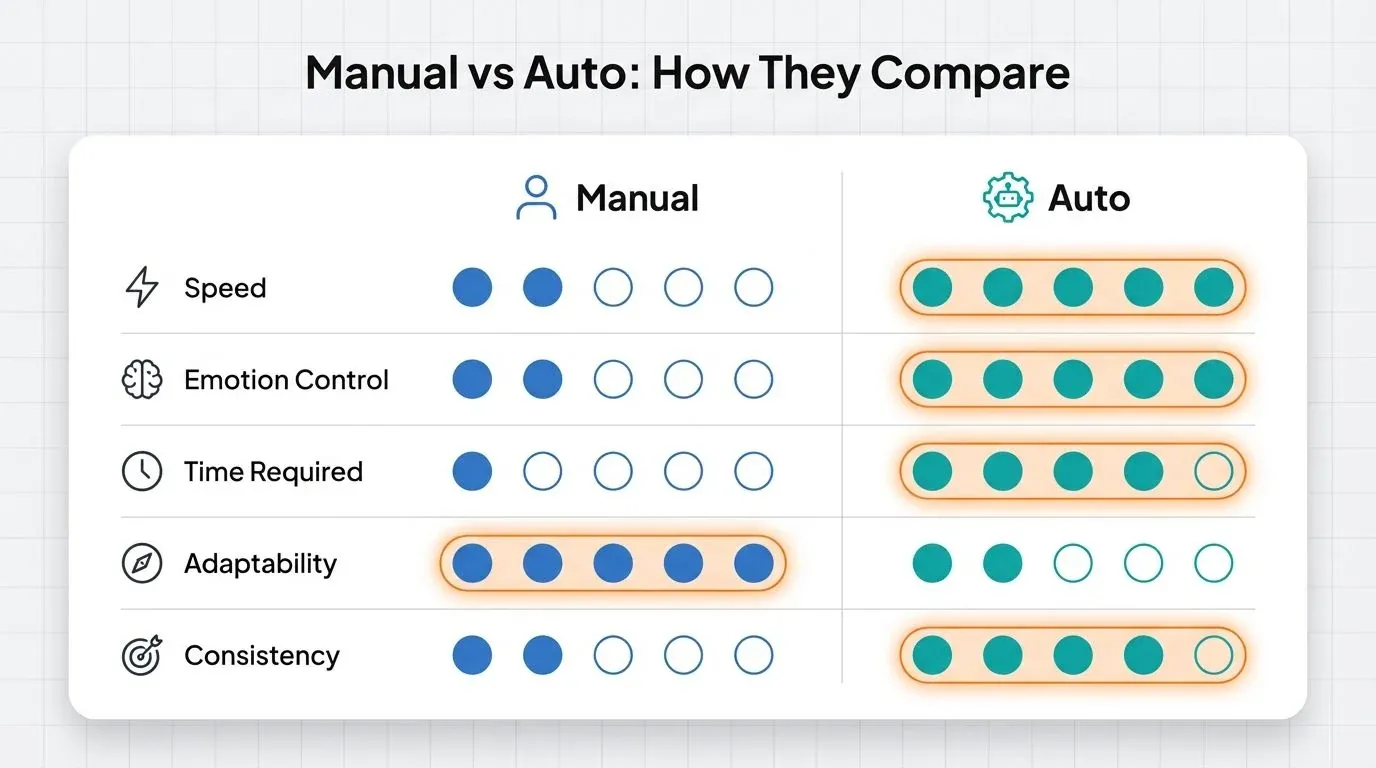
Understanding the practical differences between auto trading and manual trading helps you make an informed decision based on your actual situation rather than theoretical ideals.
Speed and Execution
Auto trading wins decisively on execution speed. Bots place orders in milliseconds while human traders need several seconds at minimum. In volatile crypto markets, this difference can mean entering a position at 2% better or worse prices.
However, speed without direction is meaningless. A fast bot running a bad strategy will lose money faster than a slow manual trader with good judgment.
Time Commitment
Manual trading requires significant daily time investment. Most active manual traders spend 4 to 8 hours per day on chart analysis, trade execution, and market monitoring. For traders with full-time jobs or other commitments, this is often unsustainable.
Auto trading dramatically reduces the time requirement. After the initial setup and configuration phase, ongoing management typically takes 30 minutes to an hour per day.
Emotional Control
This is where auto trading has a clear structural advantage. Bots do not experience fear during drawdowns or excitement during winning streaks. They execute the plan without deviation, which produces more consistent results over time for most traders.
Adaptability to Market Conditions
Manual trading excels here. Human traders can recognize when market conditions have fundamentally changed and adjust their approach accordingly. A manual trader might switch from trend-following to range-trading within minutes of identifying a regime change.
The Hybrid Approach: Best of Both Worlds
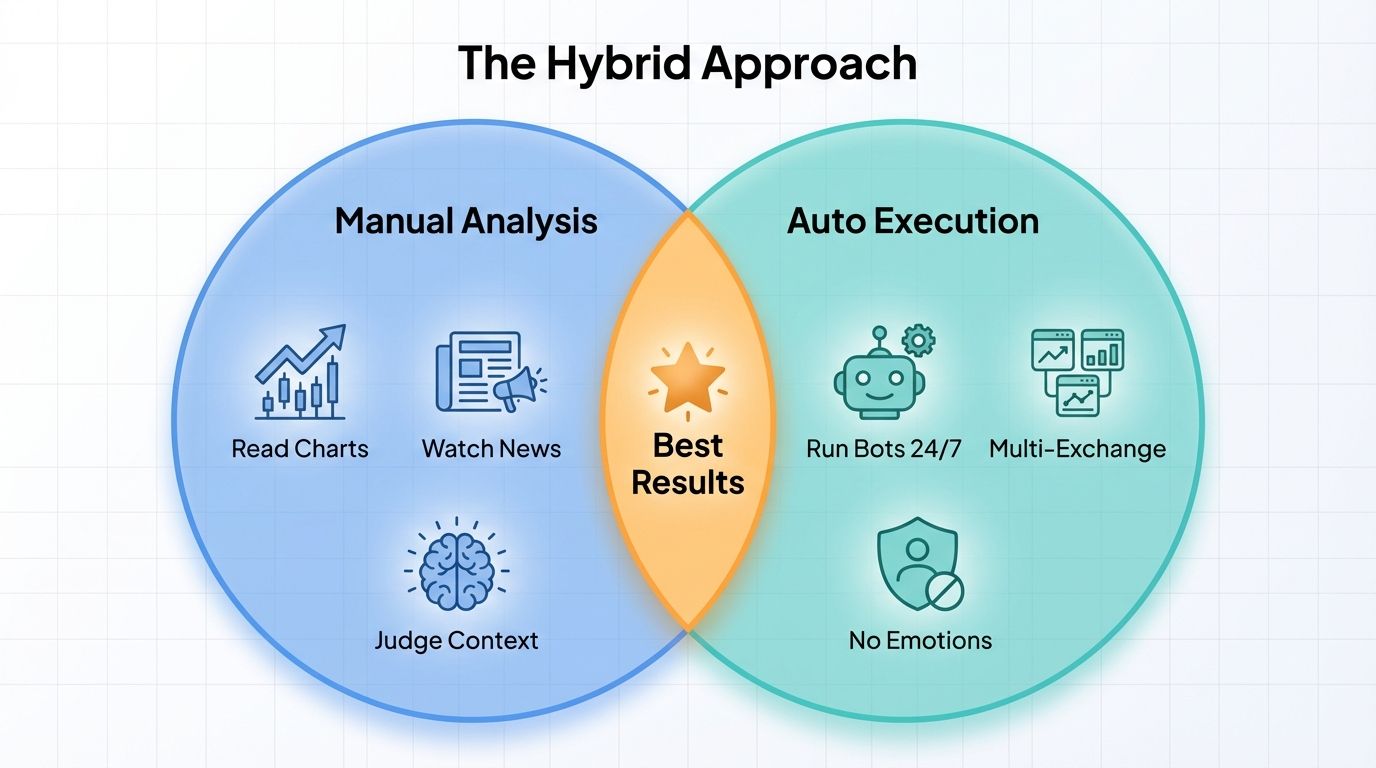
The most effective traders in 2026 rarely commit exclusively to one approach. Instead, they combine manual analysis with automated execution to leverage the strengths of both methods.
A practical hybrid workflow looks like this: you perform manual analysis to identify high-probability setups and market conditions, then use bots to execute and manage positions according to your plan.
For example, a Swing Trader might manually identify a strong support level on Bitcoin's daily chart, then configure a DCA bot to accumulate a position at that level while using a grid bot to trade the expected range.
How Altrady Supports the Hybrid Approach
Altrady's platform is designed specifically for traders who want to combine manual analysis with automated execution. The multi-exchange dashboard lets you monitor positions across all your connected exchanges in one place, while the built-in trading bots handle strategy execution.
The Smart Trading features bridge the gap between manual and automated approaches. You can set up ladder entries, trailing stop losses, and take-profit targets that execute automatically once you have manually identified your trade setup.
Grid Bots, DCA Bots, and Signal Bots each serve different use cases within the hybrid framework. Grid Bots work well for ranging markets, DCA Bots help with systematic accumulation during corrections, and Signal Bots automatically execute trades based on TradingView alerts.
Common Mistakes to Avoid
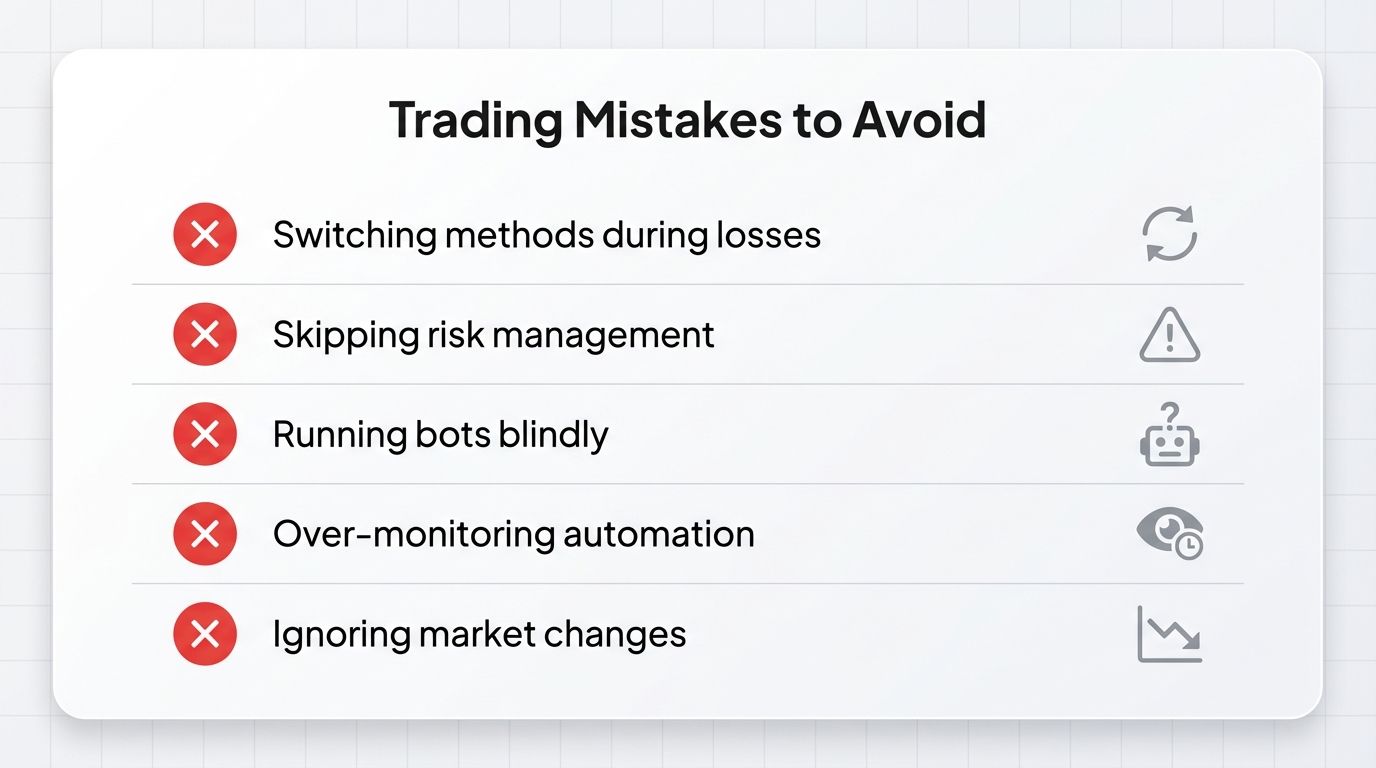
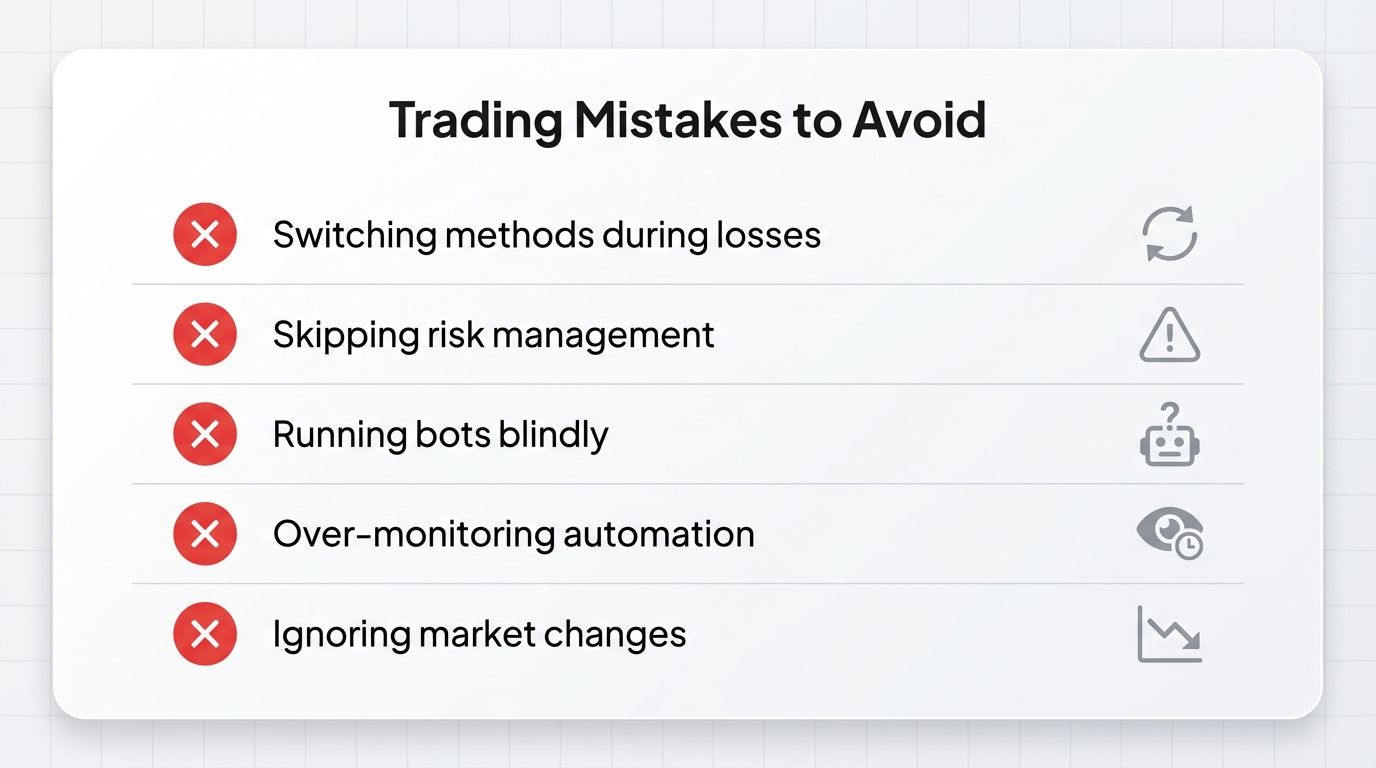
Whether you choose manual trading, auto trading, or a hybrid approach, certain mistakes can undermine your results regardless of method.
Switching approaches during drawdowns. Many traders abandon manual trading for bots after a losing streak, or vice versa. This reactive switching usually makes things worse because you are making a strategic decision based on emotional pressure rather than rational analysis.
Neglecting risk management. Bots can lose money just as fast as manual traders if position sizing and stop losses are not properly configured. Automation does not eliminate risk. It only removes the emotional component from execution.
Running bots without understanding the strategy. Launching a grid bot without understanding how grid spacing, price ranges, and investment amounts interact is a recipe for unexpected losses.
Over-monitoring automated systems. If you set up a bot and then check it every five minutes, you are not actually auto trading. You are manually trading with extra steps.
Ignoring market regime changes. Both manual and auto traders can fall into this trap. A strategy that works in a trending market may fail completely in a ranging market.
Which Approach Is Right for You?
The best approach depends on your specific situation, not on what works for someone else.
Choose manual trading if you enjoy chart analysis, have significant time to dedicate to trading, and want to develop deep market understanding.
Choose auto trading if you have limited time, trade across multiple exchanges, or struggle with emotional discipline.
Choose a hybrid approach if you want the best of both worlds and are willing to invest time in both learning market analysis and configuring trading tools. This is the approach most successful crypto traders eventually adopt.
Crypto Trading Checklist: Manual vs Auto
- Assess your available time for active trading each day
- Evaluate your emotional discipline honestly
- Determine how many exchanges and pairs you want to trade
- Decide whether you prefer learning chart analysis or strategy configuration
- Start with paper trading or small positions before committing significant capital
- Review your approach quarterly and adjust based on actual results
- Consider a hybrid approach that combines manual analysis with automated execution
FAQ
Is auto trading more profitable than manual trading?
Neither approach is inherently more profitable. Profitability depends on the quality of the strategy, risk management discipline, and market conditions. A well-configured bot can outperform an undisciplined manual trader, but an experienced manual trader can outperform a poorly set up bot. The method matters less than the skill behind it.
Can beginners use crypto trading bots effectively?
Yes, but with important caveats. Beginners should start by understanding basic trading concepts like support and resistance, trend identification, and risk management before deploying bots. Starting with paper trading mode and small positions helps build confidence without risking significant capital. Platforms like Altrady offer backtesting tools that let you test bot configurations against historical data before going live.
Do I need programming skills to set up crypto trading bots?
No. Modern crypto trading platforms provide user-friendly interfaces for configuring bots without writing any code. You set parameters like price ranges, investment amounts, and stop losses through visual forms. Some platforms also support TradingView webhook integration, which lets you trigger bot actions from chart-based alerts without programming knowledge.
Risk Disclaimer and Getting Started
Trading cryptocurrencies involves substantial risk, and past performance does not guarantee future results. Both manual and automated trading can result in losses, and you should never trade with money you cannot afford to lose. Always test strategies with paper trading before using real capital.
If you are ready to explore how auto trading and manual analysis can work together, Altrady offers a free trial that includes access to Grid Bots, DCA Bots, Signal Bots, and Smart Trading features across multiple exchanges. Start by connecting your exchange, testing bot configurations with the built-in backtesting tool, and building a workflow that matches your trading style and available time.