

Crypto airdrops have become one of the most talked-about phenomena in the blockchain industry. At their core, an airdrop is a distribution of free tokens or coins to a set of wallet addresses, usually as a way for a new or existing project to build awareness, reward loyal users, or jumpstart a community. For recipients, airdrops represent a chance to receive assets they did not pay for. For projects, they are a marketing and distribution tool rolled into one.
Understanding how airdrops work, where to find them, and how to tell the legitimate ones from scams is a skill that every intermediate crypto user should develop. This guide covers everything you need to know: the mechanics behind airdrops, the different types in circulation today, the best sources for finding them, a framework for evaluating their quality, and the practical steps for claiming and managing what you receive.
1. How Crypto Airdrops Work
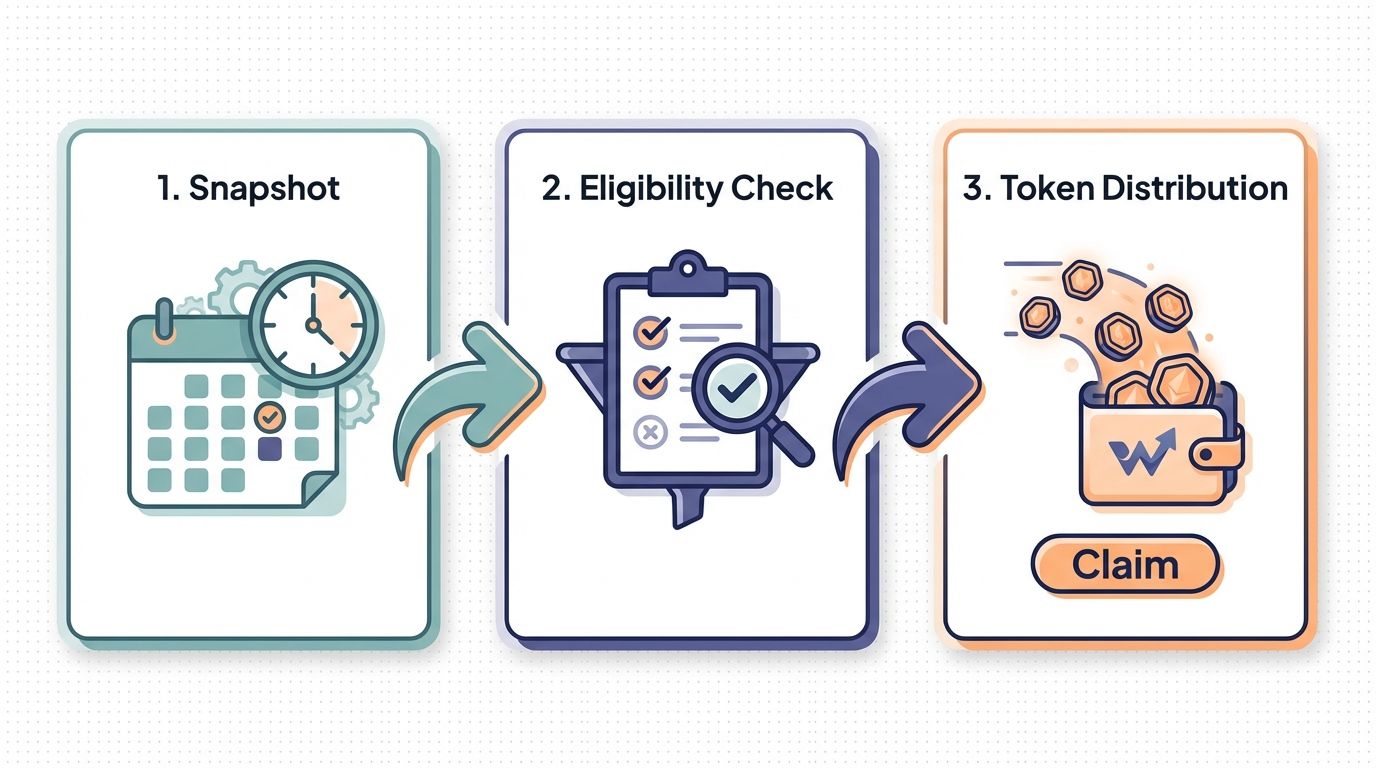
The mechanics of a crypto airdrop vary depending on the project, but the underlying process follows a predictable structure. A project decides it wants to distribute tokens, defines the rules for who qualifies, takes a snapshot of eligible wallets, and then sends tokens to those wallets either automatically or through a manual claiming process.
Eligibility Criteria
Before any tokens are sent, projects define who qualifies to receive them. Eligibility criteria typically include one or more of the following conditions:
- Holding a specific token above a minimum balance at a given time
- Having interacted with a protocol, smart contract, or decentralized application before a cutoff date
- Being an early adopter of a product, testnet, or beta feature
- Completing specific on-chain actions such as providing liquidity, voting in governance, or making a certain number of transactions
- Holding an NFT from a specific collection
- Signing up for a waitlist, completing KYC, or following social media accounts in promotional campaigns
Each project sets its own threshold. Some are generous and distribute to anyone who has touched the protocol at least once. Others have tiered systems where the more you engaged, the more tokens you receive.
Snapshot Dates
A snapshot is a point-in-time recording of all wallet balances and on-chain activity on a particular blockchain. When a project announces an airdrop based on historical activity, they typically use a snapshot date that has already passed, sometimes without announcing it in advance. This prevents last-minute manipulation where users rush to meet eligibility criteria only after the announcement.
For future airdrops that have been announced but not yet distributed, the snapshot date may be set for a future moment. In these cases, users can position themselves to be eligible before the cutoff. Tracking confirmed upcoming snapshot dates is an important part of airdrop hunting.
The Claiming Process
Some airdrops are deposited directly into eligible wallets without any action required. Others require users to visit an official claiming portal, connect their wallet, verify eligibility, and confirm a transaction to receive the tokens. Claiming portals typically have a deadline, often ranging from a few weeks to several months after the initial distribution announcement. Tokens that go unclaimed within the deadline are usually returned to the project treasury.
2. Types of Crypto Airdrops
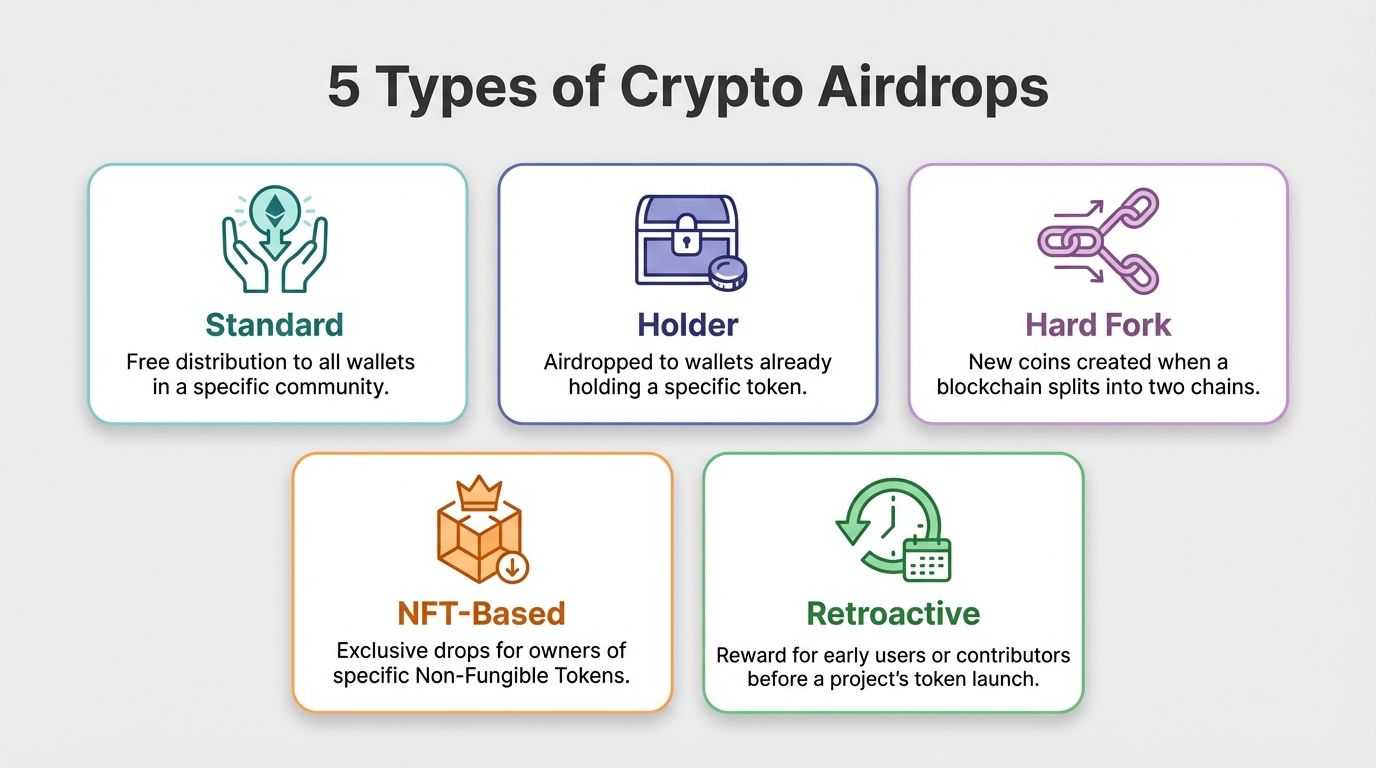
Not all airdrops work the same way. Over the years, the crypto industry has developed several distinct airdrop models, each serving a different purpose and targeting a different audience.
Standard Airdrops
Standard airdrops are the simplest form. A project sends tokens to a broad list of wallet addresses, often requiring nothing more than holding a popular base asset like ETH or BNB at the snapshot time, or signing up through a registration form. These are commonly used for new project launches to build initial holder distribution and generate buzz. The token amounts per wallet are usually small, but so is the barrier to participate.
Holder Airdrops
Holder airdrops reward existing holders of a specific token with allocations of a new or related token. A classic example is when a Layer 2 protocol distributes governance tokens to everyone who held ETH or used the Ethereum mainnet before a certain date. The logic is straightforward: reward the people who were already part of the ecosystem. Holder airdrops tend to have more defined eligibility and more predictable token amounts.
Hard Fork Airdrops
When a blockchain splits into two separate chains through a hard fork, holders of the original coin often receive an equivalent balance of the new forked coin. The most famous example in crypto history is the Bitcoin Cash fork in 2017, where every Bitcoin holder at the time of the fork received an equal amount of Bitcoin Cash. Hard fork airdrops are automatic and require no action from the holder, as long as they held their coins in a wallet where they controlled the private keys rather than on an exchange that chose not to honor the fork.
Exclusive and NFT-Based Airdrops
Some projects reserve airdrops specifically for holders of certain NFT collections. If you own an NFT from a partnered or associated project, you may qualify for token distributions, access to new NFT drops, or companion in-game items. These airdrops are often more valuable per recipient because the eligible group is smaller and the community tends to be more engaged. NFT-based airdrops have become a significant part of the value proposition for owning certain collections.
Retroactive Airdrops
Retroactive airdrops are arguably the most lucrative type. A project distributes tokens to users who interacted with their protocol before it had a token at all, effectively rewarding early adopters for their on-chain activity. The Uniswap UNI airdrop in 2020 is the defining example: anyone who had used Uniswap before a specific date received 400 UNI tokens, which were worth over $1,200 at launch prices and significantly more at peak. Retroactive airdrops cannot be anticipated with certainty, but protocols that are tokenless and growing rapidly are often watched closely by the community for exactly this reason.
3. How to Find Legitimate Airdrops
Finding airdrops requires a combination of following the right sources, using dedicated tracking tools, and staying active in relevant communities. The goal is to discover opportunities before they expire while filtering out low-quality or fraudulent distributions.
Trusted Aggregator Websites
Several websites specialize in listing active and upcoming airdrops with details on eligibility, deadlines, and estimated token values. These platforms review submissions before listing them, which provides a basic level of curation. Well-known aggregator sites include CoinMarketCap's airdrop section, Airdrops.io, and DappRadar's airdrop listings. Always cross-reference listings across multiple sources before engaging.
Official Project Channels
The most reliable source for any airdrop announcement is the project's own official channels. This means their verified Twitter or X account, their official Discord server, their Telegram announcement channel, and their blog or Medium page. Following protocols you already use or believe in gives you first-mover advantage on their announcements without having to rely on third parties.
On-Chain Activity Trackers
Tools like DeBank, Zapper, and Nansen allow you to track your on-chain interaction history across multiple protocols. These tools are useful for understanding your existing eligibility footprint: which protocols you have used, how much liquidity you have provided, and which chains you are most active on. Keeping a diversified on-chain activity history across leading DeFi protocols increases your probability of qualifying for retroactive airdrops.
Crypto Research and Community Platforms
Alpha groups, crypto research newsletters, and community Discords dedicated to airdrop hunting are valuable for discovering opportunities early. Platforms like Layer3 and Galxe publish campaigns from projects that reward on-chain activity with points, NFTs, or direct token allocations. Following credible crypto researchers and analysts on social media also surfaces airdrop opportunities before they reach mainstream aggregators.
4. How to Evaluate an Airdrop
Not every airdrop is worth your time, and a meaningful percentage of them are outright scams. Developing a systematic evaluation process protects your time, your gas fees, and your wallet security.
Green Flags
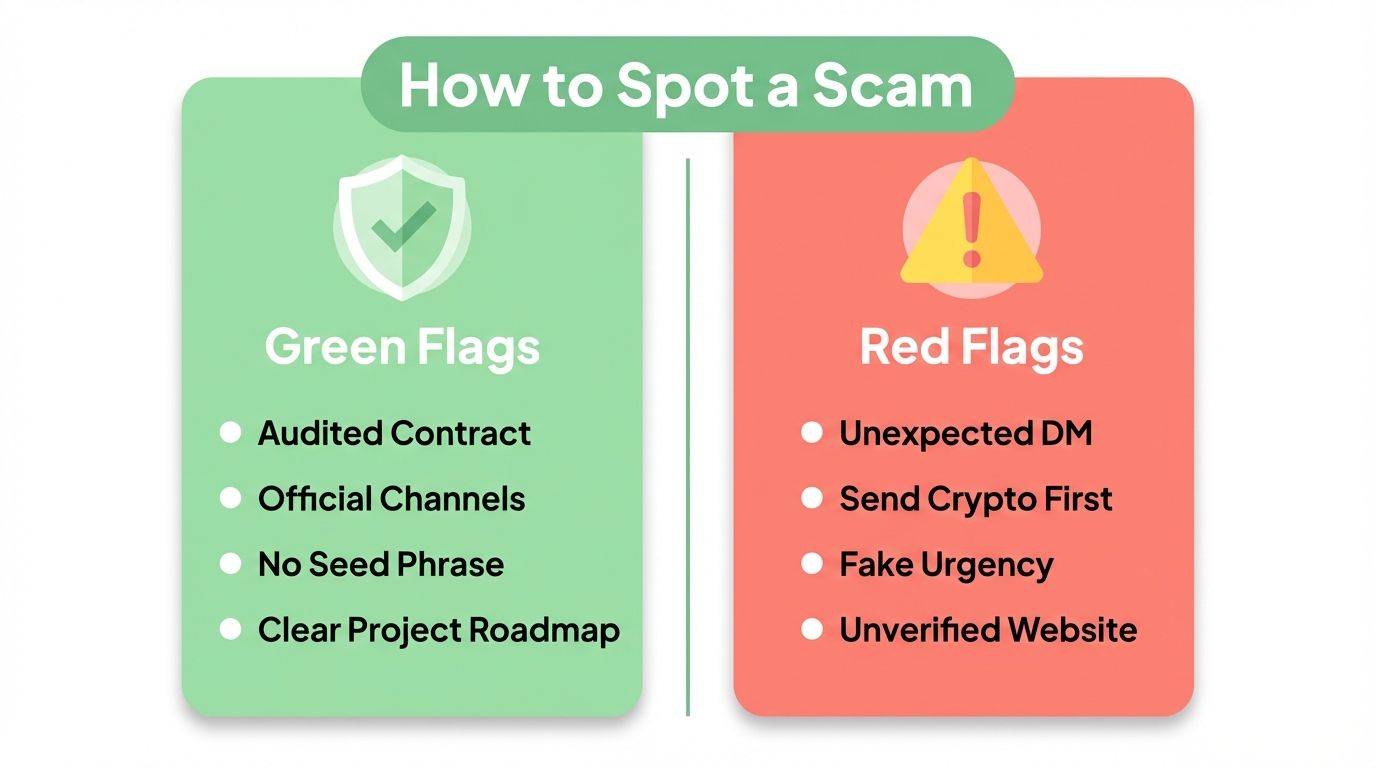
- The project has a verifiable product or protocol. A legitimate airdrop comes from a team that has built something real. Check if the protocol has an active product, on-chain transactions, audited smart contracts, and a GitHub with recent activity.
- The announcement comes from verified official channels. The Twitter account is verified or has a long history with genuine engagement. The Discord server link comes from the official website, not a third-party post.
- No seed phrase is required. A legitimate airdrop will never ask for your seed phrase or private key under any circumstances.
- The smart contract has been audited. Reputable projects publish audit reports from firms like Certik, Trail of Bits, or Consensys Diligence. A claiming contract from an unaudited project is a risk.
- The team is doxxed or has a credible track record. Founders or core contributors who are publicly known and accountable are a positive signal.
Red Flags
- Unexpected DMs offering airdrops. If someone reaches out directly to tell you that you have won tokens, it is almost certainly a scam. Legitimate airdrops do not require a private message to initiate.
- Claiming requires connecting to an unfamiliar site. Always verify the URL of any claiming portal against the project's official website. Phishing sites clone the design of real portals but redirect your approval to drain your wallet.
- The airdrop requires sending crypto to receive crypto. This is a classic advance-fee scam. You send ETH or BNB to receive the airdrop, and nothing arrives.
- Tokens appear in your wallet with no explanation. Scammers sometimes airdrop worthless tokens with attractive names into wallets to trick users into interacting with a malicious contract when they try to move or sell the tokens. Never interact with tokens you did not expect to receive without first researching them thoroughly.
- Extreme urgency or time pressure. Scams often create artificial urgency to prevent careful evaluation. Legitimate projects give users reasonable windows to claim.
5. How to Claim and Manage Airdrop Tokens
Once you have identified a legitimate airdrop and confirmed your eligibility, the practical work begins. Claiming correctly, storing securely, and understanding your options after receipt all matter.
Wallet Setup and Security
For airdrop hunting, many experienced users maintain a dedicated wallet that is separate from their main holdings. This wallet is used specifically for interacting with new protocols, claiming airdrops, and testing unfamiliar contracts. The principle is straightforward: if something goes wrong with an unfamiliar interaction, the blast radius is contained. Your main holdings in a separate wallet remain untouched.
When setting up a wallet for airdrop activity, use a non-custodial wallet where you control the private keys. MetaMask, Rabby, and Phantom are popular choices depending on the chains you are active on. Keep your seed phrase backed up offline and never enter it into any website, app, or form.
Claiming Process Step by Step
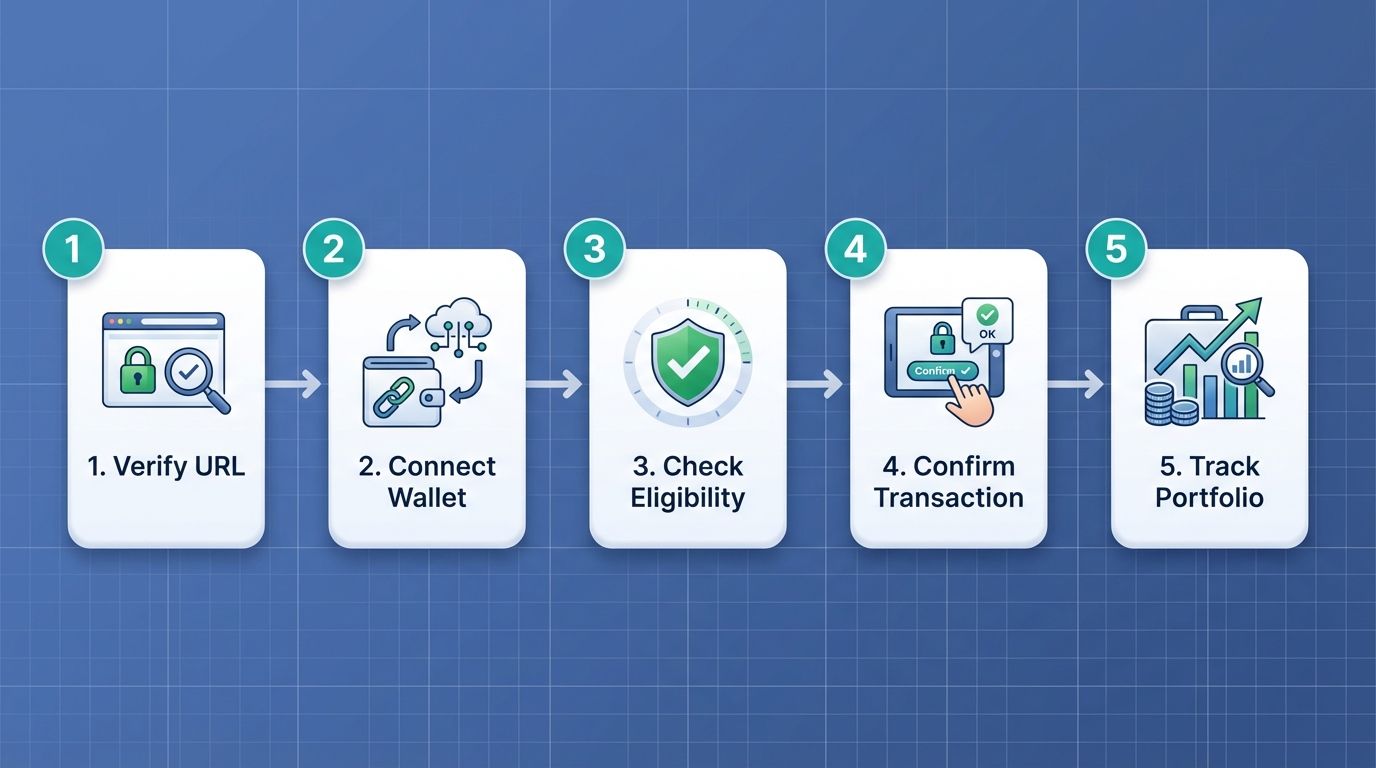
- Verify the claiming portal URL against the official project website. Do not use links from social media or DMs.
- Connect your wallet using the official button on the portal. Review the connection request before approving.
- Check your eligibility on the portal. Most legitimate portals show your allocation before you confirm the claim transaction.
- Review the transaction details in your wallet popup. Confirm the receiving address is the correct claiming contract.
- Approve the transaction and pay the gas fee. On congested networks, gas fees can be significant relative to the airdrop value, so factor this into your decision.
- Verify receipt in your wallet or on a block explorer like Etherscan or Solscan.
Tax Implications
In most jurisdictions, airdropped tokens are treated as ordinary income at the fair market value of the tokens on the date you receive them. When you later sell those tokens, any gain or loss relative to that initial value is treated as a capital gain or loss. Tax treatment varies by country and is an evolving area of regulation. Keeping records of the date, amount, and fair market value of every airdrop you receive is essential for accurate reporting. Consult a tax professional familiar with crypto if your airdrop income is significant.
When to Sell vs. Hold
Received tokens have zero cost basis for most purposes, meaning any price above zero represents a gain. The decision to sell immediately or hold depends on your assessment of the project's long-term value, the current token price relative to the project's fundamentals, and your own tax situation.
A common approach among experienced airdrop recipients is to sell a portion immediately to lock in value, particularly if the token launches at a high valuation that may not be sustainable. The remaining portion can be held if the project has genuine utility and a credible roadmap. Avoid holding purely from emotional attachment to something you received for free.
Tracking airdrop tokens as part of your broader portfolio is important for understanding your total exposure and making informed sell decisions. Managing multiple airdrop positions across different chains and exchanges quickly becomes complex without a dedicated tool.
Track Every Airdrop Token with Altrady
Receiving airdrop tokens is only the beginning. The real work is tracking their performance, managing your positions, and deciding when to act. When you are holding tokens across multiple chains and exchanges, keeping everything organized in spreadsheets is neither efficient nor reliable.
Altrady is a professional crypto trading and portfolio management platform that brings all your assets into one unified dashboard. You can monitor your airdrop token prices in real time, set custom alerts for price targets, and execute trades across multiple exchanges without switching tabs. Altrady's portfolio tracker supports assets across leading chains and centralized exchanges, giving you a complete picture of your holdings at all times.
Whether you are managing a handful of airdrop positions or running an active trading strategy alongside your airdrop portfolio, Altrady gives you the tools to stay in control. Start your free trial today and see how much clearer your crypto decisions become when all your data is in one place.
Frequently Asked Questions
Are crypto airdrops actually free money?
They can be, but the word "free" understates the work involved. Qualifying for meaningful retroactive airdrops typically requires months of genuine on-chain activity, research, and gas fees paid over time. Promotional airdrops that require no prior activity tend to distribute very small amounts. The most valuable airdrops reward users who were genuinely engaged with a protocol before it had monetary incentive to participate. In that sense, the tokens reward prior behavior rather than arrive with no strings attached.
How do I know if a crypto airdrop is a scam?
The most reliable test is to ask whether any action you are being asked to take could expose your wallet. If a process requires your seed phrase, private key, or approval of a contract you have not verified, stop immediately. Legitimate airdrops either deposit tokens directly to your wallet or send you to a known official claiming portal. Cross-reference any claiming link against the official project website, verify the project is real and has a live product, and never act on unsolicited DMs. When in doubt, search for community discussion about the airdrop on trusted forums before engaging.
Can I qualify for multiple airdrops with one wallet?
Yes, and most active airdrop participants do. A single wallet with a diverse on-chain history, across multiple protocols, chains, and use cases, has the broadest eligibility footprint. Many experienced airdrop hunters maintain several wallets with different activity profiles to diversify across potential distributions. The key is that each wallet must have genuine, organic-looking activity. Projects are increasingly sophisticated at filtering out wallets that show signs of scripted or bot-driven behavior, which can result in reduced allocations or disqualification.
What should I do with airdrop tokens I cannot identify?
Do not interact with tokens that appear in your wallet unexpectedly and that you cannot verify through official sources. Some of these tokens are part of dusting or phishing attacks where the malicious step happens when you attempt to transfer or approve the token. Look up the contract address on Etherscan or an equivalent block explorer to see what the token is. Search for discussion about it on Twitter or crypto forums. If there is no credible project associated with the contract, treat the tokens as worthless and do not attempt to move, swap, or approve them.
Do I owe taxes on crypto airdrops even if I did not sell the tokens?
In many jurisdictions, including the United States, receiving an airdrop is a taxable event at the moment of receipt, regardless of whether you sell the tokens. The taxable amount is generally the fair market value of the tokens at the time they are received. This means you could owe tax on tokens that subsequently drop in value before you sell them. Given the complexity and evolving nature of crypto tax law, it is worth consulting a qualified tax advisor, especially if you receive a large airdrop. Keeping detailed records of receipt dates and prices will make this process much easier at tax time.
2026 Update: What to Check Before You Act
Airdrops can reward early users, but they also attract phishing campaigns, fake claim pages, and expensive farming behavior. Treat each campaign like a risk/reward decision.
| Check | What to review | Why it matters |
|---|---|---|
| Eligibility | Confirm the official campaign rules, snapshot timing, chain, and required activity. | Prevents wasted gas and fake task completion. |
| Wallet safety | Use a separate wallet for farming, review approvals, and never sign unknown messages. | Limits damage if a claim page or dApp is malicious. |
| Reward economics | Estimate gas, bridge costs, time spent, vesting, and likely token liquidity. | A “free” airdrop can be negative EV if costs and risks are ignored. |
Quick trader checklist
- Use official links from the project, not replies or ads.
- Revoke unnecessary approvals after interacting with new protocols.
- Track costs so farming does not become an unmeasured expense.
FAQ
Are crypto airdrops risk-free?
No. Even legitimate airdrops can involve gas costs, low liquidity, or tax complexity, while fake airdrops can steal wallet assets through malicious signatures or approvals.