
What Are Crypto Liquidity Pools?
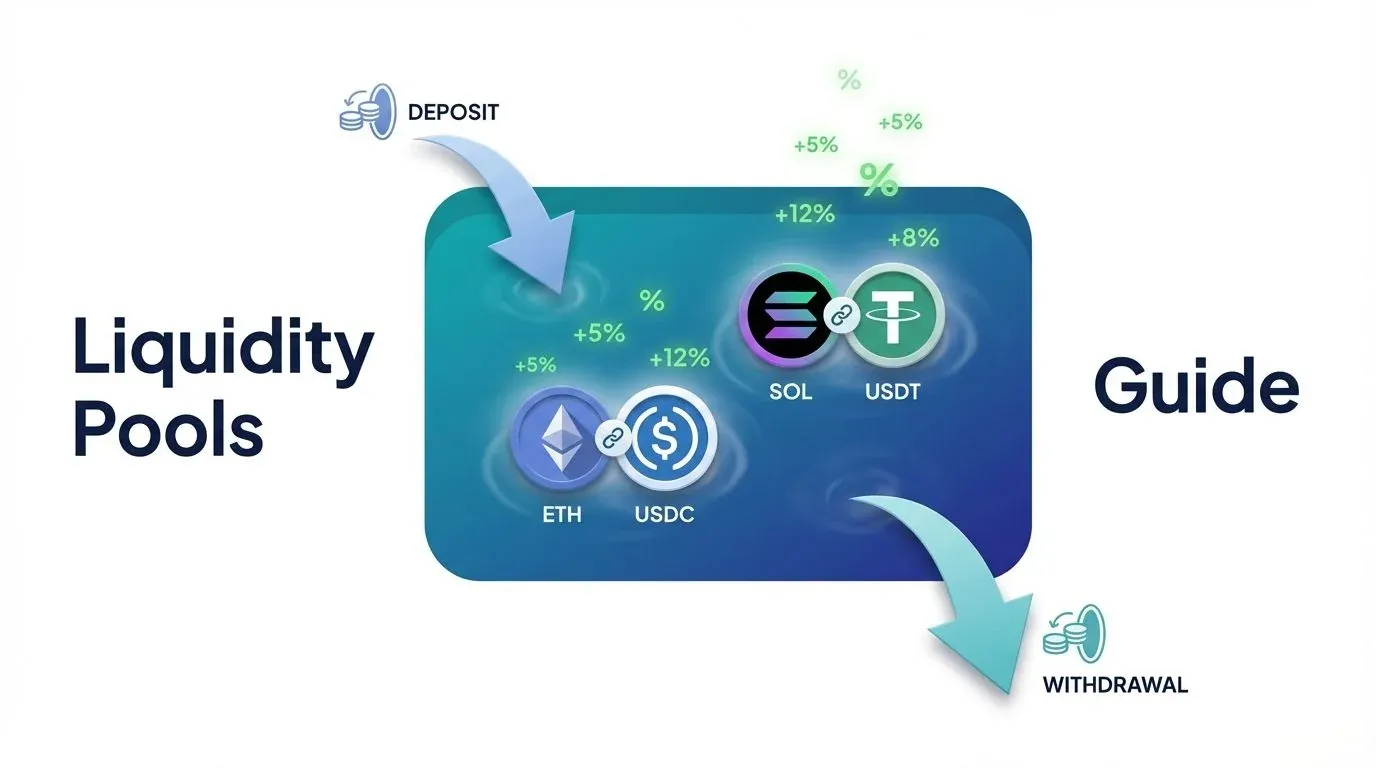
A crypto liquidity pool is a collection of tokens locked in a smart contract that provides the liquidity needed for decentralized trading. Instead of matching buyers and sellers through a traditional order book, decentralized exchanges (DEXs) use these pools to execute trades automatically through algorithms called automated market makers (AMMs).
When you trade on a DEX like Uniswap, SushiSwap, or Raydium, you are not trading against another person. You are trading against a pool of tokens that other users have deposited. These depositors, called liquidity providers (LPs), earn a share of the trading fees generated by the pool in exchange for supplying their tokens.
Liquidity pools solved a critical problem that plagued early decentralized exchanges: the lack of trading liquidity. Before AMMs, DEXs relied on order books that rarely had enough buyers and sellers to facilitate smooth trading. Prices were erratic, spreads were wide, and large trades were nearly impossible. Liquidity pools changed this by creating always-available liquidity that anyone can trade against, regardless of whether a counterparty exists at that exact moment.
Understanding how liquidity pools work, how to earn from providing liquidity, and what risks to manage is essential knowledge for any crypto trader or investor looking to participate in decentralized finance.
How Do Liquidity Pools Work?
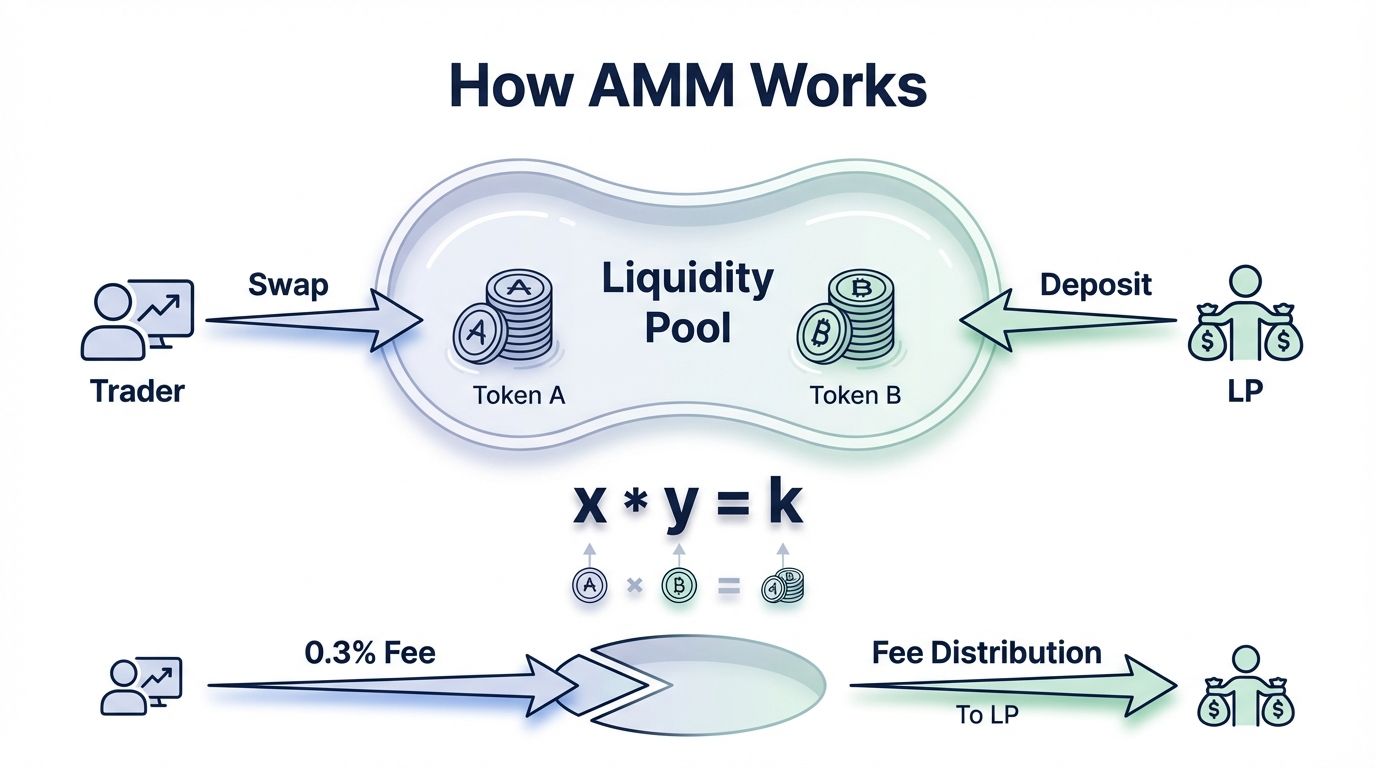
Liquidity pools operate on a mathematical formula that determines the price of tokens within the pool. The most common model is the constant product formula, pioneered by Uniswap, which maintains the equation x * y = k, where x and y represent the quantities of two tokens in the pool and k is a constant.
The Constant Product Formula
Consider a pool containing ETH and USDC. If the pool holds 100 ETH and 300,000 USDC, the constant k equals 30,000,000. When a trader buys ETH from the pool, they add USDC and remove ETH. The formula automatically adjusts the price so that the product of the two token quantities always equals k.
As the supply of ETH in the pool decreases, each additional ETH becomes progressively more expensive. This creates a natural price curve that responds to supply and demand without any human intervention. The larger the trade relative to the pool size, the more price impact the trader experiences, which is called slippage.
Trading Fees
Every trade executed through a liquidity pool incurs a fee, typically ranging from 0.01% to 1% depending on the pool and protocol. This fee is added to the pool, increasing the total value of assets that liquidity providers can claim. Over time, these fees accumulate and represent the primary income source for LPs.
On Uniswap V3, fee tiers are standardized at 0.01%, 0.05%, 0.30%, and 1.00%. Stablecoin pairs typically use the lowest fee tier because price movements are minimal, while volatile pairs use higher fees to compensate LPs for the increased risk of impermanent loss.
Price Discovery
Liquidity pool prices stay aligned with broader market prices through arbitrage. When the price of a token in a pool deviates from its price on centralized exchanges, arbitrage traders buy the cheaper version and sell the more expensive one, pocketing the difference. This arbitrage activity continuously pushes pool prices back toward the market rate, ensuring that DEX prices remain accurate.
Types of Liquidity Pools
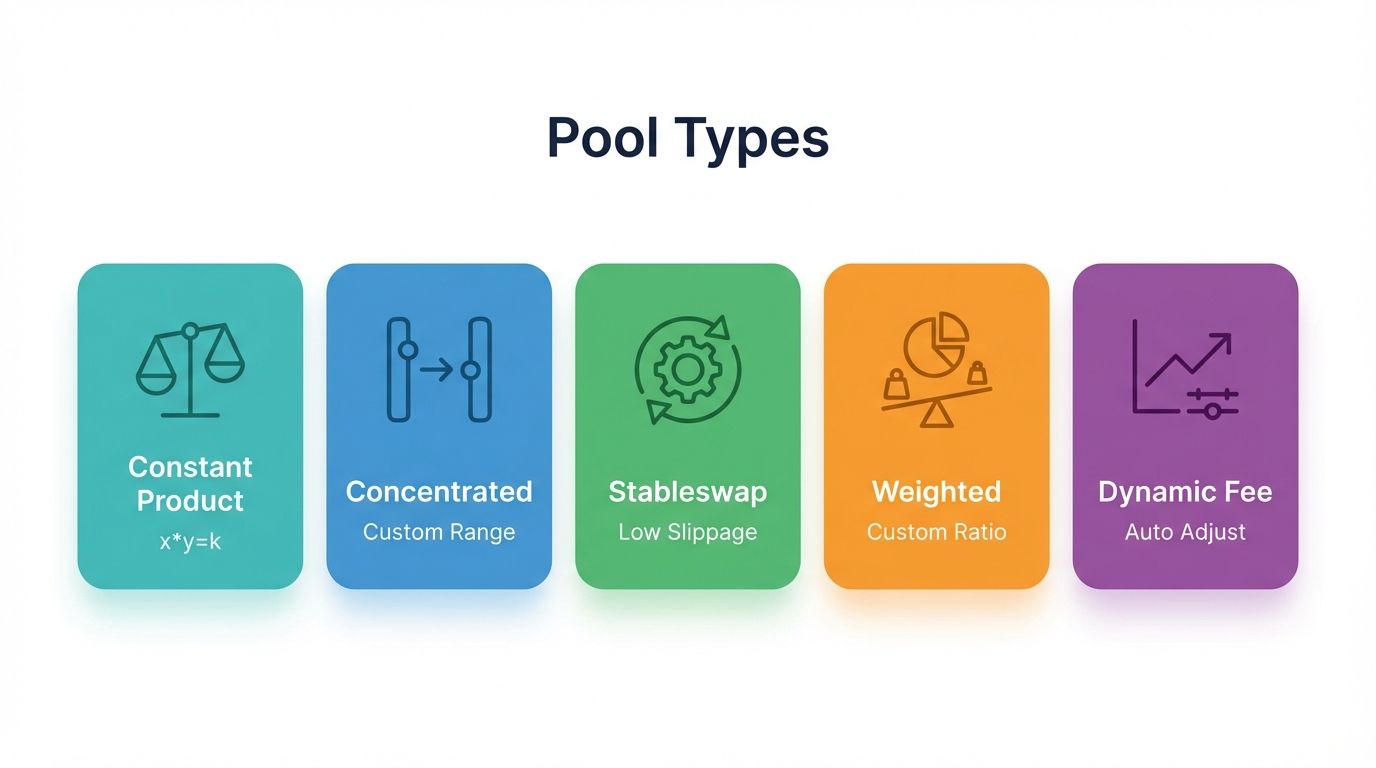
The AMM landscape has evolved significantly since the first constant product pools launched in 2018. Different pool designs optimize for different use cases, and understanding the distinctions helps you choose the right pool for your capital.
1. Constant Product Pools (x * y = k)
The original and most widely used pool type, constant product pools treat both tokens equally and work for any token pair. Uniswap V2, SushiSwap, and PancakeSwap all use this model. These pools are simple, permissionless, and work well for volatile trading pairs where prices move significantly.
The downside is capital inefficiency. Most of the liquidity in a constant product pool sits at price ranges far from the current trading price and is never used. This means LPs earn lower returns on their deposited capital than they would if all their liquidity were concentrated around the active trading range.
2. Concentrated Liquidity Pools
Uniswap V3 introduced concentrated liquidity, allowing LPs to specify a price range within which their liquidity is active. Instead of spreading capital across all possible prices from zero to infinity, LPs concentrate their tokens around the current trading price, dramatically improving capital efficiency.
A concentrated liquidity position can generate the same fees as a full-range position with a fraction of the capital. However, this approach requires active management because if the price moves outside your chosen range, your position stops earning fees and becomes entirely composed of the less valuable token. Concentrated liquidity suits experienced LPs who can monitor and adjust their positions regularly.
3. Stableswap Pools
Curve Finance pioneered stableswap pools designed specifically for assets that should trade at similar values, such as USDC/USDT/DAI or stETH/ETH. These pools use a modified formula that creates a much flatter price curve around the 1:1 ratio, allowing extremely large trades with minimal slippage.
Stableswap pools are among the safest liquidity provision opportunities because impermanent loss is minimal when the paired assets maintain their peg. The trade-off is lower fees per trade, but high trading volumes in major stablecoin pools often compensate for the lower fee rate.
4. Weighted Pools
Balancer introduced weighted pools that allow custom ratios between tokens rather than requiring the standard 50/50 split. An 80/20 pool, for example, holds 80% of its value in one token and 20% in another, reducing impermanent loss for LPs who are bullish on the majority token.
Weighted pools also support more than two tokens, enabling index-fund-style pools with three, four, or even eight different tokens. This design gives LPs exposure to a diversified basket of assets while earning trading fees on every swap involving any of the pool's tokens.
5. Dynamic Fee Pools
Newer protocols like Trader Joe (Liquidity Book) and Maverick Protocol use dynamic fee structures that adjust based on market volatility. When volatility is high, fees increase to protect LPs from impermanent loss. When volatility is low, fees decrease to attract more trading volume.
Dynamic fee pools represent the cutting edge of AMM design, attempting to solve the fundamental tension between competitive pricing for traders and adequate compensation for liquidity providers.
How to Earn From Liquidity Pools
Providing liquidity to pools generates returns through multiple mechanisms. Understanding each revenue stream helps you estimate potential returns and choose the most profitable opportunities.
Trading Fee Income
The primary income source for LPs is a proportional share of all trading fees generated by the pool. If you contribute 1% of a pool's total liquidity, you earn 1% of all fees collected. High-volume pools on major DEXs can generate significant fee income, with annualized returns ranging from 5% to 50% or more depending on trading activity and pool size.
Fee income varies daily based on trading volume. A pool that generates 30% APY during a volatile market week might drop to 5% APY during a quiet period. Tracking historical fee data through analytics platforms like DEX Screener or GeckoTerminal helps set realistic expectations.
Liquidity Mining Rewards
Many protocols offer additional token rewards to LPs who deposit into specific pools. These liquidity mining incentives are paid in the protocol's native token (like UNI, SUSHI, or CAKE) on top of trading fees. During peak incentive periods, liquidity mining can multiply total returns several times over.
However, liquidity mining rewards are typically temporary. As incentive programs expire or token emissions decrease, returns decline. LPs who chase the highest mining rewards often move their capital frequently, incurring gas fees and transaction costs that eat into profits. Evaluate whether the underlying trading fee income alone justifies the position before counting on temporary mining rewards.
LP Token Strategies
When you provide liquidity, you receive LP tokens that represent your share of the pool. These tokens are composable, meaning they can be used in other DeFi protocols. You can deposit LP tokens into yield farming protocols to earn additional rewards, use them as collateral for borrowing, or stake them in gauge systems for boosted emissions.
This composability creates layered yield strategies where a single capital base generates returns from multiple sources simultaneously. A common strategy involves providing liquidity on Curve, staking the LP tokens in Convex Finance, and earning CRV, CVX, and trading fees all at once.
Understanding Impermanent Loss
Impermanent loss is the most important risk concept for liquidity providers. It occurs when the price ratio of tokens in a pool changes relative to when you deposited them. The larger the price divergence, the greater the impermanent loss.
How Impermanent Loss Works
When you deposit equal values of two tokens into a constant product pool, the AMM formula ensures the pool maintains a specific ratio. If one token's price increases significantly, arbitrage traders buy the appreciating token from the pool and sell the depreciating one, changing the composition of your position.
The result is that your LP position ends up holding more of the token that decreased in value and less of the token that increased. Compared to simply holding both tokens in your wallet, you would have been better off not providing liquidity. This difference is impermanent loss.
Quantifying the Impact
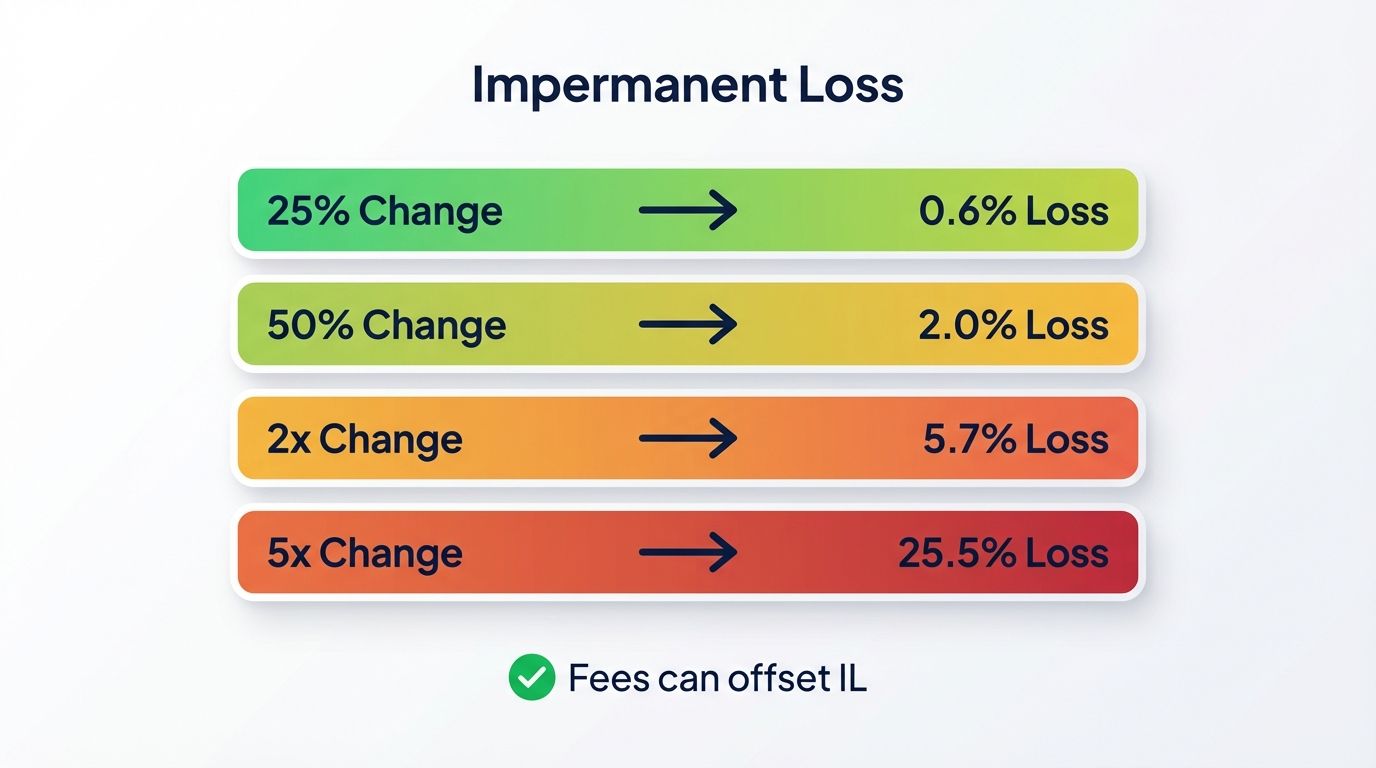
The math behind impermanent loss follows a predictable curve. A 25% price change in one token relative to the other results in approximately 0.6% impermanent loss. A 50% price change causes about 2.0% loss. A 100% price change (2x) causes roughly 5.7% loss. And a 500% price change (5x) results in approximately 25.5% loss.
These numbers demonstrate why impermanent loss matters most for volatile pairs. A stablecoin pair that barely moves experiences negligible impermanent loss, while a meme coin that pumps 10x causes devastating losses for LPs relative to simply holding.
When Fees Offset Impermanent Loss
Impermanent loss becomes a real problem only when it exceeds the trading fees earned. A pool generating 40% APY in fees can absorb significant impermanent loss and still deliver positive returns. The key is finding pools where fee income consistently exceeds expected impermanent loss based on historical volatility.
Tools like ImpermanentLoss.app and various DeFi analytics dashboards help simulate different price scenarios so you can estimate whether a specific pool position will be profitable net of impermanent loss.
10 Best Liquidity Pool Platforms in 2026
The following platforms represent the most trusted and feature-rich options for providing liquidity across different blockchains and pool types.
1. Uniswap
Uniswap is the largest DEX by trading volume, deployed across 20+ chains including Ethereum, Arbitrum, Optimism, Base, and Polygon. Uniswap V3's concentrated liquidity model offers the highest capital efficiency among major DEXs, and its deep liquidity attracts consistent trading volume that generates reliable fee income for LPs.
2. Curve Finance
Curve dominates stablecoin and pegged asset trading with its specialized stableswap algorithm. For LPs seeking lower-risk opportunities, Curve pools involving major stablecoins (USDC, USDT, DAI) and liquid staking derivatives (stETH, rETH) offer consistent returns with minimal impermanent loss.
3. Raydium
Raydium is the leading AMM on Solana, offering concentrated liquidity pools with extremely low transaction costs. Solana's high throughput makes Raydium ideal for LPs who want to actively manage concentrated positions without paying significant gas fees for each adjustment.
4. PancakeSwap
PancakeSwap is the dominant DEX on BNB Chain, with additional deployments on Ethereum, Arbitrum, and other chains. Its combination of trading fees, CAKE token rewards, and prize pool features has built one of the largest user bases in DeFi.
5. Balancer
Balancer's weighted pools enable customized portfolio allocations within a single pool. LPs can create 80/20 or other custom-weighted positions that reduce impermanent loss exposure while still earning trading fees. Balancer V2's vault architecture also improves gas efficiency for multi-token pools.
6. Aerodrome
Aerodrome is the primary DEX on Base (Coinbase's L2), built on the Velodrome model. Its vote-escrow tokenomics direct liquidity incentives to the pools that voters select, creating a market-driven system for allocating rewards to the most valuable pools.
7. Trader Joe
Trader Joe's Liquidity Book model introduced bin-based concentrated liquidity on Avalanche and Arbitrum. Each bin represents a specific price point, giving LPs granular control over their liquidity placement. The dynamic fee system automatically adjusts fees based on volatility, protecting LPs during turbulent markets.
8. Orca
Orca provides a clean, user-friendly concentrated liquidity experience on Solana. Its Whirlpools feature allows LPs to set custom price ranges with an intuitive interface, making concentrated liquidity accessible to less technical users. Low transaction costs on Solana make frequent position adjustments economically viable.
9. Maverick Protocol
Maverick introduces directional liquidity provision, allowing LPs to automatically shift their liquidity in the direction of price movement. This innovative feature reduces impermanent loss by keeping liquidity concentrated around the current price even as the market moves.
10. Osmosis
Osmosis is the primary DEX in the Cosmos ecosystem, supporting superfluid staking that allows LP tokens to simultaneously earn trading fees and staking rewards. This dual-yield mechanism makes Osmosis pools particularly attractive for LPs who want maximum capital efficiency within the Cosmos ecosystem.
Risk Management for Liquidity Providers
Successful liquidity provision requires disciplined risk management. The following strategies help protect your capital while maximizing returns.
Start with Stablecoin Pools
If you are new to liquidity provision, begin with stablecoin pools where impermanent loss is minimal. USDC/USDT pools on major DEXs provide predictable returns with low risk, allowing you to learn the mechanics before moving to more volatile pairs.
Diversify Across Pools and Chains
Never concentrate all your LP capital in a single pool or on a single blockchain. Smart contract exploits, bridge hacks, and protocol failures can wipe out positions instantly. Spreading capital across multiple pools on different chains reduces the impact of any single failure.
Monitor Impermanent Loss Continuously
Track the actual performance of your LP positions, including impermanent loss, earned fees, and net returns. Remove liquidity from pools where impermanent loss consistently exceeds fee income. Analytics tools integrated into multi-exchange trading platforms make this monitoring significantly easier by consolidating all your DeFi positions into a single dashboard.
Set Clear Exit Criteria
Define the conditions under which you will remove liquidity before entering a position. If you are providing liquidity to a volatile pair, set a maximum acceptable impermanent loss threshold (for example, 5%) and exit when it is reached. Having predetermined rules prevents emotional decision-making during volatile markets.
Account for Gas Costs
On Ethereum mainnet, entering and exiting LP positions can cost $20 to $100 or more in gas fees. These costs must be factored into your return calculations. For smaller positions, Layer 2 networks like Arbitrum, Base, or Optimism, or alternative L1s like Solana, offer dramatically lower transaction costs that improve net returns.
How to Track Liquidity Pool Performance
Managing LP positions across multiple DEXs and blockchains creates a tracking challenge. Without proper tools, it is easy to lose sight of actual returns, miss rebalancing opportunities, or fail to notice when a pool's economics deteriorate.
A comprehensive portfolio tracking platform that aggregates your exchange balances and DeFi positions into one view gives you the clarity needed to manage LP strategies effectively. Real-time price alerts help you react when token prices approach the boundaries of your concentrated liquidity ranges. Performance analytics show actual returns net of impermanent loss and fees, replacing guesswork with hard data.
Whether you are providing liquidity across two pools or twenty, having all positions visible in one dashboard is the foundation of disciplined LP management. Start your free trial to see how consolidated tracking and smart alerts can improve your liquidity provision strategy.
Frequently Asked Questions
What is the minimum amount needed to provide liquidity?
There is no universal minimum for providing liquidity. On Ethereum mainnet, gas costs make positions below $1,000 impractical because entry and exit fees consume too large a percentage of returns. On Layer 2 networks and Solana, positions as small as $50 to $100 can be economically viable due to minimal transaction costs. Most LPs find that positions of $500 or more provide a meaningful return after accounting for all costs.
Is providing liquidity profitable?
Providing liquidity can be profitable, but returns depend on several factors: trading volume in the pool, fee tier, token price volatility, impermanent loss, and gas costs. Stablecoin pools typically offer consistent but modest returns (5% to 15% APY). Volatile pairs can generate higher fees but carry significant impermanent loss risk. Successful LPs carefully select pools where expected fee income exceeds expected impermanent loss.
What happens if I remove liquidity during a price change?
When you remove liquidity, you receive your proportional share of both tokens in the pool at their current ratio, not the ratio at which you deposited. If one token has appreciated significantly since your deposit, you will receive more of the depreciated token and less of the appreciated one. The difference between what you receive and what you would have had by simply holding is your realized impermanent loss.
How are liquidity pool earnings taxed?
Tax treatment of LP earnings varies by jurisdiction. In most countries, trading fees earned from liquidity provision are treated as income and taxed accordingly. Impermanent loss may or may not be deductible depending on local tax rules. Entering and exiting LP positions may also trigger capital gains events. Consult a crypto-savvy tax professional in your jurisdiction for specific guidance.
What is the difference between a liquidity pool and staking?
Staking involves locking tokens in a blockchain protocol to support network security and earn rewards from block validation. Liquidity provision involves depositing token pairs into a DEX smart contract to facilitate trading and earn a share of trading fees. Staking carries slashing risk but no impermanent loss. Liquidity provision carries impermanent loss risk but no slashing. Both generate passive yield, but the risk profiles and mechanics are fundamentally different.