
What Is Crypto Staking?
Crypto staking is the process of locking up cryptocurrency tokens in a blockchain network to support its operations and earn rewards in return. When you stake your crypto, you contribute to the network's security and transaction validation, and the protocol compensates you with additional tokens for your participation.
Staking is the backbone of Proof of Stake (PoS) blockchains, which replaced the energy-intensive mining process used by Proof of Work networks like Bitcoin. Instead of competing to solve complex mathematical puzzles, PoS validators are selected to create new blocks based on how many tokens they have staked. This makes the validation process more energy efficient and accessible to everyday investors.
For crypto holders, staking offers a way to put idle assets to work. Rather than letting tokens sit in a wallet generating zero returns, staking turns them into yield-generating positions. Annual percentage yields (APY) typically range from 3% to 20% depending on the network, the amount staked, and current network conditions. These rewards compound over time, making staking one of the most popular strategies for building long-term wealth in crypto.
Understanding how staking works, which coins offer the best staking opportunities, and what risks to watch for helps you make informed decisions about integrating staking into your broader crypto strategy.
How Does Crypto Staking Work?
Staking operates differently depending on the blockchain, but the core mechanism follows the same principle across all Proof of Stake networks. Here is the step-by-step process that powers staking on most PoS blockchains.
Validator Selection
The network selects validators to propose and confirm new blocks based on several factors, including the amount of tokens staked, the duration of staking, and sometimes a randomization element. Validators with larger stakes have a higher probability of being selected, which incentivizes participants to commit more tokens to the network.
Block Validation
Once selected, validators verify transactions, bundle them into blocks, and add those blocks to the blockchain. Other validators then attest to the validity of the proposed block. This consensus process ensures that fraudulent transactions are rejected and that the blockchain maintains its integrity.
Reward Distribution
After a block is successfully added to the chain, the validator who proposed it and the validators who attested to it receive staking rewards. These rewards come from newly minted tokens and transaction fees paid by network users. The rewards are distributed proportionally based on each participant's stake size.
Slashing Mechanism
To prevent malicious behavior, most PoS networks implement slashing. If a validator acts dishonestly, submits invalid transactions, or goes offline for extended periods, the network can destroy (slash) a portion of their staked tokens. This penalty mechanism ensures that validators have a financial incentive to act in the network's best interest.
Types of Crypto Staking
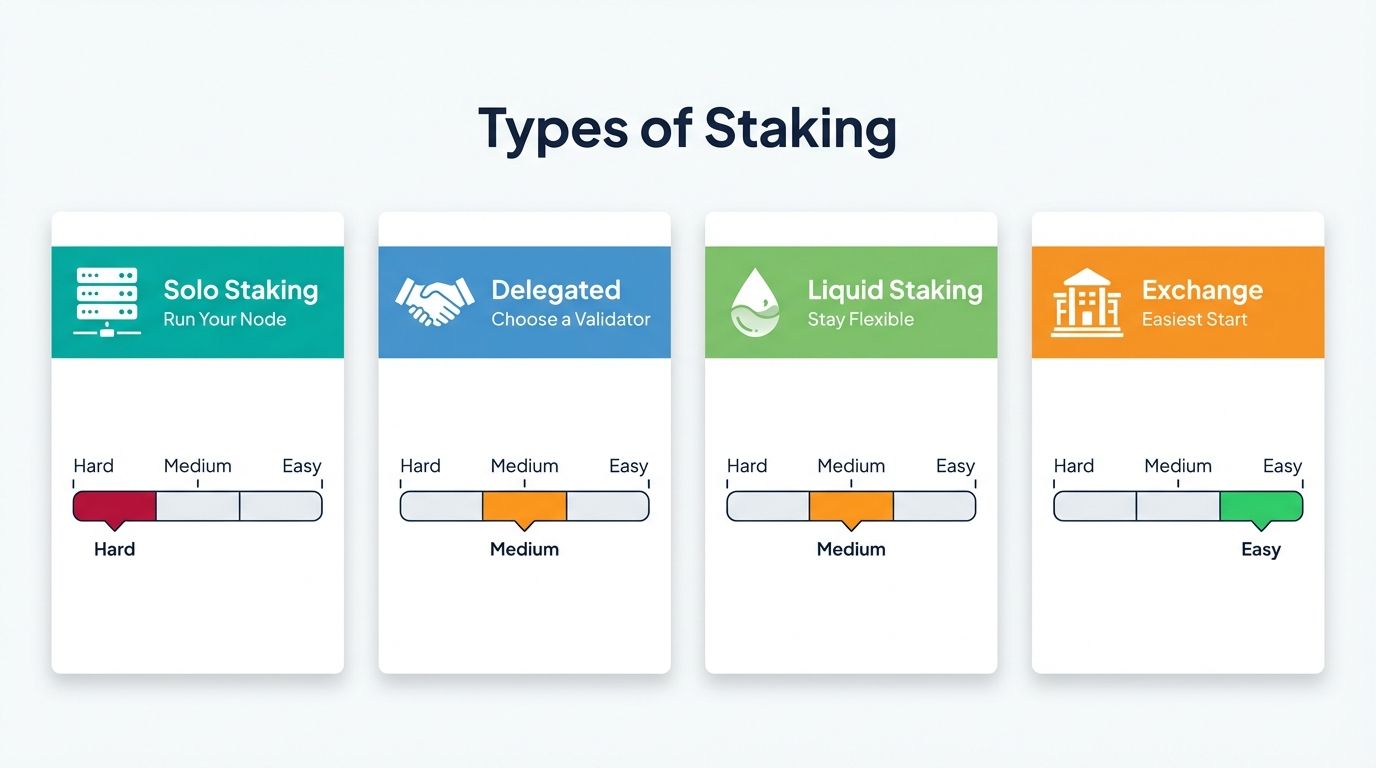
Not all staking is the same. The crypto ecosystem has developed several staking methods, each with different requirements, returns, and levels of complexity. Understanding these types helps you choose the approach that matches your technical skill level and investment goals.
1. Native Staking (Solo Staking)
Native staking involves running your own validator node directly on a blockchain network. You set up the required hardware, install the validator software, stake the minimum required tokens, and maintain the node with consistent uptime.
This approach offers the highest rewards because you capture 100% of the staking yield without paying fees to intermediaries. However, it requires significant capital (32 ETH for Ethereum, for example), technical expertise, and a commitment to keeping your node online 24/7. Downtime or errors can result in slashing penalties.
Solo staking is best suited for experienced crypto participants with substantial holdings and the technical ability to manage validator infrastructure.
2. Delegated Staking
Delegated staking allows you to assign your tokens to an existing validator without running your own node. You retain ownership of your tokens while the validator handles the technical operations. In exchange, the validator takes a commission (typically 5% to 15%) from your staking rewards.
This is the most common staking method for individual investors. Networks like Cosmos, Polkadot, Solana, and Cardano all support delegation, making it easy to start earning staking rewards with any amount of tokens. You simply select a validator through your wallet or a staking interface, delegate your tokens, and begin earning rewards.
When choosing a validator, consider their uptime record, commission rate, total stake size, and community reputation. Diversifying across multiple validators reduces the risk of losses if a single validator experiences issues.
3. Liquid Staking
Liquid staking solves the biggest drawback of traditional staking: illiquidity. When you stake through a liquid staking protocol, you receive a derivative token (like stETH from Lido or rETH from Rocket Pool) that represents your staked position. For higher yields, liquid restaking protocols like ether.fi (ETHFI token) layer additional EigenLayer AVS rewards on top of the base Ethereum staking yield. This derivative token can be traded, used as collateral in DeFi protocols, or sold at any time while your original tokens continue earning staking rewards.
Liquid staking has exploded in popularity because it eliminates the opportunity cost of traditional staking. Instead of choosing between earning staking yield and participating in DeFi, liquid staking lets you do both simultaneously. The total value locked in liquid staking protocols exceeded $50 billion in early 2026, making it one of the fastest-growing sectors in crypto.
The trade-off is an additional layer of smart contract risk. Your rewards also depend on the liquid staking protocol maintaining its peg between the derivative token and the underlying asset.
4. Exchange Staking
Centralized exchanges like Binance, Coinbase, and Kraken offer built-in staking services that require zero technical knowledge. You simply hold eligible tokens on the exchange, opt into staking, and the exchange handles everything else. Rewards are deposited directly to your exchange account.
Exchange staking is the easiest entry point for beginners, but it comes with trade-offs. Exchanges take a larger commission (often 15% to 25% of rewards), you must trust the exchange with your tokens, and you may face lock-up periods during which you cannot withdraw. The collapse of FTX and other exchanges demonstrated the custodial risk of leaving assets on centralized platforms.
For serious long-term stakers, self-custody staking through a hardware wallet offers better security and typically higher net yields than exchange-based staking.
10 Best Crypto Staking Coins in 2026
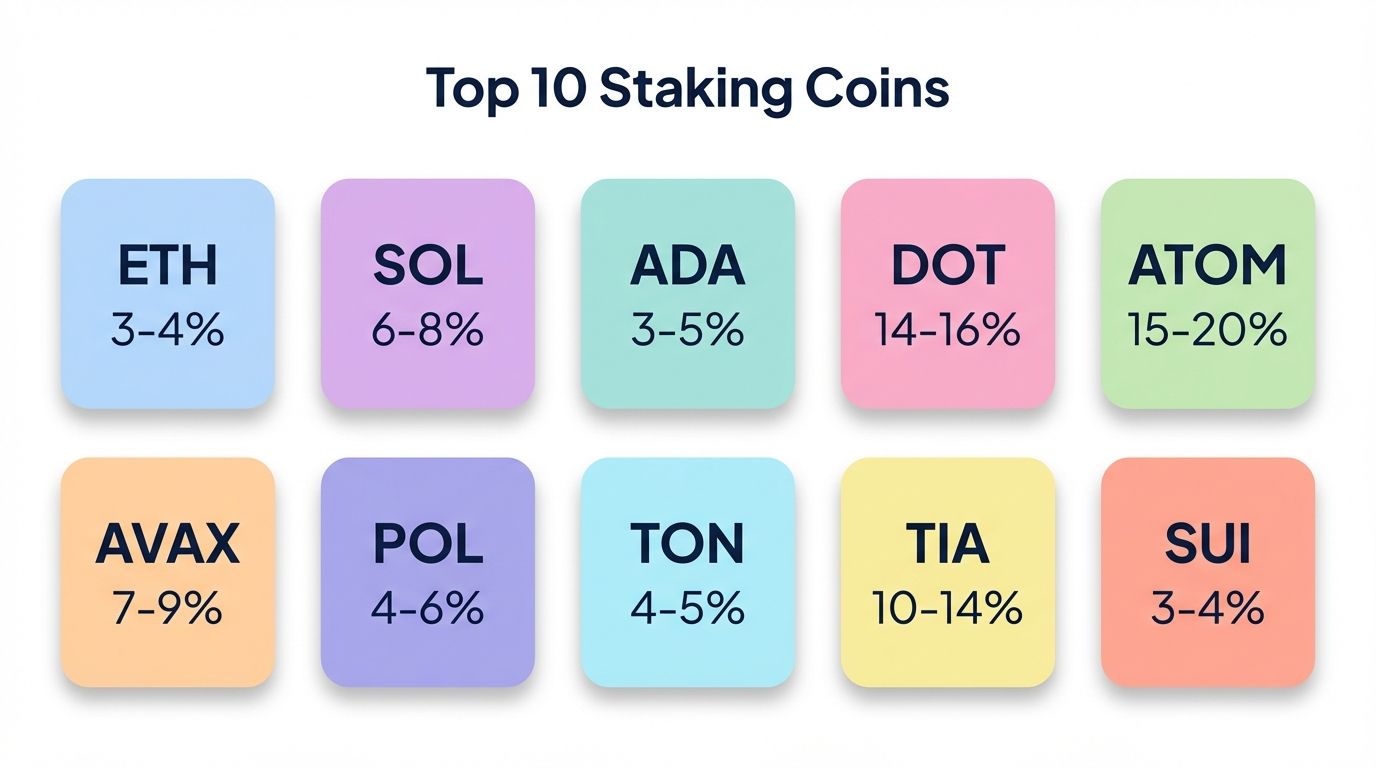
The following cryptocurrencies offer the most attractive staking opportunities based on yield, network reliability, liquidity, and long-term growth potential. Each coin is evaluated on its staking mechanism, approximate APY, minimum requirements, and risk factors.
1. Ethereum (ETH)
Ethereum is the largest Proof of Stake blockchain by market capitalization and total value staked. With over 34 million ETH staked (approximately 28% of the total supply), Ethereum's staking ecosystem is the most mature and battle-tested in the industry.
Staking ETH yields approximately 3% to 4% APY through solo validation or liquid staking protocols. While the yield is lower than many altcoins, the stability of Ethereum's network and the appreciation potential of ETH make it the foundation of most staking portfolios. Liquid staking through Lido (stETH) or Rocket Pool (rETH) allows ETH stakers to maintain liquidity while earning rewards.
2. Solana (SOL)
Solana offers one of the most user-friendly staking experiences in crypto, with over 65% of the total SOL supply actively staked. Delegating SOL to validators is straightforward through wallets like Phantom or Solflare, and staking rewards currently range from 6% to 8% APY.
Solana's high throughput and low transaction costs make it attractive for both stakers and developers. The growing ecosystem of DeFi applications, NFT marketplaces, and consumer apps on Solana drives demand for SOL, supporting both staking rewards and token appreciation over time.
3. Cardano (ADA)
Cardano pioneered the delegated Proof of Stake model, allowing ADA holders to delegate to stake pools with no minimum requirement and no lock-up period. This flexibility has resulted in over 70% of ADA being staked, one of the highest participation rates in the industry.
Staking ADA yields approximately 3% to 5% APY, with rewards distributed every epoch (5 days). The lack of a lock-up period means staked ADA remains fully liquid and can be moved or traded at any time. This makes Cardano staking particularly appealing for investors who want to earn yield without sacrificing flexibility.
4. Polkadot (DOT)
Polkadot offers some of the highest staking yields among major cryptocurrencies, with APY ranging from 14% to 16%. The network requires a minimum nomination amount that adjusts dynamically, and staked DOT is subject to a 28-day unbonding period.
Polkadot's nominated Proof of Stake system allows token holders to nominate up to 16 validators, distributing risk across multiple operators. The high staking yields compensate for DOT's inflationary token model, where new tokens are continuously minted to pay staking rewards.
5. Cosmos (ATOM)
Cosmos staking yields approximately 15% to 20% APY, making it one of the highest-yielding major staking assets. ATOM holders delegate to validators on the Cosmos Hub, with a 21-day unbonding period for withdrawals.
Interchain security has expanded ATOM's staking utility beyond the Cosmos Hub itself. Validators who secure the Hub also provide security to connected consumer chains, earning additional rewards from those chains. This creates multiple revenue streams for ATOM stakers, potentially increasing total yields as more chains adopt interchain security.
6. Avalanche (AVAX)
Avalanche requires a minimum stake of 25 AVAX for delegation (2,000 AVAX for validators) with a minimum staking period of two weeks. Current staking yields range from 7% to 9% APY, and staked AVAX is locked for the chosen staking duration.
Avalanche's subnet architecture creates additional demand for AVAX staking, as validators must stake AVAX to validate subnets in addition to the primary network. As institutional adoption of Avalanche subnets grows, demand for staked AVAX is expected to increase, potentially improving validator economics.
7. Polygon (POL)
Polygon transitioned from MATIC to POL as its native staking token, maintaining staking yields of approximately 4% to 6% APY. POL stakers secure the Polygon PoS chain and will eventually secure additional Polygon chains as the ecosystem expands.
The migration to POL introduced enhanced staking utility, allowing stakers to validate multiple chains simultaneously. This multi-chain staking model mirrors Polkadot's shared security approach and positions POL stakers to earn rewards from the growing number of chains in the Polygon ecosystem.
8. Toncoin (TON)
Toncoin, the native asset of the TON network originally developed for the Telegram ecosystem, offers staking yields of approximately 4% to 5% APY. The deep integration with Telegram's 900+ million user base provides a unique distribution advantage that few other blockchains can match.
TON staking is accessible through dedicated staking pools that allow participation with any amount. The protocol's focus on user-friendly mobile experiences and mini-app ecosystem continues to drive adoption, making TON one of the most actively used blockchains for everyday transactions.
9. Celestia (TIA)
Celestia introduced the modular blockchain concept, providing data availability services to other blockchains. Staking TIA yields approximately 10% to 14% APY, and TIA stakers have received several notable airdrops from projects building on Celestia's infrastructure.
The airdrop potential adds a significant but unpredictable reward layer on top of base staking yields. Multiple high-profile projects have allocated tokens to TIA stakers as a growth strategy, making TIA staking one of the most rewarding strategies in terms of total returns (base yield plus airdrops) during 2025 and early 2026.
10. Sui (SUI)
Sui offers delegated staking with yields ranging from 3% to 4% APY. Staked SUI has no minimum requirement and rewards are distributed at the end of each epoch (approximately 24 hours). The staking mechanism is straightforward, with major wallets like Sui Wallet and Martian supporting native delegation.
Sui's Move-based architecture and growing DeFi ecosystem position it as a next-generation Layer 1 competitor. While current staking yields are modest, the rapid growth in network activity, developer adoption, and institutional interest suggest potential for both token appreciation and improved staking economics over time.
How to Start Staking Crypto
Getting started with staking requires choosing the right method for your experience level and investment size. Here is a practical step-by-step approach that works for most investors.
Step 1: Choose Your Staking Asset
Select a cryptocurrency based on your conviction in the project's long-term prospects, not just the APY. Higher yields often come with higher inflation and risk. Start with established PoS assets like ETH, SOL, or ADA if you are new to staking, and diversify across multiple assets as you gain experience.
Step 2: Select a Staking Method
For beginners, exchange staking or liquid staking through protocols like Lido provides the simplest onboarding. Intermediate users should explore native delegation through wallets like Phantom (Solana), Keplr (Cosmos), or Polkadot.js. Advanced users with significant capital may consider running a solo validator node.
Step 3: Choose a Validator
If using delegated staking, research validators carefully. Prioritize validators with high uptime (above 99%), reasonable commission rates (below 10%), a strong track record, and active community participation. Avoid validators with the largest stakes, as spreading delegation to mid-size validators strengthens network decentralization.
Step 4: Stake and Monitor
Delegate your tokens and begin earning rewards. Track your staking performance across all your positions, including pending rewards, current APY, and any changes in validator performance. A portfolio management platform that consolidates positions across multiple networks and exchanges makes monitoring significantly easier.
Risks of Crypto Staking
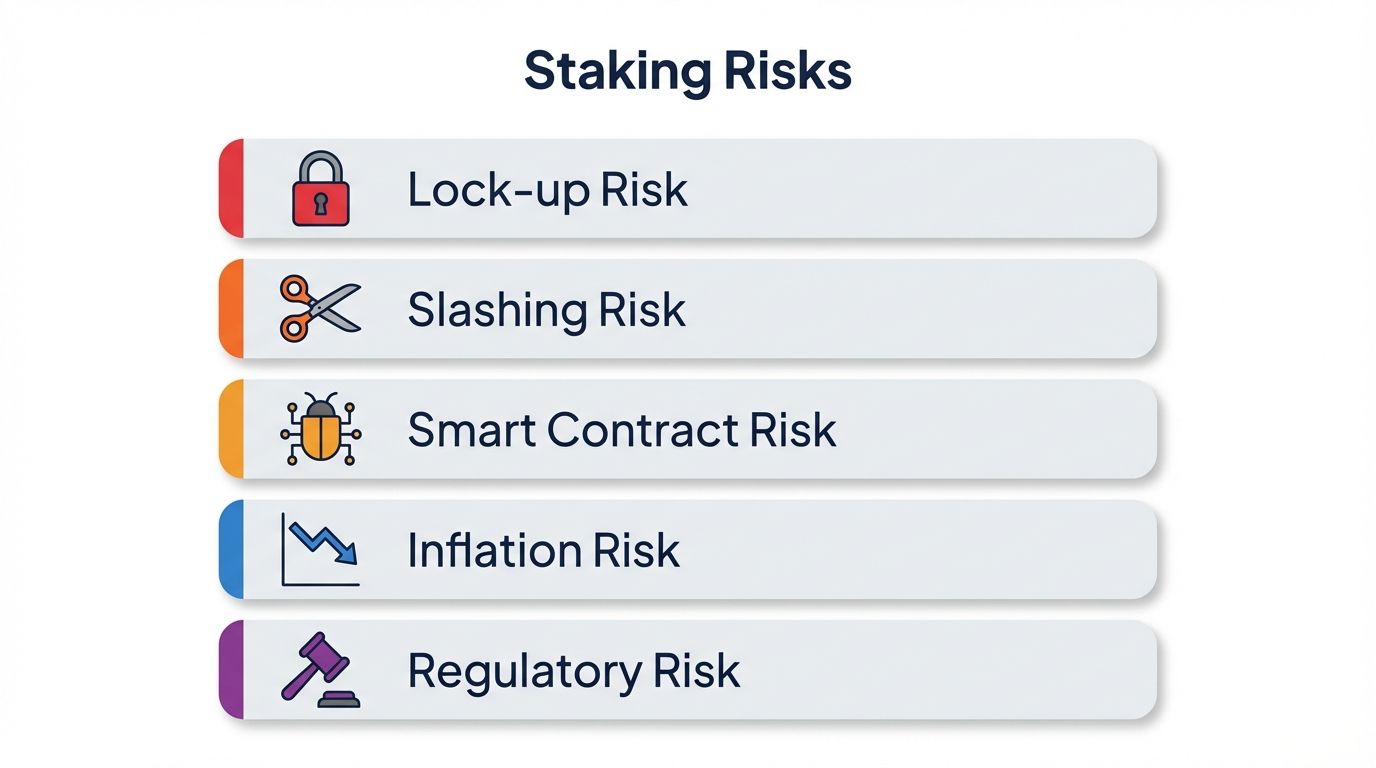
Staking is often presented as a simple way to earn passive income, but it carries risks that every staker should understand before committing capital.
Lock-up and Liquidity Risk
Many staking protocols require a lock-up period during which you cannot access your tokens. Ethereum's withdrawal queue, Polkadot's 28-day unbonding, and Cosmos's 21-day unbonding all mean you cannot quickly react to market changes. If the token price drops sharply during the unbonding period, your paper losses could exceed the staking rewards earned. Liquid staking mitigates this risk but introduces smart contract risk in exchange.
Slashing Risk
Validators who behave maliciously or experience extended downtime can have their staked tokens slashed. If you delegate to a validator that gets slashed, your tokens are at risk too. This is why validator selection and diversification across multiple validators is critical for risk management.
Smart Contract Risk
Liquid staking and DeFi-based staking strategies rely on smart contracts that could contain bugs or vulnerabilities. A smart contract exploit could result in partial or total loss of staked funds. Mitigate this risk by using battle-tested protocols with extensive audit histories and significant total value locked.
Inflation and Real Yield
High staking APY does not always translate to real returns. If a network offers 15% staking yield but inflates its token supply by 12% annually, the real yield is only 3%. Always evaluate staking yields in the context of the network's inflation rate to understand your actual purchasing power gains.
Regulatory Risk
Regulatory treatment of staking rewards varies by jurisdiction. Some countries treat staking rewards as taxable income at the time they are received, while others tax them only when sold. The SEC has targeted certain staking-as-a-service providers, creating uncertainty around the regulatory future of centralized staking services. Staying informed about regulatory developments in your jurisdiction helps avoid unexpected tax liabilities.
Staking vs Other Crypto Income Strategies
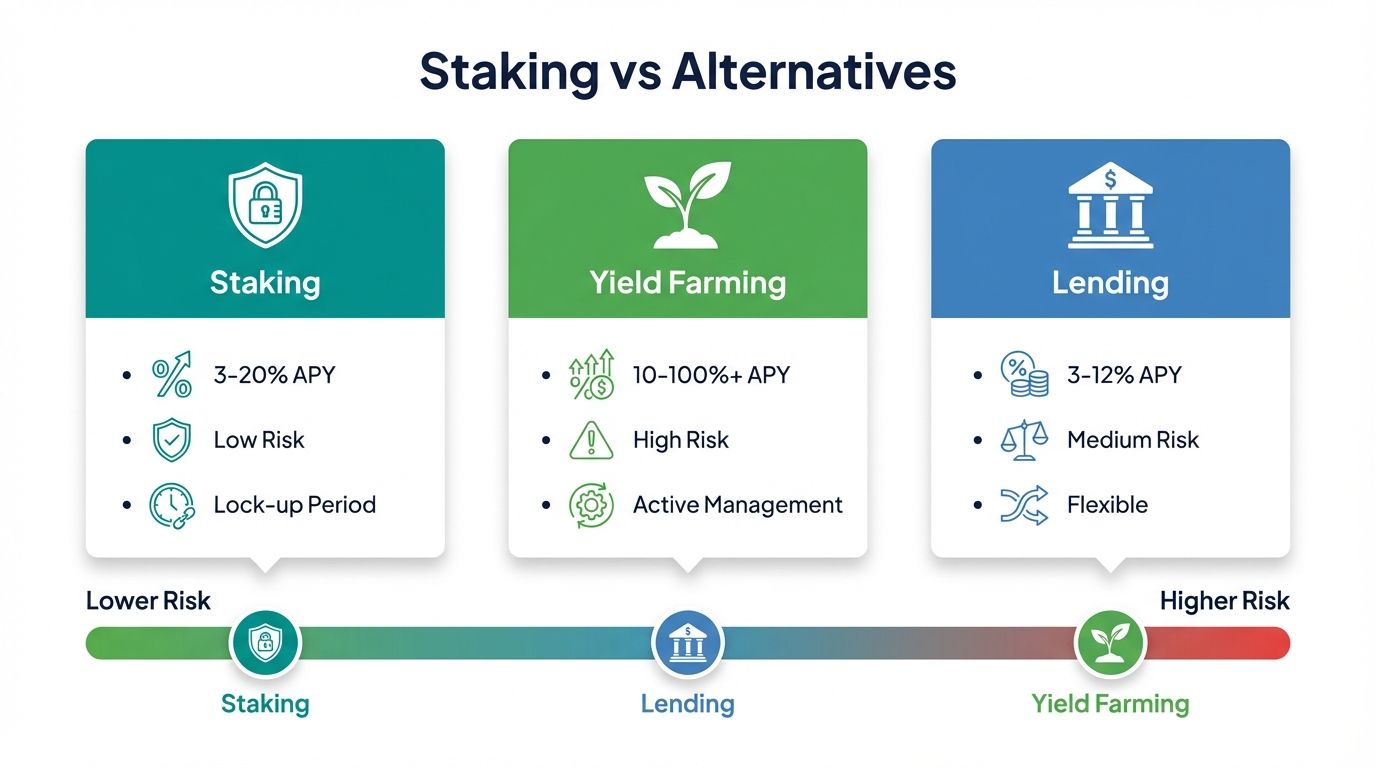
Staking is one of several ways to generate yield from crypto holdings. Understanding how it compares to alternatives helps you build a balanced income strategy.
Staking vs Yield Farming
Yield farming typically offers higher returns (10% to 100%+ APY) but requires active management, exposes you to impermanent loss, and carries higher smart contract risk. Staking provides lower but more predictable yields with simpler mechanics. For most investors, staking serves as the stable foundation of a passive income strategy, with yield farming as an optional addition for those willing to accept higher risk.
Staking vs Lending
Crypto lending generates yield by loaning your tokens to borrowers, with returns typically ranging from 3% to 12% APY depending on the asset and platform. Lending does not require lock-up periods on most platforms, offering more flexibility than traditional staking. However, lending carries counterparty risk since your tokens are in someone else's hands. Staking keeps your tokens within the network protocol, reducing counterparty exposure.
Staking vs Holding
Simply holding crypto (HODLing) requires no effort and carries no additional risks beyond price exposure. Staking adds yield on top of price appreciation but introduces lock-up periods, slashing risk, and validator risk. For assets you plan to hold long-term regardless of price movements, staking is almost always preferable to passive holding since you earn returns on tokens that would otherwise sit idle.
How to Track and Manage Your Staking Positions
As your staking portfolio grows across multiple networks and validators, tracking performance manually becomes increasingly difficult. Missed reward claims, underperforming validators, and changing APY rates can all impact your returns without you realizing it.
A multi-exchange trading platform that consolidates all your crypto positions, including staked assets, into a single dashboard gives you clear visibility into your total portfolio performance. Price alerts notify you when staking assets hit key price levels, helping you make informed decisions about adding to positions or taking profits on rewards.
Portfolio analytics tools calculate your actual yield across all staking positions, accounting for compounding and token price changes. This data-driven approach replaces guesswork with precise metrics, ensuring your staking strategy delivers the returns you expect. Start your free trial to see how consolidated portfolio tracking can simplify your staking management across all your exchanges and wallets.
Frequently Asked Questions
Is crypto staking safe?
Crypto staking on established networks like Ethereum, Solana, and Cardano is generally considered safe, but it is not risk-free. The primary risks include slashing penalties if your chosen validator misbehaves, smart contract vulnerabilities in liquid staking protocols, lock-up periods that prevent access to tokens during market downturns, and regulatory uncertainty. Mitigate these risks by diversifying across multiple validators, using reputable protocols, and never staking more than you can afford to have locked up.
How much can you earn from staking crypto?
Staking yields vary significantly by network. Major networks offer approximate APYs of 3% to 4% for Ethereum, 6% to 8% for Solana, 14% to 16% for Polkadot, and 15% to 20% for Cosmos. However, actual returns depend on token price performance, network inflation, validator commission rates, and compounding frequency. A token with 15% staking APY that drops 40% in price still results in a net loss for the staker.
What is the minimum amount needed to start staking?
Minimum staking requirements vary by network and method. Solo validating Ethereum requires 32 ETH, but liquid staking through Lido allows staking with any amount of ETH. Cardano and Solana have no minimum delegation requirement. Exchange staking platforms typically accept any amount. For most investors, delegated staking or liquid staking through established protocols provides the lowest barrier to entry.
Can you lose money staking crypto?
Yes, you can lose money staking crypto in several ways. If the price of the staked token drops more than the staking yield earned, your position loses value overall. Slashing penalties can reduce your staked balance. Smart contract exploits in liquid staking protocols can result in loss of funds. And platform failures (as seen with FTX and other exchanges) can affect staked assets held on centralized platforms. Staking rewards do not protect against price decline.
Should I use liquid staking or traditional staking?
Liquid staking is generally preferable for most investors because it preserves flexibility. You earn staking rewards while maintaining the ability to trade, use as collateral, or sell your position at any time. Traditional staking offers slightly higher yields (no protocol fee) and fewer smart contract risks, making it suitable for long-term holders who do not need liquidity. Your choice should depend on whether you value flexibility (liquid staking) or simplicity and maximum yield (traditional staking).
2026 Update: What to Check Before You Act
Staking rewards are only one part of the decision. Traders also need to evaluate lockups, validator quality, slashing risk, liquidity, and opportunity cost.
| Check | What to review | Why it matters |
|---|---|---|
| Reward source | Check whether rewards come from protocol issuance, fees, incentives, or a temporary campaign. | Unsustainable rewards often fall after incentives end. |
| Lockup and liquidity | Review unstaking periods, withdrawal queues, liquid staking risks, and secondary-market liquidity. | A high yield is less useful if you cannot exit during volatility. |
| Validator or platform risk | Evaluate uptime, commission, slashing history, custody model, and smart contract risk. | Operational failure can reduce or erase expected yield. |
Quick trader checklist
- Compare net staking yield after fees and token inflation.
- Avoid staking all of a volatile asset if you may need liquidity.
- Track staking positions alongside spot exposure in your portfolio.
FAQ
Is the highest staking APY always the best choice?
No. The best staking choice balances yield with lockup, liquidity, validator quality, slashing risk, and the underlying asset’s price risk.