
The phrase "real adoption" gets used loosely in crypto. Most projects that claim it are still measuring success in token velocity or TVL. DePIN is one of the few categories where you can point to physical hardware running in the real world, generating revenue, and producing on-chain rewards tied to actual usage.
The DePIN sector held roughly $9-10 billion in market cap by early 2026, with September 2025 projections placing the category at $19.2 billion in TVL and longer-term forecasts above $3 trillion by 2028. Helium has over 900,000 active hotspots. Render generates $38 million in monthly revenue. Akash holds GPU utilization near 80%. These numbers come from physical operations, not just speculative token trading.
This guide explains what DePIN is, walks through the main categories and projects, shows how traders can access exposure, and covers the risks that separate durable DePIN protocols from temporary narrative plays.
What Is DePIN?
DePIN stands for Decentralized Physical Infrastructure Networks. The basic idea: instead of one company building and operating physical infrastructure (a telecom network, a cloud data center, a sensor grid), thousands of independent operators each contribute hardware they own, and the network coordinates them via a blockchain and a token incentive.
A simple example. Helium pays token rewards to anyone who plugs a Helium hotspot into their home or office and provides wireless coverage. The hotspot transmits and receives data for IoT devices in the area. When real devices use the network, the operator earns more rewards. Over 900,000 hotspots are active globally, providing low-power wide-area network coverage that competes directly with cellular IoT services.
The same model applies across other infrastructure types. Render Network coordinates a global pool of GPU owners who rent their compute to artists and AI developers needing 3D rendering or model inference. Akash Network runs a marketplace where anyone with spare CPU or GPU can sell it to developers who need cloud compute. IoTeX uses a similar approach for IoT data verification.
What makes DePIN different from earlier hardware-mining projects (Filecoin, Storj) is the focus on real-world utility and real revenue. The best DePIN projects in 2026 are generating measurable demand from outside the crypto ecosystem.
Why DePIN Matters in 2026
Three drivers came together.
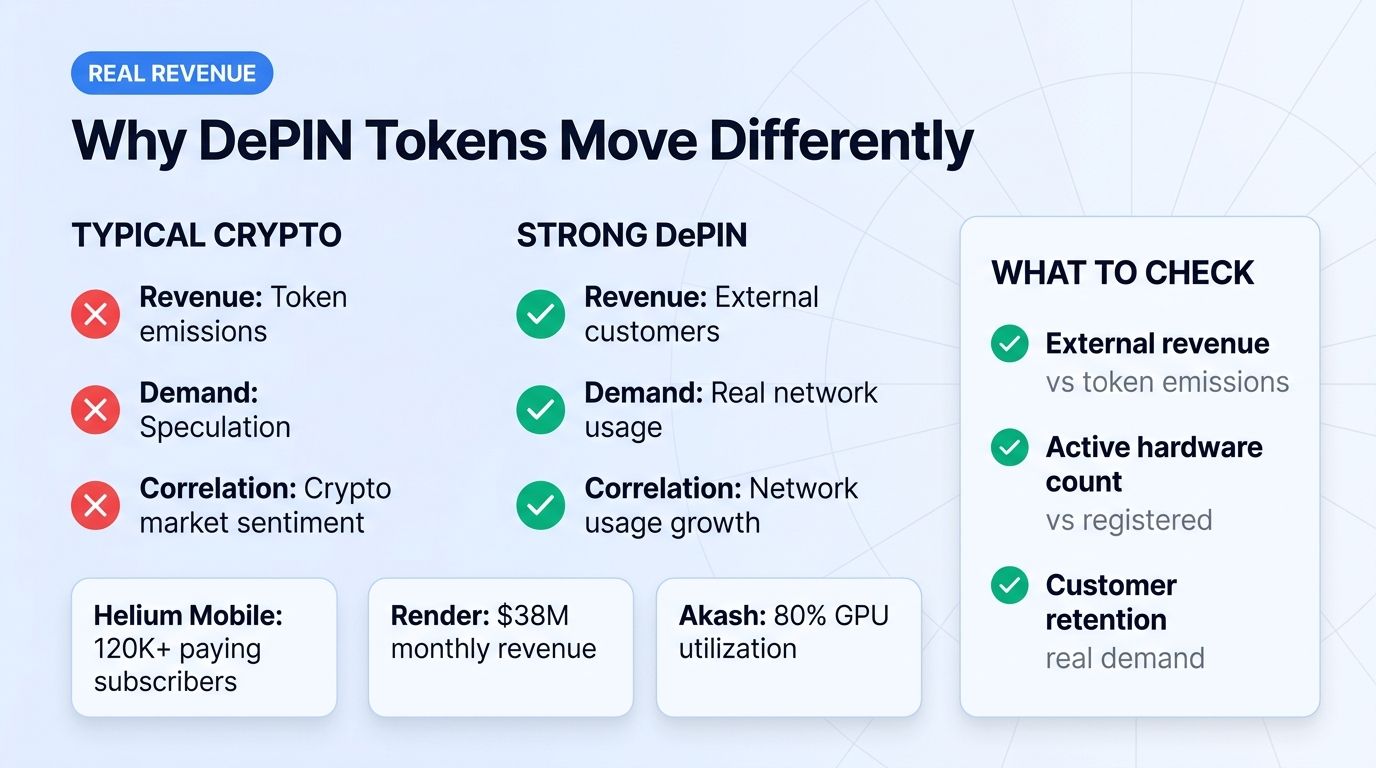
First, AI inference demand exploded. Large language models need GPUs at the edge, not just in centralized data centers. DePIN networks offering distributed GPU compute (Render, Akash, io.net) became infrastructure for the broader AI buildout. Akash GPU utilization holding near 80% is genuine demand, not idle speculation.
Second, telecom partnerships matured. Helium Mobile passed 120,000 subscribers in 2025 with partnerships from AT&T and Telefónica offloading real cellular traffic onto Helium hotspots. This is a paid service with paying customers, not a token-mining experiment.
Third, IoT and edge computing demand grew faster than centralized providers could serve cost-effectively. DePIN networks compete on price for use cases where centralized cloud is overengineered. IoTeX, DIMO (vehicle data), and Hivemapper (mapping) found product-market fit in narrow but real verticals.
The result: DePIN tokens correlate less with general crypto sentiment and more with the underlying networks growth in usage. That makes them useful for portfolio diversification.
The Five Main DePIN Categories
Wireless and Telecom
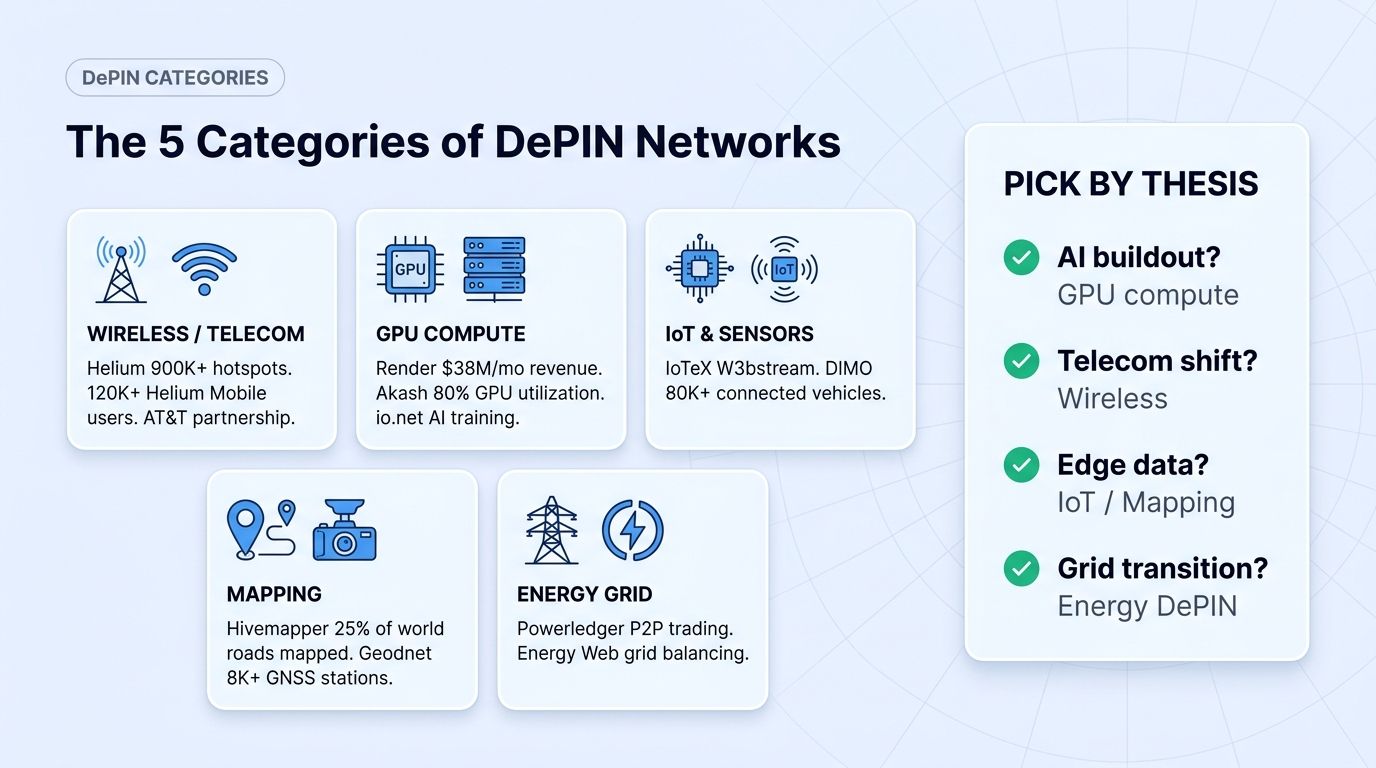
Helium leads this category. Over 900,000 IoT hotspots provide LoRaWAN coverage. Helium Mobile's 120,000+ subscribers use a cellular plan partly powered by community-deployed hotspots, with carrier partnerships from AT&T and Telefónica. HNT is the network token. MOBILE rewards 5G hotspot operators specifically.
Other projects in the category: Pollen Mobile, World Mobile, XNET.
GPU Compute and Rendering
Render Network is the largest pure-play, generating $38 million in monthly revenue by coordinating GPU owners for 3D rendering and AI inference workloads. RENDER is the network token.
Akash Network operates a reverse-auction marketplace where providers offer unused CPU and GPU capacity at below-cloud-provider prices. GPU utilization near 80% indicates real workloads, not idle hardware. AKT is the network token.
io.net is a newer entrant aggregating GPU clusters specifically for AI training. Numerous smaller projects (Aethir, Nosana) target the same workload class.
IoT and Sensors
IoTeX builds infrastructure for connecting smart devices to blockchains. Its W3bstream platform lets IoT devices generate verifiable data proofs that trigger on-chain actions. Real estate IoT, supply chain tracking, and environmental monitoring all use the stack.
DIMO collects vehicle data from over 80,000 connected cars. Drivers earn rewards for sharing usage data, which businesses purchase for fleet optimization and insurance pricing.
Mapping and Navigation
Hivemapper turns dashcams into a decentralized mapping network. Drivers earn HONEY tokens for contributing fresh imagery. The map data is sold to logistics companies and navigation services. Hivemapper has mapped over 25% of the world's roads as of late 2025.
Geodnet runs a similar model for GNSS positioning data, with over 8,000 high-precision stations contributing to a decentralized centimeter-accuracy positioning network.
Energy Grid
Powerledger and Energy Web Token coordinate distributed energy resources, peer-to-peer electricity trading, and grid balancing. Smaller in market cap than the other categories but with the longest-term thesis tied to grid modernization.
How Retail Traders Can Access DePIN
Three paths.
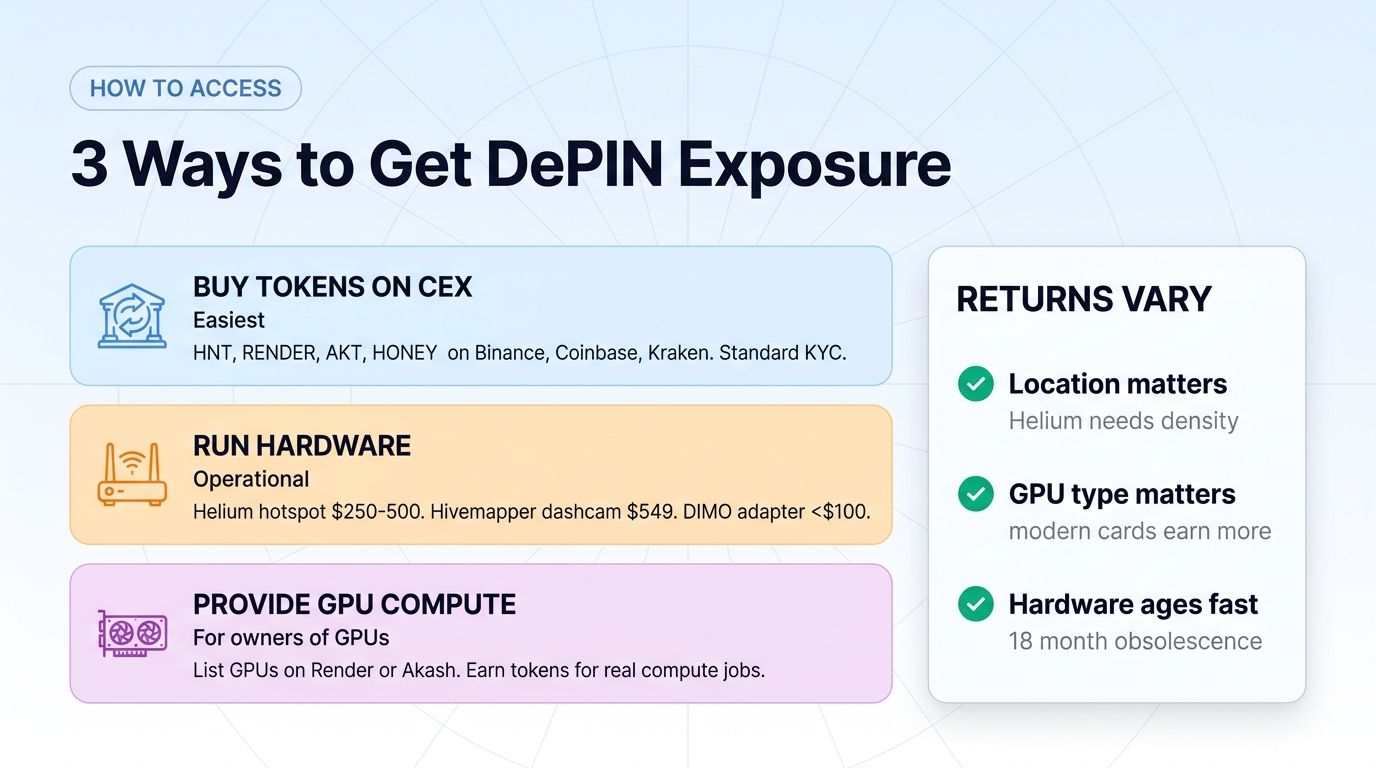
Path 1: Buy DePIN tokens on a centralized exchange. Helium (HNT), Render (RENDER), Akash (AKT), and Hivemapper (HONEY) are all listed on major exchanges including Binance, Coinbase, and Kraken. This is the simplest exposure. Tokens are liquid enough for normal position sizes. For traders managing positions across multiple exchanges, Altrady provides a multi-exchange view that includes DePIN tokens alongside the rest of your crypto holdings.
Path 2: Run hardware and earn rewards. Helium hotspots cost $250-500 depending on type. Hivemapper dashcams cost around $549. DIMO vehicle adapters cost under $100. Hardware-based earning is operational, not passive. Returns depend on your location, the network's demand, and the token's price. Some operators net $20-100 per month per device. Others break even or lose money.
Path 3: Provide GPU compute to Render, Akash, or io.net. If you already own gaming GPUs or have idle hardware, listing it on these networks earns tokens for actual compute jobs. Returns vary widely by GPU type, network demand, and uptime.
The Risks You Need to Understand
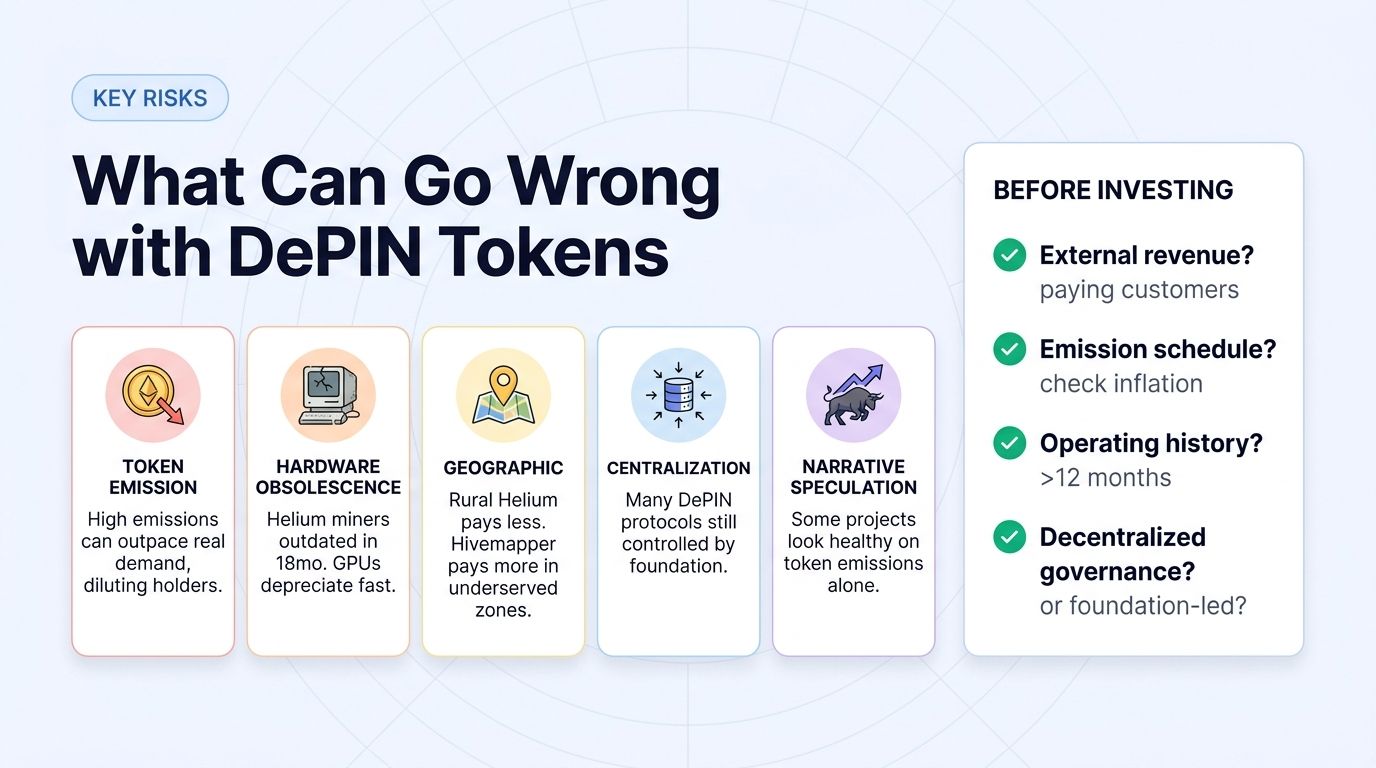
Token economics risk. Many DePIN projects emit tokens to reward operators. If emission outpaces real demand, the token price falls and operator economics break down. Read the emission schedule and demand-side revenue before committing capital or buying tokens long-term.
Hardware obsolescence. A Helium miner you buy today might be outdated in 18 months. GPU rigs running on Render face the same risk as any compute equipment. Hardware-based returns are not guaranteed to last.
Geographic risk. Helium and similar coverage networks pay more in areas with high real device usage. A hotspot in a rural area with no IoT devices nearby earns much less than one in a dense urban deployment. Hivemapper rewards more for under-mapped regions. Your location matters.
Centralization in operations. Some DePIN tokens reward network operators but the protocol's parameters are still controlled by a foundation or core team. Decision-making centralization can clash with the token's distributed-network branding.
Real demand vs. emission speculation. Some DePIN projects look healthy because token emissions push reward APYs high. Strip out emissions and ask whether the underlying service has paying customers. The strongest projects (Helium Mobile, Render, Akash) clearly do. Many smaller projects do not.
How DePIN Fits Into a Crypto Portfolio
A framework that has worked for narrative-aware traders:
- Core infrastructure (Helium, Render, Akash): 50-70% of DePIN allocation. Largest tokens, real demand, longest operating history.
- Vertical specialists (IoTeX, DIMO, Hivemapper): 20-30%. Each tied to a specific use case. Higher upside if the vertical scales, more concentrated risk if it does not.
- Speculative new entrants: 0-20%. Sized for total loss tolerance.
Total DePIN allocation typically runs 5-15% of a crypto portfolio for traders who want exposure to the AI buildout and the broader physical-infrastructure narrative without overweighting any single category.
FAQ
What is the difference between DePIN and traditional hardware mining?
Traditional hardware mining (Filecoin, Storj) focused on storage as a commodity, with rewards mostly tied to capacity provided. DePIN extends the model to physical infrastructure across many categories (wireless, GPU, sensors, mapping, energy) and emphasizes real-world utility and external paying customers, not just hash-rate-style reward emission.
Is DePIN profitable for retail operators?
Sometimes. Helium operators in dense urban areas with strong device usage earn meaningful rewards. Operators in low-demand zones often net less than they spent on hardware. GPU compute on Render and Akash depends heavily on GPU type and network demand. Treat any operator income as variable and dependent on local conditions.
Which DePIN token has the largest network effect?
By active hardware units, Helium leads with 900,000+ hotspots. By revenue, Render is one of the strongest at $38M monthly. Bittensor often gets grouped with DePIN but is more accurately classified as decentralized AI infrastructure.
Can I trade DePIN tokens on Altrady?
Yes. Major DePIN tokens including HNT (Helium), RENDER, and AKT (Akash) are listed on Binance, Coinbase, Kraken, and other exchanges that Altrady connects to. You can manage DePIN positions, run automated strategies via the signal bot or DCA bot, and view your DePIN exposure alongside other crypto in one dashboard.
What is the biggest risk for DePIN investors?
The gap between token emission and real demand. Healthy DePIN networks earn revenue from external customers (telecoms, AI developers, mapping companies). Weak DePIN projects pay rewards mostly from token issuance, which dilutes existing holders over time. Always check the ratio of external revenue to token emission before committing.
Conclusion
DePIN is one of the few categories in crypto where you can point to physical infrastructure, real customers, and measurable usage. Helium's telecom partnerships, Render's monthly revenue, and Akash's GPU utilization all reflect demand from outside the crypto economy. That is rare and worth respecting.
For traders, the practical takeaway is this: DePIN is an exposure category to the broader trend of distributed physical infrastructure and the AI compute buildout. Hold the largest, most-proven networks for stable exposure. Speculate on vertical specialists with smaller allocations. Avoid projects where token emission obviously outpaces real demand.
The category will continue to grow as AI compute, IoT, and edge demand keep climbing. The traders who pay attention to where real revenue is flowing, not just where token prices are pumping, will keep the best positions through the next cycle.