

Ethereum staking has become one of the most discussed topics in the crypto space since the network completed its transition from proof-of-work to proof-of-stake. Instead of relying on energy-intensive mining, Ethereum now secures its blockchain by locking ETH as collateral, rewarding participants who help validate transactions. This shift opened a new earning model for ETH holders, allowing them to generate passive income simply by holding and participating in network security.
Whether you hold a large amount of ETH or just a fraction, there are now multiple ways to participate in staking, from running your own validator node to using liquid staking protocols that remove the technical barriers entirely. This guide breaks down everything you need to know about ethereum staking, including how it works, what rewards to expect, the real risks involved, and how to get started today.
1. What Is Ethereum Staking
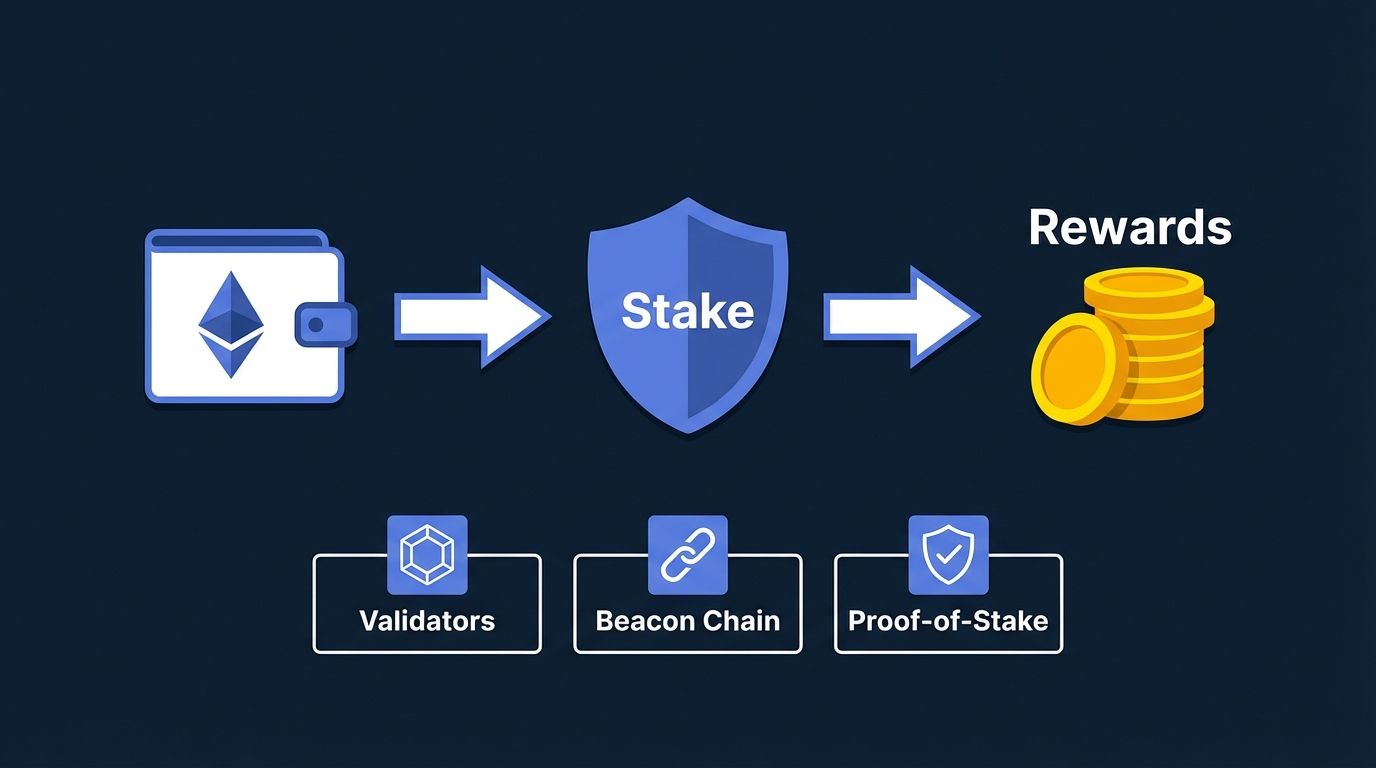
Ethereum staking is the process of locking up ETH in the Ethereum network to participate in block validation under the proof-of-stake consensus mechanism. When you stake ETH, you are essentially putting your tokens at work as collateral that proves your commitment to honest network participation.
Before September 2022, Ethereum used proof-of-work, meaning miners competed with computing power to add new blocks. The Merge changed everything. Under proof-of-stake, validators are chosen to propose and attest to new blocks based on the amount of ETH they have staked. There is no more mining hardware required. The network is secured by economic stake instead of energy consumption.
- Validators are the participants who run nodes and actively propose or attest to new blocks.
- Stakers can be validators themselves or delegators who contribute ETH to a pool or liquid staking protocol.
- The Beacon Chain is the coordination layer that manages validator assignments, staking deposits, and reward distribution.
Ethereum staking serves two purposes at once: it secures the network against attacks, and it provides ETH holders with a yield on their holdings. The more ETH that is staked across the network, the more decentralized and secure the blockchain becomes.
2. How Ethereum Staking Works
Understanding the mechanics behind ethereum staking helps you make better decisions about how and where to stake your ETH. Here is how the system operates from the ground up.
Validators and the 32 ETH requirement
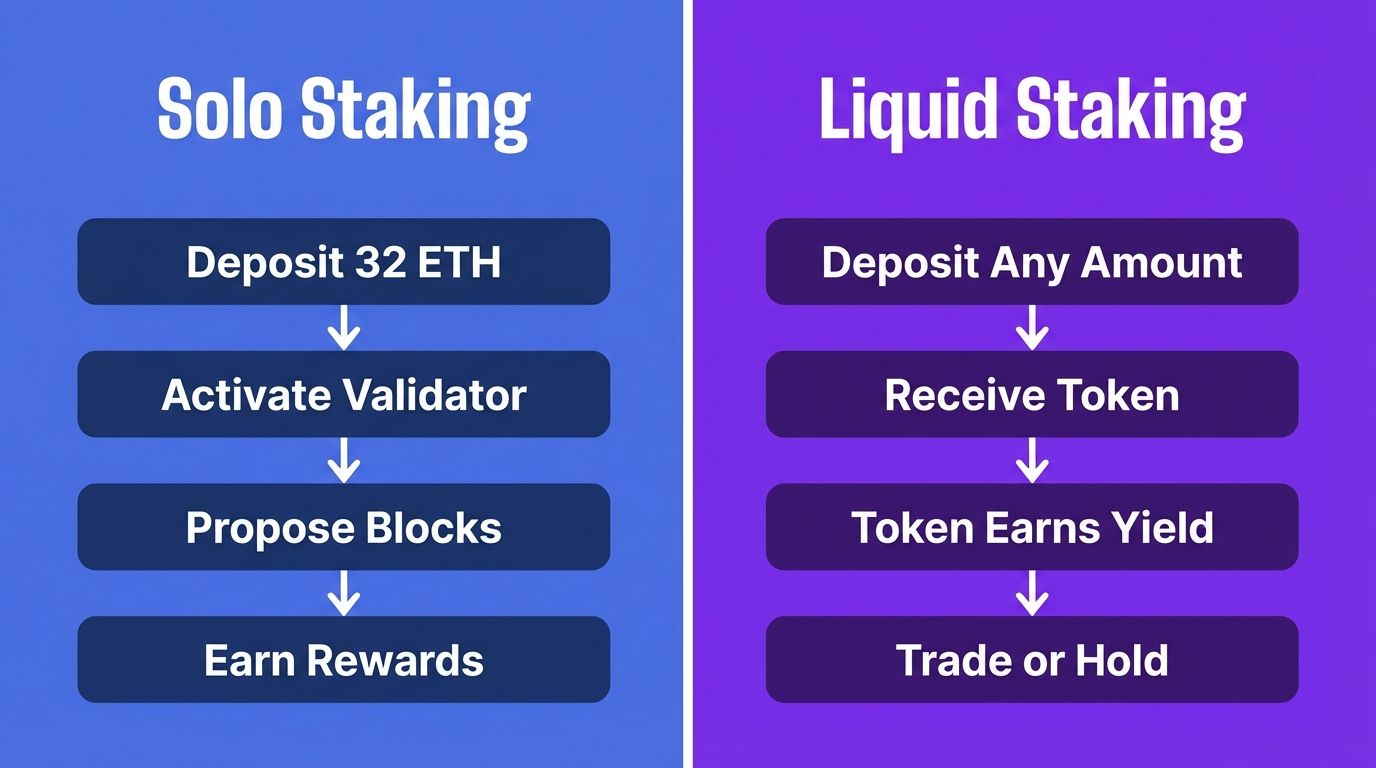
To become a solo validator on Ethereum, you must deposit exactly 32 ETH into the official deposit contract. This activates your validator node on the Beacon Chain. Your node then participates in two main activities: proposing new blocks (selected randomly but weighted by stake) and attesting to blocks proposed by others. Both activities earn rewards when done correctly, and both carry slashing penalties when done dishonestly or negligently.
Running a solo validator also requires technical knowledge. You need a dedicated machine with stable internet, enough storage to sync the Ethereum chain, and the ability to keep your node online with high uptime. If your validator goes offline, you will incur small inactivity penalties. If you act maliciously or sign conflicting blocks, you face slashing, which means a portion of your staked ETH is destroyed.
Liquid staking alternatives
For the majority of ETH holders who do not have 32 ETH or the technical skill to run a node, liquid staking protocols offer a practical solution. Platforms pool ETH from many participants, operate validator nodes on their behalf, and issue liquid staking tokens in return. These tokens represent your staked ETH plus accruing rewards and can be traded or used in DeFi while your underlying ETH remains staked.
Liquid staking has become the dominant form of ethereum staking by total value locked, precisely because it lowers the barrier to entry significantly. You can stake as little as 0.01 ETH and still earn proportional staking rewards without managing any infrastructure.
Pooled and exchange-based staking
Centralized exchanges also offer staking products where they handle the technical side entirely. You deposit ETH to the exchange and receive a yield. The trade-off is custodial risk: the exchange controls your keys and your staked ETH. Decentralized alternatives remove that trust assumption but introduce smart contract risk instead.
3. Ethereum Staking Rewards and Current APY
One of the first questions people ask is: how much can you earn from ethereum staking? The answer depends on the total amount of ETH currently staked across the network and your chosen staking method.
How rewards are calculated
Ethereum staking rewards come from two sources. The first is issuance rewards, which are newly created ETH distributed to validators for attesting and proposing blocks correctly. The second is priority fees and MEV (maximal extractable value), which are tips paid by users for transaction inclusion. As network usage increases, the fee component of rewards grows as well.
The annual percentage yield for ethereum staking is not fixed. It adjusts dynamically based on the total staked ETH. When more ETH is staked, individual rewards decrease because the same issuance pool is shared among more validators. When less ETH is staked, each validator earns more.
- Solo staking APY: approximately 3% to 5% annually, depending on network conditions and MEV income.
- Liquid staking APY: typically 3% to 4.5%, slightly lower due to protocol fees.
- Exchange staking APY: often 2% to 3.5%, as exchanges take a larger cut for managing the process.
It is also worth noting that rewards are paid in ETH, not in a stablecoin. If ETH price rises, your staking yield is amplified in fiat terms. If ETH falls, your fiat-denominated return shrinks. Staking rewards do not protect against price drawdowns.
4. Risks of Ethereum Staking
No yield comes without risk, and ethereum staking is no exception. Understanding the risks before you stake is essential for managing your exposure properly.
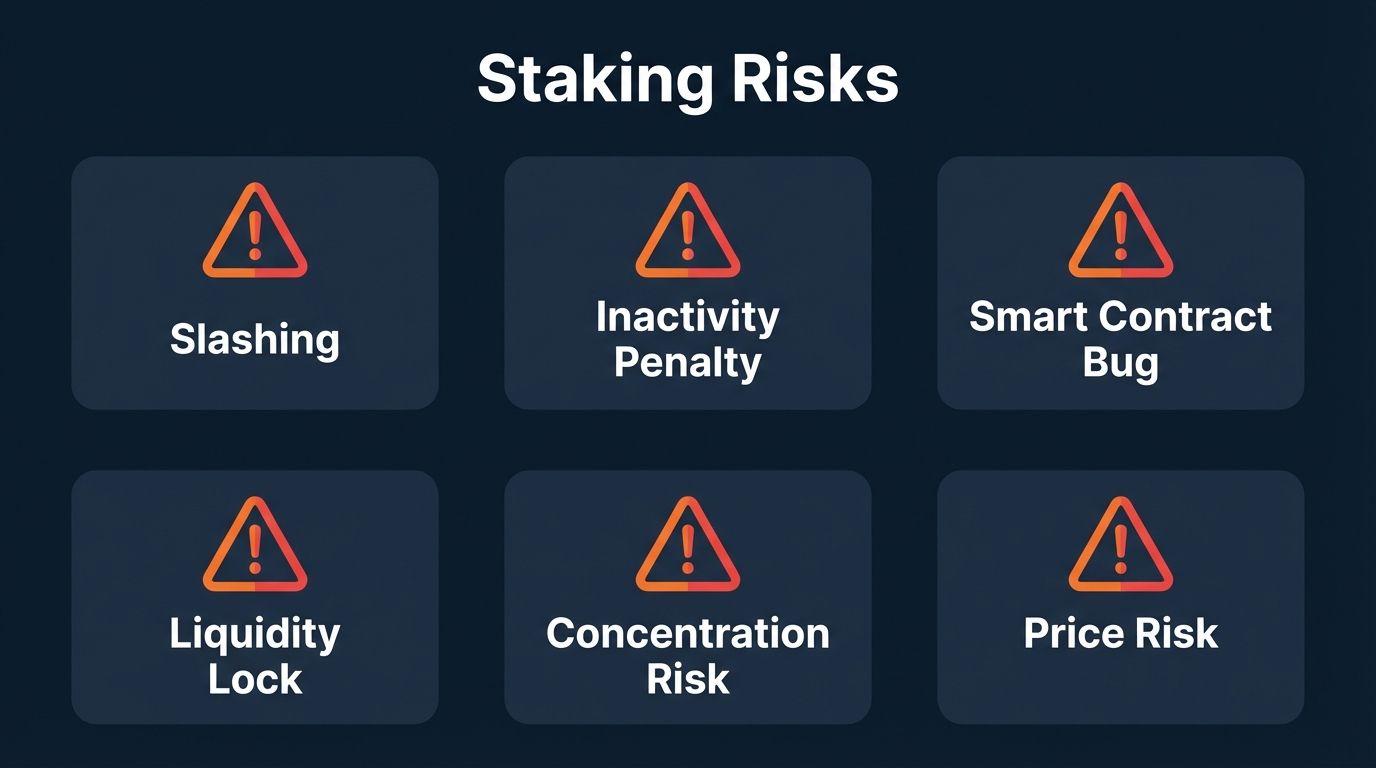
- Slashing risk: If a validator signs two conflicting blocks or behaves maliciously, the network destroys part of their staked ETH as a penalty. Solo stakers must configure their node carefully to avoid accidental double-signing, especially when migrating validator keys between machines.
- Inactivity penalties: If your validator goes offline for an extended period, you accumulate inactivity leaks that slowly reduce your staked ETH balance. These are not as severe as slashing, but they erode returns over time.
- Smart contract risk: Liquid staking protocols run on smart contracts. A bug or exploit in those contracts could result in loss of funds. No smart contract is ever completely risk-free.
- Liquidity risk: When you stake ETH natively, your ETH goes through an entry queue and may be locked for days. Withdrawals also go through an exit queue. During high-demand periods, this queue can take much longer than expected.
- Concentration risk: A large portion of staked ETH is controlled by a small number of liquid staking providers. If any of them face governance failures or regulatory pressure, it could impact a significant share of the staking ecosystem.
- Price risk: Your staking rewards are in ETH. A large drop in ETH price can wipe out months of staking yield in fiat terms. Staking does not hedge against market downturns.
5. How to Get Started with Ethereum Staking
Your ideal staking method depends on your ETH balance, technical comfort level, and tolerance for custodial or smart contract risk. Here is a practical guide for each major path.
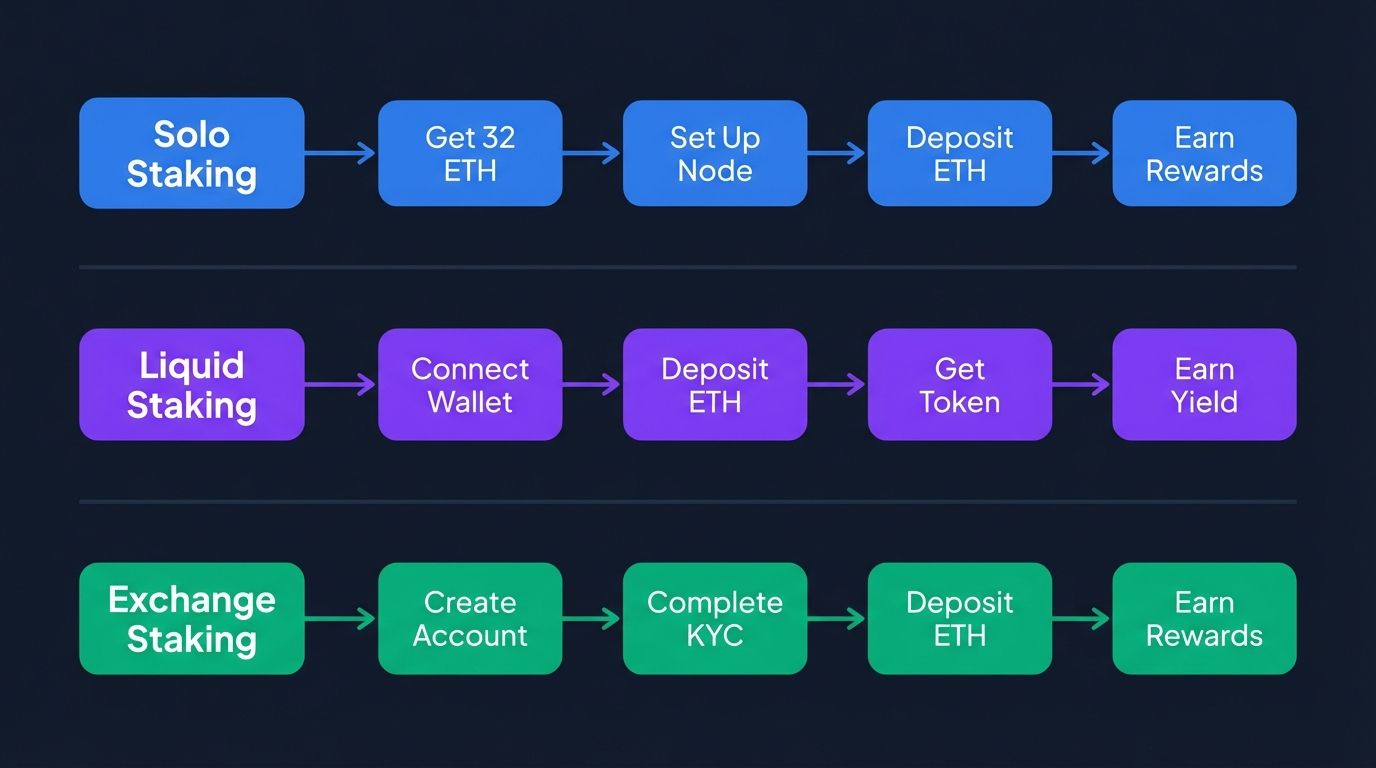
Option A: Solo Staking (32 ETH minimum)
- Acquire at least 32 ETH and set up a dedicated machine with stable internet connection.
- Install an Ethereum execution client and a consensus client on your machine.
- Generate your validator keys using the official Ethereum staking launchpad.
- Deposit exactly 32 ETH to the deposit contract using the launchpad interface.
- Wait for your validator to be activated (this can take hours to days depending on the queue).
- Monitor your validator performance regularly and keep your node updated and online.
Option B: Liquid Staking (any amount)
- Connect a self-custody wallet to the liquid staking protocol of your choice.
- Deposit your ETH into the protocol. You will receive a liquid staking token in return.
- Your liquid staking token automatically accrues staking rewards over time or increases in value relative to ETH.
- You can hold your token, use it in DeFi protocols, or redeem it for ETH at any time (subject to withdrawal queue times).
Option C: Exchange Staking (easiest, lowest control)
- Create an account on a major centralized exchange that offers ETH staking.
- Complete KYC verification as required by the platform.
- Navigate to the staking section and select the ETH staking product.
- Deposit your ETH. Rewards are typically distributed daily or weekly, depending on the platform.
Regardless of which method you choose, always confirm you are using official, verified contract addresses or platform URLs. Phishing sites impersonating legitimate staking platforms are common, and a mistaken transaction cannot be reversed on-chain.
6. How Altrady Helps You Track Your Ethereum Staking Portfolio
Staking is one piece of a larger crypto strategy, and keeping track of your staking positions alongside your active trades is where many investors struggle. Altrady is an advanced cryptocurrency trading platform that brings your entire portfolio into one unified dashboard, giving you real-time visibility across exchanges, wallets, and staking positions.
With Altrady, you can monitor ETH price movements, set price alerts for key levels, and manage your trading activity with professional-grade tools, all while your staked ETH works quietly in the background. The platform supports multiple exchanges and offers features like smart trading, portfolio tracking, and automated signals designed for both new and experienced traders.
If you are serious about growing your crypto portfolio, combining a passive ethereum staking strategy with active trade management on a platform like Altrady gives you both consistent yield and the agility to act on market opportunities. You can start exploring Altrady's full feature set with a free trial, no commitment required. Sign up and see how a centralized command center changes the way you manage crypto.
Frequently Asked Questions
How much ETH do I need to start staking?
To run your own solo validator node, you need exactly 32 ETH. However, through liquid staking protocols, you can stake any amount of ETH, even fractions of a single token. Centralized exchanges also allow staking with very small minimums, sometimes as low as 0.001 ETH.
Are ethereum staking rewards taxable?
In most jurisdictions, staking rewards are treated as taxable income at the time they are received, based on the fair market value of the ETH at that moment. When you later sell the staked ETH or liquid staking tokens, any capital gain may also be subject to tax. Tax treatment varies by country, so consulting a local tax professional familiar with crypto is strongly recommended.
Can I lose my ETH by staking it?
Yes, there are scenarios where staked ETH can be lost or reduced. Slashing penalties apply when a validator behaves maliciously or signs conflicting data. Smart contract bugs in liquid staking protocols are another potential loss vector. Solo stakers also risk inactivity penalties if their node goes offline for extended periods. However, for a passive staker using a well-established liquid staking protocol, the practical risk of total loss is low, though not zero.
What is the difference between liquid staking and regular staking?
Regular staking involves depositing ETH directly to the Ethereum network via the deposit contract, where it is locked and managed by a validator. Liquid staking involves depositing ETH to a third-party protocol that stakes it on your behalf and issues you a tradable token representing your position. The key advantage of liquid staking is that you can use or trade your token while your ETH earns rewards. The key trade-off is reliance on the protocol's smart contracts and operator performance.
How long does it take to unstake ETH?
Ethereum withdrawals go through an exit queue managed by the Beacon Chain. Under normal network conditions, the process takes anywhere from a few hours to several days depending on how many validators are queuing to exit at the same time. During periods of high exit demand, the queue can extend significantly longer. Liquid staking tokens can often be swapped on decentralized exchanges for ETH immediately, avoiding the exit queue entirely, though this depends on available liquidity.