
Every cryptocurrency trade, from a $50 Bitcoin purchase to a $5 million institutional swap, passes through an exchange. These platforms connect buyers with sellers and convert digital assets into real value. Yet most traders never look under the hood to understand what actually happens between clicking "Buy" and seeing tokens in their wallet.
This guide breaks down how crypto exchanges work, covering order books, matching engines, automated market makers, and the fees you pay along the way.
What Is a Cryptocurrency Exchange?
A cryptocurrency exchange is a platform where users buy, sell, and trade digital assets like Bitcoin, Ethereum, and thousands of altcoins. Think of it as the crypto equivalent of a stock exchange, but operating 24/7 with no closing bell.
Exchanges serve three core functions. Price discovery aggregates buy and sell orders to establish fair market prices. Liquidity ensures traders can enter and exit positions without excessive price impact. On-ramps and off-ramps allow users to convert fiat currencies like USD or EUR into crypto and back again.
There are approximately 194 active cryptocurrency exchanges tracked globally, though about 10 of them process roughly 90% of all trades. Combined monthly volume across the top exchanges averages around $1.4 trillion in early 2026, with Binance alone commanding roughly 38% to 40% of centralized spot market share.
Types of Crypto Exchanges
Not all exchanges work the same way. The three main categories differ fundamentally in architecture, custody, and user experience.
Centralized Exchanges (CEX)
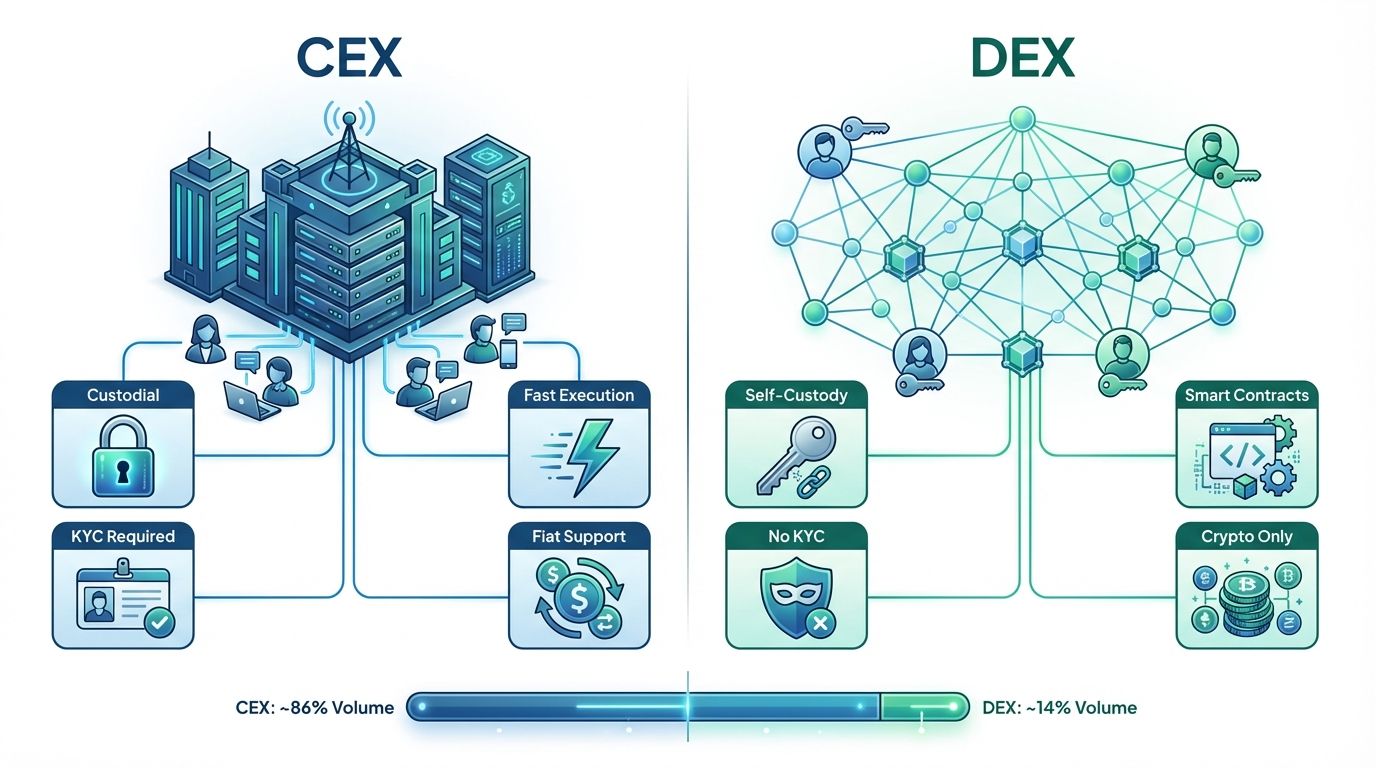
Centralized exchanges operate like traditional financial intermediaries. A company runs the platform, holds user funds in custody, and manages the order matching process internally. Examples include Binance, Coinbase, Kraken, and Bybit.
CEXs dominate global trading volume thanks to deep liquidity, fast execution, fiat currency support, and advanced trading tools like margin trading and futures contracts. However, they require users to trust the exchange with their funds and personal information.
Decentralized Exchanges (DEX)
Decentralized exchanges run on blockchain smart contracts with no central authority controlling the platform. Users trade directly from their own wallets, maintaining full custody of their assets throughout the process. Leading DEXs include Uniswap, PancakeSwap, and Raydium.
DEX market share has doubled from 6.9% of spot volume in January 2024 to 13.6% in January 2026, with monthly spot volume exceeding $231 billion. Perpetual DEX volume has grown 8-fold to $739 billion.
Hybrid Exchanges
Hybrid exchanges attempt to combine CEX performance with DEX self-custody. These platforms typically use off-chain matching engines for speed while settling trades on-chain for transparency. Examples include dYdX and newer platforms exploring this model. While still a small portion of the market, hybrid approaches are gaining traction as the technology matures.
How Centralized Exchanges Work
Understanding the step-by-step process of a centralized exchange trade reveals why these platforms remain dominant despite decentralized alternatives.
Step 1: Account Creation and KYC Verification
Before trading, users must create an account and complete Know Your Customer (KYC) verification. This process typically involves providing your full legal name, uploading a government-issued ID (passport, driver's license, or national ID card), submitting proof of address, and in many cases completing biometric verification through facial recognition.
KYC requirements have intensified under regulations like the EU's MiCA framework and the Travel Rule, which now requires exchanges to collect originator and beneficiary information for every crypto transfer. Most exchanges offer tiered verification, where basic KYC unlocks limited trading and withdrawal amounts, while enhanced verification removes those caps.
Step 2: Depositing Funds
Once verified, users deposit funds via bank transfer, credit card, or crypto transfer from an external wallet. Deposited crypto moves to wallets controlled by the exchange, not by the user, which is why centralized exchanges are called "custodial" platforms. Most exchanges store 95% or more of user funds in cold storage (wallets disconnected from the internet) to minimize hack risk.
Step 3: The Order Book
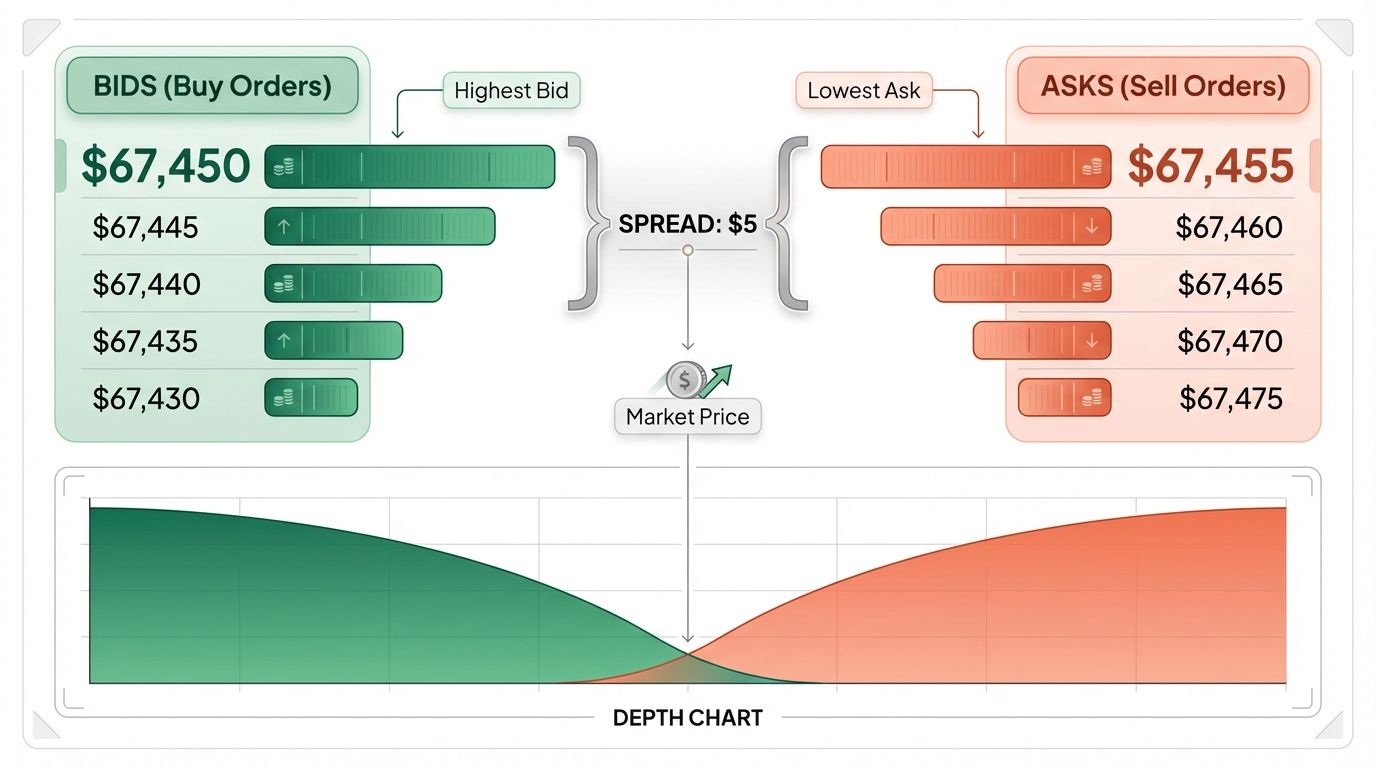
When a user places a trade, it enters the exchange's order book. This is an electronic list of all open buy and sell orders for a specific trading pair (for example, BTC/USDT). Buy orders (bids) are ranked from highest to lowest price, while sell orders (asks) are ranked from lowest to highest price.
The order book is the heart of a centralized exchange and updates in real time as orders are placed, matched, and canceled.
Step 4: The Matching Engine
The matching engine is the core technology that makes trading possible. When a new order enters the system, the engine scans the order book for a compatible counterpart and executes the trade instantly if a match exists.
Modern matching engines operate entirely in RAM, achieving execution times under 10 milliseconds (Binance averages 5ms) and processing over 5,000 trades per second. The standard algorithm follows price-time priority: orders at the best price execute first, and among orders at the same price, the earliest order gets filled first.
Step 5: Settlement
After a trade is matched, the exchange updates both users' internal balances. When you buy 0.1 BTC, the exchange debits USDT from your account and credits 0.1 BTC. The seller sees the reverse. No blockchain transaction occurs at this point because the exchange handles settlement internally in its database. Blockchain transactions only happen when users withdraw funds to external wallets.
Understanding Order Books
Learning to read the order book gives traders valuable insight into market conditions and potential price movements.
Bids, Asks, and the Spread
The bid is the highest price any buyer is willing to pay. The ask is the lowest price any seller will accept. Only limit orders appear in the order book. Market orders execute immediately against existing bids or asks.
The bid-ask spread is the gap between the highest bid and lowest ask. If the highest BTC bid is $67,450 and the lowest ask is $67,455, the spread is $5. A narrow spread signals strong liquidity, while a wide spread indicates lower liquidity or a less popular trading pair. On major exchanges, BTC/USDT spreads can be as tight as $1 to $2, while smaller altcoins might show spreads of 0.5% to 2%.
Market Depth and Slippage
Market depth refers to the volume of orders stacked at each price level. A "deep" order book has large orders near the current price, meaning big trades can execute without significantly moving the market. Exchanges visualize this through depth charts showing cumulative buy and sell volume as two curves meeting at the center.
Slippage occurs when a trade executes at a different price than expected because the order is too large for available liquidity. If you market-buy 10 BTC but only 2 BTC sits at the best ask, the remaining 8 BTC fills at progressively higher prices. Professional traders use limit orders and algorithmic execution to minimize this impact.
How Decentralized Exchanges Work
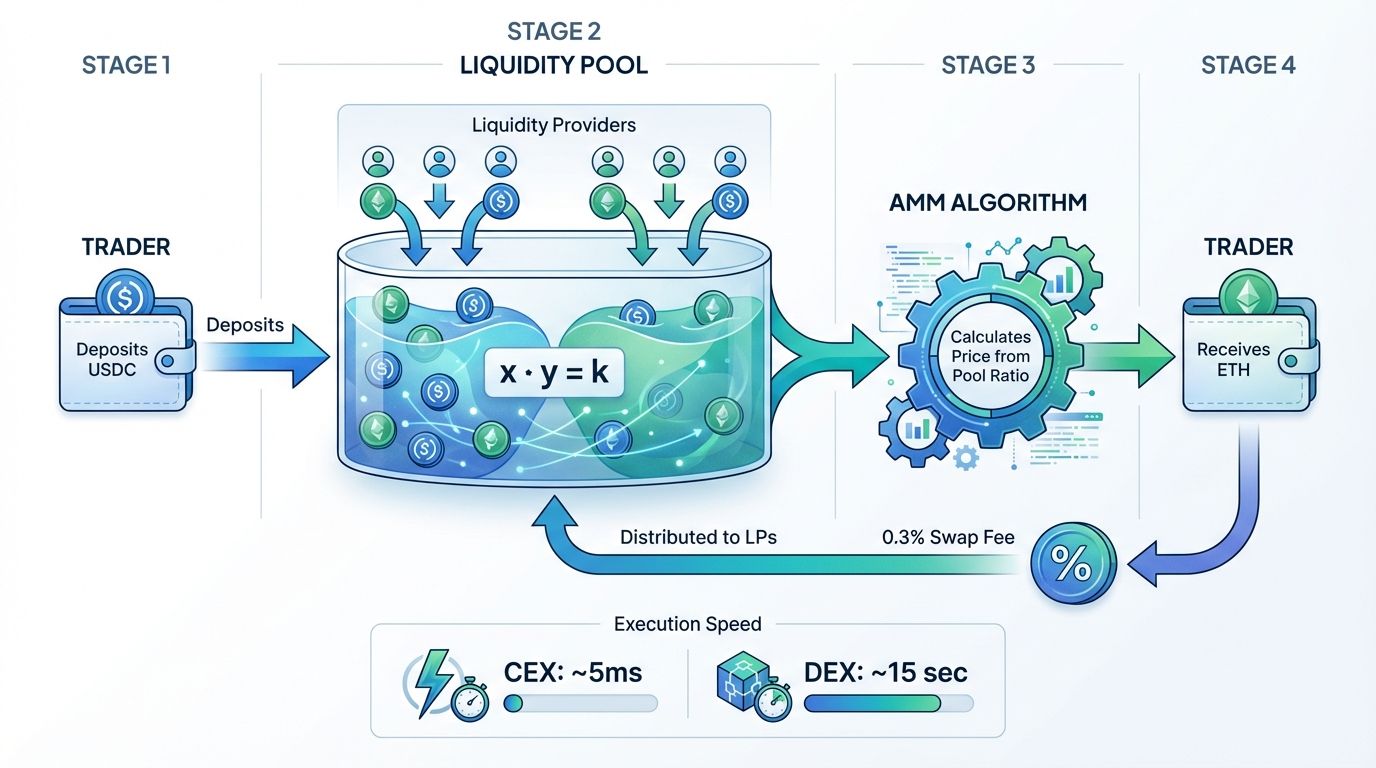
Decentralized exchanges take a fundamentally different approach to trading. Instead of matching buyers with sellers through an order book, most DEXs use an Automated Market Maker (AMM) model powered by liquidity pools and smart contracts.
Automated Market Makers (AMMs)
An AMM replaces the traditional order book with a mathematical formula that determines asset prices based on the ratio of tokens in a liquidity pool. The most common approach, popularized by Uniswap V2, is the constant product formula: x * y = k, where x and y represent the quantities of two tokens in the pool and k is a constant.
In practice, imagine a pool containing 100 ETH and 200,000 USDC (k = 20,000,000). To buy 1 ETH, the smart contract calculates that the trader must deposit approximately 2,020 USDC, giving an effective price slightly above the current pool ratio due to price impact.
Liquidity Pools and Liquidity Providers
Liquidity pools are smart contracts that hold pairs of tokens. Anyone can become a liquidity provider (LP) by depositing equal values of two tokens into a pool, receiving pool tokens representing their share. When traders swap through the pool, they pay a fee (typically 0.3% on Uniswap V2, or 0.01% to 1% on V3/V4). These fees are distributed proportionally to all LPs.
Uniswap V3 and V4 introduced concentrated liquidity, letting LPs allocate capital within specific price ranges for dramatically improved capital efficiency, though it requires more active management.
Gas Fees and Transaction Costs
Every DEX trade is an on-chain transaction, so users pay blockchain gas fees on top of the swap fee. On Ethereum mainnet, gas can range from $5 to $50+. On Layer 2 networks like Arbitrum or Base, gas drops below $0.10. On Solana, gas is typically under $0.01, making DEX costs competitive with CEXs.
Because DEXs run on code, they carry smart contract risk where bugs can lead to loss of funds. However, established DEXs like Uniswap have undergone extensive auditing and processed hundreds of billions in trades without exploit.
CEX vs DEX: A Direct Comparison
Here is how the two models compare across key factors:
| Feature | CEX | DEX |
|---|---|---|
| Custody | Exchange holds your funds | You control your own wallet |
| Speed | ~5ms execution | ~15 seconds (blockchain dependent) |
| Trading Fees | 0.02% to 0.10% | 0.01% to 1.00% swap fee + gas |
| KYC Required | Yes | No |
| Fiat Support | Yes (bank transfers, cards) | No (crypto-to-crypto only) |
| Available Assets | Hundreds to thousands | Millions (Uniswap lists 13.69M tokens) |
| Liquidity | Deep, institutional-grade | Varies widely by pool |
| Security Risk | Exchange hacks, insolvency | Smart contract exploits, MEV attacks |
| Privacy | Low (full KYC) | High (wallet-only) |
CEXs have lost over $2 billion to hacks historically, with compromised private keys being the most common failure. DEX exploits exist too, but at a smaller scale. For beginners, CEXs offer a more accessible starting point. As traders gain experience, DEXs become an important part of the toolkit.
How Exchanges Make Money
Understanding exchange revenue models helps traders anticipate fee structures and identify potential conflicts of interest.
Trading Fees
The primary revenue source is transaction fees on every trade, using a maker-taker structure: makers (who add liquidity via limit orders) pay lower fees, while takers (who remove liquidity via market orders) pay more. In 2026, competitive base rates start at 0.10% on platforms like Binance and KuCoin, with some exchanges offering negative maker fees to attract institutional liquidity.
The Spread
Some retail-focused exchanges embed revenue in the bid-ask spread rather than charging explicit fees. While they advertise "zero fees," users pay through worse execution prices. This hidden cost can be 0.5% to 2%, far exceeding explicit fees on professional platforms.
Listing Fees
Exchanges charge projects to list their tokens, with fees ranging from $100,000 to several million dollars on top-tier platforms.
Staking and Lending Commissions
Exchanges take a 25% to 30% commission on user staking earnings, and lending products generate revenue through interest rate spreads.
Premium Subscriptions
Subscription-based trading is growing. Coinbase One ($4.99 to $199.99/month) and Kraken+ ($4.99/month) offer reduced or zero trading fees for subscribers.
How to Choose the Right Exchange
Selecting an exchange is one of the most important decisions for any crypto trader. Here are the key factors to evaluate.
Security: Look for cold storage practices, mandatory 2FA, proof-of-reserves transparency, and a clean track record with hacks.
Fees: Compare total trading costs, not just headline rates. Account for maker/taker fees, withdrawal fees, and hidden spread costs on retail platforms.
Supported assets: If you trade only BTC and ETH, most exchanges work. For altcoins, DeFi tokens, or long-tail assets, you need broader listings or DEX access.
Regulation: Choose exchanges licensed in your jurisdiction for greater legal protection and higher security standards.
Features: Advanced traders should look for multiple order types, charting tools, API access, margin and futures trading, and portfolio tracking.
Managing Multiple Exchanges with Altrady
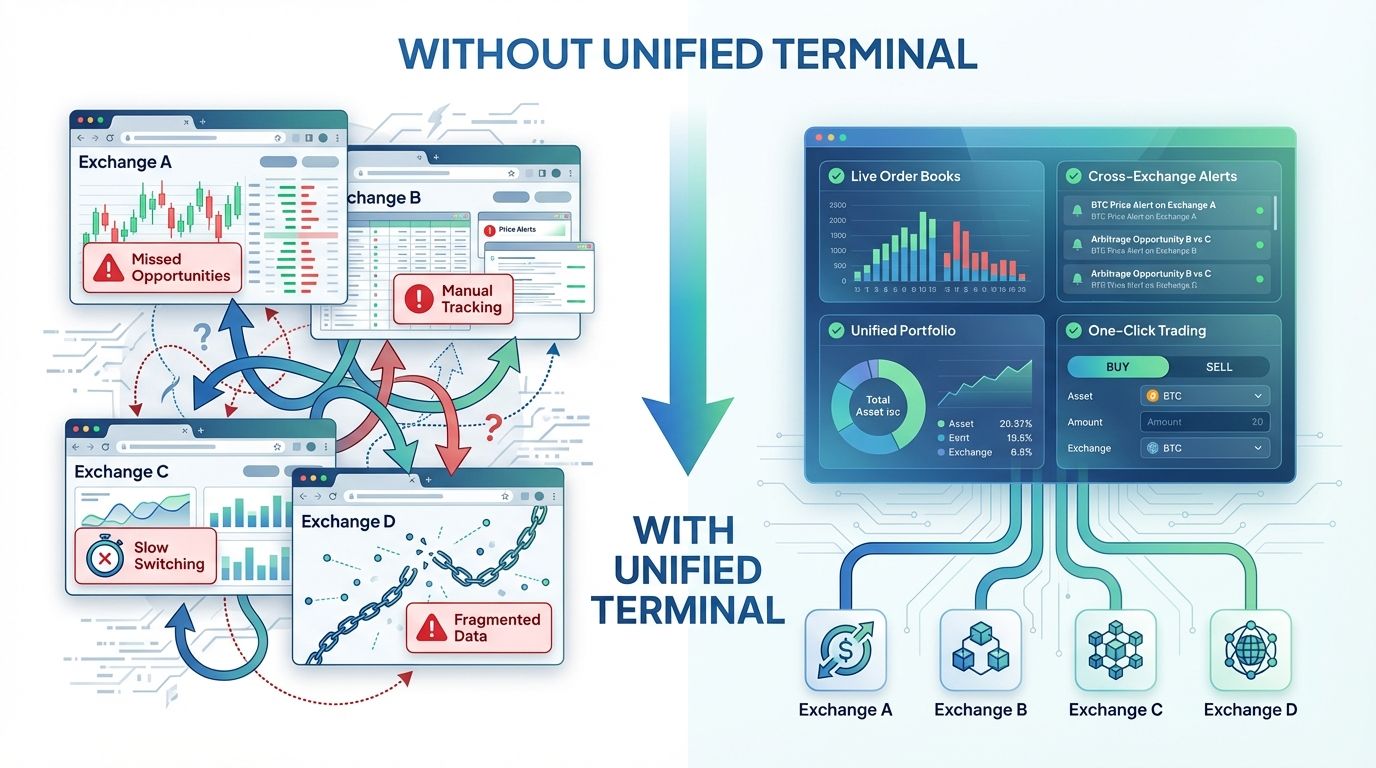
Serious traders rarely use just one exchange. They spread activity across multiple platforms for better pricing, deeper liquidity, unique listings, and arbitrage opportunities. But managing three or four exchanges means switching tabs, tracking positions manually, and missing opportunities.
Altrady solves this as a multi-exchange crypto trading terminal. It connects all your exchange accounts through a single interface where you can monitor order books across exchanges simultaneously, execute trades without switching platforms, set up cross-exchange alerts and automated strategies, and track your complete portfolio in one dashboard.
Instead of choosing between exchanges, you can leverage each one's strengths through a single terminal.
Frequently Asked Questions
What happens to my crypto when I deposit it on a centralized exchange?
Your tokens transfer to a wallet controlled by the exchange, and your account balance updates accordingly. Most reputable exchanges store 95% or more of user funds in cold storage (offline wallets). You can withdraw to a personal wallet at any time, though withdrawal fees may apply.
Can I trade on a DEX without any identification?
Yes. DEXs do not require KYC or any personal information. You only need a compatible crypto wallet (like MetaMask for Ethereum-based DEXs or Phantom for Solana DEXs) with some tokens to trade and pay gas fees. However, you cannot deposit fiat currency directly on a DEX, so you need to acquire crypto through a CEX or peer-to-peer service first.
Why do prices differ between exchanges?
Each exchange has its own independent order book or liquidity pool, so supply and demand dynamics vary. These differences create arbitrage opportunities. On major pairs, price discrepancies are usually under 0.1%, but on smaller tokens, differences can be more significant.
Are my funds safe on a crypto exchange?
No exchange is 100% risk-free. To minimize risk, choose exchanges with strong security track records, enable 2FA and withdrawal whitelists, avoid leaving large amounts on any single exchange, and consider self-custody for long-term holdings. DEXs eliminate exchange custody risk but introduce smart contract risk instead.
What is the difference between a market order and a limit order?
A market order executes immediately at the best available price, guaranteeing execution but not price. A limit order specifies the exact price you want, only executing if the market reaches it. Limit orders sit in the order book until filled or canceled and typically incur lower fees since they add liquidity.
How do exchange fees affect my trading profits?
Fees compound significantly over time, especially for active traders. At a 0.10% fee per trade, 100 round-trip trades (buy + sell) cost 20% of your traded volume in fees. This is why fee comparison matters: a trader executing $100,000 in monthly volume pays $200 at 0.10% per side, but only $40 at 0.02% per side. Volume-based discounts, maker fee rebates, and exchange-native token discounts can substantially reduce these costs.