
In May 2026, the US Commerce Department committed more than $2 billion to accelerate quantum computing infrastructure, with IBM and GlobalFoundries leading the effort. The announcement marked the largest single US public investment in quantum computing to date and reignited a question that has shadowed the crypto industry for over a decade: at what point does quantum computing threaten the cryptographic foundations of Bitcoin, Ethereum, and the broader crypto ecosystem?
For crypto traders, the quantum threat is often misunderstood as either an immediate existential risk or a distant theoretical concern. The reality is more nuanced, and the timeline matters for portfolio construction over the next 5 to 10 years.
This guide explains what quantum computing is, why it could affect crypto signatures, what the US $2 billion investment changes, the current state of quantum-resistant cryptography, and what traders should think about as the field accelerates.
What Is Quantum Computing?
Quantum computers exploit quantum mechanical phenomena (superposition, entanglement) to perform certain calculations exponentially faster than classical computers. Where a classical computer evaluates one path through a problem at a time, a quantum computer can evaluate many paths simultaneously.
For most applications (web browsing, video streaming, even most enterprise computing), classical computers remain far more practical. Quantum advantage applies to specific problem classes: factoring large numbers, simulating quantum systems, certain optimization problems.
The factoring problem matters for crypto. Two of the most widely used cryptographic primitives (RSA encryption and elliptic curve digital signatures) are secure because factoring large numbers is computationally hard for classical computers. A sufficiently large quantum computer running Shor's algorithm can factor those numbers in polynomial time, breaking the cryptographic security assumption.
Why This Matters for Crypto
Bitcoin and most major crypto networks use elliptic curve digital signatures (specifically ECDSA on secp256k1 for Bitcoin and Ethereum). The security model relies on the assumption that deriving a private key from a public key is computationally infeasible. That assumption holds against classical attacks indefinitely.
Against a sufficiently powerful quantum computer running Shor's algorithm, the assumption breaks. A quantum attacker with access to a public key could derive the corresponding private key and sign transactions as if they owned the wallet.
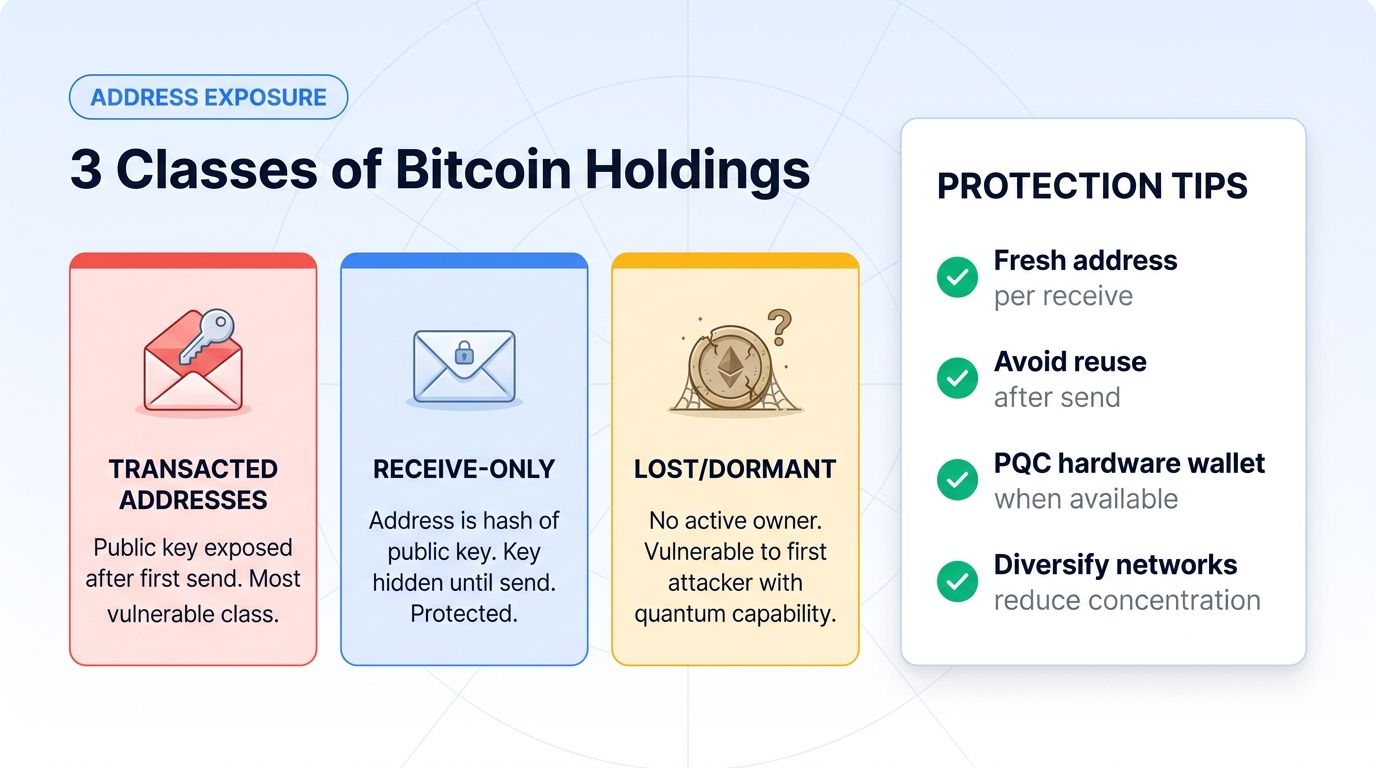
Three classes of crypto holdings face different exposure levels.
Class 1: Addresses that have transacted (public keys exposed). Once a wallet sends a transaction, its public key becomes visible on-chain. A quantum attacker can attempt to derive the private key from the exposed public key. This includes most active wallets, exchange hot wallets, and any address that has ever sent funds.
Class 2: Addresses that have only received (public keys hidden). Bitcoin addresses are hashes of public keys. If an address has only received funds (never sent), the public key behind it remains hidden. A quantum attacker would need to break the hash function first, which is harder than breaking the signature scheme directly.
Class 3: Lost or dormant coins. Significant Bitcoin supply (including the estimated 1 million BTC mined by Satoshi Nakamoto) sits in addresses whose private keys are presumed lost. These coins are not protected by being held by a paranoid user , they are vulnerable to whoever first builds a sufficiently powerful quantum computer.
Why the US $2 Billion Investment Matters
The May 2026 Commerce Department announcement is significant for three reasons.
First, the scale. $2 billion is substantially larger than prior US quantum investments. Combined with the National Quantum Initiative funding from previous years, total US quantum spend now exceeds $5 billion.
Second, the industrial partnership. IBM and GlobalFoundries leading the implementation effort signals that quantum computing is transitioning from research curiosity to industrial-scale infrastructure. Manufacturing capability, not just laboratory demonstrations, is now the focus.
Third, the strategic competition signal. The US investment is partly a response to Chinese quantum computing programs, which have been heavily funded and have produced notable demonstrations. The two countries are now in a race for quantum supremacy, with crypto security implications as a side effect.
For crypto traders, the investment accelerates the timeline for when quantum threat becomes operationally relevant. Most expert estimates for "cryptographically relevant quantum computer" still range from 7 to 15 years. The accelerated investment shortens that range modestly but does not eliminate the multi-year preparation window.
The Current State of Quantum Computers
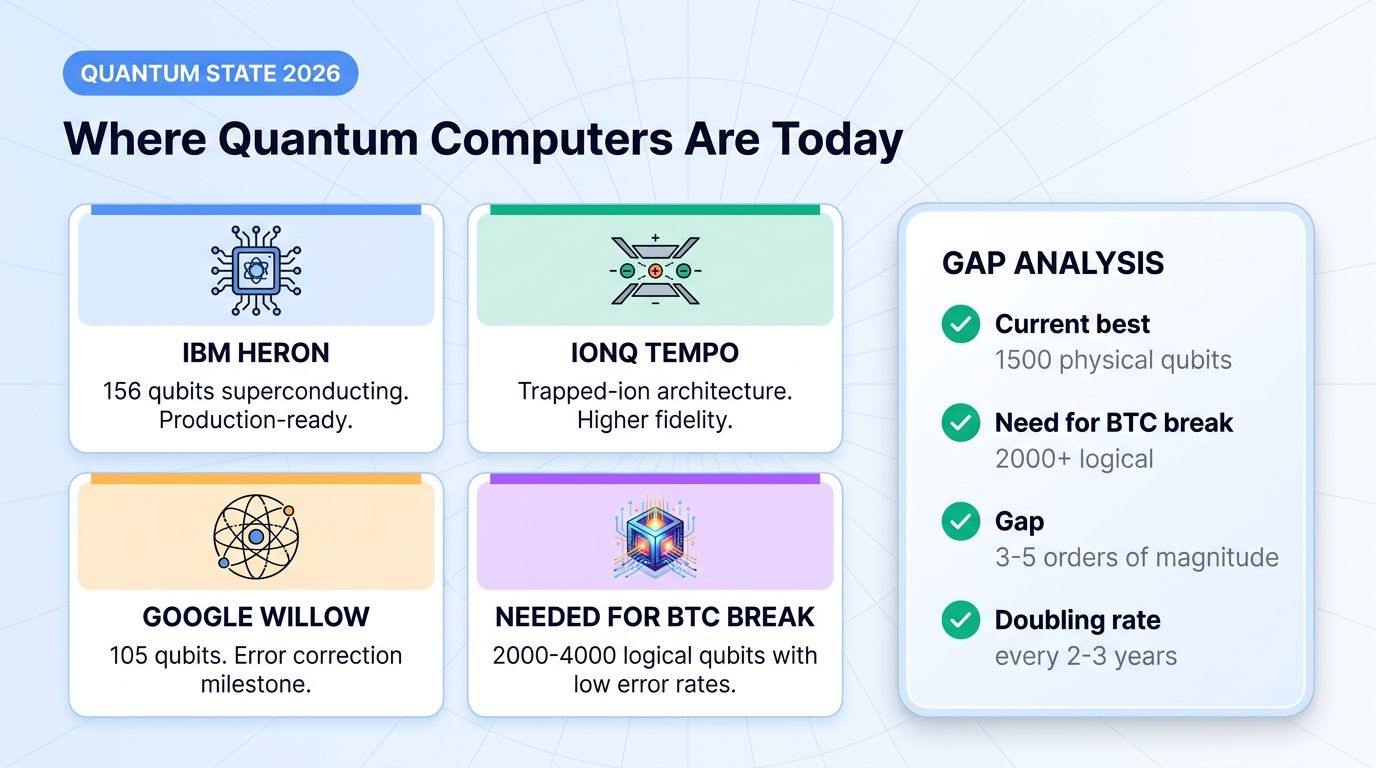
As of mid-2026, the most advanced quantum computers have several hundred to ~1,500 qubits depending on architecture. Major systems include IBM's Heron and Condor processors, Google's Sycamore variants, IonQ's trapped-ion systems, and several others.
The qubit count alone is misleading. What matters is the number of logical qubits (error-corrected) and the gate fidelity. Current systems have very few logical qubits (single digits) and limited operation depth before errors accumulate.
To break Bitcoin's elliptic curve signature scheme, current estimates suggest needing approximately 2,000 to 4,000 logical qubits operating with low error rates for the duration of the attack. Current systems are roughly 3 to 5 orders of magnitude short of that capability.
The trajectory is improving rapidly. Logical qubit counts roughly double every 2-3 years with current investment levels. The $2 billion accelerant could shorten this doubling time.
When Will Quantum Become a Real Threat?
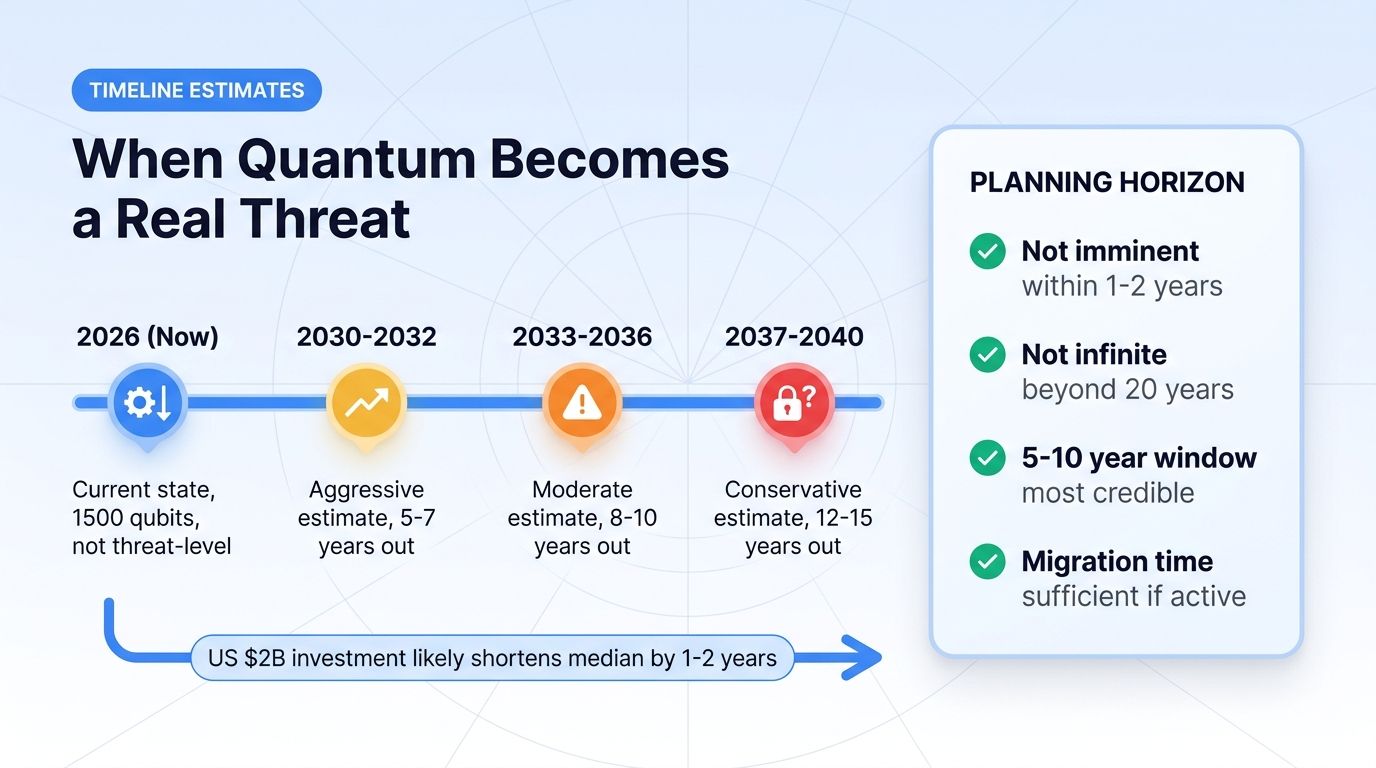
Three timeline ranges based on different assumptions.
Conservative estimate: 12 to 15 years. Standard extrapolation from current quantum progress with default investment levels. Most academic researchers cluster around this range.
Moderate estimate: 8 to 10 years. Assumes accelerated investment, breakthrough engineering advances, and continuing progress in error correction. Some industry analysts use this range.
Aggressive estimate: 5 to 7 years. Assumes major unexpected breakthroughs (new quantum architectures, algorithm improvements, or massive state investment). A minority of researchers consider this plausible.
The new $2 billion investment likely accelerates the median timeline by 1 to 2 years. The conservative estimate becomes 10 to 13 years; the moderate estimate becomes 6 to 8 years.
For crypto holders, this means the quantum threat is not imminent (within 1 to 2 years) but is also not infinitely distant (beyond 20 years). The 5 to 10 year window is the most credible planning horizon.
How Crypto Networks Are Preparing
The crypto community is working on post-quantum cryptography (PQC) , signature schemes and encryption methods that resist quantum attacks.
NIST (the US National Institute of Standards and Technology) has standardized several PQC algorithms after a multi-year competition. The leading candidates include CRYSTALS-Dilithium, CRYSTALS-Kyber, and SPHINCS+. These algorithms use mathematical problems (lattice-based, hash-based) that remain hard for quantum computers.
Bitcoin developers have been discussing PQC migration paths for years. Several proposals exist:
- Soft fork to add quantum-resistant signature schemes alongside ECDSA
- Hard fork to migrate fully to a PQC scheme
- Hybrid approach (two-signature requirement using both ECDSA and PQC)
Ethereum has been more proactive. The Ethereum roadmap includes provisions for quantum-resistant account abstraction, and several teams are developing PQC-ready smart wallet schemes.
Other major networks (Solana, Aptos, Cardano) have varying levels of PQC preparation. None is fully quantum-resistant today, but most have research programs.
What Traders Should Do
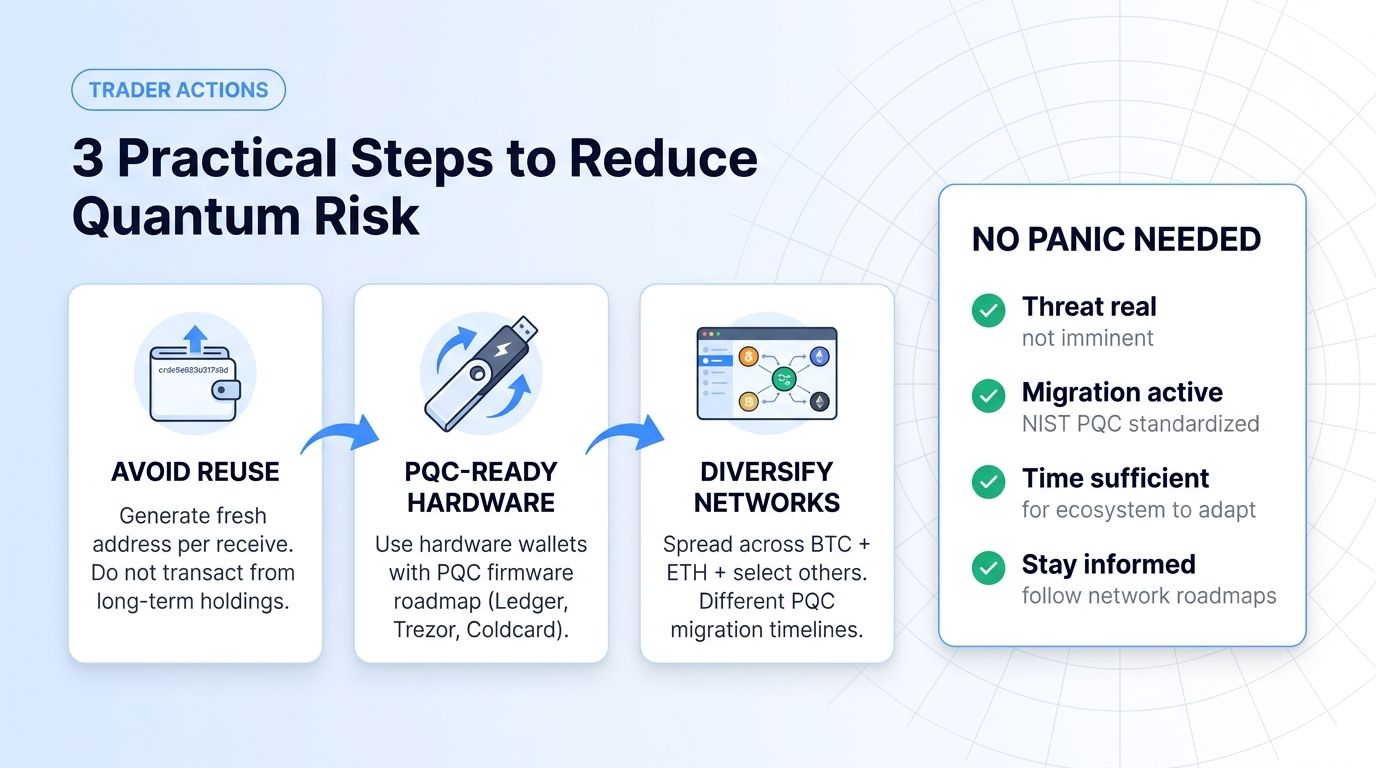
Three practical actions.
Action 1: Avoid Address Reuse for Long-Term Holdings
Bitcoin and similar networks become quantum-vulnerable once a wallet sends a transaction (revealing the public key). For long-term holdings, generate fresh addresses for receiving funds and do not transact from them until necessary. This reduces the attack surface significantly.
Action 2: Use Hardware Wallets with PQC Migration Support
Modern hardware wallets are beginning to support firmware updates for PQC schemes. Choose hardware wallets from vendors actively working on PQC migration (Ledger, Trezor, Coldcard). Update firmware as PQC support rolls out.
Action 3: Diversify Across Networks
Different networks face different quantum exposure timelines depending on their PQC migration progress. Diversifying across multiple major networks (BTC, ETH, and select others) reduces concentration risk if any one network's migration is delayed.
For active traders managing positions across multiple networks, a platform like Altrady (connecting to 19+ exchanges) provides unified portfolio tracking while networks complete their PQC migrations.
How Quantum Risk Fits Into Portfolio Allocation
A practical framework:
- 5 to 10 year holdings: Quantum risk is non-trivial but not imminent. Standard crypto allocation reasonable.
- 10 to 20 year holdings: Quantum risk is material. Consider migrating to addresses with PQC support as it becomes available.
- Generational holdings (20+ years): Quantum risk is significant. Active planning required.
Most traders should not panic-sell crypto due to quantum risk. The threat is real but the timeline is sufficient for the ecosystem to adapt.
The Broader Implications
Three structural observations.
Observation 1: The transition will be messy. PQC schemes have larger signature sizes (10 to 100x compared to ECDSA). On-chain transactions will become more expensive in storage and bandwidth. Networks must navigate this carefully.
Observation 2: Backward compatibility matters. Long-dormant coins (Satoshi's holdings, lost wallets) may become quantum-vulnerable before they migrate. The community is debating whether to freeze or burn vulnerable coins.
Observation 3: New crypto businesses may emerge. Quantum threat creates demand for PQC-native networks, quantum-safe custody services, and migration consulting. Several startups are positioning for this market.
The Risks of Underestimating Quantum
Two specific risks.
Risk 1: Surprise breakthrough. Quantum computing has occasionally produced surprise advances. A new algorithm, new physical architecture, or breakthrough in error correction could compress timelines unexpectedly.
Risk 2: Delayed migration. Networks that move slowly on PQC migration may face periods of vulnerability when quantum capability arrives. The migration must complete before threat materializes.
The mitigation for both risks is the same: support and follow the PQC migration efforts on networks you hold. Active community participation accelerates timelines.
FAQ
Is Bitcoin already vulnerable to quantum attacks?
No. Current quantum computers are 3 to 5 orders of magnitude short of the capability needed to break Bitcoin's signature scheme. The threat is real but not operationally relevant today.
When will quantum computers actually break Bitcoin?
Estimates range from 5 to 15 years. The most credible range is 8 to 12 years with the accelerated investment. This provides sufficient time for PQC migration if the ecosystem prioritizes it.
Should I sell my Bitcoin due to quantum risk?
No. The threat is not imminent and the ecosystem is actively migrating to quantum-resistant cryptography. Standard portfolio allocation remains appropriate. Avoiding address reuse for long-term holdings is a reasonable defensive measure.
What happens to Satoshi's coins if quantum breaks Bitcoin?
This is the most-debated question. The ~1 million BTC in addresses linked to Satoshi sit in old-format addresses with exposed public keys. They are technically vulnerable. The community is debating whether to freeze, burn, or migrate these coins.
Can I trade crypto on Altrady while quantum migration happens?
Yes. Altrady connects to 19+ exchanges and provides unified portfolio management. The platform itself does not introduce additional quantum exposure beyond your underlying exchange and wallet choices. As PQC support rolls out across networks and exchanges, your positions remain trackable through Altrady's multi-exchange dashboard.
Conclusion
The US Commerce Department's $2 billion quantum investment marks an inflection point in the quantum-crypto conversation. The investment signals that quantum computing is transitioning from research project to industrial infrastructure, with strategic implications that include but extend beyond crypto security.
For traders, the practical takeaway is this: quantum is a real long-term concern but not an imminent threat. The 5 to 15 year timeline is sufficient for the crypto ecosystem to migrate to quantum-resistant cryptography, but that migration requires active participation from the major networks (Bitcoin, Ethereum, Solana, others) and the broader community.
The smart positioning is awareness without panic. Maintain standard portfolio allocations. Avoid unnecessary address reuse for long-term holdings. Use hardware wallets from vendors working on PQC migration. Follow the migration progress on networks you hold.
The longer-term implication is more interesting: if PQC migration succeeds, crypto becomes one of the most cryptographically advanced financial systems in the world. If it fails or stalls, alternative networks with native PQC support will gain market share. Either way, the quantum era will reshape how crypto security is conceived and operated. The $2 billion investment is one data point in a much longer trajectory.