

The Securities and Exchange Commission is proposing its largest overhaul of US public listing rules in more than two decades. The reform aims to cut compliance costs, streamline disclosure requirements, and provide crypto firms with a much easier path to raise capital on Wall Street. For an industry that has spent years navigating ambiguous registration pathways, the proposed changes could materially reshape how crypto companies access US capital markets.
For traders watching the broader crypto regulatory environment in 2026, the SEC listing overhaul sits alongside the CLARITY Act, the Strategic Bitcoin Reserve, the FHFA crypto mortgage directive, and other coordinated policy moves toward a more mature US crypto regulatory framework.
This guide explains what the SEC listing overhaul proposes, the specific impacts on crypto firms, which companies stand to benefit, the trader implications, and the timeline for implementation.
What Is the SEC Public Listing Overhaul?
Note: Separately from the public listing overhaul, the SEC also worked on the Innovation Exemption framework that would have enabled tokenized stocks on crypto-native platforms - this was delayed in May 2026.
The SEC's listing reform addresses a broad set of rules governing how companies become publicly traded in the US. The current framework, largely shaped by Sarbanes-Oxley (2002), JOBS Act (2012), and various subsequent rules, has been criticized as overly burdensome for many companies.
The proposed overhaul has three main components.
First, simplified disclosure requirements. Smaller and earlier-stage companies face reduced disclosure burdens during the IPO process and ongoing reporting. The threshold for "emerging growth company" status and similar designations expands, allowing more companies to use streamlined paths.
Second, lower compliance costs. Various regulatory filings, certifications, and operational requirements are simplified or removed. The SEC estimates this could reduce ongoing compliance costs significantly for many issuers.
Third, expanded pathways for non-traditional listings. The reform creates clearer pathways for companies in newer industries (including crypto, AI, biotech) to navigate the listing process. The current framework was designed largely for traditional businesses and creates friction for novel business models.
The reform package is substantial in scope, with hundreds of pages of proposed rule changes across multiple SEC divisions.
Why the Overhaul Matters in 2026
Three forces drove the SEC to propose the reform.
First, US capital markets share has declined. International competitors (LSE in London, Hong Kong, Singapore, Frankfurt) have attracted listings that historically would have gone to US exchanges. Reducing listing friction is a strategic response.
Second, the IPO market has been slow. From 2022-2024, IPO activity was suppressed by market conditions, but the longer-term decline suggests structural friction. Streamlining listing rules addresses one cause.
Third, regulatory burden on growth-stage companies has compounded. As compliance technology and standards have evolved, the cumulative requirements on small and mid-cap public companies have grown. The reform attempts to recalibrate.
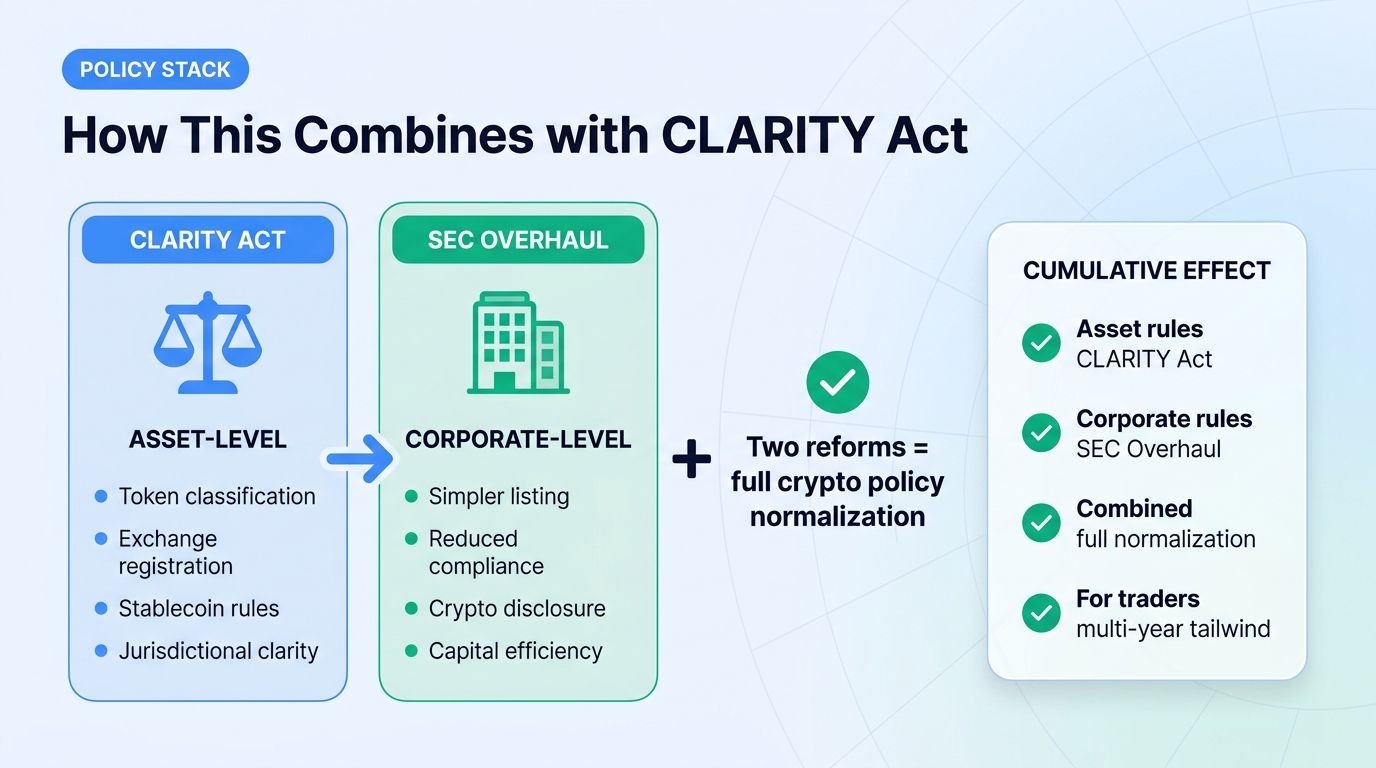
For crypto specifically, the timing aligns with broader US policy normalization. The CLARITY Act provides asset-level regulatory clarity. The SEC listing overhaul provides corporate-level regulatory clarity. Together, they reduce barriers for crypto firms to operate at scale within US markets.

What Crypto Firms Could Benefit
The reform's impact varies by company type.
Crypto Exchanges
Major US-licensed crypto exchanges (Coinbase, Kraken, Gemini, others) could benefit through additional secondary offerings, easier capital raises, and reduced ongoing compliance costs. Coinbase is already publicly listed; the reform could make secondary offerings more efficient. Privately-held Kraken and Gemini could find the IPO pathway more attractive.
Crypto-Native Operating Companies
Companies in stablecoins, custody, market making, and other crypto operations face decisions about whether to go public. Reduced listing friction makes IPO pathways more attractive relative to remaining private or listing abroad.
Tokenization and RWA Platforms
Companies like Ondo Finance, Figure Technologies, and tokenization-focused platforms can leverage simpler listing rules to go public earlier in their growth cycles. This brings more transparency to the sector and provides public-market investors with exposure.
Bitcoin and Crypto Treasury Companies
Treasury companies (Strategy, Twenty One Capital, Bitmine Immersion, smaller ones) benefit from streamlined ongoing reporting and the ability to issue equity or convertible debt more efficiently.
Crypto Mining Companies
Public crypto miners (Marathon, Riot, CleanSpark, others) gain from reduced compliance overhead. New miners can access public markets earlier.
AI Crypto Companies
Companies at the intersection of AI and crypto (Worldcoin/Tools for Humanity, Bittensor, agent-focused projects) benefit from clearer pathways to public markets when ready.
The Specific Changes That Matter
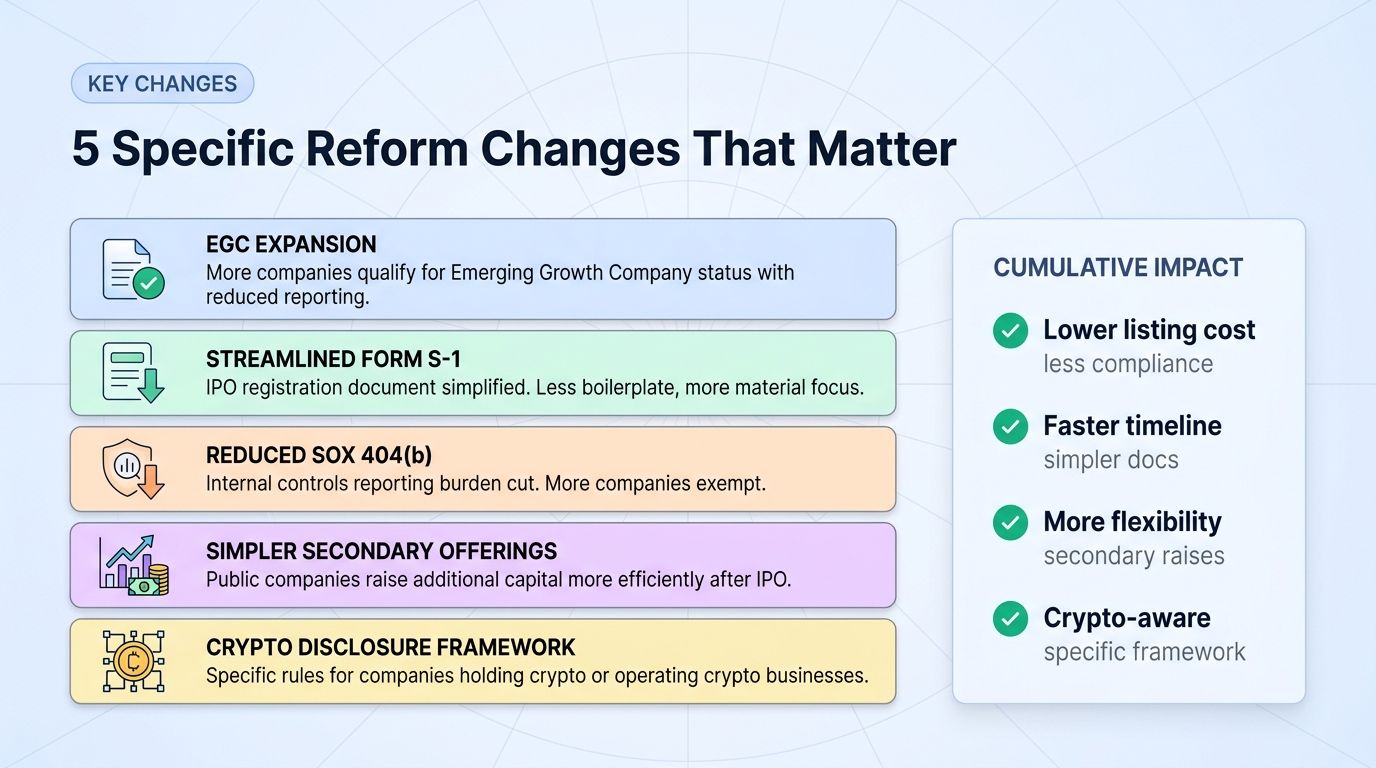
Five specific proposed changes have particular relevance.
Change 1: Emerging Growth Company (EGC) Threshold Expansion
EGC status provides relief from various reporting requirements. The reform expands the eligibility window and revenue thresholds, allowing more crypto firms to qualify and stay in EGC status longer.
Change 2: Streamlined Form S-1 Disclosure
The Form S-1 (IPO registration document) faces simplification. Required disclosures focus on material information; boilerplate is reduced. For crypto firms with non-traditional business models, this reduces the burden of explaining novel mechanics in dense regulatory language.
Change 3: Reduced Internal Controls (SOX 404(b)) Burden
Section 404(b) of Sarbanes-Oxley requires extensive internal controls reporting and auditor attestation. The reform extends exemptions or reduces requirements for more companies, lowering ongoing compliance costs.
Change 4: Simpler Secondary Offerings
After IPO, companies face complex rules for additional equity issuances. The reform streamlines these processes, making it easier and cheaper for public crypto firms to raise additional capital.
Change 5: Crypto-Specific Disclosure Framework
The reform creates a specific disclosure framework for companies holding significant crypto on their balance sheets or operating crypto businesses. This addresses the current ambiguity around how to disclose crypto activities, reducing legal risk for issuers.
How This Interacts with the CLARITY Act
The SEC listing overhaul and the CLARITY Act are complementary but address different layers.
The CLARITY Act:
- Classifies tokens as securities, commodities, or hybrid
- Creates exchange registration framework
- Addresses stablecoin yield rules
- Provides asset-level regulatory clarity
The SEC Listing Overhaul:
- Streamlines corporate listing processes
- Reduces compliance burdens for public companies
- Creates crypto-specific disclosure framework
- Provides corporate-level regulatory clarity
Together, they reduce both the asset-side (CLARITY) and corporate-side (Listing Overhaul) regulatory friction for the crypto industry. The cumulative effect could be substantial: easier to operate crypto businesses, easier to go public, easier to operate as public companies, easier to access capital.
Trader Implications
The reform affects traders through several channels.
More Public Crypto Investment Options
As more crypto firms go public, traders gain additional public-market vehicles for crypto exposure. This includes crypto exchanges, mining companies, treasury companies, tokenization platforms, and crypto-native operating companies. Diversification across these adds optionality beyond pure spot crypto.
Increased Information Transparency
Public companies file detailed financial reports. This produces more granular insight into the crypto industry's operations, revenues, and trends. Traders can use this information for fundamental analysis.
Capital Markets Activity as Signal
Equity raises, convertible bond issuances, secondary offerings, and IPO activity by crypto firms become tradable signals. Heavy capital raising signals investment activity; slowing capital raising can signal industry stress.
Indirect Crypto Exposure
For traders who want crypto exposure but cannot or do not want to hold crypto directly, public crypto company stocks provide alternative paths. The expanded universe of public crypto firms gives more options.
For active traders managing exposures across exchanges and stocks, a platform like Altrady (connecting to 19+ crypto exchanges) provides unified position management for the crypto portion alongside traditional brokerage for equity positions.
The Timeline for Implementation
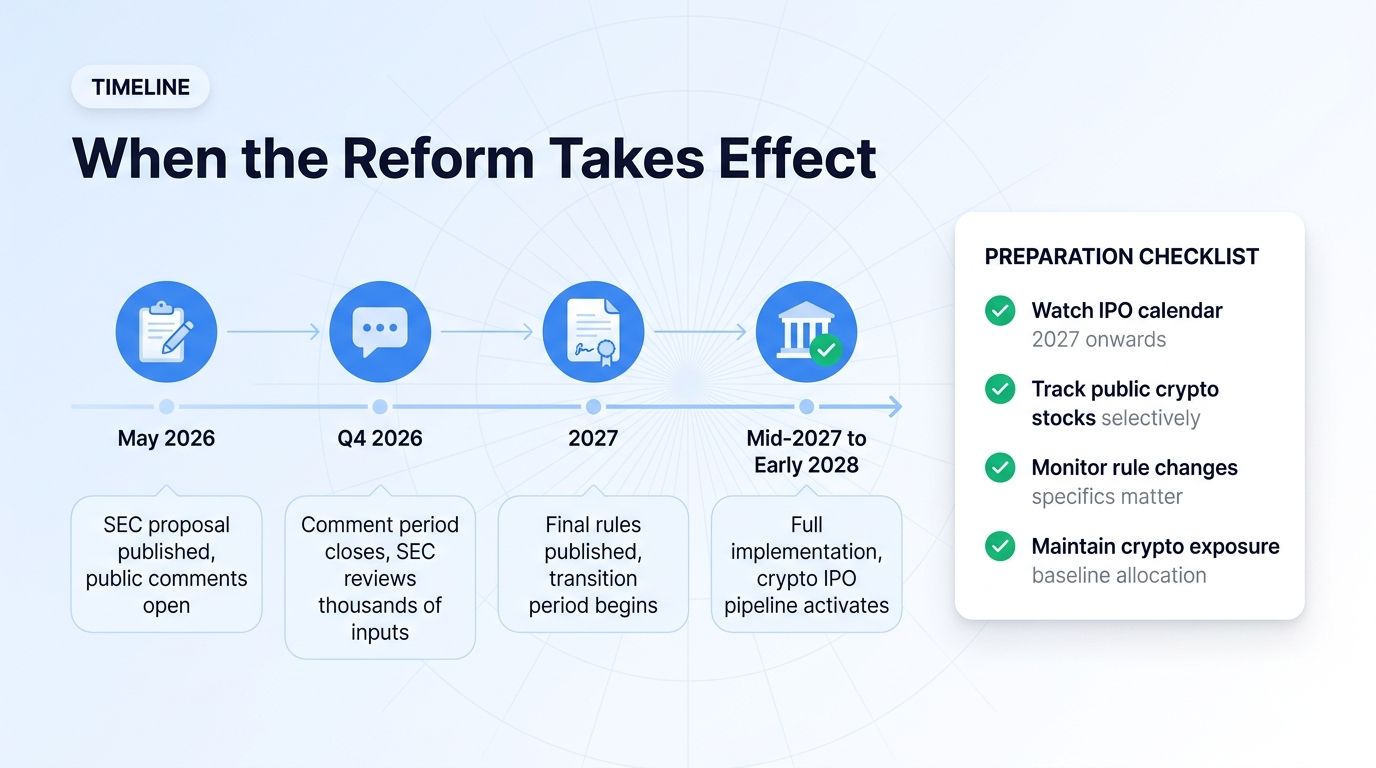
The reform process follows standard SEC rulemaking.
Proposal phase: The SEC publishes proposed rules and opens public comment period (typically 60-120 days). Comment review: SEC reviews thousands of comments from industry, investors, and stakeholders. Final rule: SEC publishes final rules, often with modifications from the proposal. Effective date: Rules take effect after a transition period.
Total timeline is typically 12-18 months from proposal to full effectiveness. For the SEC listing overhaul, this puts likely effectiveness in mid-2027 to early 2028, with some elements potentially earlier.
Crypto firms watching the reform are positioning for the transition. Several private crypto companies that had delayed IPO plans are reportedly accelerating preparation as the reform progresses.
The Risks and Limitations
The reform is not unambiguously positive.
Political reversal risk. Future administrations could revise or rescind the reform. The 12-18 month timeline creates exposure to political shifts.
Investor protection concerns. Critics argue that reducing disclosure requirements may harm retail investors who rely on transparent reporting. Some changes face vigorous opposition.
Asymmetric benefit. Larger, more sophisticated crypto firms benefit most. Smaller firms still face significant friction. The reform may not democratize listing access as much as proponents claim.
Implementation complexity. Hundreds of pages of rule changes create complexity in interpretation and application. The transition period will produce uncertainty.
International coordination. US listing rules interact with international markets, tax treaties, and cross-border investment frameworks. Coordination challenges may slow some changes.
How the Overhaul Fits Into 2026 Crypto Policy
The SEC listing overhaul is part of a broader coordinated US policy shift.
Already happened/happening: - FHFA crypto mortgage directive (May 2026) - CLARITY Act passing Senate Banking Committee (May 2026) - Strategic Bitcoin Reserve framework imminent (May-June 2026) - 67M Americans now own crypto (per NCA report)
Pending or imminent: - CLARITY Act full Senate vote (June 2026) - White House signing target (July 4, 2026) - SEC listing overhaul finalization (12-18 months) - Federal stablecoin regulatory framework
The cumulative pattern is a coordinated policy normalization that legitimizes crypto as a regulated component of the US financial system. For traders, the implication is that the structural foundation for sustained institutional growth is being built.
How to Position for the Reform
Three practical approaches.
Approach 1: Watch public crypto stocks. Public crypto companies (Coinbase, Strategy, mining stocks, others) benefit from the reform. As IPO activity picks up, additional names become available. Building positions in select public crypto stocks captures the benefit.
Approach 2: Watch IPO calendar. Crypto IPO activity will accelerate. Traders interested in early-stage public exposure can monitor IPO announcements and consider participation. IPO investing has its own risks (overpricing, lock-ups) but provides early exposure.
Approach 3: Stay informed on rule changes. Follow specific rule changes that affect your investment thesis. Industry-newsletter sources provide tracking. Understanding when specific changes take effect helps with timing.
FAQ
When does the SEC listing overhaul take effect?
The proposal phase is in 2026. Public comments, SEC review, and final rule publication typically take 12-18 months. Effective dates depend on specific rules but generally mid-2027 to early 2028 for full implementation. Some elements may take effect earlier.
Does this make it easier for new crypto exchanges to IPO?
Yes. The reform reduces compliance burdens that have historically made crypto exchange IPOs difficult. Kraken, Gemini, and other privately-held exchanges face an easier pathway. New entrants benefit even more.
Does this affect existing public crypto companies?
Yes. Existing public crypto companies (Coinbase, Strategy, mining companies, others) benefit from reduced ongoing compliance costs, simpler secondary offerings, and the new crypto-specific disclosure framework. These advantages compound over time.
How does this compare to crypto regulations in other countries?
The US has historically had more stringent listing rules than many international markets. The reform brings US rules closer to those of London, Hong Kong, Singapore, and Frankfurt. The competitive landscape becomes more balanced.
Can I trade crypto stocks on Altrady?
Crypto stocks (Coinbase, Strategy, mining companies, others) trade on traditional equity exchanges like NASDAQ and NYSE, not on crypto exchanges. Altrady focuses on crypto trading across 19+ crypto exchanges. For crypto stock exposure, you would use a traditional brokerage. Altrady provides the unified view for your crypto positions and automated strategies via signal bot, grid bot, or DCA bot.
Conclusion
The SEC's proposed listing overhaul represents the most significant US public listing reform in over two decades. For the crypto industry specifically, the changes lower barriers to going public, reduce ongoing compliance costs, and create clearer disclosure frameworks for novel business models.
For traders, the practical takeaway is this: the universe of public crypto investment options will expand significantly in 2027-2028 as more crypto firms IPO under simplified rules. This creates additional optionality for crypto exposure beyond direct token holdings.
The reform fits within a broader coordinated US policy normalization. Combined with the CLARITY Act, Strategic Bitcoin Reserve, FHFA crypto mortgage directive, and other 2026 policy moves, the structural foundation for crypto's continued institutional growth is being built. Traders who maintain exposure to the broader category will benefit from the multi-year tailwind these reforms create.
The next 18 months will produce decisive information on how the reform unfolds. Political dynamics, comment-period responses, and final rule details will all matter. But the directional momentum toward easier crypto firm access to US public markets is now firmly established, and the implications will reverberate through both the crypto industry and the broader trading landscape for years to come.