
The United States is preparing to become the first major sovereign to formally accumulate bitcoin as a reserve asset. In early May 2026, Patrick Witt, executive director of the President's Council of Advisors for Digital Assets, told the Consensus Miami audience that a Strategic Bitcoin Reserve (SBR) update is coming "in the next few weeks." Behind the scenes, the legal framework is essentially complete.
The United States already holds an estimated 328,372 BTC, worth roughly $25 billion at recent prices. These coins came almost entirely from criminal forfeitures and law enforcement seizures rather than open market purchases. The looming question is whether the US will move from passive holder to active accumulator.
This guide explains what the Strategic Bitcoin Reserve is, the two key bills in Congress (BITCOIN Act and ARMA), the current US holdings, what an active accumulation phase would mean for markets, and how traders should position for the announcements expected in summer 2026.
What Is the Strategic Bitcoin Reserve?
The Strategic Bitcoin Reserve (SBR) is the US government's framework for holding bitcoin as a sovereign reserve asset. The concept rests on three building blocks.
First, an inventory of existing holdings. The federal government already has approximately 328,000 BTC from various enforcement actions, including coins seized from Silk Road and other criminal cases. Without selling these coins, the US is the largest publicly disclosed sovereign holder of bitcoin in the world.
Second, an executive framework. The White House team led by Witt has developed administrative procedures to formalize the existing holdings as a strategic reserve. This framework can be implemented through executive action without waiting for legislation.
Third, a legislative pathway for active accumulation. The BITCOIN Act in the Senate and the American Reserves Modernization Act (ARMA) in the House would authorize the Treasury to purchase additional bitcoin on the open market, transitioning the US from passive holder to active accumulator.
Why the Strategic Bitcoin Reserve Matters in 2026
Three forces converged to make the SBR politically viable.
First, regulatory clarity advanced. With the CLARITY Act moving through Congress and the FHFA accepting crypto as a mortgage asset, the broader US regulatory environment is shifting toward crypto acceptance. The SBR fits the same direction of travel.
Second, sovereign competition emerged. El Salvador added bitcoin to its sovereign reserves in 2021. Several smaller countries have followed. As the largest economy and most influential reserve currency issuer, the US has strategic incentive to formalize its position rather than concede the narrative.
Third, the holdings already exist. With 328,000 BTC already in government custody, formalizing them as a strategic reserve is operationally simple. The harder question is whether to actively accumulate more, and that is where the legislative battle is focused.
For traders, the SBR announcement is one of the most significant catalysts on the 2026 calendar. The framing of "the United States accumulates bitcoin" reshapes the narrative around bitcoin's institutional role and could materially affect demand dynamics.
The Two Pillars: Executive Action and Legislation
Pillar 1: Executive Framework (Imminent)
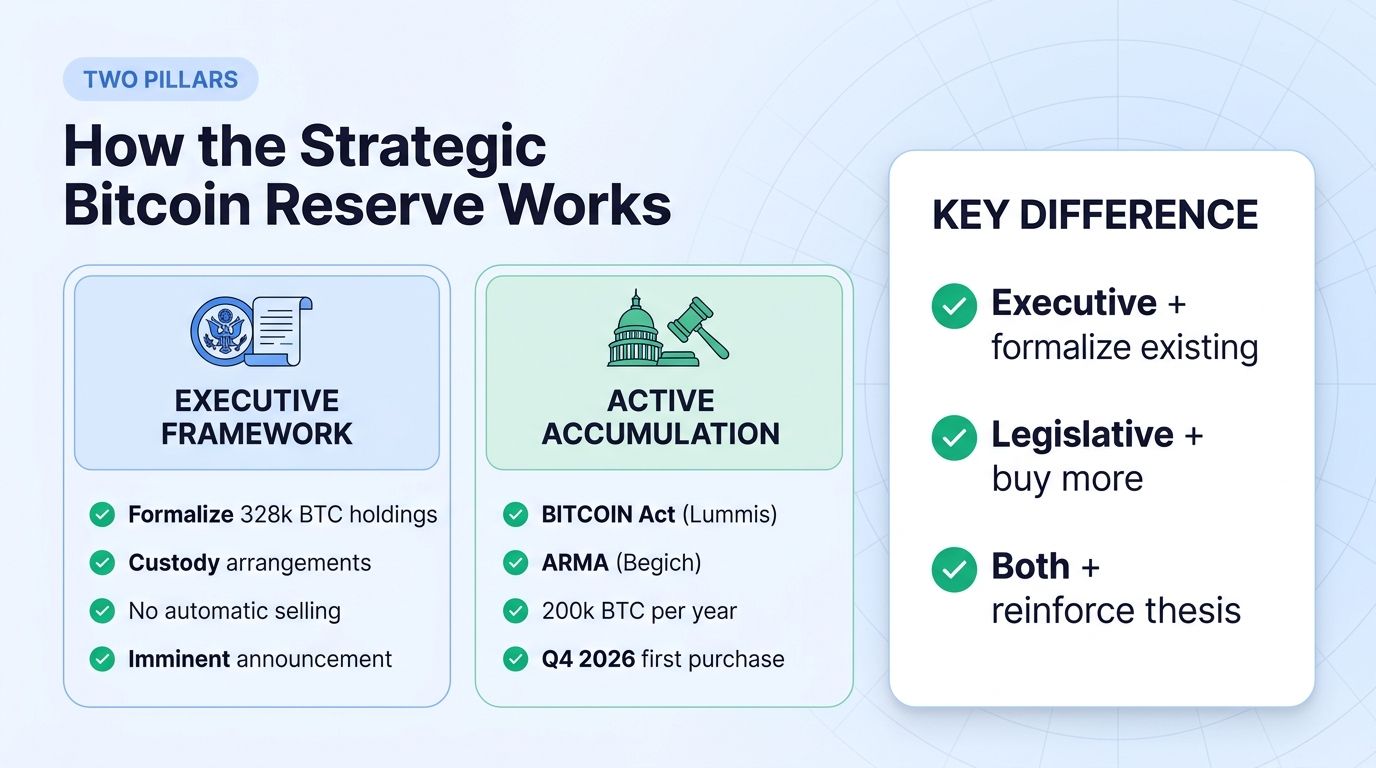
The White House team has reached what Witt described as a "breakthrough" on the legal framework. The administration can formalize existing holdings as a strategic reserve through executive action, without requiring new legislation.
Key elements of the executive framework:
- Designation of existing BTC holdings as a strategic reserve
- Custody arrangements (likely involving Treasury, Federal Reserve, or specialized custodians)
- Operational rules for the holdings (no automatic selling, valuation methodology, reporting)
- Coordination mechanisms across federal agencies
The announcement of this framework is expected in the next few weeks (as of mid-May 2026). It will set the formal structure without committing the US to additional purchases.
Pillar 2: BITCOIN Act and ARMA (Legislative)
The legislative battle centers on whether the US should actively accumulate bitcoin beyond what it already holds.
BITCOIN Act (Senator Lummis, Wyoming): Directs the Treasury to purchase 200,000 BTC per year for five years (1 million BTC total) and hold those coins for a minimum of 20 years. The proposed accumulation pace would significantly affect market supply.
American Reserves Modernization Act / ARMA (Representative Begich, Alaska): The House companion bill. Same general framework with adjustments for House procedural requirements.
If either bill passes, the Treasury would begin its first official bitcoin purchase in Q4 2026 or Q1 2027. That would represent the first time a major sovereign actively accumulates bitcoin as a reserve asset.
The bills face standard legislative friction. Bipartisan support exists, but specific provisions (funding source, accumulation pace, custody arrangements) remain contested.
The Current US Bitcoin Holdings
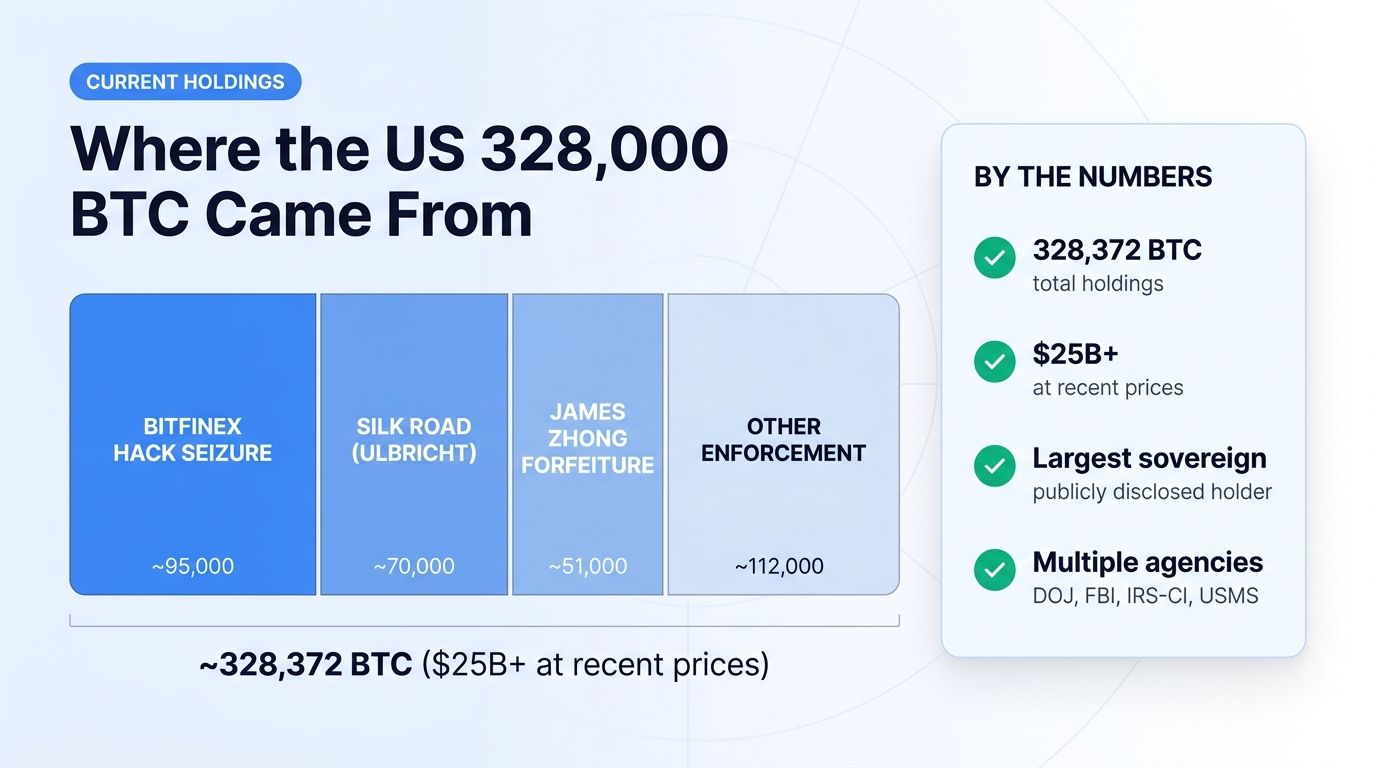
The 328,000+ BTC the US currently holds came from various sources.
Silk Road seizures: Approximately 70,000 BTC were seized from Silk Road operator Ross Ulbricht. Additional coins came from related enforcement actions.
James Zhong forfeitures: Roughly 51,000 BTC seized from Zhong, who had stolen them from Silk Road in 2012.
Bitfinex hack seizures: Approximately 95,000 BTC recovered from Ilya Lichtenstein and Heather Morgan, who had laundered coins stolen from the Bitfinex hack.
Other enforcement actions: Various smaller seizures from drug cases, sanctions violations, and other criminal cases.
These holdings are not consolidated in a single account. Various federal agencies (DOJ, FBI, US Marshals Service, IRS-CI) hold portions. Part of the SBR framework will be defining how the holdings are coordinated and reported.
Why Active Accumulation Would Matter
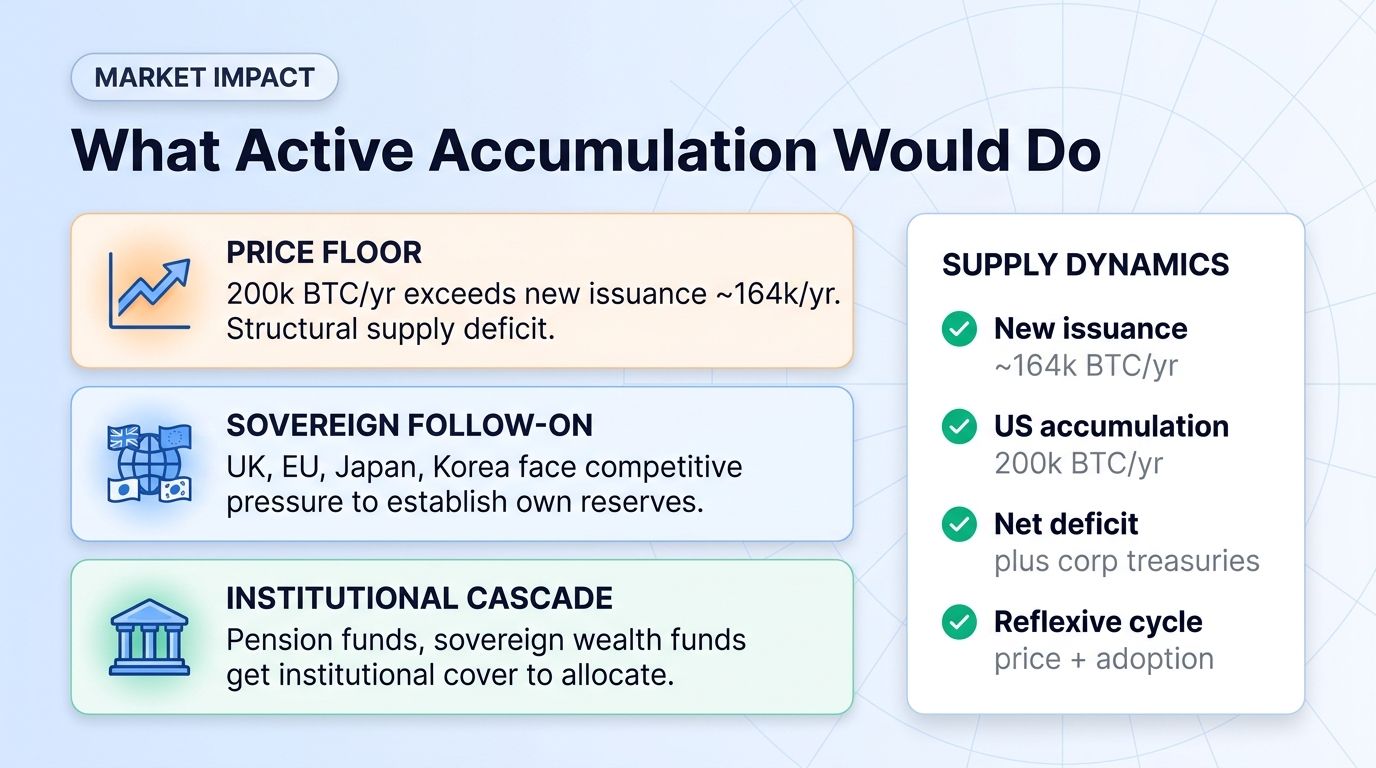
A US Treasury that buys 200,000 BTC per year for five years would absorb significant supply. To put the scale in context, total new bitcoin issuance through halvings is roughly 164,000 BTC per year currently and falling.
The proposed US accumulation pace would exceed new issuance, producing structural supply deficit. Combined with the existing buying from corporate treasury companies (Strategy, Bitmine, Twenty One Capital, and dozens of smaller ones), the cumulative demand could meaningfully tighten available bitcoin supply.
Three observable effects would likely follow.
Effect 1: Price impact. Sustained sovereign buying of 200k BTC per year creates a structural floor under bitcoin prices. The exact price impact depends on parallel selling from other holders, but the directional effect is upward.
Effect 2: Other sovereigns follow. If the US formalizes a Strategic Bitcoin Reserve and starts buying, other sovereigns (UK, EU, Japan, South Korea, others) face competitive pressure to establish their own reserves. The reflexive dynamic could accelerate sovereign demand.
Effect 3: Institutional acceleration. A US Treasury holding bitcoin as a strategic reserve provides ultimate validation. Pension funds, sovereign wealth funds, and institutional investors who have hesitated would have institutional cover to add bitcoin to their portfolios.
How Traders Should Position
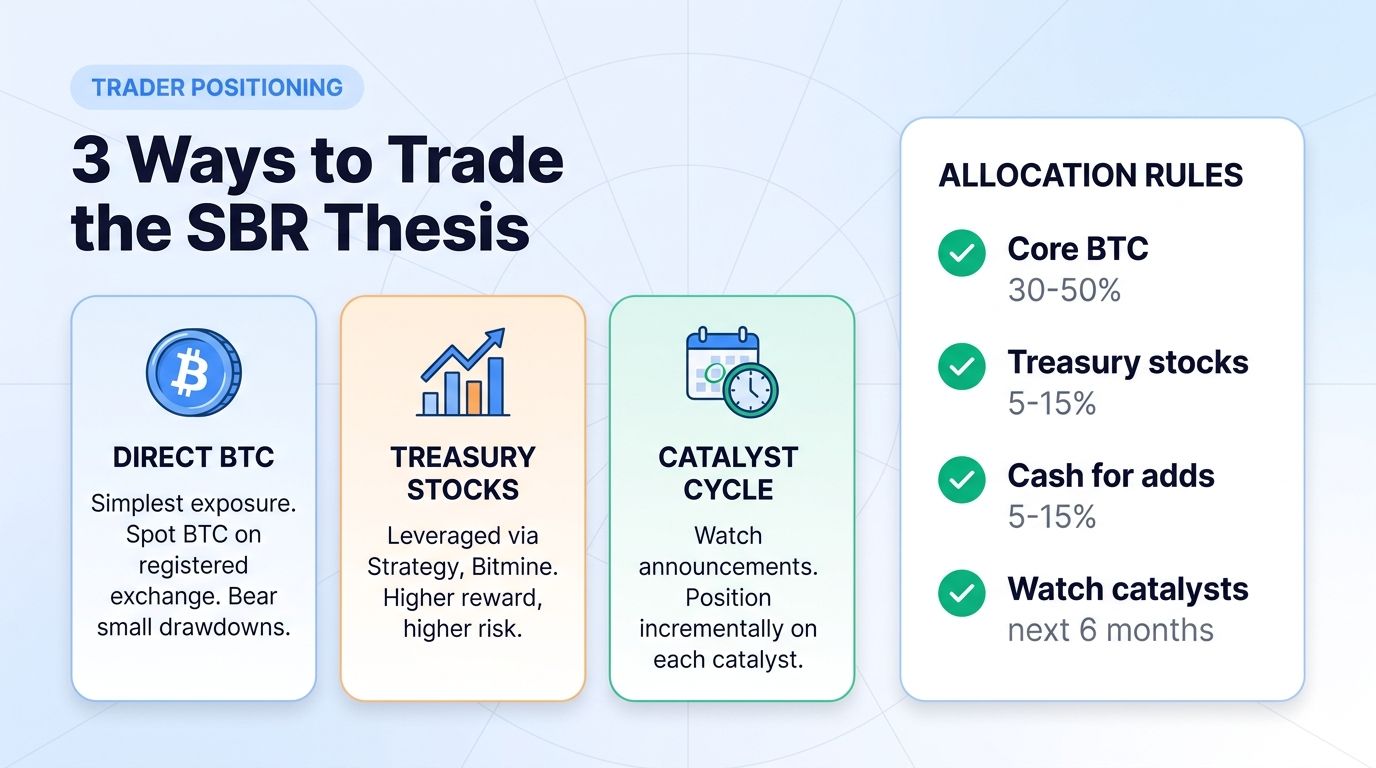
Three practical approaches.
Approach 1: Hold Direct Bitcoin Exposure
The simplest path is owning bitcoin directly. SBR announcements affect bitcoin price most directly. Traders who want to participate in the upside hold spot BTC in their preferred custody.
A platform like Altrady (connecting to 19+ exchanges) provides unified position management across exchanges, useful for traders who maintain bitcoin holdings across multiple venues.
Approach 2: Treasury Company Exposure (Leveraged)
Corporate treasury companies like Strategy provide leveraged exposure to bitcoin. If sovereign buying lifts bitcoin prices, treasury company stocks typically rise more (and fall more on downside). For higher-conviction traders, treasury company stocks amplify the SBR thesis.
Approach 3: Watch the Announcement Cycle
The next 6 months will produce multiple announcements: executive framework formalization, BITCOIN Act / ARMA progress, possible first purchase authorization. Each announcement is a tradable catalyst. Traders who watch the news flow can position incrementally rather than committing all capital at once.
The Risks of the SBR Thesis
Implementation delay. The "next few weeks" framing has been heard before. Government announcements often slip. Traders should not over-commit on specific dates.
Legislative failure. Bills face standard friction. The BITCOIN Act has bipartisan support but is not guaranteed to pass in its current form. Watered-down versions or pure framework legislation (no active accumulation) would have less market impact.
Sell pressure during transition. If the existing 328k BTC holdings are consolidated into specific custody arrangements, transitional sales (to clean up scattered accounts) could create temporary selling pressure.
Reverse risk: future administration sells. A future administration could reverse the policy and sell the reserve. This is a longer-term risk but worth incorporating into sizing discipline.
Macro overhang. If broader macro conditions (inflation surprises, geopolitical conflict, equity selloff) drive risk-off behavior, the SBR thesis can be temporarily overwhelmed by macro flows.
The Geopolitical Context
The SBR sits inside a broader geopolitical contest.
China's position: Despite restricting domestic crypto activity, China has been reported to hold significant confiscated bitcoin. Speculation persists about whether China would formalize a reserve in response to US moves.
Russia's position: Russia has explored using crypto for sanctions evasion. While Russia has not announced a formal bitcoin reserve, the strategic incentive exists.
El Salvador and small sovereign holders: El Salvador's bitcoin holdings (>5,800 BTC) and Bhutan's mining-based accumulation (>10,000 BTC) demonstrate the small-state pathway. These holders are not market movers individually but signal direction.
Public companies' role: US-listed companies (Strategy, Bitmine, others) collectively hold significantly more than US government holdings. The combined US ecosystem (government + corporate) controls approximately 1.5-2.0 million BTC, roughly 7-9% of total supply.
How the SBR Fits Into a Crypto Portfolio
A practical framework:
- Core bitcoin exposure: 30-50% of crypto allocation. The SBR is fundamentally a bitcoin story.
- Treasury company stocks: 5-15%. Leveraged exposure to the same thesis.
- Active trading capital: 20-40%. Position for catalysts as they emerge.
- Cash for opportunistic adds: 5-15%. Buy on weakness if macro overhang produces dislocations.
Most traders maintain higher bitcoin allocation in the lead-up to expected catalyst events rather than diversifying broadly. The SBR is sufficiently large that it can drive multi-month price action if announcements meet expectations.
FAQ
When will the Strategic Bitcoin Reserve be officially announced?
The White House framework announcement is expected in May or June 2026, per Witt's statements at Consensus Miami. The executive framework formalizes existing holdings. Active accumulation requires legislation, with first purchases likely in Q4 2026 or Q1 2027 if bills pass.
How much bitcoin does the US government currently hold?
Approximately 328,372 BTC as of May 2026, worth around $25 billion at recent prices. These holdings came from criminal forfeitures and law enforcement seizures, not open market purchases. The exact total varies as agencies sell or recover additional coins.
What is the BITCOIN Act?
The BITCOIN Act, introduced by Senator Cynthia Lummis, would direct the Treasury to purchase 200,000 BTC per year for five years (1 million BTC total) and hold those coins for a minimum of 20 years. The American Reserves Modernization Act (ARMA), introduced by Representative Nick Begich, is the House companion.
Will the US selling existing bitcoin holdings be a risk?
The framework specifically aims to prevent automatic selling. Past concerns about US Marshals Service auctions selling seized bitcoin should be largely addressed by formalizing the holdings as a strategic reserve. Future administrations could theoretically reverse the policy, but the framework is designed to make selling more procedurally difficult.
Can I trade bitcoin on Altrady ahead of SBR announcements?
Yes. Altrady connects to 19+ exchanges where you can hold and trade bitcoin. You can manage spot positions across multiple exchanges, run automated strategies via the signal bot, grid bot, or DCA bot, and use unified portfolio tracking to monitor your bitcoin exposure as SBR-related news develops.
Conclusion
The Strategic Bitcoin Reserve represents the most significant US sovereign crypto move in the country's history. With 328,000 BTC already in government custody and active accumulation legislation moving through Congress, the next 6-12 months will produce decisive announcements that shape the trajectory of US crypto policy.
For traders, the practical takeaway is this: bitcoin is positioned as a US sovereign reserve asset, with active accumulation potentially beginning in late 2026 or early 2027. The narrative shift from "speculative asset" to "sovereign reserve" represents one of the most powerful bull cases bitcoin has ever had.
The risks are real (implementation delays, legislative friction, macro overhangs) but the directional setup is clear. Traders who maintain bitcoin exposure and watch the announcement cycle stand to benefit from one of the most significant catalysts of the cycle.
The next several weeks will tell whether the "next few weeks" framing produces concrete action. Either way, the strategic reserve framework is now firmly part of the US crypto policy conversation, and the implications for bitcoin will reverberate through the rest of 2026 and into 2027.