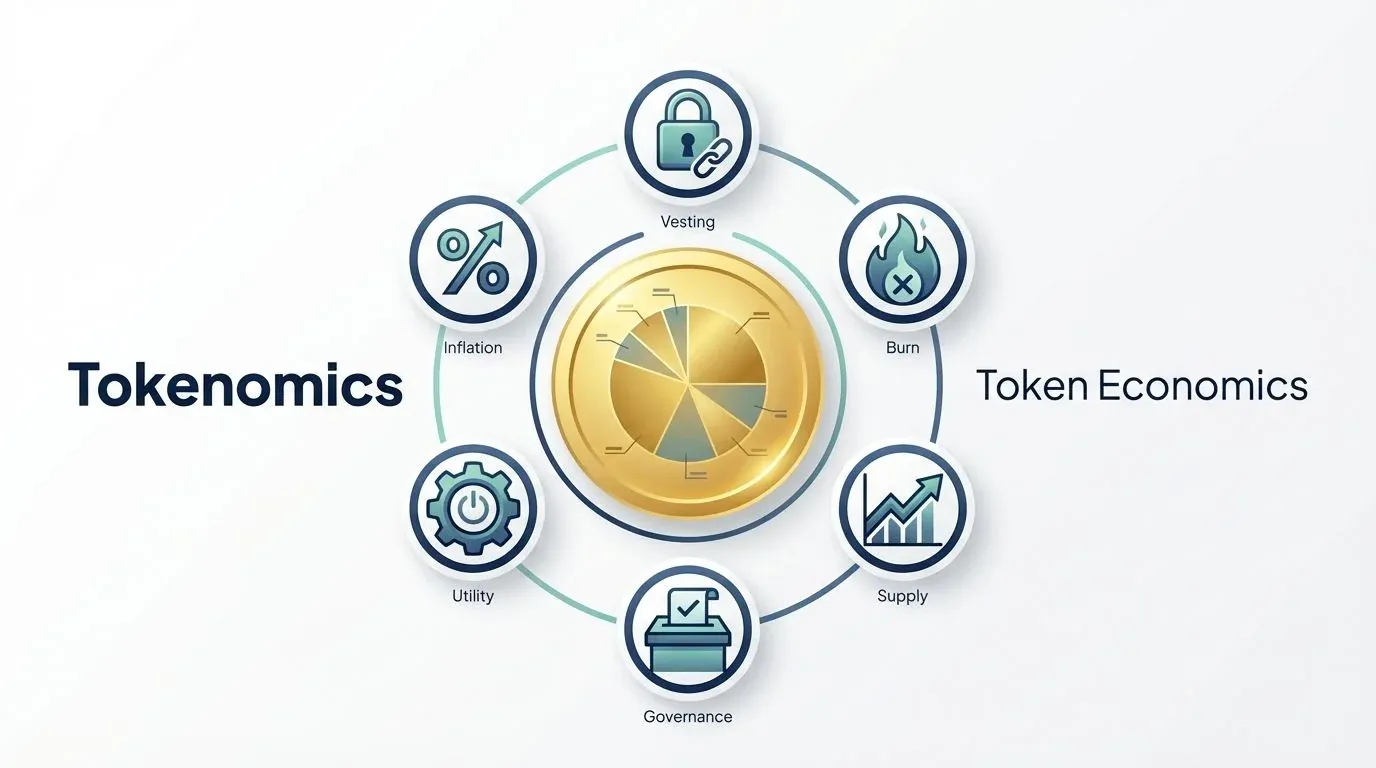

What Is Tokenomics?
Tokenomics is the study of a cryptocurrency or token's economic system: how tokens are created, distributed, used, and removed from circulation. The word combines "token" and "economics," and it covers everything from a project's total supply to who holds the tokens and why anyone would want to hold them in the first place.
Understanding tokenomics matters because price alone tells you almost nothing about a project's long-term viability. A token can surge 500% and still be heading toward zero if its design rewards early insiders at the expense of everyone else. Conversely, a seemingly flat-priced token may have strong underlying mechanics that set it up for sustained demand growth over time.
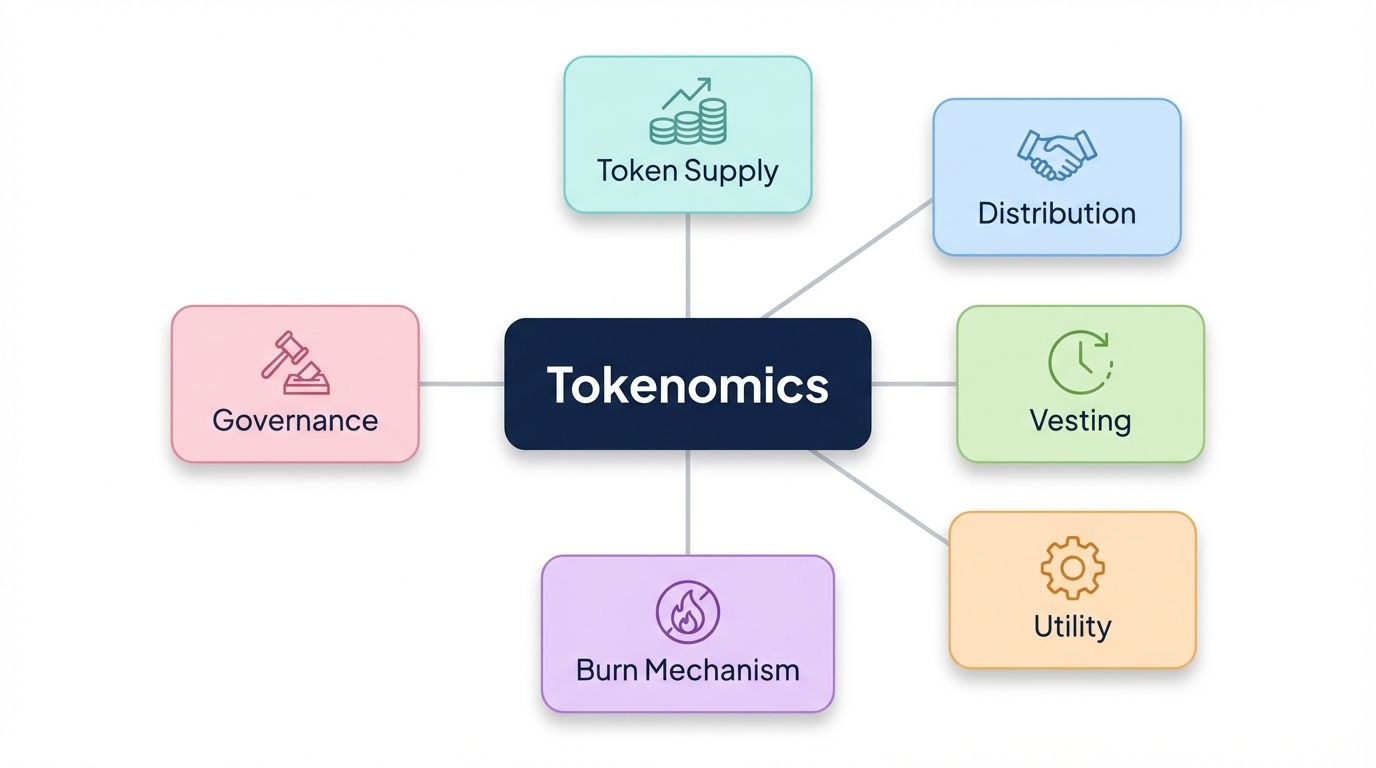
For serious crypto investors and traders, reading tokenomics is a foundational skill. It helps you separate projects built around genuine value creation from those engineered to extract value from retail buyers. Before you look at a chart, look at the token design.
The Core Components of Tokenomics
Supply: Circulating, Total, and Max
Three supply figures shape how the market prices any token. Circulating supply is the number of tokens actively tradable right now. Total supply includes circulating tokens plus any tokens locked in contracts or held in reserve but already minted. Max supply is the hard cap on how many tokens can ever exist.
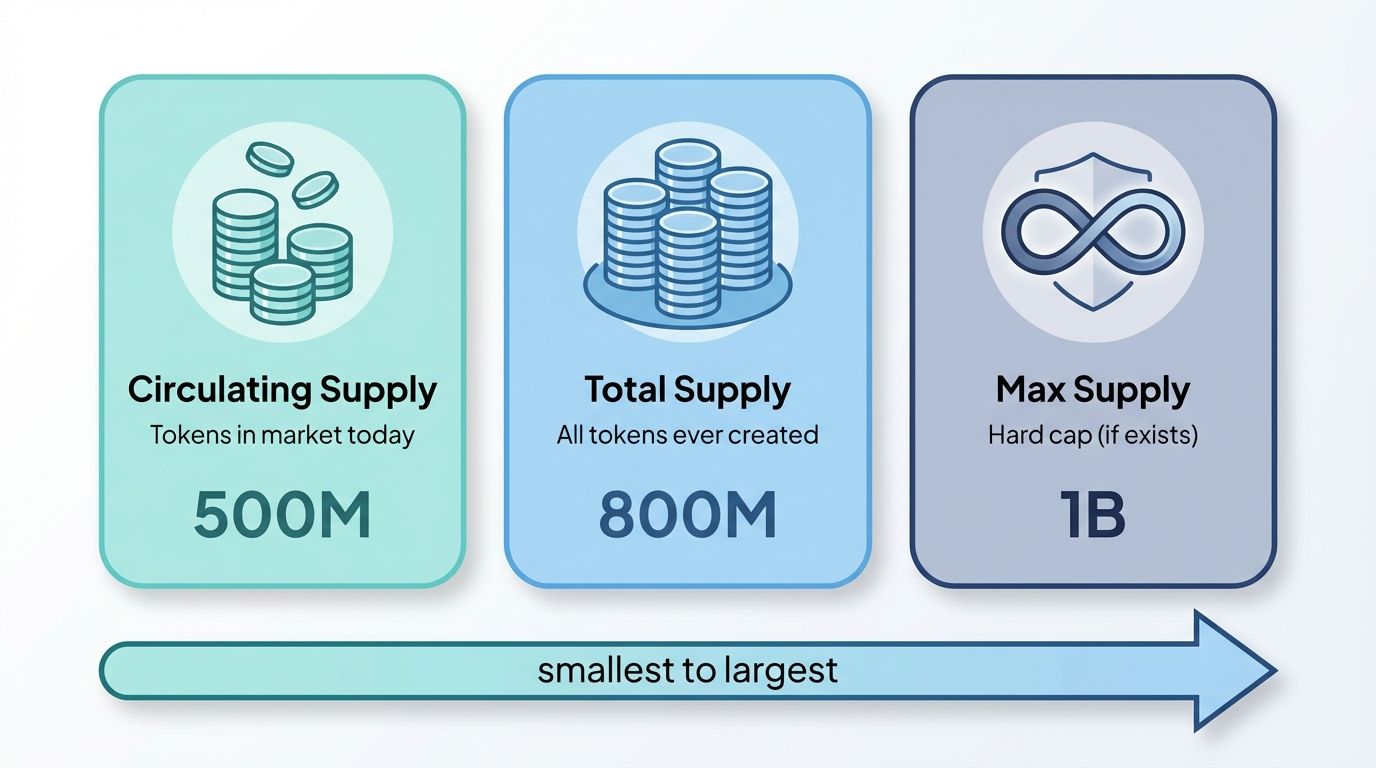
Bitcoin's max supply is capped at 21 million, which is one of its most cited properties as a store of value. Some tokens have no max supply at all, meaning new tokens can be minted indefinitely. Neither structure is automatically good or bad, but understanding the difference is essential before committing capital.
When comparing projects, always check the ratio of circulating supply to total supply. If only 10% of tokens are in circulation today, the other 90% will hit the market eventually, creating structural sell pressure even if the project performs well.
Token Distribution and Vesting
How tokens are allocated at launch reveals the intentions of the team. A typical breakdown might include allocations for team and advisors, investors and VCs, ecosystem funds, public sale, and community rewards. The problem arises when team and investor allocations are too large and unlock too quickly.
Vesting schedules define when locked tokens become transferable. A standard structure might be a 12-month cliff (no tokens released for the first year) followed by a 24-month linear unlock (a fixed number of tokens released monthly). Well-designed vesting aligns team incentives with long-term project health.
Projects that give founders tokens with no lockup, or with a cliff shorter than one year, are sending a clear signal: the people who built this project do not expect to stick around long enough to need a multi-year vesting schedule. That is a red flag worth taking seriously.
Emission Rate and Inflation
Emission rate describes how quickly new tokens enter circulation, whether through staking rewards, mining, liquidity incentives, or protocol grants. High emission rates dilute existing holders over time, similar to how share issuance dilutes equity investors.
Many DeFi projects launched with aggressive emission schedules to attract early liquidity, only to see token prices collapse as rewards were dumped by mercenary capital. A sustainable emission rate is one where new token issuance is offset by genuine demand growth or by deflationary mechanisms built into the protocol.
When evaluating a project, calculate the annual inflation rate by dividing new tokens issued per year by current circulating supply. Anything above 20 to 30% annually warrants scrutiny unless there is a compelling reason for that level of dilution.
Token Utility: Why Tokens Have Value
Governance and Voting Rights
Many tokens grant holders the right to vote on protocol decisions: fee changes, treasury spending, new feature deployments, or even changes to tokenomics itself. In theory, governance rights create demand because participants want influence over valuable protocols.
In practice, governance utility only holds up if the protocol is generating real value worth influencing. Governance tokens for protocols with little usage or revenue often trade purely on speculation, with few token holders actually participating in votes. Look for governance tokens tied to protocols with active, growing user bases.
Fee Sharing and Revenue Capture
Some protocols distribute a portion of fees generated on the platform directly to token holders or stakers. This is one of the strongest forms of token utility because it ties token value to real economic activity rather than narrative alone.
When a protocol earns fees, token holders who stake or lock their tokens may receive a percentage of that revenue. This creates a measurable yield and gives investors a way to value the token using cash flow metrics, similar to how equity investors value dividend-paying stocks. Fee-sharing tokens are worth analyzing carefully before any investment decision.
Staking and Protocol Security
Proof-of-stake networks require validators to lock up tokens as collateral in order to participate in block production. This mechanism removes tokens from circulation and creates demand from those who want to run validator nodes or delegate their stake.
Staking rewards incentivize this participation, but they also introduce inflation. The key metric here is real yield: staking reward rate minus the token's annual inflation rate. If you are earning 8% staking rewards on a token inflating at 15% per year, your real return is negative. Always calculate both figures together.
Deflationary vs Inflationary Models
Deflationary tokenomics refers to mechanisms that reduce the circulating supply over time. The most common approaches are token burns, where tokens are permanently sent to an unspendable address, and buybacks, where protocols use revenue to purchase tokens from the open market. Bitcoin is effectively deflationary through its halving cycle, which cuts new supply issuance in half roughly every four years.
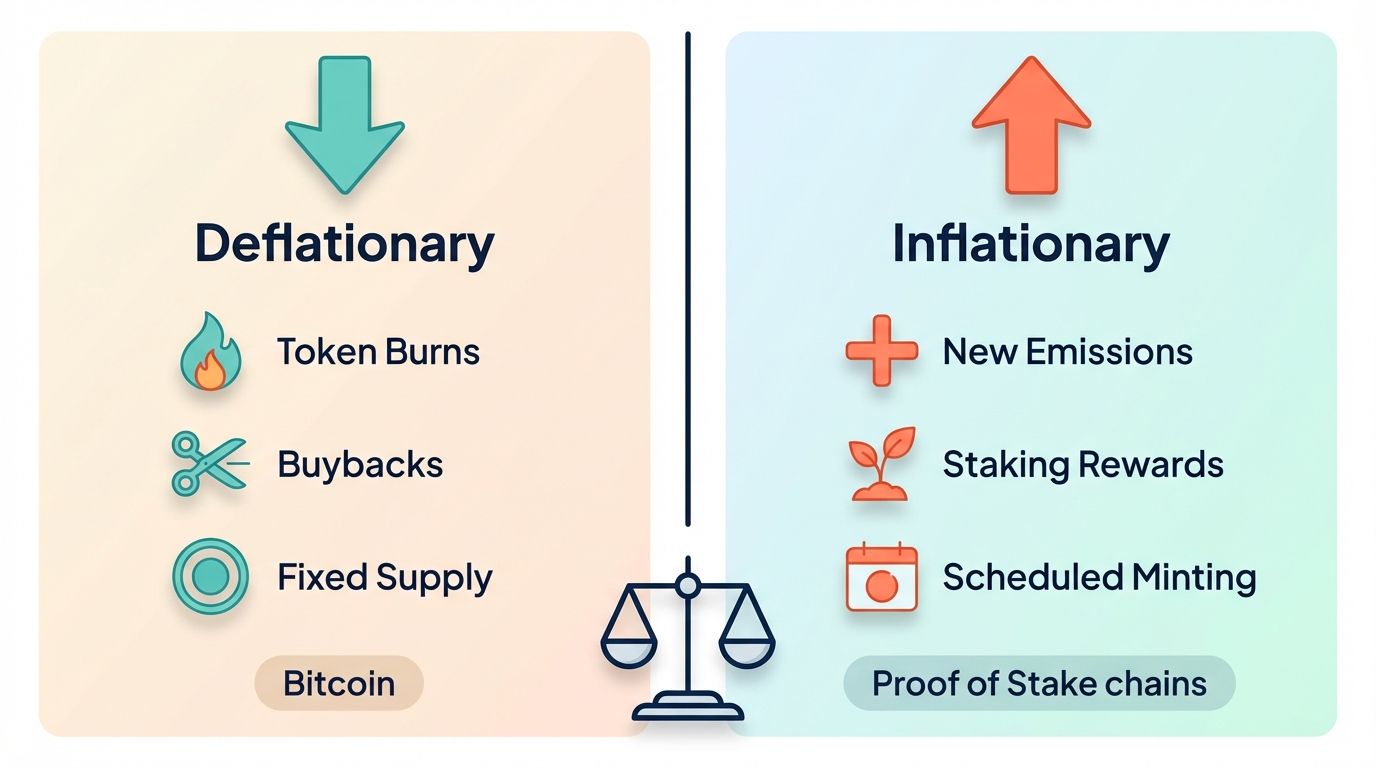
Inflationary models, by contrast, continuously mint new tokens. Most proof-of-stake blockchains are inflationary by design because staking rewards must come from somewhere. Ethereum post-Merge issues new ETH to validators, but EIP-1559 burns a portion of transaction fees. Whether Ethereum is net inflationary or deflationary depends on network activity at any given time.
Neither model is inherently superior. What matters is whether the rate of new supply entering circulation is outpaced by demand. A token can be technically inflationary and still appreciate substantially if adoption grows faster than supply. The mistake is assuming "deflationary" always means "good investment." A token with zero utility deflates toward irrelevance no matter how aggressively it burns supply.
How to Evaluate Tokenomics Before Investing
Red Flags to Watch For
Several warning signs recur in poorly designed token models. Team allocations above 20% with short vesting periods are a common one. Another is emission schedules where 70 to 80% of the total supply is scheduled to unlock within the first 18 months, front-loading sell pressure onto retail buyers who arrive after the hype.
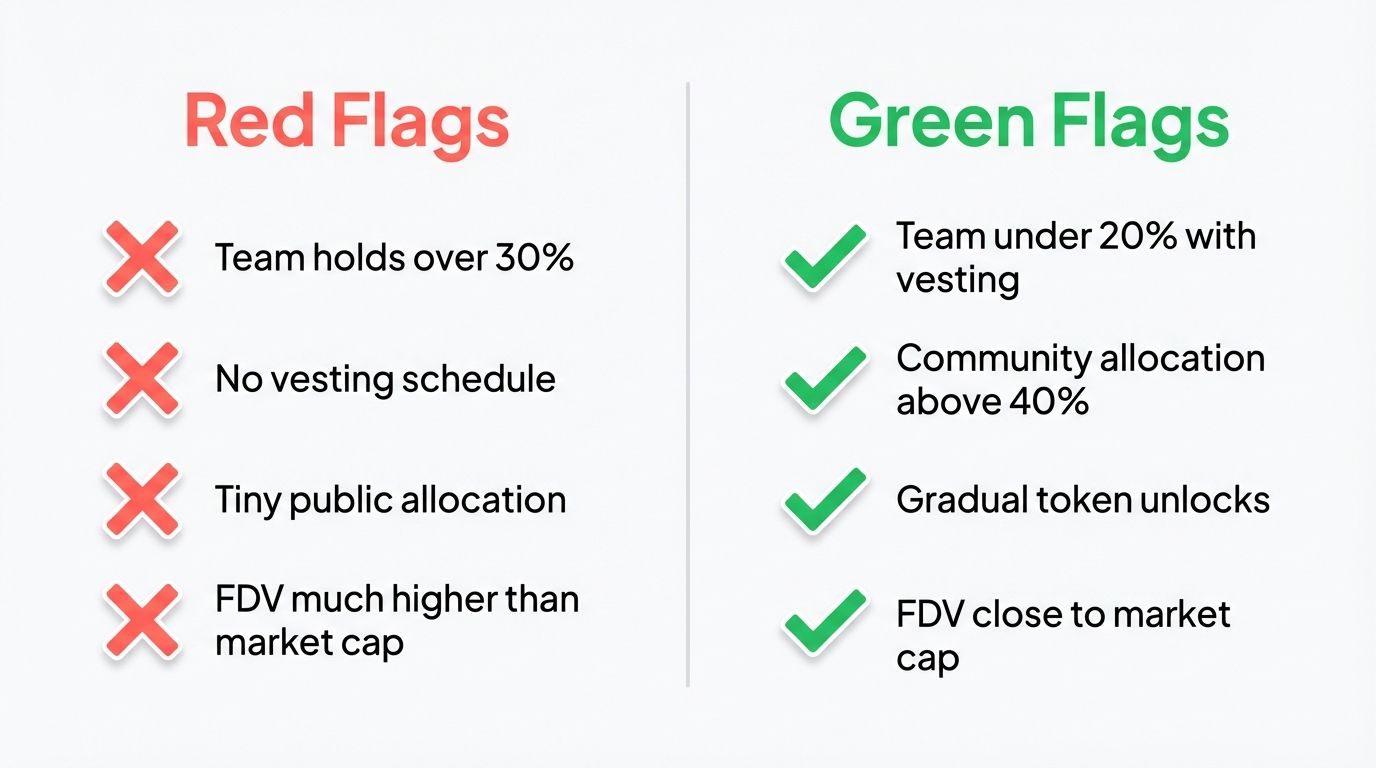
Anonymous teams with no accountability combined with large team allocations and minimal vesting is one of the most reliable exit-scam setups in crypto. Watch also for "ecosystem fund" allocations that are vague about how funds will be deployed and who controls access to them. Transparency in token distribution is not optional for a credible project.
FDV vs Market Cap
Fully diluted valuation (FDV) is the theoretical market cap if every token that will ever exist were in circulation today, calculated by multiplying current price by max supply. Market cap, by contrast, only reflects circulating supply multiplied by price.
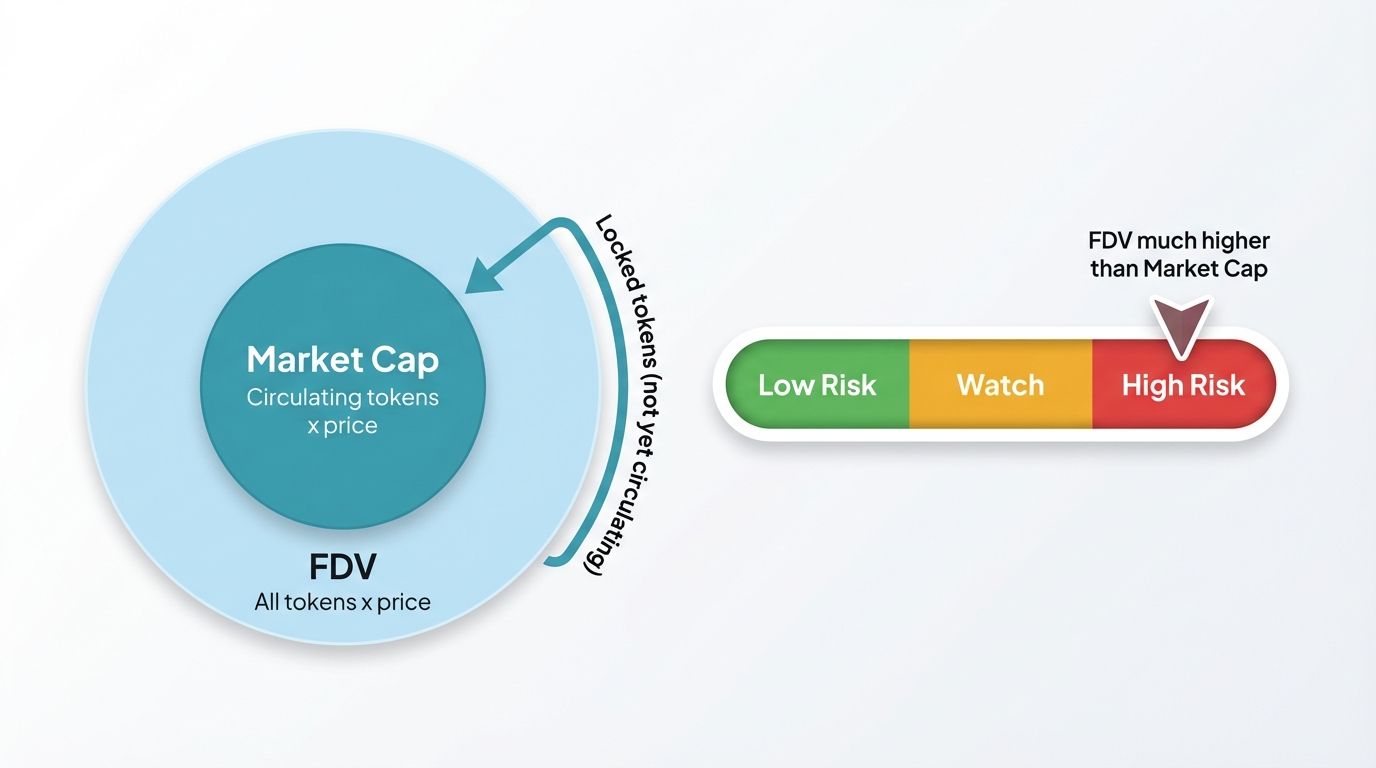
A large gap between FDV and market cap signals that a lot of supply has yet to hit the market. If a token has a market cap of $200 million but an FDV of $4 billion, you are paying current prices for a project that will eventually have 20 times more tokens in circulation. That does not mean avoid it, but it means the price must be justified by extraordinary future growth just to hold value.
Token Unlock Events
Token unlock events are scheduled dates when locked tokens become transferable. These dates are often public and predictable, making them tradeable events. When a large tranche of investor or team tokens unlocks, it is common to see sell pressure in the days surrounding that date.
Track unlock schedules using on-chain data or dedicated tools. A project with 30% of total supply unlocking in a single month is facing a significant structural headwind regardless of how good its fundamentals are. Planning your position sizing and timing around known unlock events is a practical application of tokenomics analysis.
Tokenomics in Practice: Three Examples
Bitcoin
Bitcoin's tokenomics are elegantly simple. Max supply is capped at 21 million BTC. New supply enters circulation through mining rewards, which are cut in half approximately every four years in an event called the halving. There are no team allocations, no vesting schedules, and no treasury funds controlled by a central entity.
This simplicity is a feature, not a limitation. Bitcoin's scarcity is mathematically verifiable and cannot be changed without near-universal consensus. As of March 2026, over 19.8 million BTC have already been mined, leaving less than 1.2 million left to enter circulation over the next century. The declining new supply against growing institutional adoption is the core investment thesis for many long-term holders.
Ethereum post-EIP-1559
Ethereum's tokenomics became significantly more sophisticated after EIP-1559 was activated in August 2021. Under this model, a base fee paid by every transaction is burned rather than going to validators. Validators receive only a priority tip. When network activity is high enough, the amount of ETH burned exceeds the amount issued to validators, making Ethereum net deflationary.
This dynamic ties ETH's supply directly to Ethereum's demand as a network. High usage means more burns, lower circulating supply, and upward price pressure. It also gives analysts a way to track ETH's real inflation or deflation rate in real time using on-chain data. EIP-1559 is widely studied as one of the more sophisticated token economic designs in the industry.
A Common Failure Pattern
A recurring failure pattern in crypto tokenomics looks like this: a project launches with a token that serves primarily as a reward for providing liquidity or staking. The token has no real utility beyond earning more of itself. Early participants farm large quantities of the token and sell. The sell pressure overwhelms demand. The token price collapses. Liquidity dries up. The project stagnates.
This pattern has repeated dozens of times across DeFi cycles. The specific names change but the structure is consistent: high initial yields attract capital, high emission rates dilute holders, mercenary capital exits, and the project is left with a worthless token and no organic demand. Recognizing this pattern early, by checking emission schedules and asking where the yield actually comes from, is one of the most valuable skills a crypto investor can develop.
Using Tokenomics in Your Trading Strategy
Tokenomics analysis becomes most powerful when you combine it with the right tools. Knowing that a major token unlock is approaching in two weeks, or that a project's circulating supply will double within a year, changes how you think about entry points, position size, and exit targets. The insights are only as good as your ability to act on them quickly and precisely.
Altrady gives traders a structured environment to do exactly that. You can set price alerts around key levels near token unlock dates, monitor your portfolio exposure across multiple exchanges in one dashboard, and use smart trading features like trailing stops and take-profit targets to protect gains when tokenomic sell pressure hits. The platform also supports grid bots and SMART orders, making it practical to automate strategies built on this kind of fundamental analysis.
If you want to trade crypto with tokenomics as part of your edge, start with Altrady's free trial and explore the full feature set with no upfront commitment. Understanding token design is only half the work: the other half is executing on that knowledge with the right infrastructure.
Frequently Asked Questions
What is the difference between tokenomics and fundamentals?
Tokenomics is a subset of fundamentals. Fundamentals cover everything relevant to a project's value: team quality, technology, adoption metrics, revenue, and competitive positioning. Tokenomics focuses specifically on how the token is designed and whether that design creates sustainable demand. Both matter, and neither should be analyzed in isolation from the other.
What is a good token supply?
There is no universally ideal supply number. What matters more is the distribution of supply, the rate at which locked tokens become circulating, and whether demand is growing fast enough to absorb new supply. A well-distributed supply with gradual unlocks and genuine utility is far more important than whether the max supply is 1 million or 1 trillion tokens.
How do vesting schedules affect price?
Vesting schedules affect price primarily through unlock events, which introduce new sell-side supply into the market. When large allocations unlock, especially for early investors who bought at deep discounts, there is often downward pressure on price as some holders take profits. Tracking upcoming unlock dates allows traders to anticipate and plan around these events before they occur.
What is fully diluted valuation (FDV)?
FDV is the market capitalization a project would have if its entire max token supply were in circulation at the current price. It is calculated by multiplying current price by max supply. FDV provides a more complete picture of a project's valuation than market cap alone, particularly for projects with a large proportion of tokens still locked or yet to be issued.
Can tokenomics predict project success?
Tokenomics alone cannot predict success, but poor tokenomics can reliably predict failure. A project with extractive token design, excessive insider allocations, and no real utility faces structural headwinds that good technology rarely overcomes. Strong tokenomics combined with genuine product-market fit is the combination most consistently associated with durable, long-term crypto projects.