
In May 2026, Pavel Durov announced that Telegram will operate as the primary validator on The Open Network (TON). Within 24 hours of the announcement, TON jumped over 31%, testing the $2.80 to $3.00 resistance range with upside targets discussed around $6 to $7 by the more bullish analysts.
The pivot is structurally significant. For the first time, a major messaging platform with approximately 1 billion users becomes the operational backbone of a Layer 1 blockchain. The question for traders is whether this represents a durable advantage or a centralization concern.
This guide explains what TON is, why Telegram's validator role matters, the ecosystem build-out (tap-to-earn games, mini apps, payments), the token economics, and how traders should think about TON exposure in the new structural era.
What Is The Open Network (TON)?
TON is a Layer 1 blockchain originally designed by the Telegram team in 2018-2020. Telegram exited the project formally in 2020 due to SEC enforcement pressure, and TON continued as a community-driven project under the TON Foundation.
The architecture has several distinctive features.
First, TON uses a sharded design from inception. The network scales by dividing into shards that process transactions in parallel, with cross-shard communication managed by the protocol. Throughput claims exceed many alternative L1 designs.
Second, TON has native integration with Telegram. Wallets, mini apps, and payment flows can be accessed directly within the Telegram interface. The user experience matches consumer messaging app expectations rather than crypto-native interfaces.
Third, TON has a working bot and mini app ecosystem. Tap-to-earn games (Notcoin, Hamster Kombat, others) brought millions of users into the network in 2024-2025. The retention has been mixed, but the user funnel into crypto from Telegram is unmatched by any other chain.
Why Telegram's Validator Role Matters
Three structural impacts.
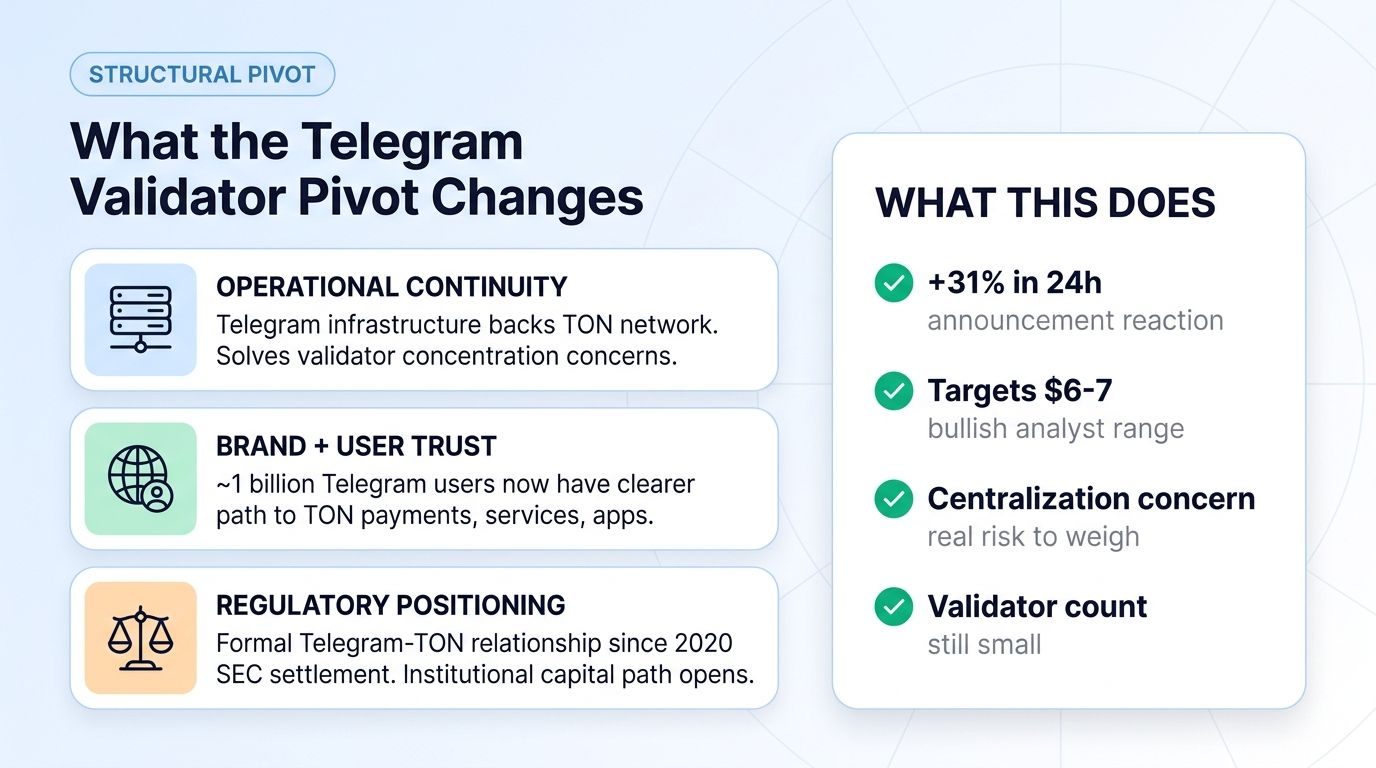
First, operational continuity. As Telegram's primary validator, the messaging platform commits substantial infrastructure to TON's operations. This addresses one of the longest-standing concerns about TON: the network's dependence on a relatively small validator set.
Second, brand and user trust. Telegram has approximately 1 billion users globally. The brand association with TON is one of the strongest in crypto. Users who trust Telegram for messaging now have a clearer path to using TON for payments, services, and apps.
Third, regulatory positioning. Telegram operates under specific legal structures (including French operations after Pavel Durov's 2024 detention). The validator role formalizes Telegram's relationship with TON in a way that has been ambiguous since the 2020 SEC settlement. The legal certainty may attract more institutional capital.
The risk is centralization. If Telegram operates as the primary validator, the network's decentralization properties are weaker than chains with broader validator distribution. The community debate around this is active.
The TON Ecosystem in 2026
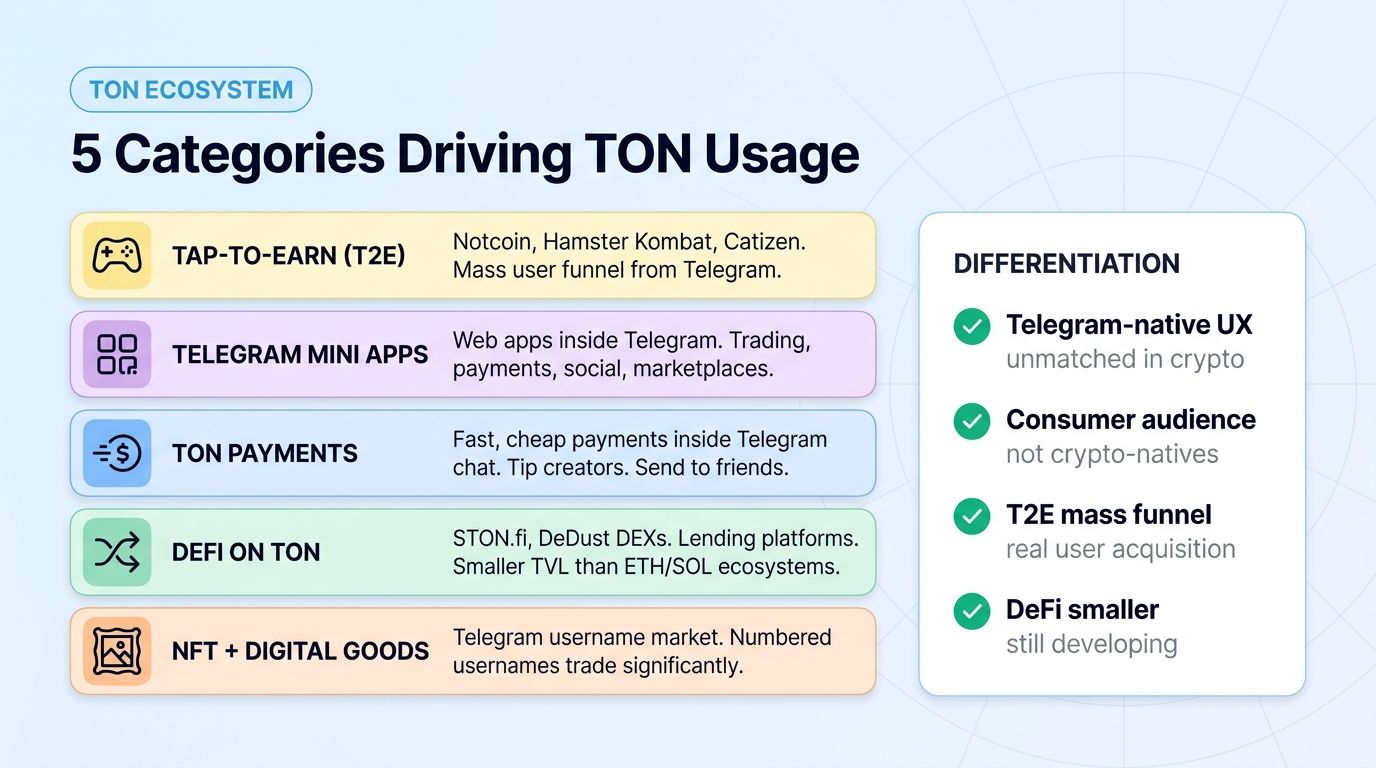
Several categories of activity drive TON usage.
Tap-to-Earn (T2E) Games
The defining adoption mechanism. Games like Notcoin, Hamster Kombat, Catizen, and others gained tens of millions of users in 2024 by offering simple tapping mechanics with token rewards. Most users churned, but the funnel demonstrated TON's ability to reach mainstream audiences.
By 2026, the T2E category has matured. Game quality has improved. Tokenization mechanics have become more sustainable. The category is now a credible (if niche) gaming category rather than a pure speculation play.
Telegram Mini Apps
Mini apps built within Telegram allow developers to deliver web app functionality directly in chat. Use cases include trading, payments, social discovery, marketplaces, and more.
The mini app category has matured rapidly. By 2026, the major mini apps have user bases comparable to mid-tier mobile apps in traditional app stores.
TON Payments
TON enables fast, cheap payments directly through Telegram. Send money to a friend by chat. Tip creators. Pay for digital goods. The integration with Telegram's UI removes friction that exists in standalone crypto wallets.
Adoption has grown but remains a fraction of fiat payment volume. The growth trajectory is positive.
DeFi on TON
DeFi protocols on TON include DEXs (STON.fi, DeDust), lending platforms, and bridges to other major chains. TVL has grown through 2025-2026 but remains smaller than Ethereum, Solana, or BSC ecosystems.
NFT and Digital Goods
TON has a growing NFT ecosystem, particularly tied to Telegram usernames and gifts. The numbered Telegram username market (rare 1-letter usernames trade at significant prices) is one of the more unique digital goods markets in crypto.
The TON Token Economics
TON serves multiple functions.
Gas and fees. All transactions on TON pay fees in TON. Mini apps, payments, and DeFi interactions all consume gas.
Staking and validation. Validators stake TON to operate the network. Stakers earn rewards from emissions and fees. The total staked TON secures the network.
Token-based governance. TON holders participate in governance for protocol upgrades and ecosystem decisions, though the structure is less formalized than some other L1s.
Foundation reserve. The TON Foundation holds significant TON that funds ecosystem development, grants, and operational expenses.
The token has been volatile. The 31% gain on the Telegram validator announcement reflects significant catalyst-driven appreciation. Whether the gain holds depends on follow-through execution by Telegram and the broader ecosystem.
How TON Compares to Other L1s
The L1 landscape has multiple competitors.
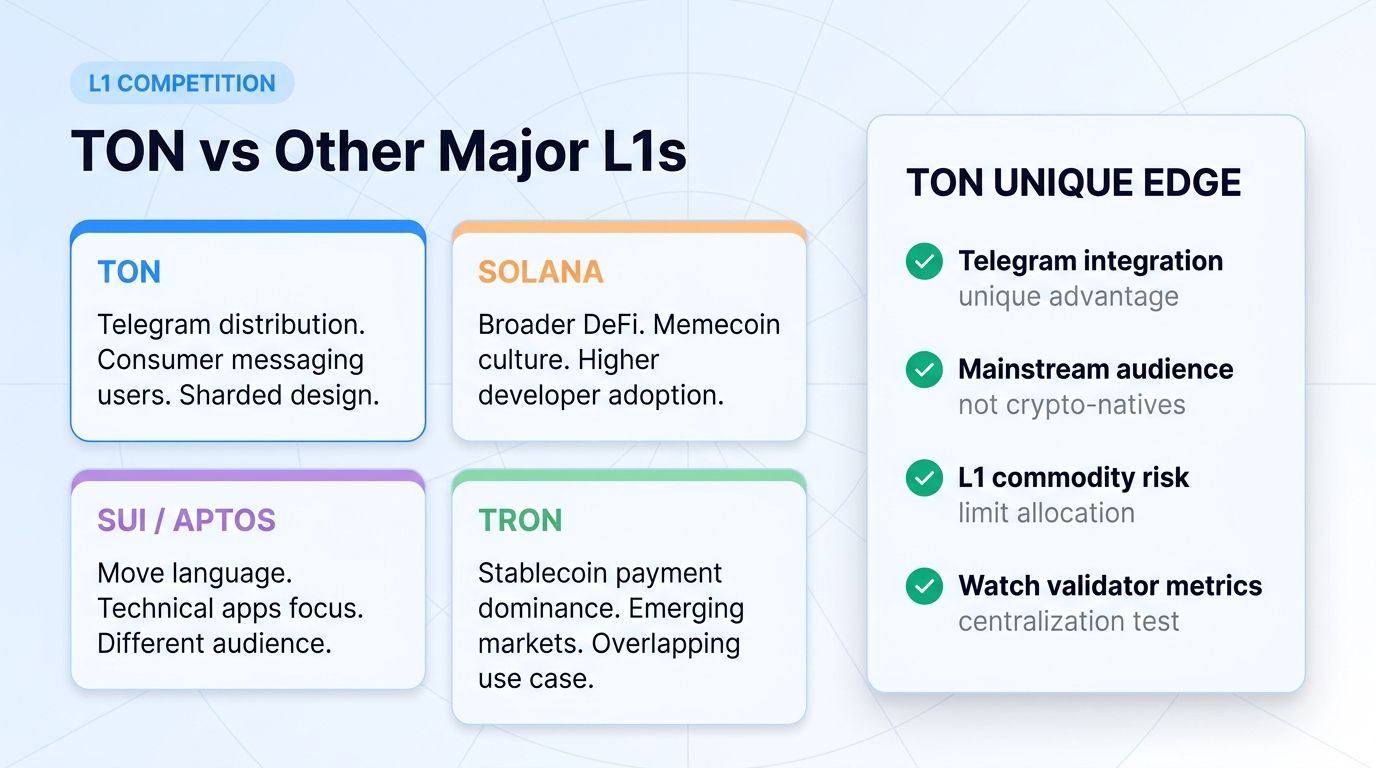
TON vs Solana: Solana has more mature DeFi ecosystem and broader developer adoption. TON has unique Telegram distribution. Different user acquisition strategies.
TON vs Sui/Aptos: Sui and Aptos use Move language and target technical applications. TON targets consumer messaging users. Different audiences.
TON vs Tron: Tron has dominated stablecoin payment volume in many emerging markets. TON's payment ambitions overlap, but TON has Telegram-native UX as differentiator.
TON vs BSC: BSC has the Binance ecosystem advantage. TON has the Telegram advantage. Both have strong centralized exchange backing.
For traders, TON represents a specific thesis: that Telegram integration produces durable user advantage that translates to network value. This thesis is independent of whether TON has the best raw technical specs.
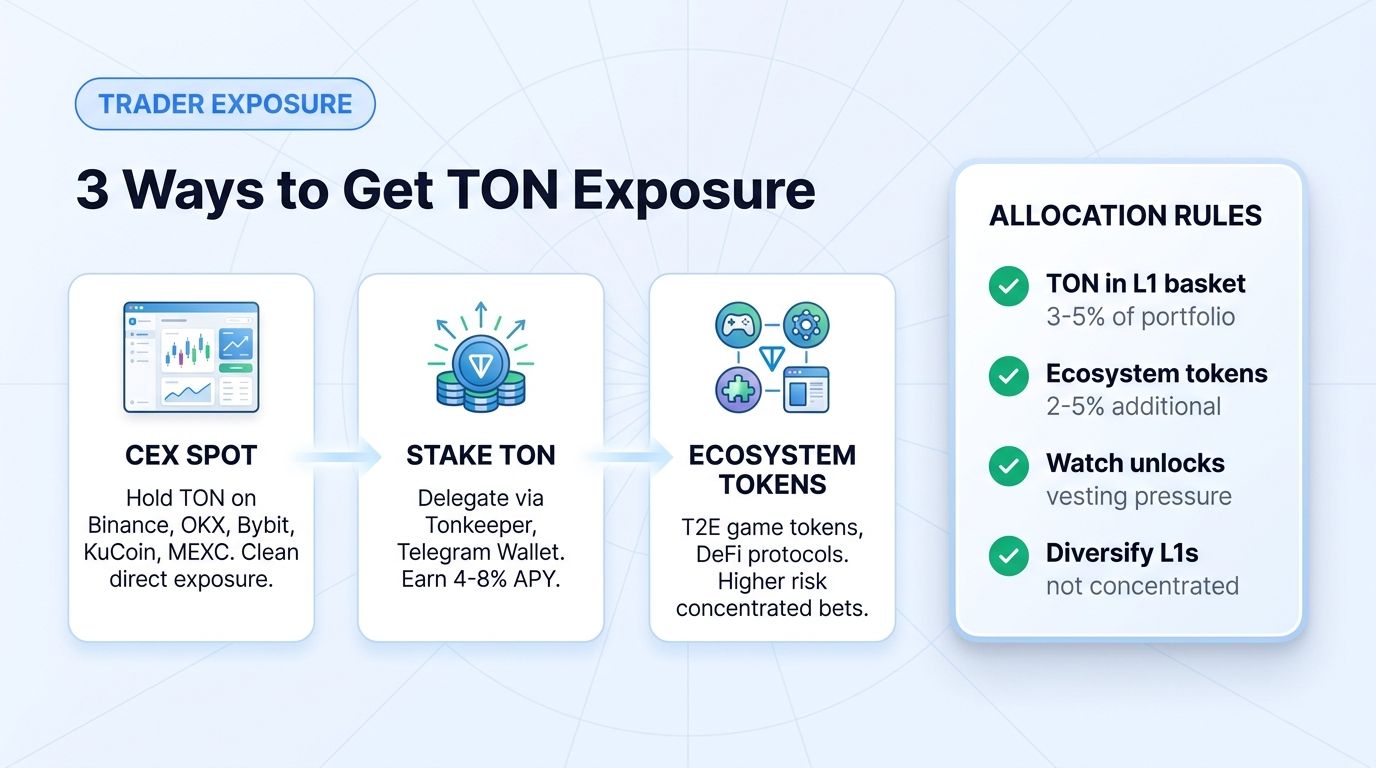
How Traders Can Get TON Exposure
Three practical paths.
Path 1: Hold TON on a centralized exchange. TON trades on Binance, OKX, Bybit, KuCoin, MEXC, Bitget, and others. This provides clean direct exposure to the broader TON thesis. A platform like Altrady connects to 19+ exchanges and supports unified TON position management across venues.
Path 2: Stake TON to validators. Holding TON and delegating to validators earns staking rewards. Yields typically range 4-8% APY. Requires using a TON-compatible wallet (Tonkeeper, Telegram Wallet, others).
Path 3: Hold tokens of TON ecosystem projects. T2E game tokens, DeFi protocol tokens, and bridge tokens all provide concentrated exposure to specific TON ecosystem segments. Higher risk than TON itself.
The Risks of TON Investing
Centralization risk. Telegram as primary validator creates centralization concerns. If Telegram faces operational issues, regulatory action, or strategic shifts, TON is more exposed than chains with diversified validators.
Regulatory risk. Pavel Durov's 2024 detention and ongoing legal situation in France creates ongoing regulatory uncertainty. Future enforcement actions could affect TON.
Adoption stickiness. T2E games drove massive user acquisition but most users churned. Whether sustainable user retention emerges is uncertain.
Competitive pressure. Other L1s with consumer focus (Solana for payments, others) compete for similar user mindshare. TON's Telegram advantage may not be defensible if other chains build comparable messaging integrations.
Token unlock pressure. TON has multi-year vesting schedules. Continued unlocks create supply pressure.
Market timing risk. The 31% gain on the validator announcement may have priced in the positive news. Buying at peak post-announcement can produce poor risk-adjusted returns.
How TON Fits Into a Crypto Portfolio
A practical framework:
- Core large-cap holdings (BTC, ETH): 50-65% of crypto allocation
- Alternative L1 basket (SOL, TON, Sui, Aptos, others): 15-25%. TON typically 3-5% of total portfolio for moderate conviction.
- TON ecosystem project tokens: 2-5%. Concentrated positions in specific games or DeFi protocols.
- Cash reserves: 5-15%
TON allocation rarely exceeds 5-8% of total portfolio due to L1 competitive pressures and TON-specific risks.
What to Watch in the Next 12 Months
Three indicators.
Indicator 1: Telegram operational metrics on TON. How much network activity flows through Telegram's validator? What is the uptime? Are there any operational issues?
Indicator 2: Mini app ecosystem growth. Are more high-quality mini apps launching? Are existing mini apps growing user bases? T2E games specifically.
Indicator 3: Regulatory clarity on Durov and Telegram. France's legal proceedings and any follow-on regulatory actions matter for TON's longer-term outlook.
If all three trend positively, TON could appreciate significantly from current levels. If any goes meaningfully negative, the structural advantage weakens.
FAQ
Is Telegram actually operating the TON network now?
As of May 2026, Telegram has been announced as the primary validator. The operational details (exactly what infrastructure Telegram runs, how it interacts with other validators) are being formalized. The pivot is significant but not yet fully implemented.
Is TON the same as Toncoin?
TON refers to the network (The Open Network). Toncoin is the native token of that network. The token's ticker is TON on exchanges, which sometimes causes confusion between "TON the network" and "TON the token."
How is TON different from the original Telegram cryptocurrency?
The original 2018-2020 Telegram cryptocurrency was called "Gram" and was tied to a SEC-blocked ICO. After Telegram exited formally, the community continued the project as TON (the network) with Toncoin (the token) replacing Gram. The 2026 Telegram validator pivot is the first formal Telegram-TON operational connection since the 2020 SEC settlement.
Can I trade TON on Altrady?
Yes. TON is listed on Binance, OKX, Bybit, KuCoin, MEXC, Bitget, and most major exchanges. Altrady connects to 19+ exchanges, so you can manage TON positions alongside other crypto holdings, run automated strategies via the signal bot, grid bot, or DCA bot, and use unified portfolio tracking.
Is TON a buy at current prices?
This depends on your view of the Telegram pivot's durability and TON's competitive position. The 31% gain on the announcement priced in some positive news. Whether further upside materializes depends on execution. Sizing positions to a level where worst-case scenarios do not damage your portfolio is the standard approach.
Conclusion
The Telegram validator pivot is one of the most structurally significant events in TON's history. With Pavel Durov committing Telegram's infrastructure to operating as TON's primary validator, the network gains the brand association, user funnel, and operational support of a 1-billion-user messaging platform.
For traders, the practical takeaway is this: TON is now a more credible structural position than it was before the pivot. The Telegram-TON integration is unique in crypto. If the execution follows through, TON could appreciate materially from current levels.
The risks are also real. Centralization concerns, regulatory uncertainty around Durov, adoption stickiness questions, and L1 competitive pressure all weigh on the thesis. Sizing TON allocation as part of a diversified L1 basket rather than concentrating in any single chain is the standard risk management approach.
The next 12 months will produce decisive data on whether the Telegram pivot delivers durable value or remains a one-time price catalyst. Watching the operational metrics, mini app growth, and regulatory developments will help distinguish the two scenarios as they unfold.