
On May 4, 2026, Western Union announced the launch of USDPT, a US dollar stablecoin issued on Solana through a partnership with Anchorage Digital Bank. The announcement signaled one of the most significant traditional-finance entries into crypto stablecoins to date: a 173-year-old remittance company with approximately $40 billion in annual cross-border transfer volume and 360,000 payout locations across 200 countries operating a native crypto stablecoin.
For the stablecoin category broadly, USDPT represents a strategic shift. For traders and observers of the stablecoin space, the launch raises specific questions: How will USDPT compete with USDC and USDT? What is the structural advantage Western Union brings? And what does this signal about the broader convergence of traditional payments and crypto?
This guide explains what USDPT is, the structural drivers behind Western Union's pivot, the technical architecture, the impact on the broader stablecoin landscape, and how traders should think about the implications.
What Is USDPT?
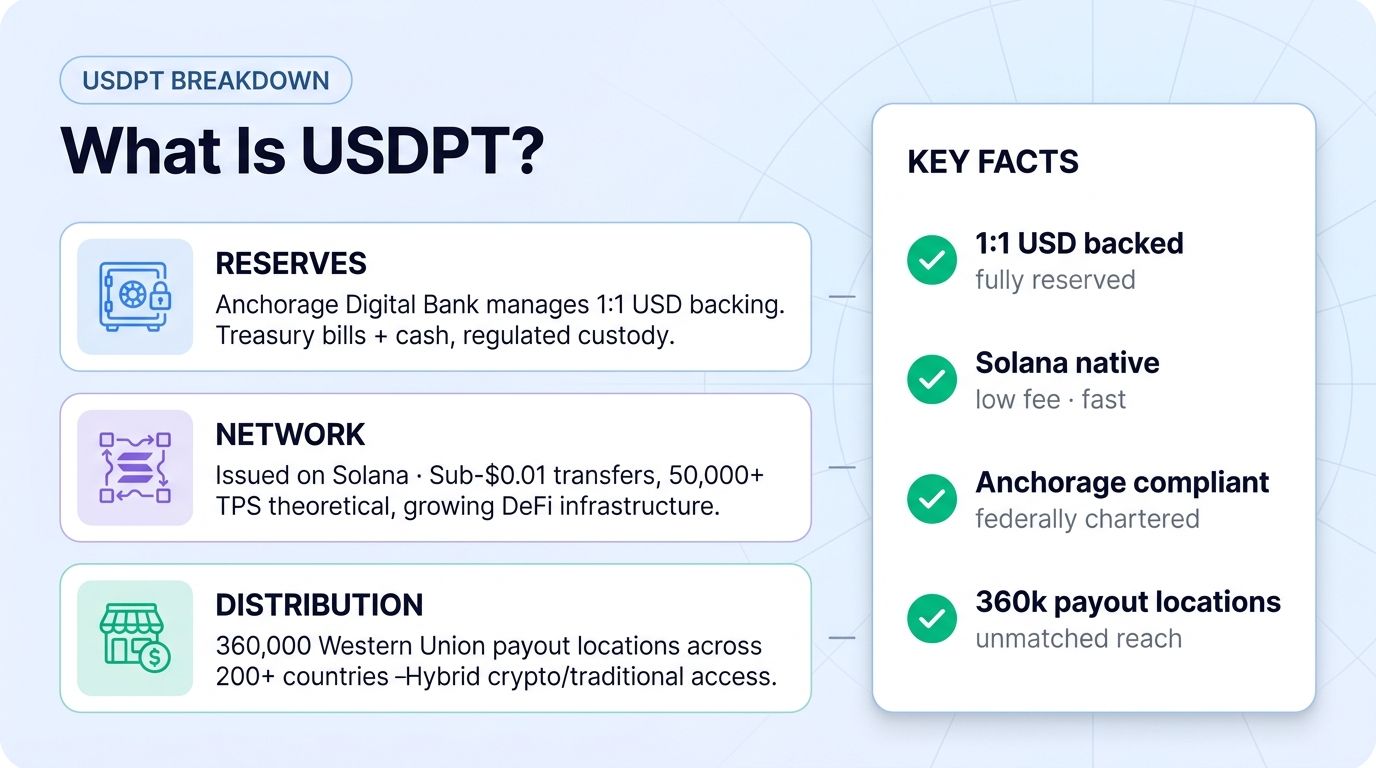
USDPT is a US dollar-backed stablecoin issued by Western Union on the Solana blockchain. The token operates as a 1:1 dollar peg, with each USDPT redeemable for one US dollar held in reserves managed through Anchorage Digital Bank.
The infrastructure has three core components.
First, the issuance and reserves are managed by Anchorage Digital, a federally chartered crypto bank that has become one of the leading institutional crypto custodians in the United States. Anchorage handles the dollar backing, custody, and regulatory compliance for the issuance.
Second, the token is deployed on Solana, chosen for its low transaction costs (typically under $0.01 per transfer), high throughput (50,000+ TPS theoretical capacity), and growing institutional infrastructure including major DeFi protocols and exchanges.
Third, USDPT is designed to integrate directly with Western Union's existing 360,000 payout locations, allowing both crypto-native users and traditional remittance customers to access the same liquidity rail.
The token launched with initial liquidity through major centralized exchanges and Solana DEXs, with Western Union committing to ongoing market-making support.
Why Western Union Pivoted Now
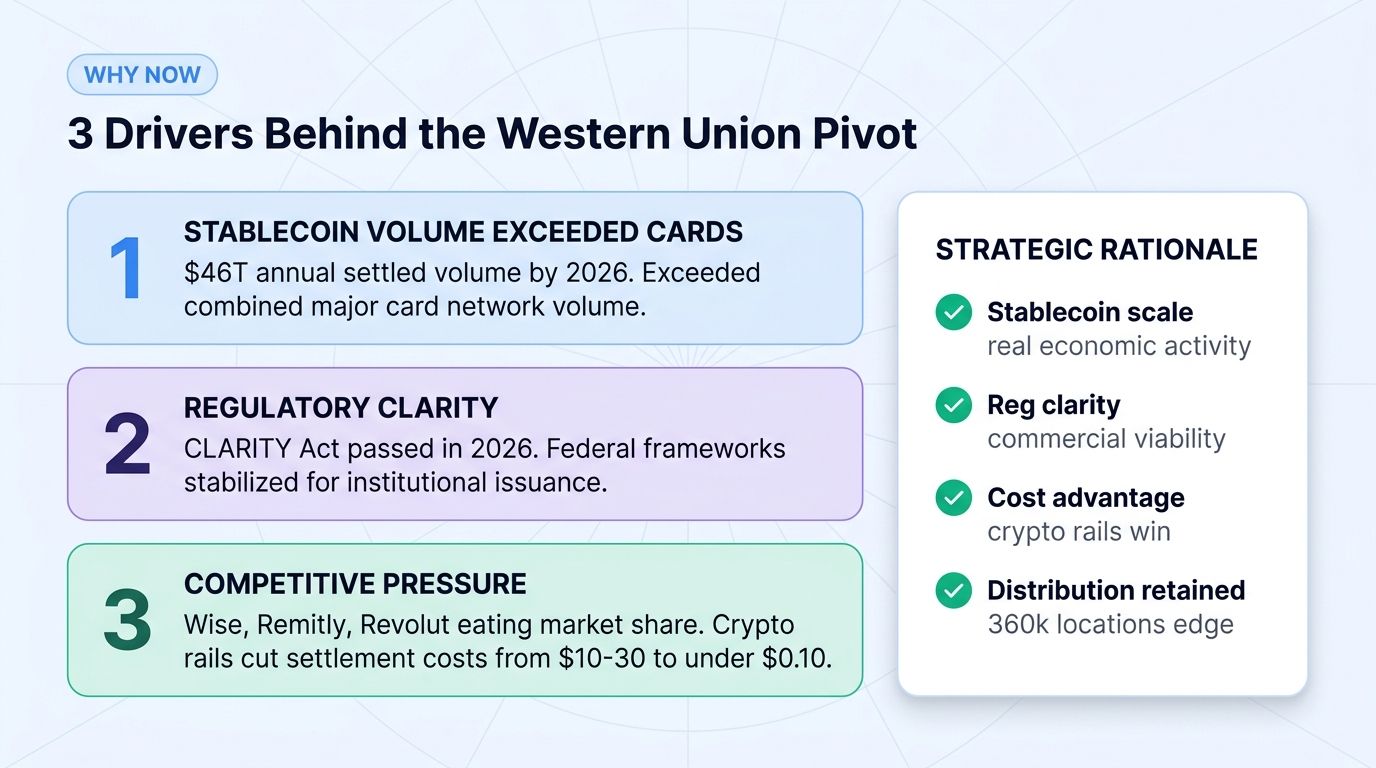
Three structural drivers explain the timing of the launch.
First, stablecoins now move trillions in annual on-chain volume. By early 2026, stablecoin annual settled volume crossed $46 trillion, exceeding the combined transaction volume of major card networks. This volume increasingly represents real economic activity (payments, remittances, trade settlements) rather than purely speculative crypto trading. For a payments company like Western Union, ignoring this volume meant ceding ground to crypto-native challengers.
Second, the regulatory environment shifted decisively in 2025-2026. The CLARITY Act passed both chambers of Congress in early 2026, creating clearer rules for stablecoin issuance. State and federal frameworks for digital dollar instruments stabilized. The result was institutional clarity that made stablecoin issuance commercially viable for major regulated entities.
Third, Western Union's core business is under structural pressure. Remittance volumes have grown but average transaction fees have compressed as digital-first competitors (Wise, Remitly, Revolut, others) ate into market share. Crypto rails offer significantly lower costs (often under $0.10 vs $10-30 for traditional remittance) for the actual settlement layer. Western Union's strategy is to capture the cost advantage of crypto rails while retaining their unique distribution advantage: 360,000 physical payout locations that crypto-native competitors cannot match.
The Strategic Implications
USDPT represents a new model for stablecoin distribution.
Traditional stablecoins (USDT, USDC) compete primarily on liquidity, integration breadth, and regulatory standing. They are crypto-native products that have expanded into traditional payments use cases.
USDPT inverts the model. It is a traditional payments product (Western Union remittance) that has integrated crypto infrastructure as the settlement rail. The distribution advantage is the existing customer base and payout network, not on-chain liquidity (which it can develop over time).
For competitors, this raises the strategic question: which existing financial institutions will follow? Visa has been exploring stablecoin settlement. Mastercard has multiple crypto integrations. Major remittance companies (MoneyGram, Ria, others) face similar pressure. The next 12-24 months may see additional traditional-finance stablecoin launches.
For users, the implications depend on use case. Crypto-native traders will likely continue using USDC and USDT given their deeper liquidity. Remittance users who interact with Western Union channels may find USDPT cheaper and faster than traditional Western Union transfers.
Technical Architecture and Token Mechanics
USDPT uses several specific technical design choices.
Solana was chosen over Ethereum for cost and throughput reasons. The average Solana transaction cost is roughly 1/100th of Ethereum L1, and Solana's higher throughput supports the payments use case without congestion. Solana's growing institutional infrastructure (DEX liquidity, native USDC presence, major exchange integrations) made it the natural choice for a payments-focused stablecoin in 2026.
Anchorage Digital handles reserves and issuance. The reserves consist of US Treasury bills and cash held in regulated custodial accounts. Daily attestations are published. Quarterly third-party audits provide additional transparency.
The token contract supports standard Solana SPL token features (transfers, freezing for compliance, supply mint/burn for issuance and redemption). Specific compliance features (freeze authority for sanctioned addresses, geographic restrictions where required) are built in but used sparingly.
The redemption process is structured to support both crypto-native and traditional customers. Crypto users can redeem through participating exchanges. Traditional Western Union customers can redeem at physical locations using a unified system.
Impact on the Stablecoin Landscape
USDPT joins a stablecoin category that has matured significantly through 2025-2026.
The dominant tokens remain USDT (approximately $130 billion market cap) and USDC (approximately $50 billion). PayPal's PYUSD has scaled to roughly $1 billion. Smaller players (FRAX, DAI, others) hold niches.
USDPT enters with structural advantages (Western Union's distribution, Anchorage's compliance positioning) but faces a steep climb against established liquidity. The initial market cap is likely to be modest. Growth depends on Western Union's ability to direct existing remittance flows through USDPT rails.
The broader category implication is significant. If USDPT achieves even moderate scale, it validates the thesis that traditional finance entities can launch competitive stablecoins. This could accelerate launches from other regulated entities, potentially fragmenting what has been a relatively concentrated category.
How Traders Should Think About USDPT
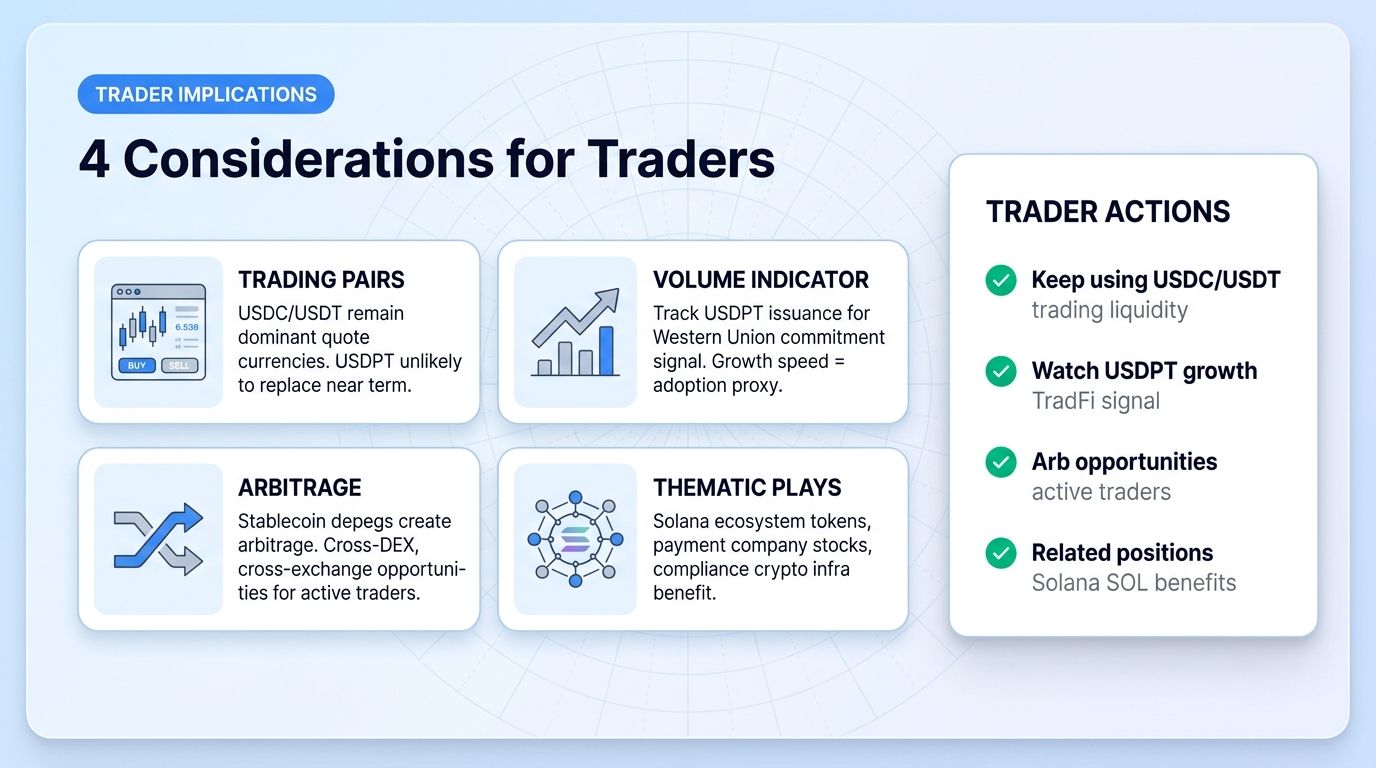
For traders, USDPT introduces several considerations.
First, USDPT is unlikely to replace USDC or USDT as the dominant trading pair quote currency in the near term. Existing liquidity moats are too deep. Most active traders will continue using USDC/USDT for trading.
Second, USDPT may become an interesting volume indicator. Tracking USDPT issuance and on-chain activity provides a window into Western Union's commitment to the crypto transition. Rapid growth signals successful integration; slow growth signals limited internal adoption.
Third, USDPT could create arbitrage opportunities. Like all stablecoins, USDPT can briefly depeg in either direction. Cross-DEX and cross-exchange arbitrage between USDPT and other dollar tokens may be profitable for active traders with appropriate execution infrastructure.
Fourth, the launch may catalyze a broader theme. Traders positioning around the "TradFi enters stablecoins" narrative may benefit from related positions: payment company stocks with crypto exposure, Solana ecosystem tokens (which benefit from increased TVL and volume), and compliance-focused crypto infrastructure providers.
How USDPT Compares to Other Stablecoins
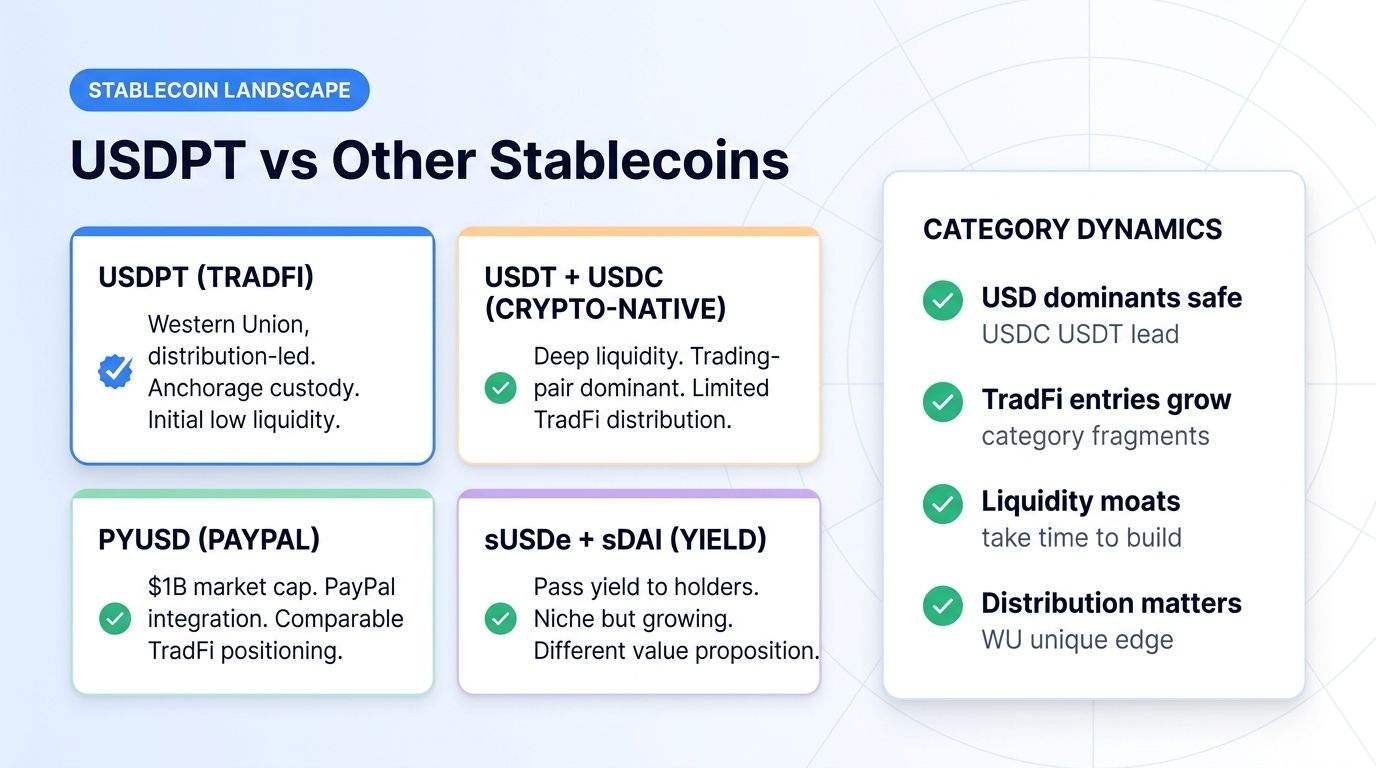
The stablecoin landscape now includes several distinct categories.
Crypto-native dominants (USDT, USDC): Designed primarily for crypto trading and DeFi. Deep liquidity, broad integration, but limited traditional payment use.
TradFi entries (USDPT, PYUSD): Designed for traditional payment use cases with crypto infrastructure as a settlement layer. Distribution advantages but limited crypto-native liquidity initially.
Algorithmic stablecoins (FRAX, others): Use various mechanisms to maintain peg without full fiat backing. Niche but technically interesting.
Yield-bearing stablecoins (sUSDe, sDAI, others): Pass yield from Treasury or DeFi sources to holders. Growing category for return-seeking users.
Regional stablecoins: Increasingly important in emerging markets. Tron's USDT dominance in Latin America and Southeast Asia is a key example.
USDPT positions in the TradFi entries category but with stronger distribution than PYUSD's PayPal integration. The Western Union network is uniquely valuable for the remittance use case.
The Risks of USDPT
Several risks apply.
Adoption uncertainty. Whether Western Union can successfully migrate existing customer flows to USDPT is unproven. Customer education, integration friction, and regulatory variation across 200+ countries may slow adoption.
Liquidity risk. Initial liquidity is modest. Heavy trading or large transfers could face slippage. This improves as the ecosystem develops but is a near-term constraint.
Concentration risk. USDPT depends on a single issuer (Western Union via Anchorage). Operational issues, regulatory action, or strategic shifts at Western Union directly affect the token.
Regulatory risk. Stablecoin regulation continues to evolve. New requirements (reserve composition, audit cadence, redemption rights) could affect operational economics.
Competitive risk. Other TradFi entrants may launch competing stablecoins with stronger distribution. The category is shifting from "few crypto-native dominants" to "many regulated issuers."
What to Watch in the Next 12 Months
Three indicators.
Indicator 1: USDPT supply growth. How fast does the market cap grow? Strong growth (multi-billion within 12 months) signals successful integration. Slow growth (tens or hundreds of millions) suggests limited internal adoption.
Indicator 2: Remittance volume migration. How much of Western Union's traditional remittance volume routes through USDPT? Public commentary, financial reporting, and on-chain data will provide signal.
Indicator 3: TradFi follower entries. Do other major regulated entities launch competing stablecoins? Visa, Mastercard, MoneyGram, and others are all watching. New entrants signal category momentum.
If all three trend positively, USDPT establishes a viable second-tier stablecoin position. If they stagnate, USDPT remains a small experiment alongside the crypto-native dominants.
FAQ
What is USDPT?
USDPT is a US dollar-backed stablecoin issued by Western Union on the Solana blockchain through a partnership with Anchorage Digital Bank. Each USDPT is backed 1:1 by dollars and dollar-equivalents held in regulated custodial accounts.
How does USDPT compare to USDC and USDT?
USDPT is significantly smaller in market cap and liquidity than USDC ($50B+) or USDT ($130B+). However, USDPT has unique distribution advantages through Western Union's 360,000 payout locations and 200+ country reach. The two categories serve different primary use cases.
Is USDPT only available on Solana?
At launch, USDPT is native to Solana. Western Union has indicated potential expansion to other chains based on adoption and demand, but Solana remains the primary network for the foreseeable future.
Can I use USDPT for everyday transactions?
Yes, if you have a Solana wallet. USDPT can be sent peer-to-peer on Solana, traded on Solana DEXs, used in DeFi protocols, and bridged to other chains via standard bridge infrastructure. Western Union integration with traditional payout channels is rolling out gradually.
Can I trade USDPT on Altrady?
USDPT is available on multiple exchanges as adoption expands. Altrady connects to 19+ exchanges, so you can manage USDPT positions alongside other crypto holdings, run automated strategies via the signal bot, grid bot, or DCA bot, and use unified portfolio tracking once USDPT is listed on your preferred exchange.
Conclusion
USDPT represents one of the most significant traditional-finance entries into crypto stablecoins. Western Union's 173-year operating history, $40 billion annual remittance volume, and 360,000 payout location network make this launch structurally different from prior TradFi stablecoin attempts.
For traders, the practical takeaway is this: USDPT will not likely displace USDC or USDT in the near term as the dominant trading pair quote currency. However, the launch validates the thesis that major traditional finance entities can launch competitive stablecoins with regulatory clarity and infrastructure partnerships.
The longer-term implication is the potential for fragmentation. If multiple TradFi entrants follow Western Union into stablecoin issuance, the category may shift from "few dominants" to "many regulated issuers." This has implications for liquidity, integration costs, and the broader trader experience.
The next 12 months will produce decisive data on USDPT's adoption trajectory and on whether other major regulated entities follow. For positioning, the practical approach is to maintain awareness of USDPT growth as a leading indicator of the TradFi-stablecoin convergence, while continuing to use established stablecoins for active trading until USDPT liquidity matures.