
Most crypto traders treat stablecoins as parking lots. USDC and USDT sit in your account when you exit positions, waiting for the next opportunity. They earn nothing while idle.
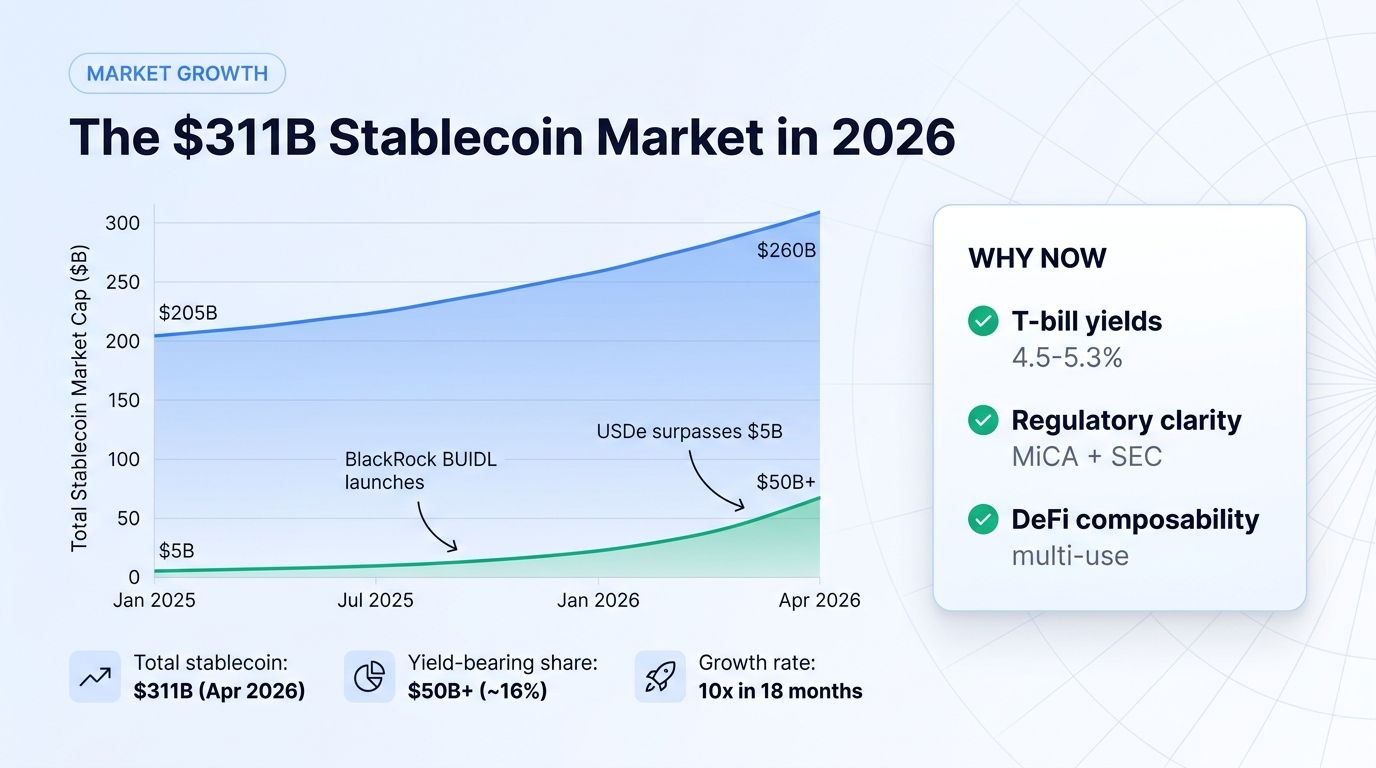
That changed in 2024-2025 and accelerated through 2026. A new category of stablecoins generates yield while you hold them, often passing 5-10% APY directly to holders. The category grew from a niche experiment to a meaningful portion of the $311 billion stablecoin market by April 2026. Ondo's USDY, Ethena's USDe and sUSDe, Sky's sUSDS, and a growing list of others now serve as default holdings for traders who used to park in plain USDC.
This guide explains what yield-bearing stablecoins are, the three mechanisms they use to generate yield, the leading products, the specific risks each carries, and how to integrate them into a trading capital strategy.
What Is a Yield-Bearing Stablecoin?
A yield-bearing stablecoin is a token pegged to USD that also pays its holders a return for holding it. The return comes from one of three sources, which determines the risk profile.
Unlike traditional stablecoins (USDC, USDT) that hold reserves and keep all the interest those reserves generate, yield-bearing stablecoins are designed to distribute that yield to token holders. Some accrue value automatically (rebasing or appreciating tokens). Others pay yield separately.
A simple example. If you hold 10,000 USDY tokens (Ondo's yield-bearing dollar), the token's redemption value increases over time. After one year at 5% APY, your 10,000 USDY is redeemable for around $10,500. You did nothing. The yield came from the underlying short-duration US Treasuries that back the token.
Compare this to holding 10,000 USDC. Same dollar value at year start. Same dollar value at year end. Circle (the issuer) earns the Treasury interest on the reserves backing your USDC and keeps it for itself.
Why Yield-Bearing Stablecoins Matter in 2026
Three forces converged. The category has also expanded geographically, with the Hong Kong stablecoin licenses awarded to HSBC and Anchorpoint in 2026 signaling that regulated traditional banks now operate stablecoin products under Asia frameworks. Stablecoins as infrastructure now move trillions in annual on-chain volume, and yield-bearing variants emerged as a natural extension of that base layer.
First, US Treasury yields stayed elevated through 2024-2025. The success of yield-bearing stablecoins paralleled the broader yield tokenization category led by protocols like Pendle Finance, where principal and yield rights can be split and traded separately. With short-duration T-bills paying 4.5-5.3%, the math for tokenizing them became attractive. Why hold USDC earning nothing when a tokenized T-bill product can give you the same dollar exposure plus 5% yield?
Second, regulatory clarity arrived for tokenized securities. The SEC and EU MiCA both produced workable frameworks for yield-bearing tokens that represent claims on regulated underlying assets. Ondo, Franklin Templeton, BlackRock, and others built compliant products that retail and institutional traders could actually use.
Third, DeFi infrastructure matured. Yield-bearing stablecoins now work as collateral on Aave, can be looped through Pendle, and provide the base layer for sophisticated yield strategies. The composability multiplied the use cases.
By April 2026, yield-bearing stablecoins collectively held tens of billions in market cap, with the category growing faster than plain stablecoins. The yield differential of 5-10% per year is too significant for traders to ignore.
The Three Mechanisms for Generating Yield
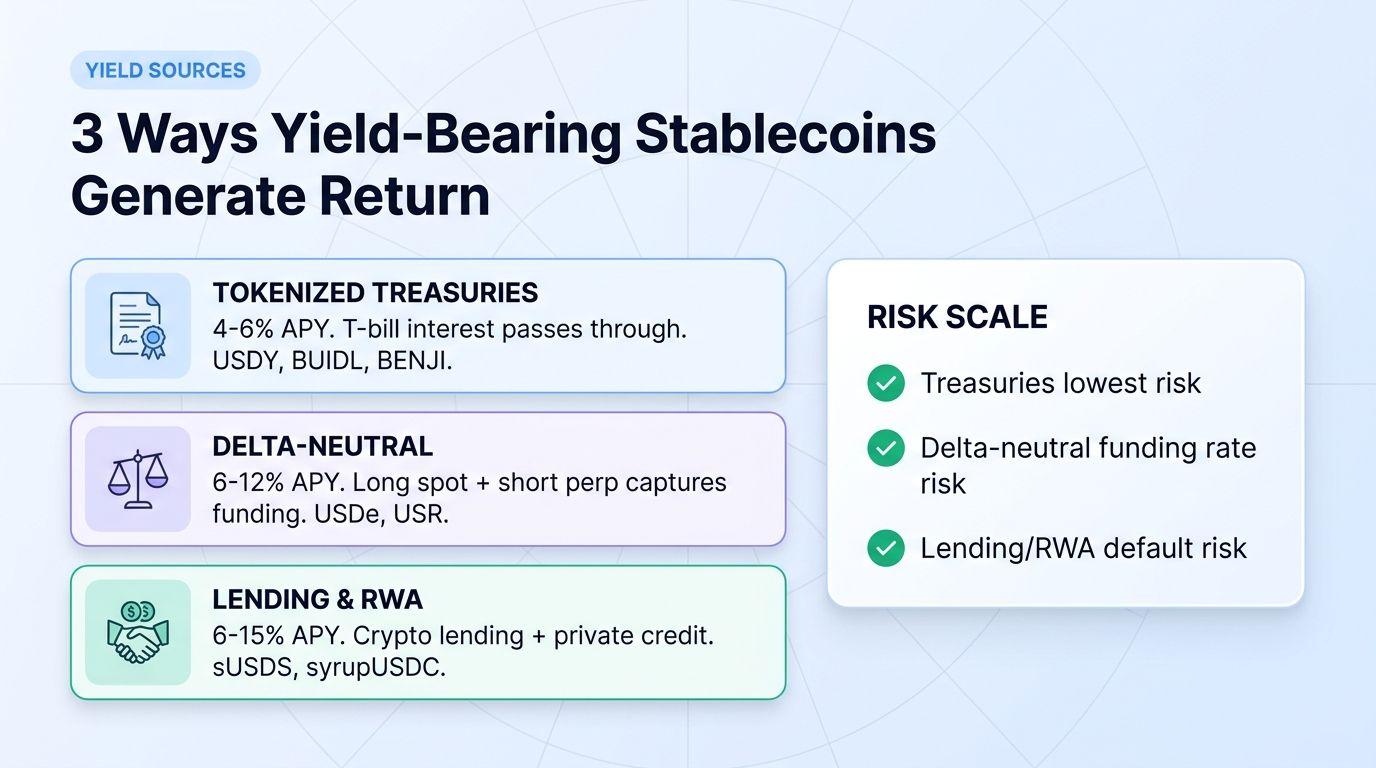
Mechanism 1: Tokenized Treasury Yield
The token represents a claim on short-duration US Treasury bills. The Treasury interest passes through to holders.
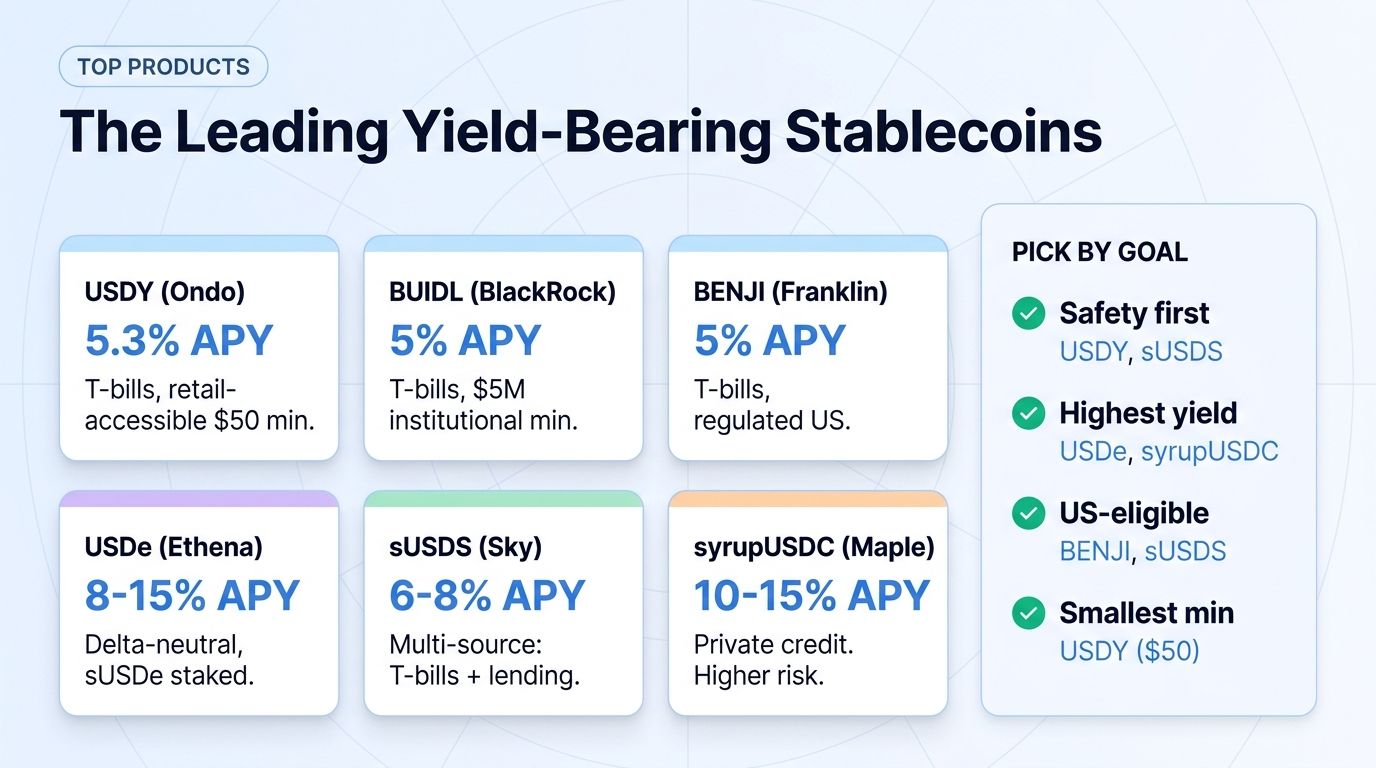
Examples: Ondo USDY (around 5.3% APY), Ondo OUSG, BlackRock BUIDL ($2.8-2.9B AUM, accredited investors only), Franklin Templeton BENJI, Hashnote USYC.
Yield source: T-bill interest, currently around 4.5-5.3% depending on duration and fees.
Risk profile: Lowest of the three categories. T-bill default risk is approximately zero. Main risks are issuer solvency (the trust holding the T-bills) and redemption process (some products have gates or minimum sizes).
Best for: Conservative trading capital, "earn yield while waiting" portfolios.
Mechanism 2: Delta-Neutral Basis Trade
The protocol holds long spot positions and offsetting short perpetual futures positions. The protocol earns the funding rate paid by perpetual longs. This funding rate is often 5-20% annualized during normal market conditions.
Examples: Ethena USDe (around 8-15% APY when staked as sUSDe), Resolv USR, Bracket BR.
Yield source: Perpetual funding rates collected by the delta-neutral hedge.
Risk profile: Medium-high. Yield depends on funding rates, which can flip negative during bear markets, eroding the protocol's collateral. Smart contract complexity is higher. Custody is split between exchanges and the protocol.
Best for: Higher-yield seekers who understand funding dynamics and accept that yield may compress or flip negative during severe drawdowns.
Mechanism 3: Lending and Real-World Asset Yield
The protocol deposits stablecoin reserves into over-collateralized lending positions (Aave, Maple) or tokenized private credit pools. The interest earned is distributed to token holders.
Examples: Sky sUSDS (formerly MakerDAO sDAI), Maple syrupUSDC, Centrifuge tokens.
Yield source: Mix of crypto lending rates and tokenized private credit (typically 6-12% APY for private credit-backed products).
Risk profile: Variable by product. Sky's sUSDS is conservative (mostly Treasury and Maker Vault yield, around 6-8% APY). Private credit products like Maple's syrupUSDC offer higher returns (10-15%) but carry borrower default risk.
Best for: Diversified yield exposure across multiple income sources.
How to Access Yield-Bearing Stablecoins
Three practical paths.
Path 1: Buy directly from the issuer. Connect a wallet to Ondo, Ethena, Sky, or another issuer. Deposit USDC. Receive the yield-bearing token. This is the cleanest path and gives you the full yield. Use Polygon, Arbitrum, or another L2 to keep gas costs low.
Path 2: Buy on a DEX. Yield-bearing stablecoins trade on Uniswap, Curve, and other DEXs. You can swap USDC directly for USDY, USDe, sUSDS, or others. Slippage is usually minimal for established tokens. You may trade at a small premium or discount to NAV depending on market conditions.
Path 3: Use as collateral in DeFi. Once you hold a yield-bearing stablecoin, you can use it on Aave, Pendle, Morpho, or other lending markets. This adds capital efficiency: you earn yield on the stablecoin while also using it as collateral for other positions. Liquidation risk applies if you leverage on top.
For traders managing positions across exchanges, the typical workflow is to keep some trading capital in yield-bearing stablecoins on-chain and move funds to CEX accounts as needed for active trading. A crypto trading platform like Altrady that integrates with major exchanges helps manage the CEX side while DeFi positions live separately in your self-custody wallet.
The Risks Each Yield Source Carries
Treasury-backed (USDY, BUIDL, BENJI): - Issuer custody risk: the trust holding the T-bills must remain solvent - Redemption risk: some products have geographic restrictions or minimum redemption sizes - Smart contract risk: even audited contracts have had bugs
Delta-neutral (USDe, USR): - Funding rate risk: negative funding can erode collateral; severe bear markets can drain the buffer - Exchange counterparty risk: the protocol holds collateral on centralized exchanges that could be hacked or fail - Liquidation risk on the short hedge: extreme moves can liquidate the protocol's short position before it can adjust
Lending and RWA (sUSDS, syrupUSDC): - Borrower default risk for private credit products - Smart contract risk on the lending protocol layer - Redemption gates: some products limit how much you can redeem at once
All three categories carry the standard crypto risks: smart contract bugs, oracle manipulation, bridge failures if you move tokens cross-chain, and regulatory changes that could restrict certain products.
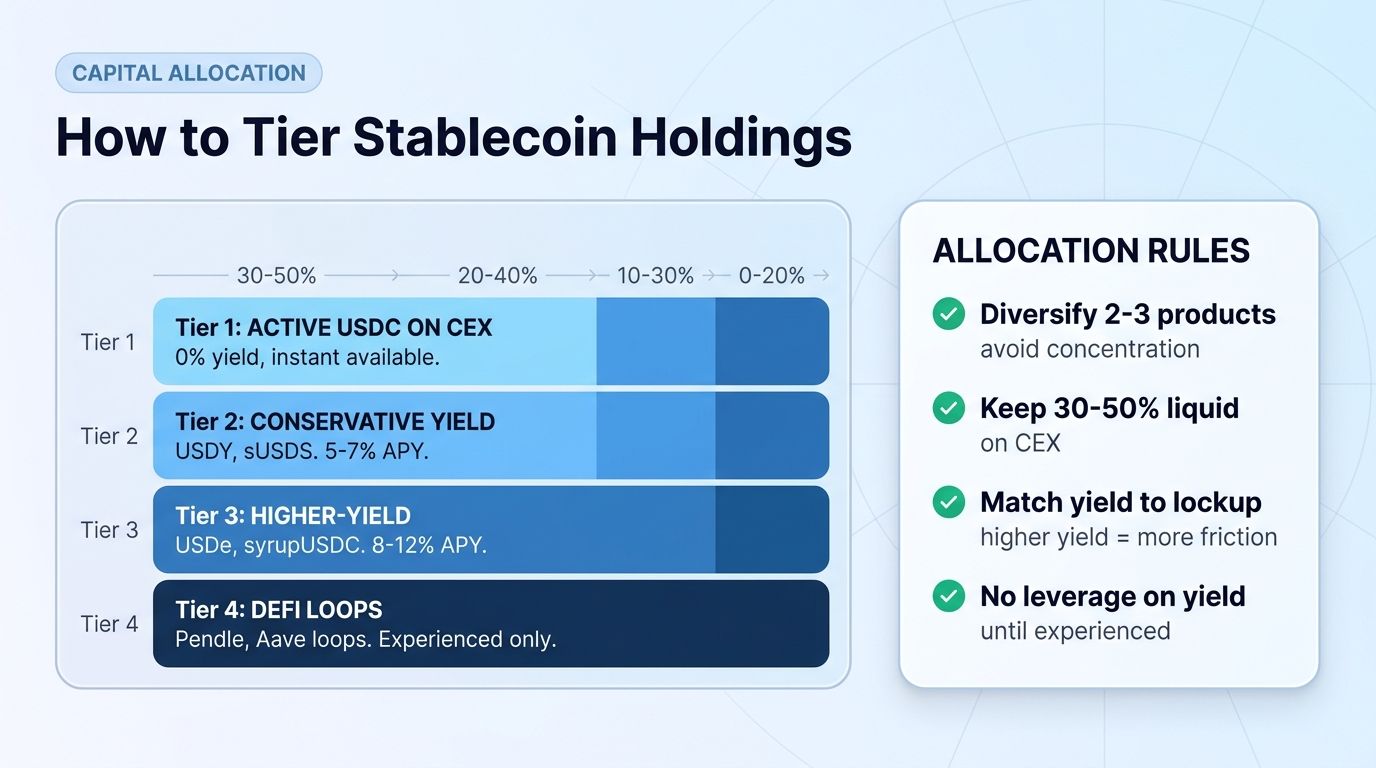
How Yield-Bearing Stablecoins Fit Into a Trading Portfolio
A practical framework:
- Active trading capital (USDC on CEX): 30-50%. Maximum availability, no yield, ready for immediate use.
- Conservative yield (USDY, sUSDS): 20-40%. Earn 5-7% APY on capital waiting for opportunities. Slight friction to redeem but easy to swap to USDC on DEX.
- Higher-yield (USDe, syrupUSDC): 10-30%. 8-12% APY on capital you can afford to lock for several days to weeks.
- Long-term DeFi loops: 0-20%. Yield-bearing stablecoins as collateral for leveraged stable strategies (Pendle, Aave loops). Only for experienced DeFi users.
Most professional traders run a tiered approach: keep liquid USDC for active trades, hold yield-bearing stablecoins for waiting capital, and avoid leveraging on stablecoin positions unless you understand liquidation cascades.
FAQ
Are yield-bearing stablecoins safe?
Safer than most DeFi but not as safe as plain USDC held with a regulated custodian. Each category carries specific risks: issuer solvency for Treasury-backed, funding rate volatility for delta-neutral, and borrower default for lending-based products. Diversify across 2-3 products rather than concentrating in one.
Are yield-bearing stablecoins regulated as securities?
In most jurisdictions, yes. The SEC and EU MiCA both treat them as regulated products. Issuers like Ondo and BlackRock have built compliant structures, which is why some products are restricted to accredited investors or specific jurisdictions. Always check eligibility for your country.
What yield should I realistically expect?
In 2026, typical yields are: 4-6% APY for Treasury-backed tokens, 6-12% APY for delta-neutral stablecoins (highly variable with funding rates), and 6-15% APY for lending/RWA-backed tokens. Anything claiming consistent 20%+ APY on a "stablecoin" should be approached with extreme skepticism.
Can I lose money on yield-bearing stablecoins?
Yes. If the issuer fails, the underlying assets default, the smart contracts get exploited, or the peg breaks, you can lose principal. The yield is real but not guaranteed. Size positions accordingly.
Can I use yield-bearing stablecoins on Altrady?
Yield-bearing stablecoins are primarily held in self-custody wallets and used on DeFi protocols. Altrady focuses on centralized exchange integration across 19+ exchanges where the wrapped or listed versions of some tokens (USDe, for example) may be tradable. For DeFi-native yield-bearing positions, you use a wallet and DeFi interfaces directly.
Conclusion
Yield-bearing stablecoins moved from experiment to default category in 2025-2026. With $311 billion in the broader stablecoin market and a growing share of that in yield-bearing variants, the question for most traders is no longer "should I use them" but "which ones and in what allocation."
For traders, the practical takeaway is this: every dollar of idle USDC in your account is a dollar earning 0% while the issuer earns 5%. Yield-bearing stablecoins close that gap, with specific tradeoffs you need to understand. Match the product to your risk tolerance and time horizon.
The category will continue to evolve. Stablecoin yields, tokenization frameworks, and DeFi composability will all keep improving through 2026 and beyond. The traders who move part of their stablecoin capital into yield-bearing variants now will compound an extra 5-10% per year while sacrificing minimal flexibility.