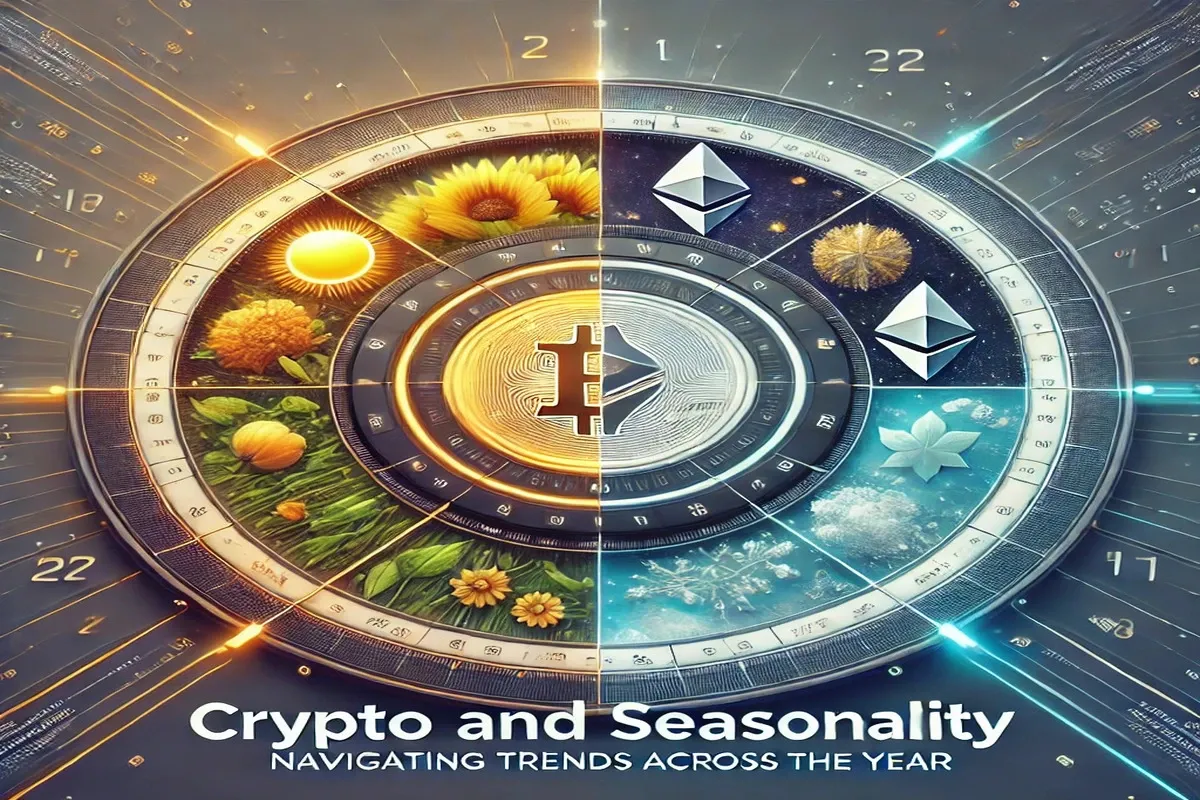

Seasonality in the market is a key concept for any investor, especially those involved in cryptocurrencies.
What Is Seasonality?
Seasonality is a macroeconomic and financial concept, studied, analyzed, and used by major investment and institutional funds to predict future market trends based on statistical analyses that align with cyclical data. These cycles are typically divided into four phases:
-
Winter
Characterized by market sideways movement and low volatility, accompanied by low trading volumes. Investors typically exhibit a tendency to close their portfolios in profit by liquidating a significant number of positions in the market. -
Spring
Typically, this season is characterized by positive to neutral trends with increasing of volatility and volume, as investors begin diversifying their portfolios with a stronger focus on cryptocurrencies. -
Summer
This period generally sees a shift towards a risk-off strategy, leading to market downturns driven by profit-taking, since many investors are on vacation. -
Fall
As investors begin to explore new strategies, market sentiment often shifts to a state of uncertainty, leading to increased volatility and unpredictable price movements. This phase is marked by a lack of clear direction, with conflicting signals
Cryptocurrencies: The Fourth Largest Investment Asset
Over the last seven years, the total market capitalization of the top 100 cryptocurrencies has grown from approximately $5.2 billion to over $2 trillion, with Bitcoin (BTC) alone accounting for $1.32 trillion. Today, investors are allocating their capital to cryptocurrencies at a rate that positions them as the fourth most popular investment asset, following stocks, mutual funds, and bonds. The market capitalization of Bitcoin alone places it among the top 20 largest companies in the S&P 500.

How to Interpret and Leverage Cryptocurrency Seasonality
The concept of cryptocurrency seasonality refers to the common belief that Bitcoin prices tend to rise and fall over predetermined periods, significantly influencing the broader cryptocurrency market. Bitcoin (BTC) was the first cryptocurrency ever created and remains the most valuable digital asset in the industry. As the pioneer, Bitcoin has a lasting significance, and all subsequent coins are in some way linked to its performance.
The chart provided illustrates Bitcoin's seasonality based on average prices over the past 3, 5, 7, and 10 years. Notably, a strong seasonal trend favors a long position from October to April, with healthy corrections occurring at 1-2 month intervals.
