
In crypto trading, there is a metric that feeds the ego, and there is a metric that feeds the wallet.
Most beginners obsess over the first one: win rate. They believe that to be a successful trader, they need to beat the market 8 or 9 times out of 10. They chase the dopamine hit of green PnL screens.
But here is the harsh reality: you can win 70% of your trades and still drain your portfolio.
If you are winning often but your balance is not growing, you are likely ignoring the metric that actually determines the health of your trading business: Profit Factor.
In this guide, you will learn what Profit Factor is, why it is the most honest “truth serum” for any strategy, and how to use a structured workflow to improve it over time.
Key takeaways
• Profit Factor measures how efficiently a strategy turns losses into profits.
• A Profit Factor above 1.0 is the minimum requirement for profitability, before costs.
• Win rate can be high while Profit Factor is below 1.0.
• Profit Factor becomes meaningful only with enough trades and realistic fees.
• Improving Profit Factor usually means reducing gross loss, increasing average win, or filtering bad trades.
What is Profit Factor
Profit Factor is the ratio of your total gross profits divided by your total gross losses over a specific period.
It answers the most important question in trading:
For every 1 unit I lose, how many units do I make?
The formula
Profit Factor = Total Gross Profit / Total Gross Loss
Where:
• Total Gross Profit is the sum of all winning trades.
• Total Gross Loss is the absolute sum of all losing trades.
Important detail: Total Gross Loss is treated as a positive number in the formula. That is why Profit Factor is expressed as a positive ratio.
A practical example
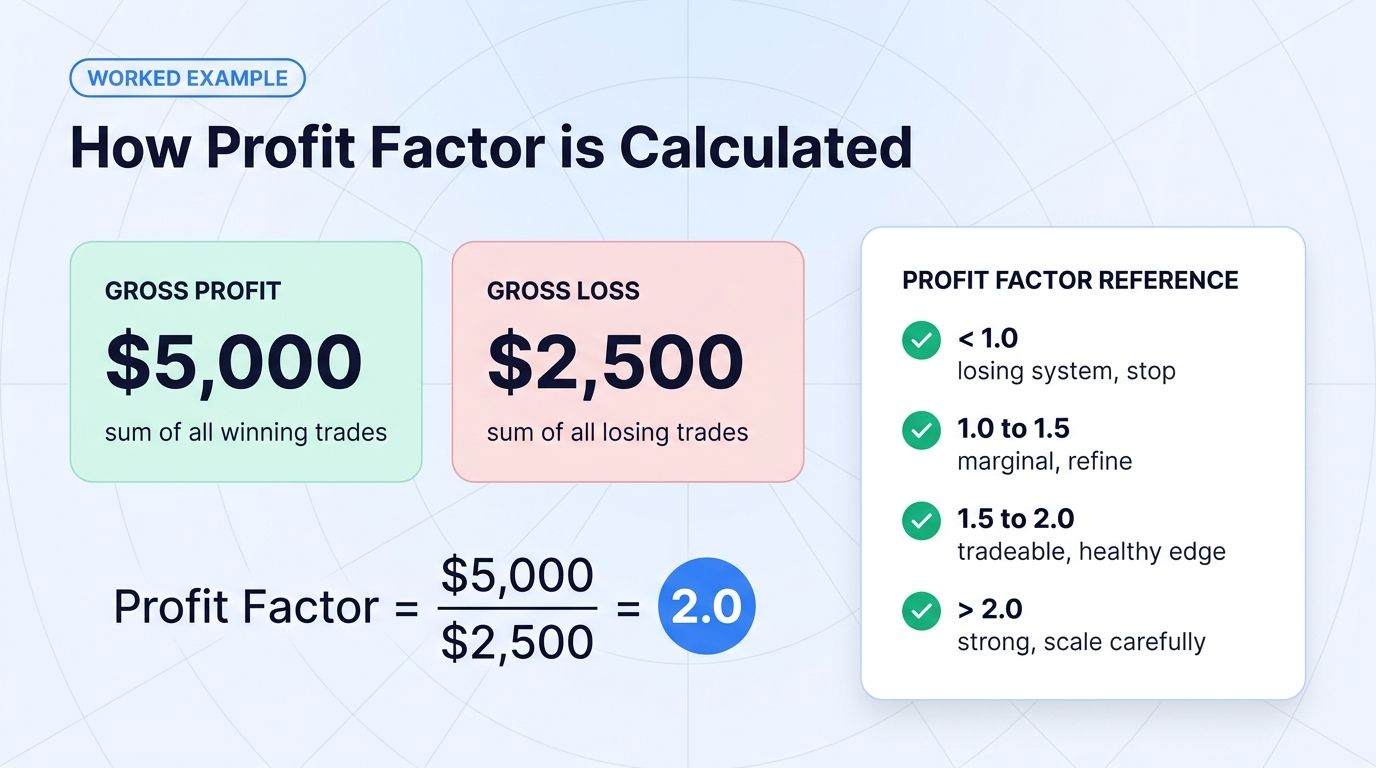
Assume you review your trading results for the last month:
• Sum of all profitable trades: $5,000
• Sum of all losing trades: $2,500
Profit Factor = 5,000 / 2,500 = 2.0
A Profit Factor of 2.0 means: for every $1.00 the strategy lost, it generated $2.00 in profit. That is typically a profitable and more sustainable system than a strategy hovering around 1.0.
How to read your Profit Factor score
Profit Factor is easy to calculate, but interpreting it correctly matters more than the number itself. The same Profit Factor can mean different things depending on trade frequency, fees, and market regime.
Here is a practical way to think about it:
Below 1.0: unprofitable
Your strategy is losing money. Total losses exceed total gains. This is usually a sign of one of these issues:
• losses are too large when you are wrong
• you are taking too many low quality setups
• fees and slippage are eating a thin edge
• your exits are cutting winners too early
At this level, the best move is to pause and diagnose, not to trade more.
1.0 to 1.5: marginally profitable
You are making money, but the edge can be fragile. One rough week, a volatility spike, or a small increase in trading costs can wipe out gains.
This range often indicates:
• winners are not large enough compared to losers
• you are profitable only in one market condition
• your strategy needs tighter loss control or better trade selection
1.5 to 2.5: the sweet spot
This is where many consistently profitable systems tend to land once fees are included. Losses are covered comfortably and the strategy has room to breathe.
A Profit Factor in this range usually means:
• losers are controlled
• winners are allowed to run enough to pay for the inevitable losing streaks
• the strategy has repeatable logic, not random outcomes
Above 3.0: exceptional, or suspicious
A Profit Factor this high can be real, but it needs scrutiny. It can happen during strong trending conditions where many strategies work, or with highly selective systems that trade rarely.
It can also be inflated by:
• too few trades
• one or two outlier winners
• unrealistic backtest assumptions
When you see a very high Profit Factor, verify it on a larger sample and across different conditions.
The trap: high win rate vs high Profit Factor
Win rate tells you how often you are right.
Profit Factor tells you how much you are right, compared to how much you are wrong.
That difference is everything.
Trader A: the scalper with a high win rate
• Win Rate: 90% (9 wins, 1 loss)
• Behavior: takes profit quickly, but allows one loss to get big
Example math:
• 9 wins of $10 = +$90
• 1 loss of $100 = -$100
Net result = -$10, despite winning 90% of the time.
Profit Factor = 90 / 100 = 0.9
This is what a fragile strategy looks like: it feels good most of the time, then one loss erases many wins.
Trader B: the trend follower with a lower win rate
• Win Rate: 40% (4 wins, 6 losses)
• Behavior: cuts losses quickly, lets winners run
Example math:
• 4 wins of $50 = +$200
• 6 losses of $10 = -$60
Net result = +$140, despite being “wrong” 60% of the time.
Profit Factor = 200 / 60 = 3.33
Trader B is the better trader because the system is efficient: small controlled losses and meaningful wins.
This is also why you do not need to predict the future to make money. You need risk-to-reward logic that is actually respected in execution.

Why Profit Factor can mislead you
Profit Factor is powerful, but it is not a magic stamp of profitability. These are the most common ways traders get fooled:
1) Too few trades
A Profit Factor of 2.5 on 20 trades can be luck. A Profit Factor of 1.4 on 300 trades is often more trustworthy.
Rule of thumb: the fewer trades you have, the less confidence you should place in the number.
2) One outlier winner
One huge winner can inflate Profit Factor and hide weak consistency. A simple check:
• remove the top 1 winner and recalculate
If Profit Factor collapses, your strategy may depend on rare outliers rather than repeatable setups.
3) Fees and slippage
A strategy can look profitable before costs and become unprofitable after realistic fees and slippage. This matters even more if your style trades frequently or exits quickly.
4) Market regime dependence
Some strategies thrive in trends and die in chop. If your Profit Factor swings wildly over time, the strategy may need a filter for conditions.
How to improve Profit Factor
Profit Factor improves in two ways:
• increase total gross profit
• reduce total gross loss
Most traders should start by reducing losses, because shrinking gross loss often improves both Profit Factor and drawdown.
1) Reduce the denominator: keep gross loss small and consistent
If losses are large or uneven, Profit Factor suffers even when win rate looks fine.
Practical actions:
• define a stop level that invalidates the setup
• do not widen stops after entry
• avoid trading setups where the stop distance is too large
• cut trades that do not move within a reasonable time window
This is where disciplined stop placement and position sizing matter most.
2) Increase the numerator: improve average win without forcing it
Growing gross profit is not about dreaming bigger targets. It is about systematic exits that let winners breathe.
Practical actions:
• scale out: take partial profit, trail the remainder
• use structure-based exits, not arbitrary numbers
• avoid exiting winners early just to lock in a small gain
Even a small improvement in average win can lift Profit Factor significantly over a large sample.
3) Filter low quality trades
Many strategies improve when you remove the worst trades rather than trying to squeeze more out of every trade.
Examples of filters:
• trade with the higher timeframe trend
• avoid low volatility sessions
• skip entries when the market is messy or levels are unclear
If the filter removes trades that mostly become losers, gross loss drops faster than gross profit. Profit Factor rises naturally.
4) Improve execution with a review loop
Profit Factor improves faster when you can identify why losses happen.
A review loop can be simple:
• tag each losing trade by reason (late entry, FOMO, no stop, bad market condition)
• review the top 2 or 3 recurring reasons
• make one rule change at a time and test again
If your rules are not measurable, the metric will not improve in a stable way.
Using Profit Factor as part of a real testing process
Profit Factor is most useful when it is part of a testing process, not a single score you check once and forget.
A practical workflow:
1. Test one strategy with fixed rules on a meaningful sample size.
2. Calculate Profit Factor after fees, not before.
3. Track it alongside trade count and maximum drawdown.
4. Segment results by market condition if possible.
5. Make one change at a time, then re-test.
6. Validate the improvement on a different period, not only the same dataset.
The goal is simple: Profit Factor should improve for the right reasons, such as tighter loss control or better exits, not because of curve fitting.
How to improve Profit Factor using an Altrady workflow
Many traders lose track of their true performance because trades are spread across exchanges and not reviewed consistently. A structured workflow can fix that.
Here is a practical approach:
1) Record trades consistently in a crypto journal
Profit Factor is only as good as your data. If trades are missing or fees are ignored, the metric becomes misleading.
A strong journaling habit includes:
• outcome per trade
• fees and notes
• tags for strategy and market condition

2) Use disciplined risk controls
Profit Factor improves quickly when losing trades stop being disasters.
Focus on:
• position sizing that matches your stop distance
• predefined stops that invalidate the idea
• avoiding trades where the stop is too wide
3) Improve exits with structure and trailing logic
Gross profit grows when winners are not cut too early.
If your strategy has many small wins and occasional big losses, improving exits and stop discipline can shift the entire distribution.
4) Review and optimize based on evidence
Treat it like a business metric:
• review weekly or monthly
• identify the biggest loss sources
• adjust one variable at a time
Over time, your Profit Factor becomes a reflection of a more consistent process, not random outcomes.
FAQ
What is a good Profit Factor in trading?
A Profit Factor above 1.0 is the minimum requirement for profitability before costs. Many traders look for 1.2 or higher across a solid sample size, then validate it across different market conditions.
Is Profit Factor better than win rate?
Profit Factor is often more useful than win rate because it includes the size of wins and losses. Win rate can be high even when the strategy loses money overall.
Can Profit Factor be negative?
Profit Factor is expressed as a positive ratio because total gross loss is taken as an absolute value. If there are no losing trades in the dataset, Profit Factor becomes undefined rather than negative.
Risk disclaimer
Trading is risky and losses can happen quickly in volatile markets. Profit Factor is a descriptive metric rather than a guarantee of profit. Always use position sizing, predefined stops, and proper testing before allocating meaningful capital. Taking advantage of a 5-day free trial of Altrady is a great way to practice these risk management habits before trading live.