The phrase "AI trading signals" has been used to sell everything from rigorous machine learning systems to spreadsheet-formula bots dressed up in marketing copy. Most retail traders cannot tell the difference until they have lost money to the second category. This guide breaks down what AI signals actually are, what to look for in legitimate ones, and the warning signs that separate real ML-driven systems from hype.
What an AI Trading Signal Actually Is
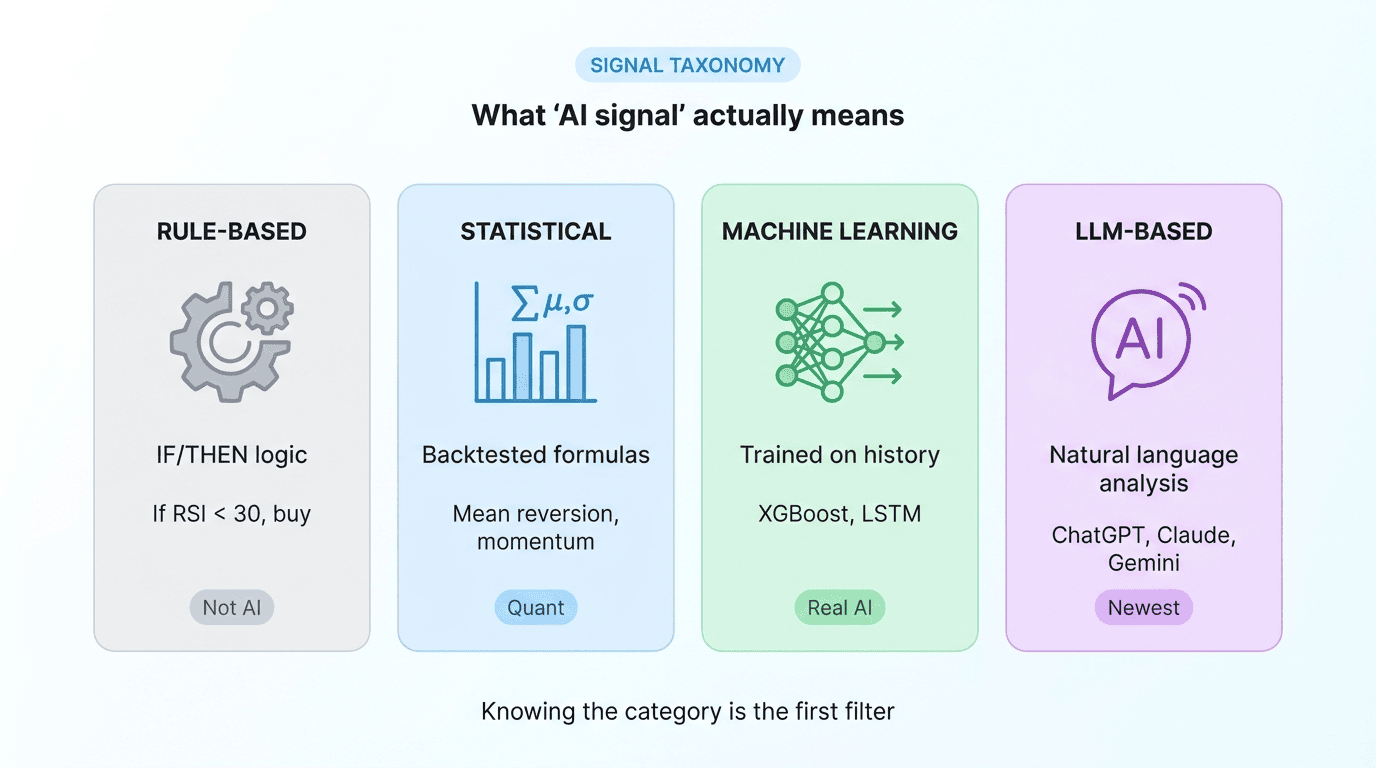
A trading signal, AI or not, is a recommendation to buy or sell a specific asset at a specific time, usually with entry, stop-loss, and target prices. The signal can be generated by:
1. Technical rules. A human trader writes IF/THEN logic ("if RSI < 30 and price touches 200-EMA, buy"). The system fires signals when conditions match. No AI involved.
2. Statistical models. Backtested formulas using historical data (mean reversion, momentum, pairs trading). Not AI in the modern sense, but often marketed as "algorithmic" or "quant".
3. Machine learning models. Models trained on historical price, volume, on-chain data, and sometimes alternative data (news sentiment, social media). The model learns to predict short-term price direction or volatility, then generates a signal when its prediction crosses a confidence threshold.
4. LLM-based assistants. ChatGPT, Claude, Gemini-style models analyzing charts or news through natural language interfaces. Newest category, fastest growing in 2025-2026.
When a service markets "AI signals", it usually means category 3 or 4, sometimes category 2 stretched. Knowing which category you are dealing with is the first filter.
How Real ML-Based Crypto Signals Are Built
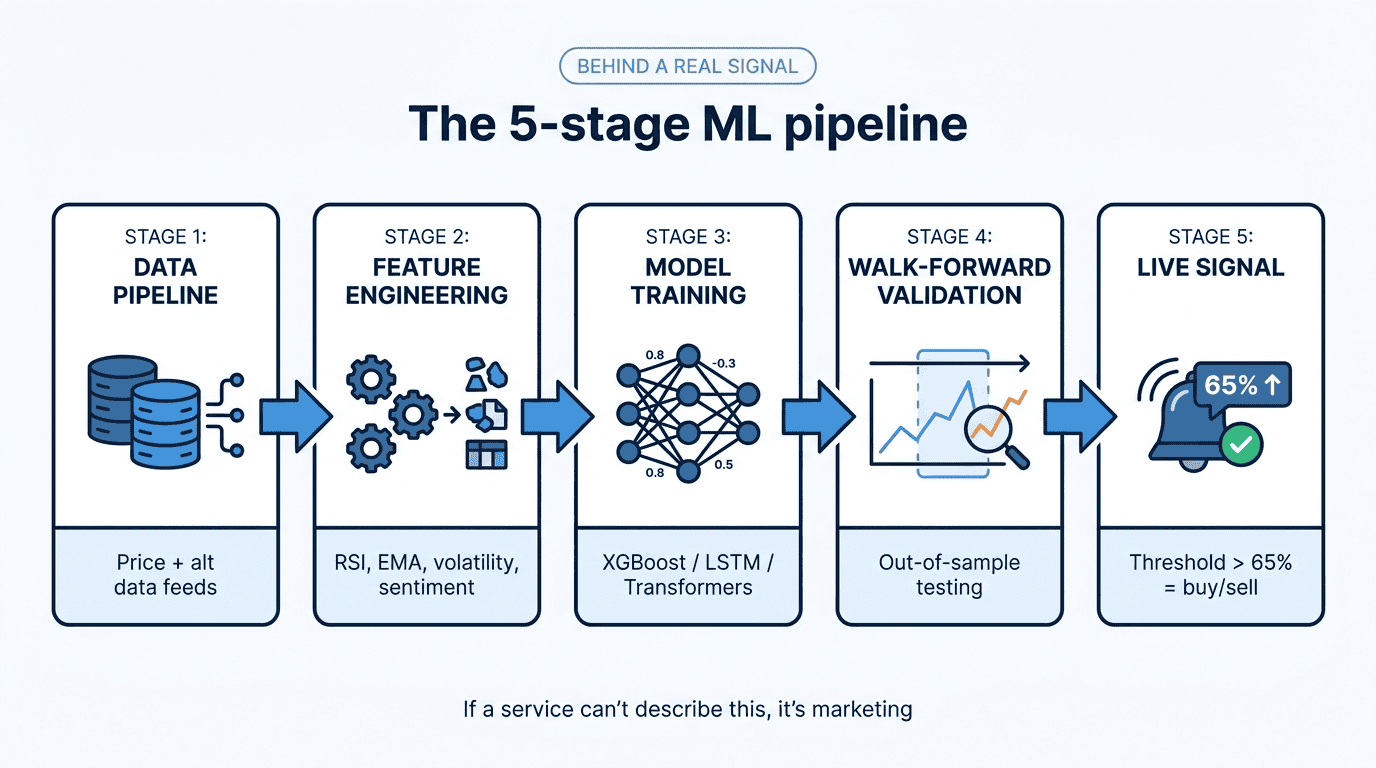
Legitimate machine learning trading systems share a recognizable architecture. If a service cannot describe its setup at this level, that is the first hype warning.
Data pipeline. Real-time price (OHLCV) feeds from multiple exchanges, plus optional alt data (order book depth, funding rates, on-chain whale moves, social sentiment, news flow). The data is cleaned, normalized, and stored in a feature store.
Feature engineering. The raw data is transformed into hundreds of derived features: RSI across multiple timeframes, EMA distances, volume Z-scores, volatility regimes, correlation to BTC, etc. The model does not see prices; it sees engineered features.
Model training. Historical data is split into train, validation, and test sets. Common model types for crypto signals: gradient boosted trees (XGBoost, LightGBM), recurrent neural networks (LSTM), transformers, or ensembles. The model trains to predict a specific target (e.g., "will price be up more than 1 percent in the next 4 hours?").
Walk-forward validation. The model is tested on data it never saw during training, simulating how it would have performed in real time. Out-of-sample accuracy, Sharpe ratio, and max drawdown are reported. If a service does not publish walk-forward results, treat the signal claims as marketing.
Live signal generation. The trained model receives current market features and outputs a probability of price direction. A threshold (e.g., 65 percent confidence) triggers a signal. Position size is often weighted by confidence.
Performance monitoring. Real-time tracking of signal win rate, average R-multiple, and degradation. If model performance drops below baseline, the team retrains or shelves it.
This is the workflow that produces signals worth following. The next sections show how to recognize the difference.
Five Warning Signs of Hype Signals
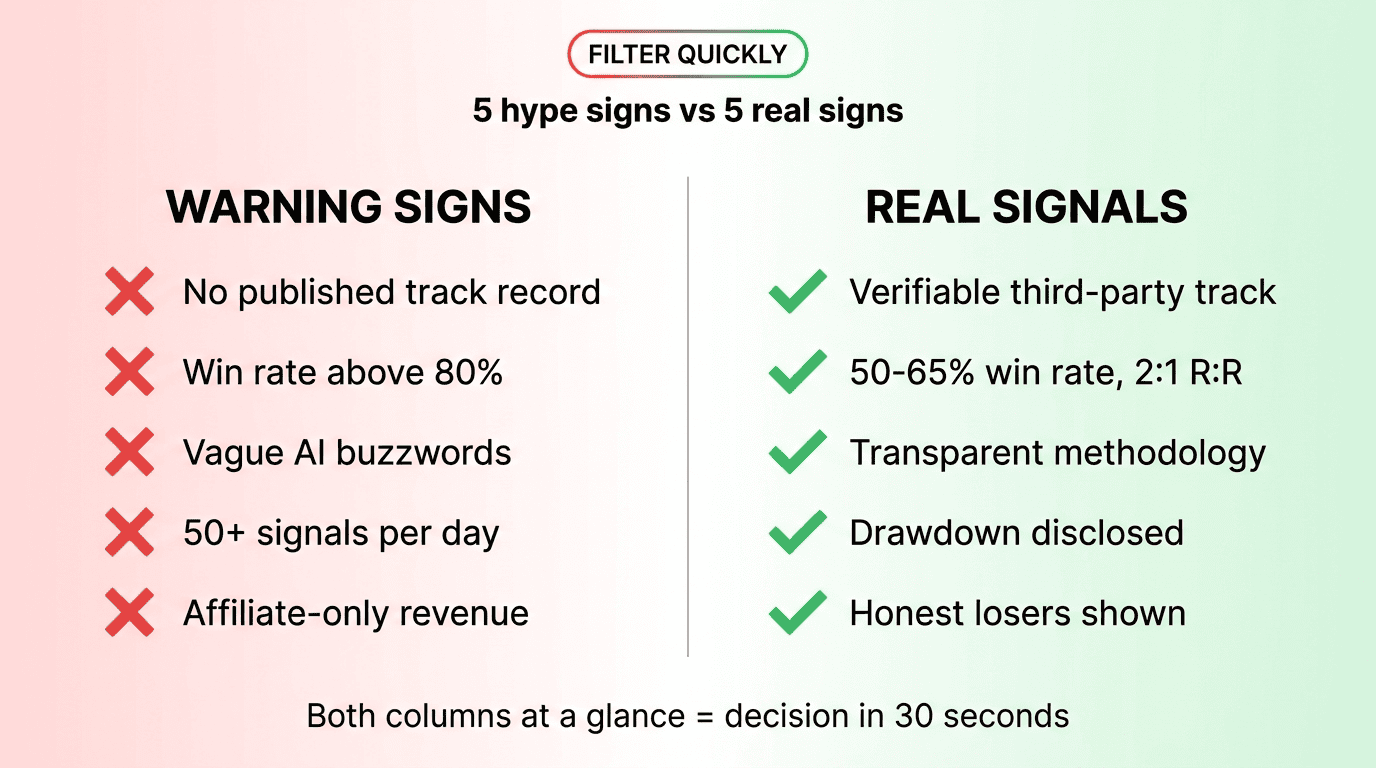
Most "AI signals" services in crypto fall into this category. The signs are consistent and easy to spot.
1. No published track record. A real signal service shows verified historical performance (ideally on a third-party tracker like FxBlue, Myfxbook, or via on-chain proof-of-trade). Hype services show curated screenshots of winners only.
2. Win rate above 80 percent. Sustainable trading systems run 50-65 percent win rate. Anyone claiming 90 percent win rate is either selling losers as wins (closing trades early at small profit while letting losers run), cherry-picking results, or backtesting on a tiny biased sample. Mathematical impossibility above the 70 percent ceiling for liquid markets over time.
3. Vague AI buzzwords. "Powered by deep learning" or "neural network signal engine" with no architectural detail or model description. Real teams talk about feature engineering, walk-forward results, and model degradation. Hype teams talk about "the AI" as if it were a black box that just works.
4. Signal volume is too high. A real ML model generates a few high-conviction signals per day across all major pairs. A hype service spams 50-100 signals per day, hoping enough will work that the marketing math holds up. High-frequency signal services are chasing volume of subscribers, not edge.
5. Affiliate-only revenue model. If the only way the service makes money is referring you to specific exchanges via affiliate links, the signals exist to generate exchange volume, not to make you profitable. Cross-reference: does the team trade their own signals with their own capital?
What to Look for in a Legitimate Signal Service
Pivoting to the positive: how do you actually evaluate a service before subscribing.
Verifiable performance. Public track record on third-party trackers, with both winning and losing trades visible. Skip if you cannot independently verify.
Realistic win rates. 50-65 percent win rate, paired with average R-multiple of 1.5-2.5. Math: 55 percent win rate at 2:1 R:R = positive expectancy. That is what real systems target.
Transparent methodology. The team can explain what features the model uses, what the prediction target is, and how often it retrains. Not necessarily open-sourcing the model, but showing they have one.
Drawdown disclosure. Worst loss streak, max drawdown percent, average days to recover. Hype services hide drawdowns; legitimate ones bake them into expectations.
Position sizing guidance. Real services tell you how much to risk per trade, not just "buy here". Position sizing is half the edge.
Honest losers. The track record includes losing trades, with explanations of what went wrong. Polished marketing without losers is a red flag.
How to Use AI Signals Correctly (Without Outsourcing Your Brain)
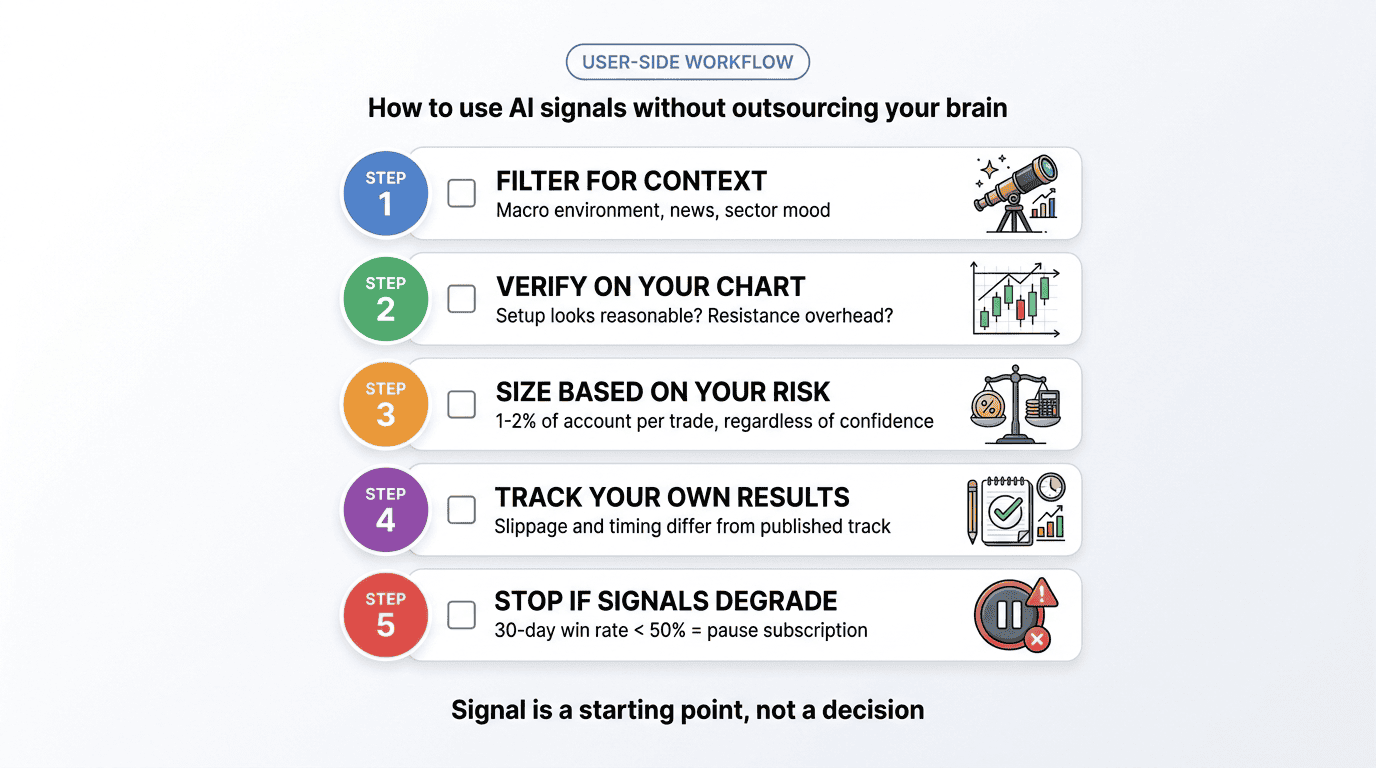
Even a high-quality AI signal is a starting point, not a trade. The traders who profit from AI signals layer their own judgment on top.
1. Filter for context. A bullish signal during a major macro selloff is weaker than the same signal in a calm market. The model might not see broad context; you do.
2. Verify on your own chart. Pull up the pair the signal references. Does the technical setup look reasonable? Is there obvious resistance overhead that would invalidate the signal? Five seconds of chart reading filters bad setups.
3. Size based on your risk, not the signal's confidence. Signals do not know your account size, your risk tolerance, or your current open exposure. Always size such that one full stop-out is 1-2 percent of your account.
4. Track your own results. Even if a service publishes its track record, your results may differ due to slippage, timing, or position sizing differences. Keep your own journal of every signal you act on, with outcome and notes.
5. Stop subscribing if the signals stop working. Signal services degrade. The market changes; the model's edge erodes. Set a personal threshold (e.g., "if 30-day win rate drops below 50 percent, pause subscription") and enforce it.
How Altrady Connects to Signal Workflows
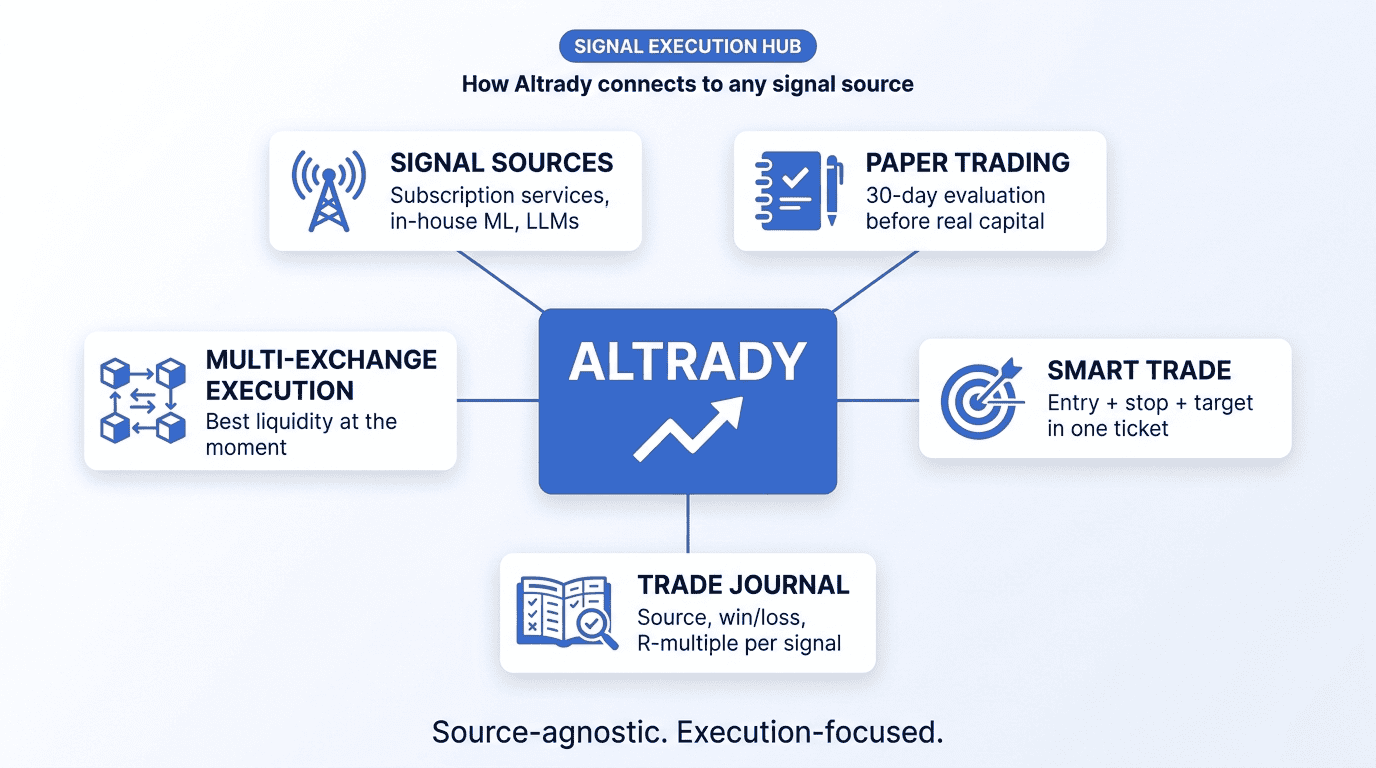
Inside Altrady, you can build a workflow that uses AI signals or your own analysis without losing edge to slippage.
Multi-exchange execution. Signals often arrive at the same moment across multiple exchanges. Altrady lets you execute on the exchange with best liquidity at that moment, not just the one your signal service is partnered with.
Smart Trading. When a signal arrives with entry/stop/target, set all three in a single Smart Trading. The platform manages the trade; you do not have to baby-sit screens.
Trailing stops. AI signals often produce winners that run further than the original target. Trailing stops let you ride extended moves without giving back gains.
Paper trading. Test a new signal service in paper mode for 30 days before committing real capital. Track win rate, R-multiple, and drawdown. If the live signals match published track record, scale in. If not, you saved yourself from joining a hype service.
Trade journal. Every signal-driven trade gets logged with source, entry/exit/outcome. After 50 trades you see which signal services are pulling weight versus which are noise.
Frequently Asked Questions
Are AI crypto trading signals reliable?
Some are, most are not. The reliable ones come from teams with verifiable track records, transparent methodology, and realistic win rate claims (50-65 percent). The unreliable ones use AI as a marketing buzzword on top of generic technical signals or curated screenshots of winners.
What is the difference between AI signals and traditional trading signals?
Traditional signals come from human-coded rules (e.g., "buy when RSI is below 30"). AI signals come from machine learning models trained on historical data to predict price direction or volatility. AI signals can in theory adapt to new market regimes; traditional signals cannot. In practice, both depend heavily on how well-built the underlying logic is.
How accurate are AI crypto signals?
Realistic accuracy: 50-65 percent win rate on direction prediction, paired with 1.5-2.5x average R-multiple. Anything above 70 percent over a meaningful sample size is suspect. Crypto's volatility caps achievable accuracy.
Should I use ChatGPT or Claude to generate trading signals?
LLMs are useful for chart pattern recognition, news sentiment analysis, and trade plan critique. They are not reliable for direct buy/sell timing because they hallucinate, they do not have real-time data without tools, and they are not optimized for short-horizon prediction. Use them for context and idea generation, not for entry signals.
How do I evaluate a signal service before subscribing?
Demand a public track record on a third-party tracker. Check win rate (50-65 percent is realistic), max drawdown, R-multiple distribution. Read 30+ user reviews on independent forums. Test in paper trading for 30 days before committing real capital. Skip any service that resists transparency.
Final Thoughts
AI crypto trading signals are not a free lunch and not a scam category by default. They sit on a spectrum between rigorous machine learning systems built by experienced quant teams and marketing campaigns that wrap generic technical signals in AI buzzwords. The traders who benefit from AI signals are the ones who learn to tell the categories apart, who layer their own context on top of every signal, and who build their workflow around tools like Altrady's Smart Trading rather than blindly executing whatever appears in their feed.
If a signal service does not publish a verifiable track record, claims a win rate above 70 percent, or talks about "the AI" without explaining the underlying model, you have learned what you need: that is hype, not signal. Move on.
Ready to test signal services without risking real capital? Start your Altrady free trial and use paper trading, multi-exchange execution, and the trade journal to evaluate any signal source on your own terms.