
A crypto trading signal is a suggestion to buy or sell a cryptocurrency when a specific condition is met. A complete signal names the trading pair, the direction (long or short), an entry price or zone, a stop loss, one or more take-profit targets and the timeframe it is based on.
Signals come from many places: analysts in Telegram groups, indicator alerts, market scanners and trading bots. This guide explains what a signal contains, how to read one before you act, the main ways to get signals, how to create and automate your own in Altrady, and how to tell a usable signal from noise. Nothing here is financial advice.
Key Takeaways
- A usable signal is complete. Pair, direction, entry, stop loss, take profit and timeframe. If the stop loss is missing, the risk is entirely yours to define.
- Read the risk before the reward. Check how far the stop is from the entry and size your position so a loss stays within your limit.
- There are four main sources. Trade calls from analysts, your own indicator alerts, market scanners and automated bot signals.
- You can build your own signals. In Altrady you create them from indicator rules in the TA Scanner and let a DCA Bot or Signal Bot trade them with your own stop loss.
- No signal is a guarantee. Test any source on paper and track its results before using real money.
What Are Crypto Trading Signals?
A crypto trading signal is a prompt to open or close a position because a measurable condition has been met: price breaking a level, an indicator crossing a threshold, or an analyst's setup becoming valid. The condition should be something you can check on a chart, not urgency or a feeling.
Signals are used for spot and futures trading on most cryptocurrencies. Some are sent by people, some are generated by software, and some go straight to a trading bot that acts on them. Whatever the source, a signal only becomes a trade once you decide how much to risk and where you are wrong.
What a Crypto Signal Includes
A complete crypto trading signal contains six parts. Here is a generic example to show how they fit together.
| Part | What it tells you | Example |
|---|---|---|
| Pair | The market to trade | ETH/USDT |
| Direction | Long (buy) or short (sell) | Long |
| Entry | The price or zone to open the position | 2,400 to 2,420 |
| Stop loss | Where the idea is wrong and you exit | 2,330 |
| Take profit | One or more targets to close the position | 2,520 and 2,600 |
| Timeframe and reason | The chart and condition behind the signal | 4-hour chart, close above resistance |
Example values are illustrative, not a recommendation. Some signals also state leverage for futures, the share of the position to close at each target, and how long the signal stays valid.
How to Read a Crypto Signal Before You Act
- Check that it is complete. If the entry, stop loss or target is missing, you cannot measure the risk, so treat it as an idea rather than a signal.
- Work out the risk and reward. In the example above, entering at 2,410 with a stop at 2,330 risks 80 per ETH; the first target at 2,520 is 110 away. That is a reward-to-risk ratio of about 1.4 to 1 for the first target.
- Size the position from the stop. If you are willing to lose $50 on the trade, a $80 stop distance means a position of about 0.62 ETH, not whatever amount feels right. A risk/reward calculator does this for you.
- Check it fits your market. Is the pair liquid on your exchange? Has price already moved past the entry? A late entry changes every number above.
- Check the timeframe. A signal from a 15-minute chart is a short trade; one from a daily chart can take weeks. Make sure it matches how you trade.
The 4 Main Ways to Get Crypto Trading Signals
1. Trade calls from analysts and communities
Telegram and Discord groups, free and paid, post trade calls with entries and targets. They can be a starting point while you learn, but quality varies widely. Before trusting any provider, check for a long, complete track record that includes losses, consistent rules and a stop loss on every call. We compare free and paid options, including signal marketplaces, in our guide to the best crypto signal providers.
2. Your own indicator alerts
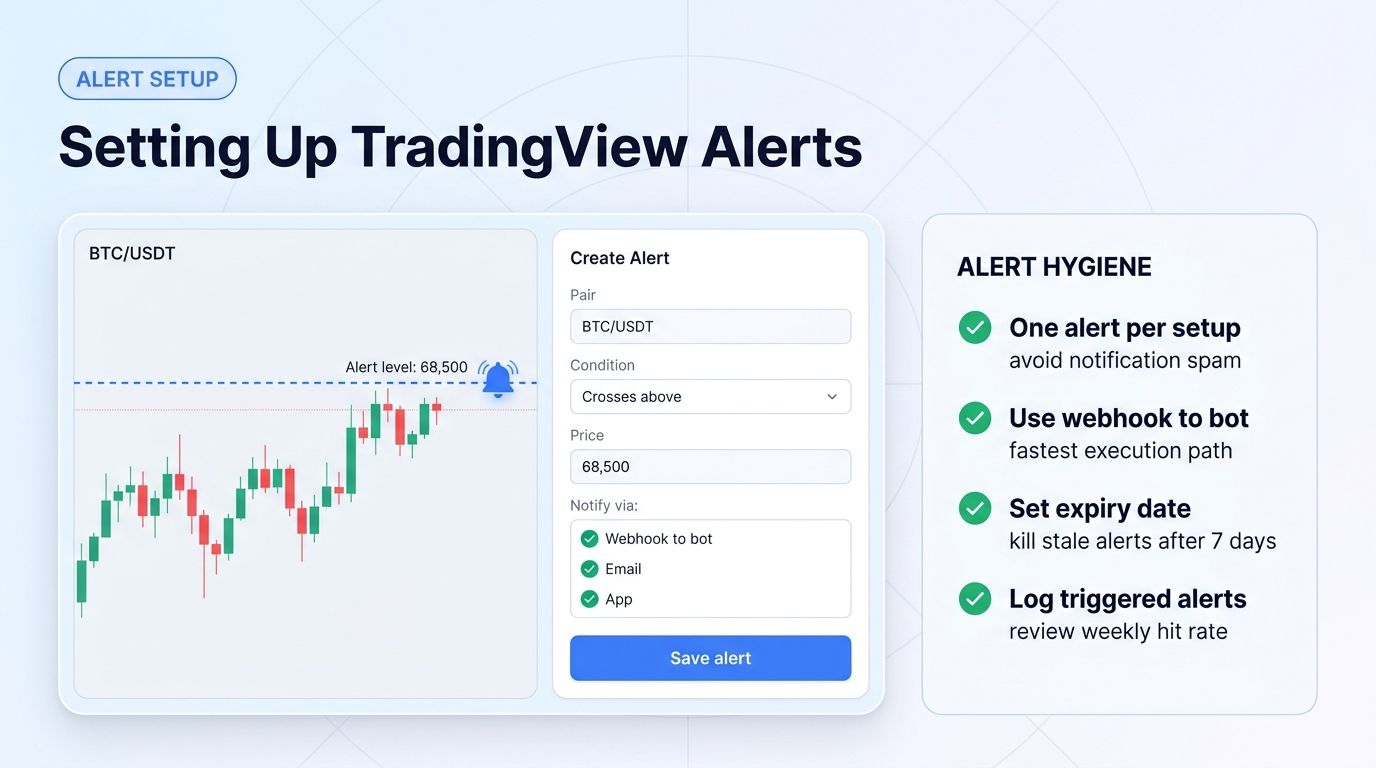
You define a condition, such as RSI crossing back above 30 or price closing above a moving average, and get an alert when it happens. The advantage is consistency; the risk is alert spam if your rules are too loose. Pair indicator alerts with a trend filter and a risk rule.
3. Market scanners
Scanners check many markets at once and highlight the ones that match your criteria: unusual volume, momentum, breakouts after consolidation or drops to support. They are best for finding candidates, which you then confirm with your own rules.
4. Automated bot signals
Signals can be sent straight to a trading bot that opens and manages the position: from a signal provider, a scanner, or your own TradingView alert sent by webhook. Automation removes hesitation but also repeats mistakes, so test on paper first and cap frequency and size.
How to Create Your Own Crypto Signals in Altrady
Instead of only following other people's calls, you can build signals from rules you understand and automate them in Altrady, which connects to your exchange accounts and does not hold your funds.
Build signals in the TA Scanner
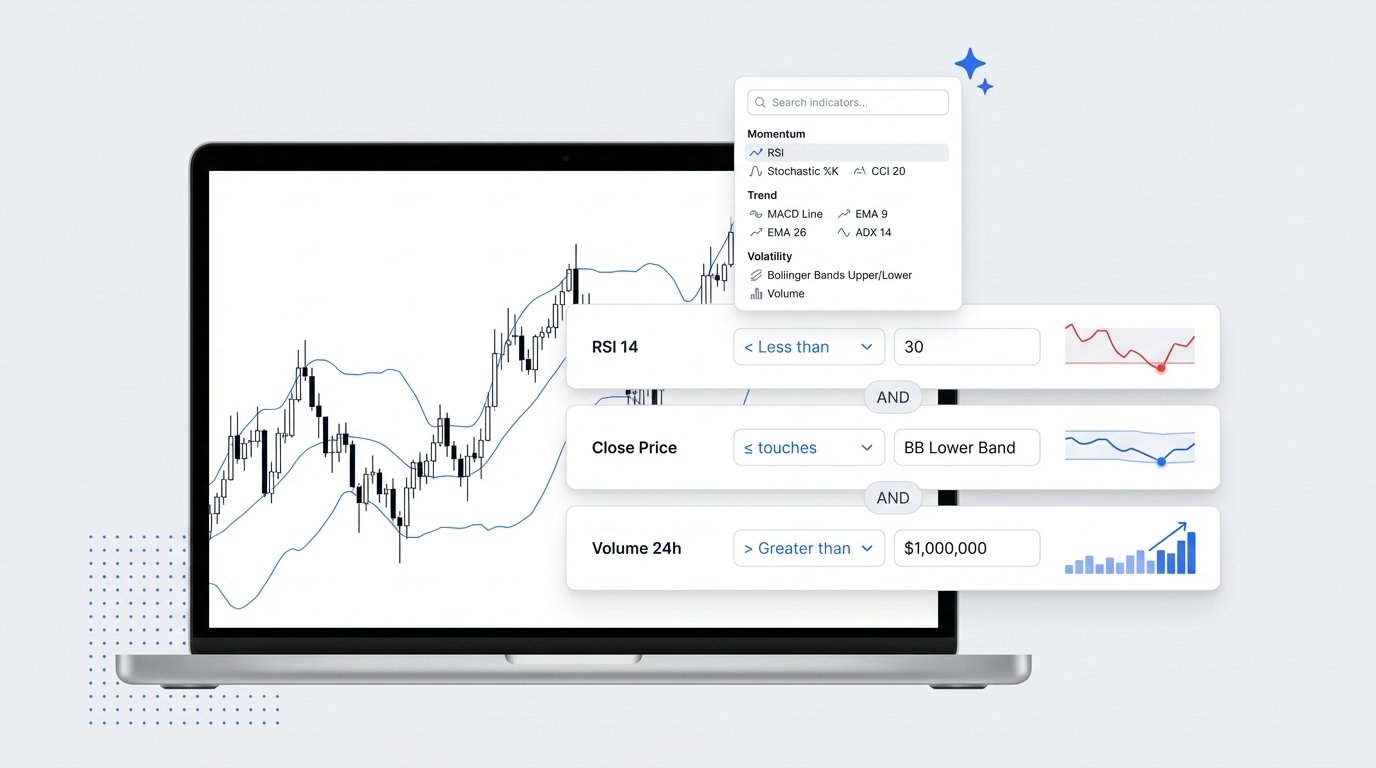
The TA Scanner combines conditions from 100+ indicators, such as RSI, MACD, EMA crossovers, Bollinger Bands and volume, with AND/OR logic. It can trigger on every tick or on candle close, runs across your exchanges and timeframes, and alerts you on screen, by sound or by push notification. If you are not sure where to start, it includes 11 preset strategies across trend continuation, mean reversion, momentum and breakouts.
Import and share strategies
TA Scanner strategies can be exported as a JSON file or shared by link. When you import one, it starts switched off, so you can read its rules before turning it on.
Automate your signals with a DCA Bot
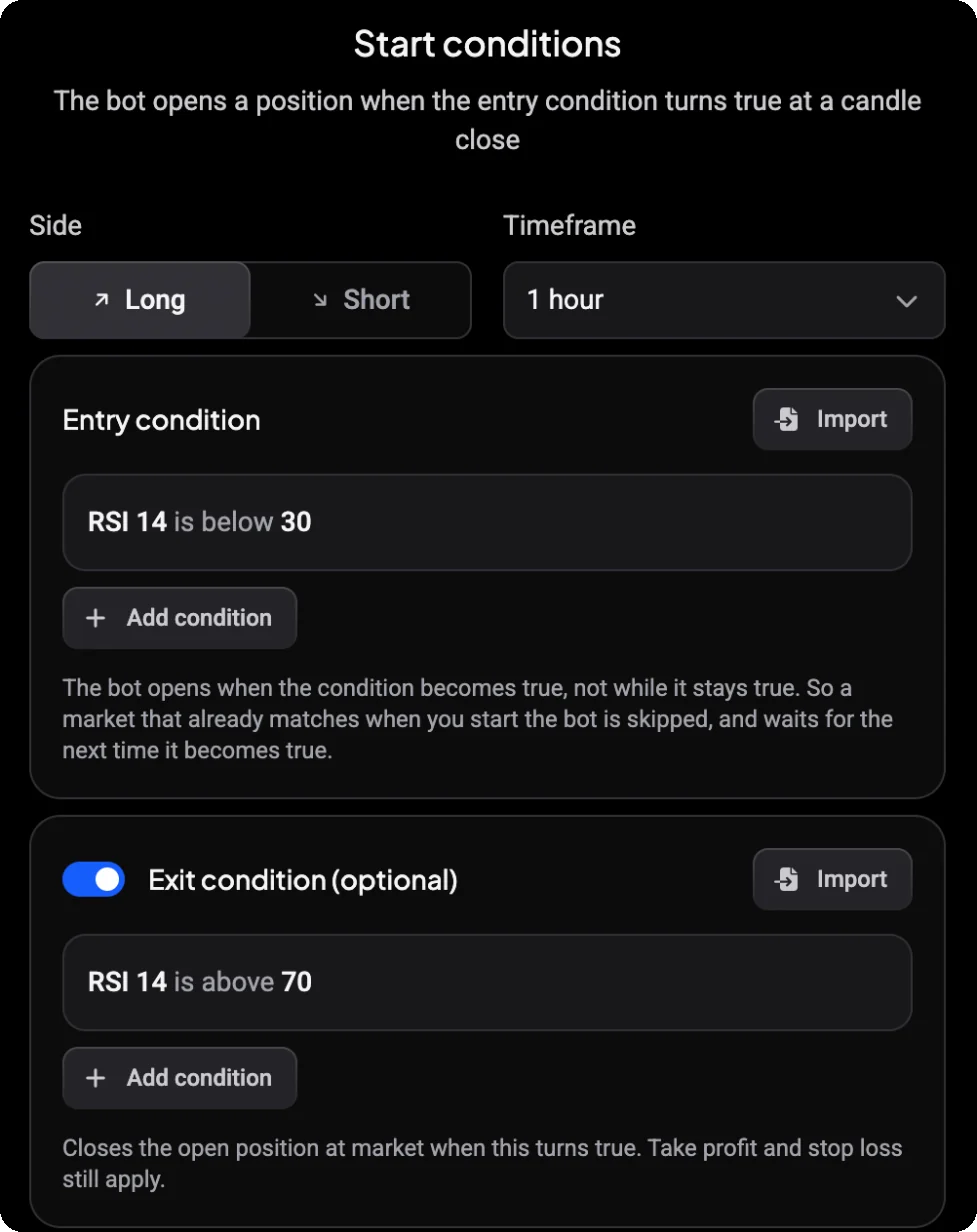
A DCA Bot can open a position when indicator conditions are met. Import a rule you built in the TA Scanner as the bot's entry condition, then set safety orders, take profit, stop loss and an optional exit condition. You can backtest the bot on recent data before running it; backtest results are simulated and do not guarantee future results.
Follow ready-made signals with Signal Bot
The Signal Bot trades signals from the Crypto Base Scanner, which detects base support levels, or from The Better Traders, whose free bot signal templates cover 26 coins, long only and spot only. Your settings decide the investment, DCA orders, take profit, stop loss and filters. Altrady plans to add a signal marketplace with more providers. To trade your own TradingView alerts, use the TradingView Bot.
Every bot can run on a paper trading account first and be converted to live when you are ready.
A Workflow for Better Signals, Not More Signals
Step 1: Choose one signal source per strategy
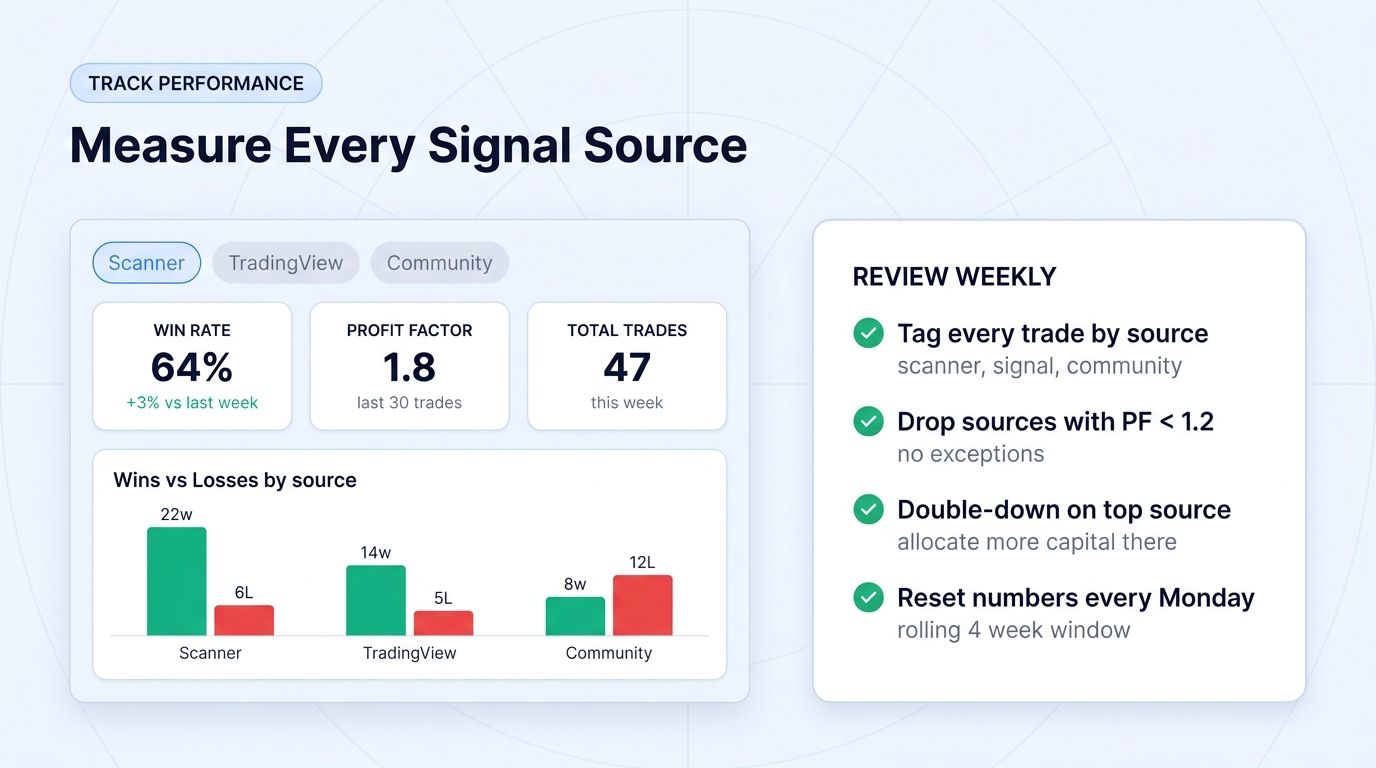
If you mix scanners, communities and indicators in one strategy, you will never know which source works. Pick one primary source per strategy and run it for a meaningful number of trades.
Step 2: Use a signal quality checklist
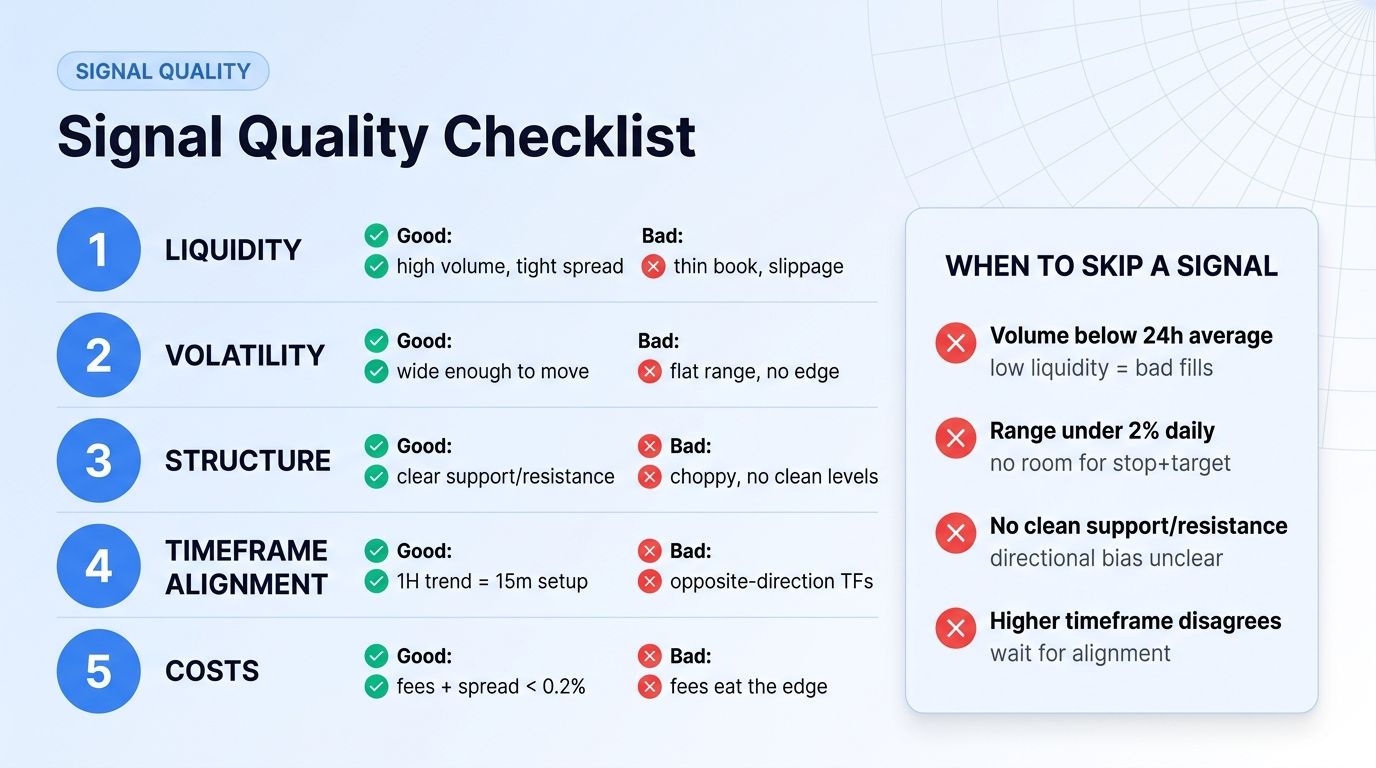
Before taking any signal, filter it for liquidity, volatility, clear structure, timeframe alignment and realistic costs. A signal that fails the checklist is a skip.
Step 3: Turn signals into alerts so you do not chase
Even when a signal comes from a trusted source, mark the level, set an alert and let price come to you. If the level never triggers, you avoided a late entry rather than missed a trade.
Step 4: Protect the downside with risk rules
Every trade needs a clear invalidation point, a stop loss, and a position size based on the stop distance. Add a maximum daily loss and a maximum number of attempts per setup.
Step 5: Track what works in a journal
Tag each trade in a trading journal with its signal source, setup and whether you followed your rules, then compare sources by results rather than by feel.
How to Spot Bad Signals
- No stop loss or invalidation level.
- "Guaranteed profit" or "100% accuracy" claims.
- A win rate with no average win and loss, or screenshots without a full record.
- Pressure to enter immediately or to upgrade to a "VIP" group.
- Calls on tiny, illiquid coins, a common pump-and-dump pattern.
- Requests for your seed phrase, deposits to a manager, or API keys with withdrawal rights.
Also watch for false signals in choppy markets, where indicators flip back and forth. If a rule triggers in both directions inside a range, add a trend or volatility filter. Read more about false signals in crypto trading.
Frequently Asked Questions
What are crypto trading signals?
Crypto trading signals are suggestions to buy or sell a cryptocurrency when a specific condition is met. A complete signal includes the pair, direction, entry, stop loss, take-profit targets and timeframe. They come from analysts, indicator alerts, scanners or automated systems.
What does a crypto signal include?
A usable signal names the trading pair, whether to go long or short, an entry price or zone, a stop loss, one or more take-profit targets and the timeframe or reason behind it. Futures signals often add leverage. Without a stop loss you have to decide the risk yourself.
How do I read a crypto trading signal?
Check the signal is complete, then measure the distance from entry to stop loss and to each target to get the reward-to-risk ratio. Size your position so a stop-out loses only what you planned, and check the pair is liquid on your exchange and price has not already moved past the entry.
Where can I get crypto trading signals?
From analyst groups on Telegram or Discord, from your own indicator alerts, from market scanners, and from bot platforms with signal providers. Our guide to the best crypto signal providers compares free and paid options with their limits and prices.
Can I create my own crypto signals?
Yes. In Altrady's TA Scanner you combine conditions from 100+ indicators or start from one of 11 templates, and get an alert when a market matches. You can import the same rule into a DCA Bot so it trades your signal with your own take profit and stop loss.
What are The Better Traders signals?
The Better Traders offers free bot signal templates that run on Altrady or 3Commas bots. They cover 26 coins, long only and spot only. In Altrady you select The Better Traders as the signal source in Signal Bot and set your own investment, take profit and stop loss.
Are crypto trading signals worth it?
They can help with finding ideas and staying consistent, but only when paired with clear rules and risk limits. Treat signals as inputs, not commands, and judge any source on a full record of its results.
Can crypto signals be automated safely?
Yes, with limits. Test on a paper account first, cap how often the bot can trade and how much it can risk, and make sure every position has a stop loss. Automation makes a good process faster and a bad one more expensive.
Risk Disclaimer
Trading cryptocurrencies is risky and losses can happen quickly. Signals do not guarantee profit, and past or simulated results do not guarantee future results.
Want to build and test your own signals? Start a 5-day free Altrady trial, no credit card required, create a rule in the TA Scanner and run it on a paper account.