
You are evaluating Altrady against Cryptohopper because both promise multi-exchange crypto automation, but the architectural difference matters more than the feature lists suggest. Altrady is a multi-exchange terminal where manual trading and 3 native bots (Signal, Grid, DCA) operate as co-equal pillars across 19+ exchanges, with funds staying on your own exchange accounts. Cryptohopper is a bot-first platform that pairs its own automation engine with an extensive marketplace where independent traders publish strategies you can subscribe to or copy.
Both connect to multiple exchanges. The choice comes down to whether you want unified control across manual and bot execution (Altrady) or a curated strategy ecosystem with bot-centric workflows (Cryptohopper). This guide breaks both down by feature, real pricing in EUR, and the trader profile each fits best.
The TL;DR: Different Tools for Different Traders
If you trade manually, take discretionary entries, watch charts during the session, and want a unified terminal across multiple exchanges, Altrady is the natural fit. The platform is designed around speed of execution, multi-exchange portfolio visibility, and risk management tools that work the way active traders think.
If you want to deploy bots that run while you are away, copy strategies from a marketplace, or trade based on signals from external services, Cryptohopper is built for that exact use case. The marketplace, signal integrations, and template-based strategy builder make it easy to go from zero to running automation without writing code.
Neither platform is universally better. Manual traders who try to force themselves to use Cryptohopper as a discretionary tool will find it clunky. Bot-focused traders who try to set up complex marketplace strategies in Altrady will hit limits because that is not what it is built for. Pick the platform that matches your dominant trading mode.
Core Philosophy: Manual Terminal vs Bot Platform
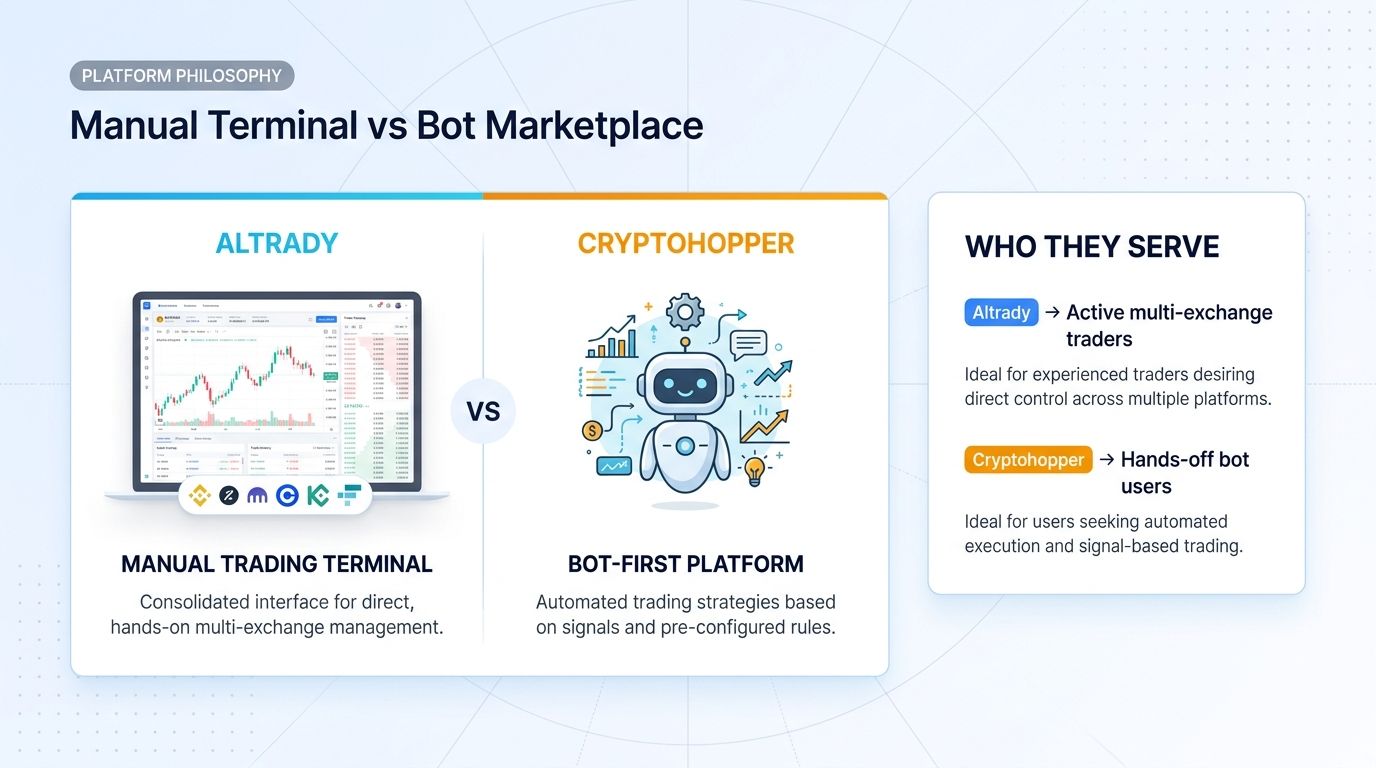
Altrady was built around a single core idea: give active traders a unified, fast, multi-exchange terminal that does not waste their attention. The Smart Trading panel is the centerpiece. You set your entry, stop loss, take profit targets, and position size in one workflow before you ever click buy. The trade fires across whichever connected exchange you choose, and your risk parameters are baked in from the start.
Altrady's 3 native bots (DCA, Grid, Signal) operate as a co-equal pillar with the manual trading terminal, not a separate add-on. The platform's design assumption is that traders blend manual and automated execution: you might trade actively during volatility and let a DCA bot accumulate during ranges, or run a grid in sideways markets while making discretionary trades on breakouts. Funds stay on your native exchange (Binance, Coinbase, Kraken, and others) regardless of which mode you use. For a deeper breakdown of how DCA strategies pair with bot automation, see our chapter on DCA Strategies and Automation in Crypto Trading.
Cryptohopper takes the opposite approach. The platform assumes the bot is the primary trading agent and you are the configurator. You select a template, plug in technical indicators or external signals, set buy and sell rules, and let the bot run. The marketplace adds a layer where you can subscribe to strategies built by other users or signal providers. Manual trading exists in Cryptohopper but feels like a secondary feature compared to the automation tooling.
This philosophical difference shows up everywhere. Altrady's UI is dense with information for an active trader. Cryptohopper's UI is dense with configuration options for an automation builder. Neither is wrong. They serve different jobs.
Trading Features Side-by-Side
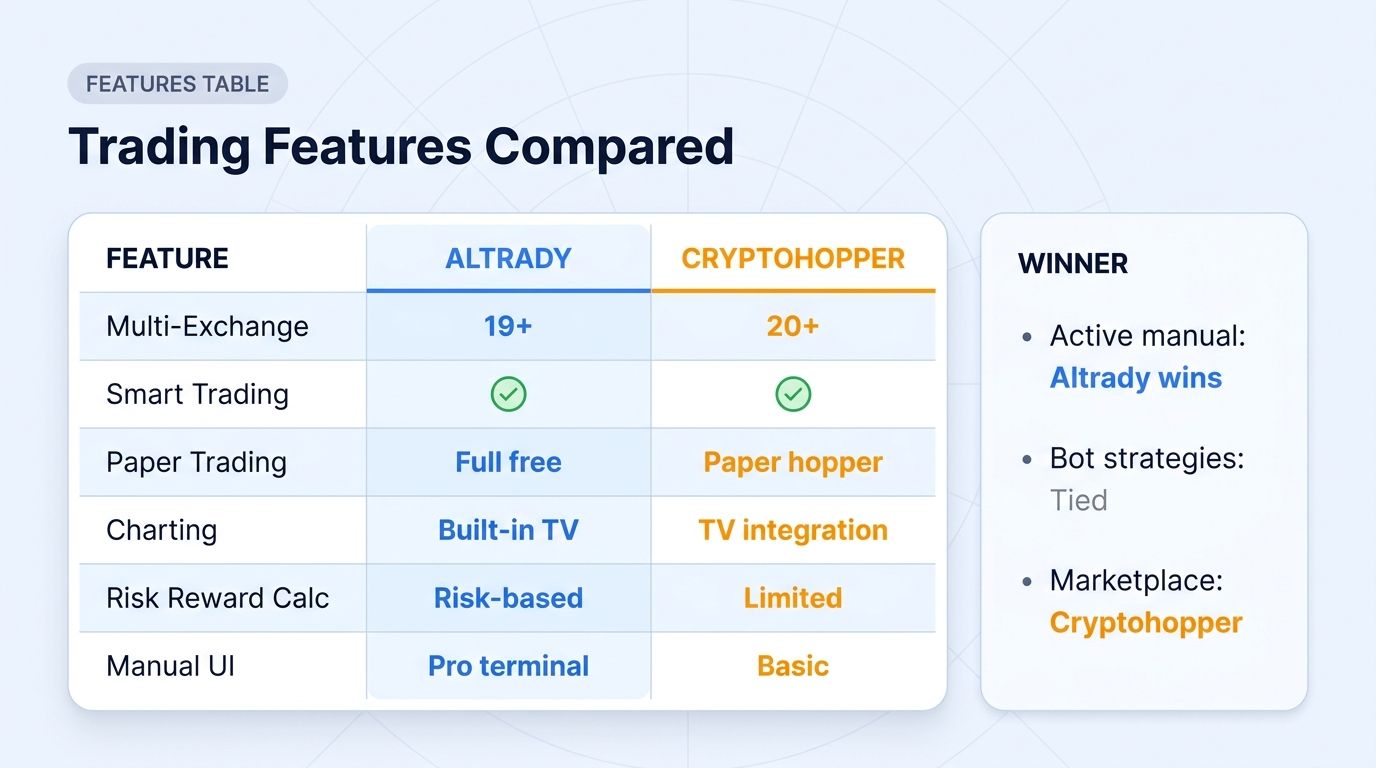
For multi-exchange coverage, Altrady connects to 19 plus major exchanges including Binance, Coinbase, Kraken, Bybit, KuCoin, OKX, Bitfinex, Gemini, Crypto.com, and others. You manage positions across all of them from one interface. Cryptohopper supports 15 plus exchanges with Binance, Coinbase, Kraken, KuCoin, Bitvavo, and others. Both cover the major venues most traders need.
Smart Trading is one of Altrady's defining features. You can preset multiple take-profit targets with separate sizes, place a stop loss, and execute the entire risk-managed trade in a single click. Trailing stops, break-even rules, and stop-loss cascading are all built in. Cryptohopper offers similar functionality through its manual trading panel but it is less central to the experience and the workflow has more clicks.
Paper trading is available on both platforms. Altrady includes a full paper trading environment that simulates execution across connected exchanges using real market data, which is excellent for testing manual strategies before going live. Cryptohopper offers paper trading mainly geared toward bot testing, letting you run automation against historical or simulated conditions.
Charting in both platforms uses TradingView integration so the actual chart experience is similar. The difference is in the trading panels and order management around the chart. Altrady's panel is faster for active manual execution. Cryptohopper's panel feels more like a configuration interface.
Position sizing tools are stronger in Altrady. The platform includes a dedicated Risk Reward Calculator that respects account risk rules, leverage settings, and stop loss distance, automatically computing the right position size for your defined risk per trade. Cryptohopper has basic sizing options inside its bot configuration but does not emphasize manual risk math the way Altrady does.
Bot Capabilities Compared
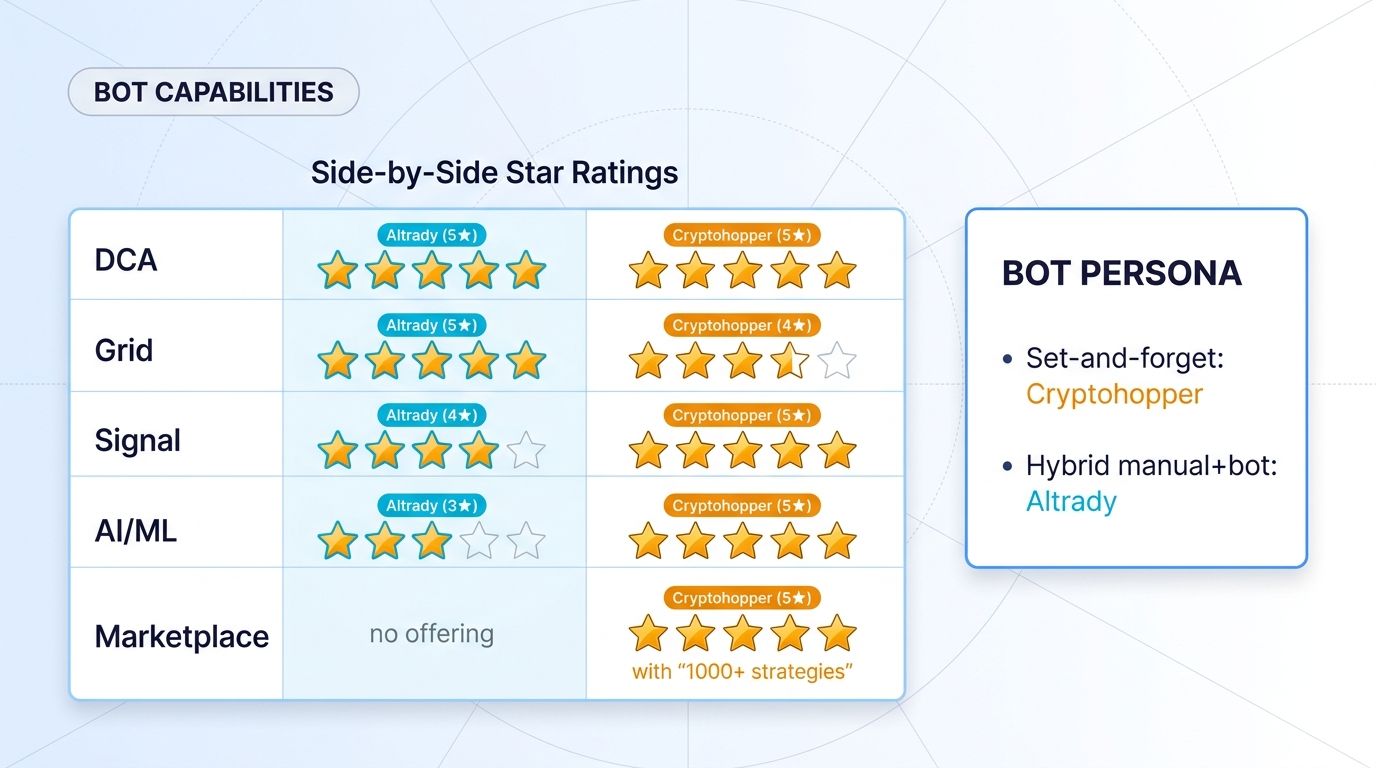
Altrady offers three core bot types. DCA bots automate dollar-cost averaging entries with customizable order grids, deviation triggers, and take-profit logic. Grid bots run buy-and-sell ladders within a defined price range, useful for sideways markets. Signal bots execute trades based on TradingView alerts or other webhook sources, letting you connect external strategies to automated execution.
Cryptohopper's bot lineup is broader and more varied. The standard automation engine lets you build strategies from over 130 technical indicators, multiple condition combinations, and complex buy-sell logic. Beyond that, Cryptohopper offers DCA features inside the standard bot, a dedicated AI bot that uses machine learning patterns, and a market-making bot. The marketplace adds another layer with hundreds of pre-built strategies and signal subscriptions you can plug into your bot.
The marketplace is where Cryptohopper really separates from Altrady. You can subscribe to strategies built by community traders, follow signal providers who broadcast trade ideas, or copy entire trading templates. Some are free, others require a one-time fee or recurring subscription. For traders who prefer to outsource strategy creation, this ecosystem is a real advantage.
Altrady deliberately does not offer a strategy marketplace. The design assumption is that you are bringing your own edge and the platform is the execution layer. This is a feature for some traders and a limitation for others. If you want to test community strategies easily, Cryptohopper wins. If you prefer building your own setups and avoiding the noise of strategy shopping, Altrady is cleaner.
The honest tradeoff is depth versus breadth. Cryptohopper has more bot variety and more configuration depth. Altrady has fewer bot types but each one is tightly integrated with the manual terminal so you can fluidly switch between manual and automated execution on the same positions.
Pricing and Value
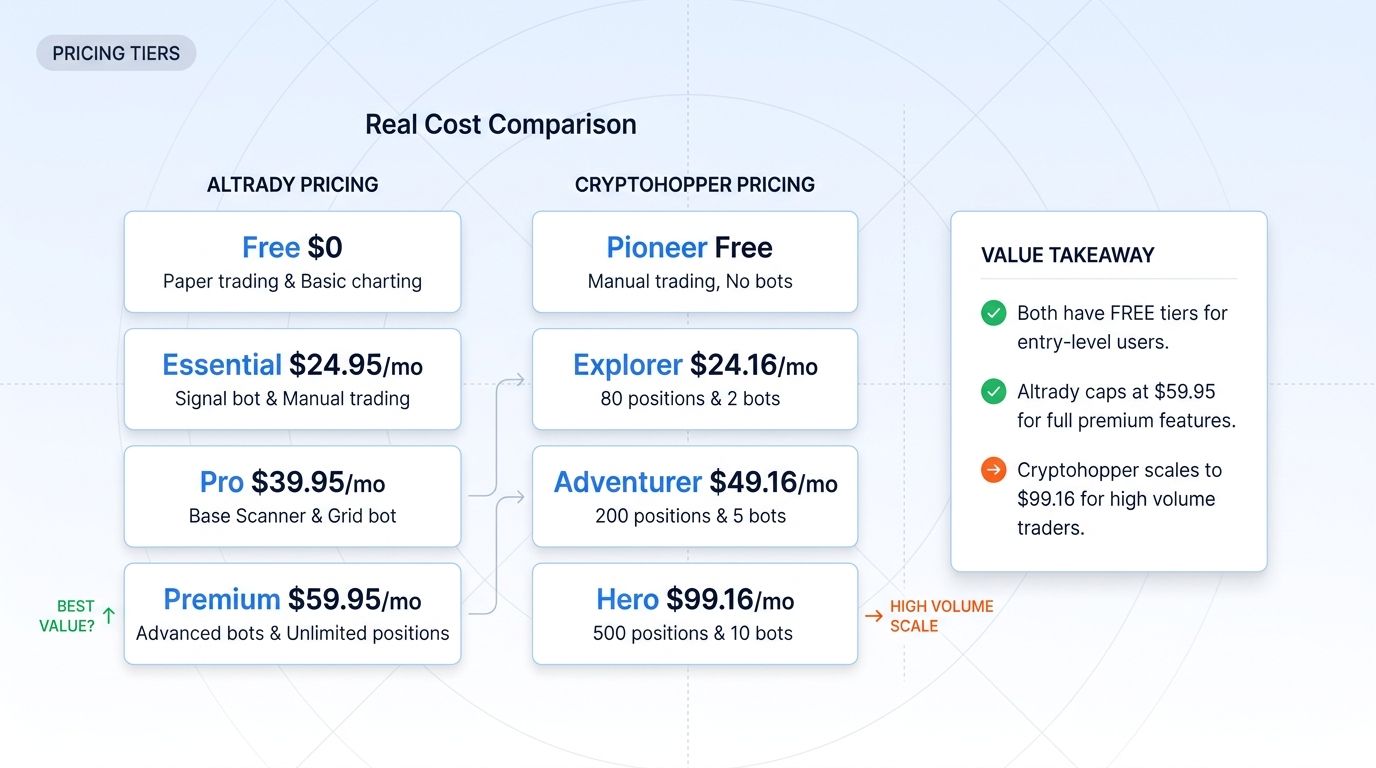
Both platforms offer free tiers and tiered paid plans. Altrady's pricing in 2026 starts with a free Basic plan that covers connected exchanges with limited features. Paid tiers include Essential at around 24.95 USD per month, Pro at around 39.95 USD per month, and Premium at around 59.95 USD per month, with annual billing discounts available. Higher tiers unlock more bots, more concurrent trades, advanced analytics, and faster data refresh rates.
Cryptohopper's pricing starts with a Pioneer free plan that lets you test core bot functionality with limits on positions and exchanges. Paid tiers in 2026 are Explorer at around 24.16 USD per month, Adventurer at around 49.16 USD per month, and Hero at around 99.16 USD per month, with annual savings available. Higher tiers add more concurrent positions, faster trigger rates, more API calls, and access to advanced bot features.
For straight feature-per-dollar comparison, the entry tiers are roughly comparable. Altrady's lower-end paid plans give you more manual terminal capability, while Cryptohopper's lower-end plans give you more automation capability. At the higher tiers, Cryptohopper's Hero plan justifies its higher cost with significantly more bot slots, faster trigger rates, and broader marketplace access. Altrady's Premium tier emphasizes professional manual trader tooling instead.
A useful exercise is to start both on free tiers, test the workflows you actually use, and only commit to a paid tier when you hit a specific feature gap. Both platforms make this easy.
User Experience and Learning Curve
Altrady has a steeper initial learning curve because the manual terminal is dense with information. New users sometimes feel overwhelmed by the depth of options in the Smart Trading panel, the multiple watchlists, and the cross-exchange portfolio views. Once you spend a few sessions inside it, the speed advantage becomes obvious. Active traders who push through the first week tend to stick.
Cryptohopper feels more accessible at first because the bot configuration flow guides you step by step. You pick a template, fill in fields, click deploy. The challenge with Cryptohopper appears later when you start trying to build sophisticated strategies. The condition logic, indicator combinations, and signal handling can become genuinely complex, and the documentation while extensive sometimes lags behind UI changes.
Mobile support exists on both. Altrady offers a mobile app for monitoring trades, adjusting stops, and executing manual orders on the go, optimized for the active trader workflow. Cryptohopper's mobile app is geared toward checking bot performance, adjusting bot settings, and reviewing the marketplace. Different priorities, different design choices.
Customer support quality on both platforms is generally rated highly by users, with responsive ticket systems and active community forums. Altrady has a smaller community focused on serious manual traders. Cryptohopper has a much larger community driven by the marketplace ecosystem, including third-party signal providers and strategy sellers active in Discord and other channels.
Who Should Use Which
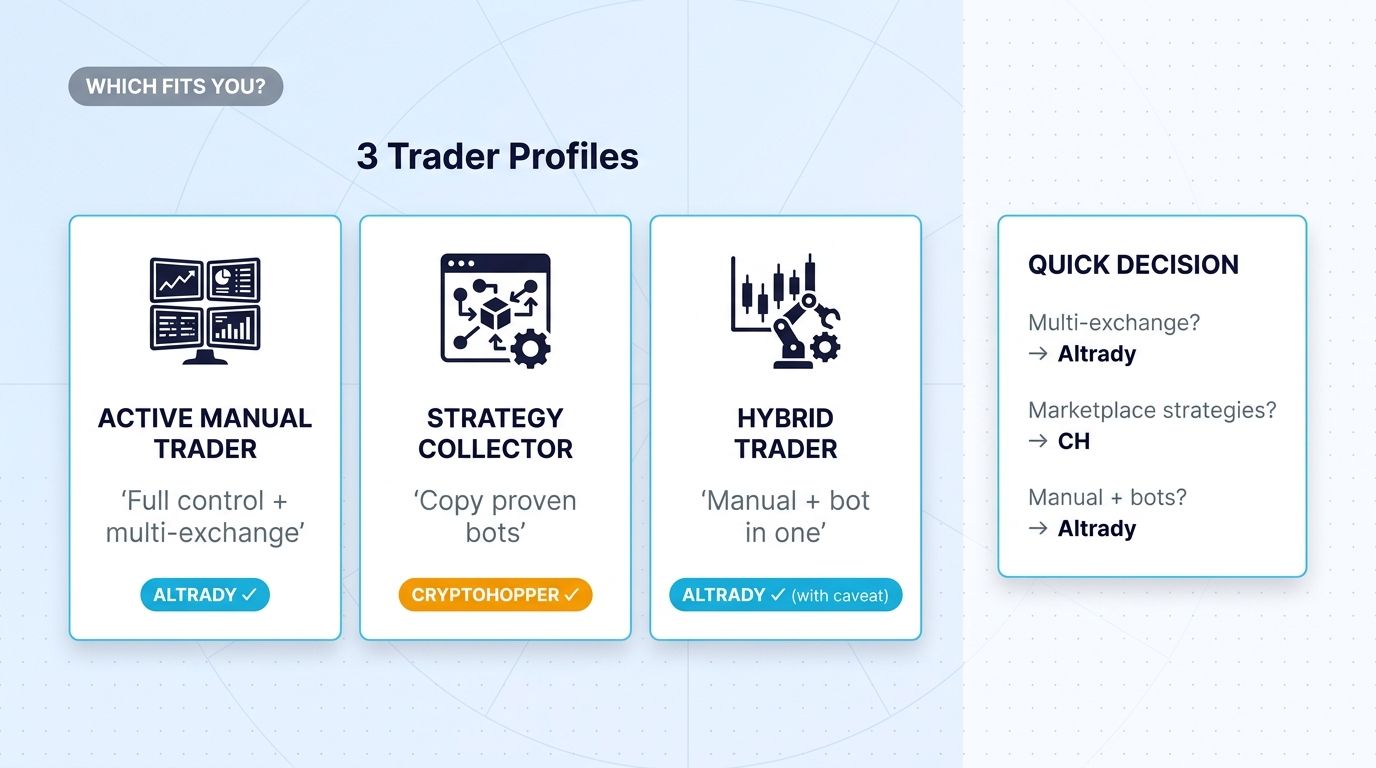
The active manual trader. If you watch charts during your trading sessions, take discretionary entries based on technical analysis, want a unified terminal across multiple exchanges, and value tight risk management baked into every trade, Altrady is the better fit. Smart Trading, position sizing, and the multi-exchange portfolio views are designed exactly for this workflow.
The hands-off automation trader. If you want bots running while you sleep, prefer to outsource strategy creation through a marketplace, follow signal providers, or build complex multi-condition automation, Cryptohopper is the better fit. The bot variety, marketplace depth, and signal integration capabilities are simply broader than what Altrady offers.
The hybrid trader. If you want both manual and automated trading from one platform with deep integration between the two modes, Altrady is the more cohesive choice. The manual terminal and the bots share the same interface and the same positions, so you can intervene manually on a bot trade or hand off a manual position to a bot easily. Cryptohopper supports manual trading but it feels like a secondary mode.
A reasonable approach for traders who are unsure is to run both on their free tiers for a few weeks. The frictions you encounter inside each platform tell you a lot about which one matches your style.
FAQ
Can I use Altrady and Cryptohopper at the same time on the same exchange?
Yes, both platforms connect to your exchange via API keys, so running them in parallel is technically supported. Just make sure you are not running competing automation that could open conflicting positions on the same pair, and consider using sub-accounts on your exchange to isolate the activity if you want clean tracking.
Which platform has lower fees?
Neither platform charges trading fees directly. You pay the fees on your connected exchange as normal. Cryptohopper's marketplace strategies sometimes have separate subscription costs from third-party providers. Altrady has no marketplace, so the only cost beyond exchange fees is your platform subscription.
Do I need to know how to code to use either platform?
No, neither platform requires coding. Cryptohopper's bot configuration is template and form-based. Altrady's manual terminal and bot setups are point-and-click. Coding is only relevant if you want to build custom signal sources or integrate external systems via API.
Is paper trading really free on both?
Yes, both platforms offer paper trading as part of their free tier or trial period. Altrady's paper trading uses real-time market data across connected exchanges. Cryptohopper's paper trading is geared toward bot testing under simulated conditions.
Which platform is better for futures and perpetual trading?
Altrady has stronger native support for futures and perpetuals on the manual terminal side, with leverage controls, liquidation price visibility, and risk management tools designed for derivatives traders. Cryptohopper supports futures but its strength remains in spot bot automation.
Final Thoughts
The honest answer is that Altrady and Cryptohopper are both good platforms aimed at different traders. Cryptohopper wins for hands-off automation, marketplace strategies, and bot-first workflows. Altrady wins for active manual trading, multi-exchange execution speed, and integrated risk management.
If you spend most of your trading time at the chart, taking discretionary entries, managing risk per position, and trading across multiple exchanges, Altrady is built for you. The Smart Trading panel alone changes how you think about execution. Layered with paper trading, position sizing tools, and integrated bots for the repetitive parts of your workflow, the platform earns its place as a primary terminal.
Try the Altrady free trial, run paper trading to test the workflow without risk, and graduate to a paid tier only when you have hit a specific limit you want to lift. That is the cleanest path to deciding whether the platform fits.