
What Is Bitget?
Bitget is a centralized cryptocurrency exchange founded in 2018 and headquartered in the Seychelles. Over the past several years, it has grown from a relatively obscure trading platform into one of the top global exchanges, boasting over 20 million registered users across more than 100 countries. As of 2026, Bitget consistently ranks among the top 10 crypto exchanges by daily trading volume, regularly processing billions of dollars in trades each day.
The exchange initially gained attention for its derivatives trading products but has since expanded into a full-service crypto ecosystem. Bitget now offers spot trading, futures contracts, copy trading, a Web3 wallet, staking products, and a launchpad for new token offerings. Its most distinguishing feature remains its copy trading platform, which allows less experienced traders to automatically replicate the positions of seasoned professionals.
In this Bitget review, we will take a close look at everything the platform offers, including its fee structure, security measures, key features, and how it stacks up against multi-exchange trading solutions.
Key Features of Bitget
Bitget has built a feature set designed to cater to both beginners and experienced traders. Below is a breakdown of the platform's core offerings.
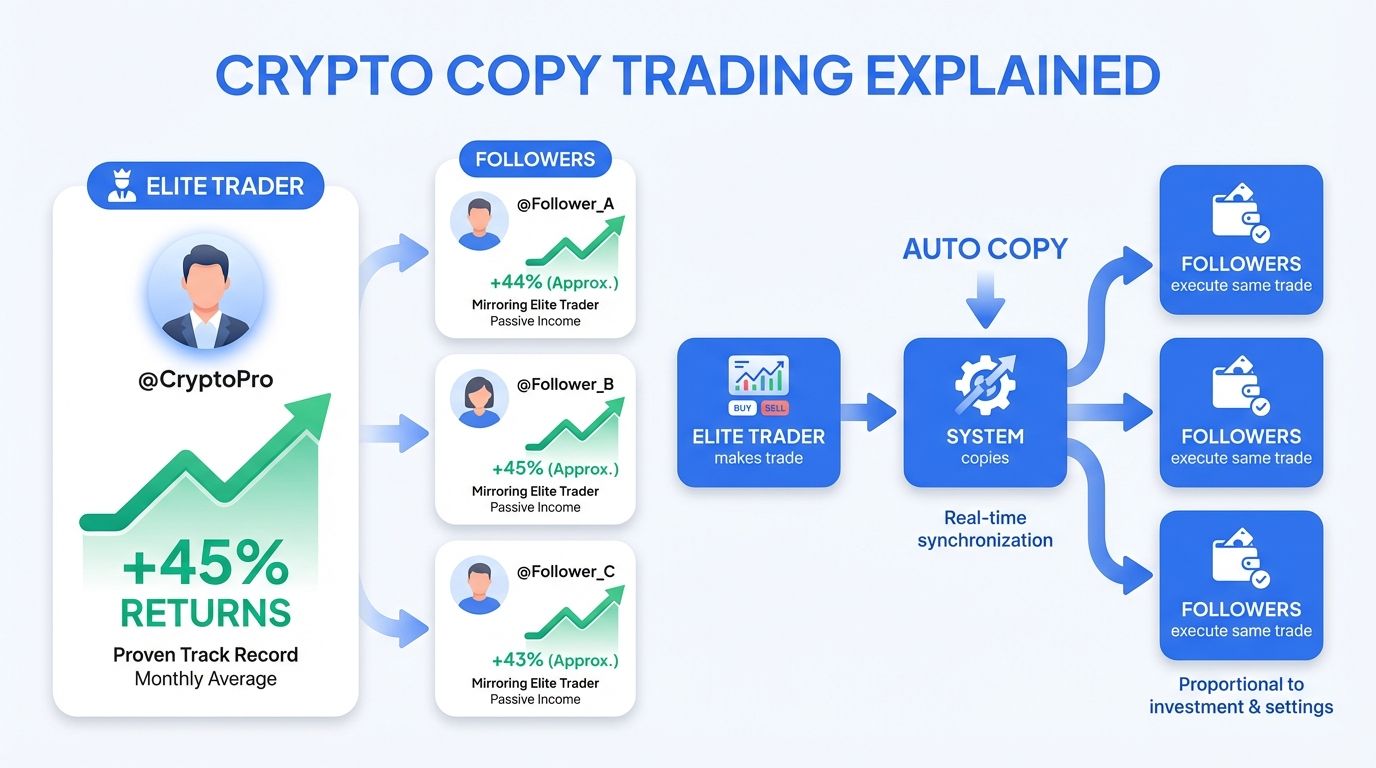 Bitget's copy trading platform connects followers with elite traders for automated trade replication
Copy Trading
Copy trading is Bitget's flagship feature and one of the primary reasons the platform has attracted millions of users. The concept is straightforward: users browse a marketplace of elite traders, review their performance metrics and trading history, and choose to automatically copy their trades in real time.
Bitget's copy trading system supports both spot and futures markets. Traders who qualify as "elite traders" must meet strict performance criteria, including minimum profit thresholds and consistent trading records. When you follow an elite trader, the platform mirrors their positions proportionally based on the amount of capital you allocate.
The profit-sharing model is transparent. Elite traders set their own profit-sharing percentage, typically ranging from 8% to 15% of the follower's net profit. Followers only pay this share when they actually make a profit, meaning there is no upfront cost for the copy trading service itself.
As of 2026, Bitget reports that over 130,000 elite traders are active on the platform, and the copy trading system has facilitated billions of dollars in cumulative trading volume. For traders who lack the time or technical expertise to actively manage positions, this feature provides a compelling entry point into crypto trading.
Spot and Futures Trading
Bitget offers a robust trading engine that supports both spot and futures markets. On the spot side, the exchange lists over 500 trading pairs, covering major cryptocurrencies like Bitcoin and Ethereum alongside a wide selection of altcoins and newer tokens.
For futures trading, Bitget provides both USDT-margined and coin-margined perpetual contracts. Traders can access leverage of up to 125x on select trading pairs, though lower leverage options are available for those who prefer reduced risk. The futures interface includes advanced order types such as limit orders, market orders, trigger orders, and trailing stop orders.
The trading interface itself is clean and functional. Bitget offers both a web-based platform and mobile applications for iOS and Android. The charting tools are powered by TradingView, giving traders access to a full suite of technical analysis indicators and drawing tools.
Bitget Wallet
Bitget has expanded beyond centralized exchange services with the launch of Bitget Wallet (formerly BitKeep). This Web3 wallet supports over 100 blockchain networks and allows users to store, swap, and manage digital assets across multiple chains.
The wallet integrates a built-in DApp browser, enabling users to interact with decentralized applications directly from the wallet interface. It also features a cross-chain swap function, allowing users to exchange tokens across different blockchains without leaving the app.
For traders who want to participate in the DeFi ecosystem while still maintaining a connection to centralized exchange services, Bitget Wallet offers a convenient bridge between these two worlds.
Launchpad and Earn Products
Bitget's Launchpad gives users early access to new token offerings. By holding BGB (Bitget's native token) or committing other supported assets, users can participate in token sales before the new projects officially list on the exchange. The Launchpad has hosted dozens of token launches, some of which have delivered significant returns for early participants.
On the passive income side, Bitget offers several Earn products. These include flexible and locked savings accounts, staking opportunities for proof-of-stake tokens, and dual investment products that combine elements of savings and options trading. Yields vary depending on the asset and lock-up period, but the platform provides a straightforward way for holders to put idle assets to work.
Bitget Fees and Costs
Understanding the fee structure is a critical part of any exchange review. Here is a detailed breakdown of what Bitget charges.
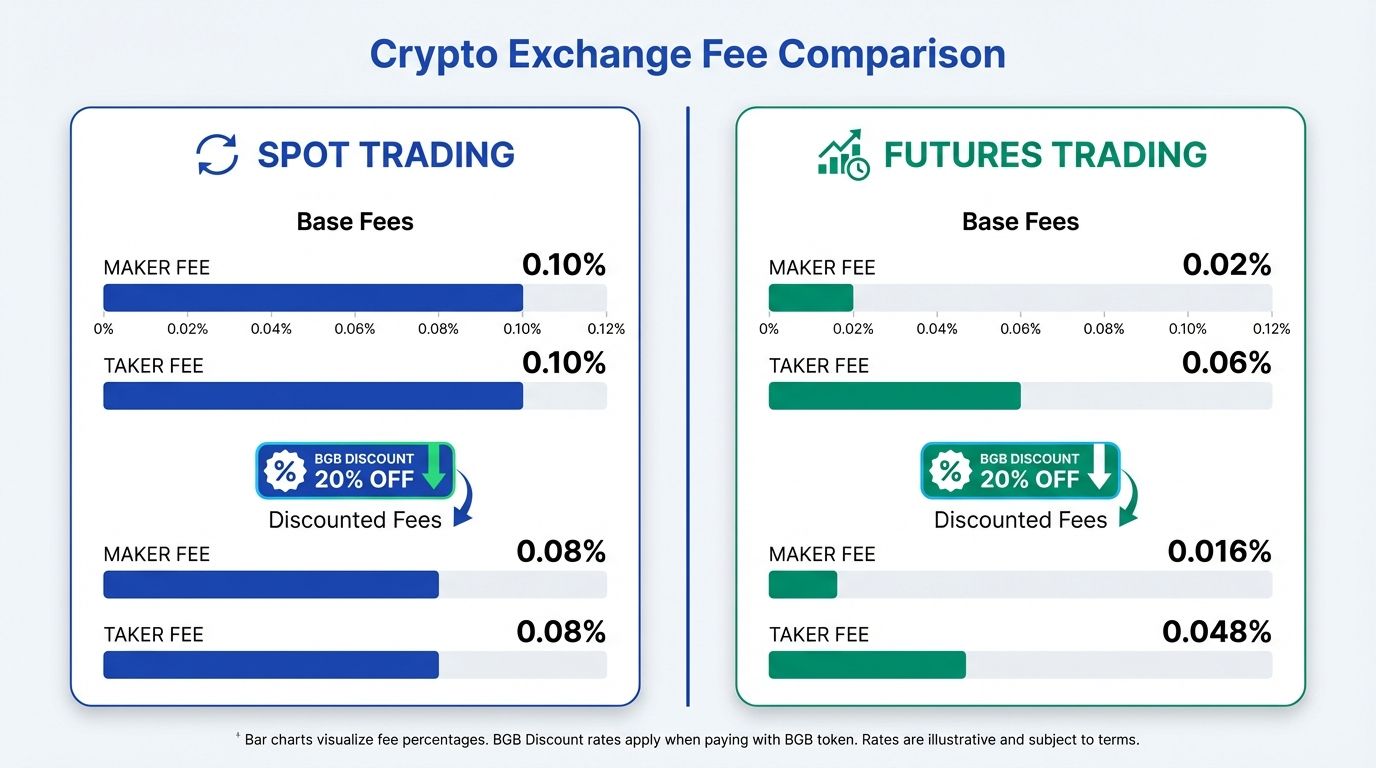 Bitget's fee structure offers competitive rates, especially for futures trading
Trading Fees
Bitget's trading fees are competitive when compared to other major exchanges:
Spot Trading:
- Maker fee: 0.1%
- Taker fee: 0.1%
Futures Trading:
- Maker fee: 0.02%
- Taker fee: 0.06%
These are the standard rates for regular users. Bitget operates a VIP tier system that reduces fees based on 30-day trading volume and BGB holdings. At the highest VIP levels, spot maker fees can drop to as low as 0.008%, and futures maker fees can go negative (meaning the exchange pays you to provide liquidity).
Holding BGB tokens unlocks an additional fee discount. Users who choose to pay trading fees with BGB receive a further reduction, making the native token a practical tool for active traders looking to minimize costs.
Deposit and Withdrawal Fees
Cryptocurrency deposits on Bitget are free, regardless of the asset or blockchain network used. This is standard practice across most major exchanges.
Withdrawal fees vary depending on the cryptocurrency and the network selected. For example, withdrawing Bitcoin via the Bitcoin network carries a fee that fluctuates with network congestion, while withdrawing USDT via the TRC-20 network is significantly cheaper than using the ERC-20 network. Bitget publishes its full withdrawal fee schedule on the platform, and it is worth reviewing network options before initiating a transfer to minimize costs.
Fiat deposits and withdrawals are available in select regions through third-party payment processors, with fees determined by the payment provider rather than Bitget itself.
Security Features
Security is a top concern for any crypto trader, and Bitget has invested substantially in this area. Here is an overview of the platform's security infrastructure.
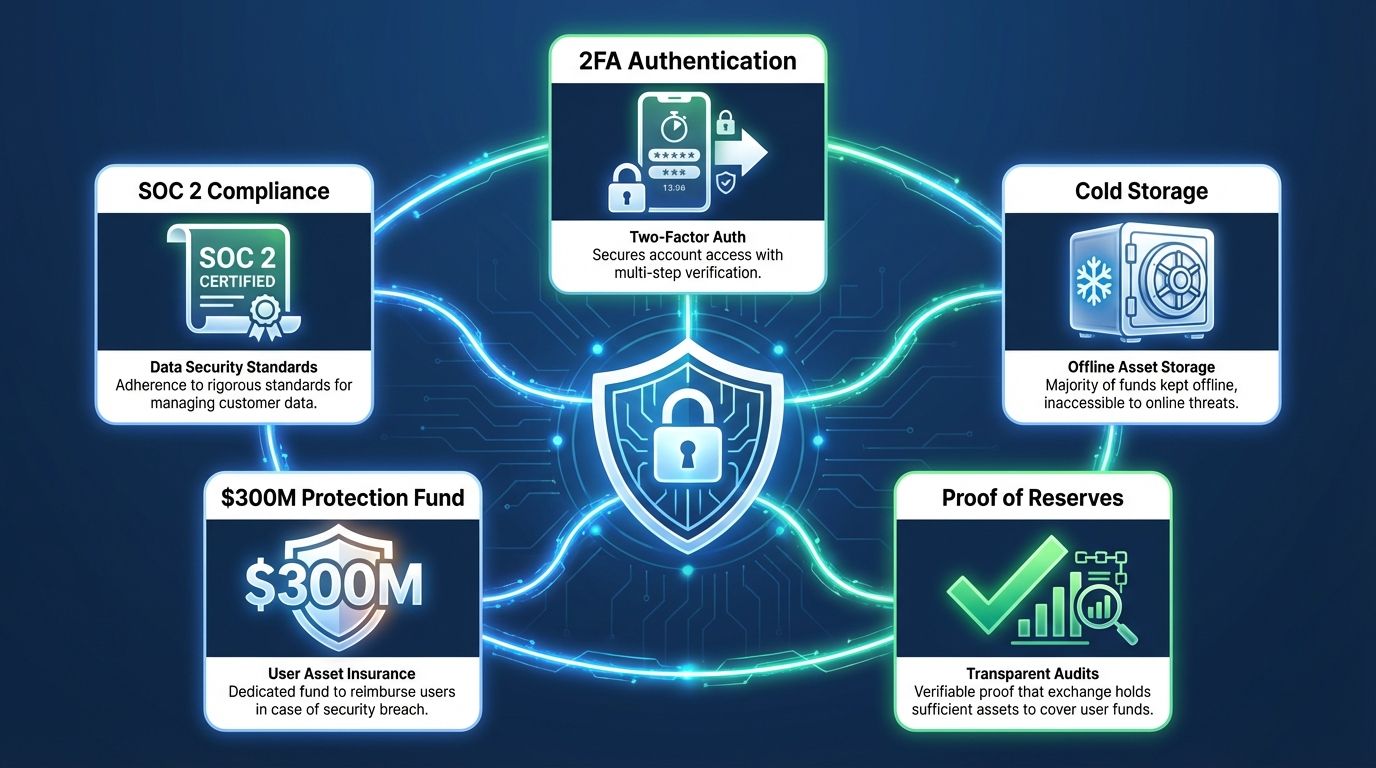 Bitget's multi-layered security approach includes a $300M protection fund and SOC 2 Type II compliance
Proof of Reserves: Bitget publishes regular Proof of Reserves reports, verifiable through Merkle tree audits. These reports demonstrate that the exchange holds customer funds at a ratio exceeding 1:1, meaning Bitget maintains more assets in reserve than the total amount deposited by users.
Protection Fund: Bitget maintains a protection fund valued at approximately $300 million. This fund is designed to compensate users in the event of a security breach or unexpected loss of funds. The fund is held in Bitcoin and USDT, and its wallet addresses are publicly viewable on-chain.
Two-Factor Authentication (2FA): The platform supports multiple 2FA methods, including Google Authenticator, SMS verification, and email confirmation. Users can configure 2FA requirements for login, withdrawals, and trading operations.
Cold Storage: The vast majority of user funds are stored in offline, cold storage wallets. This reduces the risk of loss from hacking attempts, as cold wallets are not connected to the internet and cannot be accessed remotely.
SOC 2 Type II Compliance: Bitget has achieved SOC 2 Type II certification, an independent audit standard that evaluates a company's security controls, availability, processing integrity, confidentiality, and privacy. This certification is relatively uncommon among crypto exchanges and signals a serious commitment to institutional-grade security practices.
Additional Measures: The platform also employs anti-phishing codes, withdrawal address whitelisting, and IP-based login restrictions to provide additional layers of account protection.
Bitget Pros and Cons
Pros:
- Industry-leading copy trading platform with over 130,000 elite traders
- Competitive fee structure, especially for futures trading (0.02% maker / 0.06% taker)
- Strong security track record with $300M protection fund and SOC 2 Type II compliance
- Extensive selection of 500+ trading pairs across spot and futures markets
- User-friendly interface suitable for both beginners and experienced traders
- Active Launchpad with regular new token offerings
- Integrated Web3 wallet with multi-chain support
- BGB token provides meaningful fee discounts and utility across the ecosystem
- Regular Proof of Reserves reports with Merkle tree verification
- Available in 100+ countries with multiple language support
Cons:
- Restricted access in the United States and certain other jurisdictions
- Leverage up to 125x may encourage excessive risk-taking for inexperienced traders
- Customer support response times can be slow during peak periods
- Some Earn products have lock-up periods that limit liquidity
- The sheer number of features can feel overwhelming for absolute beginners
- Fiat on-ramp options are limited compared to some larger competitors
- Regulatory landscape remains uncertain as the exchange is based in the Seychelles
How Bitget Compares to Multi-Exchange Platforms
While Bitget offers a solid standalone trading experience, relying on a single exchange comes with inherent limitations. Many serious traders diversify their activity across multiple platforms to access better liquidity, take advantage of price differences, and reduce counterparty risk.
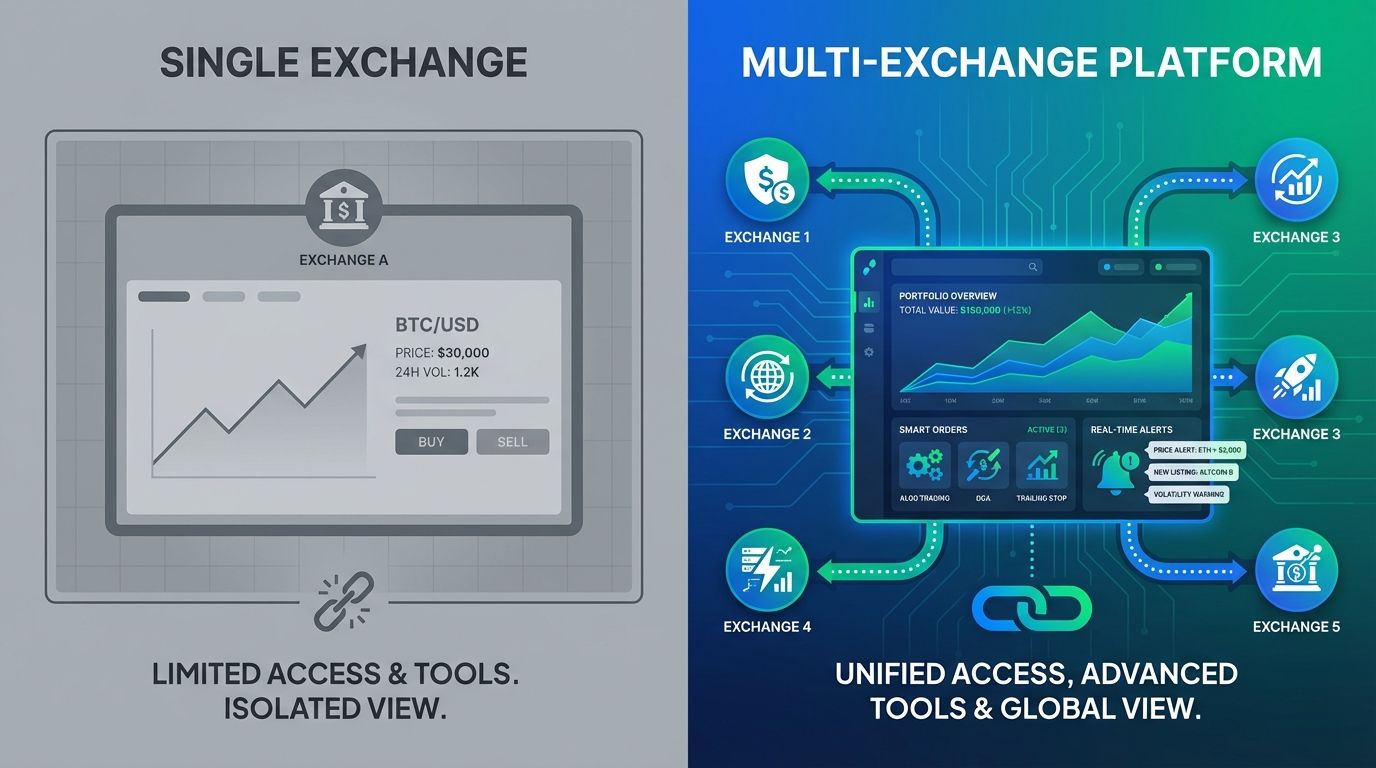 Multi-exchange platforms like Altrady let traders manage Bitget alongside other exchanges from one dashboard
The challenge with this approach is managing multiple accounts, interfaces, and order books simultaneously. Each exchange has its own dashboard, fee structure, and set of tools, which creates friction and makes it difficult to maintain a clear overview of your entire portfolio.
This is where multi-exchange trading platforms become valuable. Tools like Altrady aggregate your exchange accounts into a single unified interface, allowing you to trade across 19+ exchanges without switching between tabs or apps. Instead of logging into Bitget, Binance, and Kraken separately, you can manage all your positions, set alerts, and execute trades from one place.
For traders who use Bitget as one part of a broader exchange strategy, a multi-exchange platform eliminates the operational complexity that comes with juggling multiple accounts. It also enables you to compare prices across exchanges in real time, helping you find the best execution for each trade.
Manage Your Bitget Trades with Altrady
If you trade on Bitget alongside other exchanges, Altrady provides the tools you need to streamline your workflow and gain a competitive edge.
Altrady's unified dashboard connects to Bitget and 18+ other major exchanges, giving you a comprehensive view of your entire portfolio in one place. You can monitor balances, open positions, and order history across all your connected accounts without switching between platforms.
The platform's smart trading features include advanced order types like laddered orders, take-profit/stop-loss combos, and trailing stops that work consistently across every connected exchange. Set up your strategy once and apply it to your Bitget trades, your Binance positions, or any other supported platform.
Altrady's real-time portfolio tracker automatically calculates your gains, losses, and overall performance across all exchanges. This eliminates the need for manual spreadsheets and gives you an accurate, up-to-the-minute picture of where your capital is allocated.
Quick Scanner, one of Altrady's standout features, monitors price movements across all connected exchanges simultaneously. When an opportunity appears on Bitget or any other platform, you can spot it instantly and act before the window closes.
Ready to take your Bitget trading to the next level? Start your free trial of Altrady today and experience what it means to manage all your exchanges from a single, powerful dashboard. No credit card required, and you will have full access to every feature from day one.
Frequently Asked Questions
Is Bitget safe to use?
Bitget has established a strong security track record since its founding in 2018. The exchange maintains a $300 million protection fund to cover potential losses, stores the majority of user funds in cold storage, and has achieved SOC 2 Type II compliance. Regular Proof of Reserves reports confirm that user deposits are fully backed. While no exchange can guarantee absolute safety, Bitget's security infrastructure is among the more robust in the industry.
Is Bitget available in the United States?
Bitget has limited availability in the United States. The exchange does not hold a full operating license for the U.S. market, and many of its features, including futures trading and copy trading, are restricted for American users. U.S. residents should review Bitget's terms of service carefully and consider regulated domestic alternatives. Bitget has indicated interest in expanding its regulatory compliance, but as of 2026, full U.S. access remains unavailable.
What are Bitget's trading fees?
Bitget charges 0.1% for both maker and taker orders on spot trading, and 0.02% maker / 0.06% taker on futures trading. These rates apply to standard users and can be further reduced through the VIP tier system based on trading volume and BGB token holdings. Paying fees with BGB tokens also provides an additional discount. Compared to industry averages, Bitget's futures fees are particularly competitive.
How does Bitget's copy trading work?
Bitget's copy trading allows you to automatically replicate the trades of experienced "elite traders" on the platform. You browse available traders, review their performance statistics and historical returns, and allocate a portion of your capital to follow their strategies. Trades are mirrored in your account proportionally. Elite traders earn a profit-sharing percentage (typically 8% to 15%) only when their followers make a profit. Both spot and futures copy trading are supported.
Can I use Bitget alongside other exchanges?
Yes, many traders use Bitget as part of a multi-exchange strategy. Using a platform like Altrady, you can connect your Bitget account alongside accounts from other major exchanges and manage everything from a single dashboard. This approach allows you to diversify your trading activity, compare prices across exchanges, and maintain a unified view of your portfolio without the hassle of switching between multiple platforms.