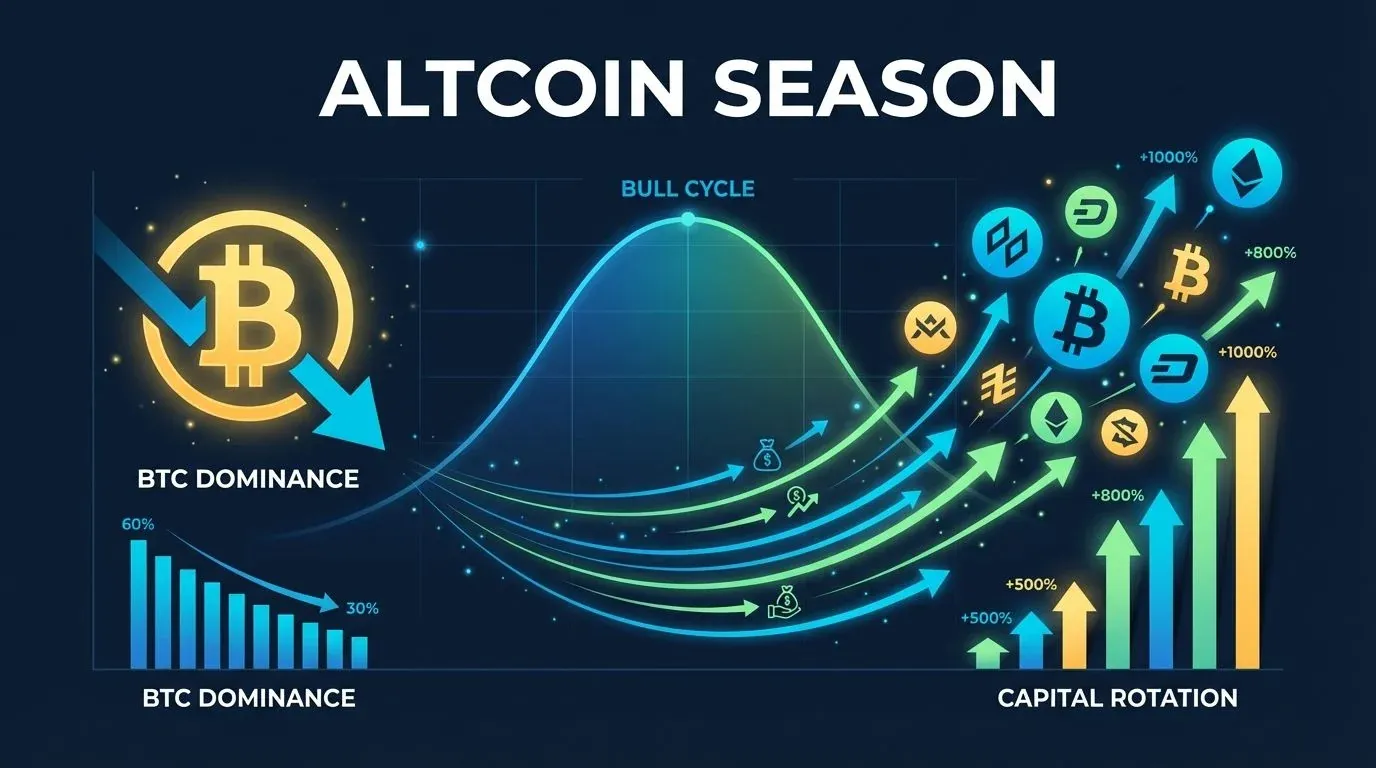

If you have been in crypto for any length of time, you have probably heard traders talk about "altcoin season" with the kind of excitement usually reserved for major price breakouts. And for good reason. Altcoin season is one of the few recurring windows in the crypto market where mid-cap and small-cap tokens can deliver returns that dwarf anything Bitcoin offers in the same period. Understanding what triggers it, how to spot it early, and how to trade it responsibly can be the difference between capturing a once-in-a-cycle opportunity and watching it pass from the sidelines.
This guide breaks down everything an intermediate crypto trader needs to know about altcoin season, from the macroeconomic triggers that set it in motion to the specific metrics you should be watching every day. Each section is designed to give you actionable insight, not just theory.
1. What Triggers Altcoin Season
Altcoin season does not appear out of nowhere. It follows a predictable sequence rooted in how capital flows through the crypto market. Understanding the triggers helps you position yourself before the crowd arrives.
Bitcoin Dominance Drop
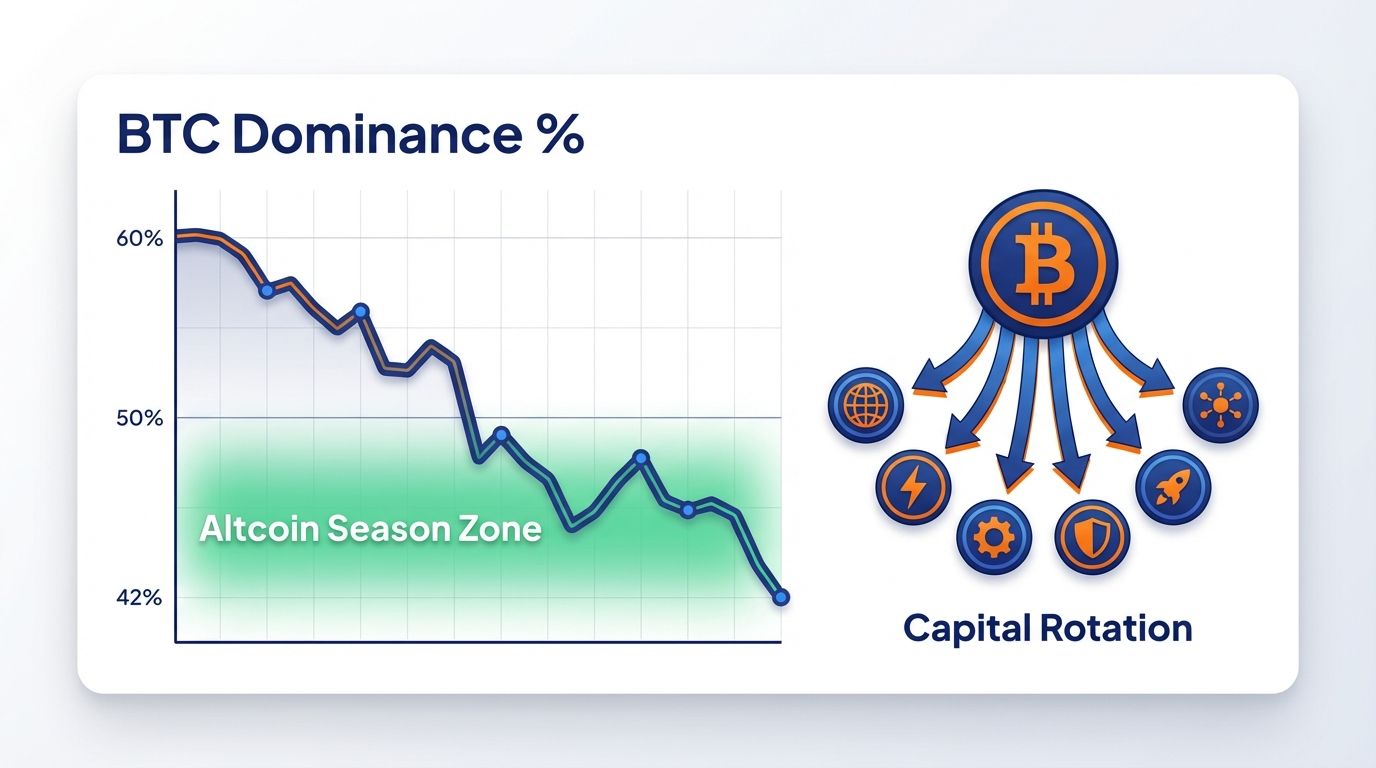
Bitcoin dominance, which is Bitcoin's share of the total crypto market capitalization, is the single most watched indicator for altcoin season timing. When BTC dominance is rising, capital is consolidating into Bitcoin, usually during bear markets or early bull cycles when investors prefer safety. When dominance starts falling, it signals that traders are rotating profits out of Bitcoin and into higher-risk, higher-reward altcoins.
A sustained drop in BTC dominance below key support levels, often around 50% or 45%, historically coincides with the start of a broad altcoin rally. But a single-day dip is not enough. You want to see a sustained trend, confirmed over multiple weeks on the weekly chart.
Capital Rotation After Bitcoin's Run
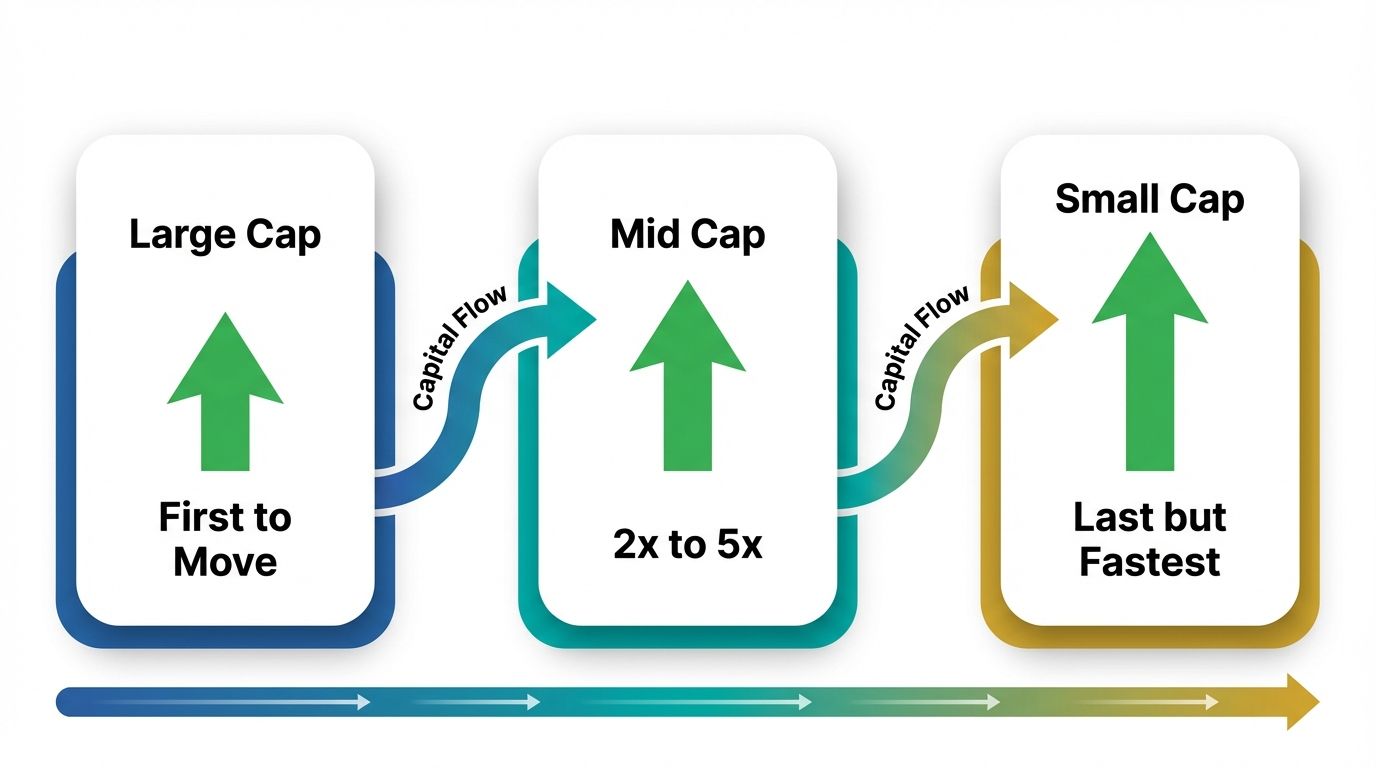
The typical cycle follows a pattern that experienced traders have documented across multiple market cycles. Bitcoin leads first, often breaking its previous all-time high and generating widespread media attention. New retail capital enters the market through Bitcoin because it is the most familiar name. As Bitcoin's price stabilizes or enters a consolidation phase, experienced traders begin moving profits into Ethereum and large-cap altcoins. From there, capital cascades further down the market cap ladder into mid-caps and eventually small-cap tokens.
This rotation is not just speculation. It reflects a basic principle of risk appetite. Once gains are locked in at the "safer" end of crypto, traders hunt for the next multiplier.
Macro and Sentiment Conditions
Broader macro conditions also play a role. Risk-on environments, falling interest rates, improving liquidity, and positive regulatory news all create the conditions where speculative assets thrive. When the overall market sentiment shifts from cautious to euphoric, altcoin season tends to follow.
2. How to Identify Altcoin Season
Identifying altcoin season early, rather than reacting to it after it has already peaked, is the skill that separates disciplined traders from those who buy the top. Several tools and metrics make this identification much more reliable.
The Altcoin Season Index
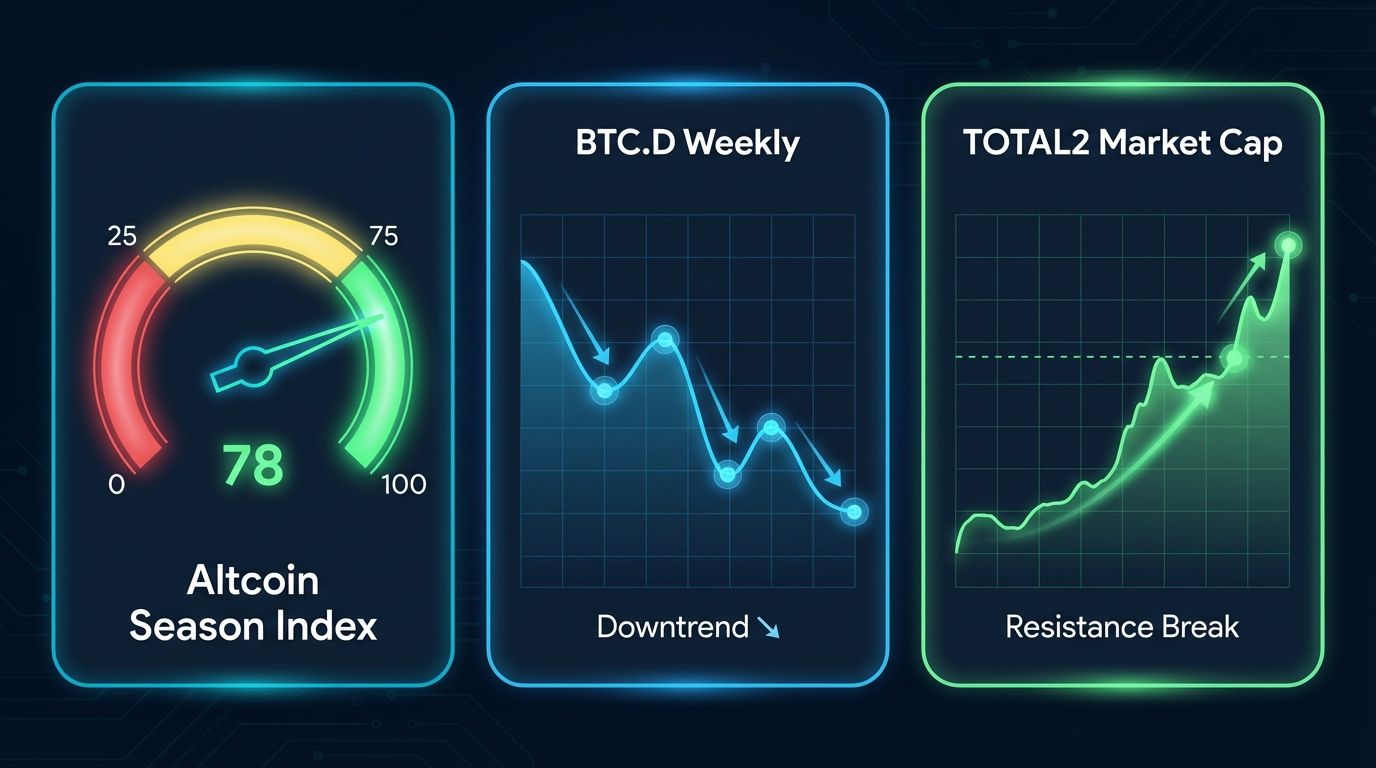
The Altcoin Season Index measures whether the top 50 altcoins have outperformed Bitcoin over a 90-day rolling period. The index runs from 0 to 100. A reading above 75 is classified as altcoin season. A reading below 25 is classified as Bitcoin season. Traders use this index as a quick reference point, though it works best when combined with other signals rather than used in isolation.
Bitcoin Dominance Chart
Opening TradingView and pulling up the BTC.D chart (Bitcoin Dominance) should be part of every altcoin trader's daily routine. Key things to watch include the following.
- Is BTC.D in a sustained downtrend on the weekly timeframe?
- Has BTC.D broken below a major support level, such as 50%, 47%, or 42%?
- Are the lower highs and lower lows forming consistently on the daily chart?
When BTC.D breaks key support and the RSI on the weekly is pointing downward with room to fall, it is a strong indication that altseason conditions are building.
Total2 and Total3 Market Cap Charts
TradingView also provides TOTAL2, which is the total crypto market cap excluding Bitcoin, and TOTAL3, which excludes both Bitcoin and Ethereum. When these charts are making new highs or breaking through resistance levels while BTC.D is falling, it confirms that capital is actively moving into altcoins rather than simply leaving the crypto market altogether.
On-Chain and Exchange Metrics
Beyond price charts, on-chain data adds another layer of confirmation. Rising transaction volumes on Ethereum and competing Layer 1 blockchains, increasing active addresses across DeFi protocols, and growing stablecoin outflows from exchanges all point toward an active altcoin rotation in progress.
3. Which Altcoins Perform Best During Altcoin Season
Not all altcoins move at the same time. Altcoin season has a distinct pecking order, and knowing where you are in that order determines which assets offer the best risk-adjusted opportunity at any given moment.
Large-Cap Altcoins Move First
Ethereum almost always leads the altcoin rally. As the foundational smart contract platform and the asset most institutions use to gain altcoin exposure, ETH tends to be the first beneficiary of capital leaving Bitcoin. Other large caps typically follow within days to weeks.
These assets offer the best liquidity and the most predictable chart patterns during altcoin season. For traders with larger position sizes, large caps are where you start.
Mid-Cap Altcoins Offer the Best Risk-Reward
Once large caps are already up 30% to 50% from their bases, capital begins flowing into mid-cap altcoins. These are typically tokens ranked between 20 and 100 by market cap. Layer 2 solutions, established DeFi protocols, and well-known gaming or NFT infrastructure tokens fall into this category.
Mid-caps offer a combination of real liquidity and enough upside that 2x to 5x moves are realistic in a strong altcoin season. They also carry meaningful risk, so position sizing and clear exit targets are essential.
Small-Cap Tokens Move Last and Fastest
The tail end of altcoin season sees capital move into smaller, more speculative tokens. These can produce the largest percentage gains, sometimes 10x or more in a matter of weeks. But they are also the most volatile, the most susceptible to pump-and-dump dynamics, and the hardest to exit when the market turns.
Sector narratives tend to drive small-cap moves. In past cycles, these narratives have included DeFi, the NFT boom, Layer 2 adoption, AI tokens, and real-world asset protocols. Identifying the dominant narrative early gives you a significant edge when selecting small-cap exposure.
4. Altcoin Season Trading Strategies
Having the right strategies in place before altcoin season arrives prevents emotional, reactive decision-making during the heat of the rally.
The Rotation Strategy
The rotation strategy involves moving capital through the market cap spectrum in sync with where the market's momentum is. You start with large caps when BTC dominance first breaks down. As large caps begin to consolidate, you rotate a portion of profits into mid-caps. As the rally matures and euphoria builds, you selectively add small-cap exposure while simultaneously taking profits on your earlier positions.
The key to executing this well is having clear entry and exit criteria for each tier. Setting price targets or percentage gains at which you will rotate is far more reliable than trying to time the exact top.
Sector-Based Positioning
Rather than buying random altcoins, experienced altcoin season traders focus on sectors with the strongest narrative momentum. Each cycle tends to have one or two dominant themes, and the tokens within those themes often move together. Tracking social volume, developer activity, and token unlock schedules helps identify which sectors have both narrative strength and reasonable supply dynamics.
Risk Management Is Non-Negotiable
The single most important rule in altcoin season trading is keeping risk management strict even when everything is going up. Specific practices that protect your capital include the following.
- Never allocate more than 5% of your portfolio to any single small-cap token.
- Use trailing stop-losses to lock in gains as positions move in your favor.
- Keep a portion of your portfolio in stablecoins or Bitcoin at all times as a buffer.
- Set hard rules for when you will exit: a percentage retracement, a time-based exit, or a dominance reversal signal.
Altcoin season ends. Sometimes it ends fast. Having a pre-written exit plan you execute without hesitation is what separates traders who keep their gains from those who give them back.
5. Mistakes to Avoid During Altcoin Season
The excitement of a rising altcoin market creates predictable patterns of behavior that cost traders money. Recognizing these patterns in yourself is the first step to avoiding them.
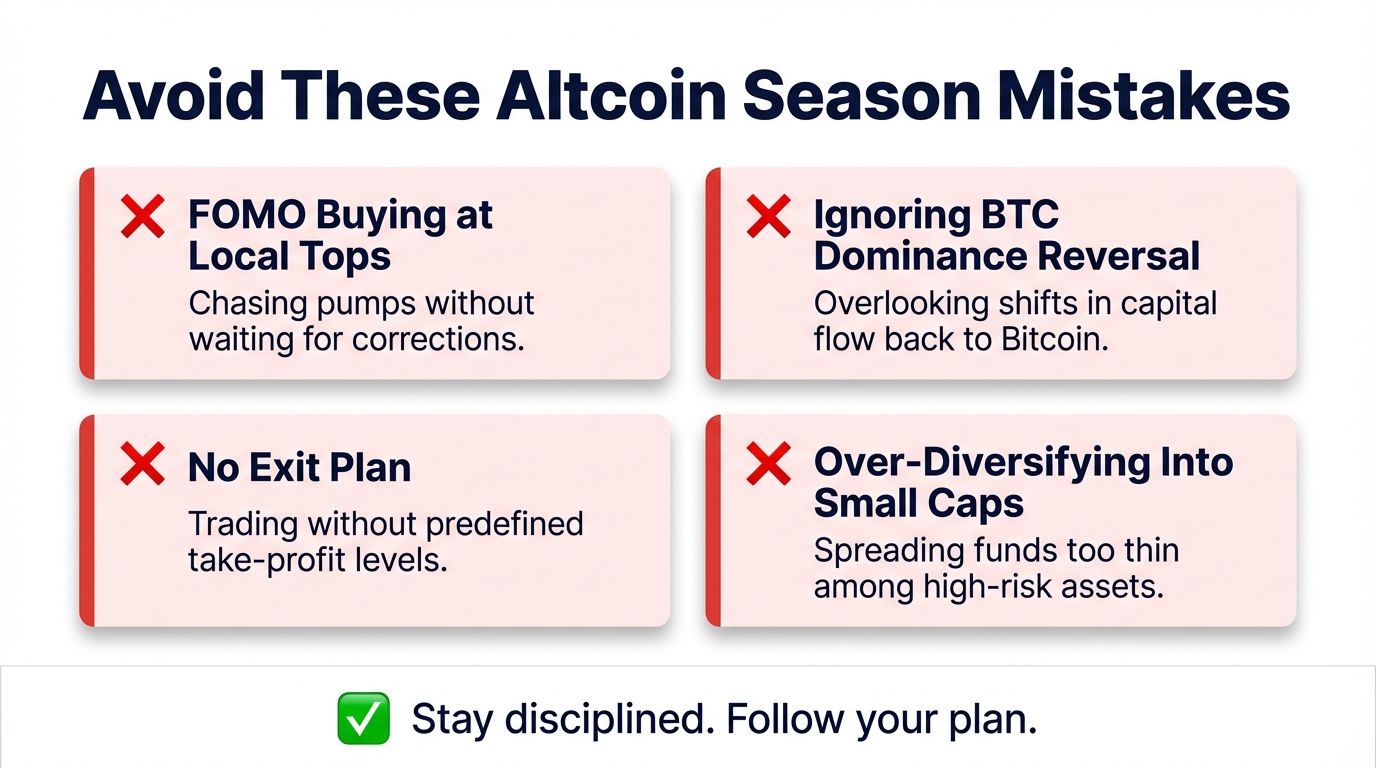
FOMO Buying at Local Tops
Fear of missing out is the dominant psychological trap during altcoin season. When you see a token up 200% in a week and social media is flooded with screenshots of gains, the impulse to buy is powerful. But FOMO buying almost always means buying at or near a local top, right before a correction. The traders celebrating publicly are often the ones selling into your buy order.
Discipline yourself to only buy setups that meet your pre-defined criteria, even if it means missing some moves entirely. The opportunities in altcoin season are abundant enough that you do not need to chase every token.
Ignoring Bitcoin Dominance Reversal Signals
Altcoin season does not last forever, and its end is often telegraphed by a reversal in Bitcoin dominance. When BTC.D starts forming higher lows and higher highs after a sustained downtrend, it signals that capital is flowing back into Bitcoin. Traders who ignore these reversal signals, convinced that the altcoin season will continue indefinitely, are often caught holding depreciating altcoin bags as BTC reclaims dominance.
Check the BTC.D chart weekly, and treat a confirmed dominance reversal as a signal to reduce altcoin exposure.
No Exit Plan
Many traders enter altcoin season with a detailed strategy for buying but no strategy for selling. Markets can reverse sharply, and the time between an all-time high and a 50% correction can be measured in days rather than weeks. Before entering any position, write down the conditions under which you will sell: a specific price target, a percentage retracement from the high, or an on-chain signal like a sharp decline in active addresses.
Over-Diversification Into Too Many Small Caps
Another common mistake is spreading capital across dozens of low-liquidity small-cap tokens in hopes that one will become a 100x winner. This creates a portfolio that is nearly impossible to monitor and exit efficiently. When the market turns, selling 30 different small-cap positions in a falling market is extremely difficult, and slippage can eat significantly into returns. A more effective approach is concentrated conviction in your highest-quality opportunities.
Start Trading Altcoin Season With Altrady
Altcoin season rewards preparation, speed, and precision. Altrady is a professional crypto trading platform built for exactly these conditions. With Altrady, you can connect multiple exchanges in one dashboard, set advanced alerts based on price, volume, and technical indicators, and track your entire portfolio in real time across all your accounts.
During fast-moving markets, having your tools in place before the opportunity arrives is critical. Altrady's smart trading features, including trailing stop-losses, take-profit targets, and multi-exchange order management, give you the execution capability to act on your strategy without switching between tabs or missing entries.
The best time to set up your trading infrastructure is before altcoin season fully ignites, not during it. Start your free trial of Altrady today and have everything configured so you are ready to trade when the market moves.
Frequently Asked Questions About Altcoin Season
How long does altcoin season typically last?
The duration varies significantly between cycles. In the 2017 and 2021 bull markets, broad altcoin seasons lasted anywhere from several weeks to a few months at their peak intensity. However, individual sector rotations within a broader altcoin season can be much shorter, sometimes just days to two or three weeks. This is why having a clear exit strategy matters more than trying to ride any single move to its absolute peak.
Does altcoin season happen every bull market?
Historically, every major Bitcoin bull cycle has been followed by an altcoin season of some kind. The 2013, 2017, and 2021 cycles all included significant periods of altcoin outperformance. That said, the composition changes with each cycle. Different sectors lead, different types of tokens attract capital, and the timing relative to Bitcoin's peak varies. Past patterns are a useful guide, but not a guarantee.
What is the best indicator to track altcoin season?
No single indicator is definitive on its own, but Bitcoin Dominance (BTC.D) on the weekly chart is the most reliable primary signal. Combine it with the Altcoin Season Index for a quick sentiment read, and watch TOTAL2 or TOTAL3 for confirmation that capital is actually entering altcoins rather than leaving crypto altogether. Together, these three data points give a well-rounded view of where the market is in the altcoin season cycle.
Can altcoin season happen during a bear market?
It is possible to have short-lived altcoin rallies even in bear markets, sometimes called "bear market bounces." However, these rallies tend to be shallower, shorter-lived, and confined to a smaller number of tokens compared to bull market altcoin seasons. True, sustained altcoin season, where the majority of the top 50 altcoins outperform Bitcoin over a 90-day period, is almost exclusively a bull market phenomenon.
Which sectors tend to lead altcoin season?
Each cycle is different, but historically the sectors that lead altcoin seasons are those with the strongest narrative momentum and real network usage growth. Layer 1 smart contract platforms, decentralized finance protocols, and whatever emerging technology narrative has captured the market's imagination tend to attract the most capital. Identifying the leading narrative early, before the broader market has priced it in, is one of the highest-value skills in altcoin trading.
How do I know when altcoin season is ending?
The clearest signal is a confirmed reversal in Bitcoin dominance, where BTC.D stops making new lows and begins forming higher lows on the weekly chart. Other warning signs include a sharp increase in the Crypto Fear and Greed Index above 85, a surge in new retail investors asking about altcoin recommendations on social media, and a flood of new token launches targeting retail buyers. When multiple signals align, it is time to reduce exposure and protect gains.