
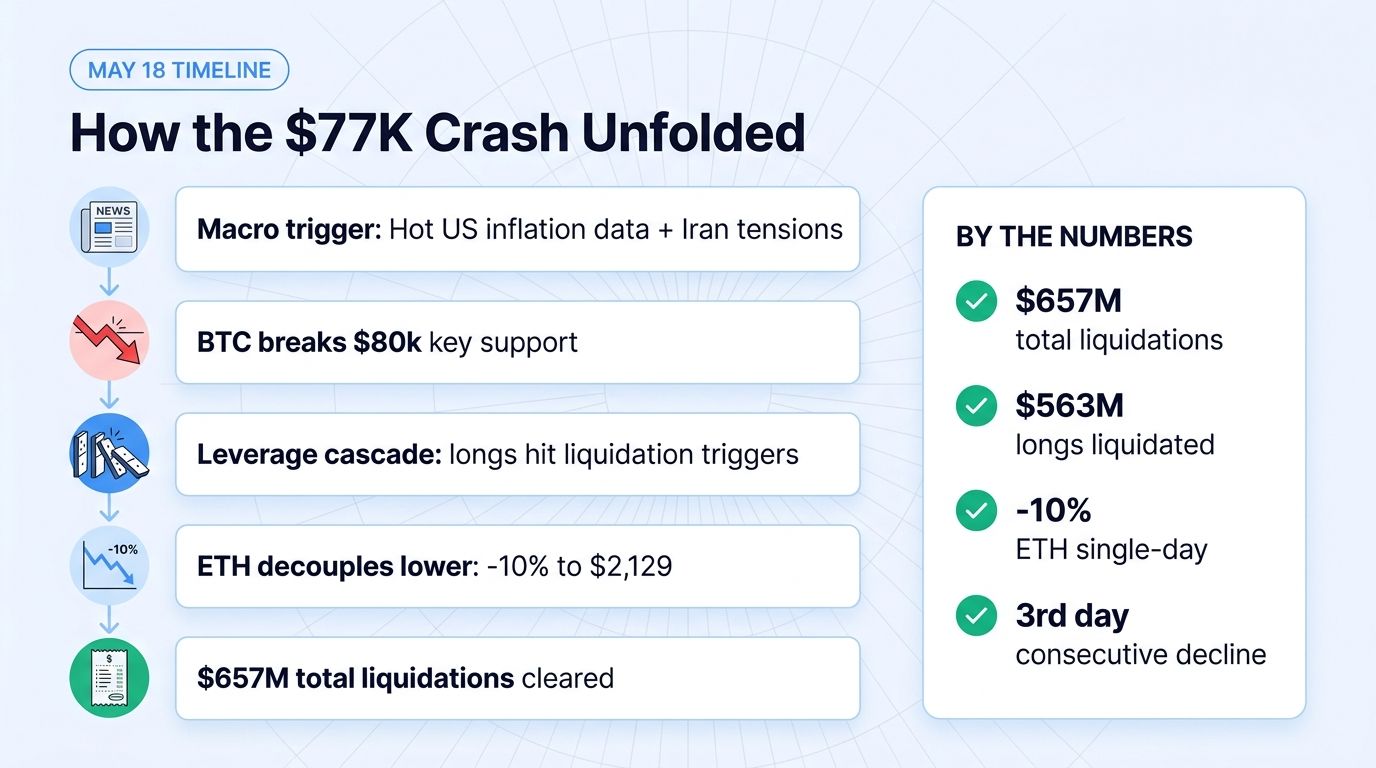
On May 18, 2026, bitcoin fell below $77,000 in a sharp move that triggered $657 million in liquidations across the broader crypto market. Long positions anticipating a continued rally were the primary casualties, with $563 million in long liquidations and ether falling 10% to $2,129. The move marked bitcoin's third consecutive daily decline and produced the largest single-session liquidation event of the second quarter.
For crypto traders, flash crashes are both a structural risk and an opportunity. Understanding what drives them, how they propagate through leverage and liquidations, and how to position both before and after the event is essential to surviving in volatile crypto markets.
This guide explains what happened on May 18, the macro triggers that drove it, how the leverage cascade amplified the move, what the data shows about positioning, and how traders should think about flash crash risk going forward.
What Happened on May 18, 2026
The sequence was characteristic of leveraged crypto markets.
Initial trigger: US inflation data released the prior week came in hotter than expected. Combined with rising Treasury yields and geopolitical tensions (reports suggesting US and Israel may resume military action against Iran), the macro environment turned sharply risk-off.
Bitcoin breaks key support: Bitcoin had been holding above $80,000 for several weeks. The macro shift pushed bitcoin through $80k, then $79k, then $78k. The break of $78k was decisive, with technical traders observing the loss of multi-week support.
Leverage cascade: As bitcoin fell, leveraged long positions began hitting liquidation levels. Each liquidation forced additional selling, which pushed prices lower, triggering more liquidations. The reflexive dynamic accelerated the drop.
Ether decoupling lower: Ether, with higher beta than bitcoin in risk-off environments, fell harder. The 10% decline to $2,129 reflected both the macro pressure and ETH-specific weakness in the broader cycle (ETH/BTC ratio at multi-month lows).
Final liquidation: By the end of the move, $657 million in total liquidations had cleared, of which $563 million were long positions. The forced selling pressure exhausted, and prices began stabilizing.
Why Flash Crashes Happen in Crypto
Three structural factors make crypto particularly susceptible to flash crashes.
Factor 1: High retail leverage. Crypto perpetual futures and margin trading offer significantly higher leverage than traditional markets (50x, 100x on some venues). When leverage is widespread, small price moves trigger cascading liquidations.
Factor 2: 24/7 markets with thin overnight liquidity. Unlike traditional markets that close at predictable times, crypto trades continuously. Overnight (Asia-time) liquidity is often thinner than US-hours liquidity. Macro events that hit during low-liquidity windows can produce outsized moves.
Factor 3: Reflexive liquidation mechanisms. Crypto derivatives platforms have auto-liquidation engines that close losing positions at specific price levels. The mechanism is efficient for the platform but creates predictable selling pressure that other traders can anticipate and exploit (or get caught in).
The Macro Triggers in Detail
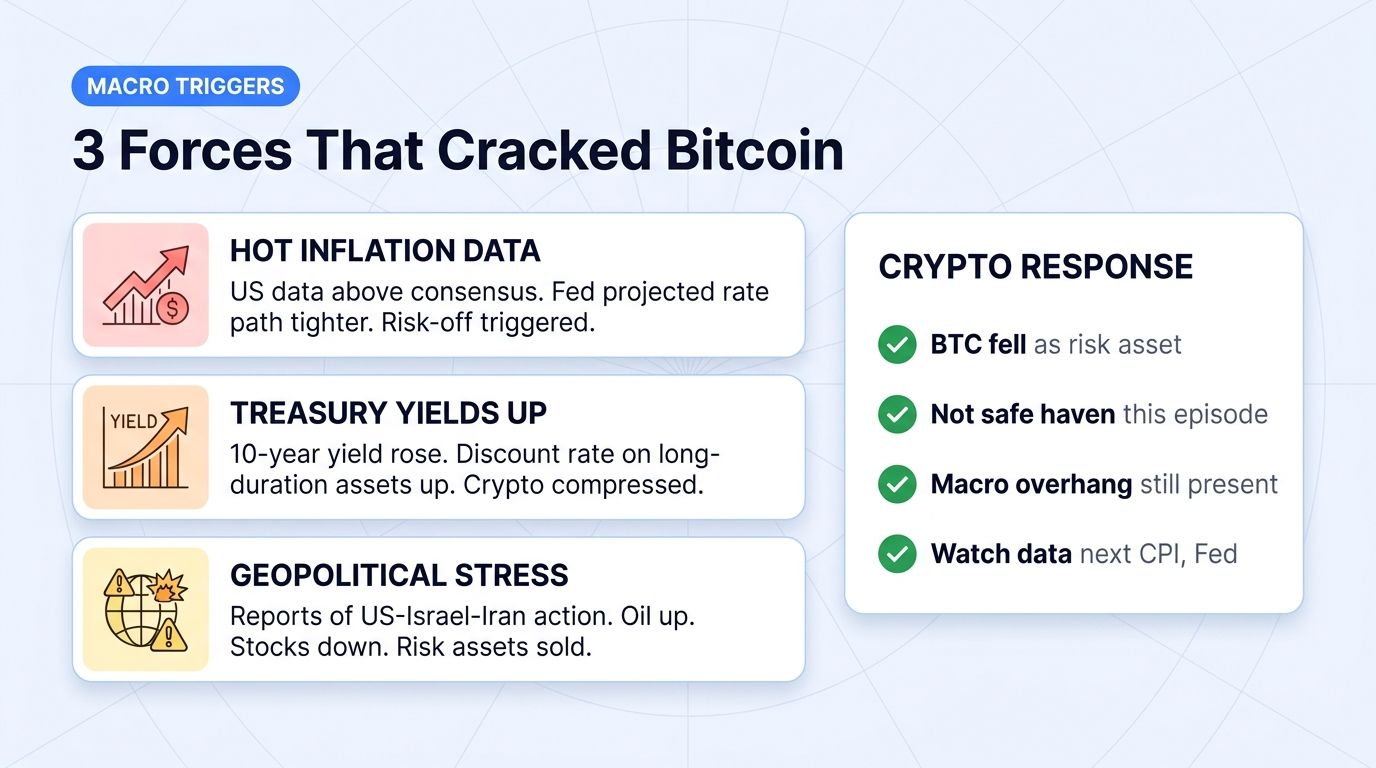
Three macro factors converged on May 18.
Trigger 1: Hotter-Than-Expected US Inflation Data
US inflation data released the prior week came in above consensus forecasts. The Federal Reserve's projected interest rate path was implicitly tightened by the data. Higher-for-longer rate expectations push real yields up, which historically pressures speculative assets including crypto.
The Fed funds futures market repriced expectations for 2026 rate cuts, reducing the implied cuts from earlier projections. Risk assets across the board reacted negatively.
Trigger 2: Treasury Yield Rise
Treasury yields rose in response to the inflation data. The 10-year yield moved higher, increasing the discount rate applied to long-duration assets. Crypto, which has been correlated with growth stocks and risk assets, faced the same compression.
Trigger 3: Geopolitical Tensions
Multiple reports suggested the US and Israel might resume military action against Iran. Oil prices rose on the speculation. Stock futures opened lower. Risk-off behavior was widespread across asset classes.
For crypto, geopolitical stress historically has mixed effects: sometimes bitcoin behaves as a safe haven (gold-like), sometimes as a risk asset (selling alongside equities). On May 18, bitcoin behaved as a risk asset.
The Liquidation Mechanism in Detail
Understanding how liquidations cascade is critical to understanding flash crashes.
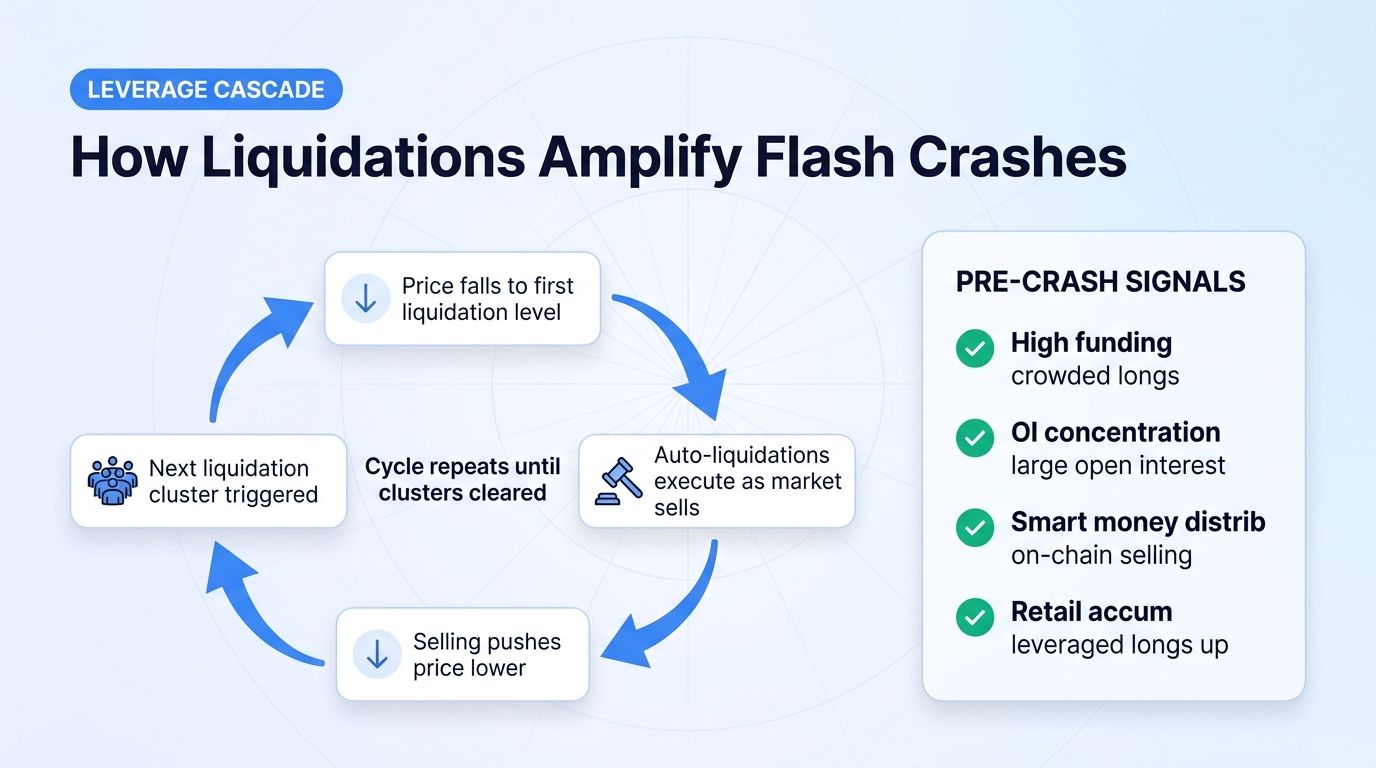
A leveraged long position has a liquidation price. If the asset falls to that price, the position is forcibly closed (liquidated) by the exchange. The liquidation involves selling the underlying asset.
When many traders have similar liquidation levels (clustered just below current price), a small drop can trigger a cascade: 1. Price falls to first liquidation level 2. Auto-liquidations execute as market sells 3. Selling pushes price lower 4. Lower price triggers next liquidation level 5. More auto-liquidations, more selling 6. The cycle continues until liquidation clusters are cleared
The reflexive dynamic means flash crashes often have a "gap" pattern: rapid drop, brief stabilization, another rapid drop, etc. Each leg of the move clears another cluster of liquidations.
What the Positioning Data Shows
Pre-crash positioning data revealed the setup.
Funding rates were elevated: Funding rates on major perpetual futures venues were significantly positive, indicating crowded long positioning. Crowded long books are vulnerable to liquidation cascades on adverse moves.
Open interest concentrated: Total open interest in bitcoin perpetuals had reached elevated levels in the weeks before the crash. Large open interest combined with crowded positioning is a structural vulnerability.
Smart money positioning: On-chain analytics suggested that large holders had been distributing positions in the weeks before the crash. Retail traders had been accumulating leveraged longs. The setup was textbook for a "smart money sells, retail buys, then crash" pattern.
By the morning of May 18, the structural setup was visible to careful observers. The macro trigger then catalyzed the unwind.
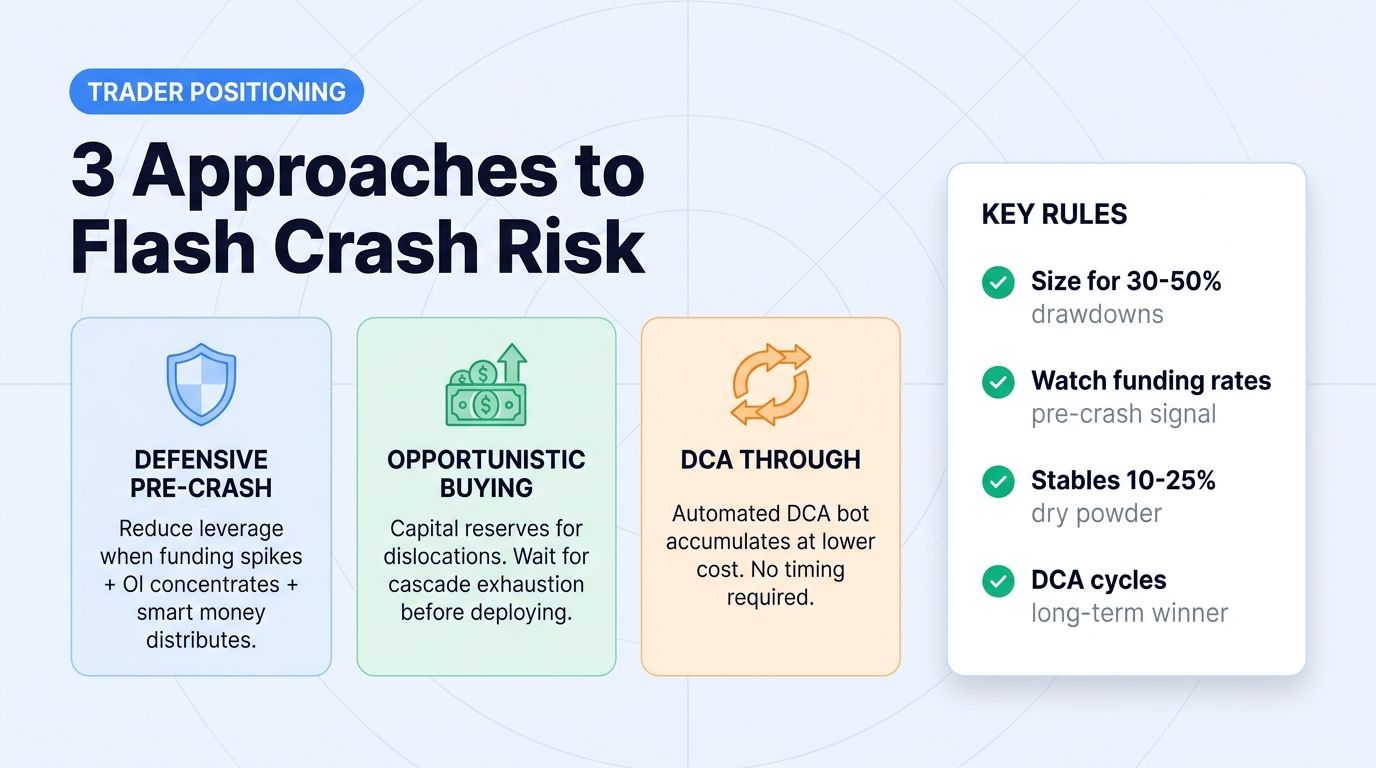
How Traders Should Position For Flash Crashes
Three practical approaches.
Approach 1: Defensive Positioning Before Setup
When funding rates run hot, open interest concentrates, and smart money distribution is visible, reduce leverage. Take some profits on long positions. Consider hedges (small short positions or put options). This is preventive rather than reactive.
Tools that aggregate positioning data (CoinGlass, Velo, others) help identify when the setup is dangerous. A platform like Altrady, which connects to 19+ exchanges, provides unified position management useful for executing defensive adjustments across venues quickly.
Approach 2: Capital Reserves for Opportunistic Buying
Flash crashes produce buying opportunities. Bitcoin's drop from $80k to $77k clears excess leverage and often marks a local bottom. Traders who maintain capital reserves (stablecoins, cash) can deploy capital into the dislocation.
The trick is patience. Buying on the first 5% drop often catches a falling knife. Waiting for the cascade to exhaust (often signaled by extremely negative funding rates, capitulation candles, declining open interest) produces better entries.
Approach 3: DCA Through Volatility
For traders with longer time horizons, dollar-cost averaging through crashes accumulates positions at lower average cost. A DCA bot that buys consistently regardless of price level captures crashes as buying opportunities automatically.
Altrady's DCA bot supports this approach across multiple exchanges, allowing systematic accumulation during volatile periods without manual intervention.
The Risks of Trading Flash Crashes
Wrong-side risk. Catching falling knives is costly. Traders who buy too early take losses. Traders who short the bounce face squeeze risk.
Funding cost during recovery. If you take leveraged longs at the bottom and hold through recovery, funding costs can compress returns. Spot positions avoid this but require more capital.
Macro overhang. Flash crashes can be the start of larger drawdowns rather than buying opportunities. If macro conditions remain hostile, the post-crash recovery can stall. Sizing positions appropriately is critical.
Emotional decisions. Flash crashes are stressful. Decisions made in panic or excitement often perform worse than decisions made with pre-planned rules. Having a written framework for how to act during volatility helps.
What This Crash Means for the Cycle
Two competing interpretations.
Interpretation 1: Healthy Mid-Cycle Correction
The crash cleared excess leverage in an overheated market. Bitcoin's $80k+ levels were stretched. The reset back to $77k brings the market closer to fair value. Once leverage is cleared and macro conditions stabilize, the next leg up can begin from cleaner foundations.
This interpretation suggests the crash is a buying opportunity. Bitcoin returns to $80k+ within months and continues the broader uptrend.
Interpretation 2: Beginning of Larger Drawdown
The crash signals a regime change. Macro conditions (higher inflation, higher rates, geopolitical stress) are durably hostile to risk assets. The crash is the first leg of a larger move lower. Subsequent rallies are sold into.
This interpretation suggests caution. Holding cash and waiting for clearer signals (macro relief, capitulation, base building) produces better outcomes than trying to catch the dip.
The two interpretations cannot both be right. The market will produce data over the next 2-8 weeks that distinguishes them. Watching key indicators (funding rates, open interest, macro data releases, BTC price action) helps determine which interpretation is correct in real time.
How Flash Crash Risk Fits Into Sizing Discipline
A practical framework:
- Always size for 30-50% drawdowns: Crypto can drop 30-50% in short periods. Position sizes that would damage your overall portfolio at -50% are too large.
- Reduce leverage in vulnerable setups: When funding rates spike, OI concentrates, or smart money distributes, reduce leverage proactively.
- Maintain stablecoin reserves: 10-25% of crypto capital in stablecoins provides dry powder for dislocations.
- Use stop losses strategically: Stops can prevent catastrophic losses but also can get hunted in volatile conditions. Wide stops or strategic stop placement matters more than tight stops.
- DCA through cycles: Systematic accumulation through volatility produces better long-term outcomes than market timing.
FAQ
Is the May 18 crash the start of a bear market?
This is the critical question. Several factors suggest it might be a mid-cycle correction: bitcoin remains above key longer-term moving averages, the structural narratives (CLARITY Act, Strategic Bitcoin Reserve, institutional adoption) remain intact, and on-chain metrics (HODLer behavior, exchange outflows) remain constructive. However, macro conditions are hostile, and a sustained move below $70k would change the picture. The next 4-8 weeks of price action will tell.
How can I tell when a flash crash is likely?
Watch funding rates (perpetual futures), open interest concentration, and smart money positioning. When all three signal crowded long positioning, the setup is dangerous. Macro calendars also matter: major data releases (inflation, employment, Fed meetings) and geopolitical events create catalyst risk. Sites like CoinGlass and Velo aggregate the data.
Should I buy the dip?
Disciplined buying of meaningful dips has historically produced good long-term returns. The execution challenge is determining "the dip" versus "the start of a larger move." A staged approach (DCA into the move rather than committing all capital at once) reduces timing risk. Cash reserves enable opportunistic buying without forcing all-in decisions.
What is the difference between a flash crash and a normal drawdown?
A flash crash is a rapid, leverage-amplified move that typically completes within minutes to hours. A normal drawdown plays out over days to weeks. Flash crashes often produce sharp reversals as forced sellers exhaust; normal drawdowns can be more sustained. Both are tradable but require different approaches.
Can I trade flash crash recoveries on Altrady?
Yes. Altrady connects to 19+ exchanges, supporting active position management during volatile periods. You can run grid bots that profit from volatility, DCA bots that accumulate during weakness, signal bots that execute on technical patterns, and view your full portfolio across exchanges in one dashboard. The combination of automation and unified monitoring is useful when manual trading would otherwise require constant attention across multiple platforms.
Conclusion
The May 18 bitcoin flash crash produced $657 million in liquidations and a sharp drop from $80,000 to below $77,000. The crash was driven by macro factors (hot inflation data, rising yields, geopolitical tensions) and amplified by structural factors (high leverage, concentrated positioning).
For traders, the practical takeaway is this: flash crashes are recurring features of crypto markets, not anomalies. Surviving them requires defensive positioning before the setup, maintaining capital reserves for opportunistic buying, and avoiding catastrophic sizing.
The question of whether May 18 marks the start of a larger drawdown or a mid-cycle correction will be resolved by data over the coming weeks. Traders who maintain disciplined sizing and watch the key indicators will be positioned to act on either outcome.
The longer-term lesson is structural. Crypto markets will continue producing flash crashes as long as leverage, 24/7 trading, and macro sensitivity remain features of the asset class. Developing a personal framework for handling them is one of the most important skills any serious crypto trader can build.